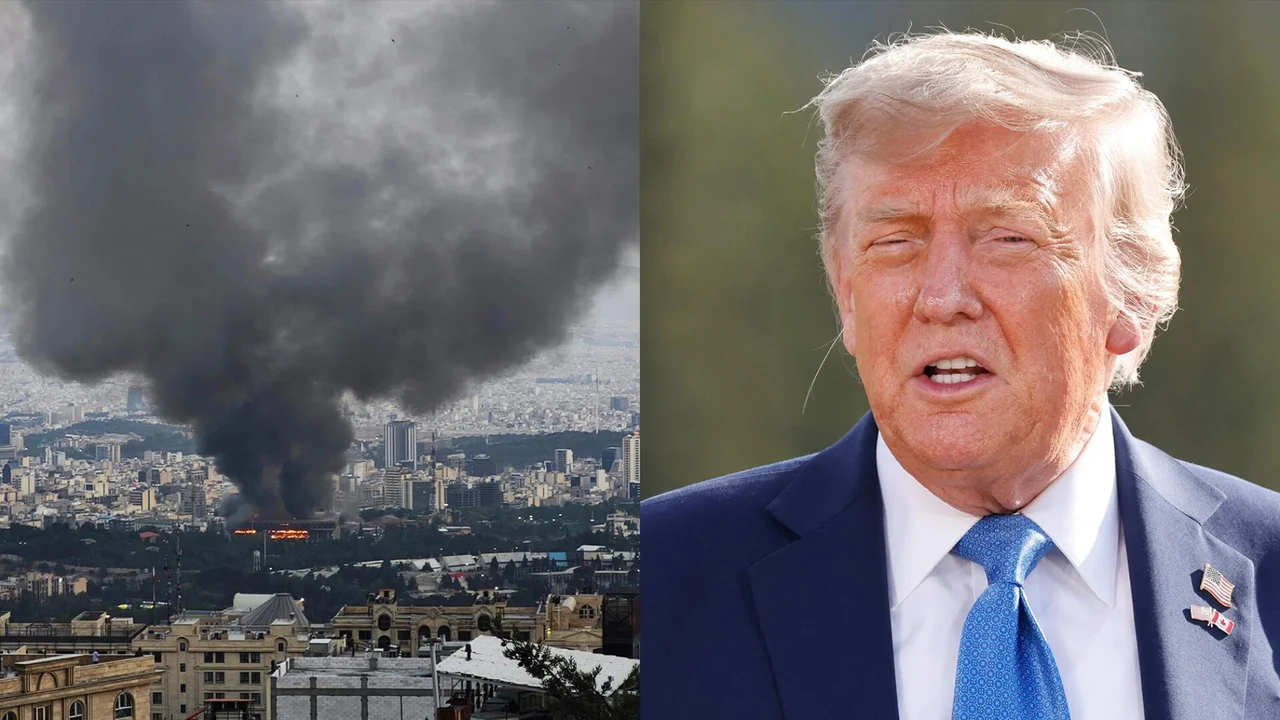
More than 6 in 10 Americans now say President Donald Trump’s war in Iran was a “mistake,” according to a poll out Friday from the Washington Post, ABC News and Ipsos.
Within two months, the war – which has inflicted thousands of civilian deaths and caused gas prices to spike worldwide with little tangible gain – has reached levels of unpopularity that previous wars now seen as historic boondoggles took years to reach.
The Post has asked the “mistake” question when polling about other major wars in the past. However, CNN senior political reporter Aaron Blake explained, “In Iraq, it took more than three years to reach that high. In Vietnam, it took six years.”
Despite a massive protest movement, voters overwhelmingly supported President George W. Bush’s decision to invade Iraq, with 81% believing it was the “right thing” in April 2003 and just 16% believing it was a mistake.
But the occupation turned into a long, deadly, and costly disaster, and the administration’s pretexts for the war were revealed to be lies. Public opinion steadily eroded to the point where 64% viewed it as a mistake by January 2007.
Vietnam never had the overwhelming support of Iraq, but 60% of Americans still supported President Lyndon Johnson’s decision to begin direct US military involvement in 1965, while just 24% said it was a mistake.
While the protest movement against the war is as present in Americans’ memories today as the conflict itself, public opinion was still split until 1968 and only reached a high of 61% in May 1971, after more than 50,000 US soldiers had been killed in battle.
Trump’s war in Iran is unique in history in that it never enjoyed even a moment of consensus support. In a Reuters/Ipsos poll just days after the opening salvo of what the Trump administration dubbed “Operation Epic Fury,” just 27% said they approved of the strikes, which killed 555 Iranians including Supreme Leader Ayatollah Ali Khamenei and several other top Iranian officials.
At that point, 43% of Americans already said they disapproved of the strikes, far eclipsing Iraq and Vietnam. But 30% still said they had not yet made up their minds.
In the coming months, they would. It was revealed that an airstrike on a school, which killed at least 155 people, including 120 children, was a double-tap attack by the United States.
Iran retaliated by blocking oil shipments through the Strait of Hormuz, which sent US gas prices hurtling above $4 per gallon.
And Trump took on an increasingly erratic and at times what many critics termed an outright genocidal posture toward Iran that made any peaceful resolution appear increasingly impossible, even with the current fragile ceasefire.
Friday’s poll shows that while the war still maintains a core base of support – 36% of Americans who say it was the right decision, nearly all of them Republicans – that base is dwarfed by the 61% who say it was a mistake.
Majorities of respondents across all demographics show that they believe the war has increased the risks of “terrorism against Americans” (61%), of “the US economy going into a recession” (60%) and of “weakening relationships with US allies” (56%).
Looking beneath the surface shows an even more worrying sign for Trump: The war has almost no constituency outside of his biggest fans. Self-identified Democrats (91%) overwhelmingly say the war was a mistake. But 71% of independents – many of whom were undecided at the war’s outset – now disapprove too, with just 24% in support.
Even within the GOP, there is a decisive split: 86% of those who self-identify as “MAGA Republicans” are still baying for blood. But “non-MAGA Republicans” have grown uncertain – 50% still say war was the right decision, while 49% say it was a mistake.
They were particularly rattled by Trump’s threat last month that “a whole civilization will die tonight” if Iran should fail to negotiate a deal to his liking. The threat was too much even for the majority of Republicans, 53% of whom said they viewed it negatively.
What remains to be seen is whether even Trump’s most faithful backers will turn against the war as it drags on. If Defense Secretary Pete Hegseth’s appearance in Congress on Thursday is any guide, the country may soon find out.
On Thursday, when Senator Kirsten Gillibrand (D-NY) pressed Hegseth about why he has “not sought the support of the American people” and added that “three out of five Americans are against this war today,” he appeared in abject denial about the war’s unpopularity.
“I believe we do have the support of the American people,” he said. “I would remind you and this group that we’re two months into an effort, and many congressional Democrats want to declare defeat two months in.”
He specifically invoked lengthy past conflicts, repeatedly emphasizing that this one had only lasted “two months,” as if to urge patience with a war Trump had previously said was intended to last only “four to five weeks.”
“Iraq took how many years? Afghanistan took how many years? And they were nebulous missions that people went along with,” he said.
“This is different,” he said of a war that has—depending on the day—been described as one aimed at regime change in Iran, defending protesters, destroying its nuclear program, eliminating its ballistic missile supply, taking its oil, defending Israel, and reopening the Strait of Hormuz, among other objectives.