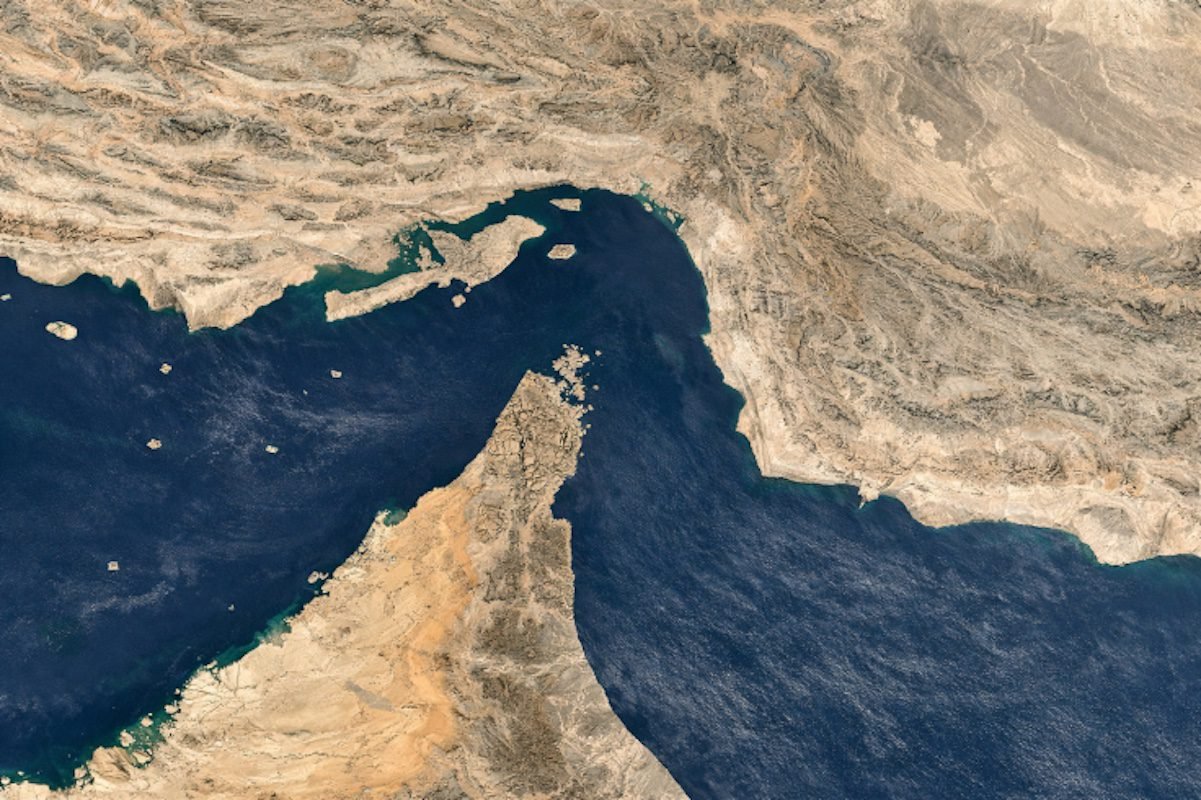
For a fortnight beginning August 30, Tehran gets to feel wanted – first in Bishkek, at the Shanghai Cooperation Organization summit, then in New Delhi at the BRICS summit, Iran’s leadership will sit among presidents and prime ministers who need something from Tehran just as much as Tehran needs something from them: a reopened Strait of Hormuz. On whose terms? It is tempting, and not entirely wrong, to read this as their shared necessity of sorts.
Before the US-Israeli attacks earlier this year resulted in the closure of the Strait of Hormuz, for 2025, this chock point had an average of over 20 million barrels of crude oil passing though on daily basis. The world’s largest and second largest crude importing nations — China and India — accounted for 44% of Gulf oil exports. China and India also import large quantities of the liquified natural gas (LNG) and fertilizers from the Gulf.
In terms of percentage share, 95% of Japanese and 70% of South Korean oil was being sourced through Strait of Hormuz. Likewise, Gulf nations’ imports of food and all else also pass through the Strait of Hormuz, closure of which has disrupted life for these and most other nations atten two summits. This is what triggers a genuine and defensible optimism from their deliberations.
Also unlike Washington, which has spent months oscillating between bravados, blockades and negotiations, China, India and many others have preferred a quiet diplomacy nudging Iran for restraint and dialogue. This is not sentimental. Apart from rising costs and uncertainties, fast-depleting strategic petroleum reserves of all these nations have caused enormous anxieties. If multilateral summits can ever manufacture momentum, this fortnight provides a setup for it.
Multiple Asias, one fault line
But scratch beneath Iran’s so-called Asian friends and their unity dissolves faster than a drop of ink in water. This is where the optimistic reading of these coming SCO and BRICS summits runs straight into the arithmetic of the member nations.
China’s frustration is real but managed. Beijing stands assured by its 140 days of strategic petroleum reserves and added purchases of Russian crude. Its EV adoption — 54% of new car sales in the first half of 2026 — is already displacing about 1.35 million barrels a day of oil demand. Nevertheless, athough China can afford to wait for Washington and Tehran to exhaust their options, Beijing wants the Strait of Hormuz open.
Then there is the uncomfortable guest at both these summits: Russia, which is not a bystander to this crisis but one of its principal beneficiaries. Moscow has already banked an estimated $1.3 to $1.9 billion windfall in oil exports as Hormuz-starved Asian buyers turned to Russian crude. A recent Chatham House study called the Iran war “an economic gift for Putin” at a moment when Western sanctions were squeezing his economy to surrender.
India’s trade tensions with the US have circumscribed its manoeuvring space and leverages. India consumes roughly 5.6 million barrels of crude a day and 70% of its crude imports are now from outside Hormuz. But it also imports 60% of its LNG from abroad of which 90% comes through Hormuz. For India hosting BRICS eleven days after Bishkek SCO summit, the likelihood of an unresolved Asian energy crisis falling at its own summit table is not an abstraction. New Delhi needs Strait of Hormuz open more urgently than either Beijing or Moscow.
Closure of Strait of Hormuz has shrunk daily shipping from its peak at 130-140 vessels a day to single digits – thereby affecting India’s reliance on Russian oil, which had fallen under US pressures. Making history, India’s crude imports from Russia for the month of June 2026 passed 50% of its total crude imports for that month.
Russia, China and India will sit at these two summits professing solidarity with Iran, but none of them have strong incentives to push either the US or Iran into reopening of Hormuz. The same is true of most other Asian friends of Iran, who remain more aligned on optics than on outcomes.
Mediators without a mandate
If Iran’s friends at these two summits stand divided, can any one of them still broker something practical enough to ensure stability if not peace? The evidence so far only supports cautious optimism, but then can these summits strengthen it any further?
The only silver lining in the US-Iran tensions was the initial April two-week ceasefire that was brokered by Pakistan. This was blessed by Iran’s new supreme leader, Mojtaba Khamenei, “after a last-minute nudge by China.” But the first ever direct US-Iran talks since 1979, between J.D. Vance and Mohammad Ghalibaf and held in Islamabad, had failed to produce any agreement. Various Trump-initiated efforts since have failed to break the either of the deadlocks, on Washington’s demand for a full halt to Iran’s enrichment or on reopening of Strait of Hormuz.
Russian, Chinese and Indian mediation ceilings remain structural, not tactical. In March, when Trump had directly asked Beijing to help secure the Strait of Hormuz as part of his naval blockade, his request went unanswered – because, as Allen Carlson of Cornell Unversity put it, China “sees the crisis as US-made and has little reason to help.”
With Iran becoming far more reticent, setting preconditions for talks, no solutions seem feasible so far. With Iran sitting as a full member at these two summits, the host nations for the SCO or BRICS communiqués will find any articulation – or even skirting – of this issue a herculean challenge.
But nations including Baharain, Egypt, Kuwait, Qatar, Saudi Arabia, Turkey and the UAE — which have also been involved in back channel efforts in bringing the US and Iran to the taking table — will also be part of these deliberations and can complicate or catalyse – or both – the US-Iran talks.
Fifty years ago …
In July 1971, a Pakistani military aircraft carried Henry Kissinger out of Islamabad on a secret mission to Beijing — a trip made possible because Pakistan had a working relationship with both Beijing and Washington. That single, discreet act of triangulation reshaped the Cold War order. It is worth remembering it as Pakistan recently enacted a similar model by bringing Vance and Ghalibaf together. With both the US and Iran betraying fatigue and frustration and looking for exit strategies, this is surely not the end of the road, not yet.
Multilateral forums can never substitute for the bilateral trust that the US-Iran talks still lack. What Bishkek and Delhi summits can do is supply back-to-back sequencing and cover: venues where China and India can urge restraint without appearing to capitulate to either side. India can use its BRICS chair to frame the US-Iran de-escalation in terms of Global South imperatives where both the US and Iran can make mutual concessions dressed as part of multilateral consensus rather than surrender. That can be the only practical face-saving-exit architecture; not a peace deal or normalization.
If these two summits can move the needle in that direction, it will not be through any joint statement. The SCO and BRICS consensus rules will make that impossible. It will be how back channels had worked in April: talking quietly to both sides, using the summit calendar as cover rather than arbiter. Pakistan did that with Beijing and Washington in 1971. Whosoever will do it with Iran and America in 2026 will have to do so not from the podium but in the margins, where all the real diplomacy in crisis management has happened in the past.
Swaran Singh is a professor of international relations at Jawaharlal Nehru University, New Delhi.