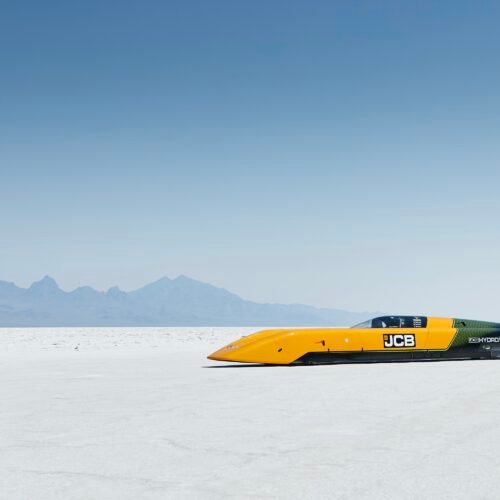
It’s been far too long since I’ve been able to report a new land speed record. For a while, it looked like Bloodhound might have been able to make good on its 1,000 mph (1,609 km/h) attempt, but then the money ran out. As a result, Thrust SSC’s two-way average of 763.6 mph (1,229 km/h), set in 1997, remains the fastest anyone has ever driven a wheeled vehicle over a timed mile. But yesterday, on the Bonneville Salt Flats in Utah, a new record was set by the JCB Hydromax for hydrogen-powered cars.
JCB is a UK-based manufacturer of heavy industrial and agricultural equipment—think diggers, loaders, backhoes, tractors, and so on. And as JCB is based in the UK, it doesn’t have the luxury of being able to ignore carbon emissions targets; it has to have alternatives to diesel engines. For some products, that means switching to batteries, but the company has also been working with hydrogen. At first, that meant fuel cells, but after developing prototypes, JCB concluded the tech was too expensive and too fragile for life on the farm or the construction site. Instead, in 2020, the company started developing its own hydrogen combustion engine.
The idea of burning hydrogen in an internal combustion engine has been tried before with little success. For example, in 2006, BMW modified a naturally aspirated V12 engine in a 7 Series to run on hydrogen, which it did, but with 60 percent of the power and five times the fuel consumption compared to gasoline. More recently, Toyota’s president Akio Toyoda has been among the drivers of an experimental hydrogen-burning Toyota Corolla in some Japanese endurance races. In this case, Toyota started with the GR Corolla’s turbocharged three-cylinder engine; the forced induction from the turbocharger made up somewhat for the reduced energy density of hydrogen.
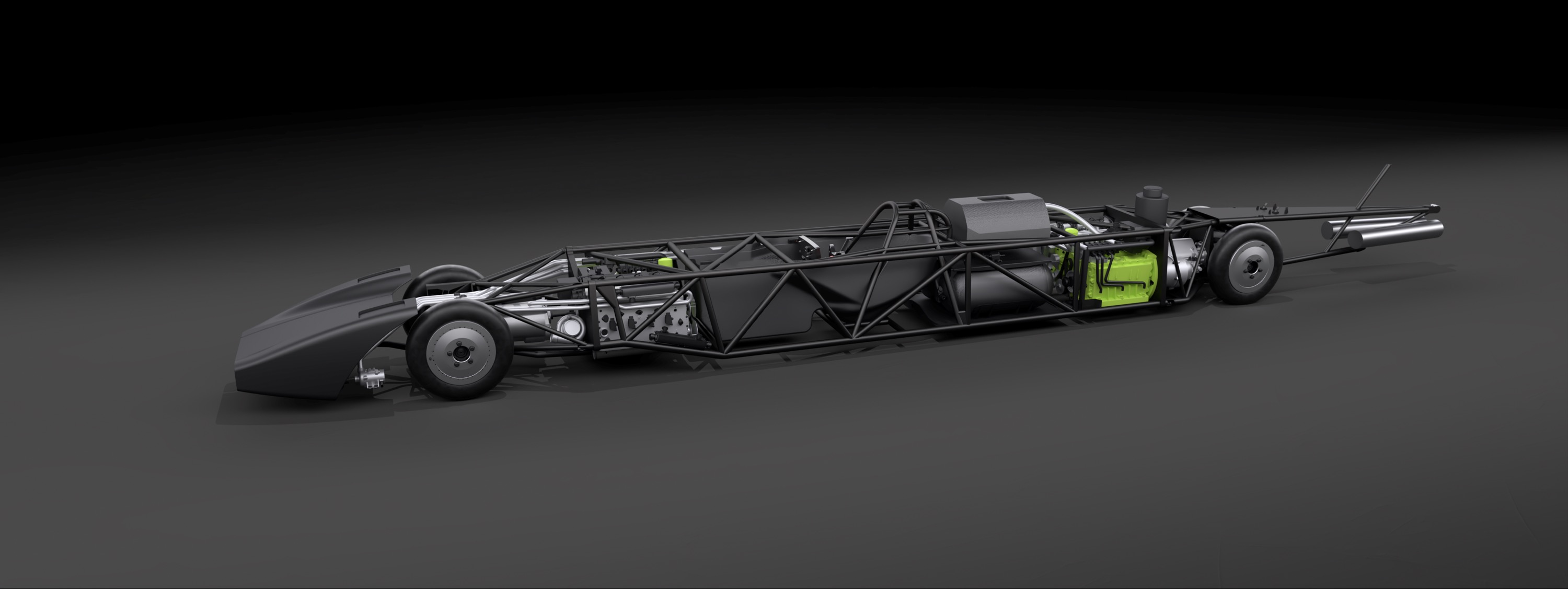
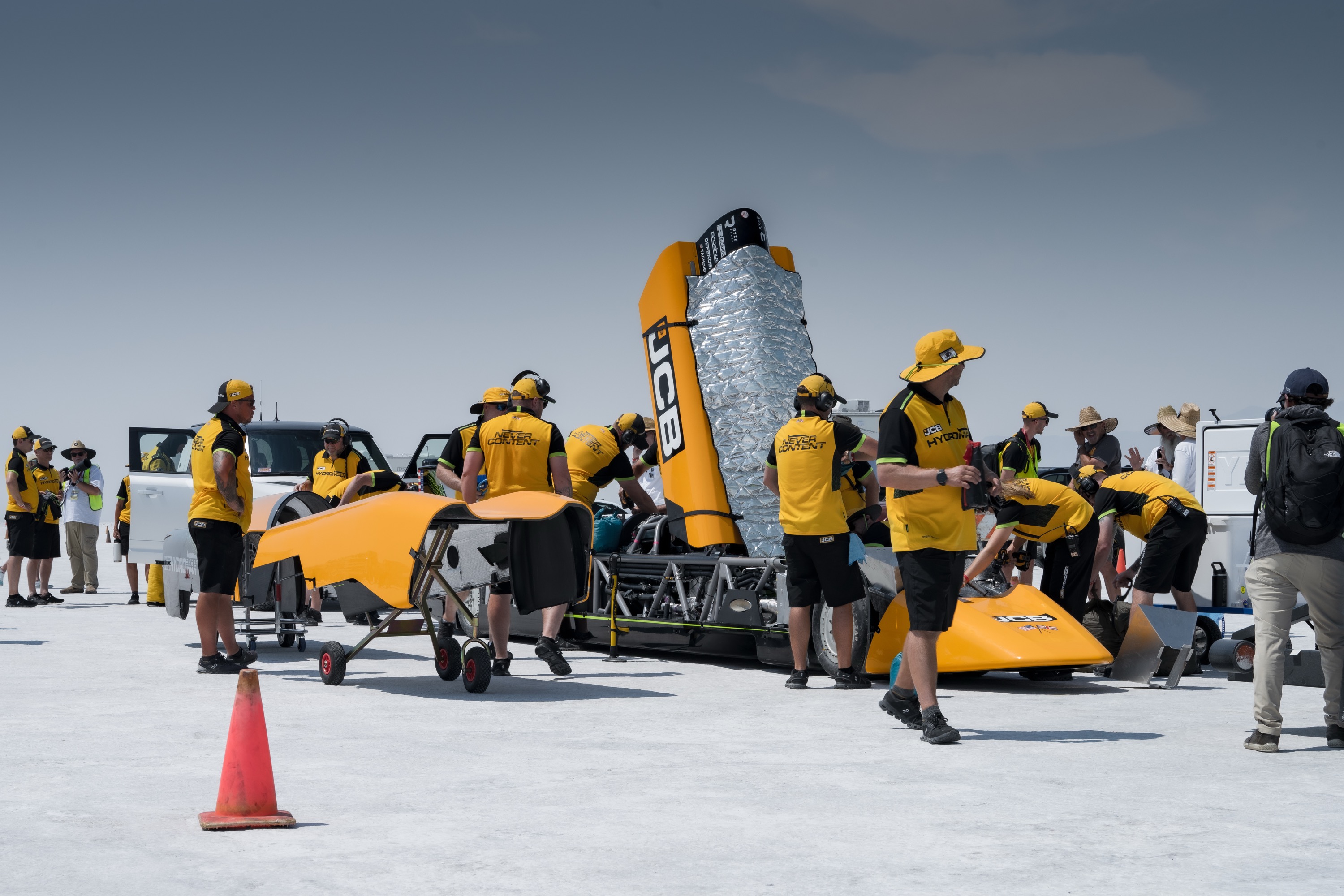
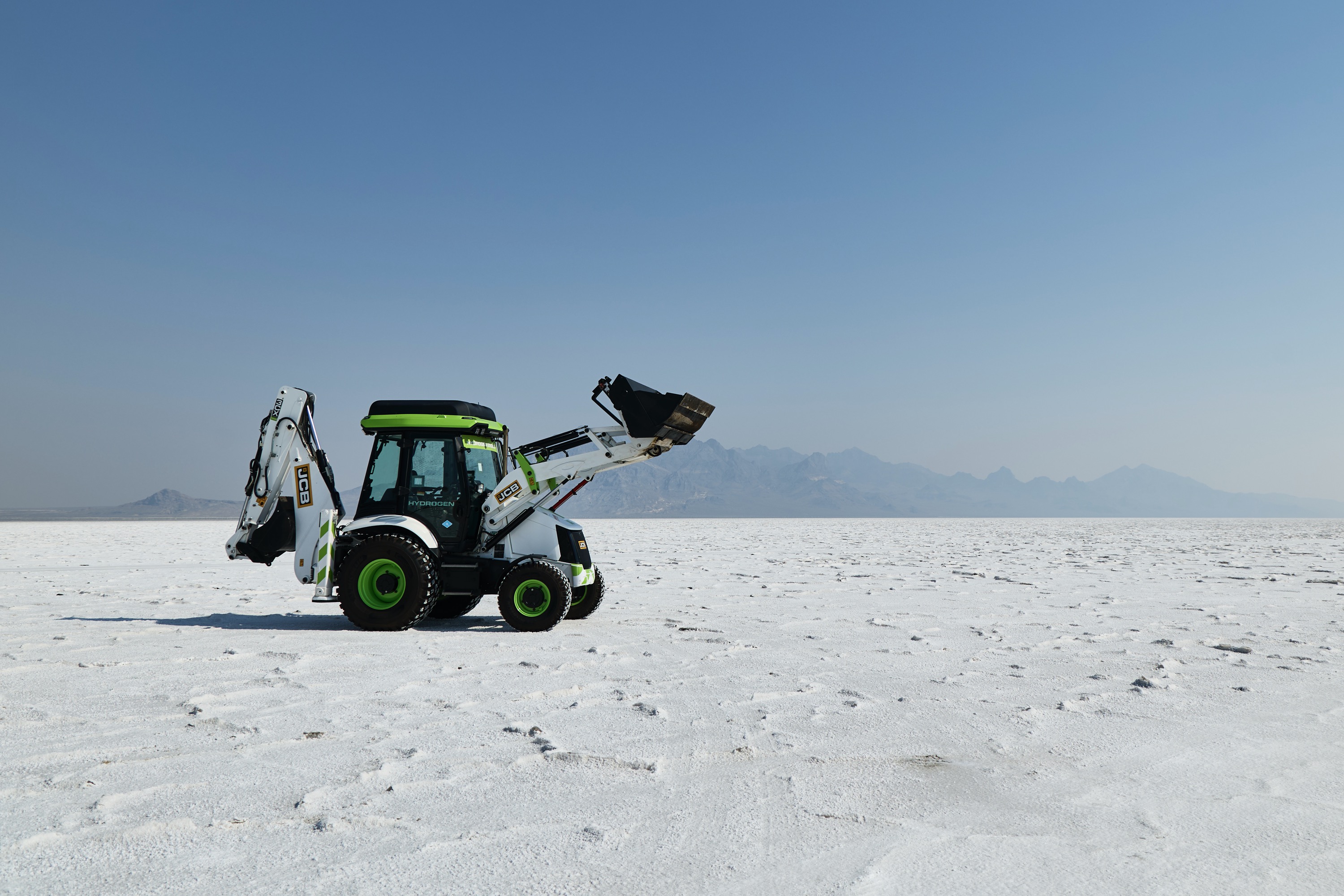
JCB decided to build an entirely new hydrogen engine, drawing on its experience developing diesel engines and sharing much of the engine architecture. Hydrogen is injected into the cylinders at much lower pressure and temperature than in a diesel engine, and a spark causes ignition. Like JCB’s diesels (and the Toyota hydrogen race car), the engine is turbocharged, and like a diesel, it runs at very low revs.
Performance might match JCB’s diesel engines, but 74 hp (55 kW) won’t go very fast on the salt. Instead, each of the two hydrogen engines powering the JCB Hydromax has been seriously worked on, increasing their outputs to 800 hp (597 kW) apiece. That required doubling the engine speed to a heady 3,800 rpm, replacing the pushrod valves with double overhead camshafts for better control over timing, and moving to direct fuel injection at much higher pressure than the production engine. JCB also dry-sumped the engine, cut weight, and improved cooling. The JCB Hydromax even uses two ice tanks to cool the air leaving the turbocharger, down from 392° F (200° C) to below 50° F (10° C).
406.320
Behind the wheel yesterday was RAF Wing Commander Andy Green, who is no stranger to the record books. He also drove Thrust SSC through the sound barrier in 1997, and in 2006, he set a diesel-powered land speed record, again with JCB, with the JCB Dieselmax, which topped out at 350 mph (563 km/h). (Green was also set to drive Bloodhound, should it have happened.)
With a combined 1,600 hp (1,193 kW) and 2,600 lb-ft (3,525 Nm) and all-wheel drive, the JCB Hydromax set a speed of 400.623 mph (644.74 km/h) yesterday, followed by a run in the other direction of 412.135 mph (663.27 km/h) for a two-way average of 406.320 mph (653.91 km/h).
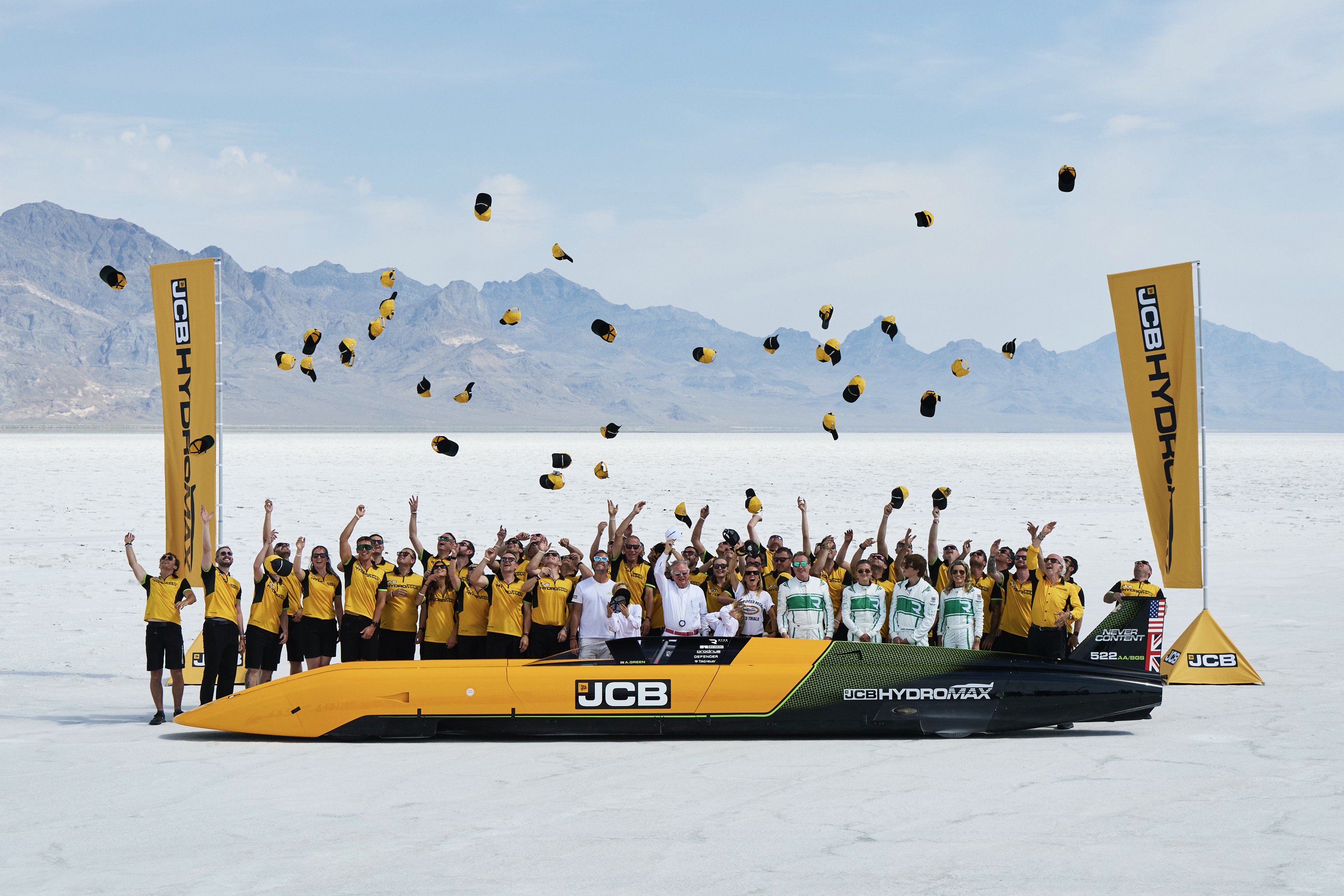
That’s more than twice as fast as the previous hydrogen combustion land speed record of 185.5 mph (298.53 km/h) set by the BMW H2R in 2004 (using the rather power-limited V12 mentioned earlier). And it’s a lot faster than the fastest hydrogen fuel cell speed record as well, which stands at 303 mph (488 km/h), set by the Venturi Buckeye Bullet 2 in 2009. It also beats the fastest EV land speed record, which was set in 2016 by VBB3 at 341 mph (549 km/h). However, the fastest wheel-driven land speed record belongs to the nitromethane-fueled V8s of Challenger II, which set a record of 449 mph (722 km/h) in 2018.
“Bonneville is the spiritual home of the world land speed record, and JCB Hydromax has just written itself into that history,” Green said. “The car was terrific—stable, strong, and fast. Setting a world land speed record with hydrogen power, twenty years after Dieselmax, is a huge privilege. This record is a huge achievement by a world-class team and superb technology.”