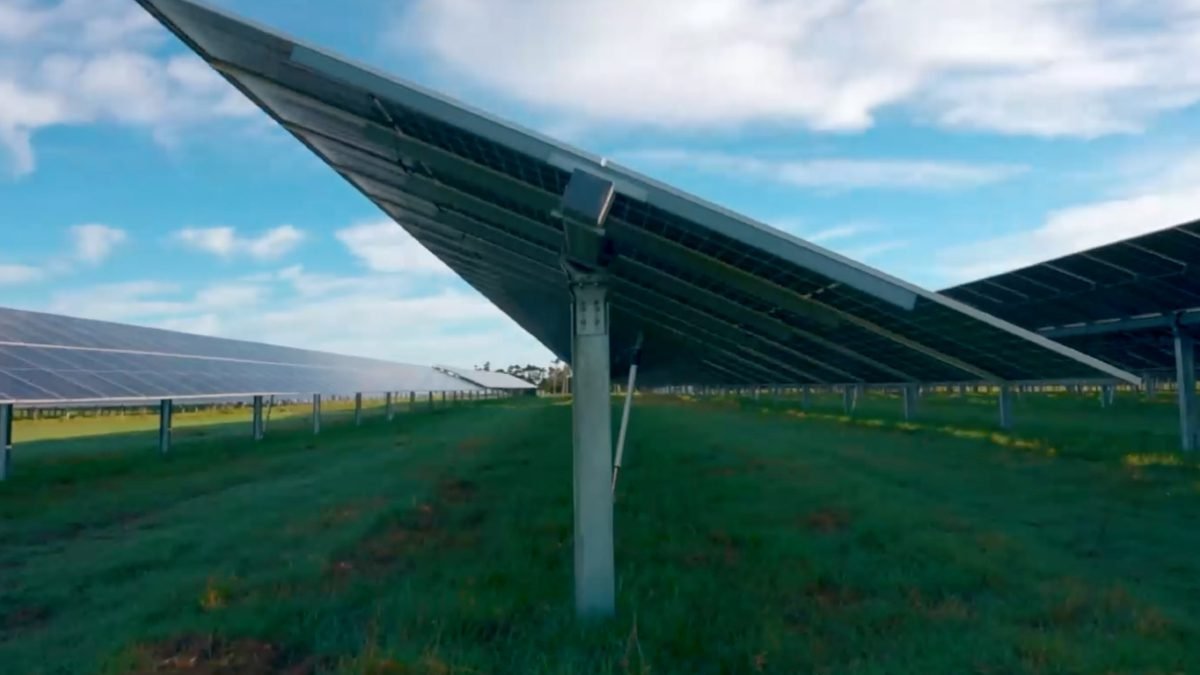
The United States is moving to impose a 15% tariff and a series of price floors on polysilicon and its derivative products, a step designed to push solar panel manufacturers toward domestic raw materials.
The proposal follows a national security investigation the US launched in July 2025 under Section 232 of the Trade Expansion Act of 1962, covering imports of polysilicon and its derivative products. Beijing has voiced opposition to the plan.
Since 2012, the US has relied on anti-dumping investigations, tariffs and tax incentives to steer Chinese solar panel makers away from China and eventually onto American soil.
The new tariffs add a final piece to that strategy, aimed at forcing these companies to use local raw materials and build a complete solar supply chain inside the US.
Some Chinese commentators have described the policy shift as a ‘pig-butchering scam,’ arguing that the Biden administration used tax credits to lure Chinese solar makers into building US factories, only for the Trump administration to slash those credits and effectively seize their investment.
The unveiling of the new tariffs coincided with China’s move to tighten its exit-entry regulations, a shift some commentators mistakenly read as a sign of national closure or a broad block on citizens leaving the country.
In fact, Beijing appears more focused on controlling its highly skilled engineers, including those with know-how in N-type solar cell technology, and preventing them from quietly joining American rivals.
Citing unnamed sources, Reuters reported on Thursday that US President Donald Trump will include minimum import prices on polysilicon, wafers, cells, modules and solar panels, along with a 15% tariff on the polysilicon derivatives.
The Chinese embassy in Washington said the US must stop the Section 232 tariff measures as soon as possible and resolve the concerns of all parties through equal dialogue.
“China firmly opposes the US overstretching the concept of national security and abusing state power to unjustifiably suppress Chinese companies,” an embassy spokesperson said. “Protectionism will not enhance US competitiveness.”
“What the US has done seriously impedes normal economic and trade exchanges between Chinese and American companies and serves the interests of no party, including American businesses and consumers,” the spokesperson said. “China will continue to firmly safeguard the lawful and legitimate rights and interests of Chinese companies.”
The Global Times, a unit of the People’s Daily, also criticized the tariff plan, citing Chinese industry experts.
Huo Jianguo, vice chairperson of the China Society for World Trade Organization Studies in Beijing, told the newspaper that the Trump administration has overstretched the concept of national security. He said Washington should avoid rash protectionist moves that serve no one’s interests, disrupt global supply chains and fail to boost US competitiveness.
Lu Jinbiao, an industry expert with the China Photovoltaic Industry Association’s expert committee, said the plan would do little to boost US polysilicon output but would raise costs for American solar manufacturers. He said the impact on Chinese producers would be limited, since their main export markets are India, Vietnam and other Southeast Asian countries.
However, many Chinese commentators acknowledge that shifts in US policy over the past decade have started shaking China’s dominant position in the global solar panel sector.
“Since last year, Chinese solar panel makers including Trina Solar, JinkoSolar and Boviet Solar have been unwinding newly built US plants. But some were put up for sale within a week of starting production,” says a Shaanxi-based columnist writing under the pen name Clear Mind. “The production lines and equipment are still there, but there’s no profit on the books, so Chinese firms end up exiting at low prices.”
“The root cause lies in tax credits,” he writes. “According to previous US policies, solar manufacturing built on American soil could enjoy tax credits covering cells, modules and other key segments, and a large module plant could save hundreds of millions of dollars a year, enough to offset high local production costs.”
He says a new federal law took effect in early July, sharply speeding up the tax credit phase-down and tightening eligibility for foreign-invested firms. He says the legislation forced most leading Chinese firms to sell out entirely or keep only a minority stake, with little chance of recovering their upfront investment.
He advises Chinese manufacturers to look closely at the long-term impact of foreign policy and government support, while keeping their production lines and market plans flexible enough to adapt if that support changes.
The US policy change refers to the One Big Beautiful Bill Act, signed into law on July 4, 2025. Under the law, solar panel makers had to have formally begun building their factories in the US before that date, July 4, 2026, to lock in the federal tax credit. Afterward they have a four-year grace period to complete the construction.
The law sets rising domestic-content thresholds for solar components. Modules sold in the US must be 50% domestically sourced in 2026, rising to 60% in 2027, 70% in 2028 and 80% in 2029. Inverters face a similar schedule, starting at 50% in 2026 and increasing five percentage points a year to reach 65% by 2029.
The law also bars tax credits for any US taxpaying entity, such as a solar plant project company or an equipment manufacturer, that qualifies as a prohibited foreign entity (PFE). A US project company falls onto that restricted list if a government, citizen, or permanent establishment of China, Russia, Iran or North Korea, or a US-sanctioned company, holds 25% or more of its equity, directly or indirectly.
Some Chinese commentators have described the policy shift as a “pig-butchering scam,” arguing that the Biden administration used tax credits to lure Chinese solar makers into building US factories, only for the Trump administration to slash those credits and effectively seize their investment.
The term describes an online scam in which victims are persuaded by a scammer (often posing as a lover) to buy investment products. The scammer disappears once the transaction is complete.
A 14-year hunt-down
China’s dominance of the global solar panel supply chain took root after the country joined the World Trade Organization (WTO) in 2001. Local governments set up scores of solar panel makers in the years that followed, and those firms gradually ate into the global market. By 2012, China already accounted for roughly 50% to 60% of global solar cell and module production. This sequence followed:
- In 2012 the Obama administration imposed anti-dumping tariffs on Chinese solar products, but a major loophole let Chinese firms easily bypass them.
- In 2018 Trump imposed tariffs that forced Chinese solar makers to relocate entire factories to Southeast Asia.
- In 2022 the Biden administration launched the Inflation Reduction Act (IRA), subsidizing Chinese firms to build factories in the United States.
- By 2025 China controlled roughly 95% to 98% of global wafer production, 85% to 92% of cell output and 80% to 85% of panel assembly. Trump dismissed the IRA as a waste of public money, imposed heavy duties on Southeast Asian-made panels and set the July 4, 2026 deadline for construction to qualify for tax credits.
“The US Commerce Department has been hunting down Chinese solar panel makers with a series of effective measures for 14 years,” says a Guangdong-based writer using the pen name Tanshuo Renjian. “Its tariffs on solar cells from Vietnam, Thailand, Malaysia and Cambodia pushed some manufacturers to move their production to Ethiopia.”
He says Ethiopia’s solar exports to the US surged from near zero to about US$300 million in the second half of last year, but then the US extended its anti-dumping probes to the African country. He says Chinese firms will find new ways to survive.
These developments may help to explain why China wants to stem the exodus of skilled workers by launching a new set of exit and entry rules effective from September 15.
Under the rules, those deemed to endanger national industrial or technological security will be barred from leaving the country, while those who have committed crimes overseas will be barred from leaving for six months to three years from the date they return to China.
Some pundits say a Chinese solar panel technician found to be working for a US firm may be barred from leaving China again after a short stay in the country, and that he would lose his US job and green card.
Read: China exit rules tightened to guard rare earth, battery secrets
Follow Jeff Pao on X at @jeffpao3