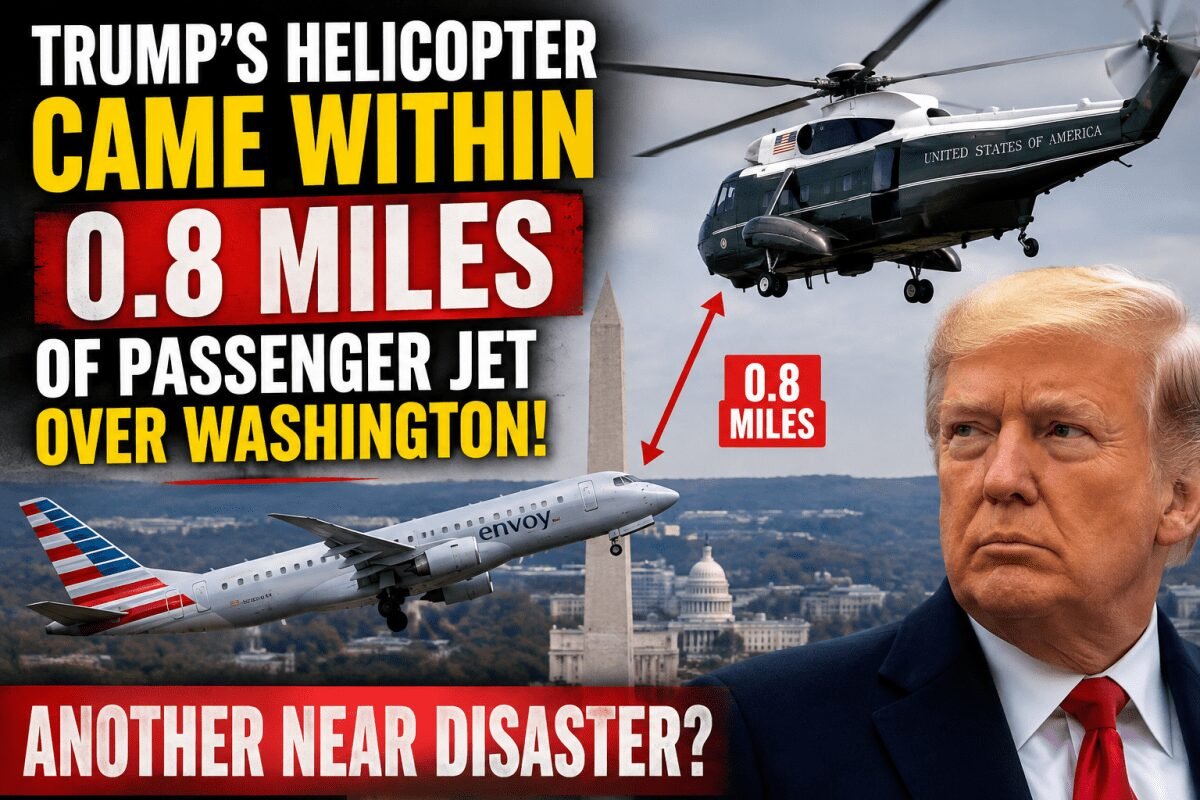
President Donald Trump was aboard Marine One when the military helicopter came dangerously close to a passenger jet over Washington, D.C. — triggering a federal investigation and raising chilling new questions about safety in the capital’s crowded skies.
The president’s helicopter reportedly came within just 0.8 miles of an Envoy Air jet taking off from Ronald Reagan Washington National Airport on Tuesday afternoon.
That distance was far below the required 1.5-mile safety buffer, according to reports.
The alarming incident unfolded as Trump was being flown to Joint Base Andrews to board Air Force One for a trip to the West Coast.
Now, aviation officials are scrambling to determine how two aircraft — including one carrying the president of the United States — were allowed to get so close.
The Federal Aviation Administration and the National Transportation Safety Board have launched investigations into the terrifying close call.
According to The New York Times, garbled communications between Marine One and the Reagan airport control tower delayed controllers from clearing nearby aircraft.
The Marine One crew reportedly tried three times to alert the tower that the president’s helicopter was preparing to lift off.
Those warnings apparently were not heard clearly.
At nearly the same moment, the Envoy Air passenger jet was cleared for takeoff — placing both aircraft inside the required safety zone.
The apparent communication failure has raised fears that Washington came frighteningly close to another aviation catastrophe.
White House Insists Trump Was Never in Danger
Despite the alarming distance between the aircraft, the White House insisted the president was safe at all times.
“Although the president was at no point in harm’s way during yesterday’s momentary loss of separation, the White House continues to work with relevant military, F.A.A. and other security personnel to ensure the president’s continued safety,” White House spokesperson Kush Desai said.
However, the incident has drawn intense scrutiny because commercial flights are usually stopped when Marine One is operating near Reagan National Airport.
Officials have not yet explained why the passenger jet was allowed to take off while Trump’s helicopter was nearby.
The close call brought back horrifying memories of the January 2025 midair collision that killed 67 people near the same airport.
American Airlines Flight 5342 was approaching Reagan National Airport when it slammed into a military Black Hawk helicopter and plunged into the icy Potomac River.
All 64 people aboard the passenger plane and all three crew members inside the helicopter were killed.
There were no survivors.
Investigators later found that the Black Hawk had been flying about 100 feet above its permitted altitude.
The helicopter was reportedly traveling between 251 and 349 feet, while the passenger jet was at approximately 325 feet when the two aircraft collided.
Flight-recorder data showed Captain Jonathan Campos and First Officer Samuel Lilley desperately tried to pull the jet’s nose upward moments before impact.
Their last-second maneuver was not enough.
Both aircraft crashed into the river below.
After the deadly collision, the FAA introduced sweeping new rules around Reagan National Airport.
Mixed helicopter and commercial jet traffic was restricted, and passenger flights were supposed to be halted whenever Marine One entered the area.
Air traffic controllers were also ordered to use radar to keep aircraft safely separated, while military helicopters were required to broadcast their exact locations.
The NTSB later uncovered a series of stunning failures behind the 2025 disaster.
A critical hotline connecting the Pentagon to the Reagan airport tower had reportedly been broken for more than three years.
Investigators also found that the air traffic controller handling the doomed aircraft had been performing two jobs during a busy period.
Tuesday’s close call is now raising disturbing questions about whether enough has changed.
Despite new rules, upgraded procedures and promises of reform, a helicopter carrying the president still came far closer to a passenger jet than federal safety standards allow.
Officials have not announced whether any pilots, controllers or federal agencies could face disciplinary action.