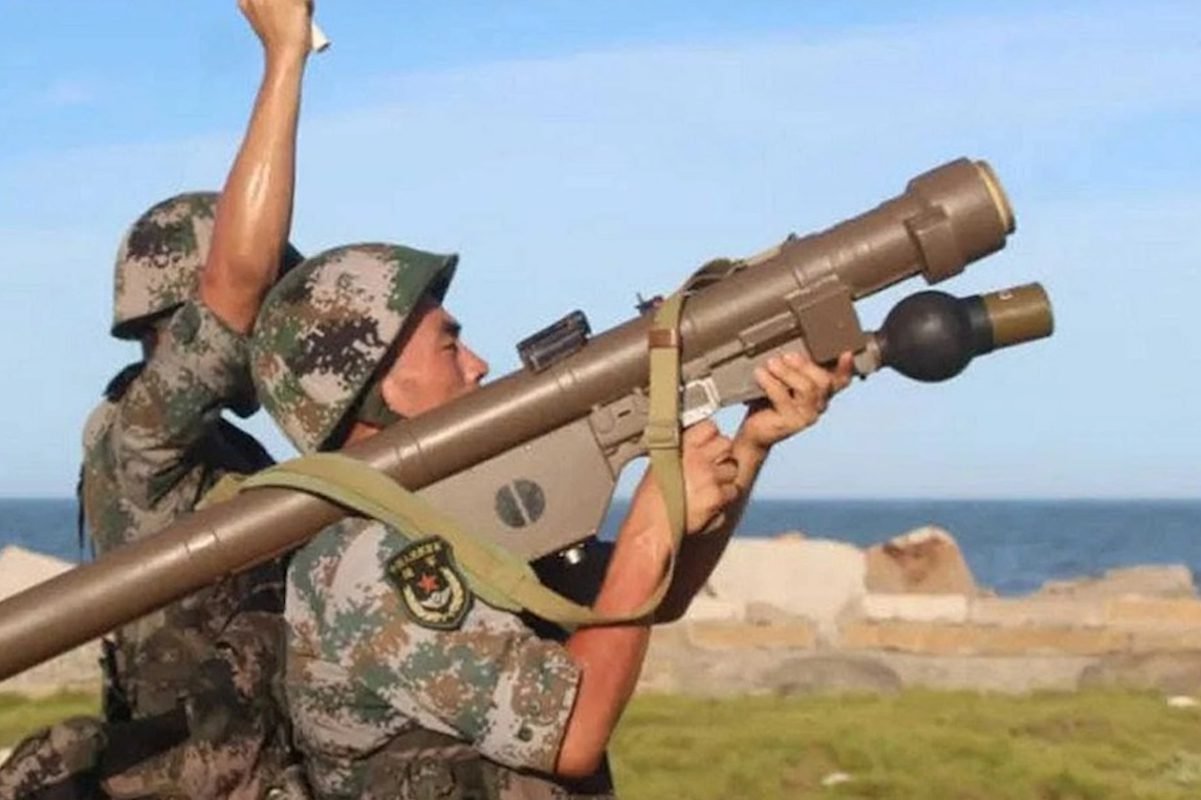
Iran’s reported acquisition of Chinese shoulder-fired air-defense missiles could turn the war’s lower altitudes into a costly battlefield of attrition for US and Israeli airpower.
Iran was set to receive its first shipment within weeks under a signed US$60-$70 million deal for 300 to 400 Chinese-made QW-12 and FN-16 shoulder-launched air defense systems, also known as MANPADS, according to multiple media reports.
The MANPADS will aim to rebuild Iran’s short-range air defenses following five months of US and Israeli air strikes that exposed critical vulnerabilities in its fixed military infrastructure.
Brokered through Hong Kong-based intermediary Zhongqing Baoshang International Investment, the reported plan calls for the infrared-guided missiles to be shipped from Urumqi in western China through Pakistan and onward to Iran by air or land.
The weapons would allow Iranian forces to deploy dispersed, highly mobile low-altitude air-defense teams with minimal radar signatures around key strategic sites.
The reported transfer has already triggered diplomatic friction. China’s Foreign Ministry dismissed the report as groundless while Pakistan’s military public relations wing forcefully denied any logistical involvement.
US President Donald Trump noted that such shipments would directly contradict personal assurances from Chinese President Xi Jinping that Chinese companies would not supply weaponry to Iran.
The reported Chinese purchase would complement an earlier Iranian agreement with Russia. Asia Times reported that Iran signed a $591 million deal in December 2025 for 500 Verba MANPADS launchers and 2,500 missiles, with deliveries scheduled through 2029.
According to the US Army’s ODIN database, the QW-12 carries a 1.42-kilogram high-explosive warhead containing prefabricated tungsten-alloy fragments.
The shoulder-fired missile can engage targets at ranges of 0.5 to 6 kilometers and altitudes of 10 meters to 4 kilometers. Its infrared seeker can reportedly detect jet aircraft at distances exceeding 9 kilometers. The system has a claimed single-shot kill probability of more than 80%.
The infrared-guided FN-16 is likewise designed for short-range engagements against low-flying aircraft, helicopters and unmanned aerial vehicles. According to ODIN, its effective engagement range varies by target type, with helicopters and drones vulnerable at comparatively short distances.
Writing for Army Recognition in August 2026, Alain Servaes argues that US and Israeli strikes by B-2, F-35 and F-15 aircraft have destroyed significant portions of Iran’s strategic infrastructure and high- and medium-altitude air defenses, shifting the campaign toward sustained pressure on remaining targets.
He notes that this phase requires sustained intelligence, surveillance and reconnaissance (ISR), battle-damage assessment, target confirmation, special operations support and combat search-and-rescue (CSAR) — missions that can require aircraft to operate at lower altitudes.
MANPADS have limited reach against high- and medium-altitude aircraft but remain dangerous to aircraft operating closer to the ground.
Chris Gordon and Stephen Losey noted in a March 2026 Air & Space Forces Magazine article that passive electro-optical and infrared weapons provide little or no radar warning, enabling surprise “pop-up” attacks against low-flying drones and aircraft.
Unlike large, multi-vehicle air-defense systems such as the S-300 and Bavar-373, MANPADS can be operated by small, dispersed teams that are mobile, rapidly concealed and difficult to detect and destroy.
Illustrating the potential threat to unmanned aircraft, ABC News reported in July 2026 that Iran had shot down roughly 30 MQ-9 Reaper drones since the start of Operation Epic Fury.
Furthermore, the Washington Times reported in June 2026 that when combat losses in Yemen from 2017 are included, the US has already lost one-third of its 135-strong pre-war Reaper drone fleet, with the production line reported closed in 2025, making each US$56 million loss difficult to replace quickly.
These losses may be pushing the US toward older alternatives. The War Zone (TWZ) reported in June 2026 that US Central Command (CENTCOM) may have reactivated Predator drones, which carry fewer munitions than the Reaper.
The Reaper and Predator were developed during a time when US air superiority was largely taken for granted. They focus on endurance and payload rather than speed and agility.
While capable of flying above MANPADS engagement ranges, missions that bring them nearer to the ground put them at risk from short-range air defenses.
Each Reaper loss also reduces available ISR and battle-damage assessment capacity. Sustained losses in Iran could therefore have consequences beyond the conflict, particularly if US forces and allies require the same limited fleet for contingencies on the Korean Peninsula or in the Taiwan Strait.
Helicopters are particularly exposed at low altitude. Defense Security Asia reported in April 2026 that an Iranian MANPADS struck a US HH-60W rescue helicopter during a mission to recover downed F-15E pilots.
Fixed-wing aircraft are not safe from the threat, as the same outlet reported that an Iranian MANPADS also damaged a low-flying A-10 supporting the rescue operation, although the aircraft returned to its base in Jordan.
Previously, in March 2026, a US F/A-18 Hornet was hit by an Iranian MANPADS during a low-altitude strafing run, sustaining damage to the tail and engine area, but was able to return to base.
If one of those aircraft were shot down and its crew captured, the resulting negotiations could be politically damaging for the Trump administration and provide Iran with significant leverage.
China’s reported MANPADS shipment could strengthen Iran’s ability to wage an aerial war of attrition by contesting the lower-altitude battlespace.
The weapons cannot stop high-altitude or standoff strikes, but they can complicate follow-on operations by forcing US forces to hunt dispersed missile teams and protect the drones, helicopters and support aircraft operating closer to the ground.
US airpower may dominate Iran’s upper skies, but Iran could impose the mounting costs to the bombing campaign much closer to the ground.