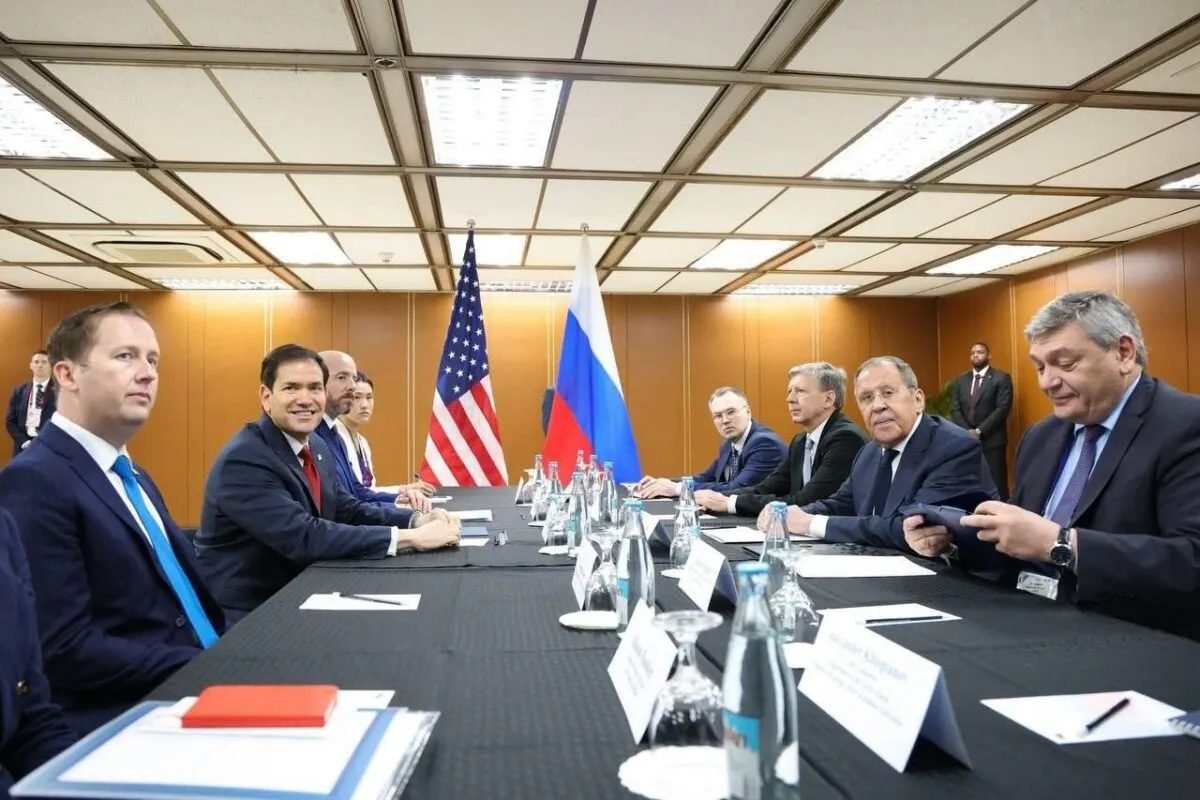
On the sidelines of the ASEAN Foreign Ministers meeting in Manila, US Secretary of State Marco Rubio met with Russian Foreign Minister Sergey Lavrov. The meeting was planned ahead, hence the US and Russian flags were prominently displayed. Yet the discussion was brief: between 35 and 37 minutes. While there were a number of topics, the main focus was Ukraine.
We do not have a readout of the meeting and both Rubio and Lavrov prefer not to disclose what took place in any detail. Even so, there was a dramatic moment when Secretary Rubio told Lavrov that the understanding seemingly reached in Anchorage between Russian President Vladimir Putin and US President Donald Trump, was dead.
According to what Rubio said in a follow-on press briefing, Anchorage failed because Ukraine would not accept it. “You can’t have a peace deal,” Rubio said, unless both sides agree to it, and the Ukrainians would not agree to it,” Rubio said.
Rubio went on to say in his press conference that the US still was willing to act as a mediator between Russia and Ukraine, but new ideas were needed if there was any possibility of moving forward. At the moment there is nothing new (or even old) on the table.
Anchorage framework
The US tabled a number of idea in Anchorage on August 15, 2025, and the Russians accepted them. Putin represented the acceptances as important Russian concessions intended to move negotiations forward.
Anchorage covered four main points. The first was a frontline freeze including territorial trade-offs.
The military freeze had two components. At the eastern front, Ukraine would pull its forces out of the remaining fortified areas in the Donbas, and Russia would completely pull out of non-annexed northern pockets in Kharkov and Sumy.
At the southern front, the line of control would be frozen in Kherson and Zaporizhzhya regions.
The freeze would not resolve the question of the future of these territories, which would be left to future negotiations and agreements.
The second main component of the Trump-Putin discussion was NATO membership for Ukraine. Ukraine has long been promised NATO membership under NATO’s Membership Action Plan. Among the provisions of that plan are for an applicant to meet core democratic standards, holding formal accession talks, and securing unanimous ratification from all current member states.
At Anchorage, the US offered either to indefinitely bar or postpone Ukraine’s formal accession into NATO. Apparently neither Putin nor Trump discussed security guarantees by various NATO members already agreed, nor did Putin and Trump apparently take up the significant NATO operational presence in Ukraine.
The third component at Anchorage was a US willingness to phase out some unspecified sanctions on Russia including tariffs on Russian energy and trade.
Finally Putin and Trump discussed the status of Russian language use in Ukraine (which the Zelensky government has mostly banned) and safeguards for the Russian Orthodox Church in Ukraine, which the Ukrainians regard as subversive.
Anchorage not a settlement
Anchorage was tabled by the US as a way to end the fighting and to resolve at least one of Russia’s main concerns, namely Ukraine in NATO. The US proposals did not take up formal boundaries for Russian-annexed territories, nor did it speak to how to prevent future fighting. In short, Anchorage was an initial part of a long-term peace process aimed at halting the fighting.
Has Ukraine gained the upper hand in the fighting?
The August 2025 Putin-Trump meeting in Anchorage took place during a moment in which the consensus view was that Russia was gaining in Ukraine, leading to Trump’s belief that Ukraine should want a deal to avoid future battlefield setbacks.
The reality at the time was that Ukraine resisted and enlisted its European backers to fight Trump.
Since then Ukraine has launched a massive drone war, on the battlefield with FPV (First Person View) drones and against Russian territory using swarms of long range suicide drones.
The Ukrainians have targeted Russia’s critical infrastructure including refineries and storage depots, military airfields, air defense installations, even third country ships in the Black Sea, some delivering oil and others supplies. Such attacks have created a gasoline crisis in Russia, and burdened the already fragile Russian economy.
Ukraine’s aggressive drone operations are partly a response to Russian targeting of Ukraine’s critical infrastructure, and are designed to break morale in Russia and undermine Russia’s leadership credibility, ultimately aimed at gaining a full Russian withdrawal from Ukraine.
There are two significant effects of the Ukrainian campaign. On the battlefield Ukraine has managed to force major changes on the Russian side, leading to much-reduced-scale military operations to prevent heavy manpower losses, but also significantly slowing Russia’s ability to gain ground.
Beyond the battlefield, Ukraine’s attacks on Russian territory have demonstrated sophisticated routing and targeting to try and avoid Russian air defenses, most likely with extensive NATO assistance using overhead sensors including satellites. The Russians have increasingly had to rely on volunteer air defense crews and continue to struggle to contain Ukrainian drone attacks.
Russia is also retaliating with stepped up operations in Odesa, including port facilities and ships, and against Kiev.
Problems ahead for Ukraine
While Ukraine has demonstrated some formidable drone capabilities, it is facing some significant issues in terms of supplies that could shift the battlefield in Russia’s favor.
The supply problem breaks down into two parts: the supply of critical parts for Ukrainian drones and the supply of precision weapons including air defense systems. The first primarily involves China; the second, the US and to a lesser extent Europe.
Kiev fields two distinct drone categories: FPV drones whose role is critical on the battlefield and long range drones aimed at Russian territory and Crimea.
FPV drones are typically plastic or composite quadcopters powered by electric motors. In 2025 Ukraine used around 3 million FPV drones. Current reports suggest Ukraine is using 10 to 15 thousand drones daily. In recent months Russia has been targeting drone manufacturing facilities in Ukraine, as well as warehouses and distribution points, but there is not much hard evidence that Russian operations have meaningfully impacted Ukraine’s use of FPV drones.
Between 85% and 90% of the components powering Ukraine’s FPV drones come from China. These include power systems (such as lithium ion cells, high discharge LiPo batteries and power distribution boards); brushless electric motors, for propulsion and servos; and electronic speed controllers and flight controller boards, CMOS navigation cameras, thermal sensors, fiber optic dispensors and basic RF transceiver modules.
In addition there are some supply issues for factories in Ukraine and in Europe that are supporting Ukraine. Included here are neodymium rare earth magnets for motors, synthetic graphite for battery anodes, and specialized carbon fiber coming exclusively from China.
Similarly Russia depends on China for its drone supplies. Even the Pentagon has given waivers so US drone producers can support US War Department needs.
Ukraine buys most of its components from third country intermediaries because China, after protests from Russia, restricted its domestic drone makers from directly exporting to Ukraine. But these so-called restrictions are just a way to jack up the price for parts and to enrich friends of the Chinese regime. China has made no effort to account for the millions of parts it is shipping that fuel the war effort.
Should China get beyond its usual corruption and clamp down, Ukraine would be out of business on the battlefield.
The long range drones are different since they use gasoline powered engines and there is less dependence on China. Moreover, the numbers of units are far fewer. Even so, electronics are important and some of the engines come from China.
The second category are precision weapons and, for Ukraine, especially air defense interceptors. Those supplies are critical, and may be in the short term irreplaceable.
ABC reports that the total US pre-Iran war stockpile of major air defense missile types is estimated at approximately 11,850 units. During the war, between 3,710 and 4,510 munitions were expended — roughly 31–38% of the entire pre-Iran war arsenal. The heaviest consumption fell on JASSM (1,100+), Tomahawk (1,000+), Patriot (1,060–1,430), THAAD (190–290), SM-6 (190–370), SM-3 (130–250), and new PrSM (40–70).
Ukraine does not have Tomahawk, THAAD or SM-6 or SM-3. It has a couple of European air defense systems (although supply is a major issue) and it has Patriot. But a Patriot without interceptor missiles is useless. It is unlikely the US can continue to supply Ukraine more than a handful of interceptors, and even that would take away from urgent needs for our allies in Europe and the Middle East.
In the Middle East the the United States maintains its own forward-deployed Patriot batteries across Jordan, Kuwait, Qatar, Bahrain, Saudi Arabia and Iraq to protect American personnel and allied bases. In addition the following countries in the region operate Patriot: Saudi Arabia, UAE, Jordan, Kuwait, Qatar, Bahrain and Egypt. In addition, NATO (Germany, Greece) operates Patriot systems in Saudi Arabia and Kuwait.
Should the fighting resume with Iran, the number of Patriot interceptors in the region will soon reach critically low levels. This directly impacts Ukraine and its ability to protect key areas, especially Kiev and Odesa.
Ukraine future
Ukraine probably can ignore peace initiatives that would leave Russian forces on Ukrainian territory, at least for a short while. But the supply crisis is closing in and it will significantly impact Ukraine’s defenses and ability to hold territory and fend off Russian missile and drone attacks.
How soon will Ukraine’s situation turn critical? If the fighting resumes in Iran, after only a few months for air defenses. If the Chinese crack down on supplies for drones to Ukraine, even sooner.
Meanwhile there are no new ideas for a peaceful solution to the Ukraine conflict.
Former US Deputy Under Secretary of Defense Stephen Bryen is a senior Asia Times correspondent. This article can also be viewed, along with many others, on his Substack newsletter Weapons and Strategy.