
Japan’s Kawasaki Heavy Industries (KHI) has signed a memorandum of understanding (MOU) with Airbus Defence and Space (Airbus D&S) to collaborate on long-endurance unmanned aerial vehicles (UAVs). The agreement covers operations combining the Eurodrone with KHI’s P-1 maritime patrol aircraft, with particular attention to anti-submarine warfare.
KHI is Japan’s second-largest defense contractor. Airbus D&S is the military aircraft and space systems division of Airbus. Airbus has worked with KHI and other Japanese companies for decades, but this agreement takes the relationship to a new level of military cooperation.
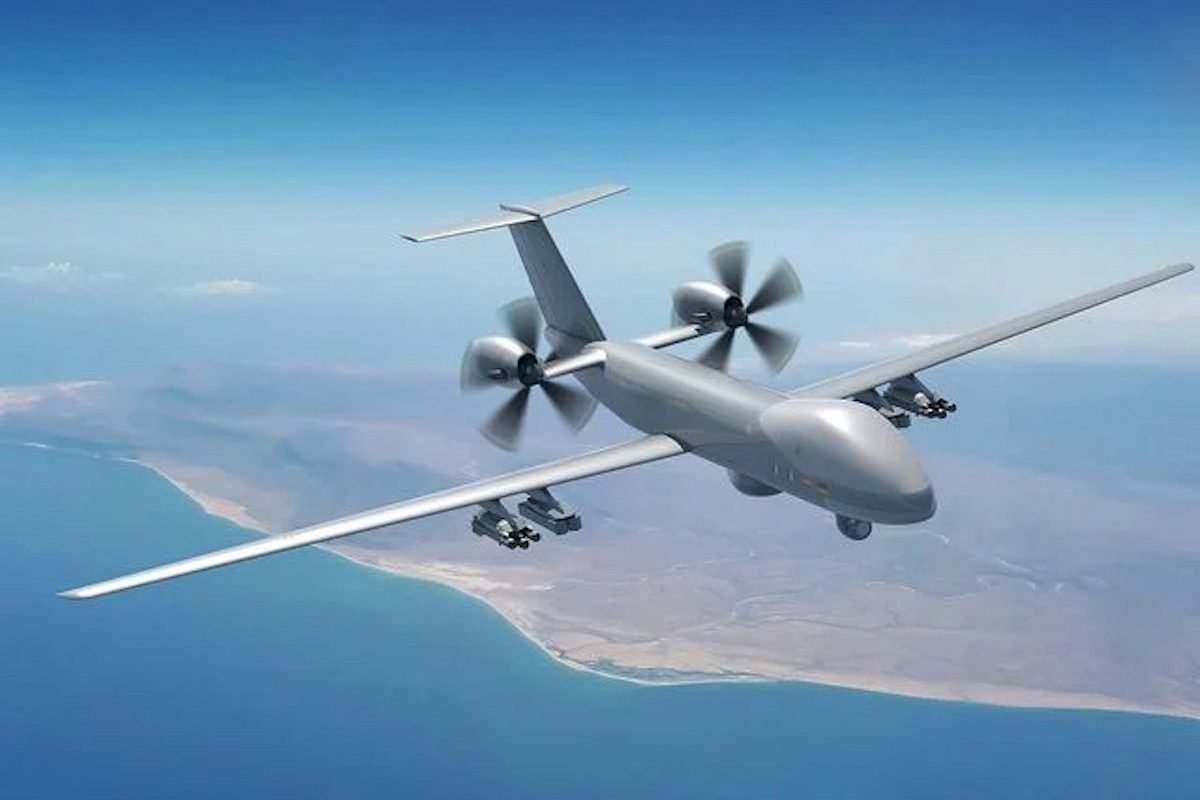
Currently under development, the Eurodrone is a large, twin-engine, remotely piloted aircraft with a 30-meter wingspan. A medium-altitude, long-endurance UAV, it can cruise at altitudes up to 12,200 meters (40,000 feet) for up to 40 hours and has a maximum payload capacity of 2.3 tons, excluding fuel.
The Eurodrone will be an armed intelligence, surveillance, target acquisition and reconnaissance (ISTAR) platform able to carry air-to-surface missiles and precision-guided bombs underwing. It will also have command, control and communications, and airborne early warning capabilities. Unlike purely military drones, it will be certified to fly in civilian airspace and use standard air traffic management systems.
The Eurodrone program is supported by Germany, France, Italy and Spain, with Airbus D&S as prime contractor and Leonardo and Dassault Aviation as industrial subcontractors. The European Union co-funds the program. Japan has been an observer since 2023, as has India.
The Eurodrone program operates independently of the International Traffic in Arms Regulations (ITAR), the US export-control regime governing trade in defense products, services and data.
The collaboration will therefore help Europe and Japan reduce their dependence on the US military-industrial complex, building on the existing EU-Japan Security and Defense Partnership.
The Eurodrone is a good fit for both KHI and Japan, which is playing catch-up in drone technology and has a very large jurisdictional sea zone — including its territorial waters (such as the Seto Inland Sea) and its exclusive economic zone (EEZ).
Japan’s EEZ is almost 12 times larger than its national territory. It extends nearly to Taiwan in the southwest, to Okinotori Island, 1,740 km south of Tokyo, and to Minamitorishima (Marcus Island), 1,850 km southeast of Tokyo (see map).
Airbus and KHI are considering development of a specialized anti-submarine variant of the Eurodrone that would carry sonobuoys and torpedoes. It would work in tandem with KHI’s P-1 maritime patrol aircraft, which is designed for prolonged surveillance over the ocean. The P-1 has an operational radius of about 2,500 km and is powered by four turbofan jet engines produced by IHI Corp. (formerly Ishikawajima-Harima Heavy Industries).
A Japanese version of the Eurodrone could include Japanese sensors and other components and involve Japanese participation in manufacturing and maintenance, making it easier for Japan to operate the aircraft independently.
“Furthermore, insights gained from developing Japan’s specific variant are expected to provide substantial operational and logistical advantages for future European naval versions of Eurodrone,” Airbus said.
The Eurodrone isn’t scheduled to make its first flight until 2029, but its capabilities would already exceed those of competing medium-altitude, long-endurance UAVs if it were flying today.
Eurodrone data:
- Wingspan: 30 meters; length: 17 meters; height: 6 meters
- Maximum takeoff weight: 13-ton class
- Mission payload: 2.3 tons (excluding fuel)
- Maximum speed: 270 knots (500 km/h)
- Flight time: up to 40 hours
Features:
- Twin turboprop engines
- Automatic takeoff and landing
- Traffic collision avoidance system
- Air traffic management communications
- Narrow/wide-band redundant data link architecture
- Detect-and-avoid system
- Weather radar
- Lightning protection
- Ice detection and protection
Mission payload:
- Electro-optical/infrared camera
- Multi-mode surveillance radar
- Line-of-sight/beyond-line-of-sight datalink
- Automatic identification system for warship detection
Source: Airbus media assets
Airbus and KHI have jointly produced helicopters for emergency medical services, transport, law enforcement and other purposes for nearly 50 years. KHI, along with All Nippon Airways and Kansai International Airport, joined the Airbus Hydrogen Hub at Airports project in 2024.
Airbus also works with Toshiba on the development of superconducting technologies for hydrogen-powered aircraft. Airbus D&S has design, manufacturing and data supply arrangements with Japanese satellite companies Astroscale, Synspective and Sky Perfect JSAT.
Airbus has also been taking market share from Boeing in Japan, while KHI, Mitsubishi Heavy Industries (MHI) and other Japanese suppliers of aircraft components have been doing more work for Airbus and less for US aerospace giant Boeing.
Follow this writer on X: @ScottFo83517667







 has signed a memorandum of understanding (MOU) with Airbus Defence and Space (Airbus D&S) to collaborate on)