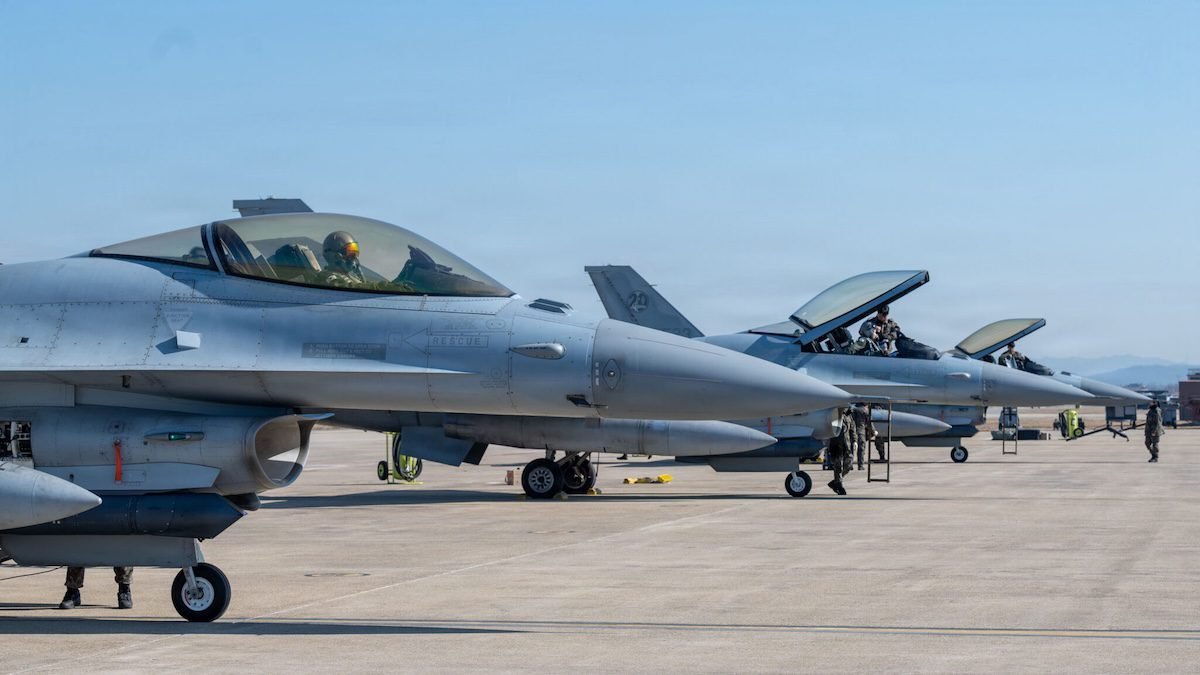
The United States and South Korea describe the latter’s defense buildup with the same enthusiasm but mean two different things. American officials call it “alliance modernization,” while South Korean officials increasingly call it “autonomous defense.” Neither side has much incentive to dwell on the difference, but it is getting harder to avoid.
As the Donald Trump administration tells it, South Korea is increasing defense spending and equipment procurement within the context of a redesigned US strategy to restructure the roles of both US and South Korean forces on the Korean Peninsula and beyond.
Modernization is the “administration’s shorthand for pushing US allies to adapt to a changing regional security environment and shoulder more of the defense burden,” Brookings Institution’s Andrew Yeo observed last fall.
Writing for the latest edition of KEI’s Korea Policy, Korea National Defense University’s In Hyo Seol describes modernization as “a redistribution of roles on a foundation of converging military interests.”
This framework is a more comfortable one for those concerned about friction between the United States and South Korea. Differences over specific issues, such as the timeline for returning wartime operational control (OPCON) of South Korean armed forces, can be more easily managed if both Washington and Seoul share the same goal of alliance modernization.
Autonomous defense
But the reality is more complicated. South Koreans increasingly place their defense buildup and its key components within a different, though not entirely contradictory, policy framework called “autonomous defense.”
Autonomous defense traces its roots to the fear of abandonment in the 1970s, when President Richard Nixon withdrew 20,000 troops from the peninsula during the Vietnam War. More recently, defense autonomy for South Korea means greater self-reliance, indigenous weapons procurement sustained by arms exports, and ultimately limiting the reliance on US forces as a deterrent to North Korea.
South Korean policymakers have long grappled with a persistent tension in defense policy between a desire for more autonomy and the reality of the operational indispensability of the US-South Korea alliance.
“The goal of autonomy policy is to hold our own while being alliance compatible,” a senior South Korean official told the author on a recent visit to Seoul. In other words, South Korea hopes to shift the alliance’s internal balance of power, reduce technological dependency on US defense systems and build sufficient indigenous capability to make Seoul a more equal partner.
On the surface, the Trump administration’s goals of shifting a greater share of defense burdens to its allies and encouraging a more regional approach to security would seem to be compatible with South Korea’s preferences. But Washington has been clear about the limits: Allies are expected to spend more, not to build alternatives.
The OPCON transfer initiative, for example, was initially targeted in 2012 but has since been replaced by a conditions-based threshold with no fixed timeline. The conditions range from South Korea’s own capability, both in equipment and command, to lead combined forces to its strike and air defense capabilities and, most nebulous of all, to the existence of a regional security environment that would be compatible with the transfer.
In 2019, the allies determined that South Korea met a minimum baseline capability and interoperability with US Forces Korea (USFK). Further progress slowed until recently, when the Trump and Lee Jae Myung administrations agreed that a second stage, full operational capability, would be verified this year. Seoul seems likely to establish 2028 as a new target year for OPCON transfer to occur by.
That push has been met, however, with resistance from the US military, led by USFK Commander Xavier Brunson, who suggested earlier this year that this timeline was too optimistic. The US Senate has backed that up by proposing tighter conditions for OPCON transfer.
Arms production and exports
Similar tensions lurk not far below the surface when it comes to South Korea’s indigenous arms production and its successful export drive across Europe and Asia. Sales of armored vehicles, artillery, jet aircraft and missile defense systems have transformed the country into a global leader of arms sales.
Earlier this month, President Lee attended a NATO forum and suggested such weapons sales could underpin an evolution of South Korea-NATO ties. But senior Trump administration officials have seemingly pushed back on the notion that allies could or should replace reliance on American weapons.

“The simple fact of the matter is that no alternative country or countries can compete with the US defense industrial base, either in quantity or quality,” Pentagon policy chief Elbridge Colby asserted on social media last week. The United States “makes the best equipment, and we make it at a scale that no plausible competitor can match,” Colby continued. Access to the US defense industrial base “is a privilege, not a right.”
Thus, even in its most ambitious formulation, South Korea’s autonomous defense still involves maintaining the US extended deterrence commitment in the face of threats from North Korea. Some sort of US military presence makes that political commitment concrete.
“The withdrawal of USFK is not something we want to see,” a senior Lee administration official told this writer. “But if it becomes a reality for us, and we have to fend for ourselves, we need to block the threat of nuclear weapons.”
The most obvious way to do so – and the one that has attracted the most attention in American policy circles – is a South Korean nuclear weapons program. Alternatively, policymakers in Seoul are interrogating whether rapid changes in defense technology might create a reliable form of conventional deterrence. The first option is still beyond the pale, while the second is still a ways down the road.
“We are learning the lessons of the Ukraine and Iran wars,” the senior official explained, notably laser weapons and AI-powered defense systems that can “potentially intercept hundreds of missiles at one time.”
For now, neither the United States nor South Korea has an interest in forcing the question. But indigenous production, export markets, command authority and the first sketches of a conventional answer to nuclear coercion add up to more than burden-sharing.
Daniel C. Sneider is a non-resident distinguished fellow at the Korea Economic Institute of America (KEI) and a lecturer in East Asian studies at Stanford University. The views expressed here are the author’s alone. Originally published by KEI, the article is republished with permission.