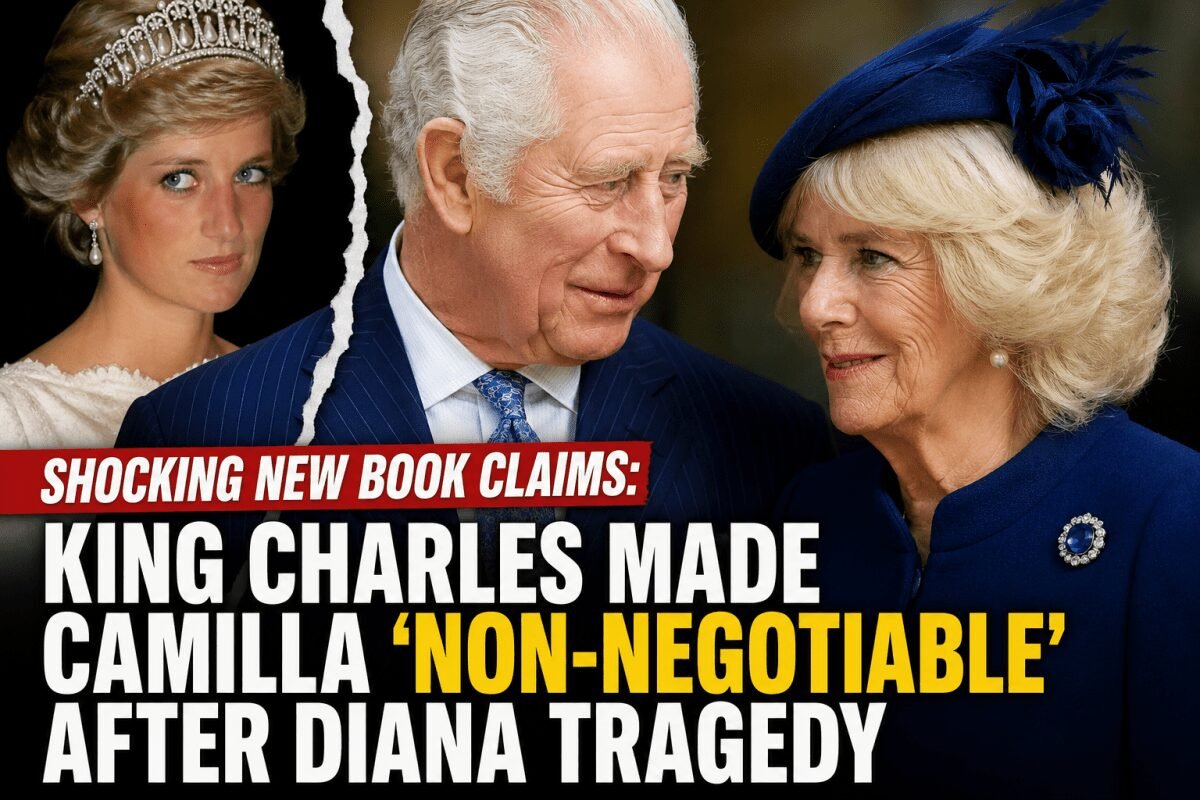
King Charles may have spent years trapped between palace tradition, public fury and the long shadow of Princess Diana, but when it came to Queen Camilla, one royal author says there was never really a choice.
Camilla was “non-negotiable.”
That is the striking claim at the center of Catherine Mayer’s new book, Divide & Rule, which examines some of history’s most misunderstood royal wives and takes a fresh look at Camilla’s extraordinary rise from scandalized “other woman” to crowned queen.
According to Mayer, anonymous friends of the monarch said Charles viewed Camilla’s place in his life as something that could not be debated, even after his bitter divorce from Diana and the princess’s shocking death in 1997.
A spokesperson for Buckingham Palace told Fox News Digital the palace does not comment on books.
Mayer, who previously wrote a biography of Charles, told the outlet that the future king’s determination to keep Camilla by his side became especially clear after the collapse of his marriage to Diana.
“I think the non-negotiability was the point after the divorce and, of course, after Diana’s death,” Mayer said. “He understood that this was the one woman who could really sustain him.”
That support, Mayer argued, was exactly what Charles felt he needed.
Camilla, she said, was not simply a romantic partner. She was the woman who steadied him, lifted him and gave him the kind of private reassurance he had long craved inside the rigid world of royalty.
“This is, in many ways, one of the most unlikely love stories you can imagine,” Mayer said.
For millions around the world, Charles and Diana had once looked like a fairy tale. Their 1981 wedding was watched by a global audience and sold as the perfect royal romance. But behind palace walls, the marriage was unraveling under pressure, incompatibility and the presence of Camilla Parker Bowles.
When the marriage finally imploded in public, Mayer said the world was forced to confront a very different truth.
“There were a lot of people who bought into the idea of the fairy-tale marriage between Diana and Charles,” Mayer said. “It was only when it imploded so spectacularly that they were forced to recognize that wasn’t the truth of what had happened.”
By then, Camilla had already been cast in the harshest possible role.
She was blamed as the woman who came between Charles and Diana, and for years her name was tied to one of the biggest royal scandals of the modern age.
Mayer said she does not believe Charles and Diana’s marriage ever had a real chance of working, though she was careful to stress that Diana was deeply wronged.
“I personally don’t think the relationship between Diana and Charles could ever have worked,” she said. “But that doesn’t mean I don’t think Diana was very badly treated.”
Still, Mayer claimed that Charles’ reaction to Camilla was impossible to miss.
After spending time following Charles during her research, Mayer said she saw the effect Camilla had on him firsthand.
“You would see him tired, very obviously out of sorts,” she recalled. “And then she would come into a room, and he would light up. She just lifts him.”
Charles first met Camilla through mutual friend Lucia Santa Cruz in 1970, and by many accounts, he was immediately taken with her. But romance alone was not enough for the future king.
At the time, palace expectations were unforgiving. Camilla was not seen as the proper woman to marry the heir to the throne. She had a social life, a romantic past and none of the carefully preserved innocence that royal insiders believed was required of a future queen.
“She had something of a past,” Mayer said.
The author insisted she was not portraying Camilla as some grand seductress, but rather as a lively, experienced woman who enjoyed life.
That, Mayer suggested, was exactly why Charles was drawn to her.
Camilla chain-smoked, loved social occasions and had boyfriends, including Andrew Parker Bowles, the man she would later marry. Mayer even recalled one colorful story about Camilla heading off to America, riding around on a motorbike in leathers and living with a freedom that the palace world found difficult to accept.
To the old guard, Mayer said, Camilla was the sort of woman a prince might enjoy, but not the sort of woman he should marry.
“This dusty, old-fashioned institution, they’re telling the heir to the throne, ‘This is the kind of woman you go off and have fun with, but not the kind you marry,’” Mayer said.
Royal broadcaster Ian Pelham Turner agreed that Camilla gave Charles something different from what he found inside palace life.
“Camilla gave Charles, from the early days, a feeling of masculinity, making him feel sexual desire,” Turner told Fox News Digital. “She treated him like a man rather than a royal.”
But Charles and Camilla did not marry in those early years. Charles joined the Royal Navy in 1971, and Camilla married Andrew Parker Bowles in 1973.
Charles was reportedly devastated, though the two remained close.
By 1980, Charles began courting Lady Diana Spencer, who appeared to fit the royal mold perfectly. Diana was young, aristocratic and widely viewed as the ideal bride for the future king.
Charles and Diana married the following year in what became known as the “wedding of the century.”
But the shadow of Camilla never disappeared.
Royal author Penny Junor previously claimed Charles and Camilla rekindled their physical relationship around 1978 or 1979. People magazine has also reported that Charles and Camilla began seeing each other again in 1986, while both were married and had children.
Mayer said the exact timeline remains difficult to untangle.
“I think they did intend to break things off in terms of any kind of physical relationship, and they did,” she said. “But exactly when they rekindled it is another matter entirely because what they’ve said and what the evidence suggests don’t always exactly match.”
Diana, according to Turner, seemed to understand early on that Camilla would never be fully gone from Charles’ life.
“Camilla, without doubt, has been the love of Charles’ life,” Turner said. “He never stopped wanting to be with her, even when he married Diana.”
One of the most infamous symbols of the love triangle was a pair of gold cuff links engraved with interwoven Cs, which Diana believed represented Charles and Camilla.
Mayer said the cuff links carried deep meaning for Charles.
“There was a famous incident described in Jonathan Dimbleby’s authorized biography of Charles in which Diana found cuff links she realized were a gift from Camilla to Charles ahead of the wedding,” Mayer said.
She also said one source described a separate incident in which Charles became upset after losing one of the cuff links.
“The suggestion is that these things had great meaning for him and that the friendship had great meaning for him,” Mayer said.
Diana later described confronting Camilla directly about the affair in recordings made for Andrew Morton’s book Diana: Her True Story.
“I was terrified of her,” Diana said, according to People.
Diana recalled telling Camilla, “I know what’s going on between you and Charles, and I just want you to know that.”
Camilla allegedly responded by telling Diana she had everything she could want, including the love of men around the world and two beautiful children.
Diana’s answer became one of the most painful lines in royal history.
“I want my husband,” she said.
Years later, Diana would famously tell the BBC’s Panorama, “There were three of us in this marriage, so it was a bit crowded.”
Charles and Diana separated in 1992. Their divorce was finalized in 1996. One year later, Diana died from injuries suffered in a Paris car crash at age 36.
For Camilla, the years that followed were brutal. Public anger remained intense, and the palace faced the delicate task of slowly reshaping her image.
Mayer said that effort was “painstaking,” but Charles’ position did not waver.
Camilla, in his eyes, was not going anywhere.
In 2005, Charles and Camilla married. In 2023, after Charles became king, she was crowned Queen Camilla.
Turner said Camilla has proved to be a vital force in Charles’ life and reign.
“In a lot of ways, Camilla has been very good for Charles,” he said. “She’s supported him in his efforts to become a great king. She has been his confidante, mentor and companion.”
British broadcaster and photographer Helena Chard said Mayer’s “non-negotiable” description fits the long arc of Charles and Camilla’s relationship.
“For years, the palace kept Charles and Camilla in separate boxes,” Chard told Fox News Digital. “Eventually, he chose love over protocol.”
Chard said Camilla survived by staying steady, avoiding unnecessary attention and carrying out her duties until the public mood began to shift.
“She became an asset, not a liability,” Chard said. “By the time Charles took the throne, it was a no-brainer. You get the king, you get the queen. There was no plan B.”
It is a stunning turnaround for a woman once blamed for helping destroy the world’s most famous marriage.
But according to Mayer’s new book, the ending was always hiding in plain sight.
For Charles, Camilla was not a scandal to be managed.
She was the woman he refused to give up.