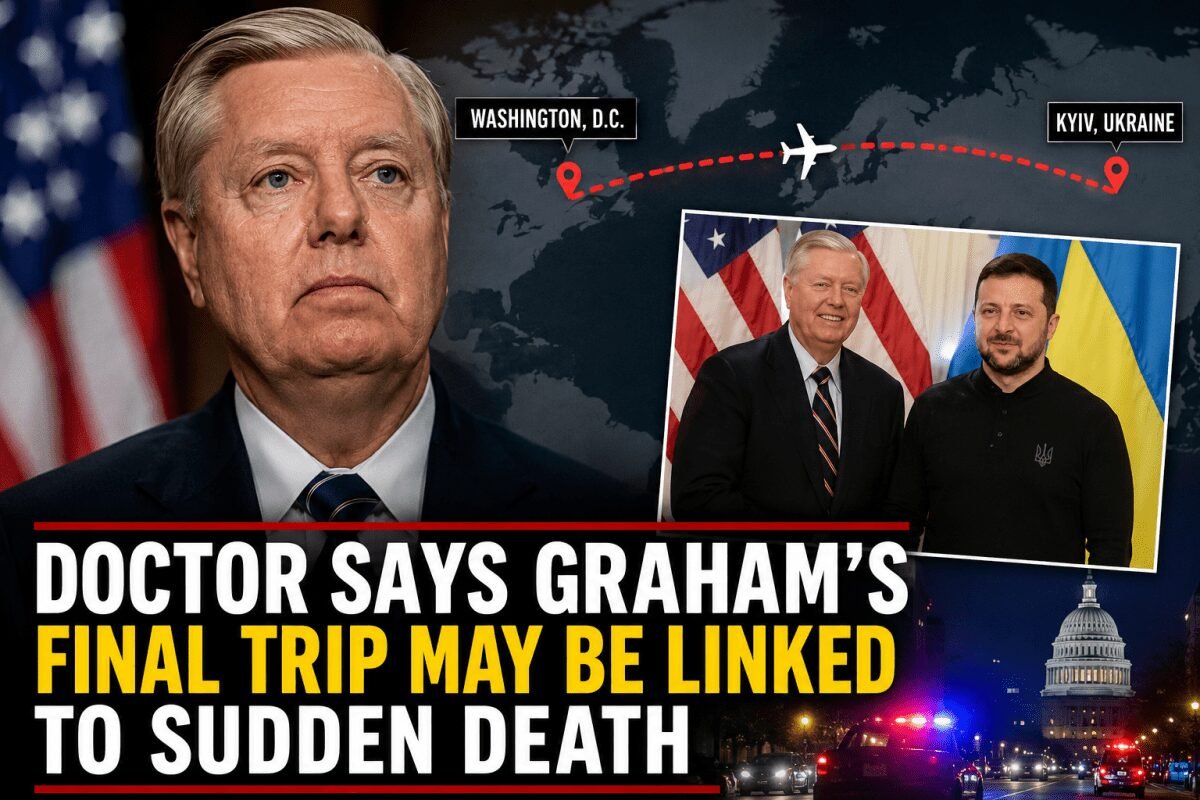
As conspiracy theories spread online following Lindsey Graham’s sudden death, one high-profile doctor offered a different explanation.
Fox News medical contributor Dr. Marc Siegel said Graham’s final trip to Ukraine may have increased his risk of a fatal cardiac event, especially given the senator’s family history of heart disease.
Graham, 71, died Saturday night after what his office described as a “brief and sudden illness.”
The South Carolina Republican had just celebrated his birthday on Thursday. By Friday, he was in Kyiv, smiling beside Ukrainian President Volodymyr Zelensky, touring drone facilities, and pushing for tougher sanctions against Russia.
By Saturday night, emergency crews were called to a Capitol Hill home owned by Graham.
According to police scanner audio obtained by The Washington Post, emergency services responded around 8:30 p.m. for a person suffering chest pains. About 25 minutes later, emergency personnel said CPR was in progress and that a man at the home was suffering from cardiac arrest.
CNN also aired 911 dispatch audio connected to the call from Graham’s house. The words “cardiac arrest” can be heard in the audio, though the call did not confirm the official cause of Graham’s death.
On Fox & Friends, Siegel said Graham’s long journey back from Ukraine could have been a factor.
“A long plane flight from Ukraine increases his risk of blood clotting,” Siegel said.
Flights from Washington, D.C. to Kyiv generally take between 10 and 14 hours, depending on layovers.
Siegel also pointed to Graham’s family history. Graham’s father, F.J. Graham, died of a heart attack at 69, when the future senator was just 22 years old.
His mother, Millie Graham, died at 52 of Hodgkin’s lymphoma. The deaths happened close together and left Graham responsible for helping raise his younger sister, Darline, who was only 13 at the time.
Graham later adopted Darline after joining the Air Force so she could receive his military benefits.
“He played an extraordinary role in bringing up his sister, Darline, when both his parents died suddenly, close together,” Siegel said.
The doctor said that background stood out to him while looking at the limited medical details available.
“As someone looking at the medical details, when his father dies of heart disease — a sudden cardiac arrest — when he’s so young, you wonder whether there could be that risk for him in terms of heart disease,” Siegel said.
Siegel also noted how deadly cardiac arrest can be when it happens outside a hospital.
“There’s 350,000 per year out-of-the hospital cardiac arrests,” he said. “Only 10 percent of them make it because, as you can imagine, you can’t get there fast enough to restart the heart right away.”
“The vast majority don’t make it, and most of the time it’s heart disease that causes this,” he added.
Graham’s death stunned Washington and sent shockwaves through MAGA circles, where grief quickly mixed with speculation.
The timing immediately drew attention. Graham had long been one of Ukraine’s most forceful defenders in the Senate, and he had just returned from meeting Zelensky, one of Russian President Vladimir Putin’s biggest enemies.
Some conservative influencers began raising questions online.
“Did Russia just poison Lindsey Graham?” Laura Loomer wrote on X, reposting a clip of Graham speaking during his Ukraine trip and calling for harsher sanctions on Moscow.
Siegel, however, pushed back on the idea of a more sinister explanation. His focus was on Graham’s age, family history, possible heart risks, and the strain of international travel.
For now, no official cause of death has been released.
Graham’s sudden passing marks the end of a long and often controversial political career. It also leaves behind a deeply personal story: a young man who lost both parents early, raised his sister, built a life in public service, and died just days after making one final overseas trip tied to one of the biggest foreign policy fights of his career.