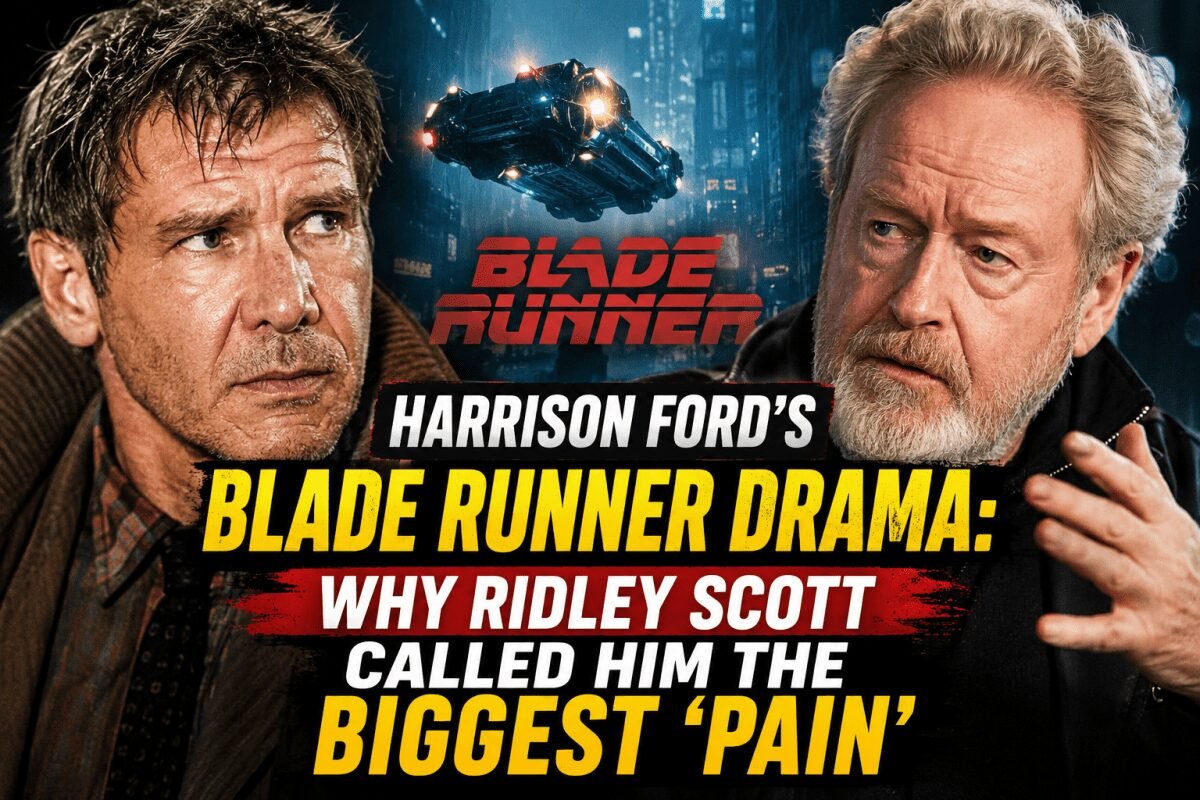
Harrison Ford and Blade Runner director Ridley Scott may have made a sci-fi classic together, but behind the scenes, things were not exactly smooth.
As Ford prepares to turn 84, some of the longtime stories from the Blade Runner set are getting another look, including the blunt reason Scott once called the actor the biggest “pain” he had ever worked with.
The tension was not all that surprising. By the time Blade Runner was being made, both men were already major forces in Hollywood.
Ford had become a global star as Han Solo in Star Wars and had just helped launch another blockbuster franchise as Indiana Jones in Raiders of the Lost Ark. Scott, meanwhile, had already made his own mark with Alien, the 1979 sci-fi horror film that turned into a major franchise.
But when the two came together for Blade Runner, their visions did not always line up.
In a 2006 BBC interview, Scott was asked who had been the “biggest pain in the a–e” that he had worked with over the years. His answer was Ford.
“He’ll forgive me because now I get on with him — but it’s got to be Harrison,” Scott said at the time. “Now he’s become charming. But he knows a lot, that’s the problem.”
Scott suggested part of the tension came from his own position at the time. He described himself as somewhat of a “new kid on the block,” even though he had already directed Alien. Still, he made clear that the difficult working relationship did not ruin the end result.
They still “made a good movie,” Scott said.
One of the biggest disagreements between Ford and Scott involved a question that Blade Runner fans have debated for decades: Was Rick Deckard a replicant?
In the film, Ford plays Deckard, a former police officer and “blade runner” assigned to hunt down and “retire” four biologically engineered humanoids known as replicants.
The movie, based on Philip K. Dick’s novel Do Androids Dream of Electric Sheep?, leaves plenty of room for interpretation. Over the years, many viewers have pointed to clues suggesting Deckard may actually be a replicant himself, possibly implanted with false memories.
Scott has said he believes Deckard is definitely a replicant.
Ford has never been on board with that idea.
The actor has pushed back on Scott’s interpretation and has even joked that the director “doesn’t know what he’s talking about.”
That was not the only issue Ford had with the film.
He was also unhappy with the voice-over narration used in the original U.S. theatrical version of Blade Runner. The narration was added back into the movie after concerns that audiences would have trouble following the story.
Ford later told Variety that he preferred any version of the film without the narration.
“I like any cut without the voice-over,” he said. “When we first saw the film in script form, it had a narration. I felt strongly that the narration was not right for the film.”
According to Ford, he worked with Scott, the screenwriter, and a producer for three weeks at his dining room table to remove the information from the voice-over and build it naturally into the scenes instead.
But Warner Bros. was not convinced.
“And then at the end of the film, Warner Bros. said, ‘What the h— is going on here? I don’t understand this at all. Explain it.’ And the voice-over came back,” Ford recalled.
The actor said he recorded the narration about six times, but nobody seemed satisfied with the results.
“I did the voice-over about six times, and nobody was ever happy with it,” he said.
That is why Ford was relieved when later versions of Blade Runner were released without the narration.
“I was glad that the film was finally released without it,” he said, explaining that he believed removing the voice-over allowed the audience to be more present in the story.
Decades later, Blade Runner is considered one of the most influential science-fiction films ever made. But its legacy came with plenty of friction.
Ford and Scott may not have agreed on Deckard, the narration, or even the best way to tell the story. But their creative clash helped fuel a movie that fans are still arguing about more than 40 years later.