The mood regarding the war in Ukraine has changed in recent months. Ukrainian drones have struck Russian oil infrastructure, causing fuel shortages across Russia. And the Ukrainian president, Volodymyr Zelensky, is exuberant about finishing the war from a “position of strength”.
The hope is that an economic crisis in Russia leads to social unrest and political instability, possibly resulting in the collapse of the ruling regime. This would not be an unprecedented event in Russian history. The Soviet Union rapidly unravelled amid economic and political crisis in 1991. But how likely is this scenario for Russia today?
I have travelled to Russia yearly since 2022 and there has been a clear change in the mood. In 2022, it was all about survival and adapting to the new reality of sanctions and war. Over the next couple of years, there was stabilisation and growing optimism about the economy’s ability to adapt. However, by 2026 there was talk of an economic recession, even before the current fuel shortages hit.
With the economy at full capacity and military spending remaining untouchable, shrinking the civilian sector through high interest rates and taxes is the only way to tame inflation and balance the budget. VAT was increased from 20% to 22% in January 2026, while taxes on small and medium-sized enterprises were raised.
At the St Petersburg International Economic Forum in June, it was suggested that tough times are likely to continue for at least three years. The question now is whether these economic difficulties will lead to mass protests and a split among the elites as happened in late Soviet times.
Soviet collapse
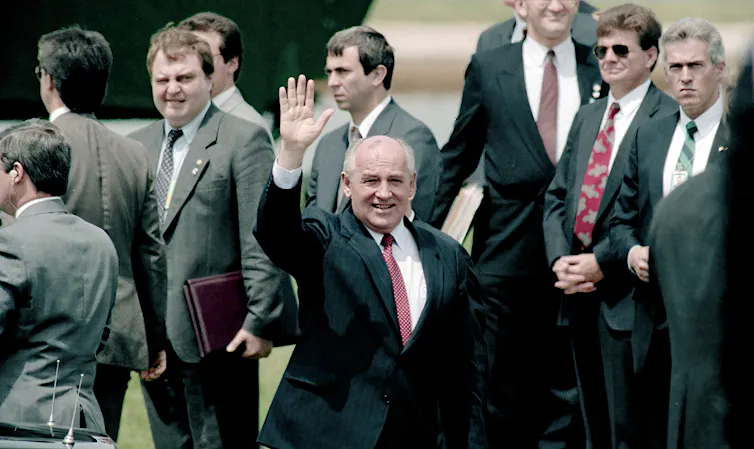
The Soviet Union collapsed under the leadership of Mikhail Gorbachev, who implemented reforms to liberalise the economy and political system. His decision to decentralise economic decision-making undermined the Soviet planned economy and led to severe food shortages.
The introduction of partially democratic elections in 1989 then gave opposition figures, such as Gorbachev’s arch-rival Boris Yeltsin, a platform – which only expanded in 1990 when Gorbachev devolved power to the Soviet republics. Combined with a deepening economic crisis, this led to Gorbachev rapidly losing power and to the dissolution of the Soviet Union itself.
The situation in today’s Russia is different. Since 2000, Vladimir Putin has presided over authoritarian consolidation. He has weakened the fragile democratic institutions he inherited from Yeltsin, his predecessor, and has increased control over the media. Meanwhile, he has marginalised and eliminated political opponents such as Alexei Navalny.
Putin has also cowed big business. This perhaps most notably occurred during the 2003 Yukos affair when Russia’s richest man, Mikhail Khodorkovsky, was imprisoned for tax evasion and his oil company was seized. The Kremlin’s degree of control over politics and society has only strengthened since the war in Ukraine began in 2022.
All unauthorised opposition in Russia has been eliminated, either through imprisonment or emigration. The business elite are increasingly under Kremlin control, not least since sanctions have forced many of them to return from the west to Russia.
And the war has consolidated the influence of the siloviki (Russia’s law-enforcement agencies), as well as the military-industrial sector and army, all of which are invested in the stability of the regime.
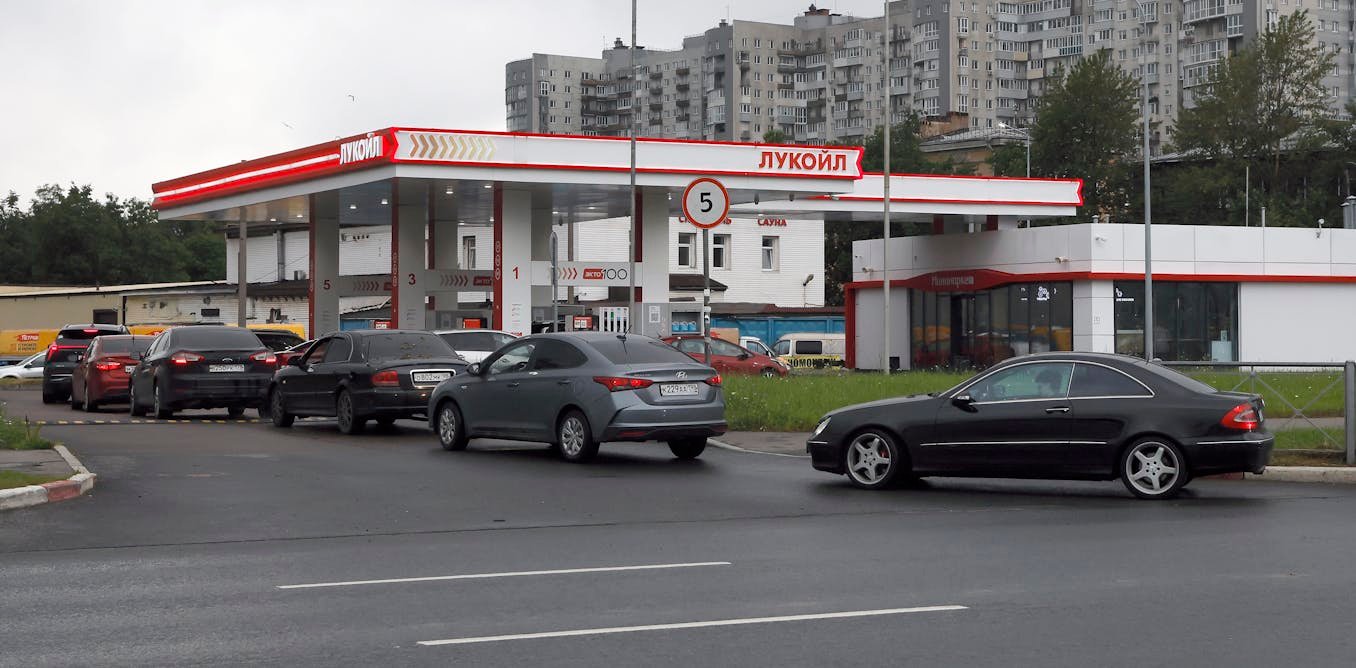
Images of queues at Russian petrol stations tempt the conclusion of a major economic crisis similar to that which brought down the Soviet Union. But, having witnessed both, I can say this is not the case.
The contemporary Russian economy is still functional. After four years of war and economic sanctions, daily life in most of Russia has hardly changed. The fuel shortages that began in June 2026 were probably the first real crisis to affect the majority of the population since the war started.
Russia’s authorities also have some room for manoeuvre. They can lower interest rates, which had already come down from 21% in 2024 to 14.25% by June. They can also devalue the rouble to boost income from energy exports. Russia’s economy has already received a temporary reprieve in the form of higher oil revenues from the Iran war.
There is economic strain, but not at a level that would cause the Kremlin to accept a complete change of course.
At the same time, the overall balance of power in a war of attrition is also determined by the relative weakness of the other side. And while Ukraine is enjoying a good turn in the war, its economy is only functioning due to western financial support.
Its biggest donor, the US, stopped funding after Donald Trump came to power in 2025. The EU has had to pick up the tab, agreeing to provide €90 billion (£77 billion) of funding over the next two years. But Ukraine needs more.
Read more: State of emergency in Crimea as Ukraine focuses pressure on ‘jewel in Putin’s crown’
Currently, Russia and Ukraine are responding to each other’s actions with countermeasures. Russia has shown in early July the devastating force with which it can strike Ukraine, carrying out a wave of attacks on the capital, Kyiv. Ukraine’s military has, in response, struck oil refineries in Russia’s Yaroslavl and Leningrad regions.
Ukraine’s supply of US Patriot missile defence systems has dried up and replacements are in short supply due to the Iran war. Zelensky has asked the US for a licence to manufacture their own interceptor missiles for the Patriot system. But any such production, if it ever went ahead, would surely be targeted immediately by Russian strikes.
Years of Russian bombing have also severely weakened Ukraine’s energy infrastructure. And there is a real possibility that Russia could render Ukrainian cities such as Kyiv, Kharkiv and Dnipro uninhabitable this winter by knocking out electricity and heating, as almost happened in 2025.
Given all this, it is extremely unlikely that Putin will give in to pressure and withdraw from Ukraine. With both sides convinced they can win, there is little prospect of the war ending any time soon.