The plans for the 250th anniversary of the American revolution, which kicks off in earnest on July 4, have drawn media scrutiny in the US. One issue has been the subject of recurrent discussion: the role of President Donald Trump.
Behind this scrutiny is the claim that Trump is co-opting the anniversary for his own agenda. His administration’s alleged sidelining of the non-partisan “America250” commission, which was established by Congress in 2016, in favour of his rival “Freedom 250” organisation has drawn particular comment.
The 250th anniversary, it seems, has become a hotly contested battleground.
This is not entirely without precedent. As historian Michael Hattem explains in his 2024 book, The Memory of ‘76, Americans have long argued over the revolution’s lessons and legacy. This can be traced to the late 18th century, when US politics began to assume some of the adversarial qualities all too familiar today.
In the 1790s, the arguments were generally between Alexander Hamilton’s Federalists and Thomas Jefferson’s Democratic-Republicans. For Federalists, who were keen to rebuild the relationship with Britain, July 4 celebrations often emphasised order and strong government.
For the Democratic-Republicans, however, the anniversary offered an opportunity to criticise what they saw as Federalist fealty to Britain. The result was that July 4 commemorations often became highly partisan.
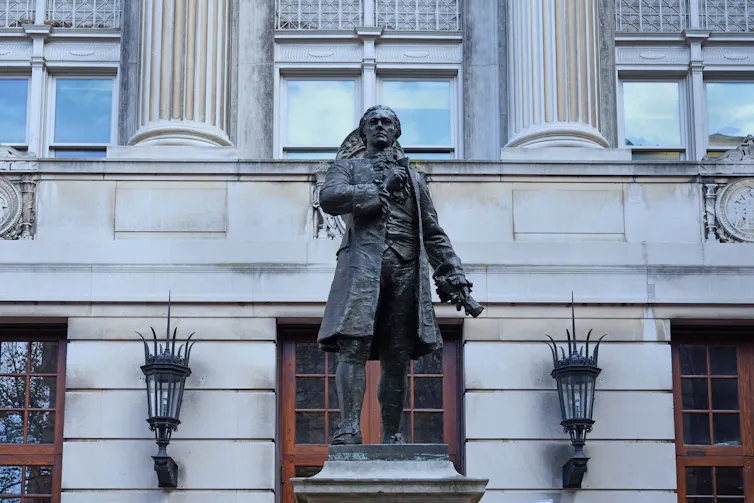
Competing claims on July 4 recurred in subsequent decades, especially during the 1850s when sectional tensions between the north and south worsened. At the centre of these tensions was slavery.
For African-American abolitionists, the ideals articulated by the Declaration of Independence provided weapons with which to attack the evil of slavery in the south. The most powerful example of this was an 1852 speech given by Frederick Douglass in which he pointedly asked: “what to the slave is the fourth of July?”
The outbreak of civil war in 1861 further intensified the sectional divide over July 4. Many white southerners even drew parallels between the south’s status in the union and that of the 13 American colonies in the British empire.
According to this view, just as American colonists had been oppressed by the “tyranny” of Britain’s King George III – who they held responsible for the imposition of taxes and restrictive legislation – so was the south similarly oppressed by the north’s refusal to countenance the expansion of slavery.
By tracing this connection, historian Paul Quigley notes that these southerners used July 4 to present “themselves as the real Americans and northerners as traitors”. This was the memory of 1776 used to justify secession. The view of the then-president, Abraham Lincoln, was of course the complete opposite. For him, it was the union which was the true heir to the ideals of July 4.
Yet more arguments over the revolutionary past followed during the centennial of 1876. The anniversary came amid an economic recession and towards the end of the period known as “Reconstruction”. This period had seen the federal government readmit southern states into the union while also attempting to secure the rights of the formerly enslaved.
For some white northerners, the centennial was seen as an opportunity to promote reconciliation with the south. One consequence of this was that African-American contributions to the revolution were marginalised, something black communities in turn actively contested.
Attempts by local elites to dominate July 4 commemorations in cities like Boston similarly provoked pushback from recent immigrants and minority groups determined to ensure their inclusion in the commemorations. As a result of these tussles, the centennial of 1876 was marked by what historian Jack Noe has called “the deep sectional, partisan and racial divisions of an unreconciled nation”.
The 1976 bicentennial
Similar to its predecessor, the 1976 commemorations followed an enormously divisive conflict: the Vietnam war. And, again like the 1870s, the anniversary also unfolded during an era of economic uncertainty. An oil crisis in 1973, caused by an embargo imposed by oil-producing countries in the Middle East, was quickly followed by a recession that lasted until 1975.
There were even accusations of corruption levelled at the Bicentennial Commission, which had been created to plan the 200th anniversary, and linked to the activities of the Nixon administration. The commission was dissolved in 1973 and replaced by a new organisation called the American Revolution Bicentennial Administration.
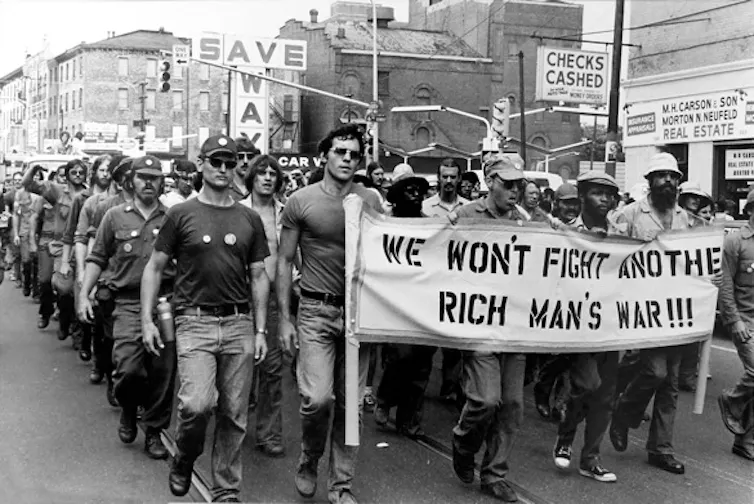
The bicentennial was thus another fraught anniversary. There were high-profile events in New York, Philadelphia and Washington, some of which were attended by Queen Elizabeth II at the invitation of the then-US president, Gerald Ford.
Following the social unrest of the Vietnam era, as well as the political turmoil of the Watergate Scandal which had led to the resignation of Richard Nixon as president in 1974, many Americans found escape in patriotic nostalgia. The anniversary even drew interest abroad. One small village in northern England, Warton in Lancashire, marked the occasion with a ten-day party due to its ancestral connections to George Washington.
Elsewhere though, the 200th anniversary again revealed domestic division. From the left came criticisms of excessive commercialisation, with historian Jesse Lemisch identifying a slew of what he called “bicentennial schlock”.
In some American towns and cities, meanwhile, commemorations likewise exposed discord. In Boston, for instance, the anniversary became tied up with local tensions linked to the desegregation of schools.
The revolutionary past has long been a contested battleground in the US, particularly during periods of partisan politics, social tumult and economic uncertainty. In this regard, the 250th anniversary has much in common with its predecessors.