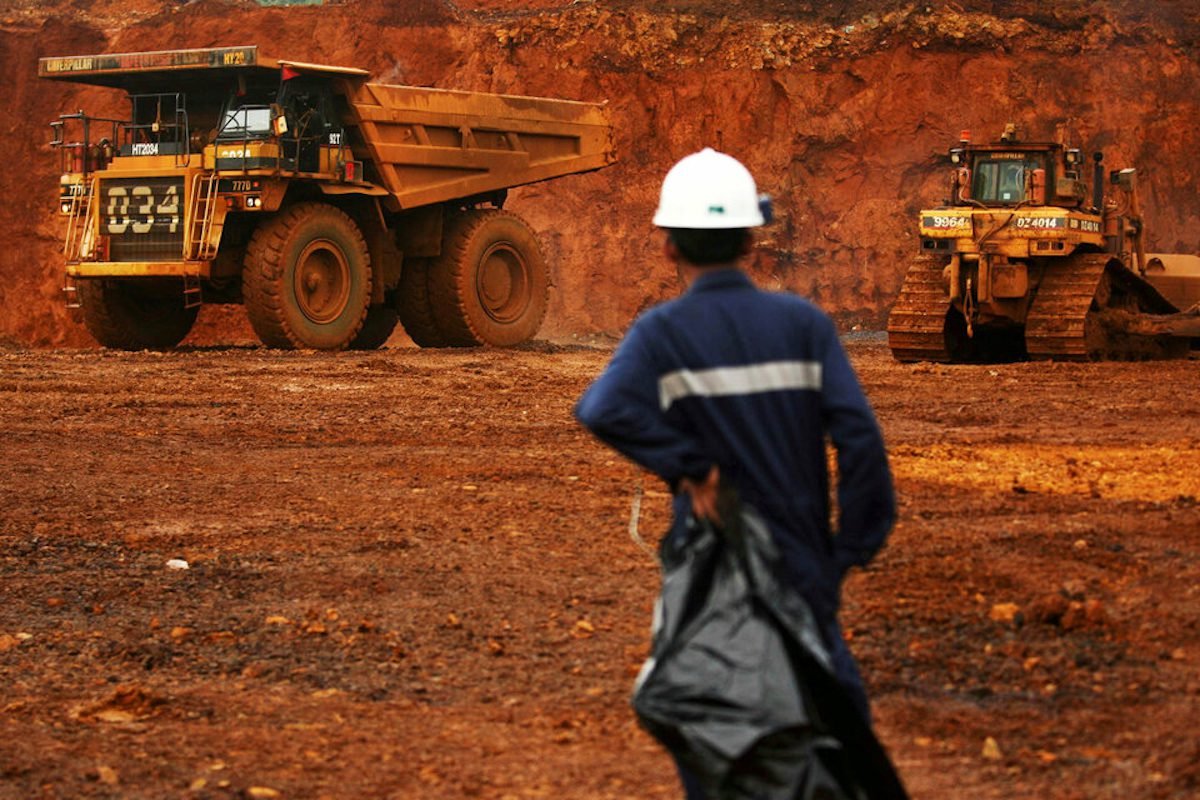

When PT Gunbuster Nickel Industry (GNI) began operating in North Morowali, it represented everything Indonesia wanted its nickel industry to become.
Built with US$2.7 billion in Chinese investment, inaugurated by then-President Joko Widodo in 2021 and designated a National Strategic Project, the smelter was supposed to prove that Indonesia could move beyond exporting raw ore and become a manufacturing powerhouse.
Its latest troubles tell a different story. The Jakarta Commercial Court recently placed GNI under temporary debt restructuring after petitions from two shipping companies over unpaid obligations.
The timing is telling. GNI is affiliated with Jiangsu Delong Nickel Industry, one of China’s largest stainless steel producers, which has itself been struggling financially. Whether GNI ultimately recovers is less important than what its predicament says about the direction of Indonesia’s broad nickel industry.
The temptation is to see this as another example of Chinese companies overextending themselves overseas. But GNI’s troubles are only the most visible sign of stress in a sector that has been under pressure for months.
Earlier this year, the Indonesian Nickel Miners Association (APNI) identified three smelters facing serious operational difficulties: PT Huadi Nickel Alloy Indonesia in South Sulawesi, PT Wanxiang Nickel Indonesia in Morowali and GNI itself.
According to APNI secretary-general Meidy Katrin Lengkey, Huadi had stopped operating altogether, Wanxiang was left with only two active production lines and GNI had shut down five of its 20 lines.
GNI disputed that assessment and insisted operations remained normal. Even so, when several major smelters run into trouble at roughly the same time, the issue is unlikely to be confined to one company’s balance sheet. The roots of today’s problems lie as much in Jakarta as they do in Beijing.
For several years, Indonesia encouraged an extraordinary expansion of smelting capacity. Chinese investors responded exactly as policymakers had hoped, pouring billions of dollars into new processing facilities across Sulawesi and Maluku.
Then concern shifted toward oversupply. Falling nickel prices prompted the government to cut mining production quotas for 2026, reducing ore availability just as more smelters were coming online.
The contradiction should have been obvious. Indonesia restricted the supply of raw materials while continuing to expand the industry’s capacity to consume them. That mismatch is now showing up in company balance sheets.
The government’s response should not be to approve another wave of smelters in the hope that scale alone will solve the problem. The country has reached the point where success should no longer be measured by how many furnaces have been built, but by how much value Indonesia captures from each tonne of nickel it processes.
That means putting new smelter licenses on hold until the existing industry is on firmer footing. The priority should be to make current investments viable rather than to add more capacity to an already crowded market.
Indonesia’s comparative advantage increasingly lies further downstream — in battery materials, battery manufacturing and energy storage — not simply in producing more nickel pig iron.
This is also an opportunity for Danantara, Indonesia’s newly created sovereign wealth fund. Rather than viewing distressed smelters solely as private-sector problems, Indonesia’s sovereign wealth fund could selectively invest in facilities that remain strategically important but are financially constrained.
That is not about rescuing individual companies. It is about preserving industrial assets that will matter if Indonesia is serious about becoming part of the global electric vehicle and battery supply chain.
The episode also raises difficult questions for China’s role in Indonesia’s industrialization. Chinese companies deserve credit for helping Indonesia build its downstream nickel industry.
Few, if any, other countries were prepared to invest at the scale or speed that China did. But long-term partnerships are tested when markets wobble, not when prices are booming.
Indonesia, therefore, has every reason to expect clarity from its Chinese investors. If ore becomes scarcer or profit margins narrow, will they continue to expand their presence in Indonesia, or will investment simply migrate to new opportunities in Africa and elsewhere?
Jakarta cannot prevent companies from making commercial decisions, but it can expect investors in strategic industries to demonstrate a commitment that extends beyond the most profitable years.
That expectation cuts both ways. Indonesia cannot ask investors to think in decades while making policy one year at a time. The abrupt shift from encouraging smelter construction to restricting ore supply has exposed weakness and unpredictability in the country’s industrial planning.
GNI’s debt restructuring should therefore be seen as more than the misfortune of a single company. It is an opportunity to rethink a nickel strategy that has delivered remarkable growth but is now running into its own contradictions.
Indonesia’s next challenge is not building more smelters. It is about ensuring that those already standing continue to produce value — for the economy, for the energy transition and for the Chinese partnerships on which the industry was built.
Bhima Yudhistira Adhinegara is the executive director of the Center of Economic and Law Studies (CELIOS). Muhammad Zulfikar Rakhmat is the director of the China-Indonesia and MENA-Indonesia desks at CELIOS.






 began operating in North Morowali, it represented everything Indonesia wanted its nickel industry to become. Built)