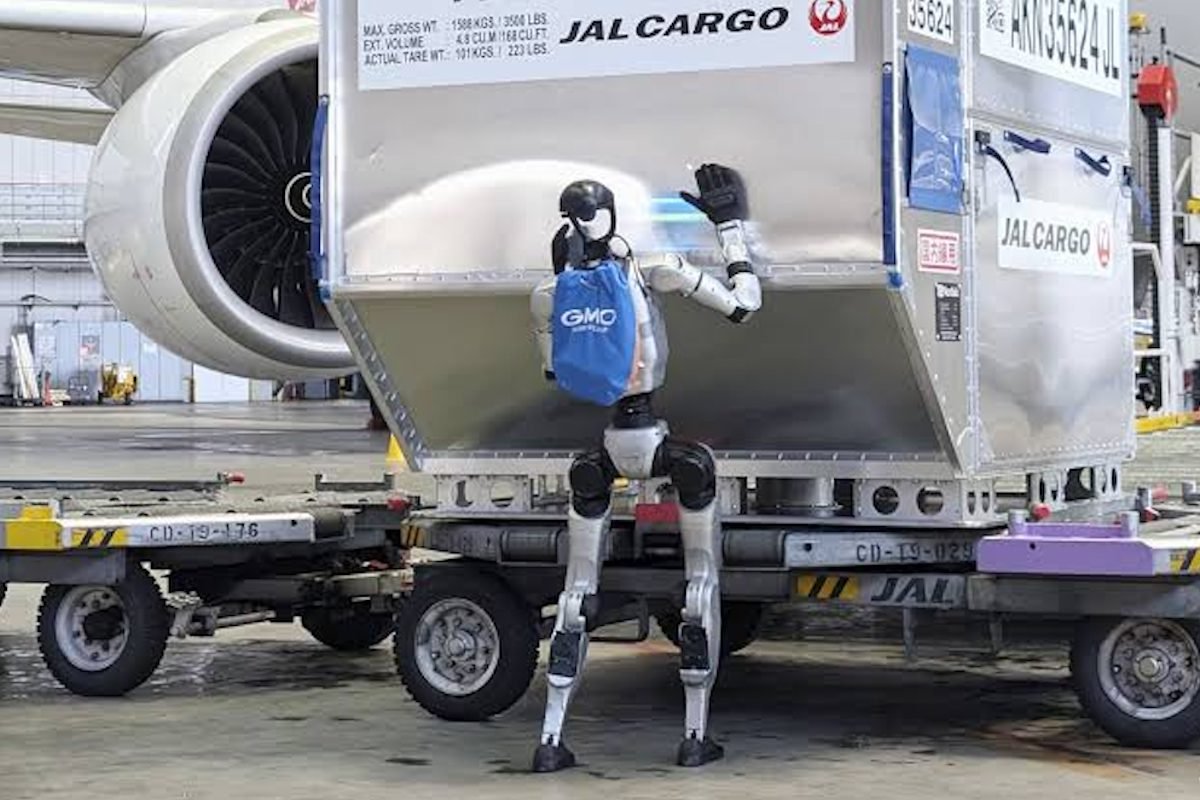
While the world focuses on the “tech cold war” and “de-risking” between the US and China, a quiet “tech truce” is unfolding at the baggage loading areas of Tokyo’s Haneda Airport.
As Japan faces a critical labor shortage and an aging workforce, it is turning to Chinese-made humanoid robots to handle baggage — a pragmatic move where biological limits override geopolitical friction on the airport floor. When an advanced humanoid can cost a mere US$4,900, “de-risking” becomes a geopolitical luxury that aging societies can no longer afford.
This commentary moves beyond the “Drunken Fist” spectacles of robot exhibitions to explore the brutal reality of Asia’s logistics landscape. I argue that the universal agony of the human spine has become the only true “neutral ground” left in an era of geopolitical friction.
In this context, technological pragmatism—where Chinese algorithms protect Japanese and Singaporean backs—offers a profound, human-centric perspective on the regional tech race. It is a story of how shared physical fragility is quietly overriding the rhetoric of “de-risking.”
In January, the Changi Terminal 5 exhibition offered a curated vision of the future: robots performing flawlessly in a climate-controlled gallery.
But by April 2026, a viral video of a ground handler struggling under an overwhelming workload and a relentless transit schedule, “violently” hurling suitcases, provided the uncurated reality of the conveyor belt, where famously conscientious but overburdened handlers struggle under the weight of global commerce.
This pressure is not unique to Singapore. Japan, which welcomed a record 42.7 million inbound tourists in 2025 and 7 million more in the first two months of 2026 alone, is facing a chronic labor shortage so severe that official estimates show it will need 6.5 million foreign workers by 2040 to sustain growth targets, even as the government faces mounting political pressure to rein in immigration.
The collision was sudden. On April 19, an android outran humans in a Beijing half-marathon; days later, a viral video captured the baggage toss in Singapore; and concurrently, Tokyo’s Haneda announced humanoid trials.
Together, these headlines crystallize a new reality for modern Asia: a region that loves the idea of a Smart Nation, but still feeds the fragile human spine into the gears of global logistics. Humanity’s physical limits have outpaced its geopolitical patience.
For the past year, the rise of Chinese humanoid robots was treated as a circus act. Observers marveled at Hangzhou-based Unitree perfecting the “Drunken Fist” – a metaphor I borrow from Hong Kong kung fu films to describe its dynamic, stumbling balance.
But in April 2026, as humanoids conquered a half-marathon in Beijing, the narrative shifted from spectacle to endurance. These stumbles were not entertainment; they were the rigorous calibration of a mechanical doppelgänger.
This is not merely a story of technological prowess, but of demographic desperation. As Japan’s working-age population continues its precipitous decline, the “humanoid” is no longer a luxury of sci-fi; it is a mechanical necessity for a nation that cannot afford to break more human backs.
The true irony of 2026 is unfolding beside the conveyor belts of Haneda Airport. In a nation historically wary of its neighbors—and aggressively pursuing “economic security” to de-risk from China — this logistical infiltration is profound.
Japan is not pursuing diplomacy; it is choosing a robot’s motor over a worker’s slipped disc. The 130cm-tall Unitree models demonstrated pushing cargo this April are scheduled for full trials in May.
At the pragmatic level of the luggage loader, the “China threat” yields to the more immediate threat of a broken supply chain. This shift comes down to simple economics. Thanks to its massive smartphone and EV industries, China has built a hardware supply chain that no one else can match. It successfully brought humanoid robots out of expensive labs and turned them into affordable commercial tools.
With prices starting at roughly $4,900 a unit—making it the most affordable humanoid on the market according to Forbes — the math is simple: it costs a mere fraction of a single foreign worker’s annual wage in Japan. Geopolitical worries naturally take a back seat. Buying Chinese tech is no longer a political debate — it is just basic business survival.
In Hong Kong’s air cargo hubs, logistics have long relied on rigid Automated Guided Vehicles (AGVs) constrained to fixed, predictable paths. But humanoids are built for a different kind of challenge: the messy, uncurated chaos of human space.
The advanced motor torque and sensory perception honed in Unitree’s “Drunken Fist” balancing framework are exactly what allow these robots to navigate the chaotic, rain-slicked reality of a cargo loader.
In a recent media demo, one such unit was filmed tentatively pushing cargo before waving to an unseen colleague—a gesture of synthetic politeness that belies the brutal, unglamorous labor it is built to replace.
This image represents technological pragmatism operating beneath the radar of geopolitics— a quiet form of mercy that requires no diplomatic communiqués. In an era of “de-risking,” the only place where a “seamless” global flow has been achieved is in the baggage bays, where Chinese algorithms protect Japanese and (potentially) Singaporean backs.
The visual shock of the Changi baggage toss should end the fascination with the “exhibition” of tech. We don’t need robots that can perform kung fu for applause; we need robots that can perform the “Drunken Fist” well enough to navigate a real-world cargo hold.
From the AGV trials in the Greater Bay Area to the humanoid pilots at Haneda, a new, cold reality is setting in: our biological limits are now the only true “neutral ground” left in the world. If trade cannot be agreed upon, at least there is agreement on the universal agony of the lower back.
This is not just about logistics; it is a preview of a new Asian order where shared survival instincts quietly override ideological barriers. The robot’s true coronation will not be on a stage in Beijing or an exhibition in Singapore.
It will be the day it renders the viral “baggage toss” video a relic of a more primitive, more cruel era. Until then, Smart Nation visions remain nothing more than expensive wallpaper for a crumbling reality. The achievement of a “spine truce” over the conveyor belt suggests that in an era of aging societies, geopolitics is finally hitting a biological wall.
With the robots already slated to expand from baggage handling to aircraft cabin cleaning, it is only a matter of time before this pragmatic logic seeps into other sectors grappling with identical demographic pressures, from elderly care to agriculture—raising the quiet question of how many more “truces” biological necessity will force upon a region fixated on ideological divides.
Hu Chao is a Singaporean art historian and curator based at the Guangzhou Academy of Fine Arts, China. His research focuses on the intersection of material culture, technology, and geopolitics in Asia.