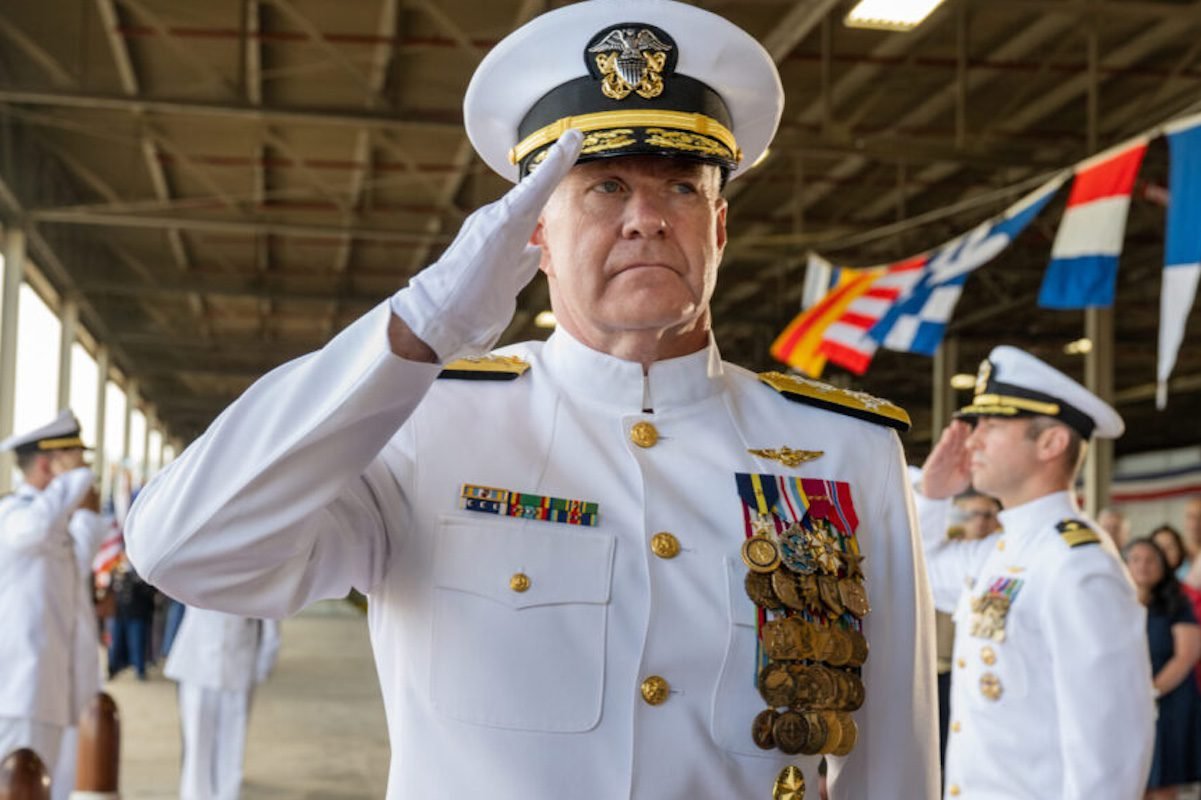
On June 16, the US Department of Defense announced that the US Indo-Pacific Command (INDOPACOM) will officially revert to its previous name, the US Pacific Command (PACOM).
The move reverses a decision made during President Donald Trump’s first term to include “Indo” in the name of its largest combatant command.
This publication reported in June 2018 that the original change “highlights the increasing significance of India in Washington’s strategic thinking and also marks India’s re-entry into the American government’s ‘Asia Nexus.’”
As much as New Delhi may protest, this change signals the opposite: the decreasing significance of India in Washington’s strategic thinking – and its exit from the American government’s “Asia Nexus.”
There were already hints of this in US Defense Secretary Pete Hegseth’s speech at the Shangri-La Dialogue in late May. “India was mentioned last,” an Asian diplomat in attendance recalled.
Hegseth praised the efforts of South Korea, the Philippines, Japan, Australia, Singapore, Indonesia, Malaysia, Thailand and Vietnam before finally turning to India.
A strong India, “acting in its own self-interest,” advances a shared goal of maintaining a regional balance of power, he said – hardly a description of a core ally in a coordinated strategy.
This name change, however, does not represent a toning down of competition with Beijing. On the contrary, it clarifies where competition with China will actually be fought — and where it will not.
The decision moves the strategy in the right direction. There are three key takeaways.
First, the fact that the Pentagon made this significant move absent any immediate trigger suggests it is sending a deliberate message: the Indian Ocean is not central to dealing with China.
That message is aimed at both allies and Beijing itself. To its allies, it signals that in a potential conflict with China, the United States will concentrate on the Taiwan Strait, operating primarily from Japan and the Philippines.
In all other regions, allies and partners will be expected to take primary responsibility for conventional defense. South Korea will deter North Korea, Europe will confront Russia and the Indian Ocean will largely fall to India to monitor and control.
Symbolically, Hegseth made no mention of “Indo-Pacific” in his Shangri-La speech, nor did he reference Japanese Prime Minister Sanae Takaichi’s efforts to “update” the Free and Open Indo-Pacific concept championed by her mentor, the late Shinzo Abe. Japan’s region-wide strategic framing may soon require a rethink.
To China, the message is equally clear: the US is laser-focused on the Taiwan Strait.
Second, the shift signals that India is being written out of the core contingency that matters most: Taiwan.
Washington believes Chinese President Xi Jinping has instructed the People’s Liberation Army to be ready to take Taiwan by force, if necessary, by 2027. The Trump administration has little patience for fence-sitters.
It is prioritizing allies such as South Korea and the Philippines – who act like they “live on the front lines,” as Hegseth said. India is not aligned, and Washington is no longer hoping that one day it will be.
Third – and most intriguingly – by treating India as a normal partner rather than a strategic centerpiece, Washington gains greater flexibility in dealing with Pakistan, India’s archrival.
Trump has turned to Pakistan’s Field Marshal Asim Munir as a key backchannel to Tehran, relied on him in defusing the 2025 India-Pakistan crisis and invited him to discussions on expanding the Abraham Accords.
Pakistan matters not because of India, but because of China’s westward pivot.
Over the past 15 years, China has steadily reduced its reliance on maritime energy routes through Indian Ocean chokepoints, such as the Malacca and Hormuz straits, shifting instead toward overland pipelines across Central Asia.
In responding to this Chinese pivot to Eurasia, Pakistan – not India – emerges as the more relevant partner.
The return to PACOM reflects these strategic realities. It is a recognition that clarity, not geographic sprawl or vague values-based alignments, will define how the US competes with China. And it is the right move.
Ken Moriyasu, a former correspondent for the Japanese newspaper Nikkei, is a senior fellow at the Hudson Institute.





 will officially revert to its previous name, the US)