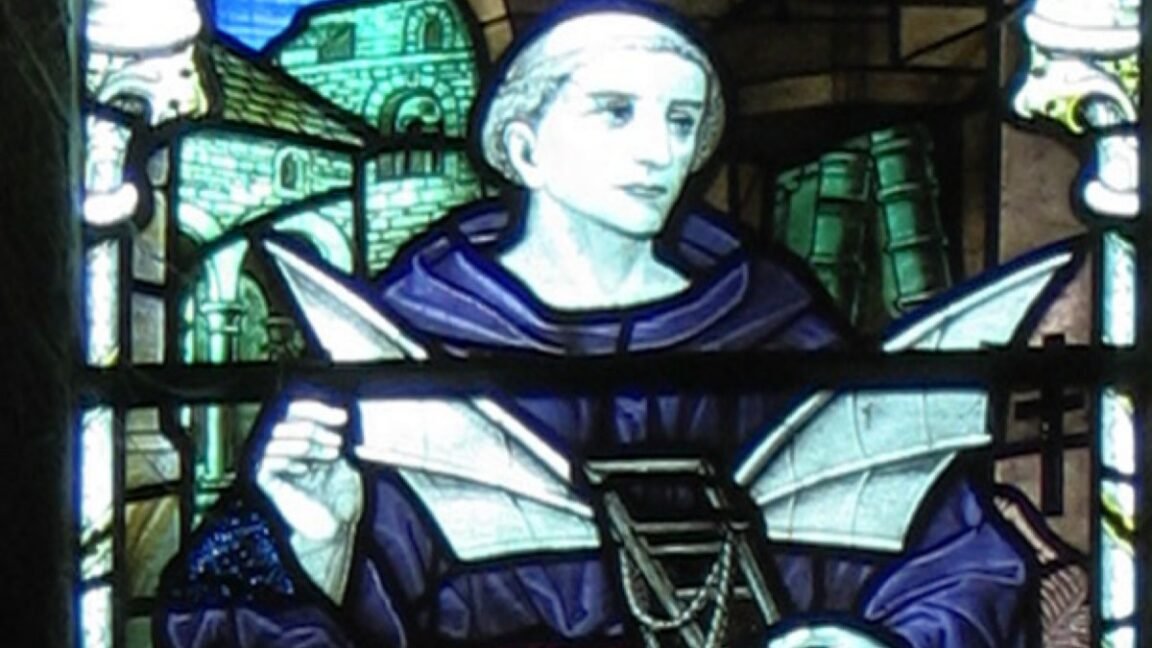
Early in the 11th century, a young Benedictine monk named Eilmer jumped from the 150-foot tower of his abbey in the small English town of Malmesbury, wearing a pair of crude wings he’d fashioned from willow wood and cloth. Eilmer managed to glide a good 600 feet, passing over the city wall before crash-landing in a small valley near the river Avon. The fall broke both his legs, crippling him. Malmesbury Abbey still boasts a stained-glass window in honor of Brother Eilmer.
This legendary experiment in medieval aviation comes to us via 12th-century historian William of Malmesbury in an account written circa 1125, although William neglected to provide future historians with an exact date for the feat. But William does mention another key episode in Eilmer’s life when the monk was “advanced in years”: Eilmer witnessed Halley’s comet in 1066, commenting, “It is long since I saw you.” Some historians have interpreted this to mean that Eilmer saw Halley’s comet on an earlier fly-by in 989, when he would have been a young boy.
Assuming Eilmer was at least five years would in 989, he would have been born no later than 984. This would make Eilmer in his 80s in 1066, with his attempt at flight—which occurred when he was “in his first youth”—likely falling between 1000 and 1010. However, it’s an estimate that is based on a lot of assumption, according to James Aitcheson of the University of Leicester, who argues in a paper published in the journal Notes and Queries that Eilmer may have seen a different comet altogether in his youth—the comet of 1018. If so, he would have been born much later and the date of his flight would have occurred between the 1020s and 1040s.
The comet of 1018 would have been visible in the British isles for about two weeks in the fall, per Aitcheson, and Eilmer may have merely assumed that it was the same as his 1066 observation of Halley’s comet, which left him “crouching in terror at the gleaming star.” Aitcheson suggests Eilmer could have been born in the early 1010s, making him over 50 in 1066, technically still consistent with William of Malmesbury’s description of Eilmer as being advanced in years.
This would also challenge recent speculation that Eilmer understood the periodicity of Halley’s comet centuries before the late 17th century astronomer Edmund Halley. So should it really be Eilmer’s Comet? Aitcheson thinks not. He acknowledges that Eilmer could have had access to historical records of comet sightings in Britain and Europe, and thus could have spotted the pattern of its cycle among all the other records of comet appearances.
But the only record we have of Eilmer is through William of Malmesbury, who doesn’t say anything about whether Eilmer was an amateur astronomer. “Indeed, it is not clear that sky-watchers in the Early Middle Ages were able to tell one comet apart from another,” Aitcheseon writes in his paper. A later date for Eilmer’s birth also makes it just possible that the monk lived long enough (to age 90) to meet William in person and “directly passed on the story of his pioneering feats of aviation.”
DOI: Notes and Queries, 2026. 10.1093/notesj/gjag066 (About DOIs).