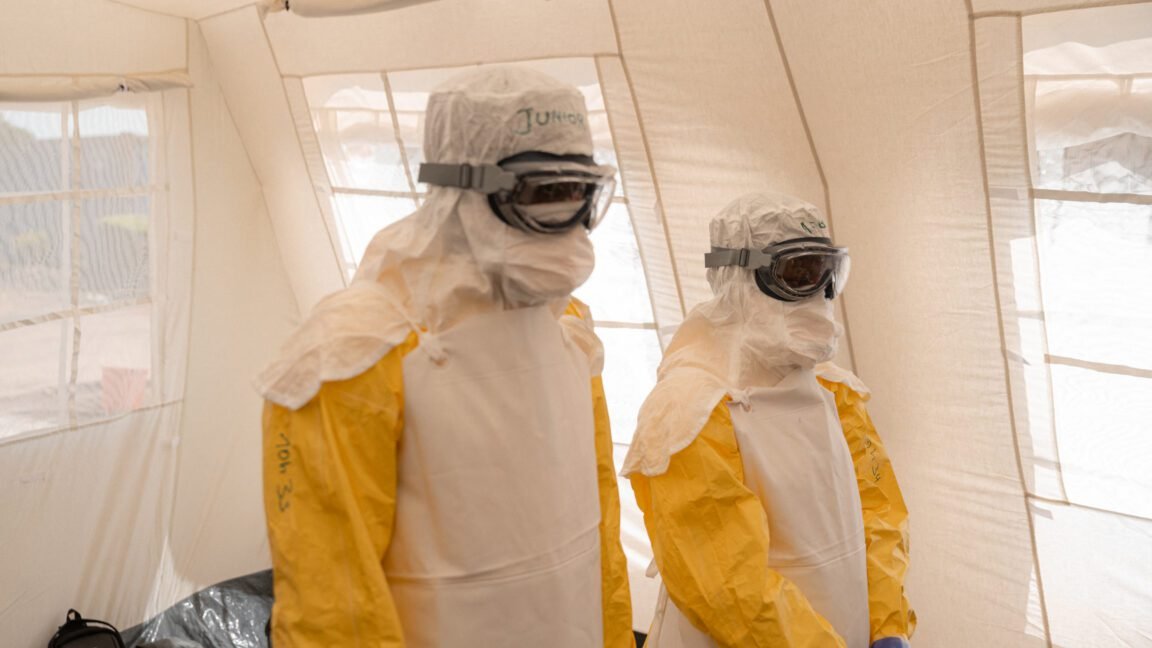
Nearly a month into the Ebola outbreak in the Democratic Republic of the Congo, cases continue to rise as officials are still trailing the virus in their response efforts.
As of Thursday, June 11, the DRC has reported 676 confirmed cases, 136 deaths, and 119 suspected cases. Uganda is reporting 19 confirmed cases and two deaths.
The outbreak, caused by the Bundibugyo strain of Ebolavirus, is already the third largest Ebola outbreak on record. But health experts fear that it could grow much larger and had been quietly spreading for months before the outbreak was declared on May 15.
Reuters reported Thursday that investigators with the DRC health ministry are working backward to find the first case—patient zero—and have identified what may have been an early superspreader event on February 4. They zeroed in on the funeral of a 44-year-old pastor in the remote gold-mining town of Mongbwalu.
The pastor was said to have died of a severe abdominal infection, which could have been a manifestation of Ebola. But he was never tested for the virus. More than 80 people attended his funeral, and many relatives and community members fell ill in the following days. Within two weeks of burial, nearly 50 deaths were recorded in the town, and many of those had reported symptoms that could have been from Ebola, including fever, vomiting, and bleeding.
As the scope of the outbreak is still coming into view, the US Centers for Disease Control and Prevention released modeling of how it could unfold. The key finding was that if public health interventions aren’t implemented swiftly and strongly—with contract tracing and case isolation—then the outbreak could rival or exceed the largest Ebola outbreak ever recorded. That’s the 2014–2016 West Africa Ebola outbreak, which totaled over 28,000 cases and 11,000 deaths.
In one of the CDC modeling’s worst-case scenarios, in which only 20 percent of Ebola cases are isolated, most simulations projected more than 20,000 cases and more than 4,000 deaths within just three months.
“Utterly disgusted”
With the US withdrawal from the World Health Organization and the US Agency for International Development (USAID) dismantled, American contributions to the response effort have been weaker and slower than in past outbreaks, diminishing the overall response.
Meanwhile, the Trump administration’s isolationist strategy involving travel restrictions and border closures has raised tensions in other countries. The administration is planning on preventing even US citizens from returning to the states if they have been exposed or infected with the virus. Instead, the US is trying to stand up a makeshift quarantine facility at a military base in Kenya, a country currently unaffected by the outbreak.
The plans have sparked outrage and violent protests among Kenyans. According to reporting by The New York Times, protesters accuse Kenyan officials of bowing to Trump at the expense of allowing a deadly virus into the country, accepting Americans that America itself refuses to take in.
“We are utterly disgusted by the government’s apparent willingness to trade national biosecurity and the lives of its citizens for foreign aid,” the Kenya Medical Practitioners Pharmacists and Dentists Union said in a statement.
The Times reports that hundreds of people have gathered for protests in Nanyuki, the town closest to the air base. At least three protesters have been shot and killed in conflicts with police, according to the Kenya Human Rights Commission.
Although a Kenyan court had temporarily suspended the quarantine facility from opening, the Trump administration continues to move forward with the plans.