Humanity has littered the sky with the refuse of fossil fuel use, releasing enough CO2 to change the planet’s climate. We are also chucking incredible sums of carbon in the form of plastics into landfills and into the environment around (and inside of) us. What if cleaning up one of these problems could also help clean up the other?
A new study led by Ruth Ebenbauer at Aarhus University experiments with this idea by upcycling discarded polystyrene into (part of) a material commonly used in carbon-capture systems.
Adding amines
This material is based on amines—a simple chemical group that conveniently acts like a sponge for CO2. An amine will grab CO2 molecules when exposed to them, but let go of the CO2 when heated or depressurized, leaving it ready to go again. The first “CO2 scrubbers” tried in smokestacks used amines dissolved in water to do this, but solid amines are used in all kinds of carbon-capture systems now because they require less energy. These solid materials—often made into granules similar to the activated carbon in a water filter—have high surface area and high porosity, so the amines can efficiently partner up with CO2 molecules.
Currently, these materials are all derived from fossil fuels. There are two components: the amine groups themselves, and something else that provides a structure for them to sit within. The research team’s idea was that polystyrene could be a great fit for that structural component. Polystyrene has been used for Styrofoam and for solid items like eating utensils or the clear portion of a CD case. Less than 1 percent of it is recycled in the US, while Europe manages a slightly less awful 10 percent.
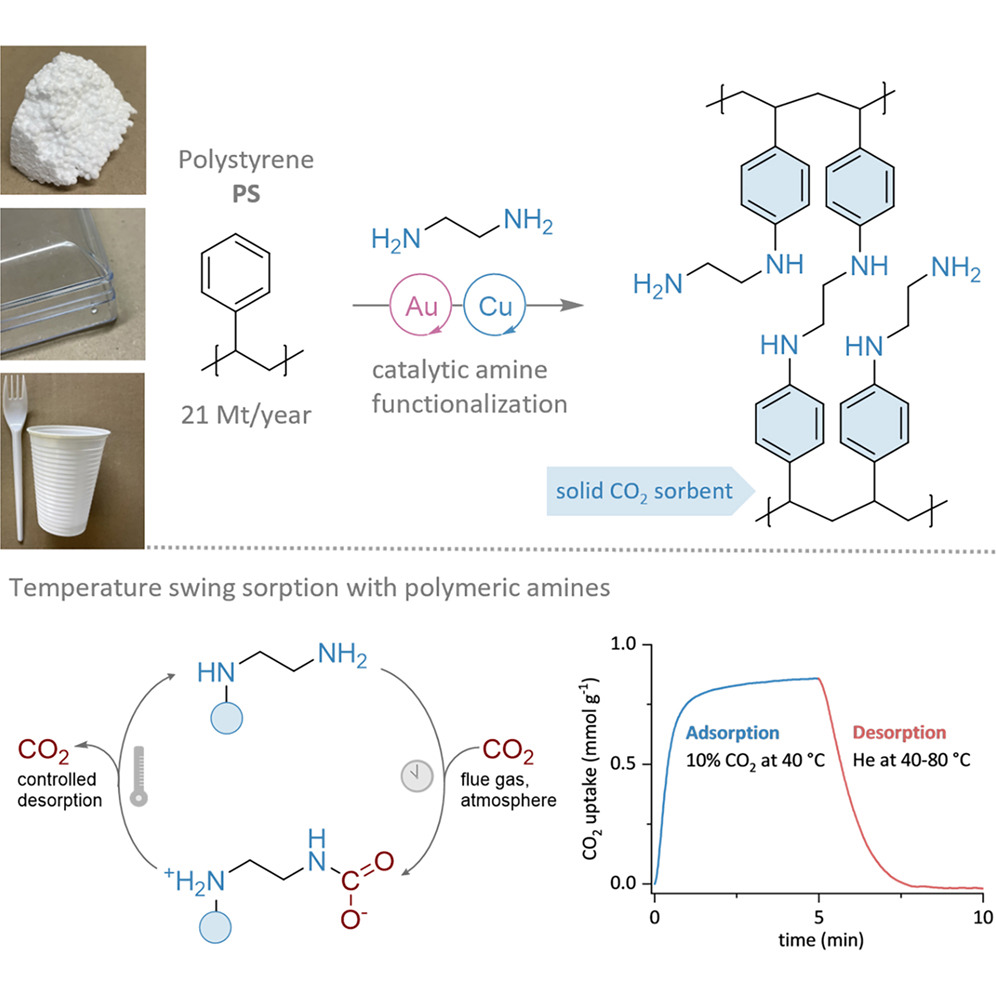
The upcycling process has two chemical steps. The first attaches bromine atoms to aromatic rings in the polystyrene, using gold as a catalyst. The second step introduces a two-carbon form of amine (a common ingredient in a wide array of products) and a copper catalyst, which swaps amine groups in where the bromine atoms were.
Some of the amine groups hang out solo, while others link with each other to help create the porosity within the solid.
The researchers tested this process with a few plastic objects, including Styrofoam, food packaging, a fork, a CD case, and a Lego base plate (which has another chemical component). They found that the material they produced performed well in the carbon-capture cycle, both at the extremely high CO2 concentration of a smokestack and the lower concentration of ambient air.
Fine tuning
The researchers also found that they could control the material’s properties along the way. They could tune the amine content up or down, as well as adjusting the proportion that made porosity-building linkages instead of CO2-grabbers.
Since the amine-containing starting material they used was ultimately fossil-fuel derived, they also tested turning a couple other kinds of synthetic materials into amines instead. Past research has shown a few pathways to do this, but those give you slightly more complicated forms of amines that may not be as reactive.
In this case, they used these amines in an upcycling reaction on urethane foam mattress material and decorative building trim. This worked, producing carbon-capture material made completely from waste, but the chunkier amine groups made from waste didn’t perform as well. Its capacity for CO2 was lower, and it failed to sponge up CO2 from ambient air.
But the polystyrene still held up its end of the bargain, and there’s a flexible blueprint here. With the right source and process for amines, carbon-capture material could be entirely produced from the flood of plastics going into landfills. And even if it’s only half produced from plastics, that would still be improvement. This could both provide a market to redirect some of the plastic waste and technically reduce the carbon footprint of carbon capture (although the vast majority of its footprint is the energy required to run the process.)
Carbon capture isn’t a license to keep using fossil fuels. It’s an additional action we can take to rein in atmospheric CO2 more quickly. And the more sustainably you can run that process, the better it is.
Chem Circularity, 2026. DOI: 10.1016/j.checir.2026.100027 (About DOIs).