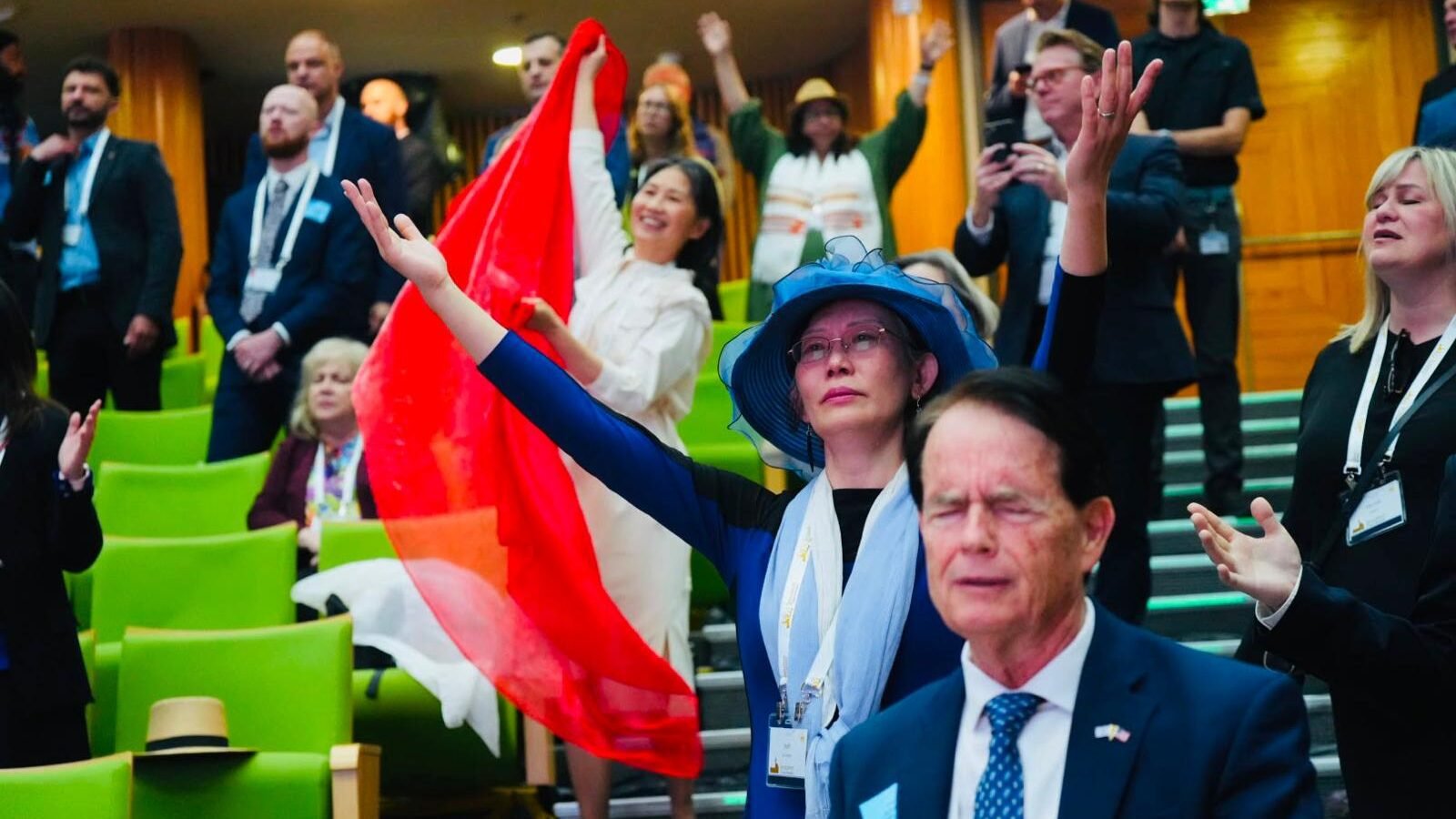
Foreign delegations reached Jerusalem despite limited flights, giving this year’s prayer gathering a sharper message of faith, politics and support for Israel
Two weeks before Christian leaders and foreign politicians filled a Knesset auditorium for the Jerusalem Prayer Breakfast, Israeli lawmaker Ohad Tal thought the event might have to wait.
He had just come out of a Foreign Affairs and Defense Committee meeting, where lawmakers had heard updated intelligence briefings. Flights into Israel were scarce, the region was still tense, and the annual gathering, which draws pro-Israel Christian delegations from around the world, looked vulnerable to the same uncertainty shaping much of Israeli public life.
When Albert Veksler, one of the organizers, later came to speak with him, Tal suggested postponing the event. Tal recalled telling him, “Listen, Albert, I’m telling you, I don’t know. Maybe let’s delay it a month or something.” Veksler, he said, was unmoved. “Ohad, it’s going to happen,” Tal recalled him saying. “You’ll see. And thank God you’re all here.”

Albert Veksler, global director of the Jerusalem Prayer Breakfast, addresses participants in the event at the Knesset, May 27, 2026. (Courtesy Jerusalem Prayer Breakfast)
By the time Tal spoke, the room was full. Christian leaders, foreign politicians, and pro-Israel activists had made it to Jerusalem despite limited flights and a travel environment several speakers described as unusually difficult. That fact shaped the mood of the 10th Jerusalem Prayer Breakfast as much as the speeches themselves.
The Jerusalem Prayer Breakfast is an annual gathering of Christian supporters of Israel, Israeli lawmakers, foreign politicians, faith leaders, and activists centered on prayer for Jerusalem and public support for Israel. This year, its usual mix of religion and politics carried sharper meaning: The guests had come during war, regional uncertainty, and growing concern among Israelis that their country was becoming more isolated abroad.
Tal, a Religious Zionism lawmaker closely involved in the gathering, thanked participants for coming “from the four corners of the earth to pray for the peace of Jerusalem,” but his remarks quickly moved from welcome to warning. The conflict Israel has faced since October 7, 2023, he said, is “a war for Jerusalem” because its enemies launched it under the name Al-Aqsa Flood.

Knesset member Ohad Tal addresses participants at the Jerusalem Prayer Breakfast in the Knesset, May 27, 2026. (Courtesy Jerusalem Prayer Breakfast)
“Their Jerusalem is one in which Jews and Christians are not welcome, where we cannot gather to pray,” Tal said. “Their Jerusalem is Jerusalem of death and bloodshed, and our Jerusalem is Jerusalem of life and peace.”
Iran and regional diplomacy ran through the morning. Tal praised recent Israeli and American operations against the Iranian regime, saying they showed “courage, precision, intelligence, but above all, faith.” He called the Iranian regime “perhaps the greatest force of evil in our time” and rejected conditioning normalization between Israel and Saudi Arabia on the establishment of a Palestinian state, arguing that such a state would bring “further violence and bloodshed.”
“As long as the Iranian regime survives, any deal is temporary,” Tal said. “Any ceasefire just delays the resumption of war. Israel will not surrender to terror and we will not surrender to evil.”
The uncertainty surrounding the event was not only logistical. Welcoming the delegations to the Knesset, opposition parliamentarian Tatiana Mazarsky of Yesh Atid said Israel had been living “under continuous attacks” for a long time. She cited threats from Hezbollah in Lebanon, Hamas in Gaza, radical groups in Judea and Samaria, Yemen, and Iran, as well as “modern ballistic missiles” and what she called “an unresolved nuclear danger.”
According to Mazarsky, the battlefield was not limited to borders or missiles. Israel also faced “another front,” she said, “the international media, which spreads distorted information and portrays Israel as an aggressor.” Israeli children, she said, continue to hide under tables, lie on the floor, and cover their heads because explosive drones penetrate Israeli territory “every single day, several times a day.”
Speaking later with The Media Line, Mazarsky said events such as the Jerusalem Prayer Breakfast give Israel something it badly needs at a time of isolation. “It is strength, it is faith, and so much love,” she said. “When the whole world stands against us, here come people who continue to be our pioneers and tell the true Israeli story. I am simply grateful for their support, for the prayers.”
A similar sense of improbability ran through the Knesset gathering. Former Knesset member Yehuda Glick looked out at the foreign guests and said he could hardly believe the room was full. “I don’t know if you guys know, but there are no airlines barely coming into this country,” he said, praising those who had changed routes, taken complicated connections, or arrived despite the uncertainty. Without their determination to come to Israel and pray in Jerusalem, he said, the event “wouldn’t happen.”
Robert Ilatov, a former Knesset member and one of the figures associated with the Jerusalem Prayer Breakfast from its early years, said organizers had feared that security conditions would cancel flights and had also wondered whether the Knesset itself would remain in session. “The miracle that we are here, because it was many difficulties,” Ilatov said. “It’s very complicated to come to Israel today with flights, especially from United States and Canada and Australia and Asia.”
Inside a parliament often marked by sharp political confrontation, the event also produced moments of unusual Israeli unity. Knesset member Michael Biton of National Unity stood alongside Tal to sing and pray for Jerusalem. Biton said the Jerusalem Prayer Breakfast was “building the walls of Jerusalem all over the world,” explaining that Zion referred not only to a city but also to a nation and a state.
That image of coalition and opposition figures sharing a stage in prayer returned later in the remarks of Orit Farkash Hacohen, a former Blue and White lawmaker who recently resigned from the Knesset to join Gadi Eisenkot’s new Yashar party. She said she is “a very vocal critic of this government,” but that domestic political arguments lose their meaning when it comes to defending Israel and the Jewish people. Recalling her participation in a previous Jerusalem Prayer Breakfast event at Mar-a-Lago, she said the atmosphere of prayer and support had allowed her and Tal, from opposite sides of Israeli politics, to put aside their disagreements. “We felt as one,” she said.
The reason, she suggested, was not abstract. Farkash Hacohen spoke about her daughter Tamara, whose life changed after two childhood friends were killed on October 7, 2023. One was Aner Shapira, who threw grenades back at terrorists at the Nova festival until he was killed. Another was Hersh Goldberg-Polin, who was kidnapped to Gaza after losing his arm and later murdered in captivity. The trauma, she said, led her daughter and many other young Israelis to suspend ordinary plans and return to military service.
“When you go back to your communities, and I know that it is not very popular today, keep up the voice of protecting the State of Israel no matter what,” Farkash Hacohen told the audience. “Because you know the truth, and you know what we represent, and we will prevail.”
Foreign support also carried emotional weight in the remarks of Knesset member Simon Davidson of Yesh Atid. He recalled a previous Jerusalem Prayer Breakfast event in Stockholm, where he said he felt surrounded by people who loved Israel, “maybe more than Israelis love Israel.” That support, he said, had become essential at a time when many Israelis feel hatred from abroad.
Davidson described a recent vacation in Cyprus with his wife. In a taxi, he said, the couple began speaking English so they would not be recognized as Israelis. More than 80 years after the Holocaust, he said, Jews were again removing kippahs, hiding mezuzahs, and feeling afraid to speak Hebrew in public. “It’s crazy,” he said. “So I just want to finish my words by saying thank you.”
If Israeli lawmakers spoke of isolation and gratitude, former US Rep. Michele Bachmann gave the gathering its most explicit religious frame. “This isn’t just another conference,” she told participants. “This isn’t just another year. This is a pivotal moment in world history, in God’s history, in biblical timing.”
In an interview with The Media Line, Bachmann insisted that the Jerusalem Prayer Breakfast was not meant to be political in the usual sense, even though it deals directly with political realities. “We’re not here to be political. We’re here to be biblical,” she said. “There’s a big difference. So we pray about political things that are happening, but we’re praying with a biblical purpose in mind.”

Former US Rep. Michele Bachmann addresses Jerusalem Prayer Breakfast participants at the Friends of Zion Museum, May 2026. (Courtesy Jerusalem Prayer Breakfast)
Representatives from 38 countries had come to Jerusalem, Bachmann said, many of them praying not only for Israel but also for their own nations. She also described the confrontation with Iran as a defining moment. “The whole world is on a knife’s edge,” she said. “The question is, what’s going to happen with Iran? The world is going to go one way or another.”
Support for the United States, and particularly for President Donald Trump, was not limited to Bachmann. Speaking on behalf of the Israeli government, Minister Amichai Chikli thanked “the American nation and the American president” for what he described as the courage “to do what’s needed” against Iran. He contrasted that approach with Europe, which he said had “forgot how to fight,” and warned that Jews in some European countries can no longer safely preserve their identity.
For Joshua Waller, president of The Israel Guys, the physical act of coming to Jerusalem is central to the event’s purpose. Speaking with The Media Line, he said the Jerusalem Prayer Breakfast brings Christians into Israel’s story through “sovereign Israel,” Jerusalem as Israel’s capital, and global Christian support beyond the United States.
“They misrepresent this place,” Waller said. “But just by coming, being a part, walking the streets, meeting the people, you can understand what’s actually happening here.” Participants, he said, can then return to their countries and challenge “the false media narrative” that demonizes Israel and the Jewish people.
Concern over information also appeared in an interview with Brad Young, a biblical scholar from Tulsa, Oklahoma. Young said misinformation is fueling hostility toward Israel and Jews, especially when people consume news only from sources that reinforce what they already believe. “It really troubles me that there’s so much misinformation,” he told The Media Line. “People are not going to reliable news outlets.”
Young said many people seek confirmation rather than facts. “This may explain why you have certain understandings,” he said, describing conversations with people about where they get their news. The result, he added, is that “anti-Jewish sentiment” is often based on “a lot of false information.”
Not all participants came only through the language of prayer or advocacy. Mike Speedy, secretary of business affairs for the state of Indiana, told The Media Line that he sees the Jerusalem Prayer Breakfast as a platform for educating policymakers and strengthening practical relationships between Israel and the United States.
“Israel needs as many friends as it can have all throughout the world,” Speedy said. “Why not use faith as that bridge?” Indiana, he said, already has an Israel-focused investment program, and he hopes to expand cooperation in areas such as drone technology and rare earth metals. “We know that that’s important for lots of different reasons, business and national defense,” he said.

Participants in the Jerusalem Prayer Breakfast gather at the Waldorf Astoria Jerusalem, May 2026. (Courtesy Jerusalem Prayer Breakfast)
The question of land and biblical legitimacy was voiced most directly by Yossi Dagan, head of the Shomron Regional Council. Speaking with The Media Line, Dagan said many people around the world are looking for “justice” and “truth,” and that the Jewish relationship to the land is both ancient and current.
“We cannot find another nation with so long and strong relationship between the people and the land,” Dagan said. “Since the days of the Bible, God promised to Abraham, our great-grandfather, that he will bring his sons and grandsons and great-grandsons to the land of Israel.” Building in Jerusalem, Judea and Samaria, and across Israel, he said, is “justice” because “this is our homeland.”
Several speakers and interviewees also presented Europe as a warning sign. Edda Fogarollo, an Italian lecturer in modern and contemporary history, told The Media Line that antisemitism in Italy had changed quickly after October 7. At first, she said, many people expressed sympathy for Israel. But after Israel began defending itself, public hostility grew, especially in universities, conferences, and civic spaces.
“If you would like to organize a conference dedicated to Israel or some topic about Israel, you can’t publish, because you can have problems,” Fogarollo said. “You must hide the flag of Israel. You must hide everything, every symbol of Israel. That is not freedom.”
The change, she said, could be felt in ordinary public life. Fogarollo recalled once wearing shirts saying “Help Israel” and “Stand with Israel” openly in the street. Today, she said, even the word Israel can provoke accusations. “Now you can’t use the word Israel because people are looking at you,” she said. “You are a criminal. It’s amazing. It’s terrible.” Italy, she said, had reached a point where “the false became true, the true became false.”
For Martin Helme, the leader of Estonia’s Conservative People’s Party and a member of the Estonian parliament, the change in Western opinion after October 7 was difficult to comprehend. In his Knesset remarks, he said he had come to Jerusalem because those who stand with Israel during hard times are its true friends. Speaking with The Media Line, he called it “mind-boggling” that after what he described as the most horrific mass killing of Jews in recent history, part of Western public opinion had come to blame Israel.
Helme attributed the shift to migration from Muslim-majority countries, media and academia, and what he described as selective censorship in Europe. “We have entirely, completely, irreparably corrupt media and academia,” he said. “They are peddling horrendous lies and constructing absurd narratives.”
His criticism also included a message to Israel. In Helme’s view, the Israeli establishment had long assumed that right-wing parties were more likely to be antisemitic, while left-wing parties were safer partners. “In fact, it’s the other way around,” he said. “The realization in the Israeli establishment that your true friends are actually on the right is only now starting to give results.”
The Jerusalem Prayer Breakfast’s political and religious character was also reflected in remarks by Mike Evans, founder of the Friends of Zion Museum, who described support for Israel as a struggle over language, perception, and influence. “He who defines the terms controls the debate,” Evans said, arguing that Israel had too often allowed its adversaries to shape the language through which the conflict is understood.

Dr. Mike Evans, founder of Jerusalem’s Friends of Zion Museum, presents the Hineni Award to Dr. Billye Brim, Jim (not pictured) and Rev. Rosemary Garlow, and Michele Bachmann (not pictured) during the 10th Jerusalem Prayer Breakfast, May 2026. (Courtesy Jerusalem Prayer Breakfast)
Evans described conversations with diplomats who, he said, receive official papers from Iran and the Palestinians but not enough official Israeli material to counter misinformation. Israel, he argued, spends too much time defending its brand after others have already poisoned it. “Perception is reality,” he said. “It’s not truth, it’s reality.”
The concern over narrative also entered the realm of journalism and technology. Felice Friedson, president and CEO of The Media Line, said artificial intelligence can help journalists work faster, organize information, and identify patterns across large amounts of material, but warned that media institutions, social platforms, and AI are also reshaping how the public absorbs conflict, often before facts are fully understood. She asked whether media today is “contributing to the problems that we see at large and abetting hate,” arguing that the public needs better tools to distinguish journalism from opinion, advocacy, sourcing failures, and algorithmic amplification.
Friedson described what she called the “AIEffect,” in which headlines, slogans, framing, and repetition can harden one version of events into the reality most people receive. “People need to consume facts and not narratives which are orchestrated,” she said. “Journalists must verify facts, be careful of headlines which merely aim for clickbait, ensure all narratives are present and ask tough questions.”
By the end of the gathering, the day’s central message was less about any single speech than about the decision to come. Foreign delegations had traveled despite flight disruptions and regional uncertainty. Israeli lawmakers from opposing parties had found, at least briefly, a setting in which shared support for Israel could stand above domestic political divisions. Christian leaders spoke of carrying the experience back into churches, parliaments, and public debates abroad.
Support for Israel, under those conditions, was not only something to declare from a distance. It was something to bring physically into the room.