When US Secretary of War Pete Hegseth took the podium at the recent Shangri-La Dialogue in Singapore, his words signaled a profound structural shift in the global security landscape. Declaring that the era of America subsidizing the defense of wealthy nations is officially over, Hegseth outlined a new doctrine of “pragmatic idealism” in which Washington demands partners, not protectorates.
For decades, the post-Cold War architecture operated on the central assumption that the American security umbrella was a permanent, ideological certainty. That assumption is now collapsing, replaced by a hyper-realistic, transactional blueprint that is forcing major Asian powers, especially Japan, to rapidly reassess their strategic foundations. For Tokyo, Hegseth’s declaration landed with particular force, signaling that the era of automatic strategic assurance has ended.
This shift carries particular weight for Tokyo. The dominant narrative surrounding this change often focuses on regional anxiety or the potential for heightened friction. It is no longer that simple. The Shangri-La Dialogue has evolved into a laboratory for a new form of geopolitical adaptation, in which medium and major powers are discovering that traditional alliances no longer guarantee automatic stability. National resilience must instead be engineered through self-reliance, enhanced capabilities, and carefully cultivated regional partnerships rather than distant guarantees.
What we are witnessing is not a retreat into isolationism, but the structural fragmentation of global security into localized, parallel arrangements that empower capable regional actors like Japan to play more proactive roles. For Japan, this is not merely a shift in diplomatic atmosphere – it is generational strategic realignment that will reshape its security posture for decades.
This matters profoundly because the Indo-Pacific remains the primary engine of global economic growth. More importantly, the unfolding dynamic exposes three structural transformations that will shape international politics over the next decade.
- First, middle and major powers are entering an era of calculated strategic autonomy, where nations like Japan must balance historical constraints with the imperatives of a more competitive environment.
- Second, the traditional security architecture is being replaced by a model of “businesslike cooperation” where burden-sharing is the mandatory baseline, compelling allies to demonstrate tangible contributions.
- Third, regional powers are taking the driver’s seat in managing their own neighborhoods, reducing their reliance on external arbiters while still preserving essential diplomatic channels.
These trends are already filtering into Japan’s domestic debates on constitutional reinterpretation, defense spending, and the country’s long term strategic identity.
Nowhere is this transformation more visible than in Tokyo’s response. For years, Western analysts assumed Japan would remain a passive consumer of Western defense guarantees, bound by historical and constitutional constraints. Instead, Tokyo is actively adapting to the new reality of American transactionalism with sophistication and determination.
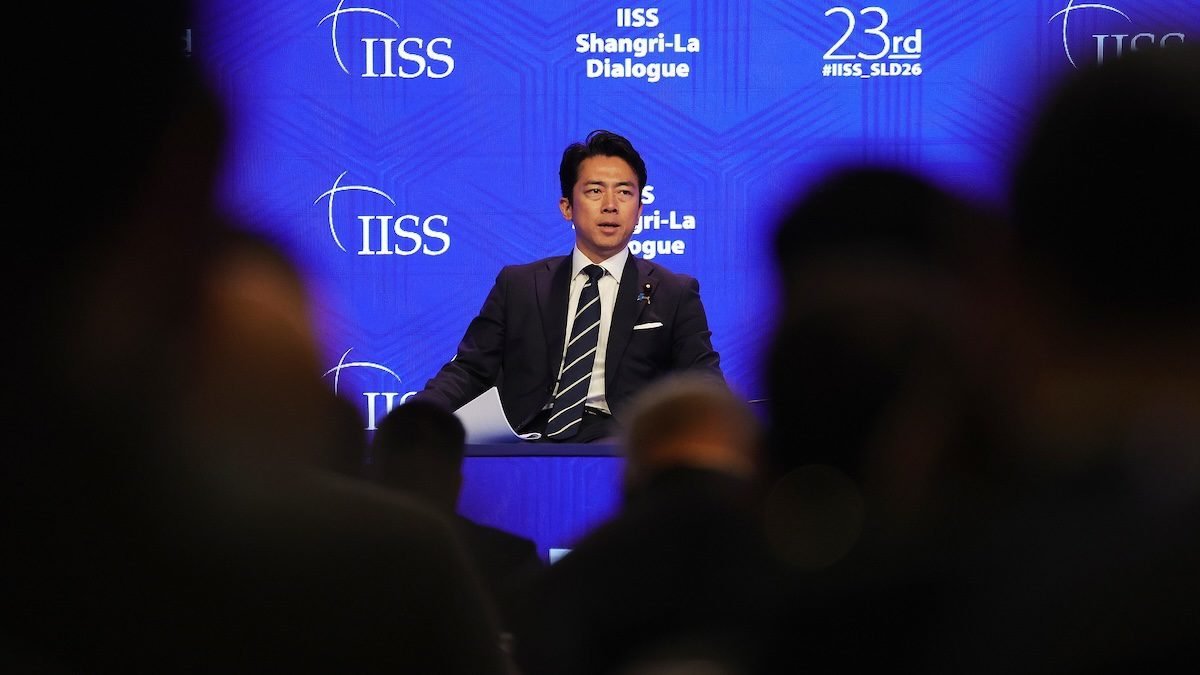
Faced with explicit signals from Washington that alliances will be judged strictly by hard power and collective readiness, Japanese Defense Minister Shinjiro Koizumi used the Singapore summit to deliver a sophisticated defense of Japan’s evolving posture. Rather than engaging in defensive rhetoric, Koizumi emphasized that Japan’s door to dialogue remains always open, even as the country advances concrete defense enhancements.
Tokyo is moving forward with tangible initiatives – including expanding defense technology co-production, revising arms export guidelines to enable greater collaboration with partners and strengthening maritime partnerships across Southeast Asia, notably with the Philippines, Australia, and South Korea. These steps build on Japan’s recent decisions to raise defense spending toward 2% of GDP and invest heavily in next-generation capabilities such as missiles, cyber defenses, and joint production arrangements.
This represents a major strategic evolution for Japan. No longer waiting for external clarity, Tokyo is quietly but steadily building its own minilateral defense networks to hedge against an increasingly unpredictable global system. These efforts include deeper integration with like-minded nations through frameworks that emphasize interoperability, intelligence sharing and joint exercises, all while maintaining a firm commitment to international law and a free and open Indo-Pacific.
Yet, this strategy is carefully calibrated. Even as Tokyo enhances its defense capabilities through increased budgets, technological innovation and expanded partnerships, its leadership has repeatedly emphasized that the door to dialogue remains open with all parties, including China. This approach rejects hostile framing in favor of maintaining practical diplomatic channels and underscores Japan’s identity as a peace-loving nation that respects established norms.
This balanced posture mirrors a broader regional trend: Asian powers are seeking to stabilize their environments through bilateral diplomacy, economic pragmatism, and incremental security cooperation rather than getting drawn into ideological crusades.
Washington, meanwhile, faces a deeper dilemma than merely demanding that allies pay their way. The current administration’s posture risks shifting from long-term systemic stability to short-term crisis management if not carefully managed. By prioritizing transactional outcomes over unconditional structural commitments, Washington is altering the psychological baseline of global deterrence.
Governments from Seoul to Manila, and particularly in Tokyo, are quietly recognizing an uncomfortable truth: military dominance without absolute predictability forces every state to become an independent strategic architect, investing more deeply in its own resilience while forging flexible partnerships. The age of dependent allies is ending; the age of self-designed security architecture is beginning.
The consequence of this realization is already transforming public psychology and policy planning across Asia. In capitals throughout the region, the strategic conversation is no longer about abstract ideological alliances alone. It is about supply chain resilience, independent deterrence capabilities, the defense of critical maritime commerce lanes and the development of robust domestic defense industries.
Middle powers like Japan recognize that they are vulnerable to uncertainty itself. A temporary strategic shift can be managed through adaptation, but permanent unpredictability alters long-term investment behavior, fiscal planning, technological priorities, and national risk assessments.
Once regional states begin pricing geopolitical volatility into their sovereign defense planning – as Japan has done through its updated national security strategies – the strategic landscape changes permanently, creating both challenges and opportunities for greater self-determination.
The danger now is not necessarily a sudden escalation between competing powers. The greater danger is the normalization of systemic fragmentation over time.
If security guarantees become contingent on transactional metrics, other regional security frameworks may follow similar patterns. Strategic defense, maritime access, and even critical digital infrastructure corridors could evolve into systems governed by temporary, conditional permissions rather than enduring commitments. That would fundamentally transform global stability in ways that require careful navigation by all parties involved.
Asia is entering an era in which security will be a patchwork of flexible arrangements rather than a single US-led framework. The coming months therefore will matter enormously for Japan and the wider region.
Washington must decide whether its long-term interests are truly served by trading structural alliances for immediate transactional concessions, or whether a balanced approach can sustain deterrence while encouraging greater partner contributions.
Concurrently, regional powers like Japan must determine how to balance their enhanced strategic autonomy with the preservation of regional equilibrium, ensuring that self-reliance strengthens stability rather than undermining it.
One reality is already clear. The Shangri-La Dialogue has shown that power in the modern era is measured no longer solely by old alliance frameworks but also by the ability of individual nations – Japan foremost among them – to navigate a fragmented world, secure their own borders, maintain strategic balance independently and contribute meaningfully to collective security in the Indo-Pacific.
Imran Khalid is a senior fellow at Foreign Policy In Focus – USA.