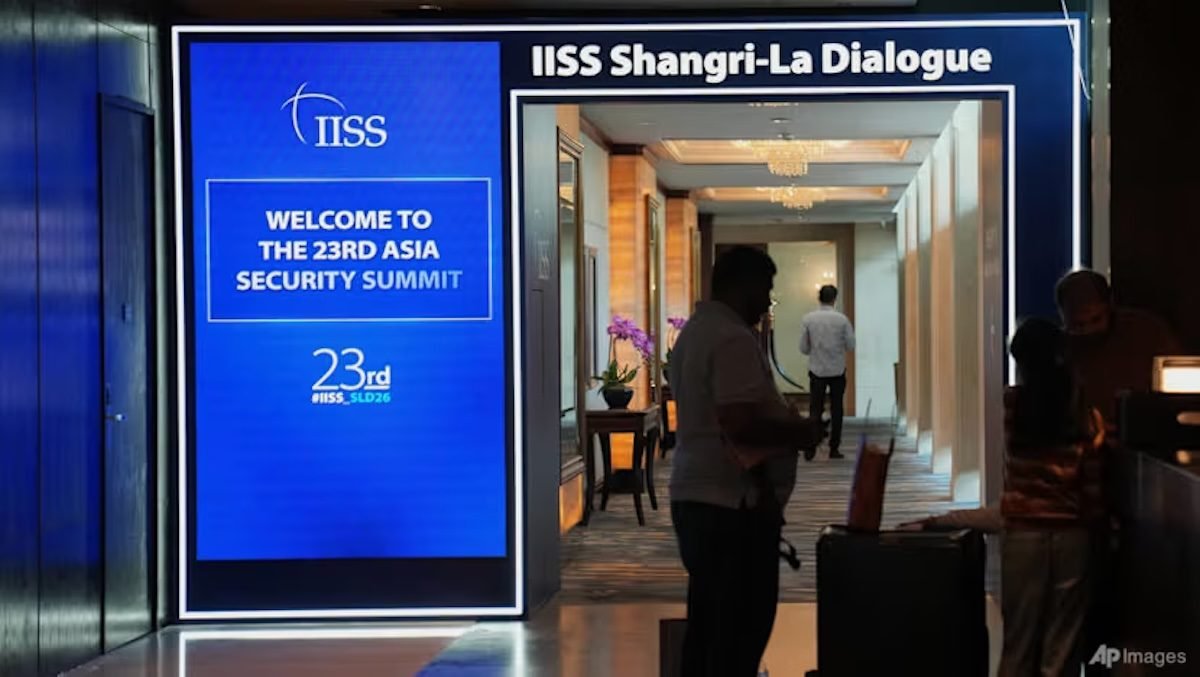
Every year, in a gleaming hotel ballroom in Singapore, the Indo-Pacific strategic order gets set for a public display. This happens not through signing of communiqués or conventions but through who shows up, at what level, and what they dare to say in front of an “unscripted” audience.
This is what makes Shangri-La Dialogue, now in its 23rd year, the most talked of barometer of Asia’s regional power equations. And the 2026 edition this weekend is unfolding this story of an unequal triangle – with radically different levels of confidence, comfort, and clarity guiding their engagement.
The United States sits at its apex – not because anyone voted for it, but because no one has successfully challenged it so far. China occupies the second vertex: militarily formidable, economically indispensable, and yet diplomatically uncomfortable in the very room where it should be most assertive. India holds the third point – ascending, consequential, and only now, after two decades of negligence, beginning to understand the strategic significance of this forum.
To collectively read these three trajectories reveals a lot about the Indo-Pacific security dynamics.
The American constant
Since 2002, most of the sitting US defense secretaries – Rumsfeld, Gates, Panetta, Hagel, Carter, Mattis, Shanahan, Austin – have delivered plenary speeches at this forum, and now Pete Hegseth isreturning for his second consecutive edition.
The forum is Washington’s annual pilgrimage to explain its strategic vision for the Indo-Pacific and to reassure US allies – before a rather influential audience of defence ministers, military chiefs, and strategic thinkers from over 40 nations that no other platform assembles in quite the same manner.
This is not routine multilateralism. It is an institutional expression of hegemonic commitment – the deliberate, annual signal that the United States regards the Indo-Pacific as its primary strategic theater and intends to remain its defining security provider.
Even as Washington’s domestic politics convulse and successive administrations disagree violently on trade and grand strategy, their Shangri-La addresses endure. Given their discursive nature these speeches are often more revealing than National Security Strategy documents: strategies can be rewritten, but showing up costs political capital that the US chooses to keep investing.
This sustained American presence creates the gravitational field in which others like China and India must choreograph their presence. The forum’s credibility test is implicitly set by Washington: show up with your defense minister, make your case and take those open house questions. Countries that meet that benchmark signal confidence. Countries that cannot reveal something about themselves stay at the sidelines.
The Chinese paradox
Nothing about China’s relationship with Shangri-La is simple. China’s military expenditure has risen every year for 31 consecutive years, reaching an $336 billion in 2025, second only to the United States. The People’s Liberation Army fields the world’s largest navy by hull count, has the most advanced ballistic missiles of any country in the region and a nuclear triad it has spent a decade modernizing.
By any material measure, China is the Indo-Pacific’s pre-eminent military power. And yet it cannot comfortably sit at Shangri La Dialogue. The most immediate reason is its institutional rot.
Dong Jun is the third consecutive serving defencs minister to face corruption investigation, following Wei Fenghe and Li Shangfu, both subsequently expelled from the Communist Party. In October 2025, Xi Jinping removed General He Weidong, the PLA’s second-highest-ranking officer, alongside the earlier suspension of Admiral Miao Hua – respectively Vice Chairman and senior members of China’s seven-person Central Military Commission (CMC). January this year saw Xi removing the second Vice Chairman of CMC Zhang Youxia.
Its not possible to send a defense minister who’s under investigation to face unscripted questions from forty nations’ military leaders.
The deeper problem is structural, not merely personal. There is a growing sense within Beijing’s political elites that Shangri La Dialogue has become nothing more than a forum to highlight and shame China’s perceived rule-breaking behavior. The South China Sea, Taiwan, the Quad, AUKUS – none of these are subjects Beijing can handle in an open Q&A format.
Unlike its own Xiangshan Forum in Beijing, where China controls the agenda and the guest list, Shangri-La Dialogue belongs to no one – which, in practice, makes it vulnerable to Washington’s agenda.
General Meng Xiangqing – a professor and strategist at China’s National Defense University – is leading the delegation for the 2026 Shangri La Dialogue.
This decision to downgrade attendance for the second straight year, after four consecutive years (except 2020 year of pandemic) of minister level engagement during 2019-2024, is not a weakness in the conventional sense. It is more like a calculated retreat from terrain that does not favor China’s ascendence. The world’s second-largest military power has decided that talking is riskier than silence.
India’s reckoning, long overdue
If China’s story at Shangri-La is a paradox – great power, thin presence – India’s is a prolonged missed opportunity now being corrected at accelerating pace. For most of the forum’s history, New Delhi’s engagement was, charitably speaking, desultory. It sent ministers of state. It sent military officials. In 2024, it sent effectively no one of consequence.
In the forum’s entire 23-year history, only Manohar Parrikar in 2016 appeared as a full defense minister. Modi’s celebrated 2018 Shangri-La keynote – still cited as India’s Indo-Pacific manifesto – was delivered as prime minister, not defense minister, representing a diplomatic one-off. This had coincided with his bilateral visit to Singapore.
What has shifted is compound and consequential. India’s 2026-27 defense budget rose by 15% to 7.85 trillion rupees (US$91 billion), making it world’s fourth-largest military spender. Defense exports have hit a historic high of 240 billion rupees (US$2.8 billion), with a 500 billion rupee (US$5.8billion) target set for 2029-30.
Operation Sindoor – India’s May 2025 precision strikes against terrorist infrastructure in Pakistan – has altered something fundamental in India’s strategic self-confidence. The latest Nilgiri-class frigates now boast over 75 per cent local content, including BrahMos supersonic missiles, and India now operates three indigenously built nuclear-powered ballistic missile submarines.
Nevertheless, India’s arrival in 2026 does not alter the fundamental asymmetry of the India-China military balance. China’s defense budget remains more than three times India’s. Rajnath Singh walking into the Shangri-La ballroom this weekend does not change that equation.
But what it certainly changes is something subtler and yet not trivial: the narrative contest over who speaks for a rules-based Indo-Pacific order. In that contest – fought in plenary halls and corridors rather than high Himalayas – India is present and China is absent.
The Triangle’s verdict
This unequal triangle at Shangri-La is not a simple story of American preponderance and India rising to challenge China. That framing underestimates China’s prowess. This instead is a story about an American-defined forum producing an uncomfortable truth; that multilateral security dialogue in the Indo-Pacific still flows most through the frameworks Washington anchors; that China is militarily supreme but diplomatically retreating; and that India – for all its newly earned confidence – is still finding its feet on a stage it should have claimed long ago.
The forum that doesn’t lie is speaking again this weekend. With the renewed hostilities threatening a fragile ceasefire between the US and Iran, China-hawk Secretary of War Pete Hegseth, has the microphone. China, for the second straight year, is only in the corridor whispers. And India, only for the second time in 23 years, is taking its seat at the table.
But that is not a story of India’s triumph, not yet. At best, its a beginning. But, in this unequal triangle, beginnings – rightly calibrated – can become game changing as well.