While we make batteries based on many different chemistries, nothing has approached the massive scale at which we can produce lithium batteries. That scale makes the economics of lithium-ion batteries hard to compete with. Even if we develop a superior battery technology, it’s unclear whether we can get manufacturing costs down quickly enough to compete with the efficiency of the lithium supply chain and manufacturing.
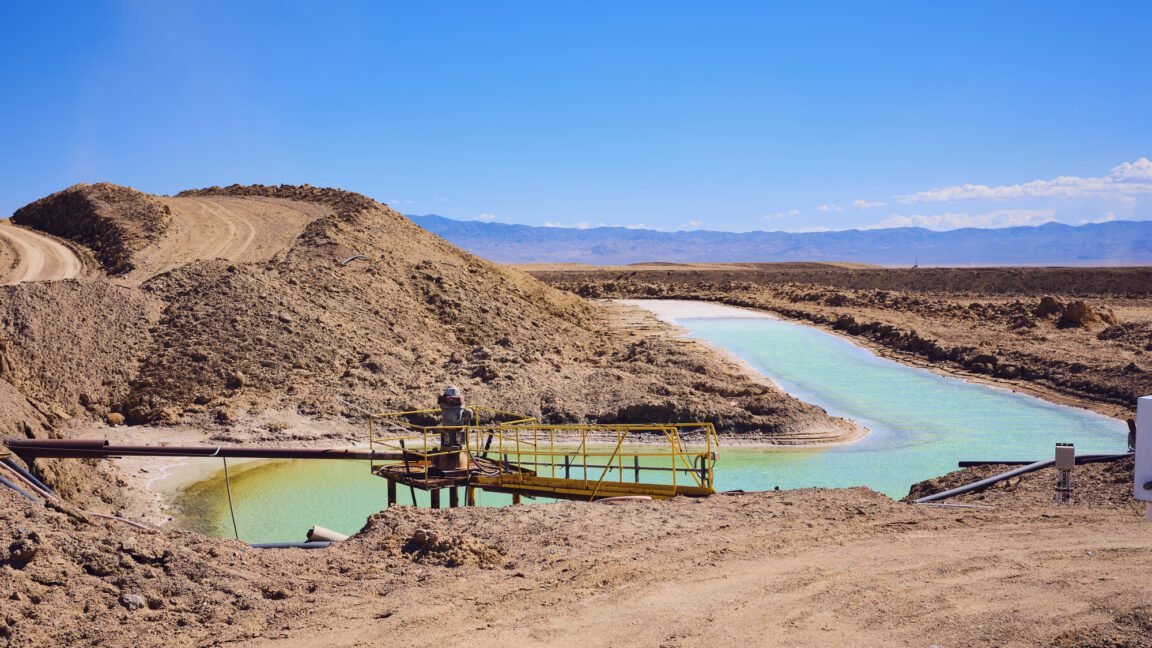
The one thing that could change the dynamics is a supply crunch. While lithium is extremely widespread, lithium that can be extracted economically is a different matter. It’s cheapest to extract it from brines, and lithium-rich brines are largely limited to South America. We do obtain some lithium from other sources, but it’s considerably more expensive.
In today’s issue of Science, however, a research team has identified an energy-efficient means of extracting lithium from rocks. The process they’ve designed uses far less energy than existing ones, regenerates all its starting chemicals, and produces byproducts that could also be sold.
Reacting rocks
Like other metals, lithium shows up in various minerals. For example, the US Geological Survey recently took an inventory of all the lithium oxide deposits in the Northeast (they are extensive), which are found in a type of rock called pegmatite. Globally, however, the new paper indicates that the most abundant lithium ore is called spodumene, a lithium-aluminum silicate (LiAl(SiO3)2). And there is some processing of this material going on—it’s just energy-intensive and leaves behind a lot of waste.
That’s because the process starts by heating the mineral to roughly 1,000° C to disrupt its compact structure, after which sulfuric acid is used to leach out the lithium. The resulting lithium sulfate solution is then converted into something useful for battery manufacturing (typically lithium carbonate), leaving behind sulfur-containing waste.
The new work was done by a collaboration between MIT researchers and a couple of Boston-area companies. Their goal was a process that was far more energy-efficient and didn’t produce as much waste. What they came up with is a process where the key chemical used at the start of the process gets regenerated at a later step, and both the silicon and aluminum in the mineral end up in a form that we’re already using in commercial applications.
The key chemical in the process is ammonium fluoride (NH4F). It’s possible to use the salt directly in a molten form, but heating it invariably leads to some production of hydrogen fluoride, which is extremely dangerous stuff (although they end up using some later). So instead, they used it dissolved in water, which apparently keeps these reactions from occurring. In this process, heating the solution to about 70° C results in the formation of NH4F2 ions, releasing ammonia gas that’s used later in the process.
This ion donates a fluorine to the lithium, leaving a water-based solution of lithium fluoride. The silicon also forms a soluble ion, (NH4)2SiF6), while the aluminum forms a similar ion that remains behind as a solid, (NH4)3AlF6). Each of these is processed separately.
Using everything
We’ll start with the aluminum chemistry, which is one of the simpler pathways. Initially, heating the (NH4)3AlF6 to about 300° C produces aluminum trifluoride and releases ammonia and hydrogen fluoride. Then, raising the temperature to 700° C causes the aluminum trifluoride to react with water, leaving behind aluminum oxide and releasing yet more hydrogen fluoride.
Again, hydrogen fluoride is dangerous stuff and needs to be handled carefully. But it’s also easy to react it with the ammonia (which is produced during two different reactions here) and reform the ammonium fluoride that was used to start the whole process. So, aside from minor losses due to inefficiencies, the process regenerates one of the key ingredients. Meanwhile, aluminum oxide is one of the key starting materials for the production of aluminum metal, and so can be fed into that, given that the purity of the end product here was over 98 percent.
We’ll just note here that this is probably the worst aspect of the whole process, given the energy requirements for these temperatures and the highly dangerous chemicals involved.
By contrast, the silicon purification is a walk in the park. Simply adding more ammonia to the solution caused the starting chemical (NH4)2SiF6) to react with water, releasing silicon dioxide and ammonium fluoride. Again, an ammonium fluoride solution is one of the starting materials; the silicon dioxide simply precipitates out of this solution. That has a variety of applications, but the team showed that it’s quite effective at strengthening concrete.
All that leaves us with is the solution of lithium fluoride. That’s actually one of the raw ingredients for production of a common battery electrolyte, LiPF6. Alternatively, the researchers showed that you could react it with nitric acid and (once again) release hydrogen fluoride, leaving behind lithium nitrate. Heat that and it will decompose into lithium oxide, which is easy to convert into other battery raw materials.
Checking the economics
While the process gets rid of the high temperatures for the initial processing of lithium-containing ore, there are several steps with elevated temperatures needed further down the line, both for the lithium and for the useful aluminum and silicon products. So, the researchers did a full economic evaluation of how their process stacked up to what’s already on the market.
The existing process, which involves roasting ore/sulfuric acid, came in at just under $9,000 for each usable tonne of lithium. By contrast, they estimate that the new process should only cost a bit over $5,000 per tonne. That’s roughly comparable to the cost of isolation from high-quality brines. If the silicon and aluminum products can also be sold, then the cost of the whole process would drop by over $1,000, making it highly cost-effective.
With those numbers come a lot of caveats, of course: Prices shift with supply and demand; not every source of spodumene produces equivalent-quality ores; switching to this process might require investments in new industrial equipment, etc. So the real world will undoubtedly be more complex than these calculations might suggest. Still, in our increasingly lithium-dependent world, it’s nice to have alternatives in case a serious supply crunch ever does hit.
Plus, it’s pretty neat to see that there’s still room for chemists to rethink large industrial processes.
Science, 2026. DOI: 10.1126/science.aec4652 (About DOIs).