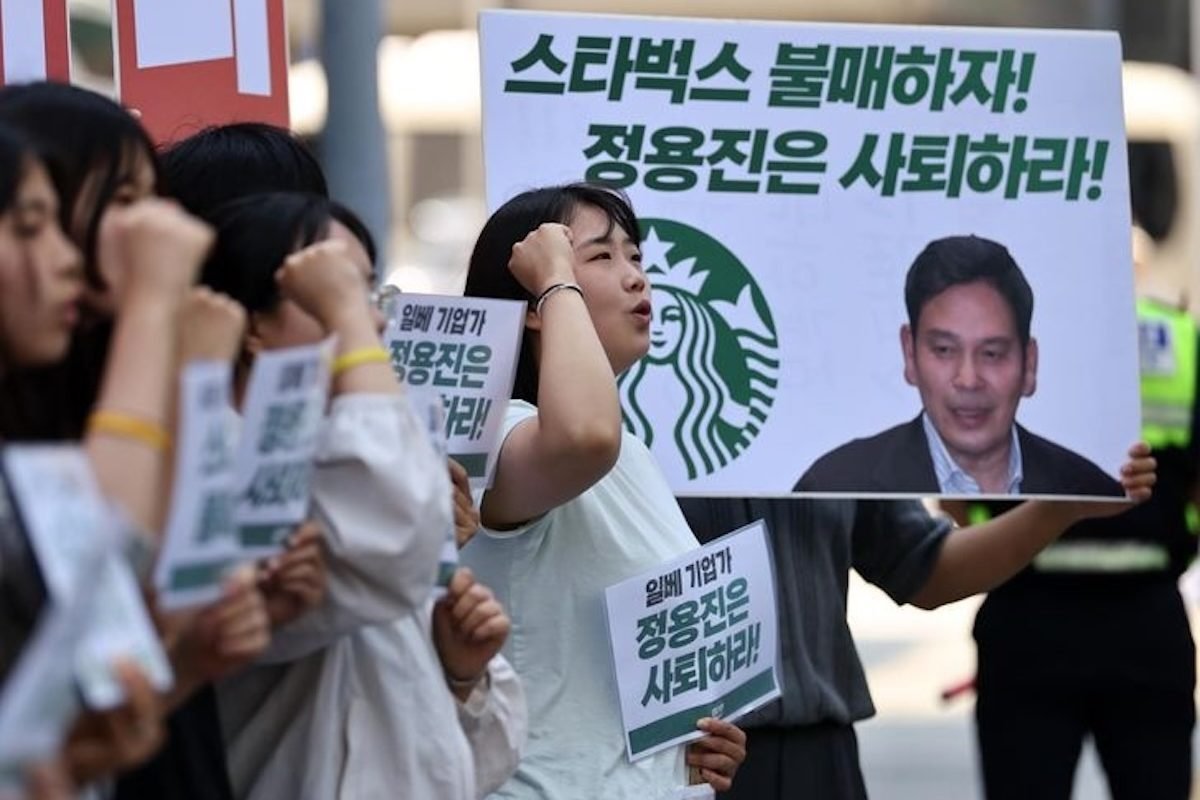
When Shinsegae Group chairman Chung Yong-jin bowed before cameras in Seoul on May 26, 2026, it marked his second public apology in two weeks.
The controversy stemmed from a Starbucks Korea promotion launched on May 18, the anniversary of the Gwangju Uprising, promoting a large tumbler branded as a “tank” while marketing the date itself as “Tank Day.”
Given the historical association between army tanks and the 1980 Gwangju crackdown, the campaign immediately triggered national outrage.
Shinsegae later acknowledged “a lack of social and historical sensitivity.”

The tumbler itself appears to have existed long before the controversy erupted.
The “tank” tumbler was reportedly sold as early as December 31, 2022, as part of Starbucks Korea’s 2023 New Year Classic Tumbler lineup, while product reviews and blog posts discussing the item appeared across multiple dates well before the current election season. Starbucks Korea also stated that similar “tank” tumblers had been sold in other countries, a claim seemingly supported by Starbucks Australia product listings.
The intensity of the political reaction, however, cannot be explained by the marketing blunder alone. The broader explanation lies in the political timing. South Korea heads into a deeply polarized national election on June 3.
A businessman with a political identity
Chung Yong-jin is not merely a businessman.
Since 2022, he has repeatedly posted myeolgong (“destroy communism”) slogans on social media, drawing sustained domestic and international attention.
In one widely discussed post, he uploaded a photograph of Chinese President Xi Jinping alongside anti-communist commentary.

He also maintains close ties with Donald Trump Jr.
The relationship is repeatedly highlighted in Korean and international business coverage.
Taken together, these markers have made Chung arguably South Korea’s most politically recognizable conservative businessman – openly pro-US, sharply anti-China and culturally aligned with the international conservative right.
The conservatives’ vulnerability
That visibility matters in the current political environment.
The conservative camp already enters the election weakened by the lingering fallout from former President Yoon Suk-yeol’s short-lived martial law declaration.
The People Power Party now carries a durable public image as a “martial law party,” while Yoon himself acquired the nickname “Yoon Tank,” giving any controversy involving tanks unusual symbolic resonance.
At the same time, conservatives face a hollowed-out political base.
A May 27 Chosun Ilbo report found that 56% of conservative and moderate voters believe no political party represents them, underscoring the depth of voter disaffection heading into the final stretch of the campaign.
Within that landscape, Chung occupies an unusually important position. He is one of the few remaining high-profile conservatives not directly tied to Yoon’s political baggage.
Under such conditions, any controversy involving Chung inevitably acquires broader political significance beyond the Starbucks incident itself.
Incentives in the final stretch
The ruling side benefits politically from keeping the controversy in the spotlight.
That broader political atmosphere is reinforced by President Lee Jae-myung’s long-discussed philosophy regarding political power, how it is something that should be used ruthlessly.
The risk of overreach
Even within the ruling camp, there are signs that some officials may fear the backlash is approaching the point of diminishing returns.
On May 27, the Democratic Party’s senior spokesman publicly stated that Chung’s apology appeared sincere and that the matter should now be considered settled.
But after criticism from other progressive politicians, he withdrew the comment five hours later.
The episode hinted at internal concern that the line between accountability and political overreach may become increasingly difficult to manage as the campaign enters its closing days.
Voter fatigue with prolonged moralistic mobilization is a recurring feature of late-stage Korean elections. The spokesman’s brief attempt at de-escalation – and his rapid retreat – suggested awareness that the political calculus cuts both ways.
What this episode reveals
The Tank Day controversy ultimately reveals less about Starbucks Korea’s internal marketing failures than about the political temperature of South Korea itself.
In a deeply polarized election environment, controversies no longer remain confined to the institutions that create them.
They are rapidly absorbed into broader ideological conflict, where symbolism often matters more than intent and political utility can outweigh factual ambiguity.
That dynamic is now shaping the final days of South Korea’s June 3 election campaign.
Hanjin Lew is a South Korean political commentator specializing in alliance politics and East Asian security affairs.