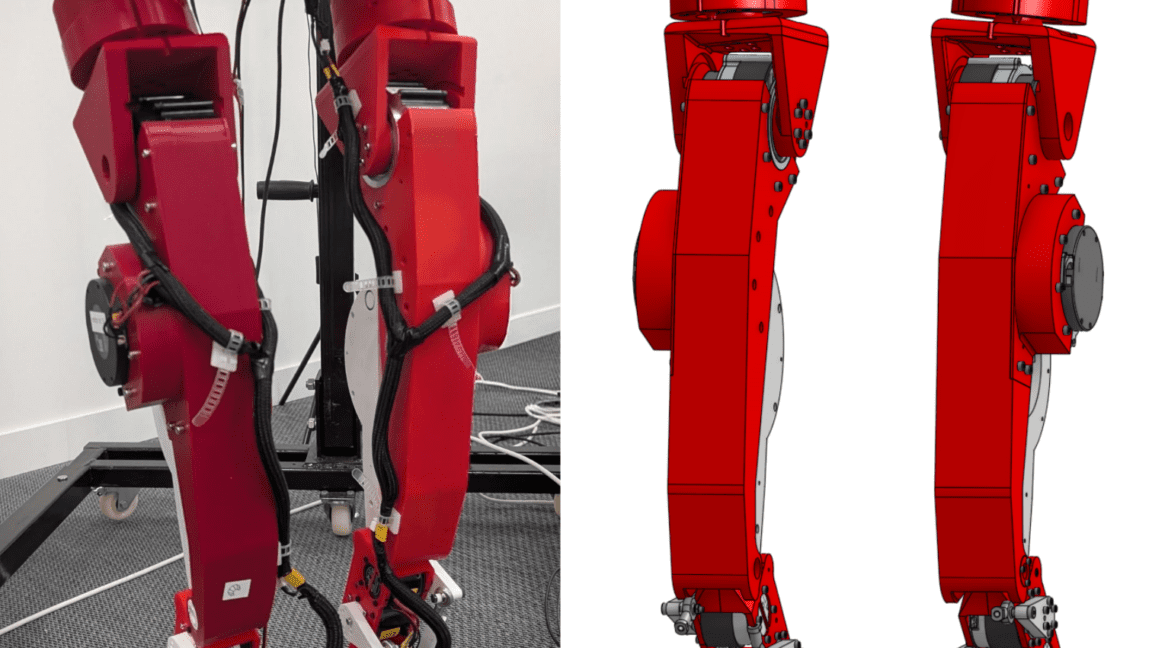
A $2,500 pair of humanoid robot legs built from 3D-printed parts and off-the-shelf components is not going to win marathons just yet. But such relatively inexpensive hardware could enable researchers to more easily test and train AI-powered robotics software in a physical body during real-world experiments.
The newly available LeRobot Humanoid project comes from the machine learning and AI development platform Hugging Face. The full-stack release gives robot builders and researchers access to a bill of materials, files for 3D-printable parts, wiring documentation, and physical assembly instructions—but it also includes software tools for calibrating and controlling the robot in both the physical body and in simulation.
“If you are looking for the most advanced humanoid robot, this is not it,” according to Virgile Batto, a robotics engineer at Hugging Face, in a blog post coauthored with other colleagues. “If you are looking for a humanoid you can build, understand, repair, instrument, simulate, and use for learning experiments, this is the robot we are trying to make.”
The Hugging Face team aimed for a “practical balance between affordability, mechanical performance, and ease of assembly.” The design, built around printable parts, off-the-shelf hardware, and affordable actuators and electronics, means the bipedal robotic platform can be easily fixed and modified to enable rapid experimentation and development, rather than being a “one-off prototype useful for a demo.”
Such a design also aims to enable a more reproducible “full-robot design loop” in which robots designed in simulation can be tested and validated in physical body experiments, according to Batto and colleagues. In turn, data from the real-world trials can help inform and improve the simulations used for training robot behaviors.
The team also promised that the LeRobot Humanoid legs are just the start of a bigger roadmap that includes integration with an upper body and more advanced behaviors. The company previously released a 3D-printable robotic arm.
The push for affordable robots
Hugging Face is backing open-source robotics projects to help make robots affordable while mitigating industry dominance by large corporate interests, Hugging Face CEO Clem Delangue previously told TechCrunch. In May 2025, the company announced it was working with the French company The Robot Studio to develop the HopeJR humanoid robot with 66 actuated degrees of freedom and a target price tag of $3,000.
Hugging Face has also begun selling a small $299 robot called Reachy Mini that is primarily designed for expressive behaviors and interactions with people.
The push for affordable robotics development comes as companies also look to reduce the manufacturing costs of commercial robots. A commercial humanoid robot still typically costs between $30,000 to $150,000 per unit as companies work to build out supply chains, according to an April 2026 report by the consulting firm McKinsey. Meanwhile, venture capital funding for robotics has more than tripled between 2023 and 2025 to surpass $40 billion last year.
Some Chinese companies, such as Unitree Robotics, are already selling robot models at price points below $20,000. Unitree is also looking to raise $610 million in its initial public offering with Shanghai’s Star Market—but the South China Morning Post highlighted a 53 percent drop in Unitree’s reported first-quarter profits despite the company seeing a 68 percent rise in revenue. SCMP described the Unitree “profit squeeze” as coming from “soaring expenses and a brutal price war,” with the company itself also acknowledging a possible “cooling” of hype surrounding humanoid robots.
Meanwhile, Hyundai Motor Group is reportedly looking to mass-produce the Boston Dynamics humanoid robot Atlas by setting up a manufacturing line at the Hyundai electric vehicle plant in Georgia, according to UPI. There is also discussion of setting up a US-based facility capable of producing 350,000 robotic actuators annually.