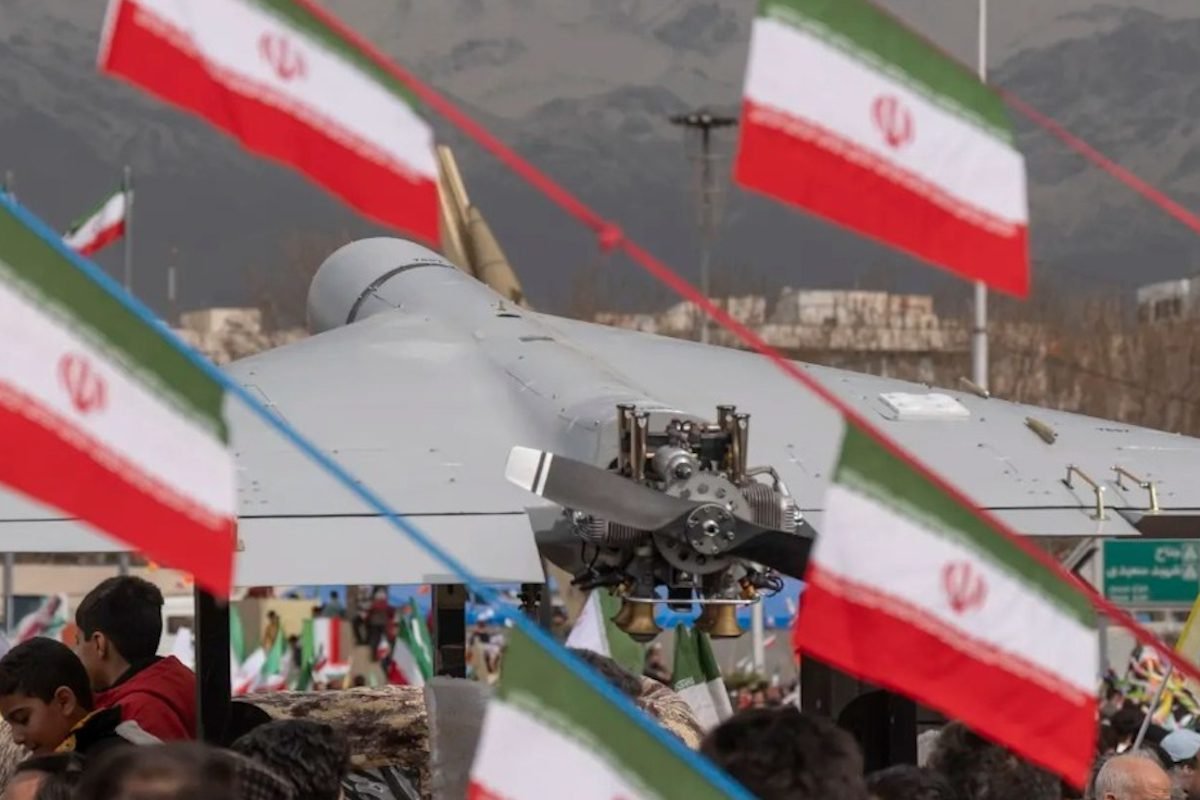
Iran’s drones may have survived not because US and Israeli strikes failed, but because Iran built a war machine designed from the start to keep fighting after the bombs fell.
According to recently disclosed US intelligence assessments, Iran is rapidly rebuilding its military industrial base during an ongoing six-week ceasefire that began in early April, defying previous US and Israeli degradation estimates, CNN reported.
Intelligence officials report that Iran has already restarted production of its signature Shahed attack drones while rebuilding missile sites, launchers and other weapon systems damaged during recent combat operations.
Four sources familiar with the data told CNN that Iran’s military is recovering much faster than the US intelligence community anticipated, with some estimates suggesting its drone strike capabilities could be fully restored in as little as six months.
This rapid mobilization is reportedly facilitated by a combination of factors: resilient underground infrastructure that left two-thirds of its missile launchers intact, incomplete damage from initial US-led coalition airstrikes and resilient supply chains for components manufacturing, with alleged support from China and Russia.
While the US and its regional allies will view Iran’s drone-making resilience as a direct, long-term threat to Gulf security, the US Department of Defense (DoD) maintains that US forces retain deep strategic superiority.
However, the acceleration complicates diplomatic dynamics as US President Donald Trump warns of a potential resumption of bombing if the final terms of a peace deal are not met. The US and Iran were closing in on a deal on Monday that would reopen the blockaded Strait of Hormuz but gaps on Iran’s nuclear program and US sanctions remained.
The intelligence assessments suggest Iran’s drone ecosystem was built for efficiency and survivability, enabling it to absorb losses, regenerate production and sustain operations in the face of sustained US and Israeli military pressure.
That apparent recovery stands in tension with earlier US claims about the destruction of Iran’s drone capabilities. In April 2026, the US DoD claimed that the US destroyed 80% of Iran’s air defense systems, 800 one-way attack drone storage facilities, every factory that produced Shahed one-way attack drones and their guidance systems.
Despite overwhelming US firepower, Iran’s drone production base may have survived due to a combination of dispersion, concealment and hardening of facilities.
In a February 2026 report for the Jewish Institute for National Security of America (JINSA), Jonathan Ruhe and Ari Cicurel note that Iran disperses its missile and drone infrastructure across numerous sites, including underground “missile cities.”
Ruhe and Cicurel pinpoint at least 24 missile sites in western Iran before the 12-Day War, including key clusters around Kermanshah, the Konesh Canyon tunnel complex, Lorestan and the Zagros region.
They also note that Iran’s drone infrastructure consists of underground bases, airfields and production facilities spread across central, western and southern Iran. The writers add that missile cities are better protected and concealed than road-mobile systems, but they are less flexible due to fixed locations and narrow firing apertures.
Bobby Yadav mentions in an April 2026 article for Drone Federation India (DFI) that Iran designed its drone ecosystem around deliberate dispersal rather than centralized facilities, distributing manufacturing nodes, procurement channels, assembly facilities and operational decision-making across dozens of independent and semi-independent layers.
Yadav says that the destruction of any single node does not cascade into systemic failure, as adjacent nodes absorb functions and alternative procurement channels activate. He notes that Iran built parallel but interconnected production lines between state entities and the Islamic Revolutionary Guards Corps (IRGC), intentionally creating institutional redundancy.
He also adds that private firms, universities, procurement networks, reverse engineering, front companies and global commercial sourcing collectively ensure that no single intervention, including a targeted airstrike or new sanctions designation, can sever the entire system simultaneously.
Support from Iran’s strategic partners, Russia and China, may also be instrumental in keeping its drone program running while under fire. Iran may have also reverse-imported its Shahed drones from Russia after the establishment of a production base there amid the Ukraine war.
In a March 2026 CNN interview, Ukrainian President Volodymyr Zelensky stated that Russia has already given Iran Shahed drones to strike back at the US and its Middle Eastern allies, citing intelligence reports confirming Russian details in those Iranian drones.
Furthermore, Joseph Bermudez Jr and other writers mention in a March 2026 Beyond Parallel report that Iran helped establish the Alabuga factory in Russia to manufacture those systems, providing advisors, training, production equipment, production technology and initial component supplies. They also state that Iranian-supplied technology enabled Russia to localize production of the Shahed-131 and Shahed-136 at Alabuga, enabling mass production.
China may also be supporting Iran’s drone production. Christopher Nye and Charles Sun mention in a March 2026 Jamestown Foundation report that China’s support for Iran’s drone program operates through a decentralized civilian manufacturing ecosystem that supplies dual-use propulsion technology, manufacturing equipment, machine tools, electronics and aerospace components.
Nye and Sun state that Chinese firms acquired and reverse-engineered the German Limbach L550E engine technology that underpins Iran’s Shahed drones, while other Chinese companies supplied computer numerical control (CNC) machine tools, integrated circuits, servos, radiofrequency (RF) connectors and testing equipment.
They say these transfers occurred through shell companies, Hong Kong intermediaries, false declarations and ambiguities in dual-use trade. They also note that China’s ongoing lack of enforcement against known proliferators created a strategic environment that has allowed Iran’s drone industry to survive sanctions pressures.
Noting the three-way dynamic between Iran, Russia and China, Kimberly Donovan and Emilly Ezratty state in a March 2026 Atlantic Council report that Iran retains the technical expertise, established production lines and ongoing access to dual-use components needed to replenish its drone stockpiles.
Additionally, Donovan and Ezratty note that collaboration with Russia and China enhances these capabilities by diversifying supply chains and protecting production from Western pressure.
They assert that not confronting the Iran-Russia-China “Axis of Evasion” across its networks permits it to keep facilitating the transfer of dual-use technologies among its members. They also stress that ongoing support will enable Iran to rebuild and enlarge its drone and missile arsenals during the current conflict and possibly after it.
If Iran can regenerate drone production under sustained attack through interlocking industrial, technological and logistics ties with Russia and China, any future US or Israeli campaign may shift from a regional air war into a broader global multi-domain systems confrontation aimed at disrupting the transnational financial, manufacturing and logistics networks that bind the Iran-Russia-China axis together.