Foreign fighters and sleeper cells remain a security concern as the group tries to revive its networks after years of territorial collapse
[DAMASCUS] Syria witnessed a notable escalation in the rhetoric of the Islamic State group (ISIS) over the past week after the organization released a new propaganda message urging its members and foreign fighters inside Syria to “continue fighting” against the Syrian state and refrain from surrendering or leaving the country.
The appeal, circulated through platforms linked to the group, comes at a sensitive moment for Syria as the government continues efforts to consolidate security control in eastern regions and the Syrian desert, where ISIS sleeper cells remain intermittently active. Analysts say the latest message reflects an attempt by the organization to exploit ongoing security tensions and reintroduce itself as a force still capable of confrontation after years of military collapse and territorial losses.
According to the statement attributed to ISIS, the group focused particularly on inciting foreign fighters, claiming that Syrian authorities “will gradually eliminate them” and calling on them to join what it described as a “new phase of fighting.” The message also urged attacks against the Syrian army and security forces, especially in Deir ez-Zur, Raqqa, and the Syrian desert, areas that have continued to figure in sporadic ISIS operations in recent months.
Analysts following Syrian affairs believe such rhetoric represents an effort by ISIS to reaffirm both its media and military presence as it seeks to reactivate dormant cells and regroup what remains of its fighters after years of heavy losses.
ISIS first emerged openly in Syria in 2013 after expanding from Iraq amid the chaos of the Syrian conflict and deteriorating security conditions. Initially operating under the name “Islamic State in Iraq and al-Sham,” the group later split from al-Qaida and became involved in violent confrontations with Syrian opposition factions.
Between 2014 and 2015, ISIS reached the peak of its power after seizing vast territories across Syria and Iraq, most notably the city of Raqqa, which it declared the “capital of the caliphate,” in addition to large parts of Deir ez-Zor, the Syrian desert, and border areas with Iraq. At the time, the organization relied on a vast network of local and foreign fighters, as well as financing through oil revenues, taxation, smuggling, and extensive media propaganda campaigns that enabled it to recruit thousands of fighters from around the world.
During its expansion phase, ISIS evolved into one of the most extreme and organized militant groups in the region, attracting thousands of foreign fighters from Arab, Asian, and European countries, as well as from the Caucasus and North Africa.
UN and Western estimates indicate that more than 40,000 foreign fighters joined ISIS in Syria and Iraq between 2013 and 2017. However, the group gradually began to decline following military campaigns launched against it by the US-led international coalition, alongside operations conducted by the Syrian army, Russian forces, and the Syrian Democratic Forces (SDF), resulting in the loss of its major strongholds and culminating in the fall of its final territorial enclave in Baghouz in 2019. Since then, the organization has shifted into a new phase based on clandestine operations and small mobile cells rather than direct territorial control.
Its attacks now rely primarily on ambushes, improvised explosive devices, assassinations, and rapid assaults targeting checkpoints and military forces, particularly across the vast Syrian desert stretching between Homs and Deir ez-Zor and in remote areas near the Iraqi border. According to a February 2025 report by the UN Security Council’s Analytical Support and Sanctions Monitoring Team, ISIS’s combined strength in Iraq and Syria was estimated at 1,500 to 3,000 fighters, most of them, including key leaders, in Syria. Those fighters are believed to operate in small cells supported by logistical networks, smugglers, and sympathizers who facilitate movement and supplies.
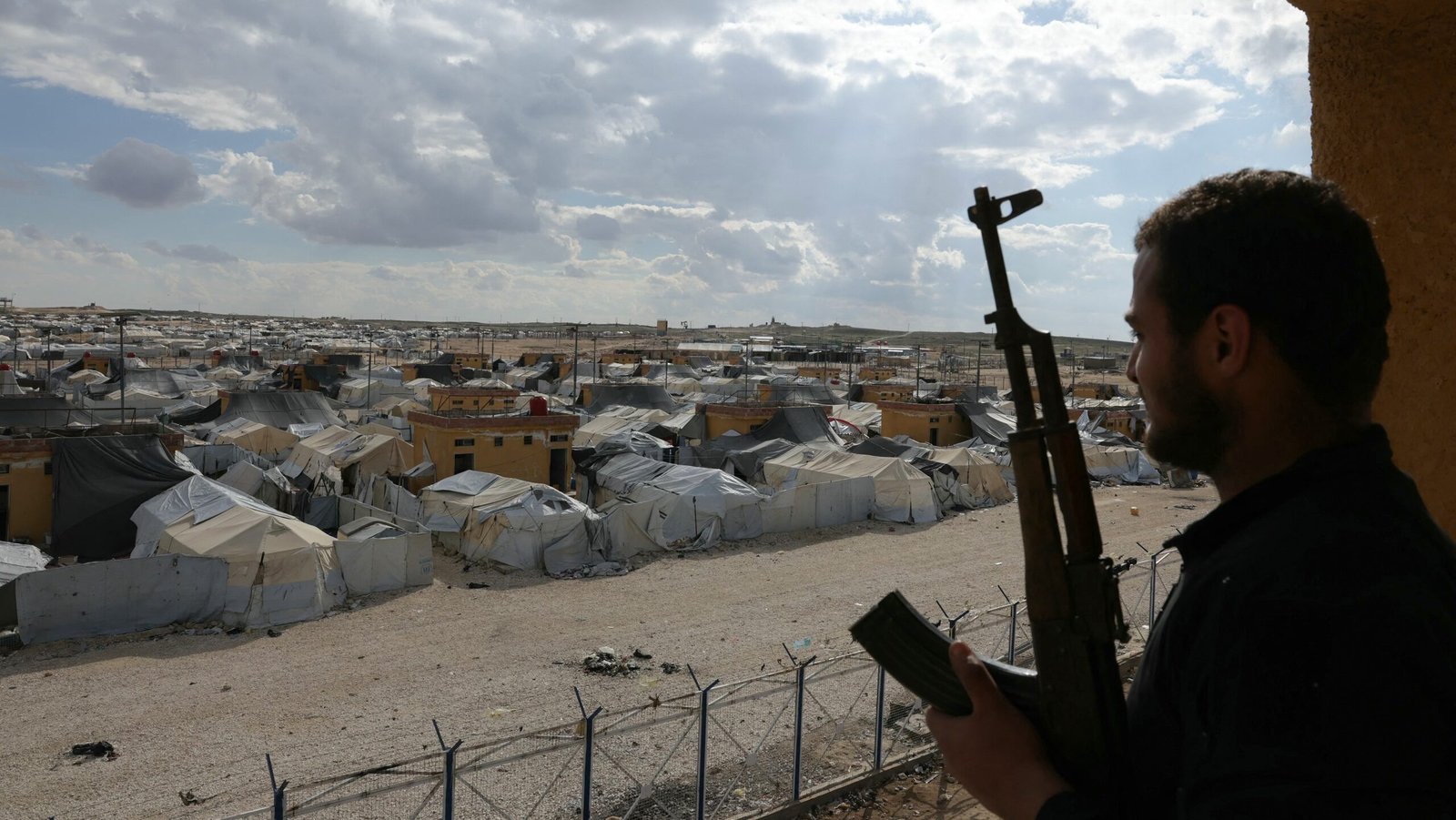
UN investigators and counterterrorism researchers say thousands of foreign nationals with alleged ISIS links remain in al-Hol, Roj, and SDF-run detention facilities in northeastern Syria. The unresolved status of foreign fighters has remained a major security concern, with UN monitors warning that jihadist networks in Syria continue to benefit from instability and weak state control in some areas.
Experts believe ISIS’s latest call directed at these fighters reflects fears within the organization of losing what remains of its most experienced cadres, while also attempting to remobilize them into a new project centered on guerrilla warfare and long-term attritional conflict.
[The latest message] reflects ISIS’s attempt to exploit any transitional phase or security shifts in order to reactivate its cells
In this context, Abdul Rahman Riyad, a Syrian affairs analyst who has written on security and political developments in Syria, told The Media Line that the latest message “reflects ISIS’s attempt to exploit any transitional phase or security shifts in order to reactivate its cells.” He added that the organization understands it has lost the ability to exercise broad territorial control and therefore now relies on propaganda, incitement, and a strategy of attrition through small mobile cells. He also noted that the group’s focus on foreign fighters reveals fears over the fragmentation of what remains of its human and military infrastructure.
[ISIS] is no longer capable of returning in the traditional form it appeared in during 2014, but it still poses a security threat due to the flexibility of its cells and their ability to move through desert regions
Retired Brig. Gen. Mustafa al-Sheikh, a security and strategic affairs expert, told The Media Line that ISIS “is no longer capable of returning in the traditional form it appeared in during 2014, but it still poses a security threat due to the flexibility of its cells and their ability to move through desert regions.” He explained that ISIS currently relies on rapid ambushes, limited nighttime attacks, and targeting military roads and supply lines, adding that “what we are witnessing today is a different version of the organization, one that depends more on guerrilla warfare and security exhaustion than on direct control of cities.”
[ISIS’s latest call carries] more propaganda and psychological dimensions than indications of a broad military comeback
Syrian academic and political researcher Dr. Mahmoud al-Hamza told The Media Line that ISIS’s latest call carries “more propaganda and psychological dimensions than indications of a broad military comeback.” He explained that the group is attempting to preserve its image among supporters after years of setbacks, which is why it focuses heavily on mobilizing rhetoric and portraying itself as an active force despite continued security pressure. He added that ISIS benefits from any security fragility or economic and social crises to rebuild its clandestine networks, especially in desert and border regions that remain difficult to fully secure.
On the other hand, Syrian authorities insist that the threat posed by the group remains under control. A security spokesperson for the Syrian Interior Ministry told The Media Line that security agencies “continue to monitor ISIS cell movements closely” and have managed in recent months to thwart several plots and arrest individuals linked to the organization.
The spokesperson, whose name is being withheld for security reasons, stated that the recent propaganda messages “reflect the weakness the organization is experiencing more than any real strength on the ground.” He added that security forces continue operations in the Syrian desert and eastern Syria and will not allow any terrorist threat to reemerge amid intensive security and intelligence coordination aimed at preventing the exploitation of any security vacuum.
Although ISIS no longer possesses the military and political capabilities that once enabled it to establish what it called a “caliphate,” recent developments indicate that the organization’s threat has not entirely disappeared and that it continues to seek opportunities to exploit instability and security gaps in order to reactivate its armed networks inside Syria. As Syrian forces and their allies continue pursuit operations, the issue of foreign fighters and the camps scattered across northeastern Syria remains one of the country’s most complicated files, amid growing fears that these environments could become fertile ground for the resurgence of extremism in the years ahead.