Originally published by Pacific Forum, this article is republished with permission.
In barely half a year, Prime Minister Sanae Takaichi has pushed Japan’s defense policy into unfamiliar territory. The FY2026 main defense budget has reached 9.04 trillion yen (approximately US$58 billion), with total security-related spending at roughly 10.6 trillion yen, at about 1.9% of GDP.
The 2% threshold, long treated as sensitive, has effectively been reached ahead of schedule. At the April 2026 LDP convention, she signaled that constitutional revision is imminent, with a proposal targeted for 2027.
This is more than higher spending. It is a compressed phase of military normalization under pressure. The driver is a China-Taiwan trilemma: Japan must deter China, prepare for instability around Taiwan and hedge against uncertainty in US commitments, all without provoking escalation or exhausting its own capacity.
While a stronger military posture can enhance deterrence and reassure the United States, rapid acceleration still creates inherent trade-offs, and prioritizing one objective can weaken another in practice.
The pressing question is whether Japan can transform this accelerated buildup into enduring military capability before structural limits impose constraints.
Acceleration beyond predecessors
Japan’s trajectory did not begin with Takaichi. Under long-serving Prime Minister Shinzo Abe, the outer boundaries of postwar security policy were stretched, most notably through the 2015 legislation that reinterpreted Article 9 to permit limited collective self-defense.
Fumio Kishida, prime minister from 2021-2024, consolidated that trajectory, committing Japan to reach 2% of GDP in defense spending by FY2027 while revising core strategic documents.
Takaichi has forced execution under time pressure. Her February 2026 supermajority mandate allowed her to compress what had been a gradual process. Speed has reduced political resistance, but it has also limited the time available for institutions to absorb change.
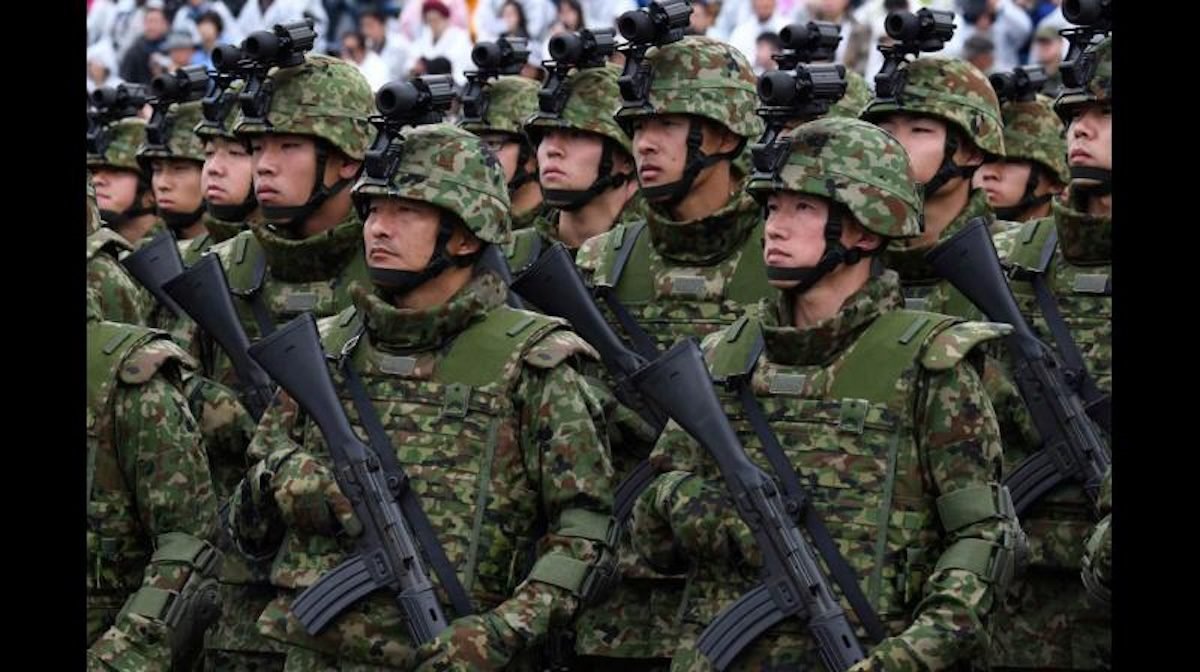
The March 2026 reorganization of the Self-Defense Forces reflects this shift. A centralized Fleet Surface Force concentrates naval command, while a new Amphibious and Mine Warfare Group sharpens the focus on island defense. The Air Self-Defense Force has expanded into an Air and Space Self-Defense Force.
Procurement has accelerated, including Tomahawk acquisition and upgrades to indigenous systems. Restrictions on arms exports have been eased, signaling a more active role in defense industrial cooperation.
The emphasis has moved beyond preparing for contingencies and toward shaping them. That transition brings initiative, but also greater exposure to miscalculation and institutional strain.
The China-Taiwan trilemma as the central driver
The strategic logic behind this acceleration is rooted in geography and timing. China’s military modernization continues at scale, accompanied by persistent gray-zone activity around the Senkaku Islands. At the same time, a Taiwan contingency, whether through blockade or direct force, has become a planning scenario rather than a remote possibility.
Japan sits uncomfortably close to this potential flashpoint. The Nansei Islands (also called the Ryukyus) extend toward Taiwan, with some points only about 110 kilometers (68 miles) away.
Critical sea lanes passing through the Miyako Strait and the Bashi Channel carry the vast majority of Japan’s energy imports. Disruption in these corridors would register immediately as an economic shock.

Tokyo increasingly treats Taiwan as strategically aligned but operationally constrained.
Political gridlock and readiness gaps raise doubts about its ability to sustain a prolonged defense.Japan cannot assume time or US availability will be on its side, particularly under an administration that frames alliances in more transactional terms.
These pressures cannot be reconciled cleanly. Strengthening deterrence risks escalation. Preparing for a Taiwan contingency demands resources that strain sustainability. Hedging against US uncertainty requires autonomy that can complicate coordination. The result is a managed tension rather than a balanced strategy.
Geographic focus and operational shift
Japan’s response is most visible along its southwestern arc. The islands of Yonaguni, Ishigaki, and Miyako are being fortified with missile deployments, surveillance systems and logistical infrastructure designed to support sustained operations.
Forward arming and refueling points extend air coverage. Unmanned systems improve surveillance while reducing risk to personnel. Electronic warfare capabilities aim to disrupt adversary targeting.

This “southwestern wall” is a distributed network designed to complicate movement through the First Island Chain and raise operational costs. The emphasis lies on denial – slowing and constraining an adversary rather than defeating it outright.
From Beijing’s perspective, such a network complicates rapid coercive options but does not eliminate them. Saturation tactics or blockade strategies could still impose severe pressure, especially if Japan struggles to sustain operations. Denial depends as much on endurance as on initial positioning.
The core constraints: Human resources, demographics, and doctrinal legacy
The ambition of Japan’s defense buildup faces structural limits that are harder to overcome than budget ceilings.
The most immediate is manpower. As of the end of FY2024, the Self-Defense Forces stood at 89.1% of authorized strength, with recruitment shortfalls persisting despite expanded eligibility and retention measures. This gap already affects readiness.
A denial strategy built on dispersed, high-tempo operations across the southwestern islands is manpower-intensive. It requires rotation, redundancy and the ability to absorb attrition. Japan is weakest where its strategy demands the most.
Demographic trends reinforce this constraint. The pool of recruitment-age citizens continues to shrink, as it is projected to decline by another 30% or so by the mid-2040s, while competition from the civilian labor market remains strong. Expanding the force will be difficult regardless of budget growth.
Doctrine presents a different challenge. The long-standing emphasis on an exclusively defense-oriented policy under Article 9 has become increasingly detached from operational practice. Counterstrike capabilities and force restructuring point toward a more flexible doctrine. Takaichi’s push for constitutional revision seeks to reconcile this gap, but the process remains politically sensitive.
Even where funding exists, conversion into capability is uneven. Roughly 1 trillion yen in defense allocations go unspent annually due to procurement delays, industrial bottlenecks, and currency effects. The constraint is no longer willingness to spend, but the ability to sustain capability over time. These pressures concentrate risk in long-duration operations, where initial gains are hardest to maintain.
Historical echoes as cautionary restraint
Japan’s postwar identity continues to shape both domestic debate and external perception. The legacy of World War II and the normative weight of pacifism remain embedded in political culture. They no longer function as an outright barrier, but they define the boundaries of acceptable policy.
Public protests in April 2026, including a large demonstration outside the Diet and coordinated actions nationwide, reflect persistent unease. Coalition dynamics reinforce the need for caution. Younger voters appear more open to a stronger defense posture, but this openness does not translate into unconditional support.
Externally, China continues to frame Japan’s military developments through historical narratives, while other regional actors watch more quietly. Tokyo’s challenge is to signal restraint externally while expanding capability internally. Perception remains integral to deterrence.
Forward outlook: 2026–2035 inflection points
The upcoming revisions to Japan’s National Security Strategy will shape the next decade. Technology will play a larger role, particularly in unmanned systems and AI-enabled support, offering partial relief from manpower constraints. Partnerships will deepen, including with the Philippines and Australia.
Several trajectories stand out. Prolonged gray-zone pressure in the East China Sea would test operational endurance, exposing weaknesses in personnel and logistics.
Economic coercion by China, combined with fiscal constraints, could slow expansion. A successful constitutional revision could strengthen legal clarity and alliance coordination, while testing domestic cohesion.
Each path stresses a different dimension of Japan’s strategy – operational endurance, fiscal sustainability or political legitimacy. None can be managed through spending alone.
Realism must match resolve
Takaichi has supplied what Japanese defense policy long lacked: urgency backed by resources. The challenge has shifted. It is no longer about overcoming political hesitation or breaking fiscal taboos.
Japan’s rearmament now depends on whether the state can sustain what it has chosen to begin. The constraints it faces are enduring, not transitional. How they are managed will determine whether this acceleration produces lasting military capacity or a force that expands quickly but struggles to endure when it is tested most.
Tang Meng Kit (mktang87@gmail.com) is a Singaporean freelance analyst and commentator. He graduated from the S. Rajaratnam School of International Studies (RSIS), NTU, Singapore in 2025. By profession, Meng Kit works as an aerospace engineer. He has keen interest in geopolitics and cross-straits affairs.