
“What kind of doctor was dr. pepper,” Utah real estate agent Kouri Richins once asked a search engine. (Sadly, there was no actual Dr. Pepper.)
But it was Richins’ less innocuous online searches that helped a jury find her guilty of murdering her husband Eric via fentanyl overdose—and of hoping to collect life insurance policies she had opened in his name but without his knowledge.
Richins was yesterday sentenced to life in prison without parole; her Internet history played a key role in the trial. A few weeks after Utah police began their investigation into Eric’s March 2022 death, they seized Kouri’s iPhone. Comparisons with records from her cell phone provider suggested that numerous text messages around the time of Eric’s death had been deleted from the device. In addition, cell phone tower pings helped establish where Kouri had been in the days before Eric’s death, which were a key piece of evidence in the state’s case against her.
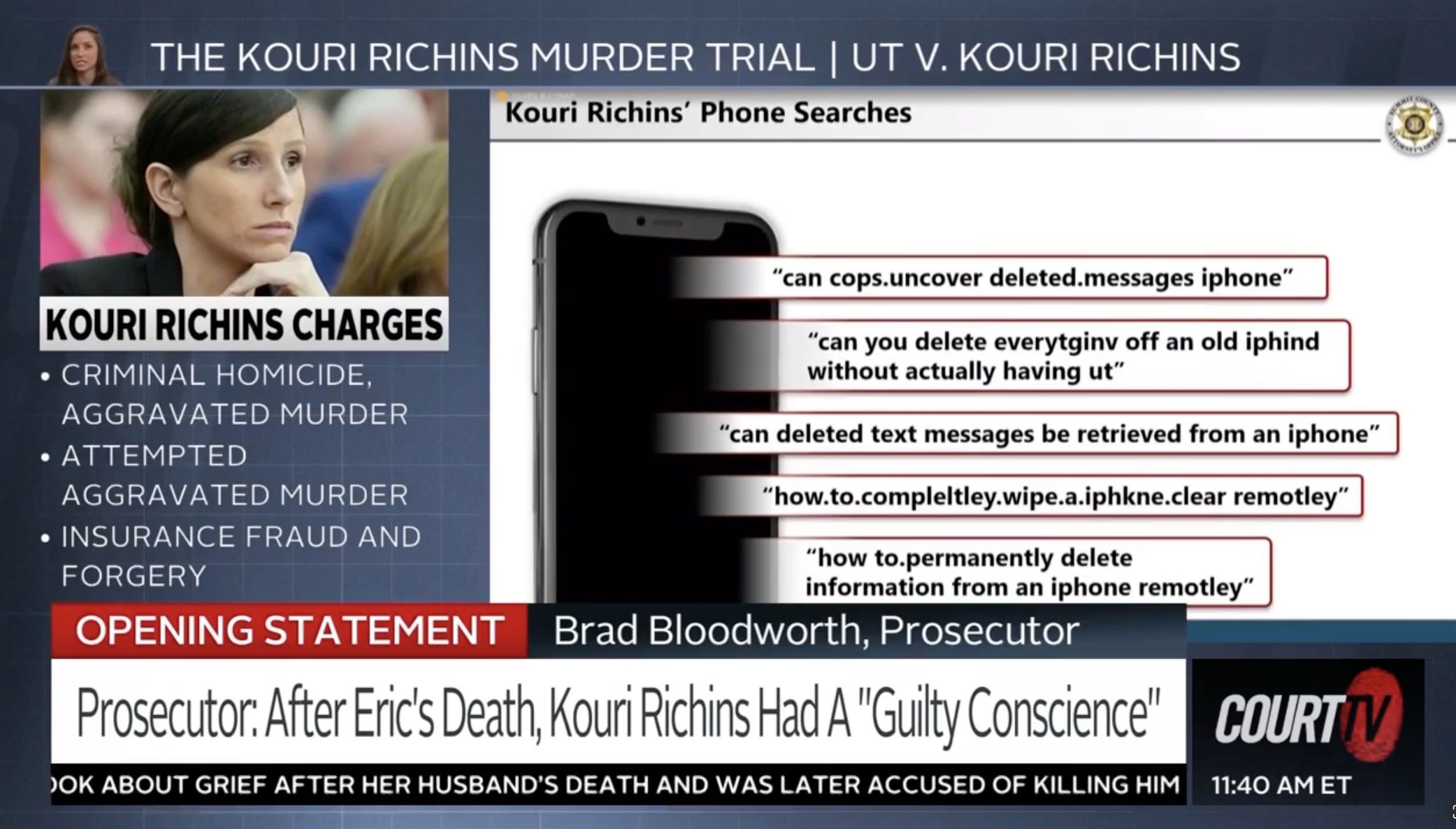
But it was her second iPhone that really made headlines. In April 2022, Kouri bought a replacement for her seized device and soon began searching for things which, at the very least, looked suspicious. Here are the five searches prosecutors decided to present to the jury during opening statements (which you can still watch on CourtTV) at Kouri’s trial earlier this year:
- “can you delete everytginv off an old iphind without actually having ut” [sic throughout]
- “can deleted text messages be retrieved from an iphone”
- “how.to.compleltley.wipe.a.iphkne.clear remotely”
- “can cops force you to do a lie detector test”
- “women utah prison”
Later in the trial, prosecutors called Chris Kotrodimos (watch his testimony on CourtTV) to the stand. Kotrodimos was a cop turned private investigator who specialized in digital forensics, and he created a PowerPoint presentation showing even more relevant searches taken from this second phone. These included:
- “can cops.uncover deleted.messages iphone”
- “how to.permanently delete information from an iphone remotely”
- “luxury prisons for the rich in America”
- “if someone is poisoned, what does it go down on the death certificate as”
But this wasn’t even the full story. The New York Times notes that a “forensic analysis of burner phones used by Ms. Richins showed searches for… ‘how long does life insurance companies takento.pay’ and ‘what is a lethal.does.of.fetanyl.’”
Kotrodimos noted that Kouri had also visited web pages titled “what happens to deleted messages” and “how do police and forensic analysts recover deleted data from phones.”
And a local news channel said that she had accessed articles called “Signs of Being Under Federal Investigation” and “Delay in Claim Payment for Death Certificate with Pending Cause of Death.”
Many of these searches and articles could be explained as attempts to understand the case evidence or to prepare for future outcomes. Still, the repeated emphasis on remote deletion of iPhone data looks more sinister, and the messages certainly helped the prosecution. A jury convicted Kouri Richins of murder and various forms of financial and insurance fraud.
Am I going to jail?
In HBO’s The Wire, criminal mastermind Stringer Bell famously had the good sense to know that one should not be “taking notes on a criminal fucking conspiracy.” But in case after case (after case!) that I cover, this is a lesson that defendants simply seem not to learn. Many will blab specific and even lurid details of their alleged crimes into search engines, text messages, and now AI tools.
For instance, there was the strange 2024 case from Minnesota in which Samantha Petersen, high on meth, hit an Amish buggy with her car. She killed two children and a horse. When police arrived, Petersen’s twin sister tried to convince police that she (the twin) had been the driver.
The evidence against Samantha included, as usual, phone information, which revealed Internet searches for “what happens if you get in an accident with an Amish buggy and kill two people” and “if you hit a buggy and kill two people are you going to prison?”
Thanks to other phone data, this wasn’t a particularly tough case to crack. According to the New York Times:
An employee at [the grocery chain] Hy-Vee, where both sisters worked, told investigators they had received a hysterical call from Samantha Petersen on the morning of the crash in which she said she was high on methamphetamines and had killed two Amish children…
She also sent a text message to another person admitting she had killed the children, according to the complaint.
Petersen pleaded guilty in 2025 and was later sentenced to four years in prison. Her twin sister got 90 days.
So many stories
Examples can be multiplied almost infinitely.
Hanging out in “child free” subreddits and researching how hot a car must be to kill a child might not seem suspicious until your young child turns up dead in a hot car days later.
This Internet evidence was used to help convict Justin Ross Harris of intentionally killing his son Cooper back in 2014. In 2022, however, the Georgia Supreme Court tossed out the murder verdict (PDF), saying that prosecutors had introduced needlessly inflammatory and prejudicial material about Harris’ personal life at his trial.
What kind of material? Well, it too came from Harris’ phone. Harris had been sexting multiple women throughout the day his son died in the car, so prosecutors used “nine color pictures of Appellant’s erect penis that the State extracted from messages and blew up to full-page size as separate exhibits,” the court said.
Though this did have some relevance for establishing motive and state of mind, it was far too lurid and may have swayed the jury unreasonably, the court said. Harris was no longer seen as a murderer, and the state decided not to retry him.
But he didn’t get out of prison, because his phone had also revealed “lewd and sometimes illegal sexual messages and pictures with four minors,” which had landed him in jail on separate charges. He was finally released in 2025.
Or there’s the case of the Florida woman accused of strangling and robbing her own friend for money to buy drugs. In the hour before the killing, police say the woman searched for:
- “chemicals to passout a person”
- “making people faint”
- “ways to kill people in their sleep”
- “how to suffocate someone”
- “how to poison someone”
This was allegedly in addition to visiting a Yahoo! Answers page called “Whats on those rags that make people pass out?“ and a Wikipedia entry for “murder-suicide.“
Our phones, our confessors
From nude photos to questions about dead children and “luxury prisons for the rich,” our devices have become such a part of our lives that there is almost nothing people will not confide to them.
This extreme trust sits uneasily against an extreme paranoia about our gadgets. For years—as just one example—enough people have asked whether Facebook listens to your microphone without permission that the company has an official response.
But as examples like those above illustrate, there’s little reason for companies to resort to outright spying like this, because users simply can’t wait to divulge the most intimate details of their minds and bodies voluntarily. Even if you’re a privacy mode-using pro, your search history may be just a quick subpoena away.