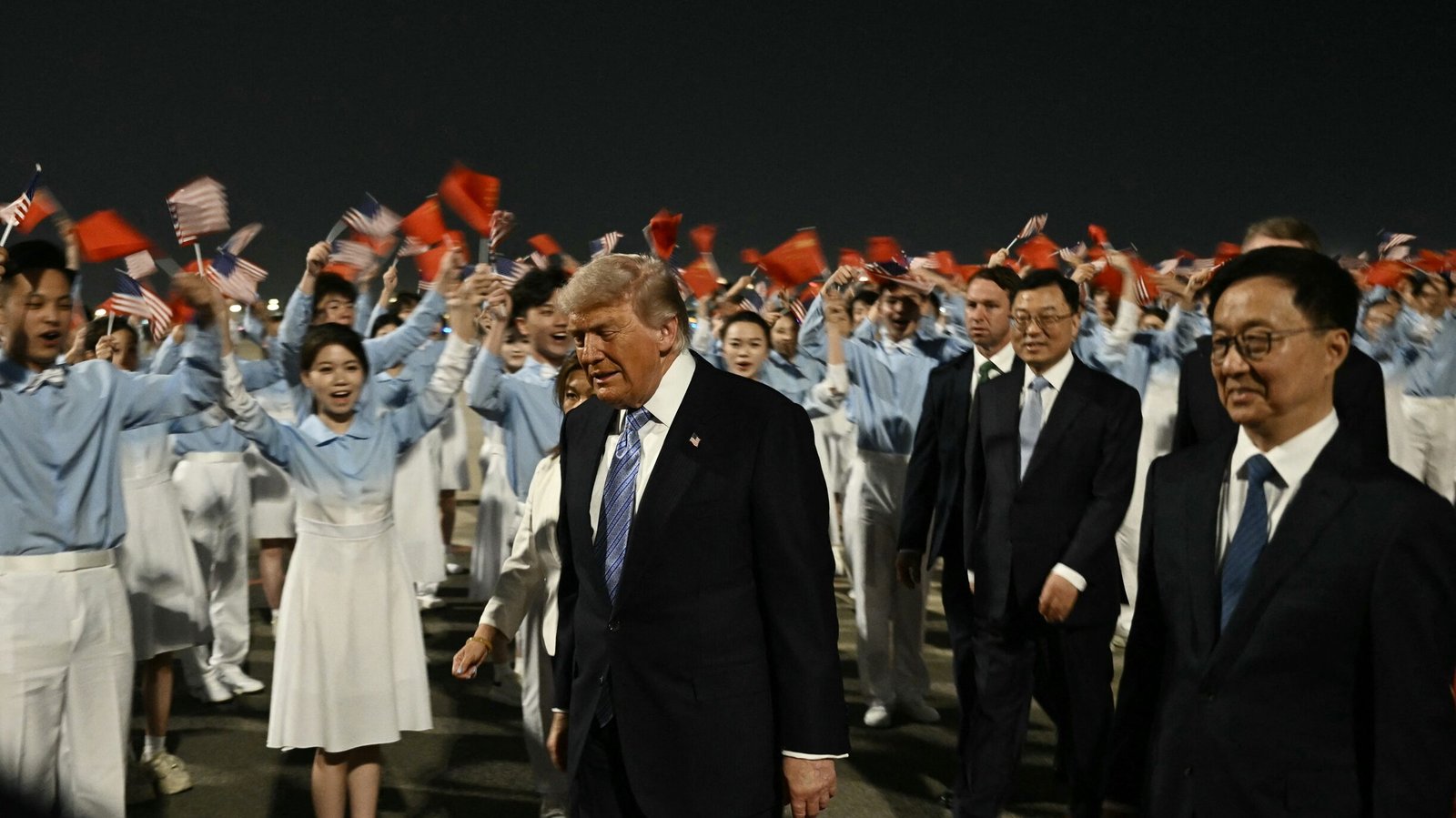
Temporary deals on tariffs, rare earths, and diplomatic language may give both leaders short-term wins while leaving deeper conflicts untouched
US President Donald Trump arrived in Beijing on Wednesday for a state visit and scheduled talks with Chinese President Xi Jinping, with trade, rare earths, Taiwan, artificial intelligence, and the Iran war expected to dominate the agenda. The visit may produce visible deliverables, but the larger test is whether either side can gain leverage while leaving the deepest disputes unresolved.
The two leaders are expected to hold bilateral talks on Thursday, with the summit focused on stabilizing economic relations, possible Chinese purchases of US agricultural goods and aircraft, rare earths, advanced chips, and the wider impact of the Iran war.
The visit follows the Busan summit in October 2025, where President Trump and Xi agreed to pause the sharpest phase of their trade war. The Guardian and The Washington Post reported that tariffs on Chinese goods reached as high as 145% during the escalation before the October truce. That truce reduced immediate pressure but did not settle the underlying disputes over technology controls, supply chains, market access, or strategic influence.
Taken together, the issues on the table point to a summit built around tactical bargains rather than strategic settlement: limited trade relief, managed language on Iran, guarded signals on Taiwan, and attempts by both governments to preserve leverage for the next round.
A foreign policy analyst who works on US-China strategic competition and spoke with The Media Line on condition of anonymity framed the summit as a likely continuation of Busan rather than a break from it.
What we can realistically expect from this meeting is basically a second round of Busan
“What we can realistically expect from this meeting is basically a second round of Busan,” the analyst said. “Both sides will walk out with some deliverables, a tariff extension, a rare earth license, maybe a good photo, and call it a historic result.”
That is not stabilization of the relationship, it is calendar management
“That is not stabilization of the relationship, it is calendar management,” the analyst added.
Beijing, the analyst said, is treating the talks as part of a phased negotiation, with commitments kept reversible and timed against the US political calendar. The closer Washington gets to the 2026 midterm elections, the analyst argued, the more valuable a visible diplomatic win becomes for President Trump.
Dr. Elizabeth Freund Larus, a Taiwan Fellow with the Republic of China Ministry of Foreign Affairs and an adjunct senior fellow at the Pacific Forum, said she did not expect a “big climactic summit” or breakthrough. Presidential visits, she told The Media Line, usually formalize work done earlier by lower-level officials.
For Larus, the summit should be understood through the practical interests of both governments. China wants tariff relief and market stability, while President Trump wants Chinese purchases of American goods and proof that his pressure campaign has delivered. Substantively, she said, the result is more likely to extend the same unresolved bargaining pattern.
“I honestly see it as more of the same rather than a breakthrough,” Larus said.
Guy Burton, author of China and Middle East Conflicts and visiting fellow at Lancaster University, also said the Beijing talks should not be mistaken for a decisive turning point in the relationship. High-level summits, he told The Media Line, are often treated as historic moments, but the main forces shaping US-China relations are structural, long-term, and already in motion.
Burton identified Taiwan, trade, rare earths, and Iran as central issues, but argued that the wider challenge for Washington lies in the ambiguity of its own strategic messaging. He said “the current US position often appears internally inconsistent,” making it difficult for both allies and adversaries to determine Washington’s priorities.
That inconsistency is especially visible on Iran. The war has moved from being a Middle Eastern crisis into a global pressure point affecting energy markets, sanctions enforcement, maritime security, and China’s relationship with both Tehran and Washington. Iran is expected to feature prominently in the Beijing talks, with US officials pressing China to use its influence with Tehran as the conflict strains regional diplomacy and global energy flows.
For Burton, the question is not only whether Beijing can influence Tehran, but whether Washington’s own Iran policy is clear enough to persuade China that cooperation would serve a defined objective. He said US policy has moved among several stated aims, including preventing nuclear escalation, weakening Iran’s regional influence, and broader regime-change signals, creating uncertainty for allies and adversaries.
Burton said President Trump’s statements matter because he remains the American president, but Washington’s frequent shifts make US signaling harder to interpret.
Iran is one of the clearest examples of how the summit’s formal agenda and its strategic subtext overlap. China has economic interests in continued energy access from Iran, while Washington wants Beijing to help restrain Tehran or at least avoid undercutting sanctions pressure. Reuters reported that Treasury Secretary Scott Bessent said China buys 90% of Iran’s energy, while oil-tracking data cited in public reporting has also pointed to China’s continuing role as a major buyer of Iranian crude.
The foreign policy analyst said Beijing is likely to present itself as a useful interlocutor on Iran while avoiding sanctions enforcement that would harm its access to discounted Iranian oil. In that reading, China’s contribution would be diplomatic language and process rather than concrete pressure on Tehran.
“What is going to happen is China offers diplomatic language and process, not actual enforcement,” the analyst said. “And the final communiqué will make that legible as cooperation.”
Beyond Iran, the conflict has given Beijing a fresh military reference point as it weighs US capabilities, Taiwan contingencies, sanctions pressure, and energy security. Dennis Wilder, former senior director for East Asia in the George W. Bush administration and professor of the practice at Georgetown University, framed the Iran conflict as a demonstration of American military reach and operational capacity.
“The conflict in Iran presents a complicated picture for China,” Wilder told The Media Line. “Militarily, Xi must now realize that Trump is not reluctant to employ the US military’s formidable offensive power for distant force projection when he deems it in the best interest of the United States.”
Wilder said the Iran war would be studied closely by the People’s Liberation Army because it showcased US and Israeli use of artificial intelligence, cyber capabilities, space-based sensors, drones, satellites, and integrated battlefield data. He argued that the Chinese military is still far from matching those capabilities in real combat conditions.
“The People’s Liberation Army (PLA) is far from having the kind of informationalized joint force warfare capabilities—using artificial intelligence, cyber, space-based sensors, etc.—exhibited by the US and Israeli militaries,” Wilder said.
For Beijing, Iran is both an opportunity and a constraint. China has benefited from discounted Iranian oil, but its economic relationships with Gulf states are far more valuable than its ties with Tehran. Wilder said this has limited China’s willingness to openly support Iran during the conflict.
“The wars in Iran and Gaza have demonstrated the limits of China’s influence in the Middle East,” Wilder said. “Pakistan, not China, is the mediator in the Iran conflict, and China had no role in mediating the resolution of the conflict in Gaza.”
Beijing’s caution, Wilder said, reflects its larger commercial stake in the Gulf. China’s trade with the Gulf Cooperation Council reached roughly $300 billion last year, compared with an estimated $10 billion to $40 billion in trade with Iran. Chinese firms have also been expanding their presence in Saudi Arabia under the “comprehensive strategic partnership” agreement signed with Riyadh in 2023.
Taiwan remains the most sensitive strategic issue between the two powers, even if it does not formally appear as part of the economic negotiation. Beijing considers Taiwan part of its territory and has not ruled out the use of force, while Taiwan rejects Beijing’s claim and says only its people can decide its future.
China’s Foreign Ministry said after a November 2025 Trump-Xi call that Xi told President Trump: “Taiwan’s return to China is an integral part of the post-war international order.”
For Burton, Taiwan is precisely where US ambiguity becomes most consequential. He said one of Beijing’s likely red lines will be preventing any formal strengthening of US commitments toward Taiwanese sovereignty or security guarantees beyond Washington’s traditional framework of strategic ambiguity.
“Chinese leaders will be especially attentive to whether Trump might casually concede rhetorical ground, improvise unexpectedly or alter longstanding diplomatic formulations in ways that create instability,” Burton said.
Larus, speaking from Taipei, said concern over China remains present but should not be confused with panic. She argued that the threat environment has changed, but life in Taiwan continues without the sense of imminent crisis often suggested in Western media coverage.
“The people in Taiwan have been facing this threat from China for a very long time. It’s just that China was not able to make good on it until recently,” Larus said.
She added that people in Taiwan still question US commitments, especially in academic and government circles, and some are watching closely to see whether President Trump says anything in Beijing about Taiwan independence or Washington’s position on the island’s future.
Larus also argued that Xi may have reasons to avoid military action for now, especially given Taiwan’s internal political divisions, China’s own military uncertainties, and the high risks of war.
“Xi Jinping knows he doesn’t have to strike Taiwan. He doesn’t have to. Taiwan’s not going anywhere. It’s an island. It can’t go anywhere. Its population is declining. People aren’t having kids here,” Larus said.
She said China may see less risk in political pressure and influence operations than in invasion. Larus warned that Beijing remains skilled at cognitive warfare, social media influence, media penetration, and cultivating sources inside Taiwan’s military.
“China is very good, very, very good at cognitive warfare,” Larus said.
The foreign policy analyst said Taiwan is unlikely to appear in any trade text but will still affect the atmosphere of the talks. Chinese cooperation on trade or Iran, the analyst argued, is likely to become harder when US arms sales to Taiwan or technology export controls accelerate.
“It will not appear that way in any agreement text, but it will show up in the timing of concessions,” the analyst added.
Trade, tariffs, and critical minerals form the most visible area for potential deliverables. China dominates several parts of the rare earth and critical mineral supply chain, giving Beijing leverage over industries ranging from electric vehicles and consumer electronics to defense production. The International Energy Agency’s 2025 Global Critical Minerals Outlook warned that China is the dominant refiner for 19 of the 20 strategic minerals analyzed, with an average market share of around 70%.
Those vulnerabilities became visible in 2025, when Chinese exports of rare earth magnets reportedly plunged 74% year over year in May after export licensing restrictions, according to a Wall Street Journal analysis cited by Automotive World. Ford was among the manufacturers affected by rare earth magnet supply constraints, with Ford-focused industry reporting that some plants were temporarily shut down over the shortage.
For Burton and the foreign policy analyst, rare earths are a powerful source of leverage but not a weapon Beijing can use without cost. Burton said China wants to preserve stability and predictability, while the analyst said aggressive use of export controls could permanently accelerate allied diversification, as happened with Japan after 2010.
“That is why China uses the threat intermittently rather than going for a full cutoff,” the analyst said. “Some new US magnet production capacity is expected to start coming online in summer 2026, which would marginally reduce exposure, but real self-sufficiency is still years away.”
Beyond rare earths, trade remains central to the summit. President Trump’s tariff policy has been one of the most visible features of his China strategy, but its stated objectives have varied between industrial protection, revenue generation, and retaliation against unfair trade practices. Both sides are expected to discuss a possible extension of the October truce, potential tariff relief, and Chinese purchases of US goods, including agricultural products and aircraft.
Burton said President Trump’s tariff policy has mixed several objectives—protecting industry, raising revenue, and punishing unfair trade practices—that do not always point in the same direction. He added that legal challenges over presidential tariff authority could narrow the administration’s room to maneuver compared with what appeared possible a year ago.
Wilder, meanwhile, placed the summit in a broader military and strategic context. For China, the Iran war is a warning about US capabilities, but also a lesson about vulnerabilities in energy supply chains. The closure or disruption of the Strait of Hormuz reinforces long-standing Chinese fears about the Strait of Malacca, through which a large share of China’s Middle Eastern oil imports travel. China depends heavily on Middle Eastern energy flows, and any disruption in Hormuz carries direct energy-security stakes for Beijing.
A closure of the Strait of Hormuz, Wilder said, would remind China of the fragility of oil supply chains and deepen long-standing concerns about the United States’ ability to disrupt Chinese oil imports from the Middle East during a Taiwan contingency by blockading the Strait of Malacca.
He added that China is likely to look for alternative energy sources, a shift that could benefit US liquefied natural gas exporters if Beijing seeks to diversify away from vulnerable maritime chokepoints.
For Larus, China’s longer-term strategic movement may be most visible not only around Taiwan but also in the South China Sea and Central Asia. She said Beijing is building naval reach while expanding land routes to reduce exposure to US-controlled maritime chokepoints.
The summit’s importance may lie less in its formal conclusions than in the balance of leverage each side accumulates while leaving major disputes unresolved. For Beijing, time can be an asset if negotiations are managed through temporary extensions and controlled concessions. For Washington, the challenge is to convert pressure into enforceable outcomes without giving China symbolic wins on Taiwan, sanctions, technology, or supply chains.
Burton said the wider global order is already undergoing a structural shift, with deeper changes taking place through trade measures, military positioning, technological competition, and erosion in the wider international order. Still, the final test of the Beijing talks may be narrower and more immediate: Which side leaves with more leverage for the next round?
The foreign policy analyst framed the issue as a question of strategic clarity.
At the end of the day, this meeting is not about resolving the specific disputes. It is about who accumulates position while the disputes stay open.
“At the end of the day, this meeting is not about resolving the specific disputes. It is about who accumulates position while the disputes stay open,” the analyst said.
“The Americans arrive in Beijing with a transactional agenda, wanting to close line items, and the Chinese arrive knowing exactly what they are willing to concede and what they are not,” the analyst added. “That asymmetry in strategic clarity is the most important variable in the room, and it will not appear in any press release.”