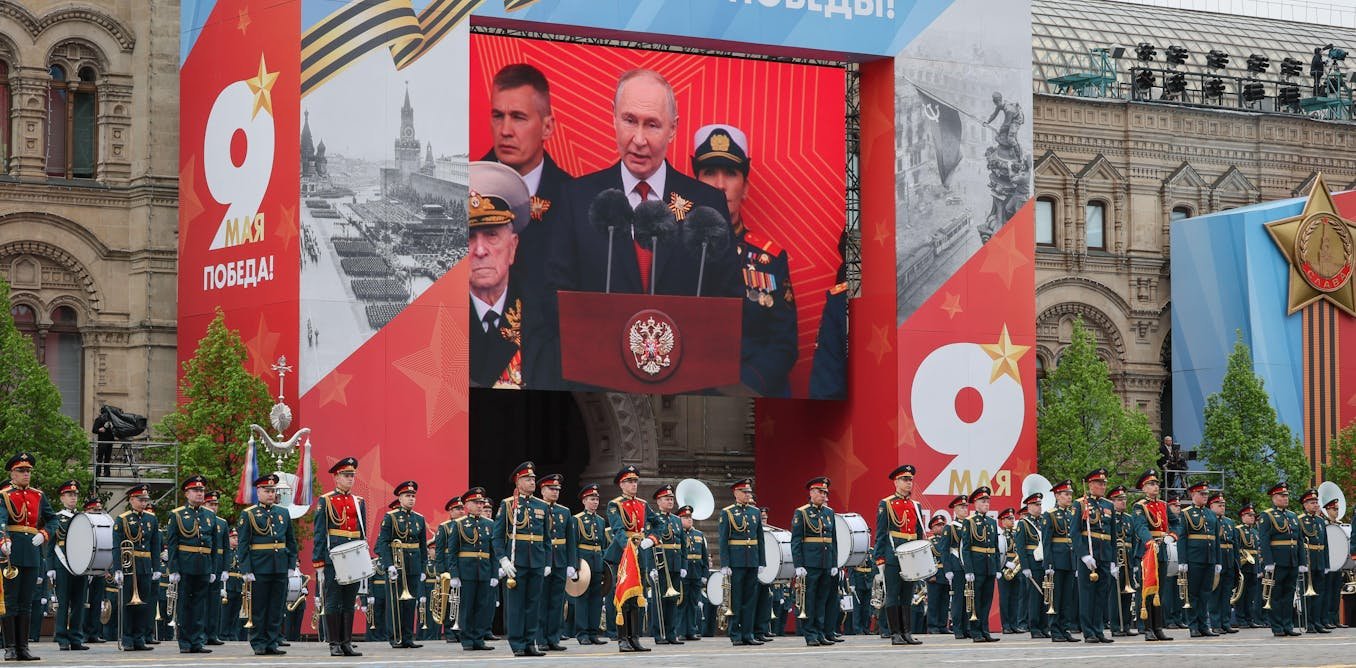
The military parade through Moscow’s Red Square on May 9, “Victory Day”, is the pinnacle of Russia’s annual celebrations marking the end of the second world war. Televised live and watched by millions, including invited foreign dignitaries, the Victory Day parade is all about showcasing Russia’s status and pride.
The first Victory Day parade was held in 1945 amid the triumph and relief at the defeat of Nazi Germany. A second was held in 1965 – but only two more were staged by the Soviet Union, in 1985 and 1990.
Under the leadership of Vladimir Putin, however, the parade has become a huge demonstration of Russia’s military prowess and might. And, since the start of Russia’s mass invasion of Ukraine in February 2022, the parade has also provided a snapshot of the progress of the conflict, including the country’s wartime mood and the extent of its international support.
But this year’s Victory Day parade showed the world a Russia that is fearful, diminished and isolated. There were no military vehicles or equipment on display. Instead, the products of Russia’s military industry were only visible to the crowds in video images displayed on big screens. Concerned that Ukraine might attack Moscow during the parade, Russian officials made the decision to protect valuable weapons needed for the war by withdrawing them from the event entirely.
The Russians had good reasons for their anxieties. Ukraine has developed the capability to strike targets deep inside Russian territory. Just a few days before the parade, two of Moscow’s airports were temporarily closed in response to hundreds of drones reportedly attacking in multiple regions of Russia, including near the capital.
This is not the first time that Russian officials have scaled down a Victory Day parade out of concern about Ukrainian attacks. In 2023 the situation was similar, with drone strikes in Russia leading up to the holiday amid widespread expectation of an imminent major Ukrainian counteroffensive. But even then, the number of military vehicles in Red Square not eliminated entirely. And the following year the parade featured launchers for intercontinental ballistic missiles to emphasise that Russia was willing and able to use any means necessary – including nuclear weapons – to impose its will on Ukraine. In 2025 the parade featured nearly 200 military vehicles.
Now, in the fifth year of the war, the Russian leadership is clearly concerned about their ability to protect their capital city from the Ukrainians, despite surrounding Moscow with elaborate air defences – including some equipment hastily relocated from combat zones.
It was not only the absence of military equipment that made this Victory Day parade underwhelming. One of the features of the event that helps to elevate it beyond a national holiday is the presence of international distinguished guests in the audience. This year, only a handful of national leaders were in attendance, three of whom represent former Soviet states and close allies of Russia: Belarus, Kazakhstan and Uzbekistan.
The contrast with last year’s parade was stark. In 2025 – to celebrate the 80th anniversary of the end of the second world war – Putin hosted leaders from nearly 30 countries, most notably China’s president Xi Jinping, who was given the place of honour next to Putin. Chinese soldiers marched in the parade, providing a further symbol of the cooperation between the two countries and the support that Moscow could rely on from Beijing.
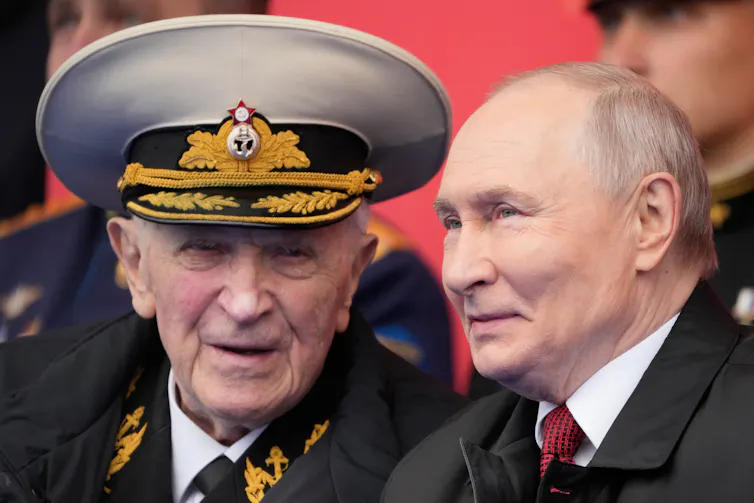
This year Russia’s president was surrounded not by powerful world leaders but by elderly war veterans placed around him in the viewing stand. In this company, Putin looked like just another old man, dreaming of glory days long behind him.
The sharp reduction in the number – and status – of foreign leaders that the Russians were able to attract to Moscow this year reflects changes in the international political climate that are not in Russia’s favour. In 2025, the Slovakian prime minister, Robert Fico, attended the parade – an indication of rifts within the European Union over the war and support for Ukraine.
In 2026 Fico was again in Moscow – but didn’t attend the parade. Last year Venezuelan President Nicholas Maduro sat in the viewing stands – this year he sits in a US jail having been removed from power in an American raid.
War-weariness in Russia
Putin’s Victory Day speech this year was another indication of a change in Russia’s fortunes, striking a far less confident tone than in previous years. In 2023, the Russian president compensated for that year’s scaled-back parade with defiant rhetoric, claiming Russia was under threat of attack from the west and styling the conflict as “the people’s war”. In 2024, Putin responded to a suggestion from French president, Emmanuel Macron, that western troops might be deployed to Ukraine with thinly veiled threats that Russia might use nuclear weapons to reassert its dominance.
This year Putin was far more subdued. Although he denounced the west and claimed that victory would belong to Russia, these statements had a tired, ritualistic feel. His emphasis on Russia’s ability to endure anything and respond to any challenge hinted at the current state of the war.
Russia is losing territory on the battlefield to the Ukrainian forces for the first time since 2024 and is reported to be losing troops faster than it can replace them. Meanwhile, Ukrainian drones regularly attack Russian oil refineries, threatening Moscow’s ability to sell its most profitable export.
But this war is far from over. Russia still has a large military, a well-resourced defence industry and is increasingly drawing in foreign soldiers to fight on its side – North Koreans marched alongside Russian troops in the parade.
But while Russia may not be on the verge of defeat, the way that it celebrated its most important holiday of the year suggests a new war-weariness. It’s a big contrast with the confidence exuded by Ukraine’s president, Volodymyr Zelensky. His tongue-in-cheek decree giving Putin permission to hold the parade suggests a turning point in the two countries’ morale – at the very least.