The United States has sanctioned a new group of mainland China- and Hong Kong-linked companies and individuals accused of helping Iran secure drone materials and missile-related components, raising fresh tensions days before US President Donald Trump’s state visit to China.
The US Treasury Department said on May 8 that its Office of Foreign Assets Control (OFAC) had targeted 10 individuals and companies across the Middle East, Asia and Eastern Europe under its “Economic Fury” campaign against Iran.
The campaign is aimed at disrupting networks that Washington says help Iran’s military secure weapons and raw materials for Shahed-series unmanned aerial vehicles and ballistic missiles. The US State Department simultaneously designated four entities over their links to Iran’s conventional arms activities.
The China- and Hong Kong-related designations fall into several broad categories:
- Aerospace-grade materials: Hitex Insulation Ningbo Co Ltd and its legal representative Li Genping were accused of supplying, or trying to supply, millions of dollars’ worth of carbon fiber, honeycomb fabric and other aerospace-grade materials to Iran-linked Pishgam Electronic Safeh Company.
- Procurement support: Yushita Shanghai International Trade Co Ltd, AE International Trade Co Ltd of Hong Kong and HK Hesin Industry Co Ltd were accused of supporting procurement efforts for the Center for Progress and Development of Iran (CPDI), the latest name of the US-designated Center for Innovation and Technology Cooperation (CITC).
- Weapons-related financing: Mustad Ltd was accused of helping facilitate financial transactions tied to the Islamic Revolutionary Guard Corps’ procurement of millions of dollars’ worth of weapons.
- Satellite imagery: Meentropy Technology Hangzhou Co Ltd (MizarVision) and The Earth Eye Co (Beijing Mumei Starry Sky Technology Co Ltd) were accused of providing satellite imagery support for Iranian military activity.
The sanctions against the two Chinese satellite-imagery firms came against the backdrop of an earlier satellite allegation that Beijing had denied.
Citing leaked Iranian military documents, the Financial Times reported on April 15 that Iran had secretly acquired a Chinese-built satellite known as TEE-01B, giving the Islamic Revolutionary Guard Corps’ Aerospace Force a new capability to target US military bases across the Middle East. The satellite was launched from China and later acquired by Iran in late 2024.
The May 8 sanctions did not cover other recent reports about alleged China-to-Iran missile-fuel shipments. The Washington Post reported in early March that two cargo ships owned by a sanctioned Iranian shipping company had left a Chinese chemical-storage port carrying suspected rocket-fuel precursor materials and were heading toward Iran.
The Telegraph reported on April 3 that five vessels carrying sodium perchlorate, a precursor used in solid-fuel rocket propellant, were identified at or near Iranian ports. The reported quantity was said to be enough for hundreds of ballistic missiles.
Trump’s visit to Beijing
On April 24, the OFAC sanctioned Hengli Petrochemical (Dalian) Refinery Co Ltd for allegedly buying Iranian crude, while also targeting about 40 shipping firms and vessels accused of moving Iranian oil through a shadow fleet.
The May 8 action goes farther because it alleges support for Iran’s weapons supply chain, not just its oil revenue. That makes the case more sensitive after Trump warned on April 8 that any country supplying military weapons to Iran would face a 50% tariff on all goods sold to the US, with “no exclusions or exemptions.”
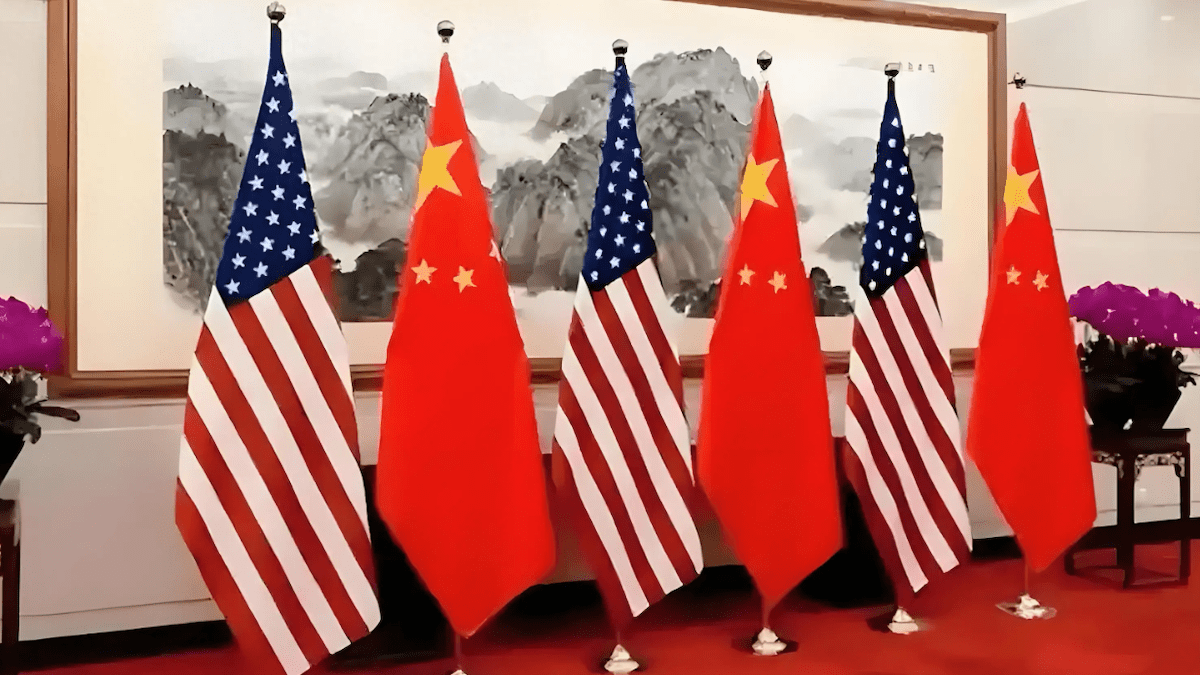
The timing has sharpened the political signal. Trump is due to visit China from Wednesday to Friday for talks with Chinese President Xi Jinping. Iran, Taiwan, trade and export controls are expected to be among the most sensitive items on the agenda.
On Monday, Beijing confirmed for the first time Trump’s upcoming trip to China.
“This will be the first visit to China by a US president in almost nine years. President Xi will have in-depth exchanges of views with President Trump on major issues concerning China-US relations and world peace and development,” the Chinese Foreign Ministry’s spokesperson Guo Jiakun said in a regular media briefing on Monday.
Guo said heads-of-state diplomacy was important in guiding China-US relations, adding that Beijing was ready to work with Washington to expand cooperation, manage differences and provide more stability in a volatile world.
But some Chinese commentators said the sanctions had cast a shadow over the summit.
“The US seems to believe that, with Trump’s China visit already scheduled, it can add sanctions to increase its bargaining chips, whether China is happy about it or not,” says a Shandong-based columnist using the pen name “Xiaoliu.”
“However, China’s swift and forceful legal countermeasures, together with Iran’s confident response, show that the other side does not intend to follow Washington’s script,” she writes, referring to the countermeasures as Beijing’s recent move to forbid local firms and banks from enforcing the US sanctions against Chinese “teapot” refiners.
“Sanctions and counter-sanctions have become a normalized tool in the China-US contest,” she says. “At such a sensitive moment, Washington’s decision to play this card again raises a question: is this a clever calculation or an arrogant misjudgment that could backfire? When Trump’s plane lands in Beijing, will the shadow created by these sanctions hang over the negotiating table?”
“This is not the first time the US has taken such unilateral action on the eve of high-level exchanges,” says a Guangdong-based writer surnamed Chen. “Before past bilateral meetings, Washington has often used sanctions or tough rhetoric to create leverage. This time, using Iran-related issues to sanction Chinese entities reflects the same game-playing mentality.”
He says this approach will not achieve its intended purpose and will instead damage the foundation of mutual trust. If Washington really wants to use the visit to improve bilateral relations, he adds, it should show sincerity rather than apply pressure in its talks.
The sanctions come as Washington and Beijing are exploring a possible trade package for the summit. Reuters reported on May 7 that the two sides are working on a proposed Board of Trade mechanism to identify products that could expand bilateral commerce without weakening national security or critical supply chains – including possible Chinese purchases of US crops, Boeing aircraft and American energy such as coal, oil and natural gas.
Whether Trump can secure Chinese commitments to buy more US products could affect Republican efforts to retain control of the House and Senate in the November midterm elections, according to some observers.
New security framework
The regional security argument has gained traction as the US-Iran ceasefire remains fragile. On April 8, Washington and Tehran agreed to a two-week ceasefire mediated by Pakistan, which was later extended while negotiations continued. However, after several rounds of direct and indirect talks via Pakistan, Trump has still not secured what Washington wants most: the removal or firm neutralization of Iran’s enriched-uranium stockpile.
On April 23, Chinese Foreign Minister Wang Yi met with Iranian Foreign Minister Seyyed Abbas Araghchi in Beijing. Wang said China and Iran had supported each other in recent years, deepened political trust, expanded practical cooperation and worked together against unilateralism and bullying, making the strategic significance of their ties more prominent.
On May 6, Wang met Araghchi again, where the Iranian side briefed China on the latest Iran-US negotiations and Tehran’s next steps.
Araghchi said political crises could not be solved by military means and that Iran would defend its sovereignty and dignity while continuing to seek a comprehensive and lasting solution through peaceful negotiations. He said Iran trusted China’s role in preventing further escalation and looked forward to Beijing continuing to promote peace.
“China is a trustworthy strategic partner of Iran,” Wang told Araghchi during the meeting. “China is willing to consolidate and deepen political mutual trust with Iran, maintain and strengthen high-level exchanges, deepen mutually beneficial cooperation in various fields, and continue to advance the China-Iran comprehensive strategic partnership.”
“Before Araghchi left for Beijing on May 5, the US had gotten ready to respond,” writes Jiangsu-based writer Jingting Guoji, who uses a pen name. “If China and Iran had reached a military deal, Washington could have quickly moved to intercept weapons shipments, expand sanctions or pressure China through its allies. But Araghchi was smart. He did not ask China for weapons. He asked China to help build a new security framework in the Middle East.”
“Iran showed diplomatic wisdom by not falling into the ‘military confrontation’ trap set by the US,” he says. “Instead, it dealt with Washington at the political and diplomatic level, using the balance among major powers to win greater strategic space.”
He says Wang’s response showed China’s attitude and determination in supporting a new security framework for the Middle East.
China has, in recent years, promoted a new Middle East security framework as part of its wider regional diplomacy. The idea involves balancing relations with major regional powers, including Saudi Arabia, Pakistan, Turkey and Egypt, rather than relying on a US-led security order.
“Pakistan played a clever move by using its role as intermediary to mislead the Trump administration,” Hong Kong-based pro-Beijing news outlet Flamingwheels said in a commentary.
It said Pakistan, in late April, passed the Territorial Transit Goods Ordinance 2026 to open six dedicated land routes for third-country goods to move through Pakistan into Iran, bringing new logistics activity and economic benefits to local communities. It also said that the new land routes would give the China-Pakistan Economic Corridor and Gwadar port a new strategic role at a moment of crisis.
Chinese media reports said the US military blockade of Iranian ports had continued for nearly a month, but China could still send about 100 to 150 containers to Iran by rail per week. The trains depart from Xi’an and travel through Kazakhstan and Turkmenistan before reaching Tehran, although the volume is only about 5% of what Iran could have received by sea before the blockade.
Read: Trump-Xi summit set to weigh Iran oil, Taiwan and US exports
Follow Jeff Pao on X at @jeffpao3