China’s open-weight AI models are coming for America’s market
The Trump administration is weighing whether to require American companies to disclose their use of Chinese artificial intelligence, Reuters reported on November 18.
The deliberation comes as models from Chinese developers, including DeepSeek, Alibaba and Moonshot AI, gain traction among US enterprises seeking capable, lower-cost alternatives to flagship offerings from leading American labs. Airbnb, for one, runs its customer service bot on Alibaba’s Qwen.
Yet even as Washington debates disclosure rules, American tech giants are actively selling access to those very rivals. In March 2025, Amazon Web Services added DeepSeek-R1 to Bedrock, its cloud AI platform. A US business can now deploy an AI engine built in China while paying an American provider to run it securely on domestic servers.
That arrangement captures a fundamental shift in the US-China tech rivalry. Chinese developers are building global market share by giving their software away, while American cloud providers make money from the infrastructure required to run it.
For frontier AI labs like OpenAI and Anthropic, which rely on premium subscription and API fees, the pressing question is how much pricing power they can retain when a free-to-download alternative performs nearly as well.
What China gains by opening the weights
Alibaba’s Qwen and DeepSeek’s R1 are frequently described as “open source,” implying their underlying code is entirely free to inspect and rebuild. “Open-weight” is the more accurate term.
Think of weights as the mathematical memory a model builds up while training on vast amounts of data. Publishing these weights allows anyone to download and run the finished AI, even though reconstructing it from scratch still requires the original training data and engineering recipe.
For corporate buyers, downloadable weights alter the financial equation. A firm can run a model on its own hardware, host it through a preferred cloud vendor, or lock in a vetted version without worrying about sudden changes from an outside provider.
Running the software still costs money for computing power, maintenance and legal compliance, but open weights give buyers control over where that money goes and who touches their data.
For Alibaba, the strategy serves a clear commercial funnel: every engineer who learns to build on Qwen becomes a prospective customer for its cloud business. Familiarity carries from one project to the next, extending Alibaba’s technological footprint far beyond its own servers even when it collects nothing upfront.
This approach only succeeds if the models deliver in practice. Stanford’s 2026 AI Index found that the performance gap between top US and Chinese models has effectively closed on standard benchmarks, though American systems still hold an edge in certain specialized domains.
The same report adds a caveat that matters here: the best closed models have pulled slightly ahead of the best open ones again, by about 3%. For an enterprise processing thousands of invoices a day, leaderboard rankings matter far less than two practical measures: reliability on its own documents and cost at scale.
Where the money goes
Cheaper, downloadable models place different parts of the US tech sector under very different pressures. Pure-play AI labs like OpenAI and Anthropic operate much like utilities, selling access to proprietary intelligence over the internet. When buyers find comparable capability at a fraction of the cost, those margins come under pressure.
Cloud giants like Amazon and Microsoft play a different game. Acting as digital landlords, they host dozens of competing models and collect rent regardless of which engine a client selects. More importantly, they sell the indispensable “plumbing”: the security layers, databases and monitoring tools that connect an AI brain to a company’s internal data.
Paying a cloud provider to manage an open-weight model has clear advantages. A bank can demand strict contractual guarantees on data privacy, uptime and technical support, so that someone is on call if the system breaks.
Running a downloaded model in-house gives the bank full control, but it shifts the burden of cybersecurity and maintenance onto its own IT staff. Widely distributed weights also raise unresolved questions about how security patches reach users and whether firms can fully verify the supply chain behind a downloaded file.
Meanwhile, competitive strategies on both sides of the Pacific are converging. OpenAI has released its own downloadable gpt-oss models under an Apache 2.0 license, allowing developers to run them freely.
Alibaba, for its part, gives away model weights while competing aggressively for enterprise cloud contracts. Both are using free software to win developers, and both are banking on hosting, support and enterprise integration to generate returns.
The stakes grow sharper as this dynamic moves from computer screens into the physical world. China already dominates global manufacturing of drones, industrial robots and electric vehicles.
Open-weight models are a natural fit for these machines: a delivery drone or warehouse robot can run a downloaded model directly on its onboard chip, avoiding network delays, per-query cloud fees and the security risk of sending sensitive camera feeds off-site.
If Chinese models become the default brain for physical machines as well as for enterprise software, the consequences will extend well beyond cloud computing.
What Washington would be regulating
Against this backdrop, Washington’s disclosure proposal runs into a thorny practical question: what actually counts as “using Chinese AI”?
A US firm might send customer queries directly to a server in China, run a Chinese-built model inside Amazon’s US cloud, or deploy downloaded weights on its own private servers. The model’s origin is identical in all three cases, yet data exposure, control over updates and legal accountability differ entirely.
Not everyone in Washington accepts that distinction. Representative John Moolenaar, who chairs the House select committee on China, welcomed the proposal and told Reuters that risks remain even when US companies run Chinese models on their own infrastructure.
The argument behind that view is about the model itself rather than where the data goes: a downloaded file can carry hidden behaviors or biases that no hosting arrangement removes.
That is a fair point, and it argues for testing models, not only tracking where they run. But a disclosure rule that treats all three cases alike would tell buyers and regulators very little about the risk they actually face.
Ultimately, the decisive test for enterprise buyers comes when a faster or cheaper model reaches the market. If a company can swap out its underlying AI engine without rebuilding its software or redoing months of security reviews, open-weight models give buyers enormous leverage.
If switching means overhauling the everyday tools employees depend on, the cloud providers, and their plumbing, will remain firmly in control.
King Charles Sparks Fresh Health Fears with Startling Medical Update
King Charles III has made a startling admission about the toll of growing older, delivering an unexpectedly personal remark about his body as he continues his battle with cancer.
The British monarch, who celebrated his 78th birthday on November 14, surprised listeners during a special appearance on Elton John’s Apple Music radio show when he joked that parts of his body were beginning to fall apart.
Although the comment was delivered with the King’s trademark dry humor, it carried added significance given his ongoing cancer treatment and the questions that have surrounded his health since his diagnosis nearly three years ago.
Charles made the remark during a previously recorded episode of Elton John’s Rocket Hour, which brought the two longtime acquaintances together to celebrate the 50th anniversary of the King’s Trust, a charity founded by the monarch in 1976.
The conversation initially focused on music, particularly John’s unforgettable performance of his hit I’m Still Standing at a charity gala in 1986.
Reflecting on the song’s enduring popularity, Charles praised its message of resilience and noted that both he and the organization had survived the passing decades.
John, 79, quickly interrupted with a playful observation.
“I’m still sitting now, though,” the music legend joked.
Charles laughed before making his unexpected admission.
“With occasional bits dropping off here and there,” the King replied. “I know this is a terrible problem as we get older.”
The lighthearted exchange offered a rare glimpse of the monarch speaking candidly about the physical challenges of aging, a subject that has become particularly sensitive following his cancer diagnosis.
While Charles did not suggest that his condition had worsened or disclose any new medical complications, his remarks inevitably drew attention to the uncertainty surrounding his health.
Buckingham Palace announced in February 2024 that doctors had discovered cancer while treating the King for an enlarged prostate. Officials subsequently clarified that the cancer was a separate condition, but they have never publicly identified its type or stage.
The diagnosis initially forced Charles to step away from public-facing royal engagements while he underwent treatment. He continued handling constitutional responsibilities behind the scenes before returning to public appearances in April 2024.
Since then, the monarch has gradually resumed a demanding schedule of royal duties, even as his medical care has continued.
In December 2025, Charles shared an encouraging development, revealing that his doctors were able to reduce his cancer treatment schedule during 2026 following a positive response to care.
The King described the progress as an important milestone and credited early detection and medical intervention for allowing him to maintain an active lifestyle.
However, the announcement did not mean he had been declared cancer-free. His treatment and medical monitoring continued, and Buckingham Palace has not publicly announced that he is in remission.
That distinction is important as Charles’s latest remarks circulate. His comments about aging were a joke rather than an official medical update, and there has been no confirmed announcement linking them to a deterioration in his cancer condition.
Despite the uncertainty surrounding his illness, Charles has shown few signs of slowing down his public schedule.
Just days before his birthday, the King completed an ambitious nine-day tour of the Caribbean, visiting the Bahamas, Guyana, and Antigua and Barbuda. The trip involved a packed schedule of official engagements, highlighting his determination to continue working while receiving medical care.
On November 13, he also visited the BRIT School in London and Surrey Street Market in Croydon, where enthusiastic crowds welcomed him with birthday wishes and a celebratory cake. HELLO!+3
His appearance alongside Elton John offered a different side of the monarch, with the pair trading jokes and sharing memories from decades of charitable work.
Their hour-long broadcast featured 14 songs, including music by Elvis Presley, Phil Collins, Lenny Kravitz, and Calvin Harris. Charles also recalled a memorable performance of All You Need Is Love during celebrations for his late mother Queen Elizabeth II’s Golden Jubilee in 2002.
The program was recorded in October at Apple’s London studios and aired on November 14, bringing together two prominent British figures who have experienced serious health challenges in recent years. The Royal Family+2
For Charles, the occasion was meant to celebrate music, friendship, and the lasting impact of his charity. Instead, his unexpected joke about his aging body has added another personal moment to the public conversation surrounding his health.
For now, however, the King’s own words about resilience may offer the clearest indication of his outlook. Despite his cancer diagnosis, advancing age, and the enormous responsibilities of the throne, Charles appears determined to keep going.
As he reminded Elton John during their conversation, he is still standing.
Israeli army launches renewed attacks on southern Lebanese towns
Smoke rises following Israeli airstrikes on the town of Kfar Tebnit in the Nabatieh Governorate, southern Lebanon, on November 03, 2026. [Ramiz Dallah – Anadolu Agency]
The Israeli army carried out a series of attacks on towns in southern Lebanon on Saturday, including artillery shelling and gunfire, Lebanon’s state-run National News Agency (NNA) reported, Anadolu reports.
An Israeli drone exploded on the roof of a house in the Deir neighborhood of Nabatieh al-Fawqa, while another exploded early Saturday near the cooperative in the town of Shoukin, in the Nabatieh district, the agency reported.
In the same district, Israeli military vehicles were seen moving through the town of Zawtar al-Sharqiya amid machine-gun fire in residential neighborhoods, the agency said.
The outskirts of Mayfadoun, Zawtar and Nabatieh al-Fawqa came under intermittent artillery shelling overnight, while the Israeli army set off an explosion between Zawtar and Kfartabnit, it added.
In the Bint Jbeil district, Israeli forces fired machine guns toward the town of Barashit early Saturday as military vehicles moved along its outskirts.
In the Marjayoun district, Israeli forces uprooted olive trees overnight on Al-Shariqa Hill in the town of Khiam, while military vehicles could be heard in the surrounding area, according to the outlet.
Israeli attacks in southern Lebanon have continued since March 2, despite a US-brokered framework agreement reached between Lebanon and Israel in June.
The understanding provides for security arrangements, including the withdrawal of Israeli forces from areas they occupy and the deployment of the Lebanese army there to assume security responsibilities.
Mini Pumpkin Pies combine flaky pastry and warmly spiced pumpkin filling with a swirl of maple-vanilla whipped cream for a lovely individual dessert.
Mini Pumpkin Pies bring everything wonderful about classic pumpkin pie into sweet little pastries made for sharing. Each one has a flaky, buttery crust and smooth pumpkin filling with brown sugar, maple, and just the right blend of warm spices. A swirl of maple-vanilla whipped cream adds a lovely finishing touch.
Best of all, these individual pumpkin pies bake in a regular muffin tin. There’s no slicing, no special tart pans, and no need to prebake the crusts. Refrigerated pie dough keeps things simple, while the homemade pumpkin custard tastes wonderfully rich and comforting.
These little pies are especially handy for holiday gatherings because you can make them ahead and add the whipped cream before serving. Arrange them on a dessert platter for Thanksgiving, Christmas, or any cozy fall celebration. They’re just as charming with afternoon coffee as they are after a holiday dinner.
Mini Pumpkin Pies combine flaky pastry and warmly spiced pumpkin filling with a swirl of maple-vanilla whipped cream for a lovely individual dessert.
Recipe Yield: 12 servings
INGREDIENTS
Pie Crust: 1 package (14.1 oz) refrigerated pie crusts (2 crusts) 1 tsp softened unsalted butter (for greasing)
Pumpkin Filling: 1 can (15 oz) pure pumpkin purée (not pumpkin pie filling) 1/2 cup packed light brown sugar 1/2 cup heavy cream 2 large eggs 2 tbsp pure maple syrup 1 tsp vanilla extract 1 1/4 tsp ground cinnamon 1/2 tsp ground ginger 1/4 tsp ground nutmeg 1/8 tsp ground cloves 1/4 tsp fine salt
Maple-Vanilla Whipped Cream: 3/4 cup cold heavy whipping cream 1 tbsp pure maple syrup 1 tbsp powdered sugar 1/2 tsp vanilla extract 1/8 tsp ground cinnamon (optional, for dusting)
INSTRUCTIONS
1. Prepare the muffin tin: Preheat oven to 375°F. Lightly grease a standard 12-cup metal muffin tin with softened butter.
2. Shape the pie crusts: Unroll the pie dough and cut twelve 4-inch circles, gently rerolling scraps as needed. Press each circle into a muffin cup, covering the bottom and sides without stretching. Refrigerate for 10–15 minutes.
3. Make the pumpkin filling: Whisk pumpkin purée, brown sugar, heavy cream, eggs, maple syrup, vanilla, spices, and salt until smooth and evenly combined.
4. Fill the mini pies: Divide the pumpkin filling among the chilled crusts, about 4 tbsp each. Leave approximately 1/4 inch of space below the pastry edges to prevent overflowing.
5. Bake until set: Bake for 25–32 minutes, until the crusts are golden and the filling is set around the edges. The centers should have only a slight wobble and reach at least 160°F.
6. Cool the pies: Let the pies rest in the muffin tin for 20 minutes. Carefully loosen with a thin spatula and transfer to a wire rack. Cool completely, then refrigerate until chilled.
7. Prepare the whipped cream: Beat the cold whipping cream, maple syrup, powdered sugar, and vanilla until medium-stiff peaks form. Spoon or pipe onto the chilled pies. Finish with a light dusting of cinnamon, if desired.
Helpful Tips to Perfect This Recipe
Use the right muffin tin: A standard 12-cup metal muffin tin creates generous individual pies. Cut the pastry into 4-inch rounds so the crust reaches the upper edges of each cup.
Keep the pastry chilled: Cold dough holds its shape better and helps create flaky layers. If the crust becomes soft while you’re working, refrigerate it briefly before filling.
Watch the pumpkin filling: Remove the pies when the edges are set and the centers barely wobble. The custard continues to firm as it cools. Overbaking can cause cracks.
Make them ahead: Bake the pies one or two days early and refrigerate in an airtight container. Refrigerate within 2 hours of baking and store for up to 4 days. Add freshly whipped cream just before serving.
Rate This Recipe
Enjoyed this recipe? Your rating helps other home cooks!
Review: Godzilla Minus Zero joins the list of truly stellar sequels
It’s a rare thing for a film sequel to match or even surpass its predecessor; The Godfather Part II and Terminator 2: Judgement Day are the best known examples on a pretty short list. Go ahead and add Godzilla Minus Zero to that list. Director Takashi Yamazaki’s sequel to his critically acclaimed Godzilla Minus One (2023) is everything one could want in a Godzilla movie: human pathos, great special effects, and, ultimately, two giant kaiju duking it out over who gets to destroy Japan (and eventually the world) the most.
(Spoilers for the first film below. Spoilers for Minus Zero but no major reveals until after the gallery. We’ll give you a heads-up when we get there.)
As I wrote previously, Yamazaki wanted to return to Godzilla’s filmic roots with Minus One, setting the events in postwar Japan and tapping into the monster’s symbolic representation of the Japanese perspective on the 1940s nuclear holocaust—while also incorporating all-too-human themes of guilt and redemption. That first film focused on kamikaze pilot Kōichi Shikishima (Ryunosuke Kamiki), who struggled with survivor’s guilt after he failed to take action when Godzilla attacked the Japanese base on Odo Island in 1945.
Knocked unconscious, Kōichi survived and awoke to find his parents and many others were killed in the World War II bombing of Tokyo. Kōichi rebuilt a life with a woman named Noriko (Minami Hamabe) and the orphaned baby she rescued, Akiko (Sae Nagatani). But then Godzilla re-emerged, and Kōichi resolved to die fighting the monster to atone for Odo Island. Kōichi saved the day and lived to tell the tale. He reunited with Noriko, who had a strange black bruise on her neck. And we saw a chunk of Godzilla’s remains start to regenerate, leaving things open for a sequel.
Godzilla Minus One was a massive hit, both in Japan—where it remains one of the highest grossing Japanese films ever—and worldwide, racking up $116 million globally and winning an Oscar for best visual effects. Yamazaki said in interviews at the time that there had as yet been no talk of a sequel—while also hinting at future directions a sequel might explore. He later admitted it was way of planting a seed for what would become Godzilla Minus Zero.
Godzilla Minus Zero is set two years after the events of the first film, with Kamiki and Hamabe reprising their roles as Kōichi and Noriko, along with Nagatani as Akiko. The family is just trying to live in peace after the devastation Godzilla inflicted on their country. Alas, a new kaiju emerges, arriving via meteorite and using its tentacles to feed on local wildlife before morphing into a dragon-like creature that causes fresh rampaging destruction. Fans of the genre will recognize this creature as Ghidorah, whose appearance in the film was teased in the various trailers.
It isn’t long before Kenji Noda (Hidetaka Yoshioka)—i.e., the dude with the magnificent wavy gray hair who is director of the Large-Scale Disaster Response Bureau—seeks out Kōichi for help in dealing with this new kaiju threat. His team is able to track Ghidorah’s movements via electrical storms and other pertinent weather patterns, thanks to meteorologist Makoto Aoyama (Masami Nagasawa). But the team has no idea how they might defeat this new threat to life and infrastructure. It’s hardly a spoiler to note that at some point, a regenerated Godzilla will come into play.
(WARNING: significant spoilers appear below. Stop reading now if you haven’t seen the film.)
Kaiju vs Kaiju
Ryunosuke Kamiki reprises his role as former kamikaze pilot Kōichi Shikishima
Ryunosuke Kamiki reprises his role as former kamikaze pilot Kōichi Shikishima
Minami Hamabe as his wife, Noriko
Minami Hamabe as his wife, Noriko
Sae Nagatani as Akiko
Sae Nagatani as Akiko
Minami Hamabe as his wife, Noriko
Sae Nagatani as Akiko
Still the best hair in the entire cast: Hidetaka Yoshioka as Kenji Noda, director of the Large-Scale Disaster Response Bureau
Min Tanaka as biologist Kanji Murakami
Masami Nagasawa as Makoto Aoyama
King Ghidorah mutates into his three-headed form
Levitating buildings seems to be Ghidorah’s superpower
Godzilla rises from the ocean depths to battle Ghidorah.
Yamazaki has retained the visual tone that made the film’s predecessor so striking; it feels like classic Godzilla fare of yore, just with 21st century cutting-edge visual effects. If anything, he’s upped his game on the special effects front, reflecting the larger production budget he had to work with. (It’s also the first Japanese movie filmed specifically for IMAX and it’s well-worth seeing in that format.)
Much of that budget went toward bringing the central monsters to cinematic life, and Godzilla Minus Zero does not disappoint. Ghidorah, for instance, responds to a bombing attack by mutating into its famous three-headed King Ghidorah form, complete with a spiffy new superpower: a “gravity beam” that lets the creature levitate entire houses (and, at one point, Godzilla) into the sky before dropping them back to the ground. And the kaiju vs. kaiju battle is spectacular in both scope and execution.
Yamazaki even managed to squeeze in what he called his “bucket-list” special effects shot inspired by a scene in 2008’s Cloverfield: Godzilla looming out of the Atlantic Ocean in front of the Statue of Liberty to wreck havoc on the statue and New York City in general. Granted, it occurs in a dream sequence of biologist Kanji Murakami (Min Tanaka), who survived the Hiroshima blast that killed his wife and children and longs for revenge. And it’s not just indulgence on the director’s part: the scene reinforces the traditional theme of linking Godzilla to nuclear radiation and the horrors of the atomic bomb.
Nor does Yamazaki ignore the human factor via the dilemma of his nuclear family trio. Kōichi must wrestle with his conscience: how can he risk his life again to battle a kaiju when it could mean leaving Akiko an orphan yet again should he fail? Noriko is infected with Godzilla’s radioactive G-cells—the only human to survive the mutations in her own body for so long. But her time could be running out, plus they’ve kept her infection secret for fear she will be taken away by the government for experimentation. Sometimes doing the right thing comes at great personal cost, and watching these quite ordinary people grapple with that reality brings emotional depth to the film.
The film ends on a suitably bittersweet note, and while Yamazaki hasn’t dropped any hints about a possible third film in the series, we’d love to learn more about Noriko’s strangely symbiotic connection to Godzilla via the G-cells in her bloodstream. Long may he reign.
Drones shut Genoa airport for two hours as Italy faces wave of hoaxes and cyberattacks
cde.news desk · 2 min read
A wave of hacking and hoax attacks that has targeted Italy in recent weeks was aimed at destabilising the country but posed no concrete threat to national security, Interior Minister Matteo Piantedosi said on Thursday.
“There is currently no emergency under way that poses a concrete threat to national security,” Piantedosi told parliament.
A series of hoaxes and cyberattacks has recently hit schools, supermarkets, blood banks, air traffic systems and broadcasters across Europe, disrupting daily life.
Last week, schools across Italy were evacuated after thousands received emailed bomb threats. In response, Prime Minister Giorgia Meloni’s government ruled that public buildings should not be evacuated unless there was concrete evidence of danger, in order to prevent further false alarms causing panic.
Piantedosi said the measure had proved effective. “On November 16, nearly 7,500 schools received such emails, yet only one evacuation was carried out,” he said.
Aim to destabilise Italy
Piantedosi said the attacks appeared designed to undermine confidence in state institutions. “We are facing hostile operations designed to maximize media coverage and emotional impact by exploiting the ease of anonymous communications,” he said.
Initial checks showed the emails, including recent false alarms involving airline flights, originated from compromised foreign accounts already under investigation by national authorities, he added.
Some European officials suspect Russia may be behind a campaign targeting countries that have supported Ukraine following Moscow’s invasion. Russia’s embassy in Italy has offered assistance in identifying those responsible.
Piantedosi said it was “still premature” to attribute responsibility for the attacks, but added that the only confirmed large-scale cyberattack so far had targeted supermarket refrigeration systems earlier this month.
Separately, drones forced the closure of Genoa’s Cristoforo Colombo airport for two hours in the evening. A flight ban on the airspace around the airport was issued at 8:10 pm and was lifted shortly after 10:00 pm, once all checks had been completed.
An Ita Airways flight bound for Rome Fiumicino was held on the runway without clearance to take off. Passengers were disembarked and later reboarded the aircraft. The possible presence of drones was reported to the east and west of the runway.
Following a meeting with Meloni on the issue last week, opposition parties criticised the government for what they described as inadequate investment in cybersecurity.
Piantedosi rejected that criticism, saying cybersecurity spending was expected to rise to €299 million ($328 million) in 2027 from €203 million this year.
New net-zero community will become Michigan’s first virtual power plant
This story was originally published by Canary Mediaand is reproduced here as part of the Climate Desk collaboration.
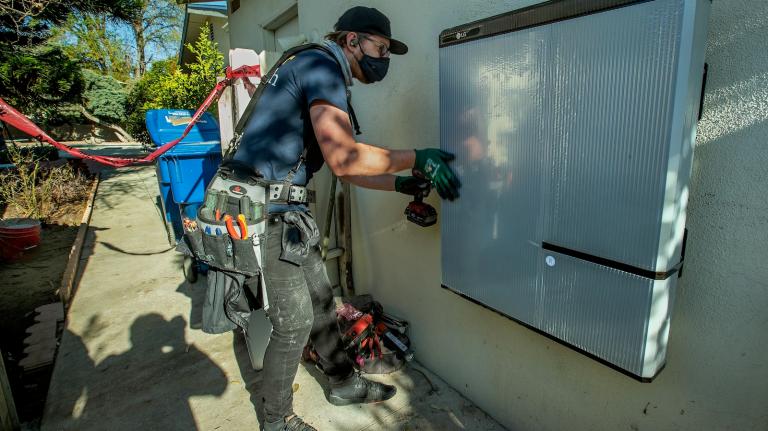
Mitch Hall and his wife, Lori, live in one of the most sustainable communities in the U.S. Their town house is among a few dozen residences constructed so far at Veridian at County Farm, a fossil-fuel-free, net-zero-energy development in Ann Arbor, Michigan. Homes here make about as much solar energy as they consume, with the help of batteries that save solar power for use in the evenings.
Now, the couple is eager to share the benefits of their clean energy infrastructure with the wider grid.
In the coming weeks, Veridian households can enroll in Michigan’s first residential pilot of a virtual power plant; Detroit-based utility DTE Energy will then be able to remotely control the network of residents’ home batteries to inject their stored solar power onto the grid when operators need it most.
“This pilot is an opportunity to test an approach that could ultimately provide a lower-cost way to meet growing energy needs and strengthen reliability,” Joi Harris, president and chief executive officer of DTE Energy, said in a statement. VPPs can smooth out demand peaks, reducing the utility’s need to invest in grid-infrastructure upgrades and generate kilowatt-hours with expensive fossil fuel peaker plants, both of which would pile costs on consumers.
The initiative “should work well for the residents, too,” Hall said. “DTE will pay us a little bit to be part of this project.” Because the utility will pull battery power automatically when the grid is strained and electricity prices are likely to be highest, “a neat part about the virtual power plant is you don’t have to spend a lot of time learning and trying to optimize,” he noted. “DTE will manage that battery for you.” (DTE did not respond to Canary Media’s request for exact figures on how much it would compensate customers in time for publication.)
Read Next
VPPs have existed for years but have been slow to gain widespread traction because of a host of factors. Utilities often haven’t been incentivized to embrace the approach, while home solar and batteries remain tooexpensive for many households in the U.S. But as electrification and the data center rush spur unprecedenteddemand, VPPs are taking off as a fast way to get power on the grid. Earlier this month, the Brattle Group estimated that 524 gigawatts of distributed energy resources harnessed in VPPs could save households on average $122 per year by 2050.
Currently, “there’s immense untapped capacity,” said Kevin Brehm, manager in the carbon-free electricity practice at clean energy think tank RMI.
Matt Grocoff, the founder of Thrive Collaborative, started to consider a VPP pilot at Veridian in 2019. He wanted the neighborhood to mimic an ecosystem — a resilient web of relationships in which individual organisms do more than just extract resources. For example, a tree in a forest turns sunlight into nutrients and shares them symbiotically with a vast, interconnected underground web of fungi.
Likewise, with a VPP, each Veridian home “can be producing energy that it needs and mutually beneficially sharing it across a network of energy rather than a linear grid that flows in only one direction,” Grocoff said.
DTE expects nearly 100 battery-equipped Veridian homes to ultimately participate in the pilot. So far, 44 market-rate homes with solar and batteries have been built, out of 120 planned, as have 50 affordable housing units that don’t have batteries yet, according to Thrive Collaborative. Battery manufacturer Sonnen USA, maker of the home storage systems installed at Veridian, is helping DTE operate the pilot using Sonnen’s proprietary software.
Read Next
“Veridian is a test bed,” said Geoff Ferrell, executive vice president of Sonnen USA’s VPP business unit. The initiative, which is expected to be able to deliver up to about 300 kilowatts for three hours, will give DTE a clearer picture of how much power the home battery fleet can actually generate and when, providing “a really great basis” for a scaled-up program, he noted.
Ferrell points to another Sonnen-facilitated VPP that also sprang up as a humble pilot project, but rapidly mushroomed into a full-scale program because of early positive results. That initiative started in 2017 with a new apartment building topped with solar, Soleil Lofts outside Salt Lake City.
Sonnen hadn’t even finished installing batteries in each of the development’s 600 units when the utility Rocky Mountain Power and the state utility commission decided that the initial data was promising enough to merit extending the program to every residential customer in the utility’s territory, Ferrell said. Today, about 7,900 homes and businesses participate in the program, now called Wattsmart Battery, in Utah, Wyoming, and Idaho.
Given the success of that VPP and many others, Brehm would like to see more utilities go full throttle at the outset.
“Do you need another pilot?” he asked, noting that numerous VPP programs exist for utilities to model their own programs after.
But for utilities that do approach VPPs with caution, Rocky Mountain Power’s pilot is a good model, according to Brehm. The utility’s employees were able to rapidly understand how the residential battery fleet worked and how to deploy it, he said, “so that they could integrate these batteries into their operations initially, and subsequently [into their resource-capacity] planning.” He’d like to see DTE do the same.
The VPP pilot at Veridian is already starting to inspire developers and utilities outside Michigan, including the development Peace Hill in Townsend, Washington, said Grocoff of Thrive Collaborative.
“We’re getting calls from all over the country,” Grocoff said. “It’s really exciting.”
‘Law & Order’ Cop Dies While Heading to Acting Gig
Veteran Hollywood actor E.J. Carroll, known for his appearances in some of television’s biggest crime dramas, has died suddenly at 66 after collapsing on a New York City street while on his way to work.
Carroll, whose nearly three-decade career included roles in Law & Order, Blue Bloods, Boardwalk Empire and HBO’s The Deuce, was heading to a commercial voice-over recording when tragedy struck on Thursday, November 19.
His manager, Jon Mason of Mason-Lewis Entertainment, confirmed that the actor suddenly collapsed in the street before his death, bringing an unexpected end to a career that had kept him busy in Hollywood and New York for decades.
Carroll had recently undergone surgery to repair a hernia and was recovering from the procedure, according to Entertainment Weekly. However, his official cause of death has not been announced, and there has been no confirmation that the surgery played any role in his passing.
The devastating news has brought renewed attention to the actor’s extensive career, which included appearances alongside some of Hollywood’s most recognizable names.
Carroll made his debut on NBC’s Law & Order in 1998, playing a police officer. He returned to the long-running crime drama several times over the following years, portraying different characters, and later appeared in its hugely successful spinoffs Law & Order: Special Victims Unit and Law & Order: Criminal Intent.
His ability to disappear into different roles made him a familiar presence on television, even if viewers did not always recognize his name.
In 2012, Carroll appeared as Sheriff Victor Sickles in HBO’s acclaimed gangster drama Boardwalk Empire, which starred Steve Buscemi and was executive produced by Martin Scorsese.
He later landed one of his most memorable roles in HBO’s The Deuce, portraying Fat Mooney, the manager of a New York City adult entertainment shop owned by James Franco’s character, Frankie Martino.
Carroll appeared in six episodes of the gritty drama, which explored the rise of New York City’s adult entertainment industry during the 1970s and 1980s. The series also starred Maggie Gyllenhaal.
His television credits continued to grow with appearances in The Blacklist, Blue Bloods, Damages, Pose, High Maintenance and Marvel’s The Punisher.
Carroll also built an impressive film résumé, appearing in Darren Aronofsky’s acclaimed drama The Wrestler, starring Mickey Rourke, and the 2009 family drama Everybody’s Fine, alongside Robert De Niro, Drew Barrymore and Kate Beckinsale.
Beyond film and television, he contributed voice work to the blockbuster video game Grand Theft Auto V, introducing his talents to another generation of fans.
Despite decades in the entertainment industry, Carroll showed no signs of stepping away from acting.
He recently worked on A Delicate Arrangement, an upcoming biographical drama starring Carla Gugino as legendary Gone with the Wind actress Vivien Leigh. The film, directed by Nick Sandow, also features Matthew Modine and David Hyde Pierce.
Carroll’s most recent screen appearance was in the 2026 film The Mayflower, while several additional projects featuring the late actor are awaiting release.
Following his death, Gugino remembered the time they spent working together in Philadelphia, describing Carroll as “a source of talent and light” and extending condolences to his family and loved ones.
Mason also paid an emotional tribute to his longtime client, remembering a performer whose dedication to his craft was matched by his generosity toward others.
“When E.J. Carroll performed, it was impossible to take your eyes off him,” Mason said in a statement.
The manager added that Carroll’s greatest legacy would be the kindness he showed friends, fellow actors and even complete strangers.
Those who knew him described a respected member of New York’s acting community who had spent decades working alongside stars including De Niro, Rourke and Bruce Dern.
His sudden death is particularly heartbreaking given that he was still actively pursuing new roles and was on his way to another professional engagement when he collapsed.
A celebration of Carroll’s life is expected to be held in New York City in the new year. Additional details about the arrangements have not yet been announced.
Alerts activated in Bahrain over ‘potential threat’
A Bahraini man holds up the national flag in Manama, Bahrain. [MOHAMMED AL-SHAIKH/AFP via Getty Images]
Bahrain’s Interior Ministry issued an alert Saturday evening over a “potential threat,” urging citizens and residents to remain calm and head to the “nearest safe location,” the ministry said in a statement, Anadolu reports.
In a post on the US social media platform X, the ministry urged the public to follow updates through official channels. It did not specify the nature of the threat.
The alert came three days after the Bahrain Defense Force’s General Command said its air defenses had intercepted several Iranian aerial attacks.
Trump admin still won’t let Wi-Fi giant TP-Link sell its latest routers in US
TP-Link, which may be the top provider of wireless routers for US homes and small businesses, isn’t allowed to sell its latest Wi-Fi routers in the US. The Trump administration imposed a sweeping ban on foreign-made consumer routers in March 2026, and TP-Link hasn’t been able to obtain an exemption.
The rules prevent the import or sale of all new router models that are manufactured, assembled, designed, or developed outside the US. The Trump administration has control over which router makers receive special permission to import and sell new products through a waiver-review process involving the Federal Communications Commission, the Department of Defense, and the Department of Homeland Security.
While some of its competitors have obtained exemptions to the ban, TP-Link appears to be having a hard time making its case to government officials. Its routers approved before the March 2026 ban remain available for sale in the US, but its newly released Wi-Fi 8 routers cannot be imported or sold.
TP-Link’s struggle is not much of a surprise, given its history as a Chinese company and the Trump administration’s focus on reducing reliance on Chinese and other foreign technology. While TP-Link faces political challenges related to the Trump administration’s push for on-shoring, its problems go deeper: It must convince the government its routers aren’t vulnerable to foreign hacking campaigns and that its routers are not Chinese-controlled technology, as suggested at a congressional committee hearing last year.
TP-Link was founded in 1996 in China but has since split into two companies, with one in the US. The US-based TP-Link established California as its global headquarters in October 2024, months after completing a “formal organizational separation” from the TP-Link entity in China.
“TP-Link has split from and no longer has any affiliation with TP-LINK Technologies Co., Ltd., which serves the mainland Chinese market. Despite having similar names, these companies have entirely different ownership, management, and operations,” TP-Link says.
Trump administration control of router sales
TP-Link opened preorders for its first Wi-Fi 8 router, the Archer 8 Ultra, in September, though not in the US. It’s expected to ship this month and costs £899.99 in the UK, or about $1,178. Since it’s priced like a luxury device, its unavailability in the US won’t make a difference to most consumers. But it’s unknown how long it will take TP-Link to gain permission to sell Wi-Fi 8 routers in the US, or whether it will receive permission at all.
TP-Link has pledged to assemble all new routers in the US, but convincing Trump officials that it is fully under US control is likely a difficult task. The government reviews of router makers’ requests for waivers, formally called conditional approvals, are shrouded in secrecy. From the outside, it is unclear whether the Trump administration applies consistent security criteria to all companies or whether it grants waivers to favored companies without regard to the actual security of their products.
Companies led by Trump allies Elon Musk and Jeff Bezos fared well in the reviews. SpaceX’s Starlink division obtained a waiver for its routers, while Amazon received a waiver covering routers for its Leo satellite broadband service and the devices sold by its Eero subsidiary. There have been 26 waivers issued so far, covering products made by firms such as Netgear, Asus, Adtran, Calix, Nokia, Micro-Star International, Askey, Zyxel, Humax, and Vantiva.
Some US lawmakers seem to think the FCC process covers too many products. House Commerce Committee Ranking Member Frank Pallone, Jr. (D-N.J.) and Chairman Brett Guthrie (R-Ky.) proposed legislation in September that would limit the FCC’s authority to place entire categories of equipment on the list of banned products, as it did with routers.
The Pallone/Guthrie bill would also require the FCC to report to Congress a week before adding any new technology or service to what’s known as the Covered List and require new additions to include only technologies or services produced or provided by an entity controlled by a foreign adversary. That means China, Russia, North Korea, or Iran.
“The current process for identifying and barring malicious foreign technology has worked in many cases, but lacks the transparency, consistency, and clarity needed to meet our long-term national security needs as technology rapidly advances,” Pallone and Guthrie said in a joint statement.
Dramatic expansion of FCC’s Covered List
The Pentagon declined Ars’ request for comment on TP-Link’s request for an exemption. The FCC and Department of Homeland Security did not provide any comment.
The US ban on all foreign routers was part of a dramatic expansion of the Covered List, which is managed by the FCC in consultation with the Commerce Department and federal agencies with national security expertise. The Covered List was created by a 2020 law and received its first additions in March 2021. It applies to products that “pose an unacceptable risk to the national security of the United States or the security and safety of United States persons.”
For the first few years of the Covered List’s existence, only specific companies were added. This included Chinese device-makers Huawei and ZTE, several video surveillance product makers, the Russian security company Kaspersky Lab, and several Chinese telecom companies. Under the Trump administration, new additions to the list include entire product categories, regardless of whether a particular vendor has been identified as a risk. In addition to routers, the Covered List currently includes foreign drones, robotic devices, and power inverters.
A former government official told Ars that the Covered List isn’t as useful as it should be.
“The government needs to be able to quickly identify national security risks and, to the extent that they can, you’ve got to give the public and industry guidance on what to do in order to avoid that risk,” said Betsy McIntyre, a lawyer and consultant who previously worked for the FCC on telecom mergers and at the Department of Justice on national security reviews of foreign investment in telecom. “That’s why I have always loved the Covered List. It’s this great tool. It’s simple. It has so much potential to guide procurement decisions for small businesses, large businesses. It can even help when moms are going to Best Buy and figuring out what kinds of equipment they should be buying.”
McIntyre doesn’t like the approach of adding entire categories of products to the list, rather than specific products from individual companies.
“The ideal Covered List would be, as soon as there’s a problem, it would be updated,” she said. “They’d name a company, and then people know: ‘don’t buy this’ or ‘this kind of equipment poses a national security risk.’ It’s a little bit muddled now.”
Although the FCC maintains the Covered List, McIntyre said the FCC’s role was set up at the beginning to be “very ministerial.” The FCC would add companies or products to the list based on determinations by national security agencies, with the FCC having no discretion once it received a determination.
McIntyre noted that she was not privy to any of the discussions that led to the broad inclusion of routers this year. It’s not necessarily clear to the public why any particular item is added to the list or why any company receives an exemption, because “the national security decision-making process can be a black box,” she said.
Router security: “They’re all equally awful”
TP-Link routers formed the bulk of a botnet controlled by Chinese threat actors, Microsoft said in 2024. But TP-Link is far from the only router maker whose products have vulnerabilities. Routers made by US companies Cisco and Netgear were part of a botnet of devices hijacked by Chinese state-sponsored attackers in 2023, the Justice Department said after taking action to remove the malware.
Security expert Bruce Schneier said there’s no reason to think TP-Link routers are less secure than those of its competitors. “They’re all awful. They’re all equally awful,” he told Ars.
Computers and smartphones generally have strong security because companies like Apple, Google, and Microsoft “have massive security teams designing these things to be good in the first place and writing patches when flaws are found,” Schneier said.
With routers, webcams, smart refrigerators, wireless drones, and Internet of Things devices in general, “there’s no one on staff to deal with a security vulnerability… These are just less secure devices because the economics of them doesn’t reward security. The way you patch a lot of your home routers is you throw it away and buy a new one. That’s the patch mechanism.”
When asked about TP-Link facing more scrutiny because of its history as a Chinese company, Schneier said that router makers are “all Chinese companies… I don’t care what [name] you stick on the box. They’re all made in China.”
TP-Link is pledging to assemble routers in the US, though it would still use parts from overseas. Schneier said that “these are distinctions that don’t matter that much.”
TP-Link has faced years of scrutiny
TP-Link says the devices it sells in the US are made in Vietnam. But an April 2025 Bloomberg article said, “TP-Link confirmed that, aside from components bought in Vietnam that account for 0.5 percent of the total value of inputs to the plant there, all other components are imported from China.”
TP-Link declined an interview request from Ars this month. “Aside from what’s already out there, the company doesn’t have any new updates to share right now,” a TP-Link spokesperson told us.
TP-Link could sue the government, but litigation can drag out for years. Drone makers have been subject to the same kind of FCC import ban since December 2025, and Chinese drone maker DJI sued the FCC in February. FCC and Justice Department lawyers urged the court to dismiss the lawsuit as “premature,” because the FCC hasn’t made a final decision on a petition that DJI filed with the FCC. The US government’s latest motion to dismiss the lawsuit is still pending with the Ninth Circuit appeals court, and the FCC hasn’t ruled on the petition for reconsideration that DJI filed in January.
Several developments over the past two years make it unsurprising that TP-Link hasn’t obtained a waiver. US officials reportedly considered a TP-Link ban due to national security risks during the final months of the Biden administration. The government separately probed TP-Link last year in an antitrust investigation reportedly focused on whether it sold goods below cost to gain a dominant share of the US router market.
The House Select Committee on the Chinese Communist Party held a March 2025 hearing on deterring China’s hacking attacks and improving what the committee called “America’s lackluster cyber defenses.” Rob Joyce, former director of cybersecurity for the National Security Agency, said in testimony that China is “undercutting our market to deliver Chinese-controlled technologies into our homes” and named TP-Link as the prime example.
“TP-Link, the world’s largest manufacturer of commercial Wi-Fi and home routers, has grown to at least 60 percent of the US retail market for Wi-Fi systems and SoHo [Small Office and Home Office] routers compared with about 10 percent of the market at the start of 2019,” he said. “How have they achieved this miraculous growth? They appear to be selling at price points below profitability to drive out the western competition… TP-Link routers were among the various brands exploited by Chinese state-sponsored hackers in the massive Volt, Flax, and Salt Typhoon attacks… We cannot have the software for these prolific devices be written, updated, and controlled by a Chinese company. By law, such a company is subject to the direction of the PRC [People’s Republic of China] Intelligence apparatus. This is a threat we cannot ignore.”
TP-Link says US market share numbers exaggerated
TP-Link said in a March 2025 response to Joyce’s comments that its “products are not ‘Chinese-controlled technology,’” that “all of TP-Link’s R&D operations globally are owned and controlled by TP-Link’s US headquarters,” and that “no government—including the PRC—has access to and control over the design and production of TP-Link routers.”
In 2023, the year before Biden administration officials reportedly considered a TP-Link ban, TP-Link boasted of being “the world’s No. 1 Wi-Fi product provider for 12 years running” based on analyst firm IDC’s tracking of worldwide shipments. More recently, TP-Link has argued that estimates of its dominance are wildly inflated, at least in the US.
TP-Link’s response to Joyce said it held “a 36.6 percent unit share and a 31 percent dollar share of the US consumer router market during 2024.” The company says in a fact sheet that when routers provided to users by Internet service providers are taken into account, “TP-Link’s market share of residential Wi-Fi router sales in North America in 2024 was under 10 percent.”
Many home Internet subscribers simply use the router that comes with their broadband service. In June, the cable lobby group NCTA asked the FCC to relax the router ban to make it easier for ISPs to change components in their devices. The FCC granted the waiver on November 5.
Florida and three other states with Republican attorneys general sued TP-Link last month, alleging that it lied to consumers about connections to China and the risks of its routers being exploited by Chinese state hackers. A group of 21 Republican state AGs also sent a letter to the FCC, urging it to address alleged violations of state laws in its review of TP-Link’s waiver request. TP-Link told the FCC that the “heightened standard” demanded by state attorneys general “would be unattainable to TP-Link or any other router manufacturer in the world.”
FCC says existing TP-Link routers exceed power limits
Last month, the FCC warned TP-Link that several of its existing routers exceeded power limits. These include devices already being used by US consumers, such as the Archer BE670 tri-band Wi-Fi 7 router.
“Based on our evaluation of the purchased samples, we have tentatively determined that TP-Link included false or incorrect information in its applications for these equipment authorizations; and these devices do not operate consistently with the parameters power levels [sic] submitted in the certification applications,” the FCC told TP-Link.
TP-Link told Bloomberg that any routers exceeding power limits are an aberration and that the four products identified by the FCC account for less than one-third of 1 percent of the company’s total US unit sales this year. Nonetheless, the power-limit investigation related to TP-Link’s existing routers may be a bad sign for its chances of getting a waiver to import and sell Wi-Fi 8 routers.
TP-Link told reporter Dong Ngo that the FCC tests were “routine spot checks.” But FCC officials may have examined existing TP-Link devices because of the pending request for a waiver from the Covered List.
“Any time a company has significant requests before the agency, it’s not unusual if the agency is making sure that the company is behaving in a manner the way they expect it to, complying with the rules,” said Jeremy Marcus, a lawyer who spent over 20 years in government in multiple roles, including deputy chief of the FCC Enforcement Bureau.
Marcus declined to discuss TP-Link specifically. He noted that the FCC Office of Engineering and Technology has ongoing market surveillance programs. But when a company has larger issues pending at the FCC, the Office of Engineering and Technology may “do their own due diligence to make sure that existing equipment is performing the way it’s authorized to,” he said.
What is a US-made router?
Although TP-Link has since gone a bit quiet and declined an interview request from Ars, a company official previously spoke to other publications about the FCC waiver process. TP-Link corporate affairs officer Steve Kovsky told PCMag last month that “there isn’t a lot of clarity” in the government’s demands for US-built technology. Many components used in routers are only available from foreign countries, he said.
“There are no published guidelines that say, ‘Well, it could be 25 percent US, or it could be 15 percent US,’” he said. “Or what about, we buy our chipsets for these products from Qualcomm and Broadcom. Is that a US product?”
Kovsky’s background is in corporate marketing and communications, and he started at TP-Link a year ago in a contracting role as a senior communications strategist and consultant. He was hired as the corporate affairs officer in June and has been the main public speaker on the company’s attempts to get a Covered List waiver.
Kovsky expressed some optimism last month. “We have no problem with the FCC, and are really looking forward to pursuing this, and really setting the standard for transparency, and showing that we have the ability to perform and meet all of these criteria with flying colors,” Kovsky told PCMag. “I don’t know if every manufacturer could say the same thing.”
Kovsky spoke to The Verge around the same time, defending the company’s security. “We do not sell customer data or share it with any government ever,” he said. “We never will. We do not allow backdoors in our products. We are not susceptible to malware or vulnerabilities to an extent that’s greater than any other manufacturer in this category, to my knowledge.”
Kovsky also downplayed TP-Link’s router market share in the US. “It’s about 9 to 10 percent, which is like top three,” he said. “It’s a good number, but we do not have an overwhelming share of the US market.”
Kovsky pleaded with government officials for a quick approval in a letter to the FCC last month. TP-Link is ready to make “a nearly $1 billion investment in America that would result in equipping existing US factories, and ultimately building new, highly automated manufacturing facilities, to start assembling next-generation Wi-Fi 8 routers in the United States as soon as next year, creating hundreds of new jobs,” he wrote. “TP-Link is proud of this proposal and is poised to unleash this investment upon a grant of its Conditional Approval application.”
Router makers must justify use of foreign parts
Because the Trump administration added virtually all routers to the Covered List, each router maker must obtain a determination from the Department of Defense or Department of Homeland Security that its routers do not pose unacceptable national security risks and present a plan to establish or expand manufacturing in the US.
Router makers seeking conditional approvals must submit, among other things, details about which countries all of the components and software in its routers come from; details about parts that have only a single source and contingency plans if those suppliers become unavailable; locations of manufacturing and assembly; and a “quantitative assessment of supply chain concentration by country, expressed as both a percentage of total value and production volume.”
Router makers must also provide a “justification on why any foreign manufactured router is not currently manufactured in the United States, including why these foreign sources were selected and whether alternatives exist,” and a “detailed, time-bound plan to establish or expand manufacturing in the United States.”
Although McIntyre would prefer that the list be focused on individual companies instead of entire product categories, she said others argue that the process benefits the US because it forces companies to think harder about where they obtain components from and to provide the government with on-shoring plans.
“I have talked to people who say, ‘Listen, you do these entire class bans, and it’s really forcing companies to really think about their supply chain… You want to have as many of these routers made in the United States as possible, just because you have a little bit more control over what’s going into the router,’” she said.
The FCC said the addition of routers was based on a determination by a White House-convened group of Executive Branch agencies with national security expertise, which said that “malicious state and non-state sponsored cyber attackers have increasingly leveraged the vulnerabilities in small and home office routers produced abroad to carry out direct attacks.” The agencies said that “routers in the United States must have trusted supply chains so we are not providing foreign actors with potential built-in backdoors to American homes, businesses, critical infrastructure, and emergency services.”
Lawmakers say Congress must oversee Covered List
Although the FCC has generally based Covered List inclusions on determinations by other agencies, McIntyre pointed out an exception. In January 2025, the Commerce Department issued a determination about the risk of connected car hardware and software being controlled by Chinese- or Russian-controlled entities and used its own authority to prohibit transactions involving Chinese or Russian vehicle-connectivity systems.
After the Commerce determination, the FCC sought comment from the public on whether to add the vehicles to the Covered List. “That is the only example I have found of the FCC doing anything other than just taking what they were given and putting it on the Covered List,” McIntyre said.
Under the law, the FCC is required to base Covered List decisions on determinations by federal agencies with national security expertise, or the Department of Commerce. With connected cars, the FCC took public comment and has not added the vehicles to the list.
“We are not required to provide the opportunity for public input on updates to the Covered List under the Commission’s rules, and we have not done so in the past,” the FCC said in May 2025. “However, because this would be the first addition that does not include the names of specific entities, we believe that offering an opportunity for public input will help promote transparency and good governance.”
The FCC made its first Covered List addition that does not include names of specific entities seven months later, but for drones, not connected cars. The Pallone/Guthrie bill mentioned earlier in this article would limit or prevent future additions that don’t name specific entities.
“The placement on or removal from the list… of a class or category of information and communications technology or service without reference to an entity that produced or provided that technology shall be deemed a major rule” as defined in the Congressional Review Act (CRA), the bill says.
The CRA lets Congress overturn certain federal actions, including major rules. Pallone and Guthrie’s bill announcement said the Covered List process needs Congressional oversight and that their proposed “changes improve consistency and transparency around the FCC Covered List, ensuring that it targets foreign adversaries and is used as Congress intended to safeguard our national security.”