New net-zero community will become Michigan’s first virtual power plant
This story was originally published by Canary Mediaand is reproduced here as part of the Climate Desk collaboration.
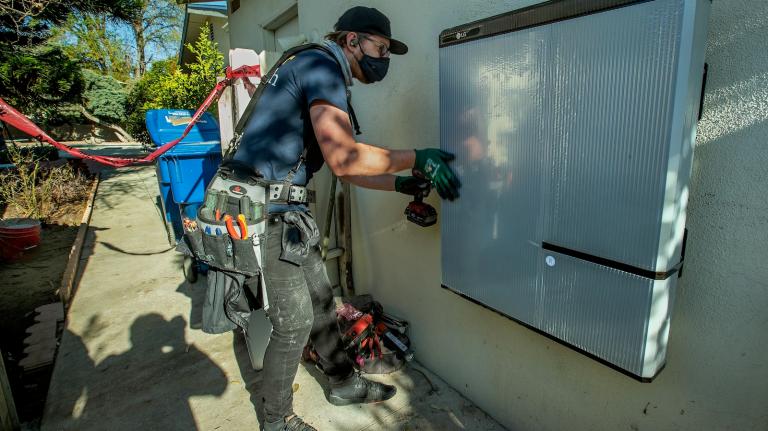
Mitch Hall and his wife, Lori, live in one of the most sustainable communities in the U.S. Their town house is among a few dozen residences constructed so far at Veridian at County Farm, a fossil-fuel-free, net-zero-energy development in Ann Arbor, Michigan. Homes here make about as much solar energy as they consume, with the help of batteries that save solar power for use in the evenings.
Now, the couple is eager to share the benefits of their clean energy infrastructure with the wider grid.
In the coming weeks, Veridian households can enroll in Michigan’s first residential pilot of a virtual power plant; Detroit-based utility DTE Energy will then be able to remotely control the network of residents’ home batteries to inject their stored solar power onto the grid when operators need it most.
“This pilot is an opportunity to test an approach that could ultimately provide a lower-cost way to meet growing energy needs and strengthen reliability,” Joi Harris, president and chief executive officer of DTE Energy, said in a statement. VPPs can smooth out demand peaks, reducing the utility’s need to invest in grid-infrastructure upgrades and generate kilowatt-hours with expensive fossil fuel peaker plants, both of which would pile costs on consumers.
The initiative “should work well for the residents, too,” Hall said. “DTE will pay us a little bit to be part of this project.” Because the utility will pull battery power automatically when the grid is strained and electricity prices are likely to be highest, “a neat part about the virtual power plant is you don’t have to spend a lot of time learning and trying to optimize,” he noted. “DTE will manage that battery for you.” (DTE did not respond to Canary Media’s request for exact figures on how much it would compensate customers in time for publication.)
Read Next
VPPs have existed for years but have been slow to gain widespread traction because of a host of factors. Utilities often haven’t been incentivized to embrace the approach, while home solar and batteries remain tooexpensive for many households in the U.S. But as electrification and the data center rush spur unprecedenteddemand, VPPs are taking off as a fast way to get power on the grid. Earlier this month, the Brattle Group estimated that 524 gigawatts of distributed energy resources harnessed in VPPs could save households on average $122 per year by 2050.
Currently, “there’s immense untapped capacity,” said Kevin Brehm, manager in the carbon-free electricity practice at clean energy think tank RMI.
Matt Grocoff, the founder of Thrive Collaborative, started to consider a VPP pilot at Veridian in 2019. He wanted the neighborhood to mimic an ecosystem — a resilient web of relationships in which individual organisms do more than just extract resources. For example, a tree in a forest turns sunlight into nutrients and shares them symbiotically with a vast, interconnected underground web of fungi.
Likewise, with a VPP, each Veridian home “can be producing energy that it needs and mutually beneficially sharing it across a network of energy rather than a linear grid that flows in only one direction,” Grocoff said.
DTE expects nearly 100 battery-equipped Veridian homes to ultimately participate in the pilot. So far, 44 market-rate homes with solar and batteries have been built, out of 120 planned, as have 50 affordable housing units that don’t have batteries yet, according to Thrive Collaborative. Battery manufacturer Sonnen USA, maker of the home storage systems installed at Veridian, is helping DTE operate the pilot using Sonnen’s proprietary software.
Read Next
“Veridian is a test bed,” said Geoff Ferrell, executive vice president of Sonnen USA’s VPP business unit. The initiative, which is expected to be able to deliver up to about 300 kilowatts for three hours, will give DTE a clearer picture of how much power the home battery fleet can actually generate and when, providing “a really great basis” for a scaled-up program, he noted.
Ferrell points to another Sonnen-facilitated VPP that also sprang up as a humble pilot project, but rapidly mushroomed into a full-scale program because of early positive results. That initiative started in 2017 with a new apartment building topped with solar, Soleil Lofts outside Salt Lake City.
Sonnen hadn’t even finished installing batteries in each of the development’s 600 units when the utility Rocky Mountain Power and the state utility commission decided that the initial data was promising enough to merit extending the program to every residential customer in the utility’s territory, Ferrell said. Today, about 7,900 homes and businesses participate in the program, now called Wattsmart Battery, in Utah, Wyoming, and Idaho.
Given the success of that VPP and many others, Brehm would like to see more utilities go full throttle at the outset.
“Do you need another pilot?” he asked, noting that numerous VPP programs exist for utilities to model their own programs after.
But for utilities that do approach VPPs with caution, Rocky Mountain Power’s pilot is a good model, according to Brehm. The utility’s employees were able to rapidly understand how the residential battery fleet worked and how to deploy it, he said, “so that they could integrate these batteries into their operations initially, and subsequently [into their resource-capacity] planning.” He’d like to see DTE do the same.
The VPP pilot at Veridian is already starting to inspire developers and utilities outside Michigan, including the development Peace Hill in Townsend, Washington, said Grocoff of Thrive Collaborative.
“We’re getting calls from all over the country,” Grocoff said. “It’s really exciting.”
‘Law & Order’ Cop Dies While Heading to Acting Gig
Veteran Hollywood actor E.J. Carroll, known for his appearances in some of television’s biggest crime dramas, has died suddenly at 66 after collapsing on a New York City street while on his way to work.
Carroll, whose nearly three-decade career included roles in Law & Order, Blue Bloods, Boardwalk Empire and HBO’s The Deuce, was heading to a commercial voice-over recording when tragedy struck on Thursday, November 19.
His manager, Jon Mason of Mason-Lewis Entertainment, confirmed that the actor suddenly collapsed in the street before his death, bringing an unexpected end to a career that had kept him busy in Hollywood and New York for decades.
Carroll had recently undergone surgery to repair a hernia and was recovering from the procedure, according to Entertainment Weekly. However, his official cause of death has not been announced, and there has been no confirmation that the surgery played any role in his passing.
The devastating news has brought renewed attention to the actor’s extensive career, which included appearances alongside some of Hollywood’s most recognizable names.
Carroll made his debut on NBC’s Law & Order in 1998, playing a police officer. He returned to the long-running crime drama several times over the following years, portraying different characters, and later appeared in its hugely successful spinoffs Law & Order: Special Victims Unit and Law & Order: Criminal Intent.
His ability to disappear into different roles made him a familiar presence on television, even if viewers did not always recognize his name.
In 2012, Carroll appeared as Sheriff Victor Sickles in HBO’s acclaimed gangster drama Boardwalk Empire, which starred Steve Buscemi and was executive produced by Martin Scorsese.
He later landed one of his most memorable roles in HBO’s The Deuce, portraying Fat Mooney, the manager of a New York City adult entertainment shop owned by James Franco’s character, Frankie Martino.
Carroll appeared in six episodes of the gritty drama, which explored the rise of New York City’s adult entertainment industry during the 1970s and 1980s. The series also starred Maggie Gyllenhaal.
His television credits continued to grow with appearances in The Blacklist, Blue Bloods, Damages, Pose, High Maintenance and Marvel’s The Punisher.
Carroll also built an impressive film résumé, appearing in Darren Aronofsky’s acclaimed drama The Wrestler, starring Mickey Rourke, and the 2009 family drama Everybody’s Fine, alongside Robert De Niro, Drew Barrymore and Kate Beckinsale.
Beyond film and television, he contributed voice work to the blockbuster video game Grand Theft Auto V, introducing his talents to another generation of fans.
Despite decades in the entertainment industry, Carroll showed no signs of stepping away from acting.
He recently worked on A Delicate Arrangement, an upcoming biographical drama starring Carla Gugino as legendary Gone with the Wind actress Vivien Leigh. The film, directed by Nick Sandow, also features Matthew Modine and David Hyde Pierce.
Carroll’s most recent screen appearance was in the 2026 film The Mayflower, while several additional projects featuring the late actor are awaiting release.
Following his death, Gugino remembered the time they spent working together in Philadelphia, describing Carroll as “a source of talent and light” and extending condolences to his family and loved ones.
Mason also paid an emotional tribute to his longtime client, remembering a performer whose dedication to his craft was matched by his generosity toward others.
“When E.J. Carroll performed, it was impossible to take your eyes off him,” Mason said in a statement.
The manager added that Carroll’s greatest legacy would be the kindness he showed friends, fellow actors and even complete strangers.
Those who knew him described a respected member of New York’s acting community who had spent decades working alongside stars including De Niro, Rourke and Bruce Dern.
His sudden death is particularly heartbreaking given that he was still actively pursuing new roles and was on his way to another professional engagement when he collapsed.
A celebration of Carroll’s life is expected to be held in New York City in the new year. Additional details about the arrangements have not yet been announced.
Alerts activated in Bahrain over ‘potential threat’
A Bahraini man holds up the national flag in Manama, Bahrain. [MOHAMMED AL-SHAIKH/AFP via Getty Images]
Bahrain’s Interior Ministry issued an alert Saturday evening over a “potential threat,” urging citizens and residents to remain calm and head to the “nearest safe location,” the ministry said in a statement, Anadolu reports.
In a post on the US social media platform X, the ministry urged the public to follow updates through official channels. It did not specify the nature of the threat.
The alert came three days after the Bahrain Defense Force’s General Command said its air defenses had intercepted several Iranian aerial attacks.
Trump admin still won’t let Wi-Fi giant TP-Link sell its latest routers in US
TP-Link, which may be the top provider of wireless routers for US homes and small businesses, isn’t allowed to sell its latest Wi-Fi routers in the US. The Trump administration imposed a sweeping ban on foreign-made consumer routers in March 2026, and TP-Link hasn’t been able to obtain an exemption.
The rules prevent the import or sale of all new router models that are manufactured, assembled, designed, or developed outside the US. The Trump administration has control over which router makers receive special permission to import and sell new products through a waiver-review process involving the Federal Communications Commission, the Department of Defense, and the Department of Homeland Security.
While some of its competitors have obtained exemptions to the ban, TP-Link appears to be having a hard time making its case to government officials. Its routers approved before the March 2026 ban remain available for sale in the US, but its newly released Wi-Fi 8 routers cannot be imported or sold.
TP-Link’s struggle is not much of a surprise, given its history as a Chinese company and the Trump administration’s focus on reducing reliance on Chinese and other foreign technology. While TP-Link faces political challenges related to the Trump administration’s push for on-shoring, its problems go deeper: It must convince the government its routers aren’t vulnerable to foreign hacking campaigns and that its routers are not Chinese-controlled technology, as suggested at a congressional committee hearing last year.
TP-Link was founded in 1996 in China but has since split into two companies, with one in the US. The US-based TP-Link established California as its global headquarters in October 2024, months after completing a “formal organizational separation” from the TP-Link entity in China.
“TP-Link has split from and no longer has any affiliation with TP-LINK Technologies Co., Ltd., which serves the mainland Chinese market. Despite having similar names, these companies have entirely different ownership, management, and operations,” TP-Link says.
Trump administration control of router sales
TP-Link opened preorders for its first Wi-Fi 8 router, the Archer 8 Ultra, in September, though not in the US. It’s expected to ship this month and costs £899.99 in the UK, or about $1,178. Since it’s priced like a luxury device, its unavailability in the US won’t make a difference to most consumers. But it’s unknown how long it will take TP-Link to gain permission to sell Wi-Fi 8 routers in the US, or whether it will receive permission at all.
TP-Link has pledged to assemble all new routers in the US, but convincing Trump officials that it is fully under US control is likely a difficult task. The government reviews of router makers’ requests for waivers, formally called conditional approvals, are shrouded in secrecy. From the outside, it is unclear whether the Trump administration applies consistent security criteria to all companies or whether it grants waivers to favored companies without regard to the actual security of their products.
Companies led by Trump allies Elon Musk and Jeff Bezos fared well in the reviews. SpaceX’s Starlink division obtained a waiver for its routers, while Amazon received a waiver covering routers for its Leo satellite broadband service and the devices sold by its Eero subsidiary. There have been 26 waivers issued so far, covering products made by firms such as Netgear, Asus, Adtran, Calix, Nokia, Micro-Star International, Askey, Zyxel, Humax, and Vantiva.
Some US lawmakers seem to think the FCC process covers too many products. House Commerce Committee Ranking Member Frank Pallone, Jr. (D-N.J.) and Chairman Brett Guthrie (R-Ky.) proposed legislation in September that would limit the FCC’s authority to place entire categories of equipment on the list of banned products, as it did with routers.
The Pallone/Guthrie bill would also require the FCC to report to Congress a week before adding any new technology or service to what’s known as the Covered List and require new additions to include only technologies or services produced or provided by an entity controlled by a foreign adversary. That means China, Russia, North Korea, or Iran.
“The current process for identifying and barring malicious foreign technology has worked in many cases, but lacks the transparency, consistency, and clarity needed to meet our long-term national security needs as technology rapidly advances,” Pallone and Guthrie said in a joint statement.
Dramatic expansion of FCC’s Covered List
The Pentagon declined Ars’ request for comment on TP-Link’s request for an exemption. The FCC and Department of Homeland Security did not provide any comment.
The US ban on all foreign routers was part of a dramatic expansion of the Covered List, which is managed by the FCC in consultation with the Commerce Department and federal agencies with national security expertise. The Covered List was created by a 2020 law and received its first additions in March 2021. It applies to products that “pose an unacceptable risk to the national security of the United States or the security and safety of United States persons.”
For the first few years of the Covered List’s existence, only specific companies were added. This included Chinese device-makers Huawei and ZTE, several video surveillance product makers, the Russian security company Kaspersky Lab, and several Chinese telecom companies. Under the Trump administration, new additions to the list include entire product categories, regardless of whether a particular vendor has been identified as a risk. In addition to routers, the Covered List currently includes foreign drones, robotic devices, and power inverters.
A former government official told Ars that the Covered List isn’t as useful as it should be.
“The government needs to be able to quickly identify national security risks and, to the extent that they can, you’ve got to give the public and industry guidance on what to do in order to avoid that risk,” said Betsy McIntyre, a lawyer and consultant who previously worked for the FCC on telecom mergers and at the Department of Justice on national security reviews of foreign investment in telecom. “That’s why I have always loved the Covered List. It’s this great tool. It’s simple. It has so much potential to guide procurement decisions for small businesses, large businesses. It can even help when moms are going to Best Buy and figuring out what kinds of equipment they should be buying.”
McIntyre doesn’t like the approach of adding entire categories of products to the list, rather than specific products from individual companies.
“The ideal Covered List would be, as soon as there’s a problem, it would be updated,” she said. “They’d name a company, and then people know: ‘don’t buy this’ or ‘this kind of equipment poses a national security risk.’ It’s a little bit muddled now.”
Although the FCC maintains the Covered List, McIntyre said the FCC’s role was set up at the beginning to be “very ministerial.” The FCC would add companies or products to the list based on determinations by national security agencies, with the FCC having no discretion once it received a determination.
McIntyre noted that she was not privy to any of the discussions that led to the broad inclusion of routers this year. It’s not necessarily clear to the public why any particular item is added to the list or why any company receives an exemption, because “the national security decision-making process can be a black box,” she said.
Router security: “They’re all equally awful”
TP-Link routers formed the bulk of a botnet controlled by Chinese threat actors, Microsoft said in 2024. But TP-Link is far from the only router maker whose products have vulnerabilities. Routers made by US companies Cisco and Netgear were part of a botnet of devices hijacked by Chinese state-sponsored attackers in 2023, the Justice Department said after taking action to remove the malware.
Security expert Bruce Schneier said there’s no reason to think TP-Link routers are less secure than those of its competitors. “They’re all awful. They’re all equally awful,” he told Ars.
Computers and smartphones generally have strong security because companies like Apple, Google, and Microsoft “have massive security teams designing these things to be good in the first place and writing patches when flaws are found,” Schneier said.
With routers, webcams, smart refrigerators, wireless drones, and Internet of Things devices in general, “there’s no one on staff to deal with a security vulnerability… These are just less secure devices because the economics of them doesn’t reward security. The way you patch a lot of your home routers is you throw it away and buy a new one. That’s the patch mechanism.”
When asked about TP-Link facing more scrutiny because of its history as a Chinese company, Schneier said that router makers are “all Chinese companies… I don’t care what [name] you stick on the box. They’re all made in China.”
TP-Link is pledging to assemble routers in the US, though it would still use parts from overseas. Schneier said that “these are distinctions that don’t matter that much.”
TP-Link has faced years of scrutiny
TP-Link says the devices it sells in the US are made in Vietnam. But an April 2025 Bloomberg article said, “TP-Link confirmed that, aside from components bought in Vietnam that account for 0.5 percent of the total value of inputs to the plant there, all other components are imported from China.”
TP-Link declined an interview request from Ars this month. “Aside from what’s already out there, the company doesn’t have any new updates to share right now,” a TP-Link spokesperson told us.
TP-Link could sue the government, but litigation can drag out for years. Drone makers have been subject to the same kind of FCC import ban since December 2025, and Chinese drone maker DJI sued the FCC in February. FCC and Justice Department lawyers urged the court to dismiss the lawsuit as “premature,” because the FCC hasn’t made a final decision on a petition that DJI filed with the FCC. The US government’s latest motion to dismiss the lawsuit is still pending with the Ninth Circuit appeals court, and the FCC hasn’t ruled on the petition for reconsideration that DJI filed in January.
Several developments over the past two years make it unsurprising that TP-Link hasn’t obtained a waiver. US officials reportedly considered a TP-Link ban due to national security risks during the final months of the Biden administration. The government separately probed TP-Link last year in an antitrust investigation reportedly focused on whether it sold goods below cost to gain a dominant share of the US router market.
The House Select Committee on the Chinese Communist Party held a March 2025 hearing on deterring China’s hacking attacks and improving what the committee called “America’s lackluster cyber defenses.” Rob Joyce, former director of cybersecurity for the National Security Agency, said in testimony that China is “undercutting our market to deliver Chinese-controlled technologies into our homes” and named TP-Link as the prime example.
“TP-Link, the world’s largest manufacturer of commercial Wi-Fi and home routers, has grown to at least 60 percent of the US retail market for Wi-Fi systems and SoHo [Small Office and Home Office] routers compared with about 10 percent of the market at the start of 2019,” he said. “How have they achieved this miraculous growth? They appear to be selling at price points below profitability to drive out the western competition… TP-Link routers were among the various brands exploited by Chinese state-sponsored hackers in the massive Volt, Flax, and Salt Typhoon attacks… We cannot have the software for these prolific devices be written, updated, and controlled by a Chinese company. By law, such a company is subject to the direction of the PRC [People’s Republic of China] Intelligence apparatus. This is a threat we cannot ignore.”
TP-Link says US market share numbers exaggerated
TP-Link said in a March 2025 response to Joyce’s comments that its “products are not ‘Chinese-controlled technology,’” that “all of TP-Link’s R&D operations globally are owned and controlled by TP-Link’s US headquarters,” and that “no government—including the PRC—has access to and control over the design and production of TP-Link routers.”
In 2023, the year before Biden administration officials reportedly considered a TP-Link ban, TP-Link boasted of being “the world’s No. 1 Wi-Fi product provider for 12 years running” based on analyst firm IDC’s tracking of worldwide shipments. More recently, TP-Link has argued that estimates of its dominance are wildly inflated, at least in the US.
TP-Link’s response to Joyce said it held “a 36.6 percent unit share and a 31 percent dollar share of the US consumer router market during 2024.” The company says in a fact sheet that when routers provided to users by Internet service providers are taken into account, “TP-Link’s market share of residential Wi-Fi router sales in North America in 2024 was under 10 percent.”
Many home Internet subscribers simply use the router that comes with their broadband service. In June, the cable lobby group NCTA asked the FCC to relax the router ban to make it easier for ISPs to change components in their devices. The FCC granted the waiver on November 5.
Florida and three other states with Republican attorneys general sued TP-Link last month, alleging that it lied to consumers about connections to China and the risks of its routers being exploited by Chinese state hackers. A group of 21 Republican state AGs also sent a letter to the FCC, urging it to address alleged violations of state laws in its review of TP-Link’s waiver request. TP-Link told the FCC that the “heightened standard” demanded by state attorneys general “would be unattainable to TP-Link or any other router manufacturer in the world.”
FCC says existing TP-Link routers exceed power limits
Last month, the FCC warned TP-Link that several of its existing routers exceeded power limits. These include devices already being used by US consumers, such as the Archer BE670 tri-band Wi-Fi 7 router.
“Based on our evaluation of the purchased samples, we have tentatively determined that TP-Link included false or incorrect information in its applications for these equipment authorizations; and these devices do not operate consistently with the parameters power levels [sic] submitted in the certification applications,” the FCC told TP-Link.
TP-Link told Bloomberg that any routers exceeding power limits are an aberration and that the four products identified by the FCC account for less than one-third of 1 percent of the company’s total US unit sales this year. Nonetheless, the power-limit investigation related to TP-Link’s existing routers may be a bad sign for its chances of getting a waiver to import and sell Wi-Fi 8 routers.
TP-Link told reporter Dong Ngo that the FCC tests were “routine spot checks.” But FCC officials may have examined existing TP-Link devices because of the pending request for a waiver from the Covered List.
“Any time a company has significant requests before the agency, it’s not unusual if the agency is making sure that the company is behaving in a manner the way they expect it to, complying with the rules,” said Jeremy Marcus, a lawyer who spent over 20 years in government in multiple roles, including deputy chief of the FCC Enforcement Bureau.
Marcus declined to discuss TP-Link specifically. He noted that the FCC Office of Engineering and Technology has ongoing market surveillance programs. But when a company has larger issues pending at the FCC, the Office of Engineering and Technology may “do their own due diligence to make sure that existing equipment is performing the way it’s authorized to,” he said.
What is a US-made router?
Although TP-Link has since gone a bit quiet and declined an interview request from Ars, a company official previously spoke to other publications about the FCC waiver process. TP-Link corporate affairs officer Steve Kovsky told PCMag last month that “there isn’t a lot of clarity” in the government’s demands for US-built technology. Many components used in routers are only available from foreign countries, he said.
“There are no published guidelines that say, ‘Well, it could be 25 percent US, or it could be 15 percent US,’” he said. “Or what about, we buy our chipsets for these products from Qualcomm and Broadcom. Is that a US product?”
Kovsky’s background is in corporate marketing and communications, and he started at TP-Link a year ago in a contracting role as a senior communications strategist and consultant. He was hired as the corporate affairs officer in June and has been the main public speaker on the company’s attempts to get a Covered List waiver.
Kovsky expressed some optimism last month. “We have no problem with the FCC, and are really looking forward to pursuing this, and really setting the standard for transparency, and showing that we have the ability to perform and meet all of these criteria with flying colors,” Kovsky told PCMag. “I don’t know if every manufacturer could say the same thing.”
Kovsky spoke to The Verge around the same time, defending the company’s security. “We do not sell customer data or share it with any government ever,” he said. “We never will. We do not allow backdoors in our products. We are not susceptible to malware or vulnerabilities to an extent that’s greater than any other manufacturer in this category, to my knowledge.”
Kovsky also downplayed TP-Link’s router market share in the US. “It’s about 9 to 10 percent, which is like top three,” he said. “It’s a good number, but we do not have an overwhelming share of the US market.”
Kovsky pleaded with government officials for a quick approval in a letter to the FCC last month. TP-Link is ready to make “a nearly $1 billion investment in America that would result in equipping existing US factories, and ultimately building new, highly automated manufacturing facilities, to start assembling next-generation Wi-Fi 8 routers in the United States as soon as next year, creating hundreds of new jobs,” he wrote. “TP-Link is proud of this proposal and is poised to unleash this investment upon a grant of its Conditional Approval application.”
Router makers must justify use of foreign parts
Because the Trump administration added virtually all routers to the Covered List, each router maker must obtain a determination from the Department of Defense or Department of Homeland Security that its routers do not pose unacceptable national security risks and present a plan to establish or expand manufacturing in the US.
Router makers seeking conditional approvals must submit, among other things, details about which countries all of the components and software in its routers come from; details about parts that have only a single source and contingency plans if those suppliers become unavailable; locations of manufacturing and assembly; and a “quantitative assessment of supply chain concentration by country, expressed as both a percentage of total value and production volume.”
Router makers must also provide a “justification on why any foreign manufactured router is not currently manufactured in the United States, including why these foreign sources were selected and whether alternatives exist,” and a “detailed, time-bound plan to establish or expand manufacturing in the United States.”
Although McIntyre would prefer that the list be focused on individual companies instead of entire product categories, she said others argue that the process benefits the US because it forces companies to think harder about where they obtain components from and to provide the government with on-shoring plans.
“I have talked to people who say, ‘Listen, you do these entire class bans, and it’s really forcing companies to really think about their supply chain… You want to have as many of these routers made in the United States as possible, just because you have a little bit more control over what’s going into the router,’” she said.
The FCC said the addition of routers was based on a determination by a White House-convened group of Executive Branch agencies with national security expertise, which said that “malicious state and non-state sponsored cyber attackers have increasingly leveraged the vulnerabilities in small and home office routers produced abroad to carry out direct attacks.” The agencies said that “routers in the United States must have trusted supply chains so we are not providing foreign actors with potential built-in backdoors to American homes, businesses, critical infrastructure, and emergency services.”
Lawmakers say Congress must oversee Covered List
Although the FCC has generally based Covered List inclusions on determinations by other agencies, McIntyre pointed out an exception. In January 2025, the Commerce Department issued a determination about the risk of connected car hardware and software being controlled by Chinese- or Russian-controlled entities and used its own authority to prohibit transactions involving Chinese or Russian vehicle-connectivity systems.
After the Commerce determination, the FCC sought comment from the public on whether to add the vehicles to the Covered List. “That is the only example I have found of the FCC doing anything other than just taking what they were given and putting it on the Covered List,” McIntyre said.
Under the law, the FCC is required to base Covered List decisions on determinations by federal agencies with national security expertise, or the Department of Commerce. With connected cars, the FCC took public comment and has not added the vehicles to the list.
“We are not required to provide the opportunity for public input on updates to the Covered List under the Commission’s rules, and we have not done so in the past,” the FCC said in May 2025. “However, because this would be the first addition that does not include the names of specific entities, we believe that offering an opportunity for public input will help promote transparency and good governance.”
The FCC made its first Covered List addition that does not include names of specific entities seven months later, but for drones, not connected cars. The Pallone/Guthrie bill mentioned earlier in this article would limit or prevent future additions that don’t name specific entities.
“The placement on or removal from the list… of a class or category of information and communications technology or service without reference to an entity that produced or provided that technology shall be deemed a major rule” as defined in the Congressional Review Act (CRA), the bill says.
The CRA lets Congress overturn certain federal actions, including major rules. Pallone and Guthrie’s bill announcement said the Covered List process needs Congressional oversight and that their proposed “changes improve consistency and transparency around the FCC Covered List, ensuring that it targets foreign adversaries and is used as Congress intended to safeguard our national security.”
Britain, EU set to agree to reset but divisions persist
cde.news desk · 3 min read
Britain and the European Union are set to agree on easing food trade and youth mobility in a reset of ties at a summit on Friday that is also likely to expose lingering divisions and question marks over the long-term future of their relationship.
A decade after Britain voted to leave the now 27-nation bloc, rancour over the divorce has faded and both sides have recognised the need for a closer alliance in a world order upset by Russia’s full-scale invasion of Ukraine, US tariffs, Chinese control of critical minerals and war in Iran.
British Prime Minister Andy Burnham has said Britain should consider options for its future relationship with the European Union, including rejoining the bloc. On Monday, he said it was the “obvious truth” that Britain had lost more than it had gained from Brexit.
At the summit, postponed from July following the resignation of Burnham’s predecessor Keir Starmer, the two sides aim to address a small part of those losses with a package of agreements.
The most significant would allow cross-border trade in animals, plants and related products, such as sausages or seeds, without the certificates and controls currently required. Britain has estimated this could add up to £5.1 billion ($6.70 billion) per year to its economy.
A further agreement would link the emissions trading systems of Britain and the European Union, which would exempt British and EU goods, such as steel, from each other’s carbon border levies.
The two sides are also set to allow in each other’s young people to work or study for three years, but here divergences are clearer. Britain, mindful that immigration was a factor behind the Brexit vote, had proposed letting in only 50,000, but the EU wanted more. They have now settled on 100,000, EU diplomats said.
DIVERGENCE ON UNIVERSITY FEES
The two have also differed over tuition fees, with EU countries wanting their students to be eligible for “home fees” at British universities, rather than the international rate, which is typically some three times higher. Britain prefers to offer only “significantly reduced” fees.
The two sides are now aiming to resolve the issue within six months.
Then there is the topic of Britain accepting EU rules, a sensitive issue for Brexit supporters.
A key UK demand is that the EU grant it special status under the bloc’s “Made in Europe” rules, notably for cars. The EU has indicated it is willing to grant this, but only on condition that Britain align with its policies, which could mean Britain having to impose tariffs on Chinese electric vehicles.
The draft joint statement had featured conflicting lines from Britain and the EU about the extent of economic coordination.
Licensed Until Charged: Three educators who were reported to the state for alleged misconduct were allowed to keep working — and to draw new complaints — until they were criminally charged.
Incomplete Investigation: One was reported for allegedly touching children inappropriately in 2019. California didn’t suspend his credentials until his 2024 arrest.
Lack of Guidelines: California’s educator licensing agency provides no guidelines to the volunteers who review teacher misconduct cases for determining when and how to mete out punishment.
These highlights were written by the reporters and editors who worked on this story.
Five years before police arrested former elementary school counselor David Braff for allegedly sexually abusing students, complaints had already been sent to the state of California: that Braff had sat students on his lap, rubbed their legs and touched them near their vaginas.
But California’s educator licensing agency failed to conduct a thorough investigation after his school district reported Braff to the state in 2019. And the agency allowed Braff to continue working with children. It wasn’t until his 2024 arrest that the agency suspended his credentials. By then, he’d gotten jobs at three more Southern California schools. At one of them, prosecutors allege, another student complained the guidance counselor had touched him, too.
The state Commission on Teacher Credentialing also delayed revoking the credentials of two other teachers who were later convicted of sexually abusing students. As with Braff, schools had reported those educators to the agency that determines who can work in California’s public schools. And as with Braff, the commission allowed those teachers to keep teaching — and draw new complaints — until after they were criminally charged, an investigation by KQED and ProPublica found. That includes a middle school math teacher who sent his student a video showing a boy’s genitals and an elementary teacher who touched students’ butts and vaginal areas and placed their hands on his crotch, according to court records.
In each of the cases, state investigators did not interview some of the students who had alleged abuse, according to the students, parents and attorneys who spoke to KQED and ProPublica. Several former agency staffers, including investigators, told the news outlets that, at times, the volunteer panel tasked with assessing teacher accusations overlooked evidence of wrongdoing. That perspective from staff members was backed up by two former members of the panel and two people who served on the state commission that ultimately decides teacher discipline.
After police arrested Braff in 2024, a parent emailed Jeffrey Weinstein, superintendent at Santa Paula Unified School District, where Braff was first accused of sexually abusing students. “Who dropped the ball and allowed this monster to still be around kids?” the parent wrote, according to public records obtained by the news outlets. (Weinstein was not working at Santa Paula at the time students accused Braff.)
In his emailed response, Weinstein blamed the state’s teacher licensing agency. He told the parent that the district had conducted its own investigation and reported the guidance counselor to the state as well as to police. He also said he had reviewed the district’s investigative file and “vehemently disagreed” with the agency’s decision not to revoke Braff’s credentials.
“We sent all the evidence we had gathered,” Weinstein said. “The district did everything in its legal capacity it could.”
Braff is soon to stand trial for sexually abusing 15 students, including 13 from Santa Paula. He has been in jail since November 2024. He has pleaded not guilty and did not respond to a request for comment sent through the Ventura County Sheriff’s Office’s electronic messaging system. His attorney declined to comment.
Braff had previously told Santa Paula Unified administrators that he did not touch students near their private parts or have them sit on his lap — and that he only gave students side hugs, high-fives, fist bumps and taps on the knee, according to the district’s 2019 report to the state.
“Mr. Braff described keeping an office environment where kids can move around; and he would not be closer than arm’s length,” the report said, summarizing the district’s interview with Braff. “It was not his intent to make them afraid but rather feel that there was someone in their corner; someone to talk to.”
The Santa Paula Unified School District recognized guidance counselor David Braff as employee of the month in 2017. The district reported him to the state for misconduct two years later.Santa Paula Unified School District via Facebook
Anita Fitzhugh, a spokesperson for the Commission on Teacher Credentialing, said the state automatically revokes teachers’ credentials when they are convicted of sexual criminal offenses. But she wrote in a statement that “unless the applicant or educator is convicted of a mandatory criminal offense, there are no written criteria that set the level of adverse action for educator discipline matters.” She did not answer questions about specific cases or details of the investigative process.
Fitzhugh said the state does not provide any guidelines for those reviewing teacher misconduct cases about when discipline is warranted or the type of punishment that should be meted out. And she said it was the commission’s role to balance “protecting students as well as the legal rights of educators who have been accused but not convicted.”
California’s system of disciplining educators dates to the 1970s, Fitzhugh said, and “a deep and comprehensive review of the educator discipline system, prioritizing student safety in the schools, is in order.”
“We expect the Commission to take this up in the near future,” she said.
Students Not Interviewed
In the summer of 2019, California’s Commission on Teacher Credentialing received a detailed report from the Santa Paula school district about Braff’s alleged misconduct at McKevett Elementary School. The state requires districts to report educators when they resign or are fired after allegations of misconduct. Braff, who had been a guidance counselor at the school for four years, had resigned in the midst of the district’s investigation into complaints by at least seven students that he had touched them inappropriately.
The district told the state agency that it had contemplated but did not initiate any discipline against Braff before accepting his resignation. The district said it appeared, based on student interviews, that Braff “had engaged in at least inappropriate conduct.” Its report to the state, submitted two months after he resigned, included a 20-page summary of the principal’s interviews with at least seven accusers and two witnesses. It also included Braff’s defense and noted multiple inconsistencies in his account of what had occurred.
One fifth grade girl said that during a visit to his office, Braff had locked the door, grabbed her by her hips and forced her to sit on his lap, according to the district’s report to the state of its investigation. She said she did not like being touched and cried every time she had to see him for counseling. The girl requested to transfer to another school, district investigators said, because she wanted to “be away from” Braff.
Two other girls alleged Braff touched them near their “privates,” the district reported to the state. Neither girl was aware of the other’s claim.
One of them, a fourth grader, told the principal that she had been meeting regularly with Braff for counseling since second grade. During those visits, he would make her sit on his lap. She told the principal that Braff tapped her on the leg with his hand “in a way to try to make her feel like she was doing a good job,” but she said the tapping hurt. After two school years of regular counseling, she alleged he started tapping her higher on the thigh, close to her “private.” In contrast, she said a different teacher pats students on the head when they do a good job, according to the district’s report to the state.
The girl, who is now 18, spoke to KQED and ProPublica with her mother and attorney present on the condition that only her first initial, J., be used to protect her privacy. J. said Braff had told her that whatever happened in his office was a secret. She said she had few friends at the school and was terrified of getting in trouble when she reported the person she confided in.
A handwritten statement submitted by one of Braff’s student victims in 2018.Santa Paula Unified School District
The district’s report to the state included notes from an interview with J.’s former principal, Lydia Olivo, who had left the school before J. and other students complained about Braff. Olivo told Santa Paula investigators that J. was “not always honest,” the report said. Olivo described Braff as a reliable employee who had strong relationships with parents, staff and students. She “seemed surprised that any of this could have occurred while she had been Principal at McKevett,” the district’s report said. Olivo did not respond to calls, emails and texts seeking comment.
During the district’s investigation, Braff acknowledged touching students on the knee. “He explained if someone is crying, he taps on the knee to say they are doing a good job to get the sad feelings out,” according to the district’s report to the state. “When asked to demonstrate, Mr. Braff showed a slap on his own knee.”
Nonetheless, the educator licensing agency appears not to have attempted to reconcile the very different accounts of Braff’s behavior. Informed of Olivo’s characterization of her complaint, J. and her mother told KQED and ProPublica that no one at the state agency had called to ask them about it or sought to verify any details, even though the district’s report to the state included J.’s contact information along with that of the other students.
“If a little girl comes up to you and says something, maybe you should not say that they’re a liar,” J. said.
“They should interview students themselves and not just rely on the school district. Do a legit investigation,” said J.’s mother, who did not know that the state had decided not to discipline Braff until the news outlets alerted her.
Fitzhugh, the spokesperson for the teacher credentialing agency, did not answer questions as to why J. was not interviewed or whether anyone else was. The case was assigned to a staffer whose job description did not include interviewing victims.
At least one other student who had reported Braff for touching her inappropriately also told KQED and ProPublica that no one from the state contacted her about her allegations.
A former agency investigator, who reviewed the district’s report to the state at the request of the news outlets, said she believed the students’ accusations because the district’s investigation described multiple children making similar claims. She also noted the contradictions in Braff’s responses. Cases involving allegations of inappropriately touching students should always be assigned to investigators trained to interview victims, she said.
“Any claim of sexual misconduct should go to somebody who’s going to be making phone calls,” said the investigator, who spoke on the condition of anonymity to protect her current job. “This man is grooming these children. There’s no other way to look at it to me. Their stories are credible.”
Per state law, the agency staff assigned to look into Braff’s case did not make recommendations about whether or how to discipline him. That recommendation is left up to a little-known group of volunteers who meet monthly at the agency’s Sacramento headquarters to weigh reports from state investigators, school districts, police and others. That volunteer panel sends its recommendations to the 19 commissioners of the credentialing body, most of whom are appointed by the governor.
If the panel does recommend discipline, the commissioners have the final say. However, if the panel decides that no punishment is warranted, the commissioners do not review that case.
Two former investigators at the state agency told the news organizations that the panel’s recommendations did not always align with the evidence they found. “Sometimes, as investigators, we’ll see the recommendations, and we’ll be like, ‘What the hell happened here?’” one former investigator said.
“I Was Consistently Shocked”
Over three days in December 2020, during the height of the COVID-19 pandemic, members of the volunteer panel, known as the Committee of Credentials, dialed into their monthly phone meeting to address 198 cases of educators accused of misconduct. Among them was Braff, who by then was working in another school.
The volunteers included a retired law enforcement officer, a school board member, a school administrator, an education consultant and several teachers. They had been selected by the commissioners for two-year terms.
State regulations give the volunteer committee broad latitude when assessing allegations of teacher misconduct and recommending discipline to the commission. Unlike jurors in a criminal trial, who need to believe a case is proven beyond a reasonable doubt in order to convict, the committee only needs to find “probable cause” before recommending a reprimand, a far lower standard.
“It’s where a normal and reasonable person would feel that there’s a chance that this person did this,” said Steve Thorpe, the former law enforcement officer who served on the committee when Braff’s case was reviewed. “It’s a low threshold. You know it when you see it.” He declined to comment on Braff’s case.
The fact that Braff’s case was not forwarded to the commissioners, former committee members said, meant the majority of the seven-member panel did not see enough evidence in the district’s investigation and the state’s report to discipline Braff.
One former committee member, who spoke on the condition of anonymity for fear of repercussions from the teacher licensing agency, said she tends to scrutinize district investigations because administrators can misrepresent the facts or ask children leading questions.
Another former committee member who served during the Braff case said that they were generally alarmed to hear some fellow members dismiss children as unreliable sources. The person, who declined to comment on Braff’s case, spoke on the condition of anonymity because they feared professional repercussions.
The Committee of Credentials, a volunteer panel, met in March 2026 to review cases involving alleged educator misconduct. A version of the committee met by telephone in 2020 to decide on Braff’s case.Beth LaBerge/KQED
“I was consistently shocked,” they said. “To have committee members discuss serious allegations as, ‘Well, you know how girls can be. They say all kinds of things they don’t mean,’ is an unacceptable, antiquated point of view. What if we get this wrong? Who are we allowing in the classroom?”
By the time the committee decided against recommending punishment for Braff, he had already been working as a counselor at a different elementary school in Los Angeles for more than a year. (A former student at that charter school would tell police after Braff’s 2024 arrest that the counselor had touched the boy’s thigh near his groin when the two met in his office, according to a court transcript from his criminal case.)
In 2022, nearly two years after the state closed Braff’s case, a school administrator reported to the district that one of the girls who had accused Braff of abuse continued to suffer severe anxiety and could not be in rooms alone with men. Another had attempted suicide multiple times and spent a year in residential treatment, she wrote in an email obtained by KQED and ProPublica.
In his response, an assistant superintendent informed the administrator that the district had previously filed with the state to have Braff’s credential revoked or suspended but the agency chose not to do so. “At this point, I think pursing this matter legally is the best way to address these issues,” he wrote, referring to following up with Santa Paula police.
Santa Paula administrators did not respond to requests for comment.
Two Additional Cases
KQED and ProPublica identified at least two other educators who, like Braff, were reported by their school districts to the state for sexual misconduct but were allowed to keep teaching until they were criminally charged. Each would draw additional allegations of sexual abuse.
As in the Braff case, the volunteer committee in these two cases evaluated much of the same evidence as police, including complaints detailing students’ experiences. And in both cases, investigators with the teacher credentialing agency did not interview some victims.
In one, a Southern California school district shared with the state agency screenshots of messages that middle school math teacher Brashawn Washington had sent to his 11-year-old student, who he regularly contacted through the video game Fortnite. Those messages included a TikTok video showing another boy’s penis. (At his trial, Washington told jurors that he did not send the video to his student.)
The Romoland School District also shared with the state screenshots of Washington’s Google Hangouts chats asking the student if he worked out, calling him “guapo,” or handsome, and sending him kissing emojis.
The boy’s mother had provided the screenshots from her son’s phone to the school in May 2020, according to public records obtained from Romoland. The school district promptly alerted police and began its own investigation, filing a report to the teacher credentialing agency that summer, district records show.
The district included in its report the mother’s contact information, records show. But neither the student nor his mother were interviewed, the mother told KQED and ProPublica. Fitzhugh, the credentialing agency spokesperson, did not answer questions about how state investigators decided who, if anyone, to interview.
A Romoland administrator who said the district shared the screenshots with the state as part of its report did not answer questions about the state’s response.
Washington resigned during the school’s investigation and soon got hired at Pasadena High School starting in the fall of 2020. Washington, teaching virtually at first during the pandemic, continued messaging students over Fortnite despite district policy prohibiting personal contact with students. He had been teaching there for seven months when the volunteer committee recommended a 21-day suspension in March. (Commissioners did not approve the suspension until after school let out.)
State law did not require Washington to notify the Pasadena school district of the recommended suspension. Nor did the teacher licensing agency have to alert his new employer of any discipline if it did not know where he was employed.
Just as his suspension was set to begin in July 2021, Washington was arrested — and the state suspended his credentials indefinitely.
Brashawn Washington at Pasadena High School in April 2021, during his first year as a math teacher there. He had resigned from the Romoland School District in the year prior after a sexual misconduct investigation.Sarah Reingewirtz, Los Angeles Daily News/SCNG
The next year, while out on bail, Washington sent a Pasadena High student images of himself having oral sex with another man, among other messages, according to court records. At Washington’s 2024 criminal trial, that student testified that the teacher had also asked him to share naked pictures of himself when he was 16. Washington told jurors that he did not know the student was a minor. He was sentenced to eight years and eight months in prison for multiple sex offenses, including “annoying or molesting” the Romoland student by sending him the video, as well as producing and possessing child sex abuse material related to minors who were not his students.
A spokesperson for Pasadena Unified did not respond to questions regarding Washington’s hiring or the state’s recommended discipline, but said in a written statement that the district conducts background checks during the hiring process.
Both Washington and his former attorney declined to comment.
A similar pattern unfolded with a San Francisco Bay Area elementary teacher, Matthew Shelton, who was convicted of sexually abusing four students last month.
Shelton had first been arrested in 2007 on charges of sexually abusing students in Napa Valley. Three third-graders had told police he touched their butts or crotches, or made them touch his penis during class.
Shelton was acquitted in that case, but the state’s licensing body did investigate the claims. At the time, Shelton told state investigators that the students had made up the allegations and that he passed a polygraph test, which he had obtained himself. Two of those former students told KQED and ProPublica that state investigators never interviewed them. The agency did not respond to questions about why the students were not interviewed.
Matthew Shelton was convicted of sexually abusing four students.Gina Castro/KQED
In 2008, the licensing agency issued Shelton a confidential written warning, which was expunged after three years, according to trial testimony. That decision meant Shelton was able to keep teaching for the long term; he had already begun a new job in nearby Benicia.
Years later, in 2022, students began accusing Shelton of touching them inappropriately. The Benicia school district and a student’s parents reported him to the state commission in 2023. More students came forward and told police that Shelton had touched their crotch or butt over their clothing; one student said he made her touch his penis when she was in first grade during a school field trip.
Shelton resigned but quickly got a job at another school. As with the other cases, the new school said it had no information about the ongoing investigation. It also had no knowledge of his earlier warning, which had been expunged more than a decade earlier.
This time around, however, things unfolded differently: While the state did not alert the new school about any problems, a parent did. In September, just weeks into the school year, Shelton’s new employer learned from a Benicia parent about the active police investigation as well as the earlier issues in Napa.
Shelton was immediately put on leave. In February 2024, prosecutors charged him, requiring the state licensing agency to automatically suspend his credentials. Unlike in Napa, the agency revoked his license in July 2024 without waiting for a conviction.
Shelton did not respond to requests for comment, and his attorney declined to comment. He is due to be sentenced in December. Benicia Superintendent Chris Calabrese declined to comment on Shelton’s hiring.
There are significant repercussions when the state fails to take disciplinary action. For one thing, it means that other schools receive no indication of a problem. A red flag typically appears next to an educator’s name in a public database when they are punished by the Commission on Teacher Credentialing. But no such warning appears when a teacher is fired or forced to resign without state discipline, leaving their potential future employers in the dark. Nor would a confidential warning letter like the one Shelton received result in a red flag. California lawmakers have tried to address the gap, but their efforts failed.
Student victims, too, suffer long-lasting damage.
A handwritten statement from one of Shelton’s victims says he touched their waist during hugs and put his hand on their upper thigh, making them uncomfortableObtained by KQED and ProPublica
One of the students who accused Shelton in Napa told KQED and ProPublica that for years she wished she hadn’t reported him to anyone because she and her classmates were characterized as liars after “we poured out so much.”
“It could’ve been stopped with us, but it wasn’t,” she said. “They didn’t believe us.”
In Braff’s case, the Santa Paula Unified students who had accused him of abuse continued to struggle in school as their former counselor kept getting new jobs in education.
J. told KQED and ProPublica that for years she avoided acknowledging what Braff did to her. “I couldn’t place where all these emotions were coming from. I was blaming everything else except the actual problem,” J. said, referring to the abuse by Braff. “I didn’t want to live anymore.”
J., now a high school senior, has been homeschooled by her mother for almost three years. She said she still has nightmares in which Braff yells at her for “telling on him.”
And she has long faced doubts from others about her account of what happened to her in elementary school. A few years ago, she recalled, a former classmate told her: “Why would they let him go work somewhere else if he did that to you?”
Science has a home here at Ars—please help keep it that way
It’s now been 21 years since I first published an article at Ars Technica. It has been the only home I’ve known as a writer, and it has been essential to my development from scientist to blogger to journalist. It’s no exaggeration to say that Ars has helped make me who I am today.
So, asking you to support Ars via a subscription is very personal (and a bit selfish) for me—I’d like to stay here! Jobs that give you this sort of independence, that let you both edit and write, are very rare in journalism, and I’m unlikely to find another. Helping secure Ars’ future through your support will mean I don’t have to.
But I’d rather make a case for why you’ll benefit from supporting Ars. In fact, I’ll make three: the writing, the people, and the community.
The people make the site
Since my start here, the central mission of Ars has been the same: cover the news in a way that helps our readers understand the facts and why they’re important. The landscape has shifted dramatically over that time—technology, science, and policy are very different from 21 years ago. But understanding those changes and why they happened matters. It matters for everything from what you should buy today to what the world you’re going to be living in 10 years from now will look like.
I’ve had the privilege of helping to decide how to translate that mission to science coverage. That decision took place against an important backdrop: While most people value things like evidence and research, they often struggle to recognize how those are used to build a body of reliable scientific information. That struggle kind of made the decision for me. Putting people in the know means helping them understand how science works as a process, and why that can produce information about the world we can trust.
Focusing on that has made our science coverage different from most of what you can get elsewhere. We don’t just tell you what’s new in the world of science; we help you understand the history of the big questions, the breakthroughs that allow us to address old problems in new ways, and the clever ideas people have for how to extract reliable information from a noisy and chaotic Universe. I’d like to think our readers get more out of that sort of writing, and it’s worth supporting.
But I’d be giving you a very incomplete picture of things if I only talked about science. Everyone at Ars has had to think about what sort of stories and presentation fit best with our mission. While our writing is essential now, it’s the people behind it that will ensure that it remains vital no matter what other changes come our way in the coming decades. And I can say with more than a little confidence that Ars is full of people you can trust to keep it that way.
One reason you can trust that is that the people at Ars now are, in many cases, the same ones who were here when you first started reading the site. We have remarkably low turnover, especially at the higher levels in our organization. There are two reasons for that: Ars is incredibly well-managed, and the people here believe in our mission.
The former is important because it should assure you that the money we get from your subscription won’t be wasted on some ill-advised pivot to video, or whatever the next craze is. The latter matters because it’s the people here who make Ars what it is. I work with some of the most thoughtful people I have ever encountered, and they all care deeply about making our work informative and compelling. I have also been lucky enough to work with a large group of freelancers over the years, and I have nothing but good things to say about them. We work hard to make sure that, even when the name on the byline is unfamiliar to you, you can be confident that you’re getting the same quality of reporting.
All of them—the full-time staff and the freelancers—are smart, great writers and know their areas of expertise better than most people in this business. Like I’m sure you do, I learn a lot from what they write (unlike you, I also get the bonus of learning from them in our Slack channels).
A big thanks to you all, too
But it’s not just my fellow writers whom I’ve learned from. We’ve got one of the smartest communities on the Internet, with experts from pretty much every area we cover regularly contributing to the comments. In the discussions attached to my articles, I have regularly seen them fill in details I didn’t have space to mention, clarify things in response to other readers’ questions, and talk about related topics that didn’t really fit into the article. I’ve learned a lot from this, and I’m confident the rest of the readers have, too.
It’s strange to say the opposite of one of the central dogmas of the Internet: Read the comments. But it’s something I’ve told our freelance writers pretty regularly.
We’ve kept things that way even as most other sites’ comments turned toxic and were shut off. That’s taken both an editorial commitment and lots of staff time spent moderating and engaging in community management. Those don’t come for free, so your subscriptions will help support that, too.
In short, subscribing to Ars will help keep us doing everything that makes this a special place. And that’s before we get to all the other benefits of being a subscriber. I’d get yelled at if I didn’t mention these, so: no ads, no trackers, options to customize content feeds and article views, full article RSS and PDF downloads, and more.
I hope you’ll consider signing up if you’re able. Beyond the financials, I know we all appreciate it as a sign we’re on the right track.
More questions arise about Israeli role in Iran dirty bomb story
Mossad chief Roman Gofman, shown here with sraeli Prime Minister Benjamin Netanyahu, was in Washington last week for talks on Iran with senior officials in US President Donald Trump’s administration, Axios reported. Photo: Haim Zach / GPO
CNN’s disputed report on Monday that Iran could be plotting a chemical attack or a “dirty bomb” attack in Washington, DC, came amid a broader effort by Israeli intelligence officials to persuade President Donald Trump to escalate his unpopular war with Iran, according to reporting by the New York Times.
Iranian officials condemned CNN’s reporting that Iran was developing plans for a possible attack on members of the Trump administration, calling it a “fabricated narrative” and part of a “calculated disinformation campaign” by a pro-Israel media outlet.
As the Times reported, Israel shared intelligence alleging that Iran had plotted to use chemical agents against senior US officials as Israeli Prime Minister Benjamin Netanyahu pressed Trump to join him in launching a “four- to seven-day campaign of airstrikes against Iran.”
In seeking to convince the United States to join in another round of major attacks, Israel has highlighted what it contends are a variety of threats from Tehran. Israeli officials have been asserting that Iran continues to possess significant chemical and biological weapon capabilities that pose a regional threat – and that could be used in terrorist attacks against the US and Europe….
The Israelis have shared intelligence claiming that Iranians have plotted to use chemical agents against senior US officials. One person briefed on the intelligence, who was not authorized to speak publicly, said that type of threat was related to the decision in recent weeks to move Treasury Secretary Scott Bessent from his home.
The detail about Bessent suggests the two outlets may have been describing the same chemical threat. CNN reported that “threats from Iran also prompted the Secret Service to move Treasury Secretary Scott Bessent into military housing last week.” The Times passage did not explicitly identify the source of the dirty bomb allegation.
CNN treated the purported threat with grave seriousness, writing that US officials had characterized it as “a signal of an alarming willingness to escalate by Iran” and saying it “shows that Tehran is now actively planning for potential attacks inside US territory.”
Trump responded to CNN’s report with yet another threat of mass destruction against Iran, warning that if the country attacked Washington, it would “pay a price the likes of which no country has ever paid before.”
CNN acknowledged that some US officials, including Homeland Security Secretary Markwayne Mullin, viewed the alleged Iranian planning as “aspirational” rather than a “new threat.”
But the network quoted no weapons experts by name. In the wake of the report, many have questioned how effective a dirty bomb would be as an assassination weapon and what Iran would gain by using one. A dirty bomb uses conventional explosives to disperse radioactive material. Such devices are often called “weapons of mass disruption,” rather than destruction.
“A dirty bomb is not typically what you would use to assassinate someone,” David Albright, a physicist and president of the Institute for Science and International Security, told Iran International. “In terms of an assassination method, I wouldn’t consider it very effective.”
Tallha Abdulrazaq, an independent defense and security consultant, told Al Jazeera that Iran has little incentive to use such a weapon. Doing so, he said, “would instantly destroy Iran’s remaining diplomatic credit” and would likely lead to an invasion that would topple its government. “I highly doubt Iranian strategists are unaware of this reality, so the likelihood of a dirty bomb remains infinitesimally remote,” he said.
Investigative journalist and Drop Site News co-founder Ryan Grim argued that the Times’ reporting showed that CNN’s “utterly preposterous” story had been “fed to us by Israel.”
Israeli intelligence officials have repeatedly tried to influence Trump with warnings about Iran that US officials could not independently corroborate or later found had been exaggerated.
Grim said “CNN must have known” that Israel was behind the warnings “but clearly left that detail out because it would have completely undermined the story. Everyone assumed it anyway.”
Despite Israel’s well-documented role in pushing this sort of intelligence to US officials to further foment tension between the US and Iran, CNN’s chemical weapons report this week includes no mention of Israel at all.
CNN’s report even cited what it called “another stream of intelligence” reported earlier this month by The New York Times about possible chemical weapons attacks against US troops in the Middle East, mentioning that military personnel lacked “adequate protective equipment or training to guard against such an attack.”
What it did not mention was that this intelligence also came from Israel and that US allies in the Persian Gulf found the claims to be “unserious.” Many US officials also doubted the warnings, with some comparing them to the false intelligence about “weapons of mass destruction” that the George W. Bush administration used to justify invading Iraq in 2003.
“Israel has a long record of deceiving Washington and feeding it false intelligence that pulls America toward war,” said Reza Nasri, an Iranian international lawyer and foreign policy analyst. “Its latest Iranian WMD alarm must be read against that record.”
“There is a clear pattern here,” Nasri said. “Yet American officials and media still treat Israeli intelligence as gospel, repeating it before verifying it. The American people have paid for that credulity in blood. They should not pay again.”
Rocket Report: A weekend of ups and downs; Stoke celebrates engine milestone
Welcome to Edition 9.20 of the Rocket Report! Last weekend was a picture of the US launch business in miniature, and emblematic of the opposing trajectories of two of the nation’s most experienced rocket makers. First, on Saturday, SpaceX completed a perfect midair catch of its Starship upper stage at its launch pad in Texas after spending nearly a day in orbit. The Super Heavy booster was lost at sea, but SpaceX proved it can recover that piece of the rocket on previous flights. While SpaceX showed it is well on the way to fielding a fully reusable rocket, United Launch Alliance suffered its first-ever total launch failure with the Vulcan rocket. That is terrible news for not only ULA, but also the US Space Force and Amazon, which have booked some 70 launches on Vulcan over the next few years. Your faithful correspondents will take a break from the Rocket Report next week for the Thanksgiving holiday, so we’ll see you again the first week of December.
As always, we welcome reader submissions, and if you don’t want to miss an issue, please subscribe using the box below (the form will not appear on AMP-enabled versions of the site). Each report will include information on small-, medium-, and heavy-lift rockets as well as a quick look ahead at the next three launches on the calendar.
Europe’s leading satellite startup eyes Italian rocket maker. Finnish satellite developer ICEYE announced Tuesday that it is seeking to buy Italian rocket-maker Avio for more than $2.2 billion in a transaction aimed at creating Europe’s first true vertically integrated end-to-end space company, Ars reports. Avio builds the Vega C rocket, a solid-fueled launcher designed to carry up to 3.3 metric tons (7,300 pounds) of payload to low-Earth orbit. ICEYE is, by far, the most successful space startup in Europe, with a valuation of more than $12 billion after the company’s most recent fundraising round in June.
Fulfilling a need … In a statement, ICEYE said it wants to join forces with Avio to meet Europe’s need for “sovereign space and defense capabilities.” ICEYE manufactures and operates its own satellites for radar surveillance and sells data to commercial customers and national governments, including Ukraine, which uses ICEYE imagery for targeting and tracking Russian troop movements. Most of ICEYE’s satellites have launched on SpaceX Falcon 9 rockets. With Falcon 9’s retirement on the horizon, ICEYE’s satellites will need rides to orbit. Avio’s Vega C rocket has a healthy backlog of contracts for European governments, but it hasn’t been a hit commercially. Investment from ICEYE could shore up Avio’s Vega rocket program and perhaps accelerate development of a new rocket.
NATO unveils launch brokerage initiative. The North Atlantic Treaty Organization is contracting commercial rockets and spaceports to grow its satellite launch network and help neutralize risks to the space systems on which it relies, Bloomberg reports. NATO launched two initiatives on Tuesday: Starlift, through which participating countries can secure slots on commercial rockets, and the Global Data Marketplace, which will bolster the alliance’s military operations in space with commercial data and services.
Swimming in launches … Starlift will allow participating countries—Belgium, Canada, Finland, Germany, Italy, the Netherlands, Norway, Sweden, Turkey, the UK, and South Korea—to pool their military launch requirements and secure launch slots on commercial rockets. The NATO initiative will also prepare and test procedures for short-notice launches, as might be needed in a crisis. Bloomberg reported NATO’s tech agency will offer about $2.7 billion in contracts over the next two years, including to commercial space companies, AI, cyber, and command-and-control networks.
Rocket Report
Keep up with the latest in space exploration and rocket launches.
Stoke wraps up booster engine development. Stoke Space has completed development of its Zenith engine, the methane-fueled powerplant that will propel the company’s medium-class Nova rocket off the launch pad. Stoke made the announcement in a social media post Thursday. “As flight engines clear acceptance testing, we’re shipping them down to Cape Canaveral for integration with Nova’s first stage—every week,” Stoke said. Seven Zenith engines will power the Nova rocket’s reusable first stage booster, combining to generate about 700,000 pounds of thrust at full throttle.
All eyes on Stage 2 … Stoke announced it cleared a “proto-qualification” milestone on Stage 1 earlier this year. Stage 2 is undergoing cryogenic proof testing and a hot-fire test campaign at Stoke’s test complex in rural Washington. Nova’s second stage is the real innovation, with a unique arrangement of 24 thrusters surrounding a regeneratively cooled heat shield to protect it during reentry back into Earth’s atmosphere. With this, Stoke aims to fully reuse both Nova stages. The first launch is currently expected sometime next year.
Soyuz flies from Russia’s Far East. A Soyuz-2.1b rocket made its first and only launch from Russia’s Vostochny Cosmodrome this year, RussianSpaceWeb.com reports. The rocket’s Fregat upper stage deployed a new pair of high-resolution imaging satellites, along with a cluster of smaller payloads, following liftoff from Russia’s Vostochny launch base on November 14 (local time). Vostochny, located in Russia’s Far East, hosted its first space launch in 2016. By some measures, Russia spent more than $5 billion building Vostochny, only to use it for an average of two launches per year.
What was onboard? … Soyuz and Fregat carried two dual-use imaging surveillance satellites. A pair of CubeSat-class satellites for a Russian arms manufacturer were also onboard. These satellites are owned by NPO Kaisant, which specializes in drone communications and counter-drone weapons. NPO Kaisant says the satellites will join a constellation providing secure communications to Russian drones over Ukraine. A total of 12 secondary payloads were reported to be onboard, according to Roscosmos.
China’s LandSpace reports rocket reuse milestone. Three months after landing its first orbital-class rocket booster, Chinese rocket company LandSpace claims it has completed “ground acceptance and testing” of the nine methane-fueled engines recovered from the first stage of its Zhuque-3 rocket, according to Guandian News, a Chinese outlet focusing on the country’s financial and economic sector. The engines were disassembled, inspected, refurbished, reassembled, and retested after flying to space and back in August.
But wait … LandSpace’s Zhuque-3 is one of two Chinese rockets to successfully land its booster after an orbital launch attempt. The company did not say whether any of the nine engines will fly again, but don’t count on the entire Zhuque-3 booster stage from the August flight making another trip to space. The Zhuque-3 first stage toppled over soon after a seemingly flawless touchdown at LandSpace’s downrange recovery zone in northwestern China. Based on this week’s news, it appears engineers were able to salvage the engines.
SpaceX makes a historic catch. SpaceX, nearly a quarter of a century after its founding, took a hugely significant step toward developing and optimizing a massive, rapidly reusable rocket with the first successful catch of its enormous Starship upper stage on November 14, Ars reports. It’s hard to overstate the significance of the moment. SpaceX’s ability to recover and quickly relaunch Starships and Super Heavy boosters is central to all of the company’s lofty commercial ambitions and many of America’s high-level strategic imperatives, from national security to maintaining dominance in space exploration.
What was it like to be there? … Ars Space Editor Eric Berger covered the launch and catch of Starship from a nearby perch at Starbase, Texas. “Watching Starship launch from here a little less than a day earlier, and knowing it had orbited the planet multiple times, added to the sense of unreality in seeing this spaceship return to Earth under its own power and be captured by the tower,” Berger writes. “It felt like stepping into the future. SpaceX has dazzled us before by landing rockets on barges and returning humans to space with Crew Dragon. But this flight took things to another level. Starships are huge. They carry a huge amount of energy coming back from orbit. And until a few years ago, it seemed beyond fantastical to think about capturing a rocket with what are essentially outsized chopsticks. Nevertheless, it happened.”
Vulcan fails to deliver for Amazon. United Launch Alliance’s Vulcan rocket and 40 Amazon Leo broadband satellites fell back to Earth minutes after liftoff Sunday, a crushing setback that will ripple across all sectors of the US space industry, Ars reports. Aside from ULA itself, the fallout from the failure will strike the US military and Amazon hardest. Sunday’s mission was the first of 38 Vulcan launches booked by Amazon to build out its network of broadband Internet satellites aimed at competing with SpaceX’s Starlink. Vulcan is also on contract to launch roughly half of the US Space Force’s national security missions over the next few years.
Identifying the cause … ULA said Wednesday that the failure was caused by inadequate fuel supply to the first stage engines, Ars reports in a follow-up story. “ULA has completed an initial integrated review of flight data from the Leo 1 launch anomaly that occurred last Sunday,” the company said in a statement. “While work remains to determine cause, preliminary indications are that the low booster thrust was the result of inadequate fuel supply from the vehicle to the BE-4 engines, not from the performance of the engines.” This is fantastic news for Blue Origin, which builds the BE-4 and uses a similar design on its own New Glenn rocket. Vulcan’s solid rocket boosters also performed as expected Sunday after experiencing nozzle failures on two prior Vulcan flights.
Google taps Blue Origin for AI launch. Blue Origin announced Thursday that its New Glenn rocket will launch data center satellites for Google in 2029 as part of that company’s Project Suncatcher program, Ars reports. Google disclosed it was working on scalable orbiting data centers about a year ago and characterized the project as one of its research “moonshots.” The mission on New Glenn is designed to deploy satellites, each with computing capacity at roughly the scale of a data center rack, into Sun-synchronous orbit where they can receive nearly continuous solar energy.
Hitching a ride … Google snatched up a ride on New Glenn just as US commercial heavy-lift rockets are filling up their capacity through the year 2030. The Google mission will fly on the 7×2 variant of the New Glenn rocket, the smaller version of the vehicle that has launched three times to date. The purpose of the 2029 launch will likely be to test the ability to network solar-powered satellites equipped with AI chips and demonstrate machine-learning compute in space. Perhaps the bigger question for Google is not whether it can make this technology work—but whether it is tenable for a company to have ambitions for a large constellation of orbital data centers in the 2030s without its own launch vehicle.
Relativity makes progress with Terran R. Another new rocket is moving closer to the launch pad. Relativity Space’s partially reusable Terran R rocket could launch sometime next year if engineers can finish development with no major setbacks. Relativity posted an update on YouTube this week, detailing several recent achievements at several of the company’s locations across the country. At Relativity headquarters in Southern California, teams have completed Terran R’s first stage thrust structure with a full set of 13 Aeon engines, fluid lines, and avionics. The engine compartment is now being integrated with Stage 1 tankage. Terran R’s second stage recently completed its first all-up test firing at Stennis Space Center, Mississippi.
Meanwhile, at Cape Canaveral … Relativity is also moving forward with the Terran R launch pad at Cape Canaveral Space Force Station, Florida. The launch pad’s lightning protection towers are now complete, as is the steel framing for Terran R’s launch table. Work continues on the rocket’s transporter-erector, strongback, and the launch pad’s propellant storage tanks.
Next three launches
November 20: Long March 8A | SatNet LEO Group | Wenchang Space Launch Site, China | 11:59 UTC
November 21: Falcon 9 | USSF-317 | Vandenberg Space Force Base, California | 02:32 UTC
November 21: Long March 6C | Unknown Payload | Taiyuan Satellite Launch Center, China | 03:50 UTC
Oil prices gain as Houthi attacks on Riyadh raise supply concerns
cde.news desk · 3 min read
Oil prices rose on Friday but were set for a weekly decline as concerns over supply disruptions grew following Houthi attacks on Saudi Arabia’s capital Riyadh and reports of tanker disruptions in the Strait of Hormuz.
Brent crude futures rose 79 cents, or 0.9%, to $92.77 a barrel by 0404 GMT. US West Texas Intermediate futures for December climbed 25 cents, or 0.3%, to $83.46 a barrel, while the more-active January contract gained 71 cents, or 0.9%, to $83.15.
Both benchmarks settled little changed on Thursday but Brent is set for a 3.5% decline for the week while the December WTI contract is set for an almost 6% weekly drop as expectations of a supply surplus grew because crude shipments through the Strait of Hormuz have returned to roughly pre-war levels.
Brent and WTI are set to fall for the third week in a row.
“Concerns over Middle Eastern crude oil supplies have resurfaced due to attacks on Riyadh by the Houthis, prompting buying,” said Satoru Yoshida, a commodity analyst with Rakuten Securities.
“Expectations that coordinated production cuts will continue at the OPEC+ meeting later this month are also providing support,” he said.
The Iran-aligned Houthi movement fired missiles at Riyadh, the latest blow to the kingdom in its war with the Houthis.
Two oil tankers also hit naval mines in the Strait of Hormuz and “exploded” and “are burning”, Iran’s Revolutionary Guards Navy said in a statement carried by state media on Thursday.
Iran’s intensifying attacks on tankers transiting the Strait of Hormuz, “running at roughly one incident per day in November”, still add a meaningful geopolitical risk premium to the market, according to UOB Group analysts in a client note.
OPEC+ ministers will hold a series of meetings on November 29 to decide their 2027 output policy. The group comprises the Organization of the Petroleum Exporting Countries and allies such as Russia.
The Middle East conflict has caused the biggest disruption ever to global oil and gas trade and could cut world oil demand by more than 4% by 2035 if governments accelerate electrification, efficiency and fuel-switching measures in response, the International Energy Agency (IEA) said on Thursday.
However, some analysts were still expecting softness in the broader equities markets to weigh on oil prices, as Asian shares fell on Friday — heading for their worst week since 2020.
“Supply disruptions remain a risk, but near-term demand concerns tied to the AI trade unwind and broader risk-off sentiment are weighing on prices,” said Saxo analysts in a note.
Separately, in Russia, crude oil output could fall again as Ukrainian attacks on refineries and export infrastructure intensify, analysts and traders say. Ukrainian drone attacks have slashed Russian oil refineries’ combined crude processing volumes by 45% since late October, Reuters reported on Wednesday.