10 C
London
Friday, November 6, 2026
Home Blog

Pakistan’s Fa’az missile aims to escape China, US arms traps

0
pakistan’s-fa’az-missile-aims-to-escape-china,-us-arms-traps
Pakistan’s Fa’az missile aims to escape China, US arms traps

<

article id=”post-952415″>

Pakistan’s recent maiden test of its indigenous Fa’az beyond-visual-range missile highlights an urgent push toward self-reliance in high-end air combat, driven by the operational imperatives of volatile border clashes with India and the strategic vulnerabilities of relying on foreign defense partners.

Multiple media outlets reported that Pakistan’s military successfully conducted the maiden flight test of its first indigenously developed Fa’az beyond-visual-range (BVR) air-to-air missile, marking a pivotal step toward self-reliance in aerial munitions.

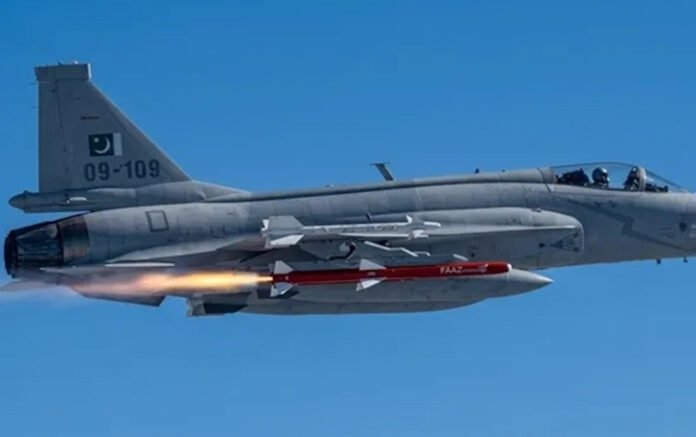
The trial saw a JF-17 Thunder fighter jet launch the orange-painted Fa’az-IIR variant, which pairs an imaging infrared terminal seeker with midcourse inertial navigation and aircraft datalinks.

Developed by the Air Weapons Complex under NESCOM and marketed by Global Industrial & Defense Solutions (GIDS), the Mach 3.5 weapon family is advertised with engagement ranges exceeding 100 kilometers.

In addition to the infrared-homing model tested, the program encompasses the radar-guided Fa’az-RF, an extended-range Fa’az-2 targeting up to 180 kilometers, and a short-range surface-launched air-defense derivative.

Pakistan is pursuing this domestic missile series to curb its reliance on foreign suppliers like China and the US, insulate frontline fighter squadrons from potential embargoes or wartime supply disruptions, and field an adaptable, dual-guidance complement to its existing inventory of Chinese PL-15E and US AIM-120 missiles.

While recent aerial engagements and fleet limitations highlight the operational need for advanced BVR capabilities, vulnerabilities from relying on both Chinese systems and restricted US sustainment underscore the strategic imperative of domestic missile programs to preserve defense autonomy.

The May 2025 aerial skirmishes over Kashmir between Pakistan and India underscored the decisive role of BVR missiles in modern air warfare. As noted by Farhat Hussain Khan in a September 2026 Strategic Thought article, fielding BVR missiles such as the Chinese PL-15E, which achieved surprise intercepts at 160 to 190 kilometers against opposing Indian aircraft, provides kinematic reach, first-shot capability, and seamless datalink integration, making them decisive against sophisticated Western aircraft and layered air defenses.

Beyond missile hardware alone, Khan argues that BVR combat is won through compressed kill chains, electronic warfare, and sensor fusion rather than numerical superiority. Khan observes that the Pakistan Air Force demonstrated how integrating airborne early warning, ground command, and data-linked fighters can induce operational paralysis across an adversary’s ranks by consistently outpacing its decision cycle.

However, Pakistan’s heavy dependence on a Chinese military ecosystem poses severe risks to its long-term strategic autonomy. March 2026 data from the Stockholm International Peace Research Institute (SIPRI) indicate that Pakistan was the largest buyer of Chinese defense exports from 2021 to 2025, accounting for 61% of China’s total sales.

That dependence cuts two ways. Aishwaria Sonavane notes in a January 2026 Takshashila Institution report that reliance on Chinese military equipment forces Pakistan to adopt Chinese operational procedures, maintenance standards, and tactical frameworks.

Sonavane adds that this alignment constrains independent procurement choices and leaves frontline readiness vulnerable to supply disruptions — particularly during external crises like a conflict over Taiwan — while China withholds sensitive source code to protect its proprietary technology.

Reinforcing concerns over constrained procurement autonomy, Kriti Upadhyaya notes in an August 2026 Heritage Foundation report that Pakistan’s entrenched reliance on Chinese military equipment creates severe technology-leakage risks, ensuring any external security assistance indirectly subsidizes a China-equipped military and ultimately reduces Pakistan to a testing and proving ground for Chinese weapons.

Concurrently, Pakistan’s legacy Western hardware offers diminishing operational utility. While Pakistan operates between 70 and 80 US F-16 fighter jets, Military Watch Magazine notes in an August 2026 article that the aging fleet faces severe operational limitations driven by outmatched BVR weaponry and escalating sustainment costs.

According to Military Watch, the F-16 fleet is constrained by the roughly 100-kilometer reach and older, jam-vulnerable seekers of its principal AIM-120C-5 missiles, placing Pakistani fighters inside the engagement envelopes of advanced Indian fighters like the Su-30MKI before they can secure firing solutions.

The report notes that this tactical deficit forced the Pakistan Air Force to withhold F-16s from high-threat sectors during the May 2025 aerial skirmishes over Kashmir.

Military Watch observes that Pakistan’s F-16s lack active electronically scanned array radars and face significantly higher maintenance costs than newer Chinese-supplied fighters, pointing toward potential retirement by the mid-2030s.

Although the US has approved upgrades for Pakistan’s aging F-16 inventory, these packages may prove insufficient to shift the regional airpower balance against India. Jane’s reported in December 2025 that the US agreed to sell Pakistan US$686 million worth of F-16 upgrades, including the Link 16 tactical datalink and six inert Mk-82 226-kilogram bomb bodies.

Furthermore, Defense Security Asia reported in May 2026 that the US agreed to proceed with a USD 488 million sustainment package for Pakistan’s AN/APG-66 and AN/APG-68 radars, extending the operational lifespan of those legacy systems.

Yet these upgrades remain subject to the shifting tides of US-India diplomacy. The US has historically calibrated such support to pressure India to curb its purchases of Russian energy and military hardware in favor of American defense equipment.

The US may thus become reluctant to authorize subsequent military sales or technical upgrades to Pakistan if India steadily diversifies its energy and defense procurement away from Russia.

In navigating these competing geopolitical pressures, Gleb Makarevich notes in a December 2023 article in the peer-reviewed journal USA & Canada: Economics, Politics, Culture that Pakistan’s defense industry strategically safeguards its autonomy by balancing across three distinct pillars: Chinese alignment, Western ties, and domestic production.

Makarevich argues that China provides deep technological cooperation through joint programs such as the JF-17 fighter, while F-16 sustainment lines preserve vital Western diplomatic and technical channels, preventing total reliance on China.

Makarevich adds that domestic production anchors both pillars, with indigenous manufacturing at state-owned facilities insulating frontline combat units from foreign embargoes, serving as a diplomatic lever through external munitions transfers, and bolstering overall strategic autonomy.

Ultimately, Pakistan’s long-term ability to maintain credible deterrence against India while insulating itself from foreign geopolitical leverage will hinge on whether programs like the Fa’az missile can transition from successful prototypes into mass-fielded indigenous mainstays that effectively underpin its strategic autonomy.

Source: Iwpost.com

Israeli army deploys troops to protect settlers after they seize homes in Jericho

0
israeli-army-deploys-troops-to-protect-settlers-after-they-seize-homes-in-jericho
Israeli army deploys troops to protect settlers after they seize homes in Jericho
The Israeli army has redeployed three combat battalions to the West Bank city of Jericho and its surrounding areas to protect settler families who have moved into eight homes in Area C near the city, Hebrew-language media reported.

The move came after settlers took over the homes without prior coordination with the army or informing security authorities.

The Israeli newspaper Yedioth Ahronoth reported that the arrival of the Jewish families took the army and the 96th Division, stationed in the Jericho area and along the eastern border, by surprise.

This forced the army to redirect troops from other security missions, including efforts to prevent smuggling along the border with Jordan.

The newspaper claimed that the settlers had followed a model previously used in Hebron, where they bought homes from Palestinians and moved into them quickly without prior coordination with security officials.

It also noted that, in previous cases in Hebron, the Israeli army had evacuated settlers from homes until the purchase documents were completed.

In Jericho, however, the homes were bought in Area C, which is under Israeli civil and military control, and on land that the newspaper said belongs to the state rather than being privately owned by Palestinians.

Source: Iwpost.com

Digital Journalism Pioneer Salon Shuts Down After 30 Years, Citing Financial Pressures 

0
digital-journalism-pioneer-salon-shuts-down-after-30-years,-citing-financial-pressures 
Digital Journalism Pioneer Salon Shuts Down After 30 Years, Citing Financial Pressures 


Salon, one of the earliest online-only magazines and a digital journalism pioneer, announced Thursday that it was shutting down after 30 years, citing financial pressures that made its publishing model unsustainable. 

In an unsigned statement on its website, the magazine said the “business realities of independent digital journalism” had changed fundamentally and that “our publishing model is no longer sustainable.” 

Erin Keane, Salon’s chief content officer, confirmed the shutdown in a social media post, announcing that the “publication was closed, effective immediately.” 

Journalist David Talbot founded Salon in San Francisco, and It officially launched on November 20, 1995, before blogs, social media, and online news outlets became widespread. 

Rather than adapting an existing print publication for the internet, its founders created a magazine exclusively for digital readers, covering politics, literature, culture and intellectual debate. 

Apple, Adobe, and Borders, the now-defunct bookstore chain, provided financial backing during the publication’s early years. 

Salon subsequently developed a reputation for progressive political commentary and cultural coverage, attracting prominent journalists and commentators who later became established figures in American media. 

Its contributors included Glenn Greenwald, Joan Walsh, and Michelle Goldberg. Steve Kornacki, now at NBC News, previously served as Salon’s politics editor, while CNN anchor Jake Tapper worked as its Washington correspondent. 

The publication changed ownership several times during its final years. In August 2019, entrepreneurs Chris Richmond and Drew Schoentrup acquired Salon for $5 million. 

Another sale followed in November 2023, when Find.co, a Malta-based company describing itself as a “performance marketing ecosystem” for cryptocurrency brands, purchased the magazine for an undisclosed amount. 

In its farewell announcement, Salon reflected on its origins in the internet’s early days, before digital publishing became an established part of the news industry. 

“Salon was never just a website,” the announcement said. “It was an idea about what journalism could be, born at a moment when the internet was still a largely unexplored frontier.” 


Source: Iwpost.com

Software squeezes more data out of Webb Telescope for imaging exoplanets

0
software-squeezes-more-data-out-of-webb-telescope-for-imaging-exoplanets
Software squeezes more data out of Webb Telescope for imaging exoplanets
With a huge and still-growing catalog of exoplanets, researchers are eager to take the next steps: trying to infer what conditions are like on them, either by imaging them directly or by capturing the light that has passed through their atmosphere. Both are substantial challenges, given the presence of stars that are far, far brighter than light that has come to us via the planet.

While telescopes can be fitted with devices called coronagraphs that block out much of a star’s light, there are limits to their effectiveness, caused by noise from subtle variations in the telescope’s configuration and pointing between observations. Now, researchers have developed a new software package that optimizes a physical model of the telescope in a way that allows us to better model these differences, producing low-noise imaging of exoplanets.

Point spreads

Central to this work is the concept of a point spread function. If you use a telescope to image a single point of light, it will not appear that way in the actual image. Instead, it will be slightly blurry and spread out, due to imperfections in the telescope hardware and the limits of our ability to keep it pointed accurately through the time it takes to image something. The mathematical description of how a telescope distorts a point of light is called its point spread function.

There are two ways to figure out what the point spread function is. One is to use the telescope to image a known target and use those observations to derive a mathematical description of the point spread function. This is effective at reducing noise but has its limits, as the behavior of the telescope hardware can change over time, and the point spread function may vary with the wavelengths being imaged.

The alternative is to try to model the hardware’s behavior and use that model to derive a point spread function. But modern telescopes are incredibly complicated instruments, with many, many factors feeding into their performance in ways that can be difficult to ascertain, even with the full engineering schematics. As a result, these models simply contain too many parameters that need to be tuned to make this route computationally tractable.

But anyone paying attention to the world of AI developments will recognize that we’ve become quite successful at tuning billions of parameters in neural networks, in part through a mathematical technique called gradient descent. And, because this is central to training large neural networks, people have put a lot of work into optimizing the performance of gradient descent on GPUs.

So a team of researchers has developed a process they’re calling FLIP (a non-acronym for Physics-based Learning for Imaging Planets) that uses a physical model of the hardware (in this case, the NIRCam on the James Webb Space Telescope) with 106 possible parameters, and then uses software to optimize all its parameters. The optimization starts with a simulated point spread function, then uses gradient descent to optimize its performance on data from an actual star. Run on a current GPU, this process only takes a bit more than half an hour.

The researchers then fine-tune the results on the actual scientific image they are analyzing. This last part of the process is critical, since some variables will differ between observations.

Good results

To test how this works, the researchers used observations of two stars with known exoplanets (HIP 65426 and 51 Eridani), along with a third (TYC 5899) that doesn’t have any known exoplanets but is known to vary a lot between observations. These are young stars, and two of them have massive planets that are still warm from their gravitational collapse, allowing them to have been imaged previously.

Using Webb data, the team used FLIP to boost the signal-to-noise ratio by a factor of 1.5 to 2, depending on the observations. At a wavelength that can be used to detect carbon dioxide, they were able to spot one of the planets in the Webb data for the first time. For TYC 5899, the approach boosted the sensitivity of the observations by a factor of 15.

The researchers point out that the applications go beyond getting a better view of known planets. By lowering the noise, it should also be possible to spot dimmer (and hence older or lower-mass) ones that had previously eluded detection. They also think they can modify FLIP to highlight where it’s making the most dramatic changes to the model, which can potentially tell us useful things about what’s going on with the telescope’s hardware.

Nature, 2026. DOI: 10.1038/s41586-026-11213-z (About DOIs).

Source: Iwpost.com

Korea, Taiwan and Japan take first jolt from Democratic AI shock

0
korea,-taiwan-and-japan-take-first-jolt-from-democratic-ai-shock
Korea, Taiwan and Japan take first jolt from Democratic AI shock

<

article id=”post-952422″>

SEOUL – The fallout from this week’s US midterms is already upending South Korea’s financial system.

On Friday, the Kospi plunged more than 8% and fell below 5,000 for the first time since February. Investors clearly fear the Democratic sweep on November 3 will delay or halt data center construction in the US. Chip makers SK Hynix and Samsung Electronics each fell more than 10%.

Fears of a chilling effect on AI investment are rapidly spreading across the region. Japan’s Nikkei 225 dropped below 60,000 for the first time since mid-May, pulled down by AI-linked names such as Kioxia, SoftBank Group and Advantest.

Both the Nikkei and Topix indexes are in bear market territory. As is Taiwan, where TSMC shares fell as much as 9.8% on Friday, which was, by many measures, the worst day for the world’s leading chip maker since the pandemic.

The rout began in New York on November 5, with chipmakers at the center of the storm. AMD and Micron each fell more than 15%, and Nvidia dropped 9%. The Philadelphia Semiconductor Index, which tracks 30 major US chipmakers, plunged more than 12%.

Nomura’s Charlie McElligott described hedge funds as “shooting the generals,” meaning they were targeting the stocks that led the rally. Saxo Bank strategist Charu Chanana said the correction reflects both a reassessment of US infrastructure demand and how crowded investors had become in the same AI winners.

Democrats beat Republicans for several reasons, including inflation tied to the Iran war. But a widening backlash against the data centers that power AI was also a major factor, along with unease over the Trump administration’s hands-off approach to AI regulation.

Texas was the starkest example. Governor Greg Abbott, who once vowed to make the state the “epicenter of AI development,” lost to Democrat Gina Hinojosa. She campaigned against data center construction and Abbott’s ties to Elon Musk and other tech billionaires.

“When I am governor,” she said, “we will put a pause – a moratorium on any agreements until we can pass laws to make sure that the people of El Paso and Texas have a seat at the table to decide if and how these data centers come into their communities.”

Musk, who put more than US$470 million into House and Senate races, saw Texas Republican Ken Paxton lose to Democrat James Talarico in a Senate contest. Musk’s response on Wednesday: “Data centers in space looking pretty appealing right now.” OpenAI co-founder Greg Brockman also backed pro-AI and crypto groups, which largely failed to gain traction.

In Georgia, anti-data-center sentiment helped elect Democrat Keisha Lance Bottoms as the state’s first Black woman governor. Atlanta has until now been one of the fastest-growing data center markets, according to CBRE.

This week, voters greenlit, or are on track to, at least 33 local ballot measures to ban, pause or limit data centers. A more restrictive environment for data centers under Democratic rule could create “incrementally more negative sentiment for AI infrastructure exposed names,” said Amit Daryanani, analyst at Evercore ISI.

Following the midterms, strategist David Roche, president at Quantum Strategy, said, “US foreign policy becomes more unpredictable. War is more, not less, likely. Dying fish flap hardest.”

In a report this week, BMI, a unit of Fitch Solutions, noted that regulatory friction surrounding AI infrastructure will intensify at the “subnational level” through to the end of 2028, with roughly 53% of hyperscaler pipeline growth concentrated in newly flipped governor states such as Texas, Georgia, Ohio and Pennsylvania now exposed to heightened slowdown risk.

“We flag the net effect on AI capex as a two-sided risk, where imposed moratoria and compressed project volumes could drag on 2028 activity starts lower, while a Democratic pivot towards state-wide bring-your-own-power mandates and unwound tax exemptions could instead lift the all-in cost per facility,” BMI analysts wrote. “Hence, the direction of our capex forecasts therefore hinges on how vigorously tighter legislation is pursued.”

As such, Roche warned, “the meltdown of the US AI model is set to accelerate, with the end of tax breaks and increased restrictions on data center construction.”

It’s concerning that Trump, Roche stressed, “will retain control of trade, and his maverick anti-globalization stance will continue. This is bad for China exports and technology access… A proposed summit of Xi, Putin and Trump would now be seen as impotent to divide the world à la Yalta. It would be seen as propping up a dying US leader. Xi is unlikely to want this. It’s a bad way for China to take its seat at the top table.”

A more restrictive US environment for data centers could create “incrementally more negative sentiment for AI infrastructure exposed names,” said Amit Daryanani, analyst at Evercore ISI.

JPMorgan strategist Michael Cembalest said that planned 2027 data center construction might not be notably affected, but 2028 could be a different story. “While pauses are the more impactful outcome,” he said, “conditions can be onerous: requiring data centers to pay grid costs to protect ratepayers, ending tax incentives, imposing water limits, setting requirements for onsite backup power, mandating labor requirements and banning non-disclosure agreements during permitting.”

Apollo Global Management is taking a more defensive approach to its AI bets. “We know that society will use dramatically more computing power in the future,” that demand for chips will remain strong, “and that AI capabilities are improving at an extraordinary rate,” said Apollo President Jim Zelter. “What we don’t know is how pricing and economics will evolve.”

Apollo CEO Marc Rowan added that “FOMO is not an investment strategy. We are prudent and we are cautious, especially in credit.”

Strategies at Jefferies noted that the most politically popular approach mirrors Pennsylvania Governor Josh Shapiro’s stance — permitting data centers conditionally with community involvement and price controls — which could help mute the backlash over time.

“Washington DC is in dispute,” said Richard Harris, Chief Executive Officer at Port Shelter Investment Management. “We have extreme left, extreme right and moderate left and right on the Hill. And an extreme individual in the White House. America is rudderless, no leadership, divided. How are we going to work our way out of a 2008-type market crisis?”

Fears that AI valuations are too rich only heighten the risks. “The AI bubble means that we’re still floating on a sea of liquidity, from AI money creation,” Harris said. “It’s the ‘Cappuccino Economy,’ all froth with the value way below.”

What’s more, markets “are increasingly fragile,” Harris said. “The AI boom looks like 1999; debt issues — not sub-prime lending but sub-hyper scaler lending — looks like 2008. Inflation everywhere — food, fuel, healthcare, housing — rates will go up.”

The economy here in South Korea may be especially in harm’s way. No major economy has hot-wired artificial intelligence into the center of its economic model faster or more ambitiously than Korea. That gambit is paying off fantastically for President Lee Jae Myung’s 16-month-old administration.

Until now, that is. Lee pledged before taking office in June 2025 to push the Kospi above 5,000, about double its level then, by fixing corporate governance and ending the “Korea discount.” Thanks to AI, the index got there without any significant legislation. In fact, the Kospi rose to 9,385 in June 2026.

Today, it’s struggling to maintain a 5-handle. The Kospi is now barely up 20% this year. This puts the broad Korean economy in harm’s way, given how reliant Korea’s $2.25 trillion economy has become on AI.

In October alone, shipments from Asia’s fourth-largest economy surged nearly 94% year on year to $115.28 billion. It was the biggest increase since 1974 and topped September’s rougher 84% gain.

These, of course, are the kinds of gains Korea and its fellow Asian Tigers posted 50-plus years ago. When a top-12 economy breaks records month after month, investors have reason to worry about sustainability, and what could happen if the AI boom goes bust.

This week’s seismic change in Washington greatly raises the stakes for Korea, Taiwan and other Asian economies that handed the steering wheel to AI.

The Democrats trounced President Donald Trump’s Republicans for a number of reasons, but a collective queasiness about the Trump administration’s hyper-laissez-faire approach to AI regulation was a big one.

Now, worries are growing about how an angry and cornered Trump might respond to realizing he’s already crossed into the lame-duck zone. “That dynamic will be heightened by the uncomfortable but unmistakable fact that Trump is losing coherence at the age of 80,” observed Ian Bremmer, CEO of Eurasia Group.

Bremmer added that “I can’t evaluate Trump’s mental state, but I can evaluate the political implications of the public perceiving him as having lost a step (with nearly half of the country already having thought Trump was experiencing cognitive decline earlier this year). Concerns over President Biden’s mental acuity led to a revolt in his party against him, ultimately sinking his reelection campaign. Trump can’t run for a third term – no matter what Steve Bannon says – but Republicans hoping to lead the party in 2028 and beyond can still desert him.”

To be sure, there’s still plenty of AI bullishness out there. But the worry is that the longer runaway investment in AI buildout continues apace, the more dangerous the bubble will be when it bursts.

“At some point in time, there’s going to be a downturn, and then things are going to break,” said Pacific Investment Management Co. CEO Emmanuel Roman, who reckons sustaining the AI boom will require about $2 trillion of financing annually over the next five years to fund capital spending by the industry.

When the music finally stops, South Korea will be Exhibit A of economies scrambling for a chair. “Exports will remain the economy’s main growth engine, supported by strong global demand for advanced chips tied to artificial intelligence investment,” said John Bromhead at Moody’s Analytics.

With “record semiconductor shipments encouraging firms to expand production capacity, facilities investment jumped 4.1% quarter-on-quarter, making its largest ever contribution to GDP growth,” said Bromhead.

“Intellectual property investment also strengthened. The risk is that growth stays heavily concentrated in the semiconductor sector, leaving South Korea exposed to a slowdown in global AI spending,” he added.

Bromhead noted that strong headline GDP has “masked weakness in household demand, with private consumption recording its sharpest contraction since early 2022. Private consumption fell 0.2% in the quarter, despite government measures cushioning households from higher living costs. Elevated energy prices squeezed purchasing power, while high borrowing costs and household debt limited discretionary spending.”

Without the jump in government consumption, the result would have been worse, Bromhead explained, adding: “We expect the recovery in household spending to be gradual, with fiscal support only partly offsetting the drag from inflation and tighter financial conditions. In other words, the two-speed economy will likely persist, with differences between external and domestic performances possibly even widening.”

Lee promised a Kospi at 5,000. He got it twice: once on the way up, and now on the way down. Now, as the bubble seems set to burst for US data centers, it’s hard to tell where Asia stocks will go from here, but the bottom could be a long way down.

Follow William Pesek on X at @WilliamPesek

Source: Iwpost.com

BMW bumps battery for the better: The 2027 i7 60 xDrive, driven

0
bmw-bumps-battery-for-the-better:-the-2027-i7-60-xdrive,-driven
BMW bumps battery for the better: The 2027 i7 60 xDrive, driven

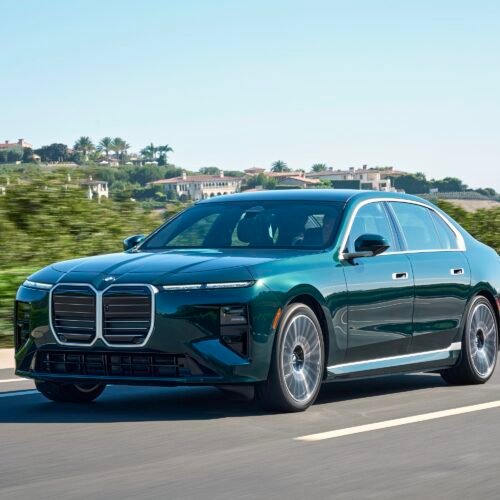
When BMW debuted the new 7 Series in 2022, it set a new standard for large luxury sedans, increasingly irrelevant though that class is. Rather than siloing off an electric alternative like Mercedes, with its EQS alongside the normal S-Class, BMW simply made the powertrain an option. Stick with a V8 if you want, or consider the rather good electric version instead—only subtle differences like the badging and lack of exhaust pipes give the game away.

Since then, BMW has brought out a string of even newer electric vehicles for the 5 and 3 Series (plus their SUV counterparts). It has switched from battery packs made of prismatic cells to more energy-dense arrangements of cylindrical cells. The motors are still electrically excited synchronous ones, but now the drive units feature silicon carbide inverters and more compact packaging.

This sixth-generation electric powertrain was designed for the clean-sheet Neue Klasse family, which also threw out the legacy cruft of dozens and dozens of discrete single-function electronic control units for a handful of powerful domain controllers. These computers take over those functions but with much faster processing power—and therefore more capabilities in terms of chassis control or powertrain efficiency—as well as the ability to be more easily updated.

A BMW i7 seen from the rear 3/4s

The sedan has a very high belt line.

The sedan has a very high belt line. Credit: Daniel Kraus/BMW

Which could have left BMW with something of a problem—should the flagship be clearly outclassed in terms of power and energy density and range efficiency by, well, all the other EVs in the range? Clearly, the board decided the answer to that was no, and for the 7 Series’ midlife update, the i7 got some comprehensive surgery under the skin.

6th-gen power

Compared to the last i7 I drove, the 2027 model boasts a higher-capacity battery pack, now 112.5 kWh (net) up from 101.7 kWh, although BMW stuck with a 400 V architecture, unlike in the Neue Klasse or the iX5 we recently drove. A less-powerful 50 xDrive and a more powerful M70 xDrive will also be available, but at the first drive, I sampled the midrange 60 xDrive model, which features a combined 544 hp (400 KW) and 549 lb-ft (745 Nm), roughly equivalent to the pre-facelift car.

Despite that power and torque, the i7 60 doesn’t feel fast like a Porsche Taycan might, and you won’t want to hustle it down a mountain road the way you might the Porsche. The entire driving experience is waftier than that, with the car offering more of a magic carpet ride, a la the iX SUV or even that very fancy cousin of the i7, the Rolls-Royce Spectre.

A BMW i7 head-on

I can’t unsee the angry birds pigs.

I can’t unsee the angry birds pigs. Credit: Daniel Kraus/BMW

Even with launch control, 0–60 mph takes 4.6 seconds. Once upon a time, this would have been considered excellent—the V12 750i of the mid-1990s needed at least two seconds more to do that job. But 30 years later, electric sedans from Lucid and Tesla and Porsche and a whole load of Chinese automakers will get you there in less than half the i7’s time, should you want that. If you’re looking for an outright speed machine that will rearrange your internal organs under acceleration, look elsewhere.

In fact, the i7 was remarkably relaxed; even with the traction and stability control turned down, it refused to chirp a wheel or even threaten to break loose in the dry at speeds considered acceptable on the road. But drive it in a more relaxed manner, and it rewards. The steering is precise, and it coasts beautifully on flat or downhill grades, a consequence of those EESMs that offer no resistance to the road when they’re not receiving a charge. The same very smooth regenerative braking to a stop that we experienced in the iX3 and iX5 shows up in the i7, too.

First drive events are never a good way to determine range efficiency, but BMW says between 344—362 miles depending on wheel size. With only a 400 V pack, DC fast-charging tops out at 250 kW (up from 195 kW), and a 10–80 percent charge takes about 28 minutes. Like other model-year 2027 BMW EVs, the i7 has a NACS charging port.

BMW i7 cockpit

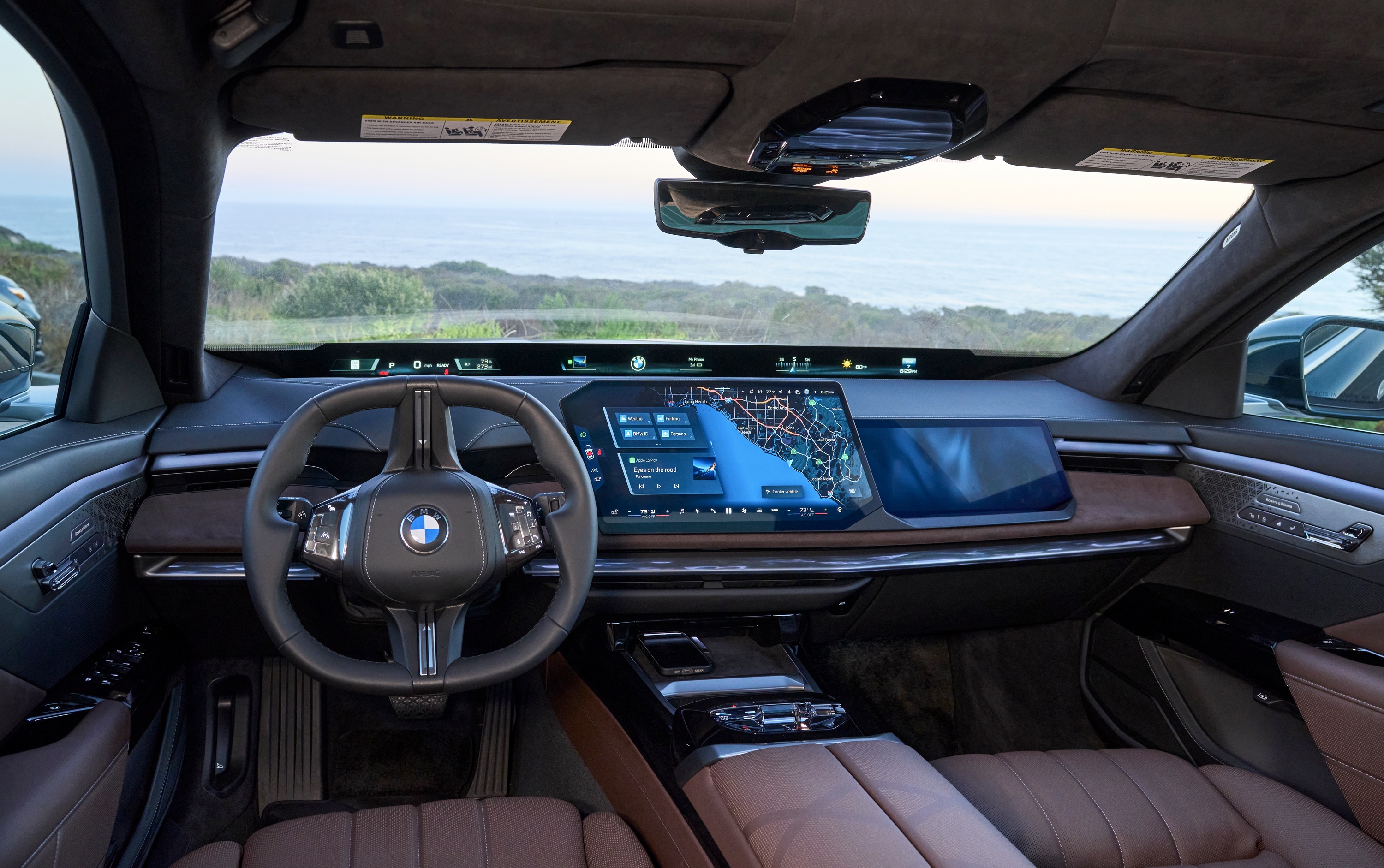
There’s a new steering wheel as well as the new displays.

There’s a new steering wheel as well as the new displays. Credit: Daniel Kraus/BMW

The domain controller for the powertrain also helps efficiency by working with the route-planning software. BMW also runs AI simulations of the battery based on previous charging cycles when planning routes and picking charging stops along the destination and will even take the cost per kWH at different stations into account.

Infotainment upgrade

There was also some rather radical surgery in the cabin, with BMW’s new Panoramic iDrive screen running along the base of the windshield, and its new trapezoidal infotainment touchscreen replacing the older system that was inspired by boutique hotel interiors.

BMW also put in a new domain controller for the infotainment systems. The front passenger screen and theater screen that folds down from the roof for the rear passengers operate independently of each other and the main infotainment screen—logging in to YouTube or Disney+ on one will not log you in on the others, for instance. Watching content on the theater screen in the back is also a little more enticing in the abstract than the practical.

The view from the back.

BMW i7 rear door card

Each rear seat has its own controller built into the door handle.

The 31.3-inch touchscreen boasts 8K resolution, but because of the aspect ratio of the screen, if you’re watching a movie—or perhaps F1 qualifying—it will only fill the middle third of the screen, with big black bars on either side. Plus, you have to tilt your head back quite a bit to look up at the screen. The Dolby Atmos sound system was impressive to my relatively cloth ears, though.

While BMW has increased the processing power, there was still some noticeable lag on the main infotainment screen. The Alexa-based voice recognition software was notably better than when I encountered it a few months ago in the iX3, however.

BMW i7 trunk at sunset

This, or a Lucid Air?

This, or a Lucid Air? Credit: Daniel Kraus/BMW

The new i7 range starts at $106,200 for the 50 xDrive, or $124,700 for the 60 xDrive.

Source: Iwpost.com

As high oil prices curb demand, fresh signs of glut appear

0
as-high-oil-prices-curb-demand,-fresh-signs-of-glut-appear
As high oil prices curb demand, fresh signs of glut appear
cde.news desk · 3 min read

The global oil market is showing signs of a ​return to excess supply as demand drops due to high prices, analysts and traders said, despite the lack of a resolution to ‌the Iran war, which has disrupted exports from the Middle East since March.

The market was widely expected at the start of 2026 to be in a surplus, but the outbreak of the Iran war in late February led to what the International Energy Agency called the world’s biggest ever supply disruption and cut Middle East exports, overturning the surplus projections.

Banks and government forecasters have cut ​global oil demand forecasts in 2026 in part due to high prices. As supplies recover, weak demand is helping the market to balance.

MARKET BACK ​IN SURPLUS, SAYS JP MORGAN

Recovering Middle Eastern oil flows, rising production from other countries and weak demand have pushed global ⁠supply above consumption once again, JP Morgan said in a report.

“We estimate the global oil market returned to a surplus of 1.1 million barrels per day ​in September, widening to 1.4 million bpd in October, nearly matching last year’s average of 1.3 million bpd,” the bank said.

Global crude oil imports in October rose ​above average 2025 levels, the bank said, while demand lags.

OIL STOCKS DID NOT FALL IN LAST TWO MONTHS, GOLDMAN SAYS

The Iran war prompted the IEA to arrange a record release of oil from industrialised nations’ strategic reserves, and has drawn down commercial inventories.

However, Goldman Sachs estimates that global stocks did not decline in September to October after falling sizeably in the ​months following the start of the Iran war.

Goldman sees the market as broadly balanced in the September-October period, compared to a deficit in March this year. ​A marginal surplus from last year, an uptick in production outside the Gulf, along with a decline in demand helped balance the market, the bank said.

GULF CRUDE FLOWS RETURN CLOSER ‌TO NORMAL, ⁠PRODUCTS LAG

Both banks also pointed to an uptick of oil flows from the Middle East since the early months of the war.

Oil shipments from the region edged lower in October from September’s levels, which were the highest since the Iran war started. Two ship-tracking firms said the October figures could be revised upwards as more details on shipments emerge.

Crude and condensate exports from the Gulf averaged 14 million bpd in October, or about 86% of pre-war levels, while refined product exports averaged ​3.1 million bpd, or just over half ​of normal volumes, ship-tracking firm Vortexa ⁠said.

MIXED SIGNALS FROM SHORT-TERM BRENT SWAPS AND BRENT FUTURES

In a sign of a short-term surplus of supply in the physical market, the price curve of Brent swaps, called contracts for differences, has moved.

The contract for delivery this week is trading ​below that for the following week and at the steepest discount since July, according to LSEG data. The prices ​of the second- and ⁠third-week contracts are also trading at a discount to the next week.

This market structure is called contango and generally reflects a perception that supply for immediate delivery is ample.

By contrast, Brent crude futures starting from January 2027 delivery remain in the opposite structure to contango, known as backwardation, where prompt prices are higher than later contracts . This ⁠indicates that ​supply remains tight in the near term.

Brent futures could also move into a contango structure if ​the swaps remain there, said Adi Imsirovic, a veteran oil trader and market expert, as such changes in the market structure usually start in the physical market.

Source:  Reuters

Source: Iwpost.com

Chris Rock Makes Shocking Confession

0
chris-rock-makes-shocking-confession
Chris Rock Makes Shocking Confession


Chris Rock has spent decades making millions laugh, but behind the scenes, the comedy legend has been confronting some painful truths about his own life. Now, at 61, he’s opening up about the mistakes that destroyed his marriage, the emotional struggles that drove him into therapy, and the difficult years that forced him to reevaluate everything.

In a revealing interview with GQ published November 3, Rock admitted he was far from the ideal husband during his nearly 20-year marriage to Malaak Compton-Rock. The comedian acknowledged his past infidelity and excessive pornography use, revealing that he has since made significant changes to his personal life.

“I was not a great husband,” Rock confessed, adding that he hasn’t watched pornography in five or six years.

Rock and Compton-Rock married in 1996, announced their separation in 2014 and finalized their divorce in 2016. The former couple shares two daughters, Lola and Zahra. Although Rock previously addressed his marital failures in his 2018 Netflix comedy special Tamborine, his latest remarks offered another unusually candid look at how those mistakes changed him.

Rather than make excuses for his behavior, Rock acknowledged that fame and success had contributed to an inflated sense of his own importance. He compared his past behavior to a superhero testing the limits of newfound powers before discovering that even the strongest people can fall.

The painful lessons extended well beyond his divorce. Rock revealed that dissatisfaction with his personal relationships eventually pushed him to seek professional help, describing an emotionally overwhelming introduction to therapy that left him in tears.

The comedian said therapy remains an ongoing part of his life, helping him confront insecurities and better understand how his behavior has affected those closest to him.

Rock also discussed his diagnosis of nonverbal learning disorder, a condition that can make it difficult to interpret social cues and understand what others are communicating without words. He explained that receiving the diagnosis helped him recognize patterns in his relationships that he had previously struggled to understand.

For years, Rock said, he sometimes blamed misunderstandings on the unusual pressures of celebrity rather than considering his own role in those interactions.

Meanwhile, his personal upheaval took a toll on his Hollywood ambitions. Rock acknowledged that his divorce created financial pressures, prompting him to focus heavily on stand-up tours while putting other creative projects on the back burner. The COVID-19 pandemic added another major disruption.

Those challenges help explain the 12-year gap between his 2014 film Top Five and his latest directing project, Misty Green, a comedy-drama about a talented actress struggling to rebuild her career.

The comedian’s life also changed dramatically in 2022 when Will Smith slapped him onstage during the Academy Awards after Rock made a joke about Jada Pinkett Smith. The incident became one of the most controversial moments in Oscars history, and Rock later addressed it in his 2023 Netflix special Selective Outrage.

But Rock made clear that he has little interest in allowing that confrontation to define the rest of his career. He would rather audiences focus on his writing, films and future projects than continue revisiting a moment he has already discussed publicly.

Now enjoying renewed attention as one of GQ’s 2026 Men of the Year honorees, Rock appears determined to make the next chapter of his career different from the last.

His latest revelations offer a striking contrast to the confident, sharp-tongued comedian audiences have known for decades. Behind the Hollywood success, Rock has spent years confronting personal failures, rebuilding relationships and learning difficult lessons about himself.

And while he remains willing to acknowledge his mistakes, the comedian has made one thing clear: His future matters more to him than continually reliving his past.

Source: Iwpost.com

US Democrats, please take note: peace is good politics

0
us-democrats,-please-take-note:-peace-is-good-politics
US Democrats, please take note: peace is good politics

<

article id=”post-952418″>

Voters across the United States were loud and clear on Tuesday in their historic drubbing of Trumpism. The election was a decisive rejection of Trump’s war on Iran and its staggering costs at home.

While savoring their victory and the historic opportunity to restore America’s constitutional order, the Democrats should take the anti-war message of the election to heart, because they suffered the same verdict two years ago, when voters rejected the Biden administration’s wars in Ukraine and Gaza.

Last week Israeli voters rejected Netanyahu’s reckless wars, and European voters are also rejecting parties that prolong the Ukraine War. The message of voters is the same everywhere: diplomacy is safer, more effective, and trillions of dollars cheaper than war.

On election night Trump conceded to Fox News, “I think a part of it was Iran.” The next day Vice President JD Vance was far blunter, posting on X: “The reason we lost is the war. The president himself said so last night…. everyone knows why we lost.” In the AP Voter Poll, about 60% of voters said the decision to use military force against Iran was wrong, and about 90% called the cost of living a crucial or major factor in their vote.

The war and the cost of living were, of course, utterly intertwined. Gasoline prices, around US$2.80 per gallon before the war began on February 28, had risen by about 55% by mid-May and reached a monthly average of $4.43 in September.

The 10-year Treasury yield climbed from below 4% before the war to above 5% in the autumn, and the Pentagon sought more than $200 billion in supplemental war funding. Every family with a mortgage, a car loan or a credit card balance suffered from the war.

The first duty of the new Congress is to restore its constitutional authority over war and its power of the purse to ensure that US forces are not sent back into combat in Iran or anywhere else on the whim of a president and the behest of domestic or foreign lobbies.

Trump must of course refrain from restarting the war, which was never remotely necessary or justified. Remember that on February 28, the day the US and Israel launched the war, Oman’s foreign minister, who was mediating the US-Iran talks, had said that a deal was within reach.

The Democrats should not imagine that the anti-war lesson applies only to Republicans. Kamala Harris lost in 2024 because voters held the Biden administration responsible for the costs of its own wars. The energy shock that followed the escalation of the Ukraine war in 2022 drove up inflation, and gasoline topped $5 per gallon for the first time in June 2022.

Biden twice rejected negotiations that could have ended the conflict: in December 2021, when his administration refused to negotiate on NATO enlargement in response to Russia’s draft security treaty, and in April 2022, when the Istanbul talks were abandoned at the behest of the US and UK.

The Gaza genocide also cost the Democrats directly. Among Americans who voted for Joe Biden in 2020 but not for Harris in 2024, 29% named ending Israel’s violence in Gaza as the main factor in their decision, the most frequently cited issue. The party’s voters have moved far ahead of its leaders. A New York Times/Siena poll in May 2026 found that roughly three-quarters of Democratic voters oppose US military and economic assistance to Israel.

Voters everywhere are sending the same message: peace through diplomacy. On October 27, after Israeli wars in Gaza, Lebanon and Iran, Netanyahu lost his majority. Similarly, European leaders who have tied themselves to open-ended war in Ukraine are being rejected by the voters.

Only 10% of Germans are satisfied with Chancellor Friedrich Merz, the lowest rating ever recorded for a German chancellor. Emmanuel Macron’s approval fell to 15% in October. In Bulgaria, Iliana Iotova, who favors dialogue with Moscow, won the presidency on November 1 with more than 58% of the vote.

A key upcoming key test for the Democrats will be Ukraine. They must stop their party’s typical Russia-bashing and instead support a diplomatic end to the war.

As a start, the Democrats should remember why the war started. In 1990 the United States assured Mikhail Gorbachev that NATO would not move “one inch eastward.” The Clinton administration broke that promise.

In 2008 the Bush administration pushed through the Bucharest declaration that Ukraine and Georgia “will become members of NATO,” despite Ambassador William Burns’s warning that this was the brightest of all red lines for Russia.

In 2014 , the United States backed the coup against Ukraine’s elected president, Viktor Yanukovych, as the leaked Nuland-Pyatt call made clear. In April 2022, when negotiators in Istanbul came close to a peace agreement based on Ukrainian neutrality, the US and UK actually intervened to block the agreement. Today, 75% of Ukrainians support negotiations with Russia to end the war.

In view of these causes of the war, I have recently set out a straightforward diplomatic framework for peace in Ukraine that would end the war. NATO would end its eastward expansion. Ukraine would adopt permanent neutrality on the model of Austria in 1955. An armistice line would be drawn, with both sides renouncing the use of force to change it.

Ukraine would pursue membership in the European Union as a permanently neutral state. The Democrats should support such a diplomatic approach. It’s what can end the war, save Ukraine, and win the backing of both the Ukrainian and American people.

Most importantly, the Democrats should not mistake their victory for a mandate to pursue their own wars. The new Democratic majority should quickly reassert the constitutional authority of Congress over war and peace, champion a negotiated peace in Ukraine, end support for Israel’s wars, cut the military budget, and redirect the savings toward lowering the cost of living and repairing the public finances.

These positions are not only right but are good politics. For the Democrats to win the White House in 2028, they should become the party of peace. Better yet, both parties should become parties of peace and conduct the 2028 campaign on which party will best address America’s needs for decent jobs, affordability, healthcare, housing, a safe environment and quality education.

Jeffrey D. Sachs is a university professor and director of the Center for Sustainable Development at Columbia University, where he directed The Earth Institute from 2002 until 2016. He is also president of the UN Sustainable Development Solutions Network and a commissioner of the UN Broadband Commission for Development. He has been an advisor to three United Nations Secretaries-General and currently serves as an SDG Advocate under Secretary-General Antonio Guterres.

– Common Dreams

Source: Iwpost.com

Google: Schools can keep search while skipping Gemini, but AI search is non-negotiable

0
google:-schools-can-keep-search-while-skipping-gemini,-but-ai-search-is-non-negotiable
Google: Schools can keep search while skipping Gemini, but AI search is non-negotiable
Google faced the ire of educators and parents earlier this week when it announced a new AI policy for K–12 schools. Google said that it developed its new approach to give schools more control, but early reporting also suggested Google would block search access for schools that didn’t want to use AI. Google didn’t see the backlash coming, but now that it’s here, the search giant is clarifying what exactly its new policy means and what’s changing.

The gist of the new policy, according to Google’s blog post, is that schools using Google apps will have to opt into its AI products going forward. Since the company considers search part of its AI portfolio (Gemini, Gemini Notebook, Gemini in Classroom, and Search), schools have to specifically turn that on for logged-in student accounts.

When Google revealed its new policy, the company’s VP for education spoke exclusively to The New York Times, which interpreted the situation as Google will “turn off search” if schools reject AI. This has a nefarious vibe, but it’s probably not the most accurate way to describe how Google’s educational AI system will operate. Google’s approach may not be entirely altruistic, but it technically offers schools more choice and control than they have now. Instead of Google turning off search, it will let schools make that decision based on their internal AI policies.

The company clarified in a tweet that it will allow schools to disable Gemini apps while leaving search active for students. If they don’t want any AI, they can leave it all off. Essentially, Google is giving schools that want to completely block AI the ability to go all the way, even removing search from student accounts.

A Google spokesperson tells Ars that the company has not made any changes to the new policy it announced this week. However, the vagueness of Google’s blog post and public statements didn’t fully explain what it plans to do. There are still reasons to dislike Google’s approach, but here’s how the company explains the process for schools:

As things currently stand, schools can block the Gemini app, but the AI tools in search (AI Overviews and AI Mode) are still present and offer many of the same intellectual shortcuts. When schools choose which AI features to use under this new system, search will be one of the options. Schools can leave search off if they want, but opting in will require them to choose the standard AI features or the new Guided Learning version, which won’t give away answers as readily (or so Google claims).

Can’t get away from AI

Schools are gaining the ability to block Google’s AI tools, even those in search, while keeping other Google apps. Notably, the company’s new approach to “responsible AI for learning” does not include the ability to use search without AI. So schools get more control, even if they don’t get the AI-free search everyone seems to want.

Many will argue that Google should let schools access web search without chatbots. However, that’s just not something Google wants to support at any level because it sees AI as the future of search. While other search engines have settings to turn off AI tools, Google steadfastly refuses to create such a toggle (and those no-AI tricks you rely on may not work forever). Ultimately, this is the core problem not just for education customers, but for everyone who wants to limit their exposure to AI while using Google.

This clarification does not change the calculus for educators who want to allow students to search the Internet without AI tools. Google won’t offer that, and switching to another provider is easier said than done. Google still has by far the most expansive index of the Internet, leaving alternatives with numerous gaps. That may change in the near future, though. As a result of Google’s loss in the DOJ’s search antitrust case, it will have to provide competitors limited access to its index of the web. This could give other provides a chance to improve and offer a more viable alternative to Google.

Source: Iwpost.com

0FansLike
0FollowersFollow
0FollowersFollow
0SubscribersSubscribe
- Advertisement -
Google search engine

Recent Posts