9.6 C
London
Thursday, November 5, 2026
Home Blog

Trump, Putin and Xi can’t carve up the world like its 1945

0
trump,-putin-and-xi-can’t-carve-up-the-world-like-its-1945
Trump, Putin and Xi can’t carve up the world like its 1945

<

article id=”post-952377″>

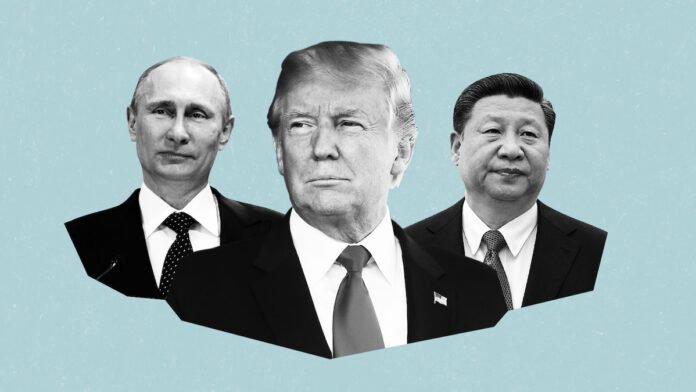
Discussions are underway for a potential meeting between Donald Trump, Xi Jinping and Vladimir Putin on the margins of the Asia-Pacific Economic Cooperation summit on November 18-19.

The prospect has prompted comparisons with the “Big Three” summit in Yalta in February 1945, at which the leaders of Britain, the US and the Soviet Union discussed a carve-up of the world following the Second World War.

It is clear that Trump, Xi and Putin, each in charge of a country that considers itself a “great power”, rather like the idea of a new world order that will revolve around them. The US president appears to see himself as one of a modern triumvirate with presidents Putin and Xi who – like their 1945 predecessors – can propose and dispose of other nations as they please.

For these leaders alone, Trump appears to show respect and deference – compared to the disdain he demonstrates for most others presidents and prime ministers.

The 2025 US national security strategy was explicit that the Western Hemisphere should be considered a region of US predominance, and implied that Russia and China could have similar spheres of influence. The US-imposed change of leadership in Venezuela and support for sympathetic populist regimes in Latin America suggest the US is serious about this.

Putin’s aim to restore Russian control over Ukraine by force of arms, meanwhile, and his use of bribery, threats and subversion to surround Russia with sympathetic regimes in the former Soviet sphere, is equally clear.

Xi has made no secret of his aim to recover control over Taiwan, and is evidently keen to exert Chinese influence in Myanmar and more broadly in Southeast Asia and the South China Sea.

All three appear to regard Europe – and specifically the European Union – as an obstacle to the acceptance of their worldview. The EU shows how countries can achieve stability and prosperity by agreeing to share sovereignty and abide by common rules, with human rights and the rule of law at the heart of the arrangement.

The US and Russia both appear bent on weakening Europe by stoking grievances against the established order and supporting anti-EU populist parties that they hope will undermine its unity.

Of course, imperialism involves more than just physical control over territory. Ultimately, it’s about who makes the important decisions about resource distribution, trade, security and government.

Partly for that reason, in the years after the Second World War, the so-called “liberal” international order appeared a lot less liberal to many states who had only recently won their independence.

Many felt that neocolonial control continued long after the formal reins of power had been handed over through imposed economic and governance norms. For them, imperialism never really went away: it just took new forms.

But the world has changed out of all recognition since the heyday of imperialism in the 19th century. Empire was a common enough form of government for millennia because it was an effective way to bring people of different faiths, cultures, languages and locations under a single authority that imposed order.

But it could not survive the rise of nationalism, based around a single culture, ethnicity, language and more centralized government.

Winston Churchill, Franklin D. Roosevelt and Josef Stalin sit together with aides in the background.
‘Big Three’: Winston Churchill, Franklin D. Roosevelt and Josef Stalin meet at Yalta, February 1945. US government photographer via Wikimedia Commons

This competitive nationalism proved chronically unstable. Though a precarious balance of power kept major conflicts at bay for a while, it led ultimately to the two most destructive world wars in human history between 1914 and 1945.

By the end of the latter, mankind had developed the ability to destroy itself utterly – and world leaders decided there must be a better way of settling differences.

Towards a new world order

From 43 member states in 1946, the UN has grown to 193 members, many having struggled for an independence they are determined to keep. The post-war multilateral order helped end empires and sought to make the world safe for small countries so that people and land could no longer be traded like properties in a game of Monopoly.

The people themselves, as the Greenlanders recently demonstrated, refuse to be traded – and Iranians as much as Ukrainians have shown they are willing to fight to choose their own government, not have it imposed by others (and it remains to be seen how long Delcy Rodriguez lasts as the US-installed interim president of Venezuela).

Alongside this, trade and technology have transformed relations between people and states. Globalization may be unfashionable, but it is still a reality.

The volume of world trade has increased by about 4,500% since 1950, and has underpinned substantial growth in both population and incomes. Leaders, democratic or not, need that prosperity to continue if they are to stay in power.

Technology has had an equally profound impact. The internet has connected people around the globe, even if it is dominated by a few US companies and rigorously controlled in a few countries by authoritarian states. And the development of new, effective military tech, such as drones, has transformed the way wars are fought.

We’re seeing that playing out in Iran and Ukraine. In these wars, and in Iraq, Afghanistan, Syria and Gaza, regardless of the imbalance in power, the “weak” have been able to inflict unbearable pain on the “strong.” Force alone no longer works as a way to settle disputes. It leads instead only to “forever wars” in which no one is willing to admit defeat.

These wars also show that having friends is as important for success as having manpower, money and military equipment. Trump’s dismissive treatment of the US’s traditional allies has done great damage to American power and influence in the world. It will be hard for whoever becomes president in 2028 to repair that.

Will the “middle powers” rally to preserve a rules-based order, as Canadian prime minister Mark Carney hopes? In practice, they are too divergent a group, many of which (in the Middle East, for example) are as likely to seek individual advantage from the decaying order as they are to work to build a better system that constrains them.

But of the world’s 193 states, all but a few are small- and medium-sized countries whose interest is overwhelmingly in having a global order that continues to observe some rules, respects the rights of others, and allows global commerce to flourish peacefully. It is not the middle powers but the small who have the greatest interest in preserving a rules-based order.

The question is who can rally them to preserve – even enhance – the liberty they have achieved? That is what the leaders of the world’s remaining democracies should be focusing on.

Nicholas Westcott is professor of practice in diplomacy, Department of Politics and International Studies, SOAS, University of London

This article is republished from The Conversation under a Creative Commons license. Read the original article.


Trump went to Iran for regime change. Iran delivered it in Washington

0
trump-went-to-iran-for-regime-change.-iran-delivered-it-in-washington
Trump went to Iran for regime change. Iran delivered it in Washington

Donald Trump went to war against Iran to demonstrate the invincibility of American empire. Eight months later, Iran has helped deliver one of the most devastating strategic defeats in the history of American imperial power. The battlefield was in Iran. The political earthquake struck Washington.

Trump wanted regime change in Tehran. American voters delivered it in Congress.

The November midterm elections have demolished Republican control of both the House and Senate.

But this is more than an electoral humiliation. It is a historic indictment of the imperial arrogance, Israeli-driven militarism, and political establishment that dragged America into another catastrophic Middle Eastern war.

The implications are staggering: Iran survived the American-Israeli assault. Trump’s congressional majority did not.

On 28th February, Washington and Israel unleashed overwhelming military force, assassinating Iran’s supreme leader, devastating infrastructure, and inflicting enormous human suffering. They possessed the aircraft, missiles, intelligence systems, and technological superiority. They could kill leaders, destroy installations, and terrorize cities.

What they could not do was compel Iran to surrender. That failure is the heart of their strategic catastrophe.

Iran demonstrated that defeating an empire does not require defeating its armies. It requires denying the empire its political objectives while making aggression unbearably costly. Tehran survived, reorganised, retaliated, and transformed American military superiority into strategic frustration.

The Strait of Hormuz became a powerful instrument of that resistance. Energy disruptions, soaring fuel costs, inflationary pressures, military expenditures, and commercial uncertainty carried the war directly into American households.

Washington exported bombs. Iran made Washington import the consequences.

The Pentagon could count its missiles. It could not count the votes those missiles would cost Trump.

Here lies the magnitude of Iran’s achievement: a country subjected to devastating assault exposed the political vulnerability of the world’s most powerful military establishment. American imperialism discovered that its capacity to inflict destruction vastly exceeds its capacity to impose submission.

And the political reckoning did not stop with Trump. The election also represents a potentially historic defeat for Zionism’s political power in America.

For decades, the pro-Israel political establishment has worked to make unwavering support for Israeli military objectives a virtually unquestionable principle of American foreign policy. Washington’s strategic priorities were repeatedly subordinated to a regional alliance whose costs ordinary Americans were expected to absorb.

The Iran war exposed the danger of that arrangement on a spectacular scale.

Trump embraced Israel’s confrontation with Iran, sacrificed his own antiwar promises, and helped plunge his presidency into political disaster. The electoral backlash now threatens something deeper than Republican control of Congress: the assumption that alignment with Israeli militarism carries no decisive domestic political price.

This election does not establish that Americans have collectively rejected Zionism. But it delivers a devastating warning to its political advocates: supporting Israel’s wars is no longer guaranteed to be politically cost-free.

The irony is merciless. Trump built his movement by denouncing endless wars, Washington corruption, and the foreign-policy establishment. Then he became the very interventionist president his supporters believed they had rejected.

He promised America First. He delivered another war abroad and political collapse at home.

Certainly, economic insecurity, corruption, and dissatisfaction with Trump’s broader presidency contributed to the Democratic landslide. But the Iran war intensified those grievances and exposed the bankruptcy of a foreign policy built on military supremacy and political impunity.

The suffering of Iranians must never be minimized. Nor should strategic resistance be confused with an uncomplicated military victory. But the historic significance remains: Iran denied Washington the outcome for which it went to war, while the war helped destroy Trump’s ability to govern with a compliant Congress.

The empire could devastate Iran. It could not dictate Iran’s future. And it could not protect its own political masters from the consequences.

Trump sought to demonstrate America’s power by changing Iran’s government. Instead, Iranian resistance helped reveal the limits of American power, shake the foundations of Washington’s pro-Israel consensus, and overturn his party’s congressional dominance.

Trump went to Iran to change its regime. Iran survived. American voters changed his.

The views expressed in this article belong to the author and do not necessarily reflect the editorial policy of Middle East Monitor.

Cristiano Ronaldo retires from international football

0
cristiano-ronaldo-retires-from-international-football
Cristiano Ronaldo retires from international football

cde.news desk · 1 min read

Cristiano Ronaldo has retired from international football.

Ronaldo, 41, called time on his career with Portugal after a legendary 23-year stint, scoring 146 goals in 234 games to become international football’s all-time top scorer.

He leaves the Selecao amid controversy following his departure on international duty in October, where he claimed ‘broken promises’ with new manager Jorge Jesus.

SafeSport Will Now Alert Schools, Clubs if Coaches Sanctioned for Abuse Continue to Work With Kids

0
safesport-will-now-alert-schools,-clubs-if-coaches-sanctioned-for-abuse-continue-to-work-with-kids
SafeSport Will Now Alert Schools, Clubs if Coaches Sanctioned for Abuse Continue to Work With Kids

The U.S. Center for SafeSport is taking steps to stop coaches banned over allegations of sexual abuse from working with children, part of an initiative that the organization said it is launching because of reporting by ProPublica and The Washington Post about gaps in the child protection system in youth sports.

Charged by Congress with investigating allegations of sexual abuse in sports, SafeSport has the power to suspend or permanently bar coaches from contact with athletes and place their names on a public disciplinary list. But the center has authority only over the country’s national sports governing bodies, which are overseen by the U.S. Olympic and Paralympic Committee. Elementary and high schools, colleges and many independent youth sports leagues are not required to follow SafeSport’s bans, though some opt to do so. Parents and other caregivers only know if a coach has been sanctioned if they check the list.

SafeSport’s new initiative encourages people to find and report banned coaches who are continuing to work with children, SafeSport said, with a publicity initiative that includes a video with its CEO.

It is also launching a new “internal process” to notify schools and other organizations that coaches are on the SafeSport list. Hilary Nemchik, SafeSport’s vice president of external affairs, said the organization would send a form letter when it learned coaches were still working with kids, either as a result of its own investigation or in response to a report.

“When SafeSport imposes a sanction for abuse or misconduct, the community should be aware,” Benita Fitzgerald Mosley, SafeSport’s CEO, said in a statement. “Someone could be on the SafeSport Database for abuse but go on to work at a school or coach for a league outside of our jurisdiction.”

ProPublica and The Post discovered several coaches who had been banned by SafeSport but continued to work with children. One story highlighted the case of a volleyball coach, Ryan Richardson, who SafeSport found to have committed sexual misconduct with a minor but who has continued coaching teenage girls in the Rio Grande Valley in Texas. An independent volleyball league allowed Richardson to coach at several of its tournaments even after his name appeared on SafeSport’s database. Videos posted online showed Richardson on the sidelines.

The reporting showed that Richardson continued coaching in part by allowing a former assistant, Gavin Rudder, to take over the volleyball club after Richardson was banned by USA Volleyball, the sport’s governing body, in 2024. ProPublica and The Post found that Rudder allowed Richardson to coach the teams for years after the ban, a violation of the SafeSport code.

After the story was published, SafeSport added Rudder’s name to its public database, listing him as temporarily restricted from unsupervised coaching or training.

Rudder is currently listed as the coach at Weslaco High School, near McAllen. Abel Aguilar, the Weslaco district’s deputy superintendent, said in an email that the district “does not comment on personnel matters.”

In a text message, Rudder said the SafeSport ban “has nothing to do with high school volleyball” and that he had not “done anything wrong.” He said he was no longer associated with Richardson’s club volleyball team following the end of the 2026 season.

Read More

Richardson has not responded to requests for comment on ProPublica and The Post’s reporting. When he was first suspended in 2024 by Lone Star Region Volleyball, the organization overseeing volleyball in South Texas, Richardson told the local news website MyRGV that complaints about him were an effort to “retaliate and defame someone’s character,” and said he “would never do anything to risk the physical or mental wellbeing of these strong young ladies.”

In announcing the changes, SafeSport also nodded to a bipartisan inquiry into a major youth sports organization launched last month by the powerful House Energy and Commerce Committee, which also oversees SafeSport.

The lawmakers said they were launching a probe of the Amateur Athletic Union after ProPublica and The Post reported that the nonprofit does not follow SafeSport bans and has become a haven for coaches who are banned for abuse. The committee asked AAU President Jo Mirza for details on its child safety policies and training, setting a deadline of Oct. 21.

Committee representatives this week didn’t respond to questions about the status of the investigation. The AAU, which has said in a statement that it is “committed to protecting its athletes through comprehensive protection policies overseen by our Compliance Department,” said it would “cooperate fully” with any inquiry.

Mercedes-AMG GT 4-Door Coupe first drive: Where tech and fun collide

0
mercedes-amg-gt-4-door-coupe-first-drive:-where-tech-and-fun-collide
Mercedes-AMG GT 4-Door Coupe first drive: Where tech and fun collide

The night before I drove the AMG GT 4-Door Coupe, I complained to a group of journalists that automakers don’t want to take chances and just build fun, weird cars anymore. About 12 hours later, Mercedes made me eat my words. Outside of all the bombastic extravaganza of the Los Angeles launch, the first true AMG powered exclusively by batteries is a technological triumph that’s as comfortable on the track as it is on the street. And it’s really very good on the track.

Triforce

One of the fundamental problems with EVs is weight. Batteries are heavy, and the old rule about an object in motion tending to stay in motion makes the notion of nimble cornering a difficult engineering problem. Mercedes loves an engineering problem, and after two days behind the wheel of the AMG GT EV, the company has mostly reduced the battery-weight tax that mires EV performance.

On the road and on the track, the vehicle is firmly planted to the roadway. Mercedes says various technologies make this possible. In addition to decades of producing high-performance vehicles, the automaker’s AMG.EA sports-car architecture does a lot of heavy lifting here, constantly adjusting power delivery from the three motors while guiding the Active Ride Control suspension, steering—including up to six degrees at the rear axle—and active aerodynamics to deliver the performance AMG customers have come to expect from a vehicle with the Affalterbach badge on the hood.

An exploded look at an axial flux motor

An exploded view of the axial flux motor.

One of the AMG GT 4-Door Coupe’s battery cells.

Of the technology added to the vehicle, the axial flux motors are the most intriguing. Three motors offer a lighter, smaller powertrain that unlocks a host of abilities: two that are 3.1 inches (79 mm) wide in the back, one that’s 3.5 inches (89 mm) wide in the front. Produced by Yasa, which Mercedes bought in 2021, the motors output up to 1,153 hp (860 kW) of peak power in the AMG GT 63, with a nominal output of 711 hp (530 kW) and 1,475 lb-ft (2,000 Nm). During Boost mode, the additional horsepower is available for 63 seconds. Because it’s the AMG GT 63, obviously.

The AMG GT 55’s Boost mode lasts for 55 seconds with a peak output of  805 hp (634 kW). The 55’s nominal output is 557 hp (415 kW)  and 1,372 lb-ft (1,860 Nm) of torque. I was able to use the Boost modes of both trim levels multiple times in a row without issue. Indeed, zero to 60 mph (97 km/h) takes about 2.3 seconds and zero to 124 mph (200 km/h) around 6.8 seconds.

Which means on track you can arrive at a corner going really quite fast.

Mercedes-AMG GT 55 4-Door Coupé | Energy consumption combined: 20.8–17.8 kWh/100 km | CO₂ emissions combined: 0 g/km | CO₂ class: A

The styling at the rear is… challenging.

The styling at the rear is… challenging. Credit: Mercedes-AMG

Thankfully, the AMG GT’s speed can be tamed with regenerative braking and hydraulic brake-by-wire friction brakes: carbon ceramic discs at the front and steel ones at the rear. The system offered incredible stopping power when I decided to push the vehicle on the track and hit the brakes far too late for a tight left-hand corner. The deceleration was solid even as the vehicle was cresting a hill when I applied the brakes.

For drivers looking for an extreme amount of control over their vehicle, there’s the AMG race engineer control system (standard on the 63, optional on the 55) that consists of three dials in the center console: Response, Agility, Traction. They all go up to nine, which is a shame because they could have added two more levels of control. At one, the settings are essentially for new drivers who really shouldn’t be behind the wheel of this vehicle. At nine, everything is turned up to (well, I’d like to say 11) the limit, and it’s a great way to fully unleash everything the vehicle has to offer and spend the day melting tires and struggling to keep the vehicle pointed forward around corners.

On the track, they had us dial it up to seven, which loosened up the rear end and increased throttle response to a level where we easily broke traction at the rear. Regardless of skill level, it’s a fun tool for track days where you can dial in exactly how you want the vehicle to respond.

Three dials on a Mercedes console

Twist for fun.

Twist for fun. Credit: Roberto Baldwin

Charging forward

Mercedes has moved to an 800 V system with the AMG GT 4-Door Coupe (yes, it’s a long name, but it distinguishes it from the current V8-powered AMG GT). The electrical architecture offers increased efficiencies and quicker charging, but because this is an AMG GT and it’s the automaker’s halo electric vehicle, they’ve decided to push the boat out and enable it to DC fast charge at up to 600kW. In a demo, one of the track AMG GT 63 vehicles hit a peak of 637 kW. At 60 percent state of charge, the car was drawing about 400 kW, and at 79 percent it was still pulling 252 kW. The vehicle went from 17 to 80 percent in about 10 minutes.

Charging quickly is great, but the same cooling technology in that battery pack also allows repeated Boost mode sessions. Mercedes is cooling its cylindrical batteries with a non-conductive oil that first flows by the connectors and then circles back past the center of the battery before returning to be cooled. Mercedes would not comment on the chemistry of the oil it uses, calling it a “secret.”

Mercedes has not shared range targets for the 106 kWh battery pack.

That sound

Mercedes AMG GT 4-Door Coupe interior

The driver’s displays are canted toward them.

The driver’s displays are canted toward them. Credit: Mercedes-AMG

I want to hate the sound. I want to bat it away as a gimmick meant to appease drivers still clinging to a world of V8 power and loud exhausts.

Instead, the roar of the AMG GT R (C190 generation) comes flooding out of the speakers and activates actuators in the seats, and it’s delightful. It won me over, and the sound placement in the cabin re-creates a sort of mid-engine location for my brain. The result is I’m driving an all-electric AMG with a fake mid-engine V8 noise, and I’m having fun.

The V8 growl appears when you walk up to the vehicle and when it’s turned on. In Comfort, Sport, and Race mode, it’s gone, but in Sport+, it rears its throaty head. When the vehicle is placed into Boost mode, the V8 noise gets louder (as it should).

It doesn’t sound real. It sounds close to real. It’s the difference between listening to a cassette tape of your favorite band and going to see them live. There’s an audio fidelity that’s not quite there, particularly in the low end. But you still enjoy that tape. It’s not necessary, but it’s delightful.

Inside (or finally a use for the passenger screen)

The interior is outfitted with all the luxury bits you expect from a Mercedes. All the usual suspects are there: the quilted door panels, the comfortable seats, and the array of available materials. This includes the screens and, yeah, the passenger screen.

Mercedes AMG GT 4-Door coupe passenger screen

Now this is useful information on a passenger screen.

Now this is useful information on a passenger screen. Credit: Roberto Baldwin

But I finally found a use for that screen. It can display all the technical information of the vehicle, including nerdy data points about the amount of Nm a motor is outputting. I’ll never watch a video or play a video game on that screen outside of testing the latest version of MBUX 4.0, but I will stare at it while it shares details about the vehicle.

The seats are very comfortable, and the lumbar support and side bolsters are controlled on screen. Usually I find this annoying, but the level of fine-tuning this affords the driver and passenger is impressive, and I’ll give it a pass. Also, at 6 feet, 3 inches (1.9 m), I fit comfortably in the back seat. The large trunk should allow for a group of four to head out for a nice weekend away. Or maybe pick up the kids from soccer practice.

Kids love fun. Adults love fun. At least they should. Mercedes-AMG built a fun but very expensive vehicle. The AMG GT 55 starts at $145,000 (destination is an additional $1,550) and will be available by the end of the year. The AMG GT 63 starts at $175,000 (destination fee unavailable at this time) and will be available at the beginning of 2027. Regardless of the 401(k) emptying price, the electric coupe should squelch the “all EVs drive the same” discourse.

Test Drive of the all-new Mercedes-AMG GT 4-Door Coupé, Marbella, 2026.

A coupe can have four doors, because it just means “cut” in French, as in the roofline has been cut.

A coupe can have four doors, because it just means “cut” in French, as in the roofline has been cut. Credit: Mercedes-AMG

The AMG-GT Four-Door Coupe delivers the promise of an AMG as an EV that drips with nerdy and driver joy that can also get very, very sideways.

Alligator Sneaks into Shop Terrifying Workers (Video)

0
alligator-sneaks-into-shop-terrifying-workers-(video)
Alligator Sneaks into Shop Terrifying Workers (Video)


A North Carolina bagel shop got the surprise of a lifetime when an unexpected visitor with sharp teeth and four legs wandered through the back door, turning an ordinary afternoon into a scene straight out of a movie.

The uninvited guest was a 3-foot alligator that casually strolled into Bagel Dock Express in Southport on Thursday, October 29, apparently determined to explore the restaurant despite having no business being anywhere near the kitchen.

Surveillance footage captured the bizarre encounter as the young reptile slipped through an open back door, wandered through a storage area and crossed the kitchen before making its way toward the front counter.

Shop owner Jesse Driscoll was busy overseeing the installation of a new oven when he suddenly spotted the scaly intruder. His reaction was priceless. Startled by the sight, Driscoll jumped back and hurried outside before returning with another man to show him the unexpected visitor.

“It’s just so far out of the ordinary for a bagel shop,” Driscoll told local station WWAY. “You can see lots of things. People coming in. Friends coming in to say hi. But, never in a million years did I think I’d see an alligator.”

Fortunately, the restaurant was closed to customers at the time, preventing what could have been an even more chaotic encounter.

Driscoll called 911, prompting Southport police and Animal Protective Services to respond. The reptile was safely captured and removed without anyone being injured.

The Southport Police Department couldn’t resist having a little fun with the unusual call, joking on social media, “Alligator- Isle 1.”

Bagel Dock Express also embraced its unexpected moment in the spotlight, sharing the surveillance footage with a hilarious explanation.

“Apparently, word of our fresh bagels has made its way into the swamp!” the business joked. “No injuries, no drama … just one very unusual customer! Fresh bagels. Wild experiences.”

While an alligator wandering into a bagel shop might sound unbelievable, encounters with the reptiles are not entirely unusual along North Carolina’s southeastern coast.

Earlier this year, Southport authorities dealt with a massive 12-foot alligator that appeared on a woman’s doorstep, while another measuring approximately 8 feet was discovered at a bank drive-thru.

Still, Driscoll probably never imagined that running a neighborhood bagel shop would involve calling the police to remove a reptile from his kitchen.

And although this particular customer left without ordering anything, it certainly gave the restaurant a story its employees won’t soon forget.

India’s $22 billion defense push can’t hide its missing fighter jets

0

<

article id=”post-952360″>

India’s military modernization drive has a core problem. While officials keep approving billions of dollars in new weapons, the country’s aerospace industry is struggling to deliver aircraft ordered years ago

The gap raises questions about the country’s industrial capacity, its dependence on foreign technology and its military readiness at a time of regional security pressure.

On October 26, India’s Defence Acquisition Council, chaired by Defense Minister Rajnath Singh, granted “acceptance of necessity” to proposals worth about 2.12 trillion rupees (US$22 billion) across the armed forces.

The package includes outlays for helicopters, air-defense systems, weapons and surveillance equipment. About 82% of the proposed procurement is intended to come from Indian industry.

These are in-principle approvals, not signed contracts or expenditure already incurred. Nor does the domestic procurement target lay out the final indigenous content of individual systems.

The announcement signals India’s determination to modernize its forces, but its rupee value says little about when the military equipment will actually become operational. Two existing aerospace programs show why.

The C295 transport: manufacturing ambitions meet production reality

The Tata Advanced Systems-Airbus C295 program was meant to mark India’s shift from importing military aircraft to building them.

The contract, signed in September 2021 for 21,935 crore rupees ($2.3 billion), covers 56 transport planes. Sixteen were delivered from Spain, while the remaining 40 were to be built and assembled in India. The final assembly line in Vadodara, inaugurated on October 28, 2024, became a centerpiece of the government’s “Make in India” initiative.

The first Indian-assembled aircraft rolled out in May this year and made its maiden flight on June 10. However, its expected September delivery slipped after technical problems emerged during production testing. Air Chief Marshal A.P. Singh said in October that fixing them could take another one to two months.

Despite the setback, the C295 program has real achievements, including creation of a domestic assembly line and a growing supplier network. But finishing an aircraft, conducting its maiden flight, winning formal military acceptance and putting it into operational service are all separate milestones.

Five years after the contract was signed, the first Indian-assembled C295 had still not been delivered to the Indian Air Force as of late October 2026.

Tejas fighter shows integration limitations

Hindustan Aeronautics’ Tejas Mk-1A program’s shortcomings are more consequential. In February 2021, India ordered 83 of the jets, specifically 73 single-seat fighters and 10 trainers, for about 46,898 crore rupees ($4.94 billion), with deliveries due to begin in March 2024. By October this year, the Indian Air Force had not received a single one.

The delays have exposed problems beyond manufacturing. GE Aerospace’s F404 engine deliveries have fallen behind schedule, while radar integration, software validation and weapons certification have also stalled.

By October 7, GE had shipped 14 engines. Hindustan Aeronautics reported 27 airframes ready in September, but unresolved integration and testing issues continued to hold up handovers. An earlier order for 40 Tejas Mk-1 aircraft was completed only in September, nearly a decade after its contractual deadline.

The contrast with the C295 program is revealing. The C295 primarily tests whether India can run licensed manufacturing, coordinate suppliers and complete certification.

The Tejas adds the integration of engines, sensors, weapons and software in a sophisticated combat aircraft. Domestic assembly capability, therefore, does not automatically establish technological independence or operational readiness.

The delays come at a costly moment. India’s fighter fleet has shrunk to about 29 squadrons, against an authorized strength of 42.5. China’s expanding aerospace capabilities and Pakistan’s ongoing fighter modernization put pressure on India’s air-power planners, especially as older aircraft approach retirement.

Delivery, not announcements

Both programs point to weaknesses in manufacturing execution, overreliance on foreign suppliers and predictable delivery timelines.

India’s Kaveri engine program shows how deep the problem runs. Decades of research have produced prototype engines, flight-testing experience and technical advances, but not yet an engine capable of powering the operational Tejas fleet.

Fixing all this will take more than new procurement announcements. Contracts will need to set measurable milestones for component supply, systems integration, certification and military acceptance. Agreements with foreign engine suppliers, meanwhile, need enforceable delivery commitments, realistic schedules and backup plans for disruptions.

Regular public reports should separate aircraft assembled, aircraft in testing, aircraft accepted by the air force and aircraft in operational service, so policymakers can identify bottlenecks rather than treat production announcements as proof of readiness.

Manufacturers, foreign suppliers, certification authorities and military users also need to coordinate more closely; penalties alone cannot fix engineering or integration failures.

India’s growing supplier base and aerospace infrastructure give it a foundation for greater self-reliance, but their strategic value depends on consistently delivering certified aircraft and critical components.

The October 26 approvals address genuine military needs. Whether they produce dependable capability will depend on whether India’s procurement institutions can turn industrial ambition into dependable operational capability.

For New Delhi, the test of self-reliance won’t be measured in billions of approved contracts or inaugurated new factories but in how many operational aircraft are delivered on time.

Saima Afzal is a researcher specializing in South Asian security, counterterrorism, and broader geopolitical dynamics across the Middle East, Afghanistan and the Indo-Pacific. She is currently a research scholar at Justus Liebig University, Germany.

Israel, Kazakhstan Agree to Joint Space Research and Technology Projects

0
israel,-kazakhstan-agree-to-joint-space-research-and-technology-projects
Israel, Kazakhstan Agree to Joint Space Research and Technology Projects


Israel and Kazakhstan agreed to pursue joint space technology projects Monday, signing a declaration in Jerusalem covering satellite applications, scientific research and cooperation between government agencies and private companies.

The agreement was signed by Israeli Minister of Innovation, Science and Technology Gila Gamliel and Baubek Oralmagambetov, who heads the Aerospace Committee at Kazakhstan’s Ministry of Artificial Intelligence and Digital Development.

Under the declaration, the two countries will examine opportunities for collaborative projects involving Earth observation, satellite information, space education and technology demonstrations. The initiative also calls for closer contact between Israeli and Kazakh space companies, including sharing information about potential partnerships.

Gamliel described space as an increasingly important component of national security and economic development, citing its applications in agriculture, navigation, communications, intelligence and early warning systems.

“Relations between Israel and Kazakhstan have developed in recent years on the basis of trust, mutual respect, and a desire to expand cooperation in strategic fields. In the space sector, both countries have an opportunity to bring together knowledge, infrastructure, technology, and professional capabilities, and turn diplomatic ties into practical cooperation among government bodies, scientists, educational systems, and companies in the industry.”

The signing was held Nov. 2 at the Waldorf Astoria Hotel during the 10th session of the Israel-Kazakhstan Intergovernmental Commission on Trade and Economic Cooperation.

The conference was led by the Ministry of Foreign Affairs and Minister Zeev Elkin, with Kazakhstan represented by a delegation headed by Deputy Prime Minister and Minister of Artificial Intelligence and Development Zhaslan Madiyev.

Dr. Shlomit Maman, chair of the Israel Space Agency, participated in separate professional meetings with Kazakh representatives.

Israel’s Ministry of Innovation, Science and Technology said relations between the countries had strengthened over the previous year through diplomatic visits and expanded discussions among government and professional institutions.

Shani Edri, head of the ministry’s Senior Department for Foreign Relations, coordinated the initiative alongside Israel Space Agency teams.

The declaration provides a basis for further discussions between the countries’ space organizations on possible projects and longer-term cooperation.

Big Tech claims voters’ AI backlash is “anti-Trump” not “anti-tech”

0
big-tech-claims-voters’-ai-backlash-is-“anti-trump”-not-“anti-tech”
Big Tech claims voters’ AI backlash is “anti-Trump” not “anti-tech”

Donald Trump’s big, rapid American AI buildout now faces a major slowdown as voters in yesterday’s elections overwhelmingly supported candidates and measures that favored increasing restrictions on AI and data centers nationwide.

One resource from a polling firm, called Redbud Consulting, tracked data center initiatives on the ballot and reported that out of 44 measures across 10 states seeking to restrict data centers, 38 passed so far. Those measures included dozens of moratoriums and bans. Analysts suggested those won’t impact data centers already under construction or approved through 2027, instead largely impacting future projects planned for 2028. Only one measure passed allowing a data center to proceed. But even that small win represented pushback on the AI industry—requiring data center developers in a North Dakota city to pay for independent reviews and hold public hearings when expanding or proposing projects.

In addition to increasing regulations on data centers, voters also backed anti-AI candidates, electing officials vowing crackdowns in key states building out the most data center capacity in the US.

Most notably, Democratic challenger Gina Hinojosa won the Texas governor race that Axios reported would fundamentally scramble the math on Trump’s AI buildout. According to Bloomberg, Hinojosa’s election has developers facing down the “worst-case scenario.” Texas is the epicenter of the AI boom, Axios noted, and was expected to account for more than 41 percent of added data center capacity in 2028.

Now, Hinojosa plans to delay projects as long as it takes to pass laws “tackling impacts on water, electricity, air, and property rights.” Approximately “13 gigawatts of data center capacity” is now exposed, Bloomberg reported. Gordon Johnson of GLJ Research warned in a note that Texas projects with “power, permits and steel keep going,” but “those with power but no state environmental permits slip 12 to 18 months,” Bloomberg reported. Some projects may leave the state entirely, perhaps moving to Louisiana or Georgia—or perhaps going nowhere.

“She would impose a moratorium until legislation is passed that gives communities a voice, protects household utility bills, and ends the tax incentives for data centers,” Johnson’s note said. “The question now is how long the pause lasts.” As PIMCO head of public policy Libby Cantrill similarly warned, “even if statewide moratoria do not result, we expect to see a lot more sand in the gears of the AI buildout regardless—with more time required to secure permits and other approvals, as well as more concessions that data center developers will have to make.”

Big Tech downplays AI election results

Texas wasn’t the only big shake-up. Democrats won governor races in the next three biggest states previously wooing data center developers—Arizona, Georgia, and Ohio. Overall, Axios projected that “nearly two-thirds of 2028 data center capacity” could face similar delays as Hinojosa threatens in Texas. Bloomberg estimated that half the data centers in the US are now more vulnerable to scrutiny.

For AI firms, that’s a nightmare, since any delays will set back revenue, and IT consulting firm Gartner recently estimated “the AI boom is nearly $5 trillion short of paying for itself.”

Likely soon, developers nationwide will face tighter rules limiting tax incentives and requiring stronger protections for residents around who pays for grid infrastructure and water use. Those kinds of regulations will most likely increase developers’ costs at an inconvenient time, Bloomberg’s report said.

While many reports suggested that the first so-called “AI election” proved the power of the people to rein in Big Tech, some AI industry insiders downplayed the election results on Wednesday. In a statement, Adam Kovacevich—a former Google executive and the CEO of a tech industry trade group and policy coalition called Chamber of Progress—suggested “the results offer little evidence of a voter mandate to crack down on AI or data centers.” He emphasized that “Democratic gubernatorial candidates who opposed data center bans won at a higher rate than those who supported them,” and admonished, “Let’s not confuse an anti-Trump wave with an anti-tech mandate.”

“Voters wanted change on the economy, not a crackdown on innovation,” Kovacevich said, while sharing a resource for those in the tech industry seeking an alternative spin on the results.

Poll: 3 out of 4 voters opposed data centers

NBC News exit polls suggest it’s true that issues like cost of living or government corruption were ranked as more significant by voters than AI and data centers. However, like many analysts who point to AI opposition as a make-or-break issue for many voters, Alejandra Montoya-Boyer, vice president of The Leadership Conference’s Center for Civil Rights and Technology, disagreed with Kovacevich’s lens.

“The 2026 midterms have been the first true AI election in the US,” Montoya-Boyer said. “We saw voters turn up at the polls in record midterm numbers and vote for leaders who are willing to protect them and their rights from unchecked AI.”

Montoya-Boyer cited NBC’s polls showing that 3 in 4 voters are opposed to data centers. Additionally, more than half of voters said that “AI and data centers were a crucial or major factor in their vote for Congress.” The mass backlash is not just about utility costs or other data center fears, Montoya-Boyer suggested, but instead stemmed from a call from voters to regulate AI. Election day came “as the biggest AI companies raced to go public, AI systems broke out of the test ‘sandboxes’ meant to contain them, and biased and discriminatory AI kept making life-altering decisions about us,” Montoya-Boyer said.

“These results confirm numerous polls and what we civil rights leaders have been hearing from the communities we represent: Innovation is only real when it includes all of us and actually improves our lives,” Montoya-Boyer said.

Other analysts told Axios that voters appeared to be “more concerned about efforts to block state AI regulation than they are about data center controversies,” with one noting that across four swing districts, “voters trust Democrats over Republicans to hold AI executives accountable by a margin of 7 to 10 points.” Brad Carson, co-founder of Americans for Responsible Innovation, told Axios that “voters just sent a clear message that they want rules for AI and data centers.”

“What we just witnessed was an AI earthquake,” Carson said.

Expert: China benefits from US slowdown

Slowing down America’s AI infrastructure buildout could hamper frontier AI and set the US back in the so-called “AI race.” That’s Trump’s main rationale for refusing to regulate the AI industry.

Gary Ng Cheuk-yan, a senior economist at a global financial institute called the Natixis Corporate and Investment Bank, told the South China Morning Post that “a slowdown in the US could be a win for China.”

Like analysts who projected that Democrats won’t try to block all data center development, Ng suggested that the AI buildout won’t come to a complete halt following the “blue wave” unseating many Republicans. However, a Democrat-controlled Congress will likely “introduce new constraints on US computing capacity,” and that could give China a leg up, Ng suggested.

“This would keep [US] AI token prices high, giving China an opportunity to export cost-effective inference services, supported by abundant electricity supplies,” Ng said.

At the furthest extreme, US data center opposition could push giants like Amazon or Google to build hyperscalers outside the US, Ng suggested. That outcome represents the opposite of Trump’s vision for 100 percent US-made tech, which experts have warned is an impossible dream.

Michael Strobaek, global chief investment officer at Swiss private bank Lombard Odier, noted that Trump still has the power to veto any federal laws that Congress may advance. Democrats will likely need “substantial Republican support” to pass laws over a potential veto, Time reported. However, with a majority, Democrats could threaten to block Trump’s efforts to roll back Environmental Protection Agency protections to aid data centers, according to some analysts.

Musk among election day’s biggest losers

On Wednesday, Trump did not directly mention AI in a batch of Truth Social posts reacting to election results. Instead, he seemed to blame Fox News for hosting Democrats, while arguing that outcomes would somehow have been different if he was on the ballot.

But Trump’s silence suggests that he has no talking points to gloss over the fact that polling from Blue Rose Research showed that “Americans would rather live near a prison, methadone clinic, or a nuclear power plant than an AI data center.” And while existential fears that AI firms like Anthropic have recently warned about are a concern for many Americans, “concrete local impacts” like higher energy bills or pollution “were far more salient” for voters, Blue Rose’s director of research, Ali Mortell, told Time. And even when developers promise to cover costs, “trust in institutions is low,” to the point where even “when tech companies and politicians offer reassurance,” Mortell said, “voters are not positioned to believe that’s true.”

“There’s not a clear divide between Democratic voters and Republican voters on how they’re thinking about [data centers],” Mortell said. “Opinion has soured with everyone.”

Counting among the biggest losers on Election Day was Elon Musk, who is currently facing a lawsuit over allegations that the gas turbines at his Colossus data center in Memphis, Tennessee, are emitting pollution. Musk dumped “almost half a billion dollars” into Republican candidates as of October, “a sum no other individual donor in the 2026 midterms approaches,” Quartz reported.

The SpaceXAI founder had joined other tech CEOs and AI SuperPACs in donating “hundreds of millions in campaign contributions to guard against any meaningful federal regulation,” Montoya-Boyer said. But “voters proved unswayable,” and instead elected members to Congress who vowed to probe AI firms.

As the votes came in, SpaceX and Tesla shares dropped, as investors perhaps questioned if a potential merger between those firms may now be in doubt, with Musk’s political foes back in power and in a position to add friction.

With opposition possibly mounting, Musk appears to be immune to the pressure and determined to plow ahead with expanding his controversial data center on a much faster timeline. According to SemiAnalysis, an independent research newsletter covering the AI industry, SpaceX recently revised its estimate for the data center capacity it’s building out for 2027. Instead of aiming to reach 10 gigawatts of capacity, SpaceX notched its goal up to approximately 13GW in 2027.

“This would be the largest amount of data center capacity ever built by any one company in that timeframe, roughly equivalent to all of Google’s data center capacity from 1999-2026 in just 1.5 years,” SemiAnalysis reported. “We think it’s possible and have already identified more than 9GW of capacity.”

Five Key Lessons from the US Midterms and What They Mean for Europe

0

cde.news desk · 5 min read

The Democrats not only made significant gains in Tuesday’s midterm elections but also took control of both chambers of Congress. Here are five insights that can be drawn from this moment.

1. US democracy is alive and well

The storming of the Capitol, attempts to change the rules of the electoral process, a spate of presidential executive orders to bypass Congress and many more examples sparked concerns that the US’ vaunted democracy was being transformed into an authoritarian system under Donald Trump. But the country’s democratic institutions have proven more resilient than many had feared.

Many voters were driven by their opposition to Trump‘s desire to rule with unfettered power. Instead they want to see country’s institutional safeguards strengthened.

A post-election survey by news agency Associated Press found that about 30% of voters thought the state of democracy was the country’s biggest problem. About 70% felt that Congress was not doing enough to provide checks and balances on the president.

This midterm result sends a clear signal that voters want stronger parliamentary oversight. President Trump could of course continue trying to govern through executive orders, bypassing Congress. But Congress sets the budget.

This means the Democrats, who now control Congress, can deny the president the funds he needs for his political initiatives. They can also set up investigative committees, which puts the Trump government under considerable pressure to justify its actions.

2. The Democrats can still win elections

For a long time, the Democratic Party lacked compelling leadership, a unified approach and a clear answer as to how it intends to win votes. Tuesday’s election proves the party is still a political force to be reckoned with.

Its gains in many Republican strongholds are nothing short of sensational. The party was even able to score victories in Texas and South Carolina. In Kansas, the Democrats won a Senate seat for the first time since 1932.

The midterms have also put the spotlight on a new generation of Democrats: Younger politicians, some of them noticeably more progressive, who could chart a fresh course for the party.

Take, for instance, the Democratic Socialists of America, or DSA, an organization which is considerably more left-wing than the Democratic Party itself. At least five candidates endorsed by the DSA have been elected to the House of Representatives.

The DSA advocate for strong welfare policies that focus on affordable housing, health care and workers’ rights. They also want to see greater checks on the power of large corporations.

“The argument was always that these folks can’t win on a national stage,” Brandon Bohrn, an expert on trans-Atlantic relations at the Bertelsmann Foundation, told DW. Now some of them have defied the odds and actually won, potentially sparking an internal debate about what the Democrats stand for and how they plan to win voters in the 2028 presidential election, Bohrn said.

3. The Republicans face a fierce internal battle over the party’s future

Donald Trump has already made it clear that he does not hold himself responsible for this midterms defeat, taking to Truth Social to deflect any blame.

Yet not everyone in the Republican party is likely to agree. Critics of Trump who had been sidelined may feel emboldened to speak up again. The question as to whether the Republicans should abandon Trumpism will be almost impossible to ignore.

By law, Donald Trump cannot run for a third term in the 2028 presidential race so Republicans will have to think about who can. But who will take the lead? And more importantly: On what policy platform?

Tuesday’s election defeat will likely accelerate this debate, making a power struggle over the Republicans’ political future inevitable.

4. For Iran’s leadership, Trump’s defeat is good news

The war against Iran and resulting economic hardships have cost the Republicans many votes. The cost of living, in particular, was a key issue for many American voters.

The consequences of the Iran war have primarily driven up energy prices. This is likely to significantly increase domestic pressure on Trump to reach a lasting agreement with Iran.

Trump does seem keen to cut foreign policy costs, especially in areas where it has been politically controversial for his party. Shortly before the midterms, he announced that he no longer intends to provide billions in military aid to Israel. This was in relation to a deal that was meant to expire in two years anyway.

5. What the election outcome could mean for Europe

Ian Lesser, an expert on US foreign and security policy at the German Marshall Fund, believes that the midterm elections could also impact trans-Atlantic relations. “This actually makes a big difference for Europe in a number of different important ways,” Lesser told DW.

The Democrats could try to reinvigorate dialogue between Europe and the US, Lesser suggests. After all, with control of Congress, the Democrats have more say on Trump’s NATO policy, can influence budget decisions and military funding, and can complicate planned cuts to US support. Europe and the US may even cooperate on climate and environmental issues.

“Simply restoring a degree of trust and predictability, however we get to that, makes a big difference,” Lesser said.

Not all differences will be resolved overnight though.

“Tariffs are a little tricky because there are clearly vested interests in the US in keeping some of this in place,” Lesser concluded. “But in terms of new and very aggressive tariff measures, I think Congress would absolutely push back against that, on both sides of the aisle, actually.”

Via DW

0FansLike
0FollowersFollow
0FollowersFollow
0SubscribersSubscribe
- Advertisement -
Google search engine

Recent Posts