8.5 C
London
Tuesday, November 3, 2026
Home Blog

Hezbollah-Nominated Minister’s Syria Visit Signals No Political Thaw, Lebanese MP Tells TML

0
hezbollah-nominated-minister’s-syria-visit-signals-no-political-thaw,-lebanese-mp-tells-tml
Hezbollah-Nominated Minister’s Syria Visit Signals No Political Thaw, Lebanese MP Tells TML


Waddah Sadek tells The Media Line that official Lebanese-Syrian relations are improving, but Hezbollah’s weapons and alleged security activities remain obstacles to rapprochement with Damascus

[DAMASCUS] Lebanese Labor Minister Mohammad Haidar, nominated by Hezbollah, joined high-level talks in Damascus on Monday, November 2, as part of a government delegation discussing Syrian refugee returns and bilateral cooperation. It was the first visit by a Hezbollah-nominated minister since the overthrow of Syrian President Bashar Assad in December 2024, but Lebanese lawmaker Waddah Sadek told The Media Line that Haidar’s participation should not be mistaken for a political thaw between Hezbollah and Syria’s new leadership.

In an exclusive interview with The Media Line, Sadek, who represents the Beirut II electoral district in Lebanon’s Parliament, said Haidar was participating in his official capacity as a government minister, not as a representative of Hezbollah.

Sadek described Haidar as a technocrat nominated by the group and rejected suggestions that his presence carried a broader political message.

Haidar made a similar distinction upon arriving at the Jdeidet Yabous border crossing, describing his visit as “ministerial work that has nothing to do with any partisan background.”

The Lebanese delegation, led by Deputy Prime Minister Tarek Mitri, met Syrian Foreign Minister Asaad al-Shaibani at Tishreen Palace in Damascus. It included Social Affairs Minister Hanin Sayed, Education and Higher Education Minister Rima Karami, and a technical delegation from Lebanon’s Interior Ministry.

On the Syrian side, the meeting was attended by Higher Education and Scientific Research Minister Marwan al-Halabi, Education Minister Mohammad Abdulrahman Turko, and Social Affairs and Labor Minister Hind Kabawat.

According to Syria’s official news agency, SANA, discussions focused on the return of displaced Syrians from Lebanon, administrative and educational matters, and the work of joint committees established to address outstanding bilateral issues. The broader agenda also included labor-market regulation and border cooperation.

Haidar’s presence was politically sensitive because Hezbollah fought alongside Assad’s forces during Syria’s civil war, intervening militarily in 2013 to support a government opposed by many of the figures who subsequently came to power in Damascus.

Assad’s overthrow in December 2024 ended the longstanding alliance between his government and the Iran-backed Lebanese group, leaving Hezbollah’s relationship with Syria’s new authorities deeply strained.

Despite that history, Hezbollah Secretary-General Naim Qassem expressed willingness in August to establish direct contact with the new Syrian leadership, saying the group had no objection to an official meeting when circumstances permitted.

Sadek acknowledged those remarks but argued that Hezbollah’s conduct had not demonstrated a meaningful change in its approach toward Syria.

He accused the group of continuing activities that undermine relations with Damascus, including alleged weapons smuggling and the operation of Hezbollah-linked cells inside Syrian territory.

Similar allegations have been made by Syrian authorities. On September 29, Syrian security officials announced the arrest of three people in southern Daraa province whom they accused of belonging to a Hezbollah-affiliated cell preparing rocket attacks.

Hezbollah denied any connection to the suspects and said it had no military or security presence in Syria. The Media Line could not independently verify Sadek’s allegations.

Questions about contacts between Hezbollah and Syria’s new leadership have also generated conflicting accounts.

On October 1, Reuters reported, citing six sources briefed on the matter, that Syrian government officials and Hezbollah representatives had met secretly in Turkey in September in an effort to reduce tensions. According to the report, Syrian representatives raised concerns about weapons smuggling and alleged Hezbollah cells operating in Syria.

Both the Syrian and Turkish governments denied that the meeting had taken place.

Sadek maintained that Hezbollah’s continued alignment with Iranian policies and its possession of weapons outside Lebanese state authority remained major obstacles to improving its relationship with Syria.

He distinguished those tensions from the official relationship between Beirut and Damascus, which he said had improved considerably since President Joseph Aoun took office and Prime Minister Nawaf Salam formed his government in 2025.

According to Sadek, the two governments have exchanged official visits and pursued agreements to address longstanding disputes. He described Monday’s talks as a continuation of that diplomatic process rather than the beginning of a new phase.

Security coordination between the countries was already functioning well, he said, although border management, older bilateral agreements, and the status of Syrian refugees in Lebanon still required further work.

The refugee issue remains one of the most pressing challenges facing both governments.

Sadek cautioned against treating the return of displaced Syrians as a simple administrative decision, emphasizing that sustainable returns depended on conditions inside Syria.

He said returning refugees would need habitable housing, access to essential services, employment opportunities, and the reconstruction of communities damaged during years of war.

The issue has featured prominently in recent bilateral contacts. On October 19, Sayed and her Syrian counterpart, Kabawat, met in Damascus to discuss refugee returns, child protection, and cooperation on social welfare services.

Sadek expressed confidence that Syria’s current authorities were working to create conditions for displaced citizens to return, while acknowledging that reconstruction and the restoration of basic services would require considerable time and sustained cooperation.

Although he described relations between the Lebanese and Syrian governments as strong and improving, Sadek maintained that Hezbollah’s continued possession of weapons outside Lebanese state control remained a major obstacle to broader political and security stability.

Googling “Zelda” today offers a glimpse of how search worked in 1998

0
googling-“zelda”-today-offers-a-glimpse-of-how-search-worked-in-1998
Googling “Zelda” today offers a glimpse of how search worked in 1998

The year was 1998. Britney Spears topped the charts, Bill Clinton was impeached, and a couple of little websites called Google and Ars Technica came online. It was also the year Nintendo released The Legend of Zelda: Ocarina of Time on the Nintendo 64. Google, which has come to dominate the Internet (Ars is still working on that), is celebrating the imminent release of the Ocarina of Time remaster by temporarily transporting us back to that storied year with a search Easter egg.

To access the Google time machine, you just have to search for either “Zelda” or “Ocarina of Time.” Google will load the standard 2026 results page, but you’ll see an animated Master Sword in the lower right corner. It appears on both mobile and desktop—just click the sword and enjoy the show.

After a little time-skipping animation and a Link shout (you know the one), you’ll swear it’s 1998 again. The search page is transformed into a simple list of blue links with retro Google branding. This is particularly apt given the time-shifting mechanics in Ocarina of Time.

Behold the simplicity of ’90s search.

Behold the simplicity of ’90s search. Credit: Google

Classic Google used to provide a list of 10 links on each page, but there are only seven included in the Easter egg. This is a curated list of links rather than a real search. You get the official Nintendo Zelda page, Zelda on Wikipedia, Zelda games on Amazon, and a couple more.

You can go back to the modern version of Google’s search results at any time by clicking the sword again. Oh, you don’t want to do that? Sadly, this is a very limited experience. The Google of today is much different, and if you try to search for anything from the retro interface, you are immediately booted back to 2026 with all the AI, sponsored content, suggested searches, and social media links.

Web links are way down the page in today’s Google search results.

Web links are way down the page in today’s Google search results. Credit: Google

The Ocarina of Time left its mark on a generation of gamers, and clearly, some of them went on to work at Google. The company’s intention is probably to leverage nostalgia to build hype for Nintendo’s big launch, but there’s also something a little sad about this. Google’s push into generative AI is transforming search in a way that many people don’t like. Seeing the simple, minimalist roots of Google search on display drives home how much the company’s core product has changed.

The Ocarina of Time has changed a lot, too. The remastered game has been completely re-created, with slick Switch 2 graphics, modern controls for movement and camera, numerous quality-of-life improvements, and more. The game is available for preorder now at $60 for digital and $70 for physical. It launches on November 5 for Nintendo Switch 2.

Referee Sends Football Player to the Hospital After Freak Accident (Video)

0
referee-sends-football-player-to-the-hospital-after-freak-accident-(video)
Referee Sends Football Player to the Hospital After Freak Accident (Video)


A college football player suffered a broken leg in a freak on-field accident Saturday after a referee slipped and crashed into him, turning an ordinary moment between plays into a painful scene that quickly went viral.

East Carolina freshman defensive back David Coleman Jr. was injured during the Pirates’ October 31 home game against Temple at Dowdy-Ficklen Stadium in Greenville, North Carolina. The bizarre collision happened in the second quarter, when an official rushed toward a group of players after the whistle.

As the official approached, he suddenly lost his footing and slid directly into Coleman’s right leg, knocking the unsuspecting player to the ground. Coleman remained on the turf in obvious discomfort before team personnel helped him off the field. He was unable to put weight on his injured leg.

What initially appeared to be an unfortunate collision soon turned into something much more serious. East Carolina head coach Blake Harrell confirmed that X-rays revealed Coleman had fractured his fibula, one of the two bones in the lower leg.

Harrell explained that the official had been attempting to separate players when he slipped, emphasizing that the incident was accidental.

“I’ve never seen that from an official,” Harrell said after the game, calling the injury an unfortunate situation for the young defensive back.

By Monday, November 2, the news had grown more concerning. Harrell revealed that Coleman was scheduled to undergo surgery Wednesday and would miss the remainder of his freshman season. The coach also said American Conference commissioner Tim Pernetti and head of officiating Bryan Platt had reached out to express their condolences and apologize.

Video of the collision spread rapidly across social media, leaving football fans stunned that a player could suffer a season-ending injury without being tackled by an opponent. Some furious viewers demanded consequences for the official, identified as back judge Jonathan Zenquis, while others expressed sympathy for Coleman and described the incident as one of the strangest injuries they had witnessed.

Despite the backlash, Harrell declined to place blame on the official, acknowledging that mistakes happen and that the collision was unintentional. He also expressed confidence in Coleman’s recovery, describing the young player as resilient and determined.

The injury is an especially disappointing setback for Coleman, a three-star recruit from Kingsland, Georgia, who enrolled at East Carolina in January. The promising freshman had appeared in four games this season, recording seven tackles while beginning his college football career.

East Carolina ultimately defeated Temple 17-9, improving its record to 4-4. But the Pirates’ victory was overshadowed by an extraordinary accident that ended a young player’s season and left college football fans asking how something so unlikely could happen in the middle of a game.

For Coleman, the focus now shifts from football to surgery and rehabilitation, with his coach expressing hope that the freshman will make a strong comeback.

Why large dogs age faster than small ones, and other October research highlights

0
why-large-dogs-age-faster-than-small-ones,-and-other-october-research-highlights
Why large dogs age faster than small ones, and other October research highlights

It’s a regrettable reality that there is never enough time to cover all the interesting scientific stories we come across. So every month, we highlight a handful of the best stories that nearly slipped through the cracks. October’s list includes an epigenetic mechanism for why large dogs age faster than smaller ones; physicists who trapped a single particle of antimatter for months; and invisible tattoo inks that only show up under UV light.

Why large dogs age faster

In many mammalian species, larger creatures tend to have longer lifespans. Mice, for instance, live an average of just two years, while some whales can last for as long as 200 years. Dogs, however, buck this pattern; larger dogs tend to age faster and die younger than smaller ones, which makes canines an ideal model for biologists to study to learn more about aging in general. Arizona State University scientists report that these lifespan differences seem to be due to so-called “jumping genes,” according to a paper published in the journal Science.

The authors used data from 864 dogs collected in the Dog Aging Project to map patterns of DNA methylation (which influences how much certain genes are turned on or off)  across the entire genome. It’s part of the epigenome, whose markers can change over time in response to stress and other environmental factors. Genetic sequences, by contrast, are largely fixed. So DNA methylation is a good chemical indicator of aging and DNA regulation.

Their analysis showed that aging in dogs is linked to the decrease in the regulation provided by DNA methylation, particularly in regions where there are “jumping genes” that can move from chromosome to chromosome. These jumps can damage DNA, causing cancer and other age-related diseases, and their activity increases with the loss of regulatory markers. The authors identified a specific class of jumping genes called LINE1s that were responsible for the different rates of aging in dogs. Giant dog breeds lost roughly 35 percent more LINE1 methylation each year compared to small breeds.

“This is one of the clearest molecular signatures we’ve seen that aligns with the well-known size-lifespan trade-off in dogs,” said co-author Blaise Mariner. “It suggests that faster aging in larger dogs may be driven, at least in part, by reduced control over these jumping genes.”

Science, 2026. DOI: 10.1126/science.aeb2986 (About DOIs).

Trapping an antimatter particle for months

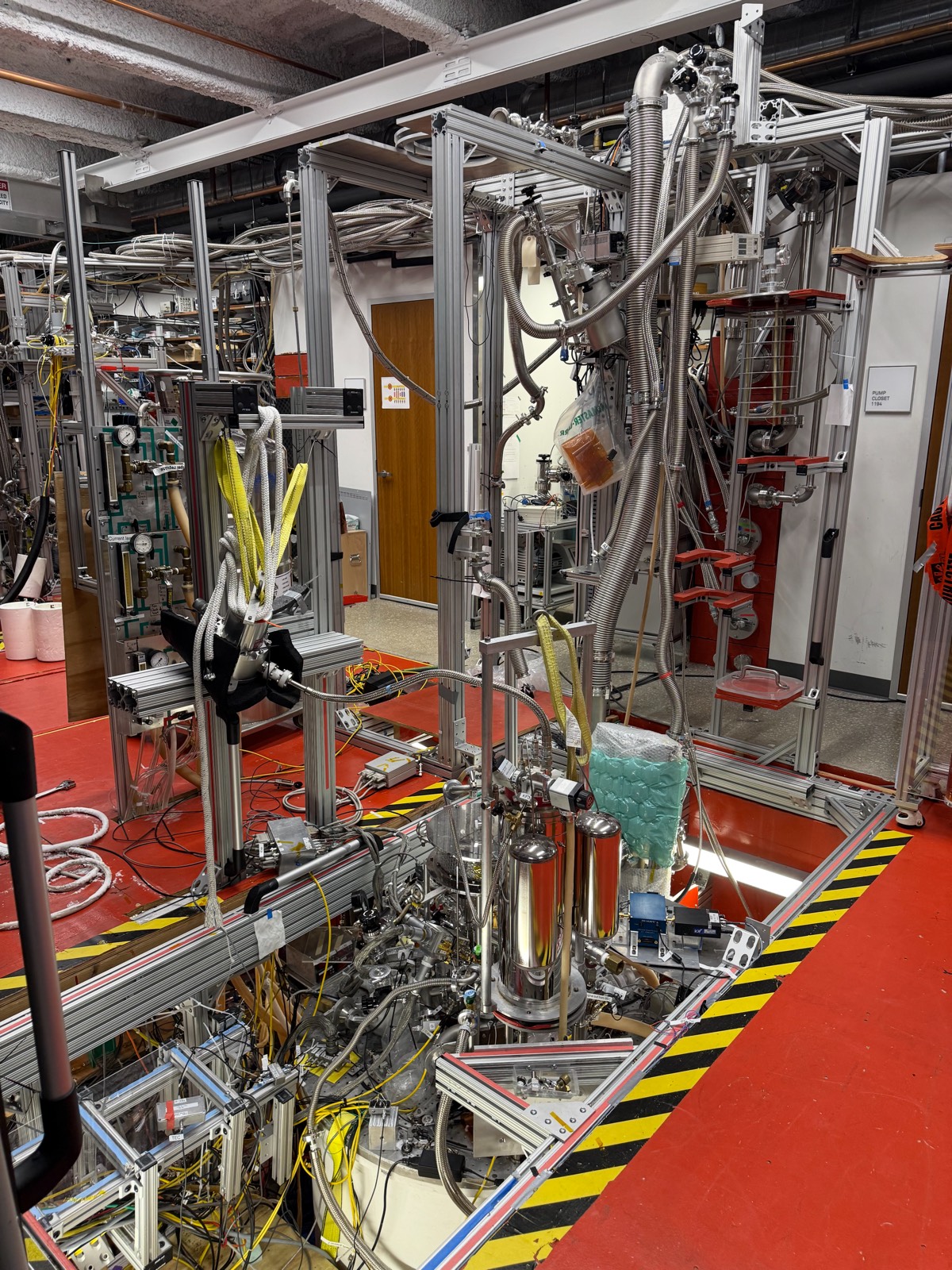
The tank in the center of the lab, lowered beneath ground level, holds the captured positron.

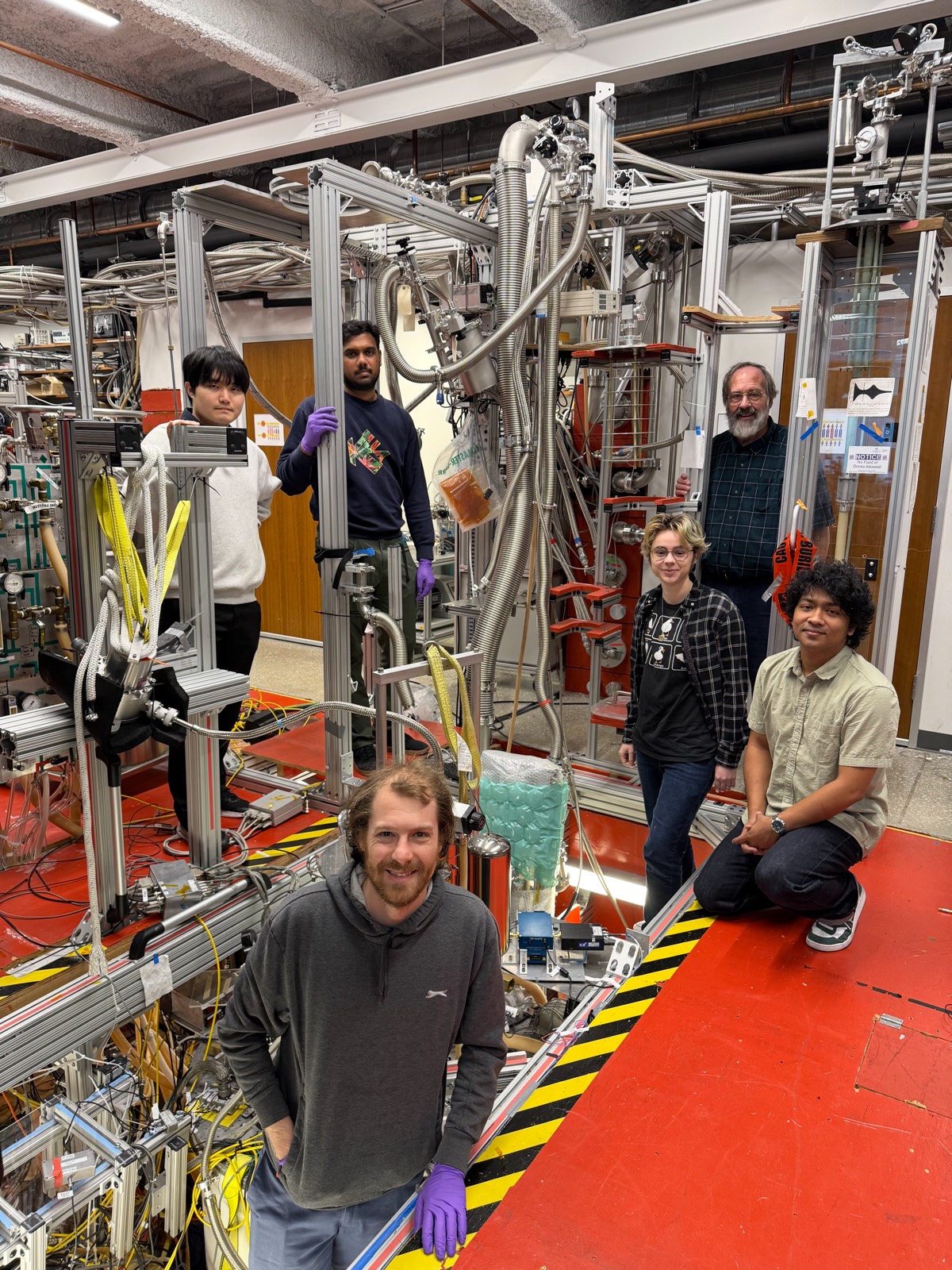
The team from the Center for Fundamental Physics stand in the lab surrounding their antimatter trap.

One of the biggest unanswered questions in cosmology is why the early universe had a fundamental asymmetry between matter and antimatter. When matter and antimatter particles collide, they annihilate into energy, so that asymmetry resulted in matter dominating our universe, which contains much more matter than antimatter. It’s extremely difficult to create and isolate antimatter, requiring special traps. Physicists at Northwestern University have succeeded in trapping a single positron (antimatter particle) for months on end, according to a paper published in Physical Review Letters.

Co-author Gerald Gabrielse and his team built on earlier work, in which they trapped a single electron to create a one-electron quantum cyclotron. They then used the setup to make one of the most precise measurements of its magnetic moment yet. Trapping a positron was a bit trickier. They harvested the positron from sodium-22 nuclei, slowing it down enough to guide it into a near-perfect vacuum trap of electric and magnetic fields. Once inside, they chilled the positron to just 300 millikelvins (0.3° above absolute zero), thereby keeping the positron in its quantum ground state. They found they could maintain that state for months at a time.

That enabled Gabrielse et al. to manipulate and detect the particle’s individual quantum energy state using tuned microwaves—the first critical step in being able to measure the positron’s magnetic properties, hopefully with the same precision they achieved in their earlier experiments with a single electron. The Standard Model of particle physics predicts that there should be no difference between the two particle measurements. If they are not equal, “that would be the biggest discovery in physics in the last century,” said Gabrielse.

Physical Review Letters, 2026. DOI: 10.1103/gbkc-6nlj.

Invisible tattoos that show up under light

Many people sport tattoos, but there are situations where hiding them is desirable. A new line of multicolored tattoo inks could one day make that dilemma moot; they are invisible to the human eye unless one illuminates them with UV light, according to a paper published in the journal Matter & Light. “There’s a stigma, in science and in many cultures, around body art,” said co-author Carson Bruns of the University of Colorado, Boulder, who sports a green lion tattoo on one arm, among others. “I’m proud to be pushing against that.”

As previously reported, epidermal electronics attached to the skin via temporary tattoos (e-tattoos) have been around for more than a decade. So-called e-tattoos connect to skin without adhesives, are practically unnoticeable, and are typically attached via temporary tattoo, allowing electrical measurements (and other measurements, such as temperature and strain) using ultra-thin polymers with embedded circuit elements. In 2024, researchers developed special polymer-based conductive inks that can be printed onto a person’s scalp to measure brain waves, even if they have hair. This could one day enable mobile EEG monitoring outside a clinical setting, among other potential applications. And earlier this year, scientists at Pennsylvania State University developed a novel conductive ink that can be painted directly onto the skin in colorful custom designs, turning into a functional electrode for biomonitoring after drying.

Bruns et al. created their inks, known as PhotoTat, from color-changing dyes injected into tiny spheres of polymethyl methacrylate (PMMA), a material used in dermal fillers among other medical applications. Mixing the primary-colored dyes can create full-color images. The tattoos are invisible until exposed to UV light, when they turn blue, magenta, or yellow. They fade after a few hours, faster if exposed to bright LED light. It’s still a proof of concept, but Bruns did test the dyes on himself, inking a black outline of fish scales that turn red, orange, or blue, like mermaid scales, under UV light. The dyes could also help cancer patients undergoing radiation therapy, who need small tattoos so doctors can guide the beams. PhotoTat would make such tattoos invisible except when the treatment is being administered.

Matter & Light, 2026. 10.1016/j.matlit.2026.100119.

Westminster skeleton likely a monk

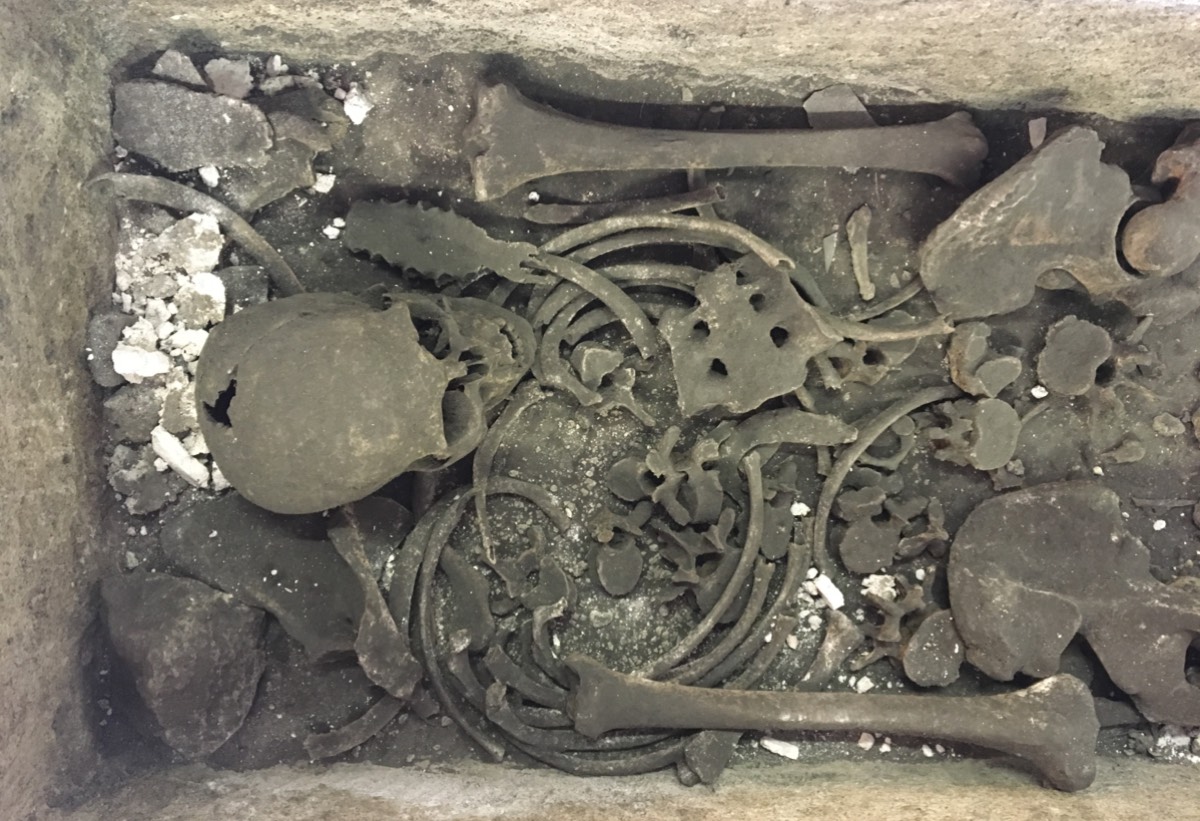
Over 150 years ago, archaeologists discovered a skeleton buried in a Roman sarcophagus on the grounds of Westminster Abbey, bearing an inscription to a wealthy Briton from between 300 to 400 CE named Valerius Amandinus. But there was also a Latin cross sculpted into the lid that dated to the 10th or 11th century, i.e., the late Saxon period. Were the remains actually those of someone who lived and died centuries after Valerius? According to a paper published in the Journal of the British Archaeological Association they are—specifically, these are the bones of a high-ranking medieval monk.

The authors reasoned that this was an abbot’s skeleton because it was buried within a sarcophagus, while skeletal clues suggested it was a man between 35 and 49, standing about 5 feet, 9 inches tall. The most likely conclusion is that the bones belong to a Benedictine monk named Aelfwig, who died around 1020 and was buried at Westminster Abbey, where he had served as abbot. However, the bones may also be those of Aelfwig’s successor, Wulboth, who died in 1049 and was likely buried on the grounds as well. There is also evidence that the body was originally housed in a timber coffin that decayed over the ensuing seven centuries.

Journal of the British Archaeological Association, 2026. DOI: 10.1080/00681288.2026.2675788.

More on how Botticelli’s favorite model died

Credit: Sandro Botticelli/Public domain

In June, we reported on the research of Paolo Pozzilli of Queen Mary University of London and several co-authors into the cause of death of one of Sandro Botticelli’s models. Among his best-known works is the Birth of Venus, depicting the naked goddess, newly birthed, standing in a giant scallop shell. The model for the painting (disputed by some historians) was allegedly Simonetta Vespucci (née Cattaneo), a renowned beauty in Florentine high society whom Botticelli greatly admired. He painted her five times before her untimely death in her early 20s.

It was long believed that Simonetta had succumbed to tuberculosis, but it was argued that she may have suffered from a pituitary tumor (adenoma) that gradually increased in size due to prolactin and growth hormone secretions, citing her appearance in several portraits as evidence. This could have caused a sudden tumor-related fatal apoplexy. They examined letters between Simonetta’s father-in-law, Piero Vespucci, and Lorenzo de Medici, which described how Simonetta had collapsed during a ball a few days before her death. Her symptoms included headache, hallucinations, vomiting, and a high fever, all symptoms of a rapidly expanding pituitary tumor, per the authors.

Pozzilli et al. are back again with a paper published in the journal Medical Humanities providing further evidence for their hypothesis about Vespucci’s cause of death. They argued that the tumor could also explain the irregular eye positioning in the Birth of Venus, suggesting the model had a squint or eye misalignment. After more closely studying how Botticelli depicted the model’s eyes in Birth of Venus and several other portraits, the authors noted pronounced swelling around the left eye, likely due to fluid buildup, while some of the tissue covering the white part of the eye is loose. This and the telltale squint support the theory that Simonetta had a tumor in her pituitary gland.

Medical Humanities, 2026. DOI: 10.1136/medhum-2026-014199.

Dating van Gogh’s Starry Night

van Gogh's painting of the night sky with dark blue sky swirling with vortices and dotted with yelllow blobs for the stars

Credit: Public domain

Vincent van Gogh’s masterpiece, The Starry Night (1889), has long fascinated art lovers and scientists like. Some physicists have even suggested that the painting is a masterful depiction of atmospheric turbulence, and a 2024 paper found that the illusion of movement in the blue sky is also due to the scale of the paint strokes—a second kind of “hidden turbulence” at the microscale that diffuses throughout the entire canvas, although others have objected to that conclusion. Now a team of South Korean astronomers has used “forensic astronomy” to pinpoint the precise month in which van Gogh painted his masterpiece, according to a paper published in the journal Scientific Reports.

Other astronomers have previously suggested that The Starry Night is not just a symbolic representation, but shows the actual night sky at the time it was created, specifically in June 1889. This new analysis—which takes into account simulations, historical weather patterns, star positions, and van Gogh’s letters from that year—shifts that date to just before dawn on July 22, 1889. Co-author Elijah Jeong-hyun Kim told Gizmodo that his interest was piqued when he came across previous research identifying the constellation Aries. Kim thought the lights in the painting more closely resembled the Hyades star cluster in the constellation Taurus, suggesting the July date. While van Gogh said that his work exaggerated the point of view he painted, the authors note that such exaggeration “presupposes a real object to amplify.”

Kim et al. are in good company in forensic astronomy. As we reported in 2020, the so-called “celestial sleuth,” Donald Olson, applied similar tools to determine that Vermeer’s View of Delft most likely shows the city on September 3 or 4, 1659 (or earlier), at 8 am. Over the years, Olson has found evidence that the blood-red sunset that inspired Edvard Munch’s The Scream was likely an aftereffect of the 1883 eruption of Mount Krakatoa in Indonesia; that the Moon may have contributed to the sinking of the Titanic; helped identify the precise location of Julius Caesar’s landing site in Britain in 55 BC; and showed that Mary Shelley was probably telling the truth about a moonlit “waking dream” that inspired Frankenstein. And in 2015, Olson determined the precise time of day that Life magazine photographer Alfred Eisenstaedt took his most famous photograph (V-J- Day in Times Square)  on August 14, 1945.

Scientific Reports, 2026. DOI: 10.1038/s41598-026-73025-5.

“At Home in Space” opens, caps Air and Space Museum renovation

0
“at-home-in-space”-opens,-caps-air-and-space-museum-renovation
“At Home in Space” opens, caps Air and Space Museum renovation

After seven years of work and nearly $1 billion, the Smithsonian has completed the renovation of the National Air and Space Museum’s flagship building in Washington, DC.

On October 30, the museum debuted its last-to-open spaceflight exhibition, returning “home” with a gallery devoted to establishing a spacefaring civilization.

“Welcome to ‘At Home in Space’!” said curator Jennifer Levasseur, who guided us through a virtual tour of the gallery. “This is the story of long-duration spaceflight in the last few decades. We generally call it ‘reaching orbit.’”

“It’s the prep story, the space shuttle story. It’s what allows us to end up at a place where we have 25-plus years of long-duration spaceflight experience, the capacity for humans to be living in space on the International Space Station (ISS), and then it carries that story forward. So the middle of our story then becomes the ISS, and the end of the story are the next steps,” said Levasseur.

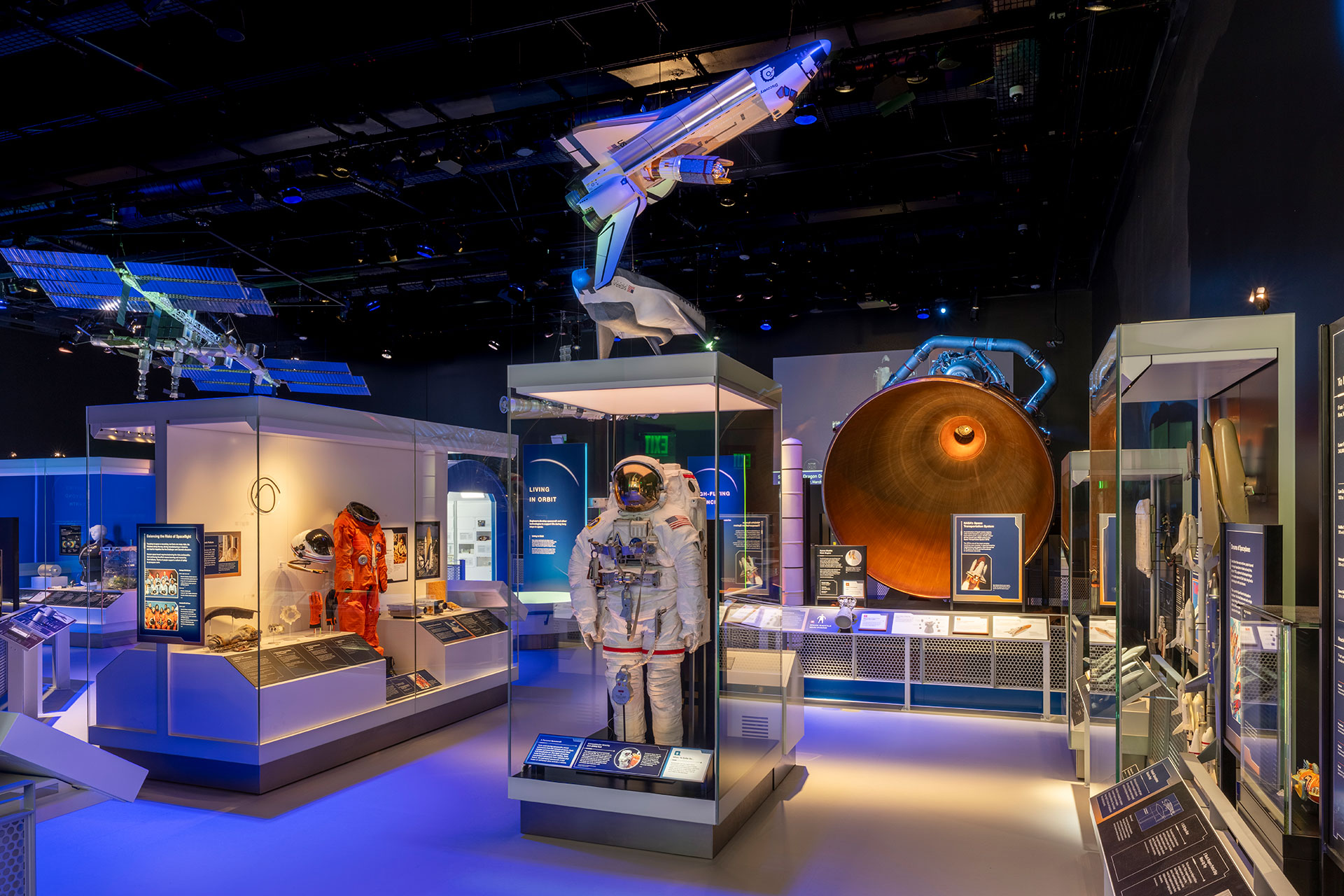
“At Home in Space” takes visitors on a 50-plus-year journey of learning how humans can live and work in space continuously and venture beyond Earth orbit.

“At Home in Space” takes visitors on a 50-plus-year journey of learning how humans can live and work in space continuously and venture beyond Earth orbit. Credit: Smithsonian National Air and Space Museum

Entering “At Home”

Over the past several years, the National Air and Space Museum has introduced new galleries showcasing how US astronauts first entered space and landed on the Moon (“Destination Moon”); how robotic probes have explored every planet in our solar system (“Kenneth C. Griffin Exploring the Planets”); how technologies and infrastructure impact our daily lives (“RTX Living in the Space Age Hall”) and what approaches spaceflight will take in the years to come (“Futures in Space”).

“At Home in Space,” which follows the similarly themed “Moving Beyond Earth,” immerses guests in the equipment, spacecraft, and orbital platforms that have enabled humanity from simply visiting space to living there, setting up the near future for bases on the Moon and Mars.

“We have a great way to attract people into the gallery, which is this overhead mock-up of an astronaut on the end of the robotic arm, and then the backdrop to that is this photo mural—a full-size photo print—of the ISS,” said Levasseur. “Our astronaut up here is intended to be [an actual] person, but I’m not going to share who that is. They are wearing an Expedition 60 patch, so that’ll give you a little clue.”

Outer space outfits

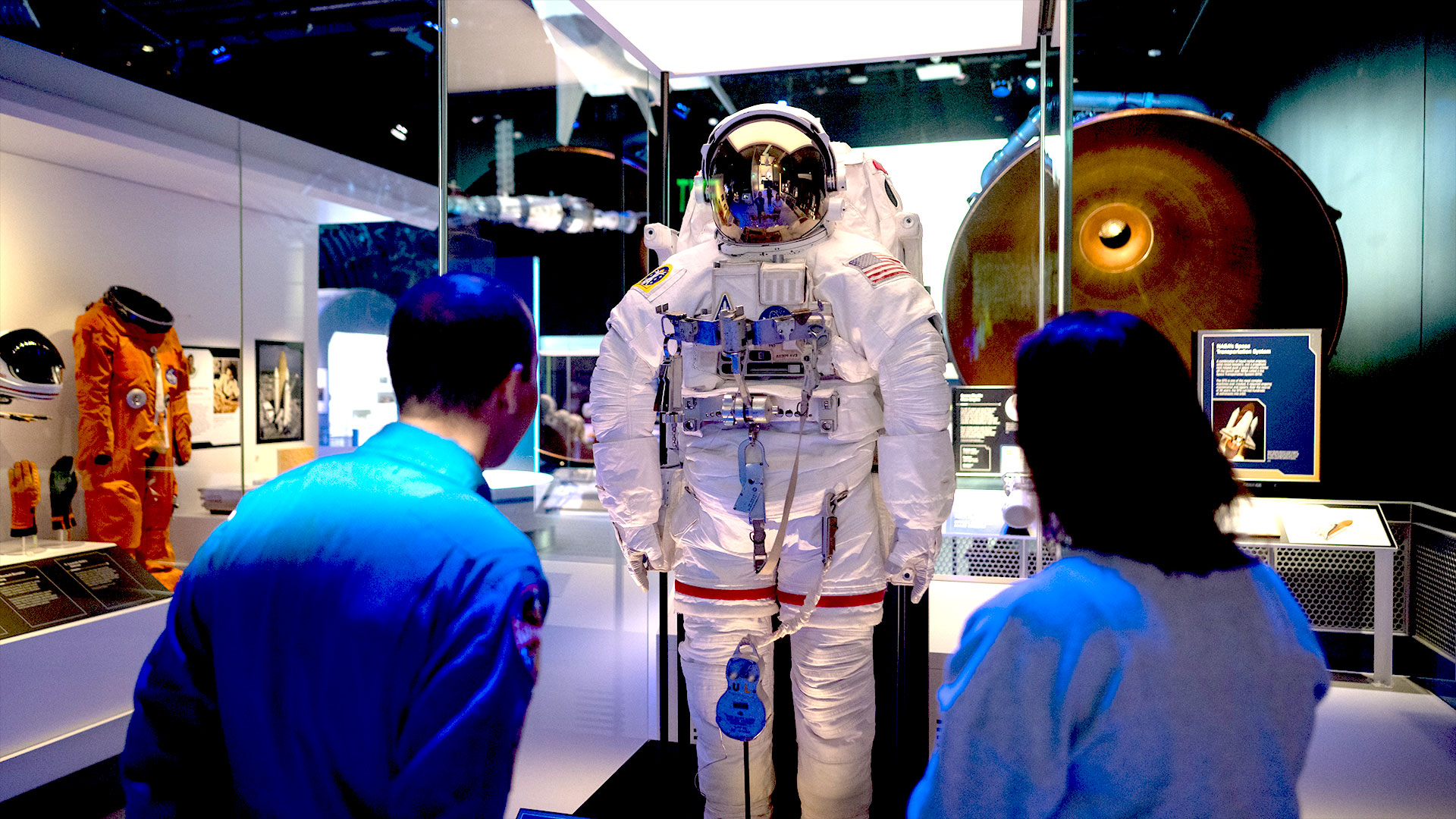
Some of the gallery’s artifacts include a space shuttle main engine, Robonaut 1A (a prototype humanoid robot), and an extravehicular mobility unit (EMU) spacesuit.

“It’s pretty damn special,” said Levasseur of the EMU. “This, as far as I know, is the first and potentially only public display of a fully flown set of EMU equipment in the world. I know NASA has one in its EVA office, but it is not on public display.”

NASA astronaut Chris Williams and curator Jennifer Levasseur view the only fully flown extravehicular mobility unit spacesuit on public display in “At Home in Space.”

NASA astronaut Chris Williams and curator Jennifer Levasseur view the only fully flown extravehicular mobility unit spacesuit on public display in “At Home in Space.” Credit: NASA/Aubrey Gemignani

Unlike Apollo-era spacesuits sized to each astronaut, the EMU was designed to be reused, so its components can be swapped out to fit astronauts of different sizes. Introduced during the early years of the space shuttle program, the same EMU suits are still used on the International Space Station for US spacewalks.

The museum’s example is only missing a functioning portable life support system (PLSS), as all the backpacks are still needed for use. So the suit on display only has a PLSS shell for now, according to Levasseur.

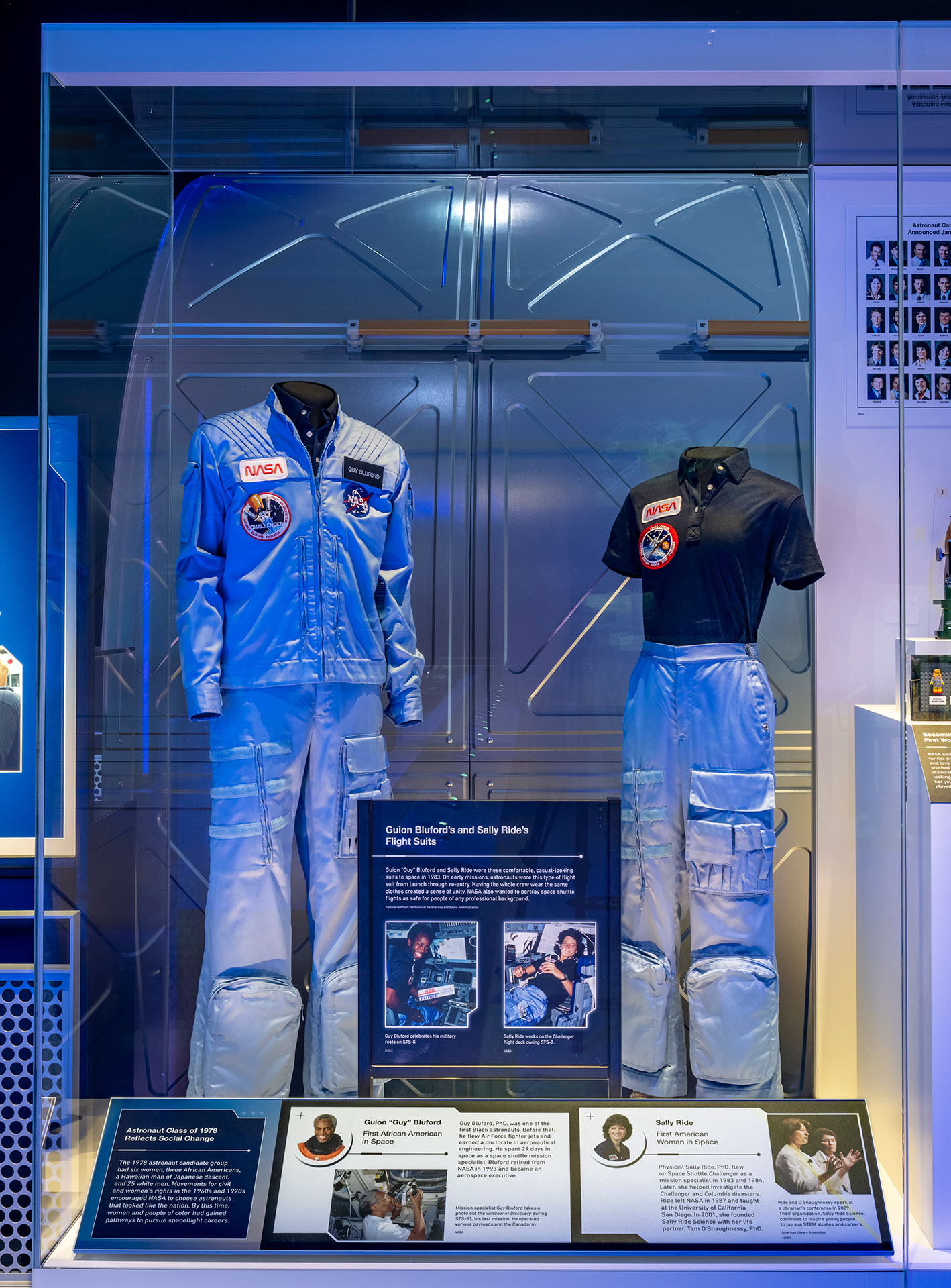
The gallery also features Guy Bluford’s and Sally Ride’s in-flight suits, the “shirt-sleeve” outfits the first African American and first US woman wore on the space shuttle (on separate missions).

“Sally is notably missing her jacket, which was a late change to our plan. We were given a drawing of this, a 3D mockup of its display case, and our designers then put it in this way without the jacket on. And we thought, ‘Hey, that’s actually kind of a nice contrast. Let’s keep the jacket out,’” Levasseur told collectSPACE.

Two mannequins are dressed in powder blue flight suits and dark blue polo shirts

Flight clothes worn by the first African American astronaut, Guion “Guy” Bluford, and the first US woman, Sally Ride, on board the space shuttle, as on display in “At Home in Space.”

Flight clothes worn by the first African American astronaut, Guion “Guy” Bluford, and the first US woman, Sally Ride, on board the space shuttle, as on display in “At Home in Space.” Credit: Smithsonian National Air and Space Museum

The gallery also includes recovered components from the Challenger and Columbia tragedies. It is only the second public display of fallen orbiter debris after a Kennedy Space Center Visitor Complex exhibit that opened in Florida in 2015.

“We wanted to honor the individuals who were lost during the shuttle program,” said Levasseur. “So we have an elevon hinge from Challenger that washed up on the beach a few years ago and a little wiring panel fragment from inside the payload bay. And then from Columbia we thought it was appropriate to help tell that story with a piece of RCC [reinforced carbon-carbon]. This is a T-panel from the starboard wing. We also have a CD [compact disc] on a long-term loan from David Brown’s family.”

Inside ISS

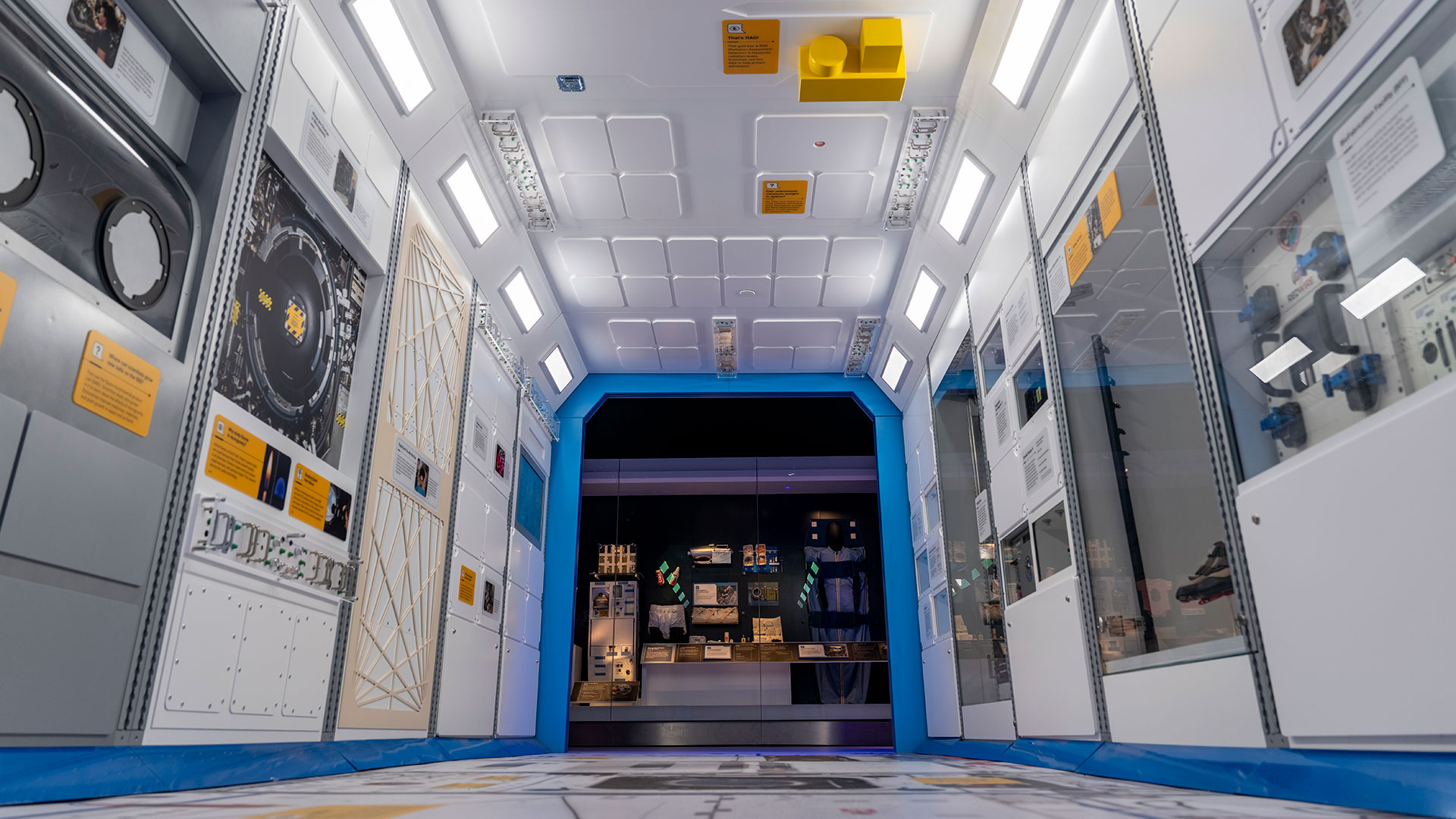
Visitors can also walk through a full-size mock-up of the space station’s Destiny module, the US national laboratory on the station, and view its equipment on both sides, as well as above and below.

“Originally, the detailing on the floor was going to be a mosaic of real images, but we found that for accessibility reasons people might come in and see the cables and worry that they were real, creating a tripping hazard,” said Levasseur. “On the flip side, and I had to fight to get these, we had to have labels to indicate activity happens on the floor and happens on the overhead. People need to see this is a literally three-dimensional space.”

The module has interactive elements on one side and showcases some of the crew equipment-related artifacts, including coffee cups engineered for use in microgravity.

Visitors to “At Home in Space” at the National Air and Space Museum can walk through a full-scale mockup of the International Space Station’s US Destiny laboratory, the US National Laboratory, which includes interactive elements and artifact displays.

Visitors to “At Home in Space” at the National Air and Space Museum can walk through a full-scale mockup of the International Space Station’s US Destiny laboratory, the US National Laboratory, which includes interactive elements and artifact displays. Credit: Smithsonian National Air and Space Museum

“This is probably the best section in my mind because it has fun stuff,” said Levasseur, pointing out the flown miniPCR biotech toolkit and MinION portable device used to sequence DNA in space for the first time.

“My absolute favorite thing to work on in this gallery answers the questions: What does space smell like, and what does the ISS smell like? We have little scent oils inside each of these that allow people to smell them,” she said.

Nearby, the  first 3D printer used in space is also on display. In 2014, Made In Space (now part of Redwire) and NASA flew the printer, which produced hundreds of objects, from astronaut tools to space station repair parts.

Awaiting Artemis

The gallery concludes with a space reserved to exhibit the Artemis I capsule, the spacecraft that flew without astronauts to the Moon in 2022. A Lockheed Martin scale model of Orion holds the place until NASA delivers the real spacecraft to the Smithsonian, which is expected later this year.

“This is the piece of Wright Flyer fabric that went to the moon with Artemis II, so that’s on display here, too,” Levasseur said, concluding the tour.

“At Home in Space” displays a scale model of the Orion spacecraft as a placeholder for Artemis I that flew to the moon.

“At Home in Space” displays a scale model of the Orion spacecraft as a placeholder for Artemis I that flew to the moon. Credit: Smithsonian National Air and Space Museum

The renovation of the National Air and Space Museum also included refacing the exterior cladding, replacing mechanical systems, and other improvements. The first half of the museum reopened in 2022 with eight new or reimagined galleries, the Northrop Grumman Planetarium, museum store, and the Mars Café. The second phase opened in 2025 with five new galleries, and five additional galleries opened July 1.

Following “At Home in Space,” “Modern Military Aviation” will open on November 11.

“We are thrilled to complete the most extensive project the museum has ever undergone,” Chris Browne, John and Adrienne Mars Director of the museum, said in a statement. “With the opening of these last two galleries, the public will once again be able to visit the entirety of the museum and learn from and engage with the nation’s world-class aerospace collection.”

Admission to all of the National Air and Space Museum galleries remains free, but timed-entry passes for the building are required to visit.

Taiwan to criminalize Nvidia AI chip smuggling to China

0
taiwan-to-criminalize-nvidia-ai-chip-smuggling-to-china
Taiwan to criminalize Nvidia AI chip smuggling to China

<

article id=”post-952209″>

Taiwan is moving to criminalize the unauthorized export of advanced AI chips to China, aiming to close a loophole exposed when Nvidia-powered servers bought on the island reached Chinese buyers via Indonesia, Japan, and Hong Kong.

The Legislative Yuan’s Economics Committee held a public hearing on Monday on an amendment to the Foreign Trade Act proposed by lawmakers of the ruling Democratic Progressive Party (DPP). It would ban exports of specified integrated circuits, key wafer materials, components and chipmaking equipment to mainland China without government approval.

Violators would face up to 10 years in prison and fines of NT$5 million to NT$10 million (US$155,000 to US$310,000), according to the proposed amendment. The same penalties would apply to anyone shipping controlled goods to China through a third country, while illegal gains would be confiscated.

The bill follows a case in which prosecutors in Keelung indicted nine people in August this year, including the general manager of Taiwanese firm Flying Tiger Technology and staff at the local units of Nvidia and Super Micro Computer. They allegedly diverted 74 Nvidia B300 servers to Chinese buyers for a profit of more than NT$600 million (US$18.5 million).

Yet none of the nine faces an export charge. Prosecutors relied on breach of trust and document forgery under the Criminal Code, building their case around the fake end-user papers the group used to pass Nvidia’s and Super Micro’s checks and a cover story that the servers would run in a rented data center in Taiwan.

Selling the servers to China broke the two companies’ internal rules and US export curbs, but not Taiwanese law. In legal terms, Taipei was prosecuting a paperwork fraud rather than an export violation.

Taiwanese officials and commentators said the amendment would close that gap by making the unauthorized export of listed chips, materials and equipment to China a criminal offense in its own right, whether the goods are shipped directly or routed through a third country.

“As a global hub of the semiconductor and AI supply chains, Taiwan’s export controls on these products have drawn international attention,” William Liu, director-general of the International Trade Administration under the Ministry of Economic Affairs, said at Monday’s hearing. “Export controls have shifted from preventing weapons proliferation to becoming a strategic tool for countries to protect their technological edge and national security.” 

He said the ministry was studying a full package of measures to bring high-end chips under control, giving enforcement a more appropriate legal basis and common standards. He added that this would help block illegal transshipments and safeguard Taiwan’s “silicon shield” while keeping the industry internationally competitive.

He said the ministry was working with overseas partners to step up enforcement as smugglers used increasingly sophisticated methods to evade controls, including:

  • Laundering the origin of goods through third countries;
  • Setting up shell companies in Southeast Asia and the Middle East;
  • Declaring high-end AI chips as ordinary consumer chips; and
  • Dismantling chipmaking tools, exporting the parts through different customs points and reassembling them overseas.

“The amendment is in line with the US-Taiwan reciprocal trade agreement and Taiwan’s national security interests,” said Wang Guo-chen, an associate research fellow at the Chung-Hua Institution for Economic Research (CIER). “But Taiwanese firms in China could be caught in a crossfire, facing Chinese fines if they follow US law and stop selling chips there, or US export controls if they listen to Beijing.”

However, Tseng Chih-chao, deputy secretary-general of the Association for Chinese Economic and Financial Research, said the amendment may not be enough to tackle Taiwan’s real security risks, as it targets only chips and related equipment and materials.

“Why does this amendment single out mainland China when the trade agreement with the US also covers North Korea, Iran and Russia?” he said. “If the current system has loopholes, the government should fix the general control mechanism rather than pass a law that is merely a policy statement.”

He said the Foreign Trade Act already allowed the ministry to designate controlled goods and destinations by public notice, while its entity list covered more than 11,000 entities. He added that adjusting those notices would be more flexible and efficient than writing specific countries and technologies into law.

Smuggling routes multiply

Since 2024, Nvidia-powered servers have repeatedly slipped through Taiwan and into China via Thailand, Indonesia, Japan and Hong Kong, but most smugglers were only exposed this year.

In March 2026, the US Department of Justice charged Super Micro co-founder Yih-Shyan “Wally” Liaw, the company’s Taiwan sales manager Ruei-Tsang “Steven” Chang and contractor Ting-Wei “Willy” Sun with conspiring to divert US-assembled servers containing restricted Nvidia chips to China. Liaw and Sun were arrested in California, while Chang, a Taiwanese citizen, remains at large.

US prosecutors said about US$2.5 billion worth of servers were sold to a Thailand-based company in 2024 and 2025, with at least US$510 million diverted to China between late April and mid-May 2025. To pass a compliance check, the group allegedly placed dummy servers in Thai warehouses and used hair dryers to swap labels and serial-number stickers.

Two months later, Taiwan’s Coast Guard Administration, acting on orders from Keelung prosecutors, searched 12 locations on May 20 and seized about 50 Supermicro servers worth more than US$15 million, along with luxury cars and NT$9 million in cash. Authorities detained three Taiwanese men on suspicion of forgery. 

Prosecutors said the trio had shipped servers from a northern Taiwan port with export documents listing a Northeast Asian country as the destination. The country was later identified as Japan, with at least one shipment reportedly passing through Japan to Hong Kong and mainland China, the suspected final stop. The May 20 raid was the first stage of the investigation that led to the indictment of nine people in Keelung in August.

In June, media reports said Taipei was considering restricting AI chip sales to all customers in China, not just firms on its export blacklist such as Huawei, as part of its trade talks with Washington. The move would allow Taiwan to prosecute AI chip smuggling as a crime for the first time.

Last month, Economy Minister Kung Ming-hsin said the government would add AI servers and cutting-edge semiconductors to Taiwan’s export-control list, making unauthorized shipments of such hardware to China a criminal offense under the Foreign Trade Act.

“Going forward, some of our measures on controlled items will correspond to American ones because we have made quite some commitments in the Agreement on Reciprocal Trade,” Kung said.

However, the bill’s fate is uncertain. The opposition Kuomintang (KMT) and Taiwan People’s Party (TPP) together hold a majority in the Legislative Yuan, so a proposal from ruling-party lawmakers could stall in committee or in cross-party negotiations without their support, some observers say. Neither party has publicly stated its position on the bill.

President Lai Ching-te’s DPP government has another option. Under the Foreign Trade Act, the economy ministry can already designate controlled goods and destinations by public notice, though exports to China are currently restricted only for 12 categories of wafer-fabrication equipment.

Adding AI servers and high-end chips to that list would make unlicensed shipments to China a violation, with penalties of up to five years in prison, the route Kung outlined last month. Lin Ching-fu, a law professor at National Tsing Hua University, told the hearing this would achieve the bill’s aims without amending the act. 

But a public notice cannot do everything the bill would. Only legislation could double the maximum jail term to 10 years, explicitly cover shipments routed through third countries and make confiscating illegal gains mandatory.

Read: China’s H200 hunger drives Nvidia chip smugglers to Japan route

Follow Jeff Pao on X at @jeffpao3

Netanyahu says he is open to broad Israeli government but insists on leading it

0
netanyahu-says-he-is-open-to-broad-israeli-government-but-insists-on-leading-it
Netanyahu says he is open to broad Israeli government but insists on leading it

Israeli Prime Minister Benjamin Netanyahu said Monday he was open to talks on forming a broad government but insisted that he should remain prime minister, Anadolu reports.

Likud “aspires to form a broad government with our partners and with any party that wishes to do so and does not support terrorism,” Netanyahu said on US social media platform X.

“I am open to holding a dialogue on the matter,” he added.

Netanyahu claimed that “the public in Israel does not want a government that is dependent on Ra’am and the Joint List,” referring to the two Arab parliamentary lists.

“From day one our hand has been extended to establish a broad national government,” he said.

Netanyahu also claimed a mandate to remain prime minister following last week’s parliamentary elections.

“A clear majority of the Jewish public chose Likud as the largest party and me, as prime minister, to lead the next government,” he said.

Meanwhile, former Prime Minister Naftali Bennett’s Together party, Yair Golan’s Democrats and Avigdor Lieberman’s Yisrael Beytenu have decided to recommend that President Isaac Herzog task Yashar leader Gadi Eisenkot with forming the next government.

The opposition parties’ backing gives Eisenkot the support of 48 lawmakers.

The two Arab parliamentary lists are also expected to recommend Eisenkot, potentially raising his support to 67 lawmakers in the 120-member Knesset.

Netanyahu’s bloc secured 53 seats in last week’s elections, compared with 48 for opposition parties and 19 for Arab parties, leaving neither bloc with a parliamentary majority.

However, recommendations to Herzog do not guarantee the formation of a governing coalition. Lieberman has rejected joining a government that includes Arab parties or depends on their parliamentary support.

Herzog is scheduled to begin two days of consultations with parliamentary factions on Wednesday before selecting a lawmaker to receive the mandate to form the next government.

Turkey’s Race to the Moon: How Ankara’s Space Ambitions Could Reshape Its Geopolitical Influence

0
turkey’s-race-to-the-moon:-how-ankara’s-space-ambitions-could-reshape-its-geopolitical-influence
Turkey’s Race to the Moon: How Ankara’s Space Ambitions Could Reshape Its Geopolitical Influence


The significance of the mission will be measured not only by whether Turkey reaches the moon on schedule, but also by whether the technologies, partnerships and industrial capabilities developed in the process can strengthen its position

Turkey is preparing to take a significant step in its space program with its first lunar mission scheduled for 2027, an ambitious undertaking that reflects Ankara’s broader efforts to strengthen technological independence and establish itself as an emerging player in an increasingly competitive international space sector.

Beyond the scientific objective of reaching the moon, the program forms part of a larger strategy involving domestic satellite development, aerospace technologies, international partnerships and the construction of a spaceport in Somalia. Together, these initiatives could expand Turkey’s geopolitical influence as outer space becomes an increasingly important domain of competition between major powers, particularly the United States and China.

The Scientific and Technological Research Council of Turkey (TÜBİTAK) developed the mission, which is expected to launch in the first half of 2027. In September 2026, Turkish authorities announced the completion of the spacecraft’s manufacturing, assembly, and integration, with the next phase involving environmental testing.

According to the announced mission plan, the uncrewed spacecraft will travel for approximately two months before entering a polar orbit around the Moon, roughly 100 kilometers above its surface. It is expected to conduct scientific observations for at least three months, with the possibility of extending operations depending on its performance. After the orbital phase, it will make a controlled descent toward the lunar surface.

Yet the mission’s importance extends beyond its technical objectives. For Ankara, developing advanced space technologies could also translate into greater strategic autonomy, industrial competitiveness, and diplomatic leverage.

“Turkey’s lunar ambitions should be interpreted as an integral component of Ankara’s broader pursuit of strategic autonomy, technological sovereignty, and international influence. While the scientific significance of reaching the Moon is undeniable, the geopolitical implications extend considerably beyond the immediate objectives of space exploration,” Dr. Hande Gül, an academic researcher in Political Science and International Relations, told The Media Line.

Turkey’s lunar program reflects a broader effort to position itself as an emerging space actor within a changing international order

“From the perspective of International Relations, outer space has increasingly evolved from a predominantly scientific domain into an arena of strategic competition, technological leadership, economic opportunity, and diplomatic influence. In this context, Turkey’s lunar program reflects a broader effort to position itself as an emerging space actor within a changing international order,” she added.

Turkey’s efforts have accelerated since the Turkish Space Agency’s establishment in December 2018 and the announcement of its National Space Program in 2021. The initiative outlined ten strategic objectives, including lunar exploration, satellite development, independent access to space and human spaceflight.

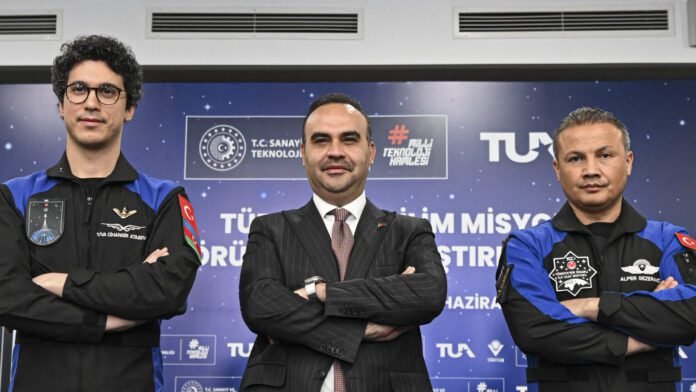
Several milestones have already been achieved. In April 2023, Turkey launched its domestically developed high-resolution Earth observation satellite, İMECE. In January 2024, Alper Gezeravcı became the first Turkish astronaut to travel to the International Space Station. Later that year, the country launched TÜRKSAT 6A, its first domestically-developed communications satellite, aboard a SpaceX Falcon 9 rocket from the United States.

For Mustafa Metin Kaşlılar, vice president of the Turkish Foreign Policy Research Center, these developments demonstrate the expanding scope of Ankara’s technological ambitions.

“In this regard, Turkey’s space projects cover a particularly broad spectrum. Significant progress has been made in the development of indigenous satellites. In July 2024, Turkey’s first domestically developed communications satellite, TÜRKSAT 6A, was launched into space. Furthermore, Turkey is expected to continue its efforts in this field through the development and deployment of high-resolution Earth observation satellites, including the İMECE satellite program,” Kaşlılar told The Media Line.

For Kaşlılar, these developments should be examined within the transformation of international competition.

Space has become one of the most critical arenas of strategic competition among countries such as the United States, China, and Russia

“The space dimension of international relations has transcended the boundaries of traditional geopolitics, introducing a new and critical domain in which interstate competition, cooperation, and strategic security policies extend beyond the Earth. In particular, I would argue that space has become one of the most critical arenas of strategic competition among countries such as the United States, China, and Russia,” Kaşlılar told The Media Line.

“Unlike the initial space race during the Cold War, today’s space domain is no longer exclusively state-driven. Rather, it has evolved into a multidimensional sphere involving private companies, military integration, and commercial interests,” he continued.

Unlike the initial space race during the Cold War, today’s space domain is no longer exclusively state-driven

The growing importance of private aerospace companies and commercial launch infrastructure has created opportunities for emerging space actors, but it has also highlighted the technological dependencies that countries such as Turkey are attempting to reduce.

Despite its progress in satellite manufacturing, Ankara continues to rely on external launch infrastructure. Its planned 2027 lunar mission is expected to use a SpaceX launch vehicle, demonstrating the distinction between developing a spacecraft domestically and possessing independent access to space.

Gül considers this dependency one of the central geopolitical questions surrounding Turkey’s program.

“For an emerging middle power such as Turkey, dependence on external technological suppliers can create significant strategic vulnerabilities. These vulnerabilities become particularly apparent during periods of geopolitical tension, export restrictions, sanctions, or disruptions in international supply chains,” she explained.

“Consequently, investment in indigenous space technologies should be understood as part of a long-term national strategy aimed at strengthening technological sovereignty and improving the country’s capacity to act independently in strategically sensitive sectors,”she added.

Nevertheless, questions remain over how quickly Turkey can transform its ambitions into operational capabilities.

Although Turkish authorities have reported substantial progress on the spacecraft and its domestically-developed hybrid propulsion system, the 2027 deadline remains contingent on the successful completion of testing and other technical preparations. The program has also undergone schedule adjustments since its initial announcement in 2021.

“The feasibility of Turkey’s 2027 lunar mission requires a careful distinction between political ambition, technological readiness, and operational capability,” Gül said.

“In Turkey’s case, the 2027 objective should therefore be understood as an ambitious target rather than an outcome that can be considered technologically guaranteed,”she added.

She stressed that the technical complexity of lunar exploration varies considerably according to the mission’s objectives.

“A lunar flyby, an orbital mission, a controlled impact on the lunar surface, and a soft landing represent fundamentally different levels of technological complexity. Reaching the vicinity of the moon is a significant achievement, but successfully navigating a spacecraft through deep space, establishing reliable communications, performing orbital maneuvers, and executing a controlled terminal descent each involve additional technical requirements,” she noted.

However, even if the mission encounters delays, the technological investments associated with it could produce benefits across other sectors, including defense and aerospace.

“Advanced propulsion research, autonomous navigation, precision guidance, secure communications, high-performance sensors, and sophisticated materials may contribute to civilian scientific missions while also possessing relevance for aerospace and defense-related industries,” Gül explained.

Turkey’s existing experience in defense technologies could create opportunities for knowledge transfer between the space sector and other strategic industries

“Turkey’s existing experience in defense technologies could create opportunities for knowledge transfer between the space sector and other strategic industries,” she added.

One of the most consequential components of Ankara’s longer-term strategy is taking shape not in Turkey itself, but in Somalia.

The spaceport project, currently under construction, is intended to provide Turkey with greater independence in launching satellites and other spacecraft. Somalia’s proximity to the equator benefits certain orbital trajectories, while its coastline provides access to launch corridors over the Indian Ocean.

The project also reflects Turkey’s expanding relationship with Somalia, where Ankara has developed cooperation involving security, infrastructure, economic development and diplomatic engagement.

Kaşlılar considers the facility essential to the broader national program.

“One of the most significant aspects of Turkey’s National Space Program is undoubtedly the spaceport project currently under construction in Somalia. Through this initiative, Turkey aims to secure independent access to space. In this respect, I would argue that Somalia represents a cornerstone of Turkey’s broader space ambitions,” he said.

“More generally, space activities constitute a strategic investment area in which Turkey is allocating substantial financial resources to projects that could enhance its international standing and strengthen its position among the world’s leading spacefaring nations,” he added.

Nevertheless, the construction of a spaceport does not by itself guarantee independent launch capabilities. Rocket development, operational infrastructure, technical personnel and sustained investment remain necessary.

Gül cautioned against equating the establishment of launch infrastructure with technological independence.

“Therefore, the existence of a planned spaceport should not automatically be equated with independent access to space.

Strategic independence will emerge only if Turkey develops or secures reliable control over the critical technological and operational components necessary for sustained launch activities,” she explained.

Gül also emphasised that the project has wider implications for Turkey’s regional presence.

“A spaceport project could potentially expand this relationship into an advanced technological sector, thereby strengthening Turkey’s long-term strategic presence in the Horn of Africa,” she said.

“Nevertheless, it is essential to distinguish between the strategic potential of the project and its actual operational feasibility,” she added.

These ambitions also intersect with the growing rivalry between Washington and Beijing, whose competing space programs increasingly encompass technological development, commercial infrastructure, lunar exploration and influence over international rules.

As a NATO member with longstanding Western security ties, Turkey is seeking to expand its domestic capabilities while maintaining international cooperation. Its strategy does not necessarily require choosing exclusively between competing space powers.

“Rather than viewing space cooperation exclusively through the binary framework of American-Chinese competition, Turkey may seek to maximize its strategic opportunities by engaging with multiple international actors while developing selected indigenous capabilities,” Gül explained.

“However, this approach should not be confused with geopolitical neutrality. Turkey’s institutional commitments, security relationships, technological dependencies, and economic partnerships continue to shape the boundaries of its strategic choices,” she added.

An important development came on August 31, 2026, when Turkey became the 71st country to sign the Artemis Accords, a US-led framework establishing principles for the peaceful and sustainable exploration of outer space.

The agreement does not automatically grant participation in NASA missions, but it provides a framework for future cooperation at a time when the United States is seeking to expand international engagement around lunar exploration.

“Turkey has also joined the Artemis Accords. Through this framework, Turkish scientists, engineers, and domestic aerospace companies have gained opportunities to participate in future civilian space missions, supply chains, and technological development processes alongside NASA and other signatory countries,” Kaşlılar said.

“For Turkey, this historic step can be regarded as one of the most significant milestones in its space diplomacy, following the country’s achievements in human spaceflight,” he added.

The diplomatic dimension of lunar exploration could become increasingly significant as governments and private companies examine the potential use of resources found on the moon.

Water ice, particularly in lunar polar regions, has attracted scientific interest because of its potential applications in life-support systems and the production of propellants. However, technological costs and unresolved regulatory questions continue to limit the commercial prospects of resource extraction.

Under the 1967 Outer Space Treaty, celestial bodies cannot be appropriated through national sovereignty claims, although the interpretation and regulation of resource utilization remain matters of international debate.

For Turkey, participation in these discussions could eventually become another source of diplomatic influence, even without the financial or technological resources required to compete directly with established space powers.

“As an emerging space actor with established experience in multilateral diplomacy, Turkey could contribute to international discussions concerning the governance of lunar resources and the prevention of excessive concentration of strategic advantages among a limited number of technologically dominant states,” Gül explained.

Yet the more immediate economic benefits of the program are likely to emerge on Earth through research, manufacturing and industrial development.

“More tangible economic benefits are likely to emerge through technological innovation and industrial development on Earth. Investment in space technologies can stimulate research-intensive industries, strengthen advanced manufacturing, encourage the development of specialized engineering expertise, and generate opportunities for high-value employment,” Gül said.

“It can also create pathways for Turkish companies to participate in international aerospace supply chains and technological partnerships.”she added.

Kaşlılar similarly sees the lunar mission as part of a longer-term effort to elevate Turkey’s international position.

“The lunar program will undoubtedly remain one of Turkey’s primary strategic objectives in the coming period. Its successful implementation could represent a significant step towards securing Turkey’s place among the world’s leading spacefaring nations,” he said.

However, the gap between Turkey and established space powers remains considerable, particularly in sustained lunar operations, launch infrastructure and financial resources.

Gül stressed that Turkey’s ambitions should be assessed in relation to the capabilities of countries that have already established extensive space programs.

“Nevertheless, it would be analytically misleading to portray Turkey as an immediate competitor to established space powers such as the United States or China.

It would be analytically misleading to portray Turkey as an immediate competitor to established space powers such as the United States or China

The technological, institutional, and financial asymmetries between these actors remain substantial.

Instead, Turkey’s most realistic strategic objective is to establish itself as a credible emerging space power capable of developing selected indigenous technologies, participating in international scientific partnerships, and contributing to the governance of an increasingly contested strategic domain.”she noted.

For Ankara, the immediate challenge is therefore not necessarily to compete directly with the United States or China, but to develop a durable technological and institutional foundation capable of supporting future space activities.

As the planned mission approaches, its significance will be measured not only by whether Turkey reaches the moon on schedule, but also by whether the technologies, partnerships and industrial capabilities developed in the process can strengthen its position over the longer term.

“The greatest strategic achievement would not necessarily be the establishment of a Turkish presence on the lunar surface,” Gül concluded.

“Rather, it would be the emergence of Turkey as a technologically capable, diplomatically relevant, and institutionally credible actor in shaping the future of space exploration. Ultimately, the geopolitical significance of Turkey’s lunar program will be determined not by the distance it travels into space, but by the extent to which it transforms scientific ambition into sustainable technological capacity, economic development, and international influence.,” she concluded.


The American Dream wasn’t built for climate change

0
the-american-dream-wasn’t-built-for-climate-change
The American Dream wasn’t built for climate change

To Sierra Isley, the American Dream brings to mind a home ringed by a white picket fence. “The house in the suburbs is just what you’re taught growing up,” the 26-year-old said. “You know, that’s what you see on TV.” What she wanted for her life was a bit different from that picket-fence ideal, but she still saw the prospect of buying her first house two years ago as a chance to live out what she called “that big dream that everybody has as a kid.” 

Isley and her girlfriend, Jamie, were moving from Philadelphia to Asheville, North Carolina, and found a home they liked, a three-bedroom brick house with lots of natural light and a big tree out front. With some help from their parents, they put down a deposit and got their offer accepted. But when they went to sign the closing papers, a complication got in the way: The house had a huge lien on it. After consulting with lawyers, they decided to break the contract and hunt for an apartment to rent in Asheville.

It was a blessing in disguise. One month later, while Sierra and Jamie were still unpacking boxes and building furniture, the remnants of Hurricane Helene turned Asheville into a disaster zone. The basement of their apartment flooded, but they were luckier than some of their neighbors, whose homes had been destroyed. 

Owning a home has long been seen as a cornerstone of the American Dream — a way to build wealth that you could use one day to pay for your children’s education and fund your retirement. That arrangement was always more precarious than it was made out to be. But as fires and floods damage homes and drive up insurance rates, pouring your life savings into a house has become riskier than ever. In a report called “Property Prices in Peril,” the firm First Street projected last year that climate risks could knock nearly $1.5 trillion off the value of American homes by 2055. For some people, the sociologist Rebecca Elliott wrote, “the American dream of homeownership may become a nightmare.”

Photo of an uprooted tree crashed into the roof of a home

A fallen tree on a home in the aftermath of Hurricane Helene in Asheville, North Carolina, in September 2024. Sean Rayford / Getty Images

Americans are beginning to grasp the threat that climate change poses to their aspirations. According to exclusive polling for Grist from the think tank Data for Progress, 58 percent of likely U.S. voters believe that climate change will hinder their ability to achieve the American Dream over the next 20 years, including 42 percent of Republicans. The survey suggests that people are worried that climate change will increase the cost of living, a concern so widespread that it’s expected to sway the midterm elections on Tuesday.

The irony is that fossil fuels have long been promoted as necessary ingredients for the American “way of life.” Starting a century ago, oil and gas companies led extensive campaigns to tie their products to comfort and prosperity, a narrative that has been repeatedly deployed by politicians and oil industry executives to thwart climate action. President Donald Trump’s administration has often said that efforts to rein in fossil fuels threaten the American Dream. Earlier this year, when the administration scrapped Biden-era rules to cut emissions from cars, along with the Environmental Protection Agency’s authority to regulate climate change, it touted the effort as “restoring the American Dream.”

But the fossil-fueled American Dream is in the process of destroying itself. Greenhouse gas emissions from burning coal, oil, and gas have ushered in a new period of precarity, undermining the promise that each generation can expect a better life than the last. Scientific reports warn that climate change “imperil[s] the quality of life” for communities in the United States, disrupting livelihoods and cultural traditions. 

Either Americans decide to reimagine what makes up the American Dream and abandon that oil-soaked version of prosperity, or climate change will dismantle it for them.


The memories of living through Hurricane Helene are still fresh in Isley’s mind. Hauling water from their flooded basement up to the toilet to flush it when the water ran out. Driving to Jamie’s parents’ house in Atlanta, holed up in a room with both of their cats until they couldn’t take it anymore. Coming back to Asheville and cooking meals in the Crock-Pot with disposable liners because even when the water was running again, it wasn’t safe to wash dishes with.

Two years later, Isley browses Zillow for fun, but she looks at homes through a post-disaster lens. “Now I have that fear in the back of my mind — anywhere near a river, or even a stream, if there’s a little bit of water on the map, I’m like, ‘Oh, no,’” she said. Jamie is trans, and after Trump was elected in 2024, the two of them briefly entertained the idea of moving somewhere with more protective policies, like California. But Isley’s mind immediately went to wildfires. Out of the question. 

Photo of a young woman in the forest with fallen leaves, wearing a yellow backpackclimate haven,” somewhere that would fare better than the rest of the country as the world warmed. Those promises were shattered when almost 14 inches of rain fell on Asheville over three days in September 2024. The French Broad River overflowed its banks, flooding homes and destroying parts of the town’s River Arts District. In western North Carolina, more than 74,000 homes were damaged, and only about 4 percent had flood insurance, resulting in $9.5 billion in uninsured residential property losses. 

Home values in western North Carolina have declined since the storm, especially in the hardest-hit counties. Asheville’s average home price shrunk 5 percent over the past year, while the national average increased 1.2 percent.

To some degree, housing markets are already pricing in the risk of increased environmental hazards. Homes within FEMA’s high-risk flood zones sell for 2.8 percent less, on average, than what they would otherwise sell for, according to a 2023 study published in the journal Nature Climate Change. The researchers found that homes exposed to flood risk were still overvalued by between $121 billion and $237 billion, though — and they identified Appalachia as a hot spot of overvaluation, one year before Helene hit. The devaluation of homes in high-risk zones is unfolding unevenly and causing “tremendous social harm,” said Elliott, a sociology professor at The London School of Economics and Political Science.

Homes are billed as a way for people to build wealth, but they can turn into a trap. After Superstorm Sandy devastated New York City and the New Jersey coast in 2012, many homeowners couldn’t sell their houses for enough money to buy a new place, leaving them stranded. Even homes that haven’t seen any kind of devastation are at risk of losing value as more people become wary of living in floodplains, coastal places exposed to storms, and wildfire-prone areas. “Those homes could become, in effect, economically worthless even before they are physically uninhabitable,” Elliott wrote in a study about property values and climate change.

Photo of a home tilted on the sand with the words for sale written on it80 percent, with the average single-family mortgage holder now paying $209 per month. Homeowners in the riskiest areas are paying substantially more, and many in California have been dropped by their insurers. Home insurance rates are rising faster in the Midwest than any other region, driven by the costs of severe storms. 

“We are, for a lot of people, on the edge of a dysfunctional insurance marketplace,” Heller said. The more extreme weather we’re seeing is only part of the story: He argues that the insurance industry has become a “climate opportunist,” using climate change as an excuse to justify excessive rate increases.

People relying on Social Security benefits who own condos around Lake Tahoe are particularly vulnerable to rising rates, said Andrew Engler, the founder and CEO of Rock Rose Risk, who helps people in California protect their homes against wildfire and get their insurance premiums down. They’re facing ballooning homeowners association payments, to share the cost of insurance in a risky wildfire area, on a limited paycheck. If they try to move, their properties are worth significantly less because of the huge HOA bills, Engler said. Economists estimate that rising insurance costs linked to disaster risk have reduced the growth of home prices by more than $40,000 in the most hurricane- and wildfire-prone ZIP codes.

Renting might make you more nimble, but it doesn’t insulate you from these costs. One reason rents are going up is because landlords’ property insurance rates are increasing. “Whether you are a homeowner or a renter, we’re all paying for living under the increased risks of climate change,” said Caroline Nagy, the associate director of housing policy at Americans for Financial Reform. That makes it harder for people to save for a home — if that’s even a good idea anymore.


When Sierra Isley walks around her neighborhood these days, she sees the evidence of Helene all around her — in the form of banners with the slogan “Asheville Strong” and shirts that say “WNC Strong.” 

One of the most surprising things about disasters might be the way that people who live through them rise to the occasion and come together. In the aftermath of the Helene, with the power and cell service knocked out, Sierra and Jamie walked all around town, talking to their neighbors to try to learn what had happened. People started congregating at the fire station where there was fresh water.

“It’s hard to put into words what that experience was like, but I’ve never felt more of a community, and really having to lean on my neighbors and feeling like my neighbors were leaning on me,” Isley said.

While the American Dream is usually all about independence and personal freedom, living through a disaster has a way of revealing how people depend on each other. The experience can prompt people to hold tightly to what they have, doubling down on protecting their communities, said Nick Tinoco, a sociology researcher in a doctoral program at the University of California, Los Angeles, who interviewed survivors of the 2018 Woolsey Fire in Los Angeles County. Some of the residents he talked to have taken things into their own hands and organized volunteer fire brigades, and plan to stay behind to defend their neighborhoods during future fires. 

Photo of wreckage from a fire on the ground behind a white picket fencepoll from Ipsos last year showed that 46 percent of baby boomers associate homeownership with the American Dream, but only 13 percent of Gen Zers do, suggesting that there’s room for its defining features to change.


Sierra and Jamie couldn’t help but wonder what happened to the house they’d almost bought, and they drove over to check it out soon after Hurricane Helene hit. It was still standing, but they couldn’t see if there was any damage hidden inside. “Who knows if it flooded or anything like that, what kind of storm damage it took, and that would have immediately been our problem,” Isley said.

Living through Hurricane Helene didn’t just make Isley relieved she hadn’t bought a house in Asheville. It has shaped what she wants for her life, helping her discover a passion for public health and pushing her to want to work in emergency preparedness. Now she’s applying to schools to pursue a master’s degree in public health.

“I think I owe it to people like me, people in other rural communities who are going to face the same kind of climate change emergencies, to use my skills to help combat climate change and natural disasters,” Isley said. “I just feel such a calling.”


Abdul El-Sayed’s Race Has Been Defined Islamophobia. Will It Be Determined By It?

0


As Abdul El-Sayed’s one-time primary opponent attempts to redirect closing arguments in the Michigan Senate contest to the topics of Israel and antisemitism, the Democratic nominee has entered the final stretch of the midterms against a barrage of bigoted attacks over his own race and religion.

President Donald Trump called him a “jihadist.” Health and Human Services Secretary Robert F. Kennedy Jr. went on a racist rant against Arabs. According to Michigan state Sen. Mallory McMorrow, a mailer went out showing El-Sayed’s face next to the World Trade Center’s Twin Towers.

“They are running the most bigoted, hateful, Islamophobic campaign I’ve ever seen,” McMorrow told a local TV outlet. McMorrow, who ran for the Democratic Senate nomination but dropped out before the August primary, is taking a far different tack than Rep. Haley Stevens, the Democratic primary runner-up who has spent the race’s final days painting El-Sayed as an angry antisemite and crossed party lines Sunday to endorse Republican contender Mike Rogers.

Rogers has sought to portray El-Sayed as anti-American and repeatedly tried to tie his opponent to the Muslim Brotherhood. He insists the attacks have nothing to do with faith. But that is exactly how many observers see them, including Muslim Republicans who have been disgusted by the rhetoric.

As the election draws to a close, the Islamophobic attacks have taken a backseat to Stevens’s claims of antisemitism — most prominently concerning a PAC ad that connected high grocery prices to U.S. spending on Israeli military aid — and a personal feud between the former primary opponents. And some of El-Sayed’s allies worry that the Muslim and Arab-baiting attacks will work. One recent poll found that 38 percent of Michigan voters said they would be less likely to vote for a Muslim candidate.

Michigan’s Muslim and Arab organizers have not been taking the attacks lying down, however. In interviews last month, two prominent leaders in Dearborn’s Arab American community described widespread excitement over the opportunity to vote for the man who would be the first Muslim in the U.S. Senate.

“It very much feels like when President Obama was running and his whole campaign was around like hope. That’s what it feels like,” Layla Elabed, the organizing director at Arab Americans for Progress, told the Intercept on October 8.

Elabed, the sister of Rep. Rashida Tlaib, D-Mich., was one of the key movers in the Uncommitted movement, which urged Michigan voters to withhold their votes from Joe Biden during the 2024 primary in protest of his support for Israel’s war on Gaza. The movement succeeded in making a statement, but also drew criticism from centrist Democrats for allegedly fracturing party unity.

Elabed’s current group is an evolution of the Uncommitted movement. Its canvassers have been knocking on doors to turn out support for El-Sayed and other candidates.

“I don’t think many people in Dearborn are surprised by Haley Stevens,” Elabed told The Intercept on Monday. “Arab American Democrats in Michigan have been sounding the alarm about her for years, warning our fellow Democrats about a pattern of putting political interests ahead of the people she was elected to represent.”

She believes the same coalition that came together for Uncommitted could help push El-Sayed over the top this election.

“Abdul has been able to really take a stand on all the issues that were really important to anti-war voters and anti-genocide voters,” she said. “It’s not a coincidence that that same coalition, that same base of Democratic voters are now all coming out to support us.”

Hers is not the only group seeking to mobilize Muslim and Arab voters, who make up a sizable slice of the Michigan electorate. The Arab American Political Action Committee has also endorsed El-Sayed. Its president, Osama Siblani, said there is widespread enthusiasm for El-Sayed in areas with dense Arab populations such as Dearborn.

Siblani compared El-Sayed’s potential victory to John F. Kennedy’s pathbreaking election as the first Catholic president.

“First of all, he’s qualified. Second of all, he’s saying the right things, he has a good agenda,” Siblani. “His opponent is an asshole. In addition to all of this, he is breaking the ceiling for our community and for other communities. That is a plus.”

The goal of the Arab and Muslim-baiting attacks from El-Sayed’s enemies is clear, according to Nazita Lajevardi, an associate professor of political science at the University of Michigan.

“Islamophobia is a tried and true strategy for garnering a candidate support and swaying the vote,” she said.

“When political elites discriminate, it does mobilize people into action.”

Yet it is also possible that the attacks on El-Sayed’s identity will lead to greater turnout in places like Dearborn, she said.

“I think scholarship would tell us that when political elites discriminate, that it does mobilize people into action. Past scholarship would say yes, it would, but it’s an open question,” she said.

Elabed agreed that the attacks are nothing new. “We’ve watched it play out time and time again,” she told The Intercept. Stevens’s about-face isn’t a major development, she said, “It’s that the rest of the Democratic Party is finally seeing what our communities have been saying all along. We weren’t wrong. We just weren’t being listened to.”

Siblani expressed a similar sentiment on Monday. “I’m not surprised, I’m disgusted,” he wrote of Stevens in a text message, attaching an emoji of a person vomiting.

Stevens’s choice to jump ship for the Rogers campaign appears to have galvanized El-Sayed’s base. His campaign announced a one-day fundraising record after his fellow Democrat pulled her endorsement on Sunday.

0FansLike
0FollowersFollow
0FollowersFollow
0SubscribersSubscribe
- Advertisement -
Google search engine

Recent Posts