Iran war damage to US bases may cost billions in reconstruction: Report
The financial toll of the Iran war is mounting beyond battlefield losses, with hundreds of buildings at US military installations across the Middle East damaged in Iranian strikes, potentially adding billions of dollars to the cost of the conflict, the Wall Street Journal reported Friday.
An analysis of satellite imagery found that 274 structures at 24 installations with a US military presence sustained damage during the war’s first six months.
Among the hardest-hit sites was Muwaffaq Salti Air Base in Jordan, where an Iranian strike on July 17 killed three American service members and damaged at least 19 buildings, including facilities where troops sleep.
READ: Iran warns war could spread ‘much wider’ if US launches ‘another military adventure’
The Washington-based Center for Strategic and International Studies estimated that rebuilding the damaged structures alone would cost more than $4 billion, excluding the replacement of equipment and systems inside the buildings.
Meanwhile, the Pentagon has put the damage to US military bases at a minimum of $5 billion, with estimates potentially reaching $15 billion, according to US officials cited by the Journal.
These expenses come on top of the estimated $47.1 billion cost of the war as of Oct. 16, the report said.
Beyond the financial burden, the destruction has raised concerns over the safety of military personnel, with more than 20 US servicemembers killed and over 400 wounded since the conflict began Feb. 28.
READ: Iran has no plans for talks with US officials: Foreign minister
Are Americans gloomy about the economy or is something else afoot?
<
article id=”post-952143″>
Polling is looking grim for Republicans ahead of the US midterm elections on November 3, 2026, due in large part to deep pessimism among the public about the economy.
This has prompted a debate over whether mere “vibes” are in play, or whether these long-used metrics are no longer capturing something fundamental to Americans’ economic well-being.
This debate matters politically because voters are placing an overwhelming priority on the economy as an issue in the midterms.
A Pew Research survey in early October 2026 found that 84% of registered voters said the economy was very important to their vote, and the concern is bipartisan. Among the issues in that Pew survey, for example, “the economy” was the least polarizing, with 82% of Republicans and 88% of Democrats ranking it as very important.
Meanwhile, the overall drop in voters’ economic outlook has largely been driven by growing pessimism among Republicans. While Democrats remain much gloomier about the economy than Republicans, the gap is narrowing.
These trends help explain why Democrats are expected to make significant gains in Congress: This election will likely be seen as an indictment of how well the economy is working for ordinary Americans under President Donald Trump and the Republican-controlled Congress, despite strong macroeconomic measures.
So what is going on?
As a scholar of financial markets and global inequality, I believe the relationship between how people see their own finances and their view of the broader economy is also changing on a more fundamental level. And this shift will affect how they judge the next class of lawmakers in power.
Reality versus ‘vibes’
When scholars try to understand how people judge the economy – and how they separate their own personal circumstances from the broader economy – one of their key reference points is the University of Michigan’s consumer sentiment index.
It asks respondents about their personal finances, their short-term and long-term economic outlook, and whether they think it’s a good time to make major purchases.
This gauge has historically tracked key economic measures of consumer spending and inflation: The state of the broader economy usually shapes the way people think about their own financial well-being.
But in recent years, these have diverged. By many measures, the economy is doing well, but people feel they’re falling behind. And this has only become more pronounced ahead of the midterms.
Some commentators point to ongoing inflation as the reason for gloom. It has remained stubbornly above the Federal Reserve’s annual 2% target rate due to drivers like tariffs, energy price hikes stemming from Middle East turmoil, and massive amounts of investment in the artificial intelligence build-out.
But what’s really happening is that consumer sentiment data and inflation data have become untethered. Inflation has actually dropped sharply from its 21st-century peak of 9.1% in June 2022 after the pandemic to 3.7% in September 2026, but consumer sentiment is lower now than it was even then.
What about wages? Here, too, the data also doesn’t fully explain this disconnect. While inflation makes consumer goods pricier, it also lifts pay. Inflation-adjusted wages actually increased between 2022 and the first half of 2026, all while consumer sentiment remained weak.
This trend is important for understanding which consumers are shelling out cash. The Fed has consistently cited strong consumer spending in its economic assessments, but the richest 10% of Americans account for half of that spending today. Meanwhile, spending by the bottom 80% of earners has fallen behind inflation.
In other words, the strong total consumer spending figures reported as official data are being driven by very wealthy Americans and fail to reflect the experience of typical consumers who are the bulk of the electorate.
This trend of increasing inequality has been particularly acute in terms of wealth: The top 0.1% of American households together own five times as much wealth as the bottom 50%. Much of this reflects the uneven gains of the stock market boom and how wealth is taxed.
In short, Americans’ economic malaise might be driven by concerns over income and wealth that conventional measures don’t fully capture.
A surging stock market in 2026 helped boost Americans’ retirement accounts, but it hasn’t translated into greater consumer confidence. Photo: AP via The Conversation / Yuki Iwamura
It’s not just about me
When it comes to consumer surveys like the University of Michigan index, economists generally assume that the answers reflect the personal experience of respondents.
But I agree with other scholars who argue that sometimes these answers may be based less on people’s own circumstances and more on how they view the economy as a whole. This assessment could reflect, for example, concerns like equity, equality of opportunity and economic justice.
When responses are driven by a concern for collective well-being rather than just personal material self-interest, social scientists refer to such perceptions as “sociotropic.”
This last point isn’t just theoretical. Research suggests voters tend to weight their perceptions of the economy more heavily than their personal financial circumstances when deciding whether to vote for the incumbent party.
Trade is one good example. Americans’ preferences for trade policy are driven less by how a particular measure, like tariffs, would impact them personally and more by how they think it would affect the country as a whole.
If consumer sentiment follows a similar path, that could explain the divergence between generally strong economic trends and weak consumer sentiment. People are thinking not just about their own conditions but those of the US as a whole, and it’s possible that their understanding of “the economy” includes its relationship to inequality.
Understanding the disconnect between the economic data traditionally used to assess the economy’s health and Americans’ perceptions of that economy is important not just to the scholars trying to make sense of it – it could also help set an agenda for the incoming Congress. If economic insecurity punishes the governing party at the polls, the next Congress will be expected to do something about it once sworn in.
Voters generally back the incumbent party when the economy is doing well and the out-party when it’s not. But how they judge the health of the economy is not straightforward, and the past six years suggest that improving headline measures of economic health – without regard to Americans’ lived experience and their concerns about what kind of economy is being built – may not be enough to assuage voters’ concerns.
Israel’s political rivals must move beyond coalition vetoes and agree on security, reconstruction and accountability if a unity government is to deliver more than shared power
Israelis voted on October 27 with turnout not seen since 1999, only to produce a familiar result: a divided Knesset and no clear path to 61 seats for either main bloc. The country is consumed by coalition arithmetic and vetoes. Who will sit with whom? Who will never sit with whom? Missing is a convincing account of where Israel should go next.
For years, much of the opposition has rallied around “No Bibi.” Many Israelis have substantive objections to Benjamin Netanyahu’s record and approach to democratic institutions. But opposition is not a governing program. It cannot tell a reservist’s family how to make rent, a young couple in Kiryat Shmona when they can safely raise children there, or a high-tech founder why she should build in Beersheba rather than Berlin.
A movement defined by the man it opposes risks letting him define it. After October 7 and three years of war and upheaval, Israelis need more than someone to reject. They need a shared horizon.
When Leaders Put Country Above Camp
Abraham Lincoln brought former rivals for the 1860 Republican nomination into his Cabinet, among them William Seward and Salmon Chase. In 1864, with the Civil War raging, he sought reelection on a National Union ticket with Andrew Johnson, a Southern Democrat loyal to the Union. Lincoln understood that preserving the nation required a coalition broader than his party.
Winston Churchill, who had crossed the floor of Parliament twice, formed a wartime coalition with Labour in 1940. Its leader, Clement Attlee, became deputy prime minister in 1942. They governed together through the war, then competed at the polls in 1945. Unity was a mission, not a merger.
Neither leader surrendered his convictions. Both knew that some national objectives could not be held hostage to party differences.
Israel Has Done This Before
In May 1967, as Arab armies threatened Israel, Menachem Begin proposed bringing David Ben-Gurion back as prime minister in place of Levi Eshkol. Eshkol refused, but Begin joined his expanded government as a minister without portfolio, while Moshe Dayan became defense minister. Days later came the Six-Day War.
Begin did not stop being Begin. He understood that the hour belonged to Israel, not merely to his party.
In 1984, with inflation above 400% and Israeli soldiers entrenched in Lebanon, Shimon Peres and Yitzhak Shamir formed a rotation government despite profound differences. It enacted the 1985 Economic Stabilization Plan, curbed hyperinflation and withdrew most troops from Lebanon, while retaining a security zone in the south.
In October 2023, Benny Gantz and Gadi Eisenkot joined Netanyahu’s emergency government after the Hamas-led attack, putting political opposition aside. But unity is no magic charm: the Netanyahu-Gantz government of 2020 collapsed in a budget dispute before its promised rotation could occur. Trust, purpose and credible commitments matter.
Unity Must Mean More Than Sharing Power
The current numbers offer no easy answer. Netanyahu’s bloc holds 53 seats, eight short of a majority. The main non-Arab opposition parties hold 48; with the Arab-led parties’ 19, they could reach 67, but only by overcoming serious political disagreements. The Bennett-Lapid government of 2021 passed a budget and showed that disparate parties could cooperate, yet eventually fell after defections.
A broad national unity government would not eliminate disagreements. It could, though, create the room to make decisions without each faction threatening the government’s survival.
Such a coalition needs more than a list of ministries. It needs a written program with deadlines: a long-term security strategy; reconstruction for communities damaged by war; relief on housing and living costs; a fairer distribution of military and national service; an independent investigation of October 7; and protection of democratic institutions.
Nor can unity mean excluding citizens from the conversation. Arab citizens, religious and secular Jews, and political opponents all have a stake in what comes next.
The burden falls on both camps. The “No Bibi” parties must turn vetoes into proposals and decide whether they can negotiate without abandoning their principles. Netanyahu and his allies must accept meaningful power-sharing, binding commitments and accountability. If the identity of the prime minister blocks agreement, that too must be negotiable.
A unity government formed merely to keep one leader in office, or keep another out, would repeat the very mistake Israel needs to escape.
Lift Our Eyes
The psalmist wrote, “I will lift up mine eyes unto the hills.” Israelis have always looked toward Jerusalem, return, and a future others deemed impossible. Their leaders now owe them more than reasons to dislike their rivals. They owe them a reason to hope.
The party man asks, “How do I win?” The statesman asks, “How does Israel win?”
Lincoln, Churchill, Begin, and Peres faced versions of that question. Israel needs leaders willing not merely to count the seats they control, but to consider the future they can build together.
EU drops associate membership proposal for Canada after German objections
The European Union has dropped the term “associate membership” from a draft declaration ahead of its summit with Canada, replacing it with a commitment to pursue “ever closer association” following objections from Germany and other member states.
The revised text, circulated on Wednesday, is due to be adopted at the EU-Canada summit in Montreal on Thursday and Friday. European Council President António Costa’s office held talks with several member states to address concerns over the wording.
European Commission President Ursula von der Leyen proposed making Canada the first associate member of the EU in her State of the Union address to the European Parliament last month.
However, an earlier draft of the declaration faced objections from Germany, France, Italy and Greece. Germany emerged as the strongest opponent, arguing that the focus should be on defining practical cooperation rather than using a term absent from EU treaties that could carry significant legal implications.
German Chancellor Friedrich Merz had previously proposed a similar status for Ukraine as a way of providing security guarantees before the country joins the bloc.
Canadian Prime Minister Mark Carney has favoured the phrase “alliance for the future”, emphasising the substance of closer cooperation while leaving the terminology to the EU.
The latest draft has been resubmitted to member states for approval under the bloc’s silent procedure, whereby a text is adopted unless a member explicitly objects.
Empty arsenal, empty threat: how to fix America’s arms deficit
<
article id=”post-952139″>
The Pentagon is starting to understand that the current arsenal of traditional and precision weapons is far too small to fight any prolonged war longer than a few days.
The exhaustion of key weapons such as Patriot and HIMARS missiles, shortages of 155mm ammunition, and lack of replacement radars and missile launch platforms, is illustration enough of the problem. The failure to protect US and allies‘ bases adequately against a second-tier threat such as Iran illustrates that current-day solutions don’t work.
The Russians and Chinese, plus the Iranians and even the lowly Houthis, have certainly figured out that the US and its allies face a serious problem. Today, any conflict in Europe or Asia would prove devastating for the United States.
On top of everything else, American weapons have become uber-expensive and hard to manufacture. A Patriot interceptor costs almost US$4 million per shot, and since two are required to knock out a single target with a high kill probability, it is unaffordable.
Meanwhile, America’s defense industrial base is primarily made up of five huge companies (Lockheed Martin, RTX, Northrop Grumman, General Dynamics and Boeing), where each mammoth company is actually a glued-together series of acquisitions, many of which were not designed for mass production.
In the more traditional category, ammunition makers and gun tube manufacturers are typically old companies that cannot significantly accelerate production.
The consolidation of America’s defense industrial base was concocted by the Pentagon to reduce overhead and speed up procurement.
That got underway on July 21, 1993 when then-Secretary of Defense Les Aspin and Deputy Secretary of Defense Matthew Perry invited a dozen of the top defense companies (at the time there were 20 companies in this category) and told them that in five years time half of them had to be gone.
The Defense Department, Aspin and Perry reportedly said, would not give them any more contracts. The dinner at the Pentagon has since been dubbed The Last Supper.
The consolidation promoted by the Pentagon created five very large defense companies who controlled most of the top defense systems, priced their output very high and were under no pressure to speed up production, save money, or worry about competition.
Foreign competitors were blocked. For example, the superior European Airbus refueling aircraft was scrapped in favor of a problematic and untested Boeing-proposed refueler. Even when the UK offered a STOL platform (Harrier), the US forced a redesign and US production, which jacked up costs considerably and delayed deliveries.
The same thing happened with the US now scrapped frigate program called FFG-(X). It was based on Europe’s highly successful FREMM platform. Had the Navy not messed with it, stuffed it with incompatible US systems, and reengineered it when it didn’t need it, the US Navy would have the new frigates at sea today.
In fact, it would have made good sense just to buy the ships ready-made from European shipyards. Unfortunately, US laws prohibit the use of foreign hulls. Beyond the failure to outsource, US government-controlled arsenals face serious manufacturing problems.
A good example is the Watervliet Arsenal in upstate New York. It was founded in 1813 and manufactures the gun tubes for 155mm guns and 120mm guns for US tanks. These gun tubes wear out fairly quickly, or warp, or both, which means they have to be replaced.
Watervliet can produce only 216 155mm gun tubes annually, far below the need. In Ukraine, fully one-third of its big guns are out of action mainly because of missing replacement gun tubes. Today, Watervliet has a $900 billion backlog. It takes the Arsenal four months to produce one tube.
Watervliet Arsenal
Watervliet is a defense “untouchable,” so any idea of funding a competitor is a non-starter. Arsenal is government-owned and government-operated.
The search for a cheaper, faster way of doing things is just starting, but it will be years before any real reform. Despite the significant defensive failures in the Persian Gulf, where the US, with its most up-to-date air defense hardware, failed to protect military bases from Iran (and more recently from the Houthis), this suggests that even the US’s best “solutions” don’t work well enough.
Consider the Patriot, America’s number one air defense system. It was first deployed in 1985 and, over the next 40-plus years, has been “evolved” in various ways. It was originally designed to shoot down enemy aircraft, like the I Hawk, which it replaced.
Improvements in Patriot include the most modern intercept missile, PAC-3, introduced in 1999, better radars and better integration with other systems, for example THAAD.
Today, PAC-3 interceptors are in very short supply. During a single five-week window at the height of the conflict in the Middle East earlier this year, US and allied coalition forces expended an estimated 1,700 Patriot missiles.
The current US reserve is estimated at 750 missiles. Lockheed Martin produces about 650 missiles each year, but there have been many delays, including on the radar seeker, which Boeing produces for the PAC-3 and PAC-3 MSE interceptors.
The Pentagon just authorized a sale of 500 Patriot missiles to Ukraine, but as Ukrainian President Volodymyr Zelensky has noted, it will take years before they arrive.
An active radar-homing seeker from the MIM-104F missile. Photo credit: MDA
The problem isn’t that evolved Patriots don’t work well, although some question their overall efficacy against modern ballistic missiles. The issue is their survivability under waves of attack that include everything from drones, cruise missiles and ballistic missiles. They also cost a fortune, which has stimulated the hunt for “something” cheaper.
There is no competitor to Patriot in the United States. While the Department of War is trying to speed up interceptor missile production, that is not enough.
The Pentagon needs to figure out how to deal with massed swarm attacks, which likely means that far more air defense platforms are needed and lots of innovations, including the use of artificial intelligence, deep networking and multiple land, sea and air systems that can take out enemy drones, cruise and ballistic missiles.
Instead of the narrow-minded “Buy America” approach, which is simply a protectionist racket, sharing and distributing production among allies is the only practical way to produce enough to fight today. The Pentagon also must rethink the overhead it imposes on production and testing, because bottlenecks are not the way forward.
America’s potential adversaries already know that it is not ready to fight today except in very limited operations. This impacts not only US foreign policy but, ultimately, national security.
Stephen Bryen is a former US deputy undersecretary of defense and special correspondent at Asia Times. This article was first published on his Weapons and Strategy Substack and is republished with permission.
This Halloween Chocolate Cookie Cake is rich, fudgy, and decorated with candy corn and festive candies for a fun fall dessert.
Halloween Chocolate Cookie Cake brings everything wonderful about a chewy chocolate cookie into one shareable skillet dessert. The edges bake with a delicate bite, while the center stays rich, soft, and just a little fudgy. Semisweet chocolate chips add delicious pockets of chocolate without making the dough overly sweet.
The fun happens after baking! Bright candy corn and little orange, yellow, and white chocolates are pressed into the warm cookie, creating a playful Halloween finish without frosting or complicated decorating. Adding the candies afterward also helps preserve their cheerful colors and shapes.
The deep chocolate cookie makes every little pop of color stand out, especially when served right in its cast-iron skillet. Slice it into wedges for a Halloween party, a festive dessert table, or a cozy fall movie night. Simple ingredients, beautiful results, and plenty of chocolate in every bite.
This Halloween Chocolate Cookie Cake is rich, fudgy, and decorated with candy corn and festive candies for a fun fall dessert.
Recipe Yield: 10 servings
INGREDIENTS
1 1/4 cups all-purpose flour 1/3 cup natural unsweetened cocoa powder 1/2 tsp baking soda 1 tsp unsalted butter, for greasing the skillet 1/2 cup unsalted butter, melted and slightly cooled 3/4 cup packed light brown sugar 1/4 cup granulated sugar 1 large egg 1 large egg yolk 2 tsp vanilla extract 1/2 tsp salt 3/4 cup semisweet chocolate chips, divided 1/3 cup mini candy-coated chocolates (orange, yellow, and white) 1/4 cup candy corn
INSTRUCTIONS
1. Preheat Oven: Preheat the oven to 350°F with a rack in the center, and lightly grease a 10-inch cast-iron skillet with 1 tsp butter.
2. Combine Dry Ingredients: Whisk together the flour, cocoa powder, baking soda, and salt in a medium bowl, breaking up any cocoa lumps.
3. Mix Butter and Sugars: In a large bowl, whisk the melted, slightly cooled butter with both sugars until well combined.
4. Add Egg and Vanilla: Whisk in the whole egg, egg yolk, and vanilla until smooth.
5. Make Cookie Dough: Gently fold in the dry ingredients until just combined, then stir in 1/2 cup of the chocolate chips.
6. Fill Skillet: Spread the thick dough evenly into the prepared skillet, then scatter the remaining 1/4 cup chocolate chips across the surface, leaving some dough visible.
7. Bake Cookie Cake: Bake for 23–28 minutes, until the edges are set and the center looks matte and just set, with no wet dough visible; an instant-read thermometer should register approximately 195°F in the center.
8. Add Halloween Chocolates: Place the skillet on a cooling rack for 8–10 minutes, then scatter the mini chocolates across the warm cookie, leaving little spaces between them. Gently press each into the surface using the back of a teaspoon.
9. Finish Decorating: Arrange whole candy corn in the open spaces, varying their directions naturally. Gently press them into place with the back of the teaspoon, leaving some chocolate cookie visible.
10. Cool and Serve: Let the cookie cake cool in the skillet for at least 45 minutes total before slicing into wedges and serving.
Helpful Tips to Perfect This Recipe
Keep the Center Fudgy: Spoon and level the flour rather than packing it into the measuring cup. Avoid overmixing or overbaking, since the hot cast iron continues cooking the cookie after it leaves the oven.
Decorate at the Right Temperature: Add the candies while the cookie is warm enough to hold them, but no longer piping hot. If they begin softening too much, pause for a few minutes before continuing. Keep hands away from the hot skillet.
For Beautiful Slices: Allow the cookie cake to cool for at least 45 minutes before cutting. For firmer wedges, cool completely. Store covered at room temperature for up to 3 days.
Rate This Recipe
Enjoyed this recipe? Your rating helps other home cooks!
Police detain Palestine Action supporters outside US Embassy in London
British police arrestes protesters outside the US Embassy in London on Saturday, during a demonstration against the government’s ban on the pro-Palestinian group Palestine Action, Anadolu reports.
More than 100 people gathered in Nine Elms, south London, carrying placards expressing opposition to genocide and support for the banned organization. Around 400 participants had been expected at the demonstration.
The protest was organized by Defend Our Juries, which also planned a separate demonstration outside the US Consulate near Holyrood in Edinburgh.
Ahead of the gathering, London’s Metropolitan Police warned that participants could face arrest for expressing support for Palestine Action, including those who did not carry placards.
Palestine Action was formally banned under the UK’s Terrorism Act on July 5, 2025, making certain forms of support for the organization a criminal offense.
READ: Hind Rajab Foundation files UK criminal complaint against Israeli soldier over Gaza war crimes
The demonstrations came ahead of a Supreme Court hearing scheduled for Nov. 4 to examine a legal challenge against the group’s designation as a terrorist organization.
In June, the Court of Appeal upheld the ban, overturning an earlier High Court ruling that had found the government’s decision unlawful following a legal challenge brought by Palestine Action co-founder Huda Ammori.
Defend Our Juries said it had chosen US diplomatic buildings as protest locations because it believed the British government’s ban was intended to appease US President Donald Trump.
The demonstrations also came amid a sharp increase in terrorism-related arrests across Great Britain.
According to official Home Office figures, police recorded 3,867 terrorism-related arrests in the year ending June 2026, compared with 234 in the previous 12-month period, an increase of 1,553%.
Of those arrests, 3,630, approximately 94%, were linked to suspected support for Palestine Action following its proscription.
READ: US rapper Macklemore wraps up Free Palestine Tour with concert in London
Eurovision confirms 2027 countries, Spain and Slovenia still unsure
Spain and Slovenia have yet to decide whether to take part in next year’s Eurovision Song Contest, having boycotted the 2026 edition over Israel’s participation.
The European Broadcasting Union (EBU), which organises the competition, announced on Wednesday that broadcasters from 36 countries would participate in the 2027 contest, scheduled for next May in Burgas, eastern Bulgaria.
Five countries boycotted this year’s event over Israel’s war in Gaza, which followed the Hamas-led attack on Israel on 7 October 2023 and the ensuing humanitarian crisis.
Ireland, the Netherlands and Iceland have confirmed they will also boycott the 2027 contest, while Spain and Slovenia are still considering their positions. The EBU has given both broadcasters until December to confirm their decisions, citing the complexity of the issue.
Israel’s participation has become a source of growing controversy. Earlier this year, the EBU amended its rules to prevent countries involved in armed conflicts or other sensitive geopolitical situations from hosting the contest, following Israel’s near-victories in the 2025 and 2026 editions.
Canada will make its Eurovision debut in 2027, while North Macedonia will return after a four-year absence. Czechia, meanwhile, has withdrawn from next year’s competition, citing financial pressures.
Syria is considering joining the Mecca Defence Alliance, a NATO-style mutual defense pact comprising Saudi Arabia, Turkey and Pakistan, as Damascus explores expanded regional security cooperation, Foreign Minister Asaad al-Shaibani said Saturday.
“Discussions are currently underway to evaluate Syria’s entry into the Mecca alliance,” al-Shaibani said during a regional security session at the IISS Manama Dialogue conference in Bahrain.
Damascus is examining membership as it seeks to develop joint deterrence systems, although it has not submitted a formal application and no timetable for a decision has been announced.
Syria first publicly disclosed its interest in the alliance in late August during al-Shaibani’s visit to Islamabad, the first by a Syrian foreign minister to Pakistan in nearly two decades.
During that trip, al-Shaibani said Damascus had reviewed the agreement but had not reached a decision on joining. He described the alliance’s three founding members as important regional powers and cited Turkey as a key partner in Syria’s reconstruction and security.
Interest in Syria’s potential participation received renewed attention after President Ahmed al-Sharaa traveled to Riyadh on Oct. 6 for talks with Saudi Crown Prince Mohammed bin Salman as Damascus sought to strengthen relations with Arab countries.
Syrian officials subsequently rejected reports that Damascus could provide military assistance to Saudi Arabia, saying any cooperation would be conducted through established bilateral channels.
The Syrian government has maintained close diplomatic relations with Saudi Arabia and Turkey since the fall of the Assad regime in December 2024. Both countries are key backers of the government led by al-Sharaa.
Other countries have also shown varying degrees of interest in the Mecca Defence Alliance. Bangladesh has expressed interest, while Egypt has been identified as another potential participant.
Centrist Democrats Would Rather Lose the Senate Than Win With El-Sayed
Eoin Higgins is the author of “Owned: How Tech Billionaires on the Right Bought the Loudest Voice on the Left.”
Halloween weekend is the last chance for centrist Democrats to stop the nightmare they fear most: Michigan’s Abdul El-Sayed, who could be the first Muslim in the Senate.
The Michigan Democrat’s campaign came under pressure from party moderates days out from the general election to denounce an ad produced by The Young Turks presenter Cenk Uygur and his Rebellion PAC. El-Sayed and his campaign were not involved in the production or distribution of the ad, which tied rising domestic prices to U.S. financial backing of the Israel military. But on Thursday, the campaign made the conciliatory gesture of distancing itself.
For centrists, it still wasn’t enough.
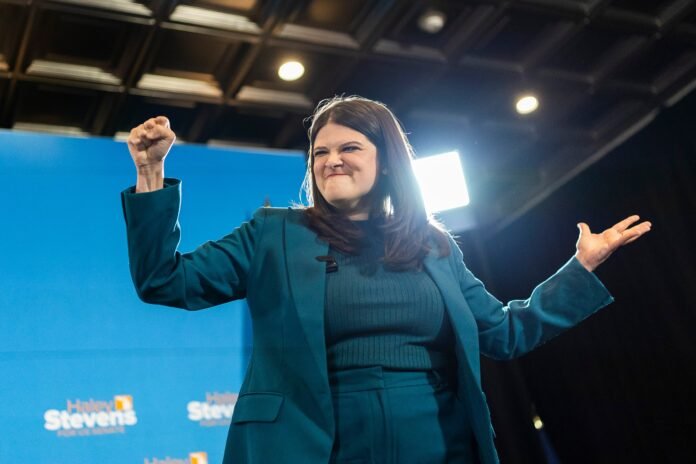
Rather than take the win, Haley Stevens, the House member who lost to El-Sayed in Michigan’s Democratic primary for Senate in August, used that condemnation on Friday as a springboard for a scathing denouncement of her former opponent, framed as a “celebration” of her magnanimous decision to campaign for El-Sayed this weekend alongside Rep. Jim Clyburn, D-S.C. — and laying out conditions for her support with just a few days to go.
In the statement, in which Stevens assigned herself the role as spokeswoman for Michigan’s Black and Jewish communities — Stevens herself is a white Protestant — she all but called El-Sayed an antisemite and a bigot attempting to cozy up to the worst of the far right.
“I have learned from Democratic Party leaders and emissaries, as reported in the news media, that Dr. El-Sayed has heard the deep concerns of the Jewish community and is now, for the first time in this campaign, formally condemning that ad for what it is,” Stevens wrote. “That is why I accepted Congressman Clyburn’s invitation to appear with Abdul on Sunday.”
Stevens’s eleventh-hour ratfuck came after her fiancé Jason Turkish, a political donor who supported incumbent Maine Republican Susan Collins this cycle, as well as other politicians of both parties, announced he’d vote for the Republican candidate, Mike Rogers, on Tuesday. On Friday night, Turkish told TMZ that his fiancee might join him if El-Sayed didn’t accede to her list of demands.
Establishment Democrats see El-Sayed, and the politics he represents, as an existential threat. It’s not his rather anodyne liberalism in domestic policy — his policy portfolio isn’t far from that of party stalwart Elizabeth Warren — but El-Sayed’s opposition to Israel’s genocide of Palestinians that’s the issue. It’s a major problem for the entrenched, centrist Democrats who have controlled the party for decades and have tamped down any dissent on this issue.
Recent polling is likely motivating efforts to ding the El-Sayed campaign. Senate polling from The New York Times/Siena University this week showed South Carolina in a dead heat — an absolute shocker — with Minnesota comfortably in the Democratic corner. CNN polling published on Thursday gave Democrats leads in Texas and Michigan and toss-ups in Maine and Kansas.
With a Senate majority on the horizon, centrists need to enforce discipline and regain control. AIPAC is down, but not out; the lobbying group still has a hold on the party, even as voters are moving away from pro-genocide policies.
Taking El-Sayed down would be a show of force to keep donors and the party’s right wing happy. If Democrats can win the Senate without him, it would be all the better.
But the effort may be backfiring as a faction of party elites, led by popular former President Barack Obama, are putting their muscle behind the El-Sayed campaign. Obama has been a steady presence in Michigan, and Clyburn will rally for the candidate on Sunday at the aforementioned event that Stevens was set to attend.
Anger is also spreading among party members in the state.
“I have no idea what the hell Haley Stevens is doing,” Mallory McMorrow, the Michigan state senator who placed third in the August primary, told CNN Friday night. “This is a moment where we have to recognize the stakes.”
Stevens — who also demanded El-Sayed pull an ad showing far-right broadcaster Tucker Carlson saying he would “never” support the Republican in the race, Rogers — seems undeterred.
Given an inch by the campaign’s willingness to publicly mend fences, Stevens took it several miles, using that ad as a way of implying that El-Sayed was, at best, disinterested in the concerns of Black Michiganders.
This last-minute blitz comes after months of attacks on El-Sayed by centrist Democrats, both before and after his primary win. The smears have been normalized and facilitated by a number of Democrats eager to stay on good terms with the party’s powerful but increasingly marginalized pro-Israel wing. El-Sayed’s connection to the streamer Hasan Piker, who helped get out the vote in the primary, has been a direct and implied slam on the campaign for over half a year from other members of the party.
Rep. Nancy Pelosi, D-Calif., on Thursday called opposition to Israel’s existence as an apartheid ethnostate “more than concerning, it’s wrong,” on Donny Deutsch’s podcast, adding, “This new person in Michigan, we’ll see if he gets elected to the Congress.” On CNN Wednesday, New Jersey Sen. Cory Booker — a consistent pro-Israel voice — declined to directly endorse El-Sayed by name.
Right-wing Democrats aren’t stupid. They know their influence over the party is at a historic low. The genocide in Gaza has pushed the base away from supporting Israel, perhaps permanently. Supermajorities of Democrats oppose the occupation and sympathize with Palestinians.
But the party’s donor class still backs Israel to the hilt and is fomenting a war-on-terror-style Islamophobic bigotry toward Muslims. As Perry Bacon noted on Thursday in The New Republic, party elites attacked then-candidate for New York City Mayor Zohran Mamdani throughout 2025, then picked up where they left off with El-Sayed, the next prominent Muslim Democrat running for office, in 2026.
The same Democrats who indulge in the attacks on El-Sayed are making hay out of rejecting more openly bigoted attacks from the likes of President Donald Trump and Rogers. Rep. Dan Goldman — an outgoing pro-Israel Democrat who jumped on the Condemn El-Sayed bandwagon earlier this week — called Republican attacks on El-Sayed “Islamaphobia” [sic] on Thursday; Booker did the same. And Pelosi, just days after her comments on Deutsch’s show, urged Democrats to vote for El-Sayed.
Voters don’t seem very interested in the back and forth. In a Marist poll of Michiganders released October 21, 95 percent of the state’s Democrats said they support El-Sayed. There’s no split in the party at the state level with respect to the nominee; the fight is at a higher, ideological level with a national stage.
As for El-Sayed, he seems done with Stevens and focused on the election. That rally on Sunday? Stevens isn’t wanted there, Politico reported, as the El-Sayed campaign is making clear it would be a distraction. In a statement released Friday evening, the candidate said he is intent on fighting for affordability, defeating the GOP, and making sure the Senate seat stays blue.
With a Senate majority on the horizon, centrists will look to enforce discipline and regain control.
“That should be the priority for all of us right now,” El-Sayed wrote. “So while Congresswoman Stevens seems intent on relitigating a primary that ended three months ago, let’s all focus on the task at hand: that’s beating Mike Rogers, holding Trump accountable, and getting money out of politics, putting money in pockets, and passing Medicare for All.”
Washing his hands of the wrecker behavior Stevens is engaging in at the final stretch of the campaign is a smart move for El-Sayed. After Tuesday, the Democratic Party should do the same for anyone who indulged in and encouraged it and present a united front against Trump. There’s no room for anyone more interested in keeping their increasingly untenable right-wing ideology beyond voters’ reproach — even if that means losing.














 Eoin Higgins is the






