14.8 C
London
Thursday, October 29, 2026
Home Blog

AI Tried to Buy the Midterms — Then the Lobby Learned Everyone Hates AI

0
ai-tried-to-buy-the-midterms-—-then-the-lobby-learned-everyone-hates-ai
AI Tried to Buy the Midterms — Then the Lobby Learned Everyone Hates AI


The artificial intelligence industry was poised to act as a kingmaker in the midterm elections.

Super PAC networks bankrolled with millions of dollars from Anthropic and OpenAI executives spent heavily in competitive primaries earlier this year, including a high-profile race in New York City. They were touted as the looming successor to another single-issue group, the American Israel Public Affairs Committee, as AIPAC moved its spending underground.

Yet as public outrage over data centers and AI’s threat to jobs soared, artificial intelligence super PACs dramatically throttled back spending on congressional races compared to the primaries. The biggest AI super PAC network has spent only modestly ahead of next week’s general election — and mostly in safe seats.

An Intercept analysis of AI spending in the 2026 midterms, based on Federal Election Commission records and independent race ratings, shows that only 5 percent of their direct expenditures have gone to contested general election races. The industry’s avoidance of the contested races that could determine control of the next Congress suggest that the PACs have realized how the public has soured on the tech, campaign finance and industry observers told The Intercept.

“Essentially these companies underestimated how much the public despises the data center buildout, and the inescapability of AI systems that no one asked for that say they will automate jobs and maybe kill us all,” said Rick Claypool, a research director for the president’s office at Public Citizen, a nonprofit campaign finance watchdog.

Although there is still time for a last-minute flurry of spending, the story of AI’s role in the 2026 midterm elections may turn out to be the story of a single race — a primary in New York — that forced the industry to step away from the limelight.


Claypool’s group released an analysis earlier this year of “corporate supremacist” super PACs, a new breed of campaign committees modeled on a crypto super PAC called Fairshake that spent tens of millions on the 2024 elections.

The model was to amass a massive war chest and use it to punish candidates who opposed the company’s preferred government regulations, while throwing cash at allies or potential allies from both parties.

The first big AI super PAC to launch in August 2025 was Leading the Future, which was bankrolled by the president of OpenAI and its investors. A rival super PAC network, Public First, launched months later with the goal of countering Leading the Future’s influence. Its donors include Anthropic CEO Dario Amodei, who gave $1 million. Anthropic has also given a nonprofit associated with Public First millions of dollars, while stipulating that the money cannot be used on elections. Public First says that it supports tighter regulations than its rival.

The two networks plowed $50.7 million into the primaries, campaign finance records show. Most of that money was spent on primary races where the outcome was in doubt, driven by an eye-popping $21.3 million the networks spent on supporting or opposing a single congressional candidate, Alex Bores, in the Democratic primary for New York’s 12th Congressional District.

Bores, a New York State Assembly member, attracted the ire of those in the industry who favor a laissez-faire approach by authoring an AI regulation bill in the state legislature.

Leading the Future succeeded in defeating Bores, who lost to his State Assembly colleague Micah Lasher in June. But the group drew intense blowback in the process. Many observers suggested Leading the Future’s spending had boosted Bores rather than hurt him, because it gave him a chance to position himself as a foe of the AI industry — while also benefiting from a PAC aligned with the Public First network.

“Down to the wire, they were sweating,” Bores told The Intercept, referring to Leading the Future. “I think people who have been in politics for a while will realize that their spending really served to elevate the issue of AI.”

Leading the Future did not respond to a request for comment.

After wading into contested primary elections, the two leading AI super PAC networks have held back from spending on competitive general elections — even though they have plenty of money in the bank.

Until a few days ago, Public First had spent nothing on general election races. Leading the Future has spent only $7.4 million on general election races as of October 26, according to the FEC data, despite having $34 million in cash on hand across its network as of its most recent report.

Only 31 percent of that total has gone toward competitive races, as measured by the independent analytics website FiftyPlusOne. The only reason Leading the Future has spent money on competitive general election races at all is because it’s backing U.S. Sen. Darline Graham, R-S.C., who filled the seat of her late brother Lindsey Graham and is now facing an unexpectedly fierce challenge from a Democrat to win a full term in ruby-red South Carolina.

“They are not going to have an impact on the balance of power in Congress,” said Shaunna Thomas, one of the founders of Guardrails Alliance, another new super PAC set up to counter Leading the Future’s influence. “They are spending money on candidates who they think will protect their ability to control if and how they are regulated.”

Public First has only recently started spending a relatively small sum on a handful of general election races. The spending had amounted to $1.1 million as of the morning of October 26, according to processed FEC data.

Asked for comment on how its strategy has changed since the primaries, a Public First spokesperson said that it was still trying to support “strong advocates for AI regulation.”

“Public First was founded as a counterweight to Leading the Future, and that fight looks very different today. Leading the Future is going dark. Its biggest backers are walking away,” said Anthony Rivera-Rodriguez, the spokesperson.

Into that gap have stepped new groups pushing for tougher AI regulation such as the Guardrails Alliance, which bills itself as a grassroots alternative to corporate-backed super PACs. It is funded in large part by Silicon Valley tech workers but has taken a more aggressive stance against “tech oligarchs.” Guardrails has spent about $2 million thus far and reported having $1.2 million on hand as of October 14.

About three-quarters of voters are less likely to support a candidate they know has received support from an AI super PAC, according to a Data for Progress poll of more than 3,000 likely voters in Iowa, Michigan, and Ohio commissioned by Guardrails. Voters were more concerned about spending from AI companies than from crypto companies or AIPAC.

Voters were more concerned about spending from AI companies than from crypto companies or AIPAC.

The dislike for data centers and AI cuts across party lines. In Michigan’s purple 7th Congressional District, Democratic candidate Will Lawrence has seized on data centers as one of his leading issues.

“The politics of this are terrible. Eighty percent of everybody is against it, whether you’re a Democrat, independent, or Republican,” he told supporters at a recent town hall.

Notably, neither of the super PAC networks has intervened in Lawrence’s race, despite it being one of the closest in the nation. (Lawrence’s campaign has pointed out that Elon Musk, who leads AI company xAI, has spent against Lawrence via his America PAC.)

There are emerging signs that the big AI super PAC networks are changing tactics in response to that public distaste. Public First’s dark-money affiliate donated $3 million since August to a preexisting super PAC supporting California state Sen. Scott Wiener, one of two Democrats vying to replace retiring Rep. Nancy Pelosi in California.

Leading the Future, meanwhile, gave a $500,000 donation on October 9 to a pro-data center nonprofit called Build American AI.

AI super PAC critics are also watching to see what Leading the Future will do, given its large war chest.

“I think they are going to continue to spend. I think they are going to try to do more and more spending that isn’t as easily tracked, because they are such political dead weight,” said Bores.

Delaware Corporations

When single-issue super PACs know their issue is unpopular, they use vague names, “pop-up” affiliates, and other dubious tactics to hide their activities from voters.

Add another one to the list: Leading the Future has routed more than $30 million of spending through newly minted Delaware corporations, blocking transparency during an election that has been defined by voter backlash against the industry.

Those apparent shell corporations have accounted for the lion’s share of the largest artificial intelligence super PAC network’s expenses during this year’s election.

The practice is a flagrant violation of Federal Election Commission guidelines that require campaign organizations to disclose which consultants, pollsters, and advertisers they are paying, a campaign watchdog alleged in a complaint filed in May.

There may be little recourse for observers worried about the lack of transparency for now, however. The FEC is short of the quorum that would allow it to take action on complaints such as the one filed by the Campaign Legal Center. (Leading the Future, which did not respond to a request for comment, has previously defended its tactics as legal in a statement to Wired.)

The Leading the Future network was funded in large part by an executive at or investors in OpenAI, one of the world’s largest AI companies. (In 2024, The Intercept sued OpenAI in federal court over the company’s use of copyrighted articles to train its chatbot ChatGPT. The case is ongoing.)

Company president Greg Brockman and his wife, Anna Brockman, donated $25 million to the network last year. When it came time to spend that money, the Leading the Future network leaned on two affiliate super PACs, one for Democratic candidates called Think Big and the other for Republican candidates called American Mission.

That is a typical tactic of the new breed of single-issue super PACs popularized by the crypto industry. Campaign finance reform advocates say it may help obscure the origin of campaign ads from voters but does not run afoul of any laws itself.

What those super PACs did next raised red flags for watchdogs, however. Since December, American Mission has reported spending $17.4 million through a Delaware-incorporated limited liability corporation called Summit Ridge Media Group, on services ranging from media placement to ad production to consulting.

Think Big has spent $21.3 million through a different Delaware corporation, Lantern Production Consultants, on a similarly wide range of expenses.

The grab bag of expenses is a giveaway that the super PACs are likely using the newly created corporations to hide their true vendors, according to Shanna Ports, a senior legal counsel at the Campaign Legal Center.

“There’s no way of knowing what is motivating this arrangement — but I know there is backlash to AI. It is possible that the vendors who are working with American Mission and Think Big don’t want to be identified in FEC reports,” Ports said.

Thomas, of the rival super PAC Guardrails Alliance, told The Intercept she thinks the network is obscuring its spending because a lax regulatory approach has become “politically toxic.”

“Their donors don’t want to be associated, their candidates don’t want their support, and their vendors don’t want to be associated,” Thomas said. “If you were public, you are running away. If you are not, you are interested in not being exposed.”

This story was supported by a grant from the Tarbell Center for AI Journalism.
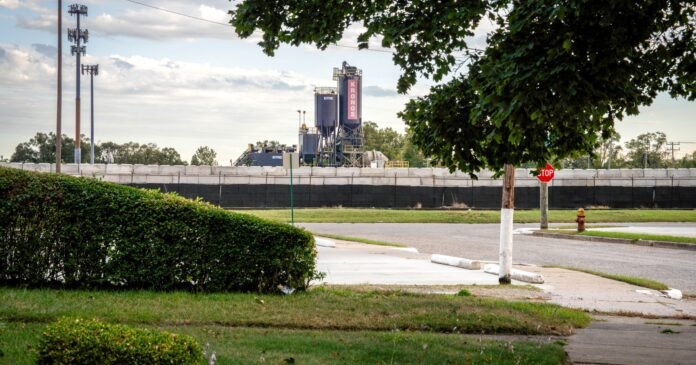
Detroit Could Block Billionaire-Owned Concrete Plant From Further Neighborhood Expansion

0
detroit-could-block-billionaire-owned-concrete-plant-from-further-neighborhood-expansion
Detroit Could Block Billionaire-Owned Concrete Plant From Further Neighborhood Expansion

After years of community opposition, Detroit city officials have taken steps to stop a concrete mixing facility from further expanding into a residential neighborhood.

City Council members, acting on a recommendation last week from planning officials, will soon consider a rezoning measure that would restrict industrial activity at the site of the Kronos concrete plant and surrounding area. The concrete facility at its current size could stay and continue to operate as normal.

The planning recommendation comes after a BridgeDetroit and ProPublica investigation this year revealed how city officials helped Crown Enterprises, a real estate company owned by Detroit’s wealthy Moroun family, obtain property in Cadillac Heights and then provided latitude when its Kronos facility violated environmental laws. Residents have been filing complaints and protesting Kronos for years, frustrated by the dust, noise and other issues created by the concrete operation.

Read More

The City Planning Commission voted Oct. 22 to recommend a change to some of the zoning in the neighborhood from heavy to light industrial, which allows buildings such as warehouses but excludes facilities like concrete plants. The commission also recommended that other lots be zoned for residential and commercial purposes. Earlier this month, the commissioners unanimously voted to exclude industrial zoning in the area adjacent to Kronos, but they stepped back from that last week.

Crown has objected to any zoning change.

Sharon Buttry, who helped organize residents to protest against the Kronos plant, said she is  glad the lots would be rezoned but was disappointed that the earlier recommendation, which was more pedestrian- and transit-friendly, didn’t stand.

Buttry said she fears that the latest zoning recommendation would make it easier for Crown to expand eventually. “We still want them to shut down or move,” she said.

The zoning plan was revisited at the request of City Planning Commissioner Fred Russell Jr., who said the adjustment would create a buffer between residents and the existing concrete plant.

The City Council, which will ultimately decide on the rezoning, has scheduled a public hearing for Nov. 19.

Over the last seven years, Crown has obtained dozens of parcels in Cadillac Heights — some through a land deal with the city in 2019 and others after residents sold their parcels and left. In all, the company now owns more than 160 lots in the neighborhood, most of which are barren.

How a 2019 Land-Swap Deal Accelerated the Morouns’ Foothold

The Moroun family spent decades, from 1966 to 2018, records show, gradually acquiring lots in Cadillac Heights through their various companies, eventually putting the parcels all under the ownership of Crown Enterprises. A May 2019 deal with the city of Detroit allowed Crown to acquire dozens of additional parcels during the next seven years.

Note: Sale dates for 19 parcels could not be identified, but records show Crown owned them as of June. Sources: City of Detroit, Detroit’s Office of the Assessor, Wayne County Register of Deeds, Detroit City Council. Chris Alcantara/ProPublica

In a letter to Detroit officials in mid-September and Oct. 22, a law firm representing Crown threatened legal action if city officials change the zoning, arguing that doing so would devalue the property and create uncertainty about future development.

Attorney Melvin Butch Hollowell also said if the rezoning goes through, the city would be backtracking on its commitment to support Crown’s development in Cadillac Heights. Crown obtained the land there in exchange for the company swapping property in another part of the city, which allowed automaker Stellantis to open the first new car plant in Detroit in three decades.

City officials have said they didn’t know Crown’s plans included a concrete facility. Crown did not present a specific plan at the time of the land transfer. But after the concrete plant opened, the city in 2022 signed a first-of-its-kind agreement with Crown that gave the company time to fix issues before being penalized. The agreement has allowed the company to avoid fines on several occasions, the news organizations have documented.

In response to questions from BridgeDetroit and ProPublica, a Crown spokesperson said the company has invested more than $10 million to develop the concrete operation based “on the City’s promises and actions of approving our plans for this facility.”

“The property was traded to us for the express purpose of redevelopment,” the spokesperson, Kenneth Dobson, wrote.

Dobson said that if the zoning changes, the company will not make the improvements it has promised, including new landscaping and sidewalks. He claimed the improvements would not be allowed under the new zoning and that they also wouldn’t be a sound business decision. City planning staff, however, said the company can still make the improvements.

The neighborhood surrounding Kronos has been zoned to allow heavy industry since the 1940s, when a rail line operated there. Before the concrete operation, the land was occupied by a trucking depot for decades.

Despite the zoning designation, the neighborhood attracted working-class families who lived in modest single-family houses. Buddy’s Pizza, famous as the birthplace of Detroit-style pizza, was founded there and drew crowds from across the city.

The City Planning Commission’s votes this month were four years in the making and part of a broader evaluation of land near the proposed Joe Louis Greenway, a walking and biking trail that will traverse the city and is already under construction.

Scott Benson, the council member who represents Cadillac Heights, asked the planning commission in 2023 to consider whether the industrial zoned areas along the greenway should be rezoned to a use that better supports safety and public health. He said the request at first was unrelated to Kronos, but then community input further influenced the desire for change.

“That did play a role here,” he said in an interview. “The community came out and said, ‘Yes, we especially want this part done and it abuts the Joe Louis Greenway.’”

A man wearing a suit holds his chin in his hands while he sits in a government building. In front of him is a placard that reads, “Council Member Benson,” and behind him is an American flag.
Scott Benson represents Cadillac Heights in the Detroit City Council. Nick Hagen for ProPublica

More than 30 people — some in favor of a zoning change and some against — spoke out at recent commission meetings. Kronos employees and others told the commission that the company has created jobs for Detroit residents and said Crown has invested in the neighborhood with new paving.

Terrell Daniel, whom the city identified in meeting minutes as a Kronos employee, urged the commission at its Oct. 1 meeting to continue to allow industry in the neighborhood.

“It’s bringing back the backbone of Detroit,” he said. He said the concrete plant has provided an opportunity “for guys who never had a chance to work in the city.”

Those in support of rezoning expressed concerns about the dust, air quality and Crown’s track record of not taking care of the neighborhood, which has included leaving vacant homes unsecured and messy.

A dilapidated house with no front windows and an overgrown, trash-covered lawn.
A house that Crown purchased in January has no front door or first-floor windows, and trash litters the yard. Nick Hagen for ProPublica

Residents have filed about 80 complaints to both city and state environmental offices, according to records obtained by BridgeDetroit and ProPublica. They have described “literal whiteout conditions” and “dust clouds” that blanket their neighborhood and irritate their eyes.

The city has issued several tickets to Kronos for violating Detroit’s fugitive dust ordinance, passed in 2024 to limit pollution. The law requires businesses such as concrete plants and scrapyards to submit plans to limit dust and prevent it from spreading into neighborhoods.

On Oct. 7, the city received a complaint about Kronos and an inspector found the company had spread dust in the neighborhood and had piles of materials that should have been blocked from view, according to city spokesperson Georgette Johnson.

Kronos wrote in a letter to the city that it swept and watered the streets and reduced the height of the piles. Johnson said Crown corrected the problems.

Dobson said readings from its air monitors have never exceeded the city’s pollution limits and that a small number of people regularly complain. He previously said that the company planned to demolish a vacant home littered with trash but was waiting on utilities to be disconnected.

China’s Belt and Road hasn’t lived up to Xi’s promise

0
china’s-belt-and-road-hasn’t-lived-up-to-xi’s-promise
China’s Belt and Road hasn’t lived up to Xi’s promise

Designed to dwarf even the Marshall Plan, the American program to rebuild Europe after World War II, China’s Belt and Road Initiative (BRI) was first unveiled by President Xi Jinping in a 2013 speech at Nazarbayev University in Kazakhstan.

Beijing later pledged to invest US$1 trillion, and by some estimates as much as $8 trillion, in roads, railways, bridges, ports and other infrastructure projects around the world, with an emphasis on sparking economic development in the underfinanced Global South.

Originally called One Belt, One Road, the BRI was meant to usher in what Xi described in his speech as a more just world order. But on many counts, the program has not measured up to its original, world-changing ambition.

Thirteen years after its launch, many observers and analysts now see the BRI as more of a liability than an asset to China’s plan to forge a post-America-led world order. In one of the first signs of retreat, Xi recast the BRI as “small and beautiful” in November 2021, saying the emphasis should shift to smaller, less costly projects in areas such as clean energy and technology.

The pivot has reshaped the initiative – once portrayed as driven by developing-world uplift, but now clearly more profit-seeking than altruistic – rather than ending it.

BRI projects have since become more transactional, aimed at securing energy and minerals, acquiring equity stakes in developing-world natural resources and finding overseas buyers for China’s surplus industrial output amid rising Western protectionism, rather than advancing Xi’s once-grand vision of a more equitable alternative to supposed Western exploitation of the Global South.

For many developing nations, BRI-related loans have become a new type of financial albatross, pushing them deep into debt to China with scant prospects of repaying at the initial interest rates and terms.

It has also caused financial strain among Chinese financial institutions directed by Beijing to issue BRI-related loans and credit facilities, which have struggled to collect on those debts.

China’s two main policy banks, China Development Bank and China Eximbank, carry particularly high exposure to non-performing loans in low- and middle-income countries, according to AidData, a research lab at William & Mary University.

That NPL situation will likely get worse before it gets better: AidData estimates that 55% of those loans have already entered their principal repayment periods, a share scheduled to rise to 75% by 2030.

BRI-related financial trouble comes as China’s once-spectacular economic growth structurally slows from double-digit and high single-digit rates of previous decades. The International Monetary Fund projects China’s economy will expand about 4.6% in 2026 and 4.1% in 2027, down from the 5% the government targeted and claimed to have hit right on the dot in 2024 and 2025.

Beijing’s attempts to swap unpaid loans for equity have met with only moderate success and sparked nationalistic firestorms in some BRI-recipient nations. In December 2017, unable to service the heavy commercial loans used to build the underperforming deep-sea port at Hambantota on Sri Lanka’s southern coast, the Colombo government signed a 99-year lease giving China Merchants Port Holdings a 70% controlling stake.

Laos, already one of Asia’s poorest countries, accumulated enormous external debt under the BRI to pay for large-scale infrastructure projects, including power plants and a high-speed railway linking the capital, Vientiane, to Boten on the Chinese border and onward into China.

Faced with a debt crisis caused by its inability to repay BRI loans on their original terms, the government agreed to hand majority control of a large part of Électricité du Laos, the state corporation that runs the country’s power generation, transmission and distribution, to the Chinese state-owned China Southern Power Grid Company.

BRI critics once feared the scheme was a calculated master plan for Chinese global domination. From the start, however, the reality was very different. A major weakness in carrying out Xi’s vision is that no central government body has ever overseen BRI projects, and it remains unclear to this day which ministry or ministries are responsible for them.

Yuen Yuen Ang, a prominent political scientist at Johns Hopkins University, wrote in a 2018 essay that the BRI’s modus operandi was “typical of China, where the central government often issues broad directives and expects lower-ranking officials to figure out how to fulfill them.”

The hallmark of such communist-style mass campaigns, Ang argued, is frenzied enthusiasm and little coordination. Vast resources and human capital are mobilized toward one goal. Banks, businesses and officials across the country join in en masse rather than dividing up responsibilities, as local governments rush to satisfy what they perceive to be their superiors’ wishes.

In the BRI’s early days, Beijing sought to win global friends with fanciful schemes, including an indoor ski slope near the beaches of Australia’s Gold Coast, a spa in the Czech Republic and cultural centers and amusement parks in the Philippines, Indonesia, Vietnam, Italy, Hungary and Serbia. None of them were ever built.

There was even a BRI coloring book for children, underscoring the enterprise’s haphazard nature. Italy, the only G7 nation to join the BRI, withdrew when its initial five-year term expired in 2023, with Prime Minister Giorgia Meloni saying joining was a “mistake.”

In late 2023, the Philippine government officially announced it had withdrawn from funding talks for several railway projects once linked to BRI. In 2016, China had pledged $24 billion in investment projects, including under BRI, but little of that amount materialized. Panama formally quit BRI in 2025, becoming the first Latin American country to do so.

The China-Pakistan Economic Corridor (CPEC), which links China’s Xinjiang region to ports on the Arabian Sea, has been seen as something of a BRI success story. But it has left Pakistan heavily indebted to China.

China is now Pakistan’s largest bilateral creditor, holding about $28.8 billion, or 22% of the country’s total external debt, according to the World Bank’s most recent International Debt Report.

The US State Department, in a May report to Congress, said Pakistan has the highest absolute debt to China of any country, and that most of it stems from the $62 billion corridor.

While China has agreed to roll over, refinance, and restructure some of the debt, it has held firm on repayment for the bulk of it at originally agreed interest rates. That forced Islamabad to turn to the IMF for a $7 billion bailout in September 2024, pushing the country back toward Western-led lenders to repay its China debt.

Resentment runs deepest in Balochistan, where resistance to BRI projects has often been violent. In the first half of 2026, the Balochistan Liberation Army, a local separatist group, carried out more than 100 attacks on police, military and paramilitary forces, as well as BRI projects those forces are deployed to protect. Dozens of Chinese nationals, including BRI project engineers and managers, have been targeted and killed in recent years.

It is too early to say what effect BRI’s failure to achieve its initial lofty goals will have on Xi personally. At least in part, the initiative sought to secure Xi’s place in the pantheon of China’s great leaders. Mao Zedong destroyed the old, corrupt feudal order and unified a then-fragmented country. Deng Xiaoping, once derisively branded a “capitalist roader,” lived up to that moniker and laid the foundations of China’s modern economy.

Xi has sought to transform China from an economic growth machine into a global political and military power, one that will eventually surpass the US as the world’s most powerful nation. But 13 years after its launch in Kazakhstan, Xi’s signature program has morphed into something much smaller and more transactional than his original vision for forging a more equitable world with China at its benevolent center.

Bertil Lintner is a former correspondent with the Far Eastern Economic Review and author of “The End of the Chinese Century? How Xi Jinping Lost the Belt and Road Initiative.” Purchase the book here.  

King Charles’ visit to the Caribbean evokes specter of British slavery – and local demands for justice

0
king-charles’-visit-to-the-caribbean-evokes-specter-of-british-slavery-–-and-local-demands-for-justice
King Charles’ visit to the Caribbean evokes specter of British slavery – and local demands for justice

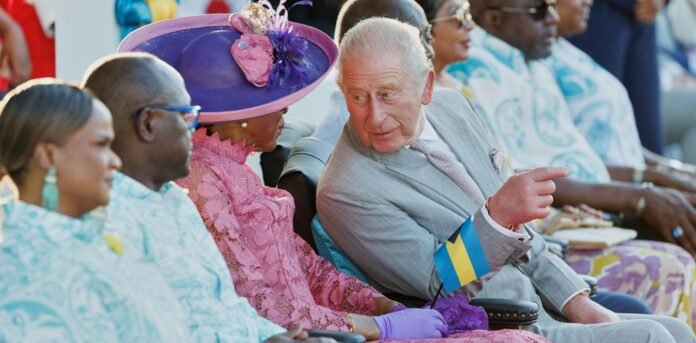
King Charles III touched down in the Bahamas on Oct. 27, 2026, with far more baggage than usual. The nine-day trip in the Caribbean also features stops for the U.K. monarch in Guyana and in Antigua and Barbuda for the annual Commonwealth Heads of Government Meeting.

The king’s royal tour comes amid mounting Caribbean demands for reparations and renewed scrutiny of the British monarchy’s historical role in slavery. These developments have intensified debate in Caribbean Commonwealth realms over whether to retain the British monarch as head of state.

Anticipating local calls for a royal apology, Buckingham Palace telegraphed ahead of time that Charles would not formally apologize for slavery on behalf of the British government during the visit. King Charles started his tour noting the “great suffering of the past,” but Buckingham Palace has said previously that the legacies of colonialism and slavery are matters “primarily for governments to address.”

It is a familiar formula for the Crown: acknowledge the horrors of the past, express sorrow and leave responsibility unanswered.

Both as heir apparent and now as king, Charles has spoken about the atrocity of slavery during visits to Ghana, Barbados, Rwanda and Bermuda. Such acknowledgment matters, particularly when historical injustices have been repeatedly minimized or excluded from official narratives.

But as a historian focused on Britain’s Atlantic slave empire, I believe that expressions of regret cannot substitute for meaningful engagement with the demands of those whose ancestors were enslaved. The king’s Caribbean visit is an occasion to recognize the full story of Britain’s trafficking and enslavement of millions of Africans across the Atlantic – and the Crown’s direct culpability.

The monarchy’s deep ties to slavery

While Buckingham Palace today says it is up to the government to litigate questions of historical justice, the monarchy was no passive participant in the Atlantic slave system.

Alongside the work of other historians, my recent book, “The Crown’s Silence,” documents the monarchy’s direct involvement in the expansion and administration of Britain’s Atlantic slave empire.

Beginning in 1563 with the reign of Elizabeth I, the monarchy invested in transatlantic slaving voyages, granted monopoly charters to slave-trading companies, provided Royal Navy vessels for convoy protection of slaving vessels, and profited from the expansion of slavery in the Atlantic world.

Successive monarchs relied heavily on customs revenue derived from enslaved labor and endorsed colonial laws categorizing enslaved people as property – to be bought, sold, mortgaged, seized for debt and inherited. Enslaved men and women were also purchased in the Crown’s name to labor at Royal Navy dockyards and serve in the West India Regiments.

The paper trail of royal complicity in slavery thus stretches across three centuries.

The financial settlement that accompanied Britain’s abolition of slavery in 1834 makes the injustice particularly stark. The British state compensated enslavers $26.6 million (approximately $4.5 billion today) for the loss of their so-called human property.

In contrast, the formerly enslaved received no restitution for generations of stolen labor and lives, extreme brutality and family separation. The consequences extended well beyond emancipation, shaping patterns of land ownership, wealth, racial inequality and economic dependency that continue to affect Caribbean societies and members of the African diaspora today.

Calls for reparatory justice

This history is central to understanding why reparatory justice remains a pressing demand.

Reparations transcend apologies and requests for monetary compensation. In June, the African Union and CARICOM, the intergovernmental organization covering more than a dozen Caribbean nations, agreed to a 19-point reparations plan that calls for, among other things, formal apologies, debt relief, financial reform, cultural restitution and the establishment of an international reparatory justice fund.

The Caribbean has advanced a comprehensive case for reparations targeting Britain and other European colonial powers for years. In 2014, CARICOM’s reparations initiative gained momentum – but efforts to pursue claims against the British government met legal resistance, including a successful challenge that the claim lacked jurisdiction. The demand has nonetheless persisted, exposing for countries in question the inadequacy of indefinitely postponing reparations through diplomatic language.

The Commonwealth Heads of Government Meeting, Nov. 1-4, 2026, offers another test of the Commonwealth, which comprises 56 member states, the majority of which were once part of the British Empire, and its commitment to equality. The organization describes itself as a voluntary association of independent states united by shared goals and values. Yet that ideal sits uncomfortably alongside the afterlives of slavery and empire.

Caribbean countries are attempting to participate as equal partners, while Britain, the former imperial center, resists meaningful engagement with the historical foundations of its wealth and power. As Shirley Botchwey, the Commonwealth’s secretary-general, recently remarked, the “time has come” for the king to apologize for slavery and discuss reparations.

The Crown’s position on this issue extends beyond what Charles does or does not say in a speech. That, to critics, is evident in the boundaries imposed on the discussion: The king may condemn slavery, but he leaves the monarchy’s institutional responsibility unaddressed; he may express sorrow for colonial atrocities, but reparations are left to governments that refuse to consider them.

The ripple effects for the Commonwealth

As new historical research has further documented Britain’s involvement in slavery, the United Nations in March 2026 declared slavery “the gravest crime against humanity.” In September, Jamaica submitted a petition asking Charles, as Britain’s head of state, to refer questions about the legality of slavery, its compatibility with international law and Britain’s potential obligation to provide a remedy to the Judicial Committee of the Privy Council – Britain’s final court of appeal for overseas territories and Crown dependencies.

The petition represents the first time a Commonwealth realm has sought a legal determination on the legality of Britain’s trafficking and enslavement of Africans. On Sept. 22, the king referred the petition to the Privy Council, which has set a preliminary hearing for March 2027.

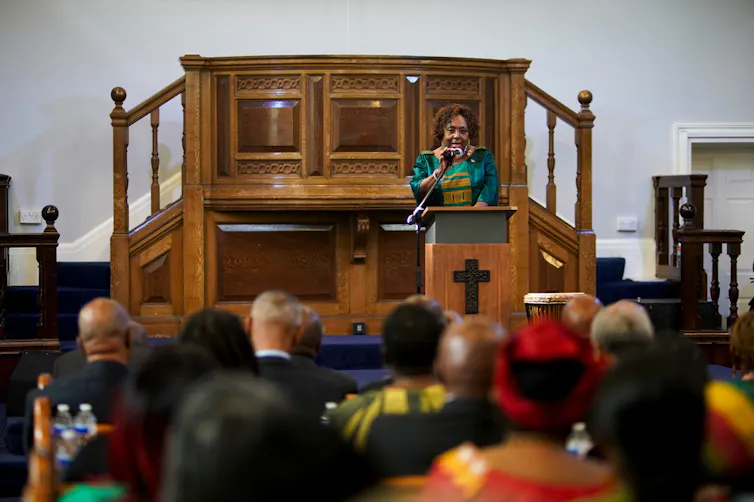
A woman speaks at a pulpit before an audience.

Jamaica’s Minister of Culture, Gender, Entertainment and Sport, Olivia Grange, speaks in London on Sept. 6, 2026, before filing a petition to refer three specific questions about trans-Atlantic slavery to the Judicial Committee of the Privy Council. AP Photo/Alberto Pezzali)

Charles could have declined the referral, and the move provides a route for legal consideration of questions long resisted by Britain. But it also illustrates the monarchy’s contradictory position. The king’s constitutional role can facilitate a pathway for Jamaica’s reparations petition, even as the Palace invoked constitutional limitations to temper expectations during the Caribbean royal tour.

Consequently, while the referral marks a significant procedural step, it’s still, on its own, insufficient, according to reparations activists.

Unless the king takes more substantive action, his position as head of state in multiple Caribbean countries is at risk. Since Charles’ accession in 2022, several Commonwealth realms have renewed discussions about becoming republics. Following Barbados’ removal of the British monarch as head of state in 2021, Jamaica, the Bahamas, Antigua and Barbuda and others have reconsidered their own constitutional arrangements.

These republican movements in the Caribbean are about more than opposition to Britain or the monarchy. They concern sovereignty, democratic accountability and an end to the extractive institutions inherited from colonial rule. Proponents argue that if a distant head of state cannot meaningfully engage with issues of profound historical and national significance, the value of retaining that relationship must be questioned.

Thus, CARICOM leaders aim to use the Commonwealth Heads of Government Meeting as a springboard to press for sustained engagement with the region’s reparations plan, despite the British government’s insistence that an apology and reparations are off the table.

King Charles sits on a throne inextricably bound up with slavery and colonial extraction. Although his formal political powers are limited, his symbolic influence is considerable. Even if the Crown continues to defer constitutional questions over Britain’s responsibility for slavery to the government, there are other steps Charles could take. Those include acknowledging the monarchy’s own institutional role in colonialism and slavery and commissioning an independent investigation into its history, as King Willem-Alexander of the Netherlands has done.

The question now is to what degree Charles will use his office to encourage a consequential reckoning or, in the eyes of many of his Caribbean subjects, to continue to offer little more than superficial acknowledgment of historical suffering. That could well decide the visit’s lasting significance.

Amazon turns its most capable smart speaker into a smart camera, too

0
amazon-turns-its-most-capable-smart-speaker-into-a-smart-camera,-too
Amazon turns its most capable smart speaker into a smart camera, too

Since debuting in 2019, Amazon’s Echo Studio targeted users who wanted superior audio quality from their Alexa-based smart speaker. The latest Echo Studio adds another less-expected differentiator: an integrated camera.

The Echo Studio with Home Camera, released alongside a pile of other Alexa devices today, doesn’t have many audio upgrades over the standard Echo Studio. Each speaker has one 3.75-inch high-excursion woofer and three full-range drivers. They both support Dolby Atmos and Amazon’s proprietary algorithm for adding a surround sound-like effect to stereo audio. Per the devices’ product pages, the speakers have lossless HD audio, Advanced Room Adaptation, and features for fighting noise distortion. Amazon announced the Advanced Room Adaptaion today, saying that the feature “continuously tunes the sound to your space, automatically adapting to the room’s acoustics.”

Both speakers have four-microphone arrays and the same AZ3 Pro processor that Amazon introduced a year ago. The processor has an AI accelerator for using Amazon’s Alexa+ generative AI chatbot.

The devices also have the same dimensions, even though the new Echo Studio With Home Camera fits in a 13MP camera.

The speaker can use the camera to see where you are and adjust audio volume “so your music or audiobook maintains the same volume as you move about.”

Beyond audio capabilities, Amazon sees people using the speaker as a smart camera, allowing them to remotely check on a room in the home to see, for example, “how the dog is doing or make sure you didn’t leave the lights on.”

“Alexa can also see and understand what’s in front of the camera and help you in real time. Pull out a board game box and ask Alexa+ to explain the rules or hold up a cereal box, and Alexa can recognize it and help you reorder more flavors,” Amazon’s announcement says.

One day, users will be able to pair the smart speaker-camera with an Amazon Fire TV for video calls, Amazon’s announcement said, without confirming when.

Regarding user privacy, Amazon’s announcement said:

Like all of our Echo devices, a dedicated button turns off the microphones and any included cameras. There are clear visual indicators whenever Echo devices with a camera are streaming images or video to the cloud to provide transparency—on Echo Studio with Home Camera, a built-in LED turns on. The standard Echo Studio remains available for those who prefer no camera.

Echo Studio With Home Camera users can disable the camera via the Alexa mobile app and “continue interacting with Alexa when the camera is disabled,” the device’s product page says.

Watching the Amazon Echo Studio with Home Camera's camera feed from a phone.

Watching the Echo Studio with Home Camera’s camera feed from a phone.

Watching the Echo Studio with Home Camera’s camera feed from a phone. Credit: Amazon

Amazon has a notable past when it comes to smart cameras, including previously giving cops access to data from Ring smart cameras without user consent and allegations from the Federal Trade Commission that its employees illegally spied on Ring users (Amazon eventually settled the FTC’s lawsuit for $5.8 million without admitting any wrongdoing). These incidents may lead some privacy-focused customers to opt for camera-less alternatives.

The new gadget indicates where Amazon is going with gadgets since launching Alexa+ in a bid to transform its AI assistant from a money pit into a lucrative tool. With standard Alexa said to have cost Amazon billions of dollars, Amazon’s newest devices aim to boost capabilities for more advanced tasks, especially ones leading to purchases on Amazon’s website or with its partners through Alexa+.

Those added capabilities come at costs that extend beyond potential privacy concerns. The Echo Studio With Home Camera is $250, which is $30 more than the camera-free version.

Meloni condemns judge’s decision to free man accused of inciting violent protests

0
meloni-condemns-judge’s-decision-to-free-man-accused-of-inciting-violent-protests
Meloni condemns judge’s decision to free man accused of inciting violent protests


Italian Prime Minister Giorgia Meloni has condemned a judge’s decision to release a university researcher accused of helping organise violent protests in Milan, describing the ruling as “shameful”.

Youssef Siher, a 30-year-old Italian freelance journalist of Moroccan origin, was detained on 24 October on charges of incitement to commit crimes, aggravated by alleged terrorist motives.

However, Milan judge Tiziana Landoni ordered his release, saying the investigation appeared deeply flawed and there were no serious grounds to believe he had committed the alleged offences or posed a flight risk.

Police had identified Siher as the administrator of a Telegram group called “October 17 Movement”, which was created after violent demonstrations in Milan. Investigators alleged that messages posted in the group encouraged protesters to gather and commit offences against public order.

Landoni said, however, that the comments in question had been posted by other group members and that Siher had not been found to have encouraged or supported their calls for violence. Siher has denied wrongdoing.

Meloni said the decision was an “unbearable humiliation” of the work of police and investigators.

The case comes as the government steps up its law-and-order measures. A security decree introduced this month provides prison sentences of four to 12 years for organisers of groups that endanger public safety or cause damage during demonstrations.

via Reuters

Whoopi Goldberg Reveals Her Paycheck Would ‘Shock’ Fans

0
whoopi-goldberg-reveals-her-paycheck-would-‘shock’-fans
Whoopi Goldberg Reveals Her Paycheck Would ‘Shock’ Fans


After nearly two decades of heated debates, political showdowns and countless controversies on The View, Whoopi Goldberg is finally revealing what keeps her coming back to the ABC talk show — and her answer has everything to do with money.

The 70-year-old television veteran made no attempt to sugarcoat her motivation during a revealing interview with W Magazine, admitting that her lucrative paycheck is the biggest reason she continues occupying her familiar seat at the table.

Asked why she has remained on the program for so long, Goldberg delivered a refreshingly blunt two-word answer: “Good check.”

And when pressed on whether money really was her primary motivation, the Oscar-winning actress doubled down.

“That’s really what it is,” Goldberg declared. “I’m well-paid, and I do a good job. I earn my dough, and sometimes people like it, sometimes they don’t.”

The admission comes as Goldberg celebrates her 20th season on the daytime television powerhouse, where her outspoken opinions and frequent political clashes have made her one of the show’s most recognizable — and polarizing — personalities.

But despite her decades of Hollywood success, Goldberg suggested that the entertainment industry still isn’t offering women the same financial opportunities as their male counterparts.

“No one is going to pay me guy money to be in a movie,” she explained, acknowledging that her steady television paycheck provides an attractive alternative to chasing film roles.

And while Goldberg has refused to reveal her exact ABC salary, she has already hinted that the figure would leave viewers stunned.

During an August appearance on Keke Palmer’s Baby, This Is Keke Palmer podcast, the longtime host was asked what she enjoyed most about working on The View.

Her answer was immediate: “The check. I love the check.”

When Palmer suggested she could only imagine how much Goldberg was earning, the actress insisted the reality was even more surprising.

“Trust me. You can’t. You would be shocked,” Goldberg teased.

Although various reports have placed her annual earnings in the multimillion-dollar range, Goldberg has not publicly confirmed her exact salary. She has also acknowledged that The View isn’t necessarily the highest-paying job of her extraordinary career.

For Goldberg, however, the financial security carries particular significance.

The Sister Act star joined the program in September 2007 after legendary broadcaster Barbara Walters offered her a position following Rosie O’Donnell’s departure. Despite having already won an Oscar and established herself as one of Hollywood’s most successful entertainers, Goldberg has admitted she desperately needed work at the time.

Nearly 20 years later, she remains the show’s longest-serving uninterrupted co-host, having watched numerous television personalities come and go while continuing to lead its often explosive discussions.

Goldberg has also acknowledged that she has considered leaving the program numerous times over the years. Yet her latest comments make clear that the financial rewards remain a powerful incentive to stay.

Still, she insists her commitment goes beyond collecting a paycheck.

The entertainer has spoken openly about feeling fortunate to have steady employment when so many Americans are struggling to find work, explaining that seeing her family each morning reminds her of the importance of having a job.

She also defended her willingness to express controversial opinions, regardless of whether viewers agree with them.

Goldberg said she takes her responsibilities seriously because Walters specifically hired her to speak her mind — something she has never been particularly shy about doing.

And after 20 seasons of arguments, backlash and headline-making television moments, Goldberg appears perfectly comfortable with the arrangement.

Viewers may love her or dislike her, but as long as ABC continues signing those substantial checks, Goldberg has made it clear why she has little reason to walk away.

Lula can’t decouple from China, whatever Trump may want

0
lula-can’t-decouple-from-china,-whatever-trump-may-want
Lula can’t decouple from China, whatever Trump may want

Luiz Inacio Lula da Silva’s re-election on October 25 may have frustrated Donald Trump’s ambitions in Latin America, but the more consequential story lies beyond the ballot box on China.

Brazil’s relationship with Beijing is now so deeply embedded in its economy that even a president more sympathetic to Washington would struggle to unwind it. Political loyalties can change overnight, but trade routes, industrial investments and commercial dependencies cannot.

Lula secured 51.79% of valid votes against Flavio Bolsonaro’s 48.21%, according to Brazil’s electoral authority. His victory preserves a government committed to maintaining relations with competing global powers.

Nevertheless, the election exposed a deeper reality. Brazil’s economic relationship with Beijing is increasingly sustained by interests that extend well beyond presidential preferences.

Between January and September 2026, Brazilian exports to China reached US$84.7 billion, up 12% from a year earlier. China absorbed 29.75% of Brazil’s exports, compared with just 9.65% destined for the United States.

Meanwhile, exports to America declined 6.5%. For Brazilian producers, these figures represent customers, revenues and investments that cannot simply be redirected by diplomatic decree.

Nor is China merely purchasing Brazilian commodities. Chinese companies are increasingly involved in the country’s electricity networks, mining operations, automobile manufacturing and energy transition.

Consequently, the relationship is evolving from a conventional exchange of raw materials for manufactured goods into something more consequential: an economic partnership deeply woven into Brazil’s productive infrastructure.

That means Washington’s strategic preferences increasingly collide with Brazil’s commercial realities. American policymakers may regard Chinese influence in the Western Hemisphere as a geopolitical vulnerability.

Brazilian exporters, manufacturers and infrastructure operators, however, calculate their interests differently. For them, disengagement would require alternative markets, financing and technology, not simply a change in political allegiance.

Unbreakable relationship

China’s importance to Brazil begins with the extraordinary scale of its demand. Brazilian soybeans feed Chinese livestock, iron ore supports its steel industry, and crude oil supplies its refineries. These exchanges have created powerful domestic constituencies whose commercial interests transcend ideological divisions.

Indeed, Brazil’s dependence is not confined to the political left. Agribusiness, historically associated with conservative political forces, benefits enormously from Chinese demand. Mining companies and commodity exporters operate according to similarly pragmatic calculations. A government seeking to distance Brazil from Beijing would therefore confront resistance not only from China but also from powerful interests at home.

Bilateral trade reached approximately $143.3 billion in the first nine months of this year, generating a Brazilian surplus of $26.1 billion. That accounted for roughly 42% of Brazil’s overall merchandise trade surplus.

To be sure, the relationship has vulnerabilities. Brazil predominantly exports agricultural products, minerals and energy commodities while importing manufactured goods, machinery and increasingly sophisticated technologies.

This pattern generates substantial revenues but does not necessarily strengthen domestic technological capabilities. Indeed, commodity dependence can coexist with and even promote industrial stagnation.

The emerging lithium trade illustrates the dilemma. During January-September, Brazilian exports of spodumene, a lithium-bearing mineral, rose 339% in value to $172.3 million. China purchased approximately 97% of those exports.

Brazil possesses the resource, while China commands much of the downstream battery-processing and manufacturing ecosystem. The commercial opportunity is considerable, but so is the risk of remaining confined to the least technologically sophisticated stages of production.

Still, Brazil’s dependence should not be confused with helplessness. Brazil supplies commodities that Chinese industries need, and alternative markets exist for some of the products.

The real question is how quickly exporters could replace Chinese demand, at what price and with what consequences for employment and investment. Economic vulnerability depends not merely on the size of a relationship but on the cost of replacing it.

Investment as strategic infrastructure

According to the Brazil-China Business Council, Chinese investment in Brazil reached $6.1 billion in 2025, up 45% from the previous year. Brazil attracted 10.9% of Chinese overseas investment tracked by the council, making it the largest destination in its assessment. Crucially, the money was not concentrated exclusively in commodity extraction.

Electricity projects received approximately $1.79 billion, while mining attracted $1.76 billion. Automotive investment reached about $965 million. Chinese companies are consequently participating in sectors that shape Brazil’s future industrial capacity, particularly electricity infrastructure, electric vehicles and strategic minerals.

Still, Chinese investment is not automatically beneficial to Brazil. China’s factories may create jobs and introduce technology, but they also make Brazil reliant on imported components, limiting domestic value creation. Likewise, mining investment may increase exports without developing Brazilian processing capabilities.

Washington faces a corresponding challenge. If American policymakers want Brazil to reduce its exposure to China, trade restrictions and diplomatic pressure will likely accomplish little.

They must offer credible alternatives involving market access, financing, industrial cooperation and technology. Otherwise, Brazil would be expected to absorb the economic costs of advancing another country’s geopolitical objectives.

While Washington introduced additional tariffs on Brazilian products in July, both governments established a working group in September to explore a possible trade agreement.

Brazil has continued engaging the United States even as its commercial relationship with China expands, reflecting Brasilia’s effort to preserve economic options rather than accept an exclusive alignment.

Brazil’s real choice

Lula’s challenge, therefore, is not whether Brazil should choose Washington or Beijing. It is whether the country can transform relationships with both into greater productive independence.

Brazil’s Nova Indústria Brasil program provides one potential instrument. Initially backed by $300 billion real (US$55 billion) in planned financing, the initiative received an additional $70 billion real commitment in February 2026.

Its ambitions include industrial modernization, technological development and stronger domestic production chains, though clearly financing commitments alone won’t guarantee industrial transformation.

The relevant measures are domestic value added, productivity growth, technological learning, supplier development and the ability to export sophisticated products. Chinese investment should be assessed against these benchmarks, just as American or European investment should.

Diversification nevertheless remains essential. During the first half of 2026, Brazilian exports to India expanded by more than 88%, while sales to the European Union, Mexico and Singapore also increased. These developments suggest that alternative commercial relationships can grow alongside Chinese demand rather than replacing it outright.

Washington may try to influence Lula’s new government’s strategic calculations, but it cannot erase the commercial incentives sustaining relations with Beijing. Brazil’s strategic autonomy will be measured neither by its distance from Washington nor by its closeness to Beijing.

It will depend on whether the country can convert access to competing powers into domestic capabilities that neither power can monopolize or control.

Lula’s objective won’t be decoupling from China at America’s behest. Rather, it will be to make external dependence less costly, less concentrated and, above all, less able to dictate Brazil’s choices.

Ronny P Sasmita is a senior international affairs analyst at the Indonesia Strategic and Economic Action Institution, a Jakarta-based think tank. He holds a PhD from the University of Tokyo.

4 Ways Out of Israel’s Election Deadlock—and None Is Easy

0
4-ways-out-of-israel’s-election-deadlock—and-none-is-easy
4 Ways Out of Israel’s Election Deadlock—and None Is Easy


Israel has elected a parliament, but not necessarily a government. With 85.6% of votes counted Wednesday, Prime Minister Benjamin Netanyahu’s right-wing and ultra-Orthodox bloc was projected to win 53 seats, eight short of a majority. A four-party opposition bloc led by Gadi Eisenkot had 48, while two predominantly Arab parties were projected to hold a combined 19. The arithmetic suggests a way to unseat Netanyahu. The politics are another matter.

Keren Setton examines four possible outcomes of Tuesday’s election, beginning with the prime minister’s familiar skill at finding coalition partners where none seem available. Strategic adviser Roni Rimon believes Netanyahu may approach political adversaries, including former Prime Minister Naftali Bennett. Yet Bennett has ruled out joining a Netanyahu government, and crossing that line would require a spectacular reversal.

The opposition’s alternative looks stronger on paper. Its 48 seats, combined with 19 for the Joint List and Ra’am, would give Netanyahu’s opponents 67 lawmakers. Arab turnout reached an estimated 80%, helping deliver what could be their parties’ strongest combined representation. Joint List leader Yousef Jabareen has signaled willingness to help replace Netanyahu, while Ra’am leader Mansour Abbas is open to joining an Eisenkot-led coalition.

But Bennett and Yisrael Beitenu leader Avigdor Liberman oppose depending on Arab parties. Eisenkot has also imposed conditions on potential partners. A minority government backed by Arab lawmakers from outside the coalition remains possible, as Israeli parliamentary precedent shows.

A unity government presents a third option, though opposition leaders reject serving under Netanyahu. His far-right partners, disputes over military conscription, and the prime minister’s corruption trial add further complications. University of Haifa professor Eran Vigoda-Gadot dismisses a Netanyahu-Eisenkot deal outright.

Then comes the fourth possibility: another election, potentially in early 2027. Israel held five between 2019 and 2022. Roughly 600,000 special ballots still awaited counting Wednesday, and official results are due by November 4.

In Setton’s interviews, the competing forecasts expose how much hinges on decisions rather than numbers. President Isaac Herzog has urged party leaders to approach coalition talks with an open mind. Failure would leave Netanyahu governing as caretaker, and Israelis facing yet another trip to the polls.

Google announces Gemini 4 Carbon, its latest frontier AI model that you can’t use

0
google-announces-gemini-4-carbon,-its-latest-frontier-ai-model-that-you-can’t-use
Google announces Gemini 4 Carbon, its latest frontier AI model that you can’t use

It’s almost like Google’s got something to prove after taking a break from releasing new frontier AI models earlier this year. Just two weeks after rolling out Gemini 4 Argon, Google has announced Gemini 4 Carbon. This isn’t the Flash model equivalent we’ve been waiting for but, rather, is an improvement on Argon, and like that model, Google is working on a staged release that could take a while.

Stop me if you’ve heard this one before: Google says its latest AI model reaches a new threshold in coding, agentic tasks, and scientific analysis. It’s so capable, in fact, that Google can’t let you use it just yet.

Gemini 4 Carbon reportedly makes big gains in cybersecurity applications. Google says the model shows a “significant leap” in vulnerability detection, validation, and remediation. Carbon is also apparently twice as likely to generate code that is free of vulnerabilities versus Argon. Meanwhile, the Chrome team claims that Carbon is 10 times better at generating “high-quality” patches compared to non-Google models. Google also notes that Carbon has increased its score by 89 points on WebDev Arena, now ranking at number four on the leaderboard.

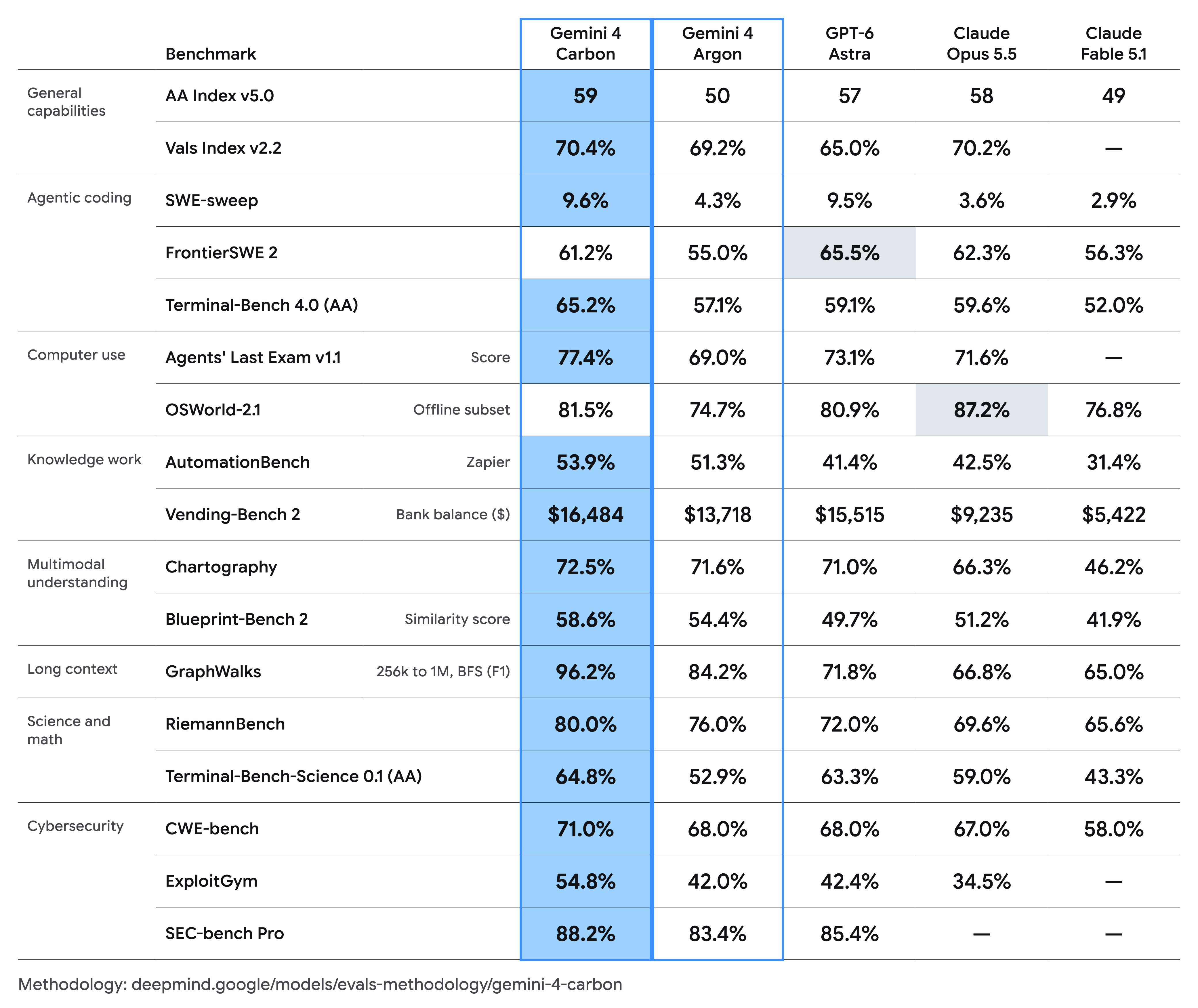
Google has some numbers to support these vague assessments (below), showing Carbon at the top of the charts. Google positions Carbon as a totally new model, but for all we know, it could be a post-training upgrade of Argon. The two models have a lot in common, but Carbon does best Argon by slim margins in every test Google has given it. Its new model also beats GPT-6 Astra, Claude Opus 5.5, and Claude Fable 5.1 in almost every test. Benchmarks don’t tell the whole story, of course, and it’s notable that every frontier model scores in the same neighborhood in these tests. The gap between Carbon and the competition is just a few points.

Credit: Google

By Google’s reckoning, Carbon is the most capable frontier AI model right now, and its improved capabilities come with more rigorous safeguards. In the Grey Swan evaluation, Carbon resisted every attempted prompt-injection attack. That 0 percent score is better than Argon (0.7 percent), Opus 5.5 (1 percent), and GPT-6 Astra (8.5 percent).

The release plans for Gemini 4 Carbon mirror those for Argon. According to Google, the model’s strong performance in agentic coding and cybersecurity means that it has to take a “deliberative approach.” The company is working within the voluntary testing framework established by the US government, and it plans to roll the model out through its Fairwinds cyber defense program once that’s done. Google does not make any promises about the timeline for a wide release of Gemini 4 Carbon, but if it’s anything like Argon, the model could be available in a couple of weeks.

Carbon will probably arrive first for AI Ultra subscribers and developers using the Gemini API. Like Argon, Google will temporarily offer a discounted API rate of $2 per million input tokens and $10 per million output tokens. That price will double once the introductory period expires. Argon’s discounted rates are only good through the end of November, but Google doesn’t specify a date for Carbon. Google has declined to provide an end date when asked, suggesting it hasn’t decided when the price will increase.

0FansLike
0FollowersFollow
0FollowersFollow
0SubscribersSubscribe
- Advertisement -
Google search engine

Recent Posts