Trump’s Obsession With Somalia Isn’t Just Racist. It’s Been Lethal.
The Trump administration is waging a multi-pronged war on Somali people, painting them as criminals, murderers, and terrorists and using multiple federal agencies to target them at home and abroad. The campaign includes military attacks in Somalia, as well as arrests, deportations, and the weaponization of federal law enforcement agencies against immigrants and the Somali American community in the United States, including the recent use of Homeland Security agents as a goon squad to target Minnesota congresswoman Ilhan Omar.
In his second term, President Donald Trump has routinely cast Somalia as lawless and Somalis as violent. Meanwhile, his administration has, largely without public knowledge, killed hundreds of people in Somalia, claiming they belong to terror groups. Trump personally ordered the death of a Somali man within days of regaining the White House, according to his counterterrorism czar Sebastian Gorka. The administration claimed, without offering any evidence, that the man was connected with the Islamic State terror group. Trump has sought to do the same with Omar.
Homeland Security agents raided Omar’s Washington, D.C., home last Monday, three weeks before the midterms, in which she is seeking reelection. The Trump administration reportedly launched the investigation to build a case to strip Omar of her U.S. citizenship and ultimately deport her. (Omar fled war in Somalia with her family when she was 8 years old, later immigrated to the U.S. as a refugee, and became a citizen in 2000.) The administration has also issued more than a dozen subpoenas, including to some of Omar’s relatives. On Monday, conservative media outlets reported that federal prosecutors obtained Omar’s DNA as part of their investigation.
“This is what happens in a dictatorship. The leader identifies his political, ethnic and religious enemies, and his agents scramble to do his bidding and make him happy,” Zaynab Mohamed, a Somali immigrant who represents Minneapolis in Minnesota’s state Senate, told The Intercept. “Representative Omar is the latest subject where Trump identifies the target and his minions go looking for a crime. The cases always fall apart, and this one will, too.”
Trump claimed not to have ordered the raid, but throughout his second term, his Justice Department has repeatedly targeted his political enemies — from New York’s attorney general, to the former head of the FBI, to members of the Federal Reserve. “I think she’s a terrible person, but that’s really up to the DOJ,” Trump said to reporters. “I have nothing to do with it.”
Omar called it “an attempt to target political enemies and weaponize federal law enforcement.” She added: “For ten years, Trump has targeted me with baseless lies and smear campaigns. This is just the latest escalation in his campaign of political intimidation.” Omar’s office did not respond to multiple requests for comment from The Intercept.
With the Somali community, Trump found a target that he could attack with Islamophobic, racist, and xenophobic rhetoric, without incurring much mainstream backlash, said Jaylani Hussein, the executive director of the Minnesota chapter of the Council on American-Islamic Relations.
“As immigrants, Muslims, and — most importantly — Black people, it’s the trifecta,” he told The Intercept. “None of us expected the scale and level of the vitriol. But despite this, it’s at the point that the traditional media almost ignore the attacks on the Somali-American community because it’s not a large constituency. Trump says these things, and people just move on.”
Trump’s War on Somalia
Over the last decade, Trump has overseen the killing of as many as 1,500 Somalis in more than 400 attacks, according to a count by New America, a D.C.-based think tank. During his second term alone, the Trump administration has conducted more than 200 airstrikes in Somalia, including close to 90 this year, claiming to target terrorists.
The U.S. military has been at war in Somalia for almost a quarter-century, conducting air attacks and commando raids aimed at the terrorist group al-Shabab as well as the Islamic State group, while the CIA and special operators created local proxy forces to conduct low-profile operations on behalf of America. At the same time, the U.S. has provided Somalia with billions of dollars in counterterrorism assistance.
U.S. attacks in Somalia have skyrocketed during Trump’s terms in office. From 2007 to 2017, under the administrations of George W. Bush and Barack Obama, the U.S. military carried out 59 declared airstrikes in Somalia. The Biden administration conducted 51 declared strikes over four years. During Trump’s six years in office, the U.S. has launched more than 400 attacks against purported militants.
The U.S. rarely offers any evidence that those killed are members of terrorist groups, much less leaders. A New America analysis found militant leaders comprised just 1.7 percent of those killed. Africa Command refused to provide requested evidence that any of those killed in airstrikes in Somalia this year were militants. “All U.S. strikes in Somalia are conducted in close coordination partners [sic] against designated terror groups,” an AFRICOM spokesperson told The Intercept by email.
“Trump has conducted more drone strikes in Somalia than Bush, Obama, and Biden combined. And so many civilians have died,” historian Elizabeth Schmidt, the author of “Foreign Intervention in Africa After the Cold War: Sovereignty, Responsibility, and the War on Terror,” told The Intercept. “They were often just young men living in an area where it was easy to label them jihadis. And it turns out they had nothing to do with terrorism.”
The U.S. claims that it has only killed six civilians over almost two decades of war in Somalia. A count by the airstrike monitoring group Airwars put the number at as much as 2,600 percent higher. A 2023 investigation by The Intercept determined, for example, that a drone attack in Somalia during Trump’s first term killed at least three, and possibly five, civilians, including 22-year-old Luul Dahir Mohamed and her 4-year-old daughter Mariam Shilow Muse. At the time of the attack, the U.S. announced it had killed “five terrorists”and that “no civilians were killed in this airstrike.”
Trump calls Somalia a “third-world” or “fourth-world nation,” says that it “stinks,” and disparaged Somalis who come to the U.S., saying “we’re going to go the wrong way if we keep taking in garbage into our country.”
His most xenophobic consigliere also claims Somalia is responsible for violence that has caused people to flee the country. “The entire Somali refugee program is predicated on a lie,” wrote Trump’s deputy chief of staff for policy and homeland security adviser, Stephen Miller, late last year. “Destroying your own country does not give you the right to become a citizen in ours.” But this faux history disregards America’s decadeslong role in fomenting violence in Somalia and destabilizing the country.
“The presence of Somalis in the U.S. has a lot to do with U.S. wars in Somalia.”
A casualty of the Cold War geopolitics that led to widespread conflict, political repression, and millions of deaths across the developing world, Somalia has experienced persistent political instability and strife since the late 1960s. In recent decades, the country has suffered civil war, famine, droughts, a longtime al-Shabab insurgency, and persistent humanitarian crises.
Over the last quarter century, the U.S. has intensified conflict in Somalia through direct attacks; training, funding, and running proxy forces; and funneling in weapons and other military assistance to one side of a civil war. As early as 2007, the Pentagon was aware that there were fundamental flaws with U.S. military operations in the Horn of Africa, and Somalia devolved into another forever war stalemate. This has continued, despite the record number of airstrikes in Somalia under Trump.
Before Trump took office, in 2016, Islamist militants in Somalia killed 4,281 people, according to the Africa Center for Strategic Studies, a Pentagon research institution. By August, this year’s total hit 6,731 deaths, a 57 percent increase. An analysis by the Costs of War project at Brown University found that instead of eliminating militant groups, the U.S. counterterrorism campaign in Somalia was “ensuring that the conflict continues in perpetuity.” An AFRICOM spokesperson said the command’s “operational focus remains on working with partners to degrade terrorist organizations to create the space required for Somali-led governance and stability.” But Trump claims Somalia has no government, no military, and is “not even a country.”
“ They weren’t coming because they wanted a better job. It’s because they feared for their lives and their children’s lives.”
The Intercept interviewed people displaced by the forever war in a camp on the outskirts of Somalia’s capital, Mogadishu, in 2023. “We had to leave because of the drought and the conflict,” a mother of seven told this reporter. She was one of more than a dozen women from the Lower Shabelle region of southwest Somalia who spoke to The Intercept after fleeing the front lines of an offensive by the U.S.-backed Somali government against al-Shabab. Since Trump first took office, the number of Somalis forced from their homes has almost doubled from 2.4 million to 4.4 million.
“I don’t think most Americans realize that the presence of Somalis in the U.S. has a lot to do with U.S. wars in Somalia. U.S. military intervention made a bad situation worse. This led to a surge of refugees and asylum-seekers to the U.S.,” said Schmidt. “They weren’t coming because they wanted a better job. It’s because they feared for their lives and their children’s lives.”
During Trump’s first term, his administration acknowledged “the ongoing armed conflict” as a reason to extend temporary protected status — which grants legal status, work authorization, and protection from deportation — to Somalis in the U.S., noting the security situation was “fragile and volatile, with ongoing armed conflict among government forces, clan militias, African Union Mission in Somalia (AMISOM) troops, and al-Shabaab.”
Bringing the War Home
Despite the increase in violence, according to Pentagon statistics, the administration terminated Somalia’s TPS designation earlier this year. More than 1,000 Somali asylum-seekers have been ordered deported since February; more than half the deportation orders involve Somalis living in Minnesota, a nearly tenfold increase from 2025, according to a Minnesota Star Tribune investigation.
About 84,000 of the 260,000 people of Somali descent in the U.S. live in the Minneapolis–St. Paul area, according to the Census Bureau’s annual American Community Survey. The overwhelming majority are American citizens. Almost 58 percent were born in the U.S. and 87 percent of foreign-born Somalis are naturalized citizens.
During Metro Surge, federal agents shot and killed protesters Renee Nicole Good and Alex Pretti. They, like Omar and hundreds of drone strike victims in Somalia, were labeled as terrorists by the administration without providing evidence.
“If the president can threaten to denaturalize and deport a member of Congress, no one is safe.”
During Trump’s second term, Immigration and Customs Enforcement agents have also arrested hundreds of Somali people, with reports of assault and mistreatment at the hands of federal agents.
Trump recently seemed to call for vigilante violence and threatened to back it with federal force. “The once Great State of Minnesota is being taken over by Somali Immigrants,” Trump posted on Truth Social earlier this month. “The Somalians should not be allowed to get away with what they are doing. They view you as weak and stupid people. Fight back Minnesota, fight back! If you need, the Federal Government will come to your rescue.” The White House did not respond to a request for comment.
Hussein, of CAIR-MN, said Trump’s rhetoric was endangering the Somali community. “Every few weeks, he’s literally going on a tirade. And I don’t think he’s ever spoken about other people the same way. He literally put out the message saying, ‘go fight them. I’ll come and help’ on social media,” he told The Intercept. “We’ve seen bullying. We’ve dealt with harassment. We’ve have some assaults.”
Trump has routinely demonized Somalis by tying the broader community to a high-profile fraud case: the alleged theft of $250 million from a pandemic-era program that provided food for children. The former leader of Feeding Our Future, the nonprofit at the center of the case, is white, although most of the defendants in the related cases are of Somali descent. “The Somalians, they’re crooked as hell,” Trump ranted at a Cabinet meeting in May, with the administration offering escalating and unverified claims, including reference to a “$19 billion Somali fraud scandal.”
The Trump administration’s effort to denaturalize and deport Omar is part of a broader push to strip naturalized Americans of their citizenship, with those of Somali descent specifically singled out. “I would do it in a heartbeat if they were dishonest,” Trump said in an Oval Office interview earlier this year. “I think that many of the people that came in from Somalia, they hate our country.”
Trump’s border czar Tom Homan said on Saturday that he had been “told they have a strong case” against Omar. “Of course, if you lie during the naturalization process, there is a process to denaturalize somebody. We’ve done it before,” he told Fox News. The rarely used denaturalization statute has been most famously employed to strip citizenship from Nazi war criminals, like John Demjanjuk, a former death camp guard and retired U.S. autoworker convicted on 28,060 counts of being an accessory to murder.
Mohamed, who in 2022 became the first Somali woman elected to the Minnesota Senate, called out Trump’s push to expel Omar as a grave threat to the country. “If the president can threaten to denaturalize and deport a member of Congress, no one is safe,” she told The Intercept. “This is a test of our democracy, and even Republicans should be speaking out about it. If we don’t defend the rights of Ilhan Omar, Somali-Americans, immigrants, and Trump’s political targets, we lose everything.”
A Known Threat: After two wildfires in 2024 charred hillsides above Ruidoso, New Mexico, experts warned dangerous flash floods could affect large parts of the tourist town.
Tending to Business: Village leaders considered a plan to relocate some residences and businesses away from flood prone areas but returned to promoting tourism in 2025.
Flooding Fatalities: On July 8, 2025, three people at an RV park died in a flood.Some first responders say the tragedy could have been avoided, while leaders insist they did all they could.
These highlights were written by the reporters and editors who worked on this story.
Peak tourist season had arrived in Ruidoso, New Mexico, and Mayor Lynn Crawford was campaigning to convince the public that the village was safe. A Republican with white hair and a Texas drawl, Crawford said he was frustrated with residents who were sharing warnings of flooding on social media. “They spout stuff off,” he said in a radio address on June 30, 2025. “And I don’t know why they’re so afraid. I do not understand it.”
The community had experienced severe flooding the previous summer, after two wildfires burned 25,000 acres above town, in the Sacramento Mountains. The fires and floods had destroyed about 1,000 homes. Together, the Village of Ruidoso and its smaller neighbor, Ruidoso Downs, are home to some 10,000 residents, but that number more than doubles during the summer.
Since then, residents had been on edge. A new monsoon season had arrived, bringing sporadic flooding that jeopardized the town’s economic engine of horse racing. At stake were big crowds to celebrate the Fourth of July, watch quarter horse racing and enjoy cool weather that’d lured Texans here for generations.
“We have flooding temporarily,” Crawford had told a Texas news anchor in an interview. “And just almost as fast as it came to town, and went through town, it’s gone.” Crawford, who is 64, managed an exclusive club at the Ruidoso Downs Race Track & Casino and once called that his “real job.” He made less than $26,000 as mayor.
But if the town’s economy was precarious, so was its geography. The South Fork and Salt fires charred the landscape, leaving soils that didn’t easily absorb water. Imagine spilling hot wax on a carpet, letting it cool and repeatedly pouring water over it. Now place the wax on steep hills above a river lined with log homes, tourist shops selling wooden bears and an iconic racetrack.
Officials were aware of the threat but clung to Ruidoso’s animating idea: that nature could be subdued for the enjoyment of tourists and profit of the community. Nowhere was this more apparent than at the track, where the Rio Ruidoso, channeled through culverts, crossed the infield. After the 2024 flooding damaged the track, the culverts had been rebuilt with a $16 million public investment authorized by New Mexico’s Democratic governor, Michelle Lujan Grisham.
The track had only recently reopened, and flooding was again threatening to derail the racing season. On June 26, internal records show, Ruidoso’s emergency management department was at a heightened threat awareness level. Flooding had destroyed a bridge upstream of the town, and the forecast called for more rain.
But publicly, the village maintained it was prepared and the community was safe. The next day, the emergency manager reduced the threat level a notch, and the communications department chided residents for sharing warnings of catastrophic flooding on social media, noting that some posts featured old videos. “Protect our community from fear-based falsehoods,” the village implored in a public service announcement.
Village of Ruidoso Mayor Lynn Crawford, shown in his office, was presiding at a council meeting when the flood hit.Village of Ruidoso Mayor Lynn Crawford, shown in his office, was presiding at a council meeting when the flood hit.
On July 4, and one state over, violent flooding killed more than 130 people in central Texas. But multiple tourists who were arriving in Ruidoso said they had no idea the town was in danger. At the racetrack, the horses ran, and Crawford hosted members at the Ruidoso Jockey Club, where private tables cost as much as six figures.
That weekend, Sebastian Trotter and his family traveled to Ruidoso from El Paso, Texas. Trotter was an Army helicopter pilot stationed at Fort Bliss; his wife, Stephanie, was a nursing student. They thought the place looked family friendly; they saw no warnings online. They brought their two children and three dogs. On Sunday, July 6, they parked their trailer in a desirable spot on the water’s edge at the Riverview RV Park. In online photos, the river appeared gentle. “You could go put your toes in,” said Sebastian.
That day, the Rio Ruidoso — “noisy river,” in Spanish — briefly flooded and firefighters rescued at least four people. The Trotters saw the water rise, but the campground host said it was a regular occurrence. Then the river receded.
In the park, the Trotters’ children, Sebastian Rowan, 7, and Charlotte, 4, biked under the tall pines. The boy was a soccer player who was enchanted by the idea of camping in the woods; Charlotte was bright and cheery, sometimes applying glitter to her father’s mustache. Later, the family walked through the village, where elk and wild horses occasionally graze near tourists.
On Tuesday, July 8, the Trotters were visiting a lake when they saw clouds form. They decided to head into town, ordering pizza before allowing the children to pick out souvenirs. The younger Sebastian selected a rainbow gemstone, Charlotte a bracelet and a ring. Then they returned to the RV park, where they relaxed by the river.
At 1 p.m., Crawford presided over a council meeting at Village Hall. He began by recognizing the Texas flood victims and nodding to Ruidoso’s relative success. “We want to keep all of central Texas in our thoughts and prayers and see how bad it was and how fortunate we’ve been,” he said. “The goal of the village is to protect the village.” That meant balancing public safety with tourism, he said.
Read More
At almost the same moment, storm clouds gathered in the mountains. Even short periods of moderate rain on severe burn scars can unleash post-fire floods. By 1:30 p.m., radar indicated storms might douse both scars simultaneously. A little before 2 p.m., firefighters texted images of the radar to one another. “It could be interesting,” wrote one. Only about a third of the department was on duty at the time and the chief, Cade Hall, had for weeks declined to preposition additional flood specialists near low-lying areas.
Hall disputed ProPublica’s reporting about the emergency response but declined to comment with specifics.
Less than an hour later, another flood arrived, carrying debris that backed up behind bridges. The water kept coming, fanning onto roads until the normal course of the river disappeared. What the wall of brown water carried told residents it was time to panic.
Jason Fulcher, an owner of the Riverview RV Park, saw a tree-size log in the waterway. Two miles downstream, a maintenance worker at a mobile home park saw a car float past and lodge against a bridge.
Farther downstream, the track’s executives did not need physical signs of danger; they knew what was coming because they’d been alerted.
But the Trotters were caught unprepared. Around 3 p.m., they retreated to their trailer to escape the rain. Then the flood tore through a wall and took their children.
The July 2025 flood left Riverview RV Park, where the Trotter family and others were staying, littered with debris.
The wildfire crisis engulfing the West presents a secondary threat that has received less attention: Entire neighborhoods could wash away in debris flows and floods that often follow.
Scientists say there’s a direct correlation between fire intensity and flood risk. Research shows that if more than 20% of the ground burns at moderate to high severity, especially on steep slopes, there’s an increased danger of debris flows and post-fire flooding during storms. The fires that burned above the Rio Ruidoso watershed far exceeded that threshold.
Before the 2025 tourist season, local and state officials had an opportunity to safeguard Ruidoso and adapt to the realities of a warming climate that is exacerbating wildfires and flooding. The state and village each commissioned experts to model flooding scenarios. The engineers’ reports predicted serious flooding. “They told us exactly where it was going to come and what it was going to do,” said Hall, the fire chief. Federal emergency officials suggested that significant parts of the town should relocate away from the river.
Instead, leaders from the mayor to the governor recommitted to tourism and the racetrack.
Ruidoso Is Surrounded on Three Sides by Thousands of Acres of Burn Scars
The South Fork and Salt fires burned in 2024. The McBride Fire was in 2022.Lucas Waldron/ProPublica
Since the July 8, 2025, flood, officials have insisted they performed admirably against a historic disaster. Michael Martinez, the village’s former deputy manager, who helped direct the response, said, “We’re lucky we didn’t have a Texas.”
But according to five first responders, the tragedy could have been avoided. All of the first responders spoke on the condition of anonymity for fear of reprisal. Their accounts are supported by public records, including emails, internal reports and hydrologic assessments. Before July 8, Crawford, Hall and others made decisions that left residents and tourists vulnerable, even though they knew a damaging flood was likely, first responders and officials say.
Some of those choices, such as the village’s promotion of tourism to visitors largely unaware of the threat, appeared to be financially motivated, according to current and former officials who worked on flood response. “Money was the driver,” said Thora Walsh Padilla, the former president of the Mescalero Apache Tribe, which is based south and west of town. “You’re taking a chance with people who aren’t even from this area and don’t know how to get around enough.” She added, “You’re putting them in jeopardy.”
Other missteps were caused by inaction: the failure to relocate vulnerable residents and to replace infrastructure damaged during previous flooding, even as the governor drove the state’s $16 million investment in the track. And just before the flood arrived, at least one of the RV park’s owners received emergency alerts but did not evacuate campers.
Village officials including Crawford did not respond to more than 70 questions from ProPublica, including about whether they had emphasized tourism at the track over public safety. But in an interview last year, Crawford said: “Who’s to blame? I didn’t start the fire.”
Reached by phone, Kerry Gladden, the village’s public information officer, referred questions to an attorney, who did not answer them. Village officials have said that their emergency department sent text-message warnings before the flood through a system that the public had to sign up for.
A spokesperson for Lujan Grisham said the state’s investments in the track were necessary to protect life and safety. The track’s general manager, Rick Baugh, did not respond to multiple inquiries about ProPublica’s reporting, and one of the racing operation’s owners didn’t answer questions sent by email.
The lapses and missed opportunities in Ruidoso offer challenging lessons about the harsh reality facing communities throughout the American West. This summer, post-fire flooding and debris flows killed one person and prompted more than a dozen rescues in Colorado. In August, flash floods in the Grand Canyon killed three; some of those floodwaters had coursed over burned areas. And in Utah, Gov. Spencer Cox declared a state of emergency following post-fire flooding in three counties.
The West is not yet prepared for the spreading threat. While federal scientists have created a national model to assess the likelihood of post-fire debris flows, communities don’t have an easily accessible tool to gauge their risk of post-fire flooding.
Ruidoso still looks like a tourist hub, but it survives on disaster aid from the state and federal governments. Since 2024, the state and federal governments have spent over half a billion dollars on disasters in Ruidoso — nine times the village’s annual budget.
Even as funding pours in, first responders say the village remains inadequately prepared to protect residents and tourists.
Ruidoso’s bustling downtown on a Friday afternoon this past summer. The village and its smaller neighbor, Ruidoso Downs, are home to some 10,000 residents, but that number more than doubles during the summer.
Ruidoso is not a glitzy escape of vast alpine vistas. Homes are close together, built into riverbanks and overhung with trees. Cabins abut RV parks. Located in Lincoln County, it has long been an escape for working families from Texas and soldiers stationed at Fort Bliss, 130 miles to the south. “Our kids deserved this small trip,” Stephanie Trotter wrote on social media after the July 8 flood.
The place they booked sat across from a 19th-century mill that’s recognized as the village’s birthplace. One of the RV park’s owners, Fulcher, said that if you looked hard enough, you might find bullet holes in the trees from old Western battles.
The village’s colonial founders were unwise to set their community on the river. The Mescalero Apache traditionally lived on hills above the creeks and wetlands to avoid rising water and mosquitoes, Walsh Padilla said. Over and over, the river flooded, including in 2008 and 2022. Randall Camp, the former Lincoln County manager and public works director for Ruidoso, said, “The river can’t be trusted.”
Many new residents did not understand the danger. Fulcher and his wife, Lindsey, moved to Ruidoso from the Houston area in 2022, seeking a quiet life near family. Jason was leaving a high-income, high-stress career in gas sales. The 1.5 acre property they purchased sat just below confluences of the Rio Ruidoso and two tributaries. Lindsey’s sister and brother-in-law had their own RV park upriver.
The Fulchers arrived as the threat reached a new extreme. A decade ago, researchers from Northern Arizona University studied tree rings on the Mescalero Apache reservation, finding that fires had occurred regularly — every six to 18 years, in many cases — until the turn of the 20th century. Then they declined in frequency as the government started suppressing fires. With fewer fires, the forests grew thick. The shade drew tourists. But, Walsh Padilla said: “This isn’t natural. It’s not natural anymore.”
The Forest Service’s policy of quickly extinguishing fires was symbolically tied to Lincoln County, where in 1950, firefighters found a singed bear cub in the mountains northeast of Ruidoso. The injured cub was named Smokey and flown to the National Zoo in Washington, D.C., where it became the living icon for the agency’s ongoing messaging campaign.
As the climate warmed, the government’s policy of putting out fires fundamentally altered the landscape. Between 1950 and 2010, wildfires in the Rio Ruidoso watershed burned just under 11,000 acres, according to a ProPublica analysis of data from the National Interagency Fire Center. Since then, nearly 54,000 acres have burned — an area nearly five times larger than in the previous 60 years. And scientists say those fires are hotter than ever, as heavy fuels like Douglas firs and ponderosa pines lose moisture in the warming climate.
In June 2024, two major fires ignited, and monsoon rains soon followed. A 16-foot flood tore through town on July 20, 2024.
Three massive wildfires have charred the mountains above Ruidoso since 2022.Three massive wildfires have charred the mountains above Ruidoso since 2022.
The Fulchers’ house, which was located in their park, sustained minor damage, but their relatives’ property, a couple hundred yards upstream, was destroyed. The Federal Emergency Management Agency deemed Chelsey Jarvis and Darrel McKay’s house uninhabitable and prohibited them from building even temporary housing on the land. The couple closed the park for the season. “I wasn’t going to put people in harm’s way because I wanted their money,” Jarvis said during an October 2024 village meeting, as she begged the council to buy their property. “It’s just going to be Groundhog Day. Next year it’s going to wash away.”
Jarvis proposed they turn the park into a retention pond to slow floodwaters and protect downstream businesses. Officials were considering such drastic measures. The Natural Resources Conservation Service, a subagency of the U.S. Department of Agriculture, had raised the idea of a large-scale buyout. It had recently committed $106 million to move more than 600 homes following 2022 flooding in Kentucky.
The project in Ruidoso would be even more costly. Martinez, the village’s former deputy manager, and Camp, who was then the county manager, estimated they needed $650 million to move about 1,000 properties. But the NRCS would only pay if a local partner provided a 25% match, meaning the county, village or state would have to raise vast sums. While Jarvis and McKay immediately said they wanted a buyout, Jason Fulcher was torn. He loved his property. But he and his wife worried that the village’s infrastructure didn’t adequately protect their home. In December 2024, they submitted a form saying they wanted to be relocated.
During New Mexico’s 2025 legislative session, no lawmaker proposed funding a buyout for Ruidoso. By spring, with the opportunity fading for a mass relocation of homes and businesses, optimism crept back into public discourse.
According to Jarvis and McKay, Crawford encouraged them to reopen their park, saying the village needed affordable rentals. (Neither Crawford nor the village answered a question about the interaction.) As tourist season approached, the families adopted different strategies. Jarvis said she was never comfortable with reopening, but McKay felt the family had little choice given how much they’d invested. They resolved to keep their property open but only to book half the camp sites.
Fulcher, on the other hand, wanted a full park from June to September, when the most tourists arrived and so did the monsoons. He said he’d withdrawn all his retirement savings to cover the down payment and improvements on the $645,000 property, and he was so attached to the place that he’d rebuffed multiple potential buyers. The park needed to be fully operational, he said, “because at 50% operational, we’re losing money every month.”
On March 31, 2025, the village released a new map of the floodplain online, which allowed viewers to zoom in on their properties. The map was based on flood models created by a company called Cobb, Fendley & Associates, which had months earlier outlined a dire scenario to village officials.
The Trotter Family’s Campsite Sat on the Edge of the River
The Village of Ruidoso’s floodplain and floodway maps show that most of the RV park was at risk prior to the July 2025 flood.
The floodway is the river channel where fast-moving water flows during a flood. A floodplain is the area expected to flood during a 100-year storm. Sources: Satellite image via NAIP. 2025 floodplain and floodway data were obtained from the Village of Ruidoso.Lucas Waldron/ProPublica
The company had been hired to model what might happen in a 100-year storm — a term that reflects the anticipated depth and intensity of rainfall. In January 2025, a Cobb Fendley engineer sent an email to the village saying that the company thought a 100-year storm would bring six times the volume of the July 2024 flood that destroyed Jarvis and McKay’s home. In a separate report, Cobb Fendley identified more than 200 at-risk addresses. The list included their property, as well as the Fulchers’ RV park.
But the village didn’t make clear the threat to existing properties. When officials discussed the map, they often focused on its impact on development and building permits. “There was never a time where we specifically said, ‘Someone can die,’” Martinez, the village’s former deputy manager, said in an interview. “Never have I ever stated those words. Everything I’ve ever shared with somebody has been: ‘This is the floodplain. This is what was adopted. These are the new high-water marks. If we ever get a flood that is a 100-year flood, the waters will get this high.’”
Both RV parks were in the floodplain. But both Fulcher and McKay said they’d internalized the government’s optimism. “The leadership dang sure makes you feel like it’s gonna be OK,” said McKay. “All they kept saying was build back better. We’re stronger.”
Members of the New Mexico National Guard provided sandbags in order to help local residents protect against flooding last summer.Members of the New Mexico National Guard provided sandbags in order to help local residents protect against flooding last summer.The destroyed Ruidoso Downs racetrack on July 31, 2025. Continued flooding left it caked in mud and debris.
On May 25, 2025, Lujan Grisham celebrated the reopening of the track, aided by the funds she secured. “Ruidoso Downs has reopened for its first races since those disasters in record time,” read a post on the governor’s official Instagram page. “Ruidoso Strong!”
New Mexico’s constitution prohibits the use of public funds on private businesses in most cases, but there are exceptions for certain public and economic development projects. Records show that starting in September 2024, New Mexico’s then-transportation secretary, Ricky Serna, directed a team of engineers to prioritize work at the track, even as his subordinates raised concerns that FEMA might not reimburse the costs because the project hadn’t yet met the agency’s standards.
Crews excavated an 8-acre basin in the infield to serve as a holding pond, while contractors rebuilt the culverts under the track and reinforced the road leading into it. These efforts were designed to slow floodwater, but the project also allowed the track to reopen.
The track was best known for hosting the world’s richest quarter horse race, the All American Futurity, which awarded $3 million annually, with half going to the contest’s winner.
Horses at the track were cared for by grooms, many of whom were immigrants. The grooms worked for horse trainers rather than the track itself. But the track provided space for them to sleep in barns and storage rooms, in what one executive called industry-standard conditions. Baugh, the general manager, did not answer questions about living conditions at the track. Izzy Trejo, executive director of the New Mexico Racing Commission, said in an email that the commission had no authority over the matter. “The living conditions for the grooms is the responsibility of each individual trainer,” said Trejo.
But there was little scrutiny of such issues at “our beloved racetrack,” as Crawford has called it. In addition to the mayor, the village’s public information officer previously handled publicity for the track and the mayor of Ruidoso Downs previously oversaw its security.
The racetrack’s various businesses and their owners, Jana and Johnny Trotter — they are not related to Sebastian and Stephanie — contributed more than $35,000 to Lujan Grisham’s gubernatorial campaigns. Michael Coleman, a spokesperson for the governor, said in an email, “The infrastructure improvement projects at Ruidoso Downs and the surrounding area were undertaken because of the life-safety risk the site posed to the surrounding community.” Coleman said the project was “not solely for economic development reasons.”
But the track framed the project differently. “The clock’s ticking,” said Tim Keithley, the track’s former marketing director, in a February report by KRQE, a New Mexico outlet. “We need to race so that the community can have tourism and bring those Texans over to spend some money with us.”
As work at the track progressed, one urgent mitigation project upriver lagged. Officials were concerned about old and damaged bridges and culverts on the Rio Ruidoso. During floods they could act like dams, forcing rising water onto roads and increasing the threat downstream. “If you have a bunch of debris that comes in and clogs bridges, at some point that’s going to release,” said Eric Queller, Ruidoso’s emergency manager.
In the year leading up to the 2025 tourist season, bridge repairs and replacements once again fell by the wayside as village and state officials argued over who was responsible for them. The work at the track, meanwhile, was completed by Memorial Day.
On Sunday, July 6, when firefighters made at least four flooding rescues, the Ruidoso News posted a video about the track repair on its Facebook page. In the video, which was produced by the newspaper’s general manager, Eugene Heathman, Crawford said the infrastructure was holding.
The next day, an executive at the paper’s parent company, El Rito Media, told Heathman his journalism, which had included footage of severe flood damage, was bad for business. The executive has since left the company and told ProPublica he was acting on the orders of El Rito’s publisher, Richard Connor. In a statement, Connor denied attempting to influence coverage. “We have dug, investigated, and sought out all angles in our flood and racetrack coverage,” he said.
Heathman soon resigned. The video of Crawford at the track has disappeared from the internet, and Heathman’s footage showing flood damage has been removed from the Ruidoso News’ Facebook account.
The Rio Ruidoso near downtown Ruidoso rose quickly during a flash flood on July 30, 2025, after rain hit burn scar on the surrounding mountains.
Just before 2 p.m. on July 8, a fierce rain began to fall near the headwaters of one of the Rio Ruidoso’s upper forks. Within 10 minutes, nearly three-quarters of an inch of rain pelted the charred ground. At 2:12 p.m., the National Weather Service sent out a flash flood warning, which it upgraded to an emergency 35 minutes later, after debris slid down steep slopes and into the river.
At Village Hall, Crawford adjourned the council meeting just before 3:10 p.m., saying: “We’ve had a wall of water come over. It’s predicted this is the big one.” Shortly after, he called the track’s general manager, Rick Baugh.
Josh Gibson, a track executive, was with Baugh when the call arrived. He said Crawford “told him he had 45 minutes or so before the water got there.” (Baugh did not respond to repeated inquiries, and Crawford and Gladden, the public information officer, did not answer a question about the call.)
The advance notice allowed Baugh and his colleagues to alert dozens of grooms living in the barns to evacuate before the flood reached them.
Three miles upstream, at the Riverview RV Park, Jason Fulcher, the Trotters and other campers stood by the river. They talked about the weather. They talked about which trailers they preferred. They talked about whether there were any reports of ghosts in the area. The Trotters’ children played in the shade.
Multiple people who were in the park received text alerts warning of flooding. But all of them, including one of the park’s owners, said the alerts seemed routine. “We received watch and warning alerts daily, sometimes multiple times in the same day,” Fulcher said in an email. He also told ProPublica in an interview that he’d followed the village’s advice: “Just be vigilant. Watch the skies, stay out of low-lying areas, watch the river.” But he didn’t stay out of low-lying areas, because his property sat in one.
The Trotters said that although their phones were on, they didn’t receive any alerts from the National Weather Service. They did not know about the village’s alerts. “There was nothing,” Sebastian said.
Residents had “alert fatigue.” So officials wanted first responders to drive into threatened areas on dangerous flood days to ensure that people evacuated. In parts of the community, including much of Ruidoso Downs, first responders showed up with loudspeakers, telling people to seek high ground just before the flood arrived.
But at the Riverview RV Park, no one came, even though the park sat just about a third of a mile from the fire department’s headquarters.
After receiving the alerts, Fulcher began his monsoon season routine: He went to the riverbank to ask guests to move back. Fulcher said the Trotters were among those he asked to step slightly away from the river; the Trotters dispute this.
When it started to rain, the children retreated to their trailer, which had an extending compartment known as a slide-out. The river rose, carrying branches and rocks. The Trotters joined the kids, preparing to drive to higher ground. Then they heard a noise that Sebastian likened to television static through noise canceling headphones.
According to the Trotters, the trailer door was open and blocked by debris. Sebastian stuck his leg out and was temporarily caught, but he managed to get back inside. He was reaching for a mattress when the flood ripped off the slide-out. Stephanie, holding both children, was sucked into the water. “Once I was in the water, I only had Charlotte in my arms,” she said. Sebastian dove in after his son.
Fulcher had steered out of the park in a truck. At the road he was met by brown, sediment-laden floodwaters carrying vehicles and a dumpster. The flood was remarkable for both its scale — a river gauge showed twice the volume of the July 2024 flood — and its bulk. One survivor said it felt like liquid cement. Fulcher left his truck and sprinted to a high point from which he could see his house. His two children were trapped inside. He stepped onto a building, planning to swim to them, but the structure collapsed. Fulcher climbed a wall and tried to swim but was pushed back. In the house, his children clung to a ceiling fan as rising water pushed their mattress toward the ceiling.
Muddy handprints were left on the ceiling in the house of Jason and Lindsey Fulcher, owners of the Riverview RV Park.Obtained by ProPublica
The campground host, Jere Stark, had made his way to a pavilion, where he used a post to shield his body from the water. Stark, who is 71, was trying to help another camper, Benjamin Timothy Feagin, from the bed of a truck. The flood pulled them in.
Near their camp site, the younger Sebastian held onto a tree. His father repeatedly tried to reach him but struggled to move in the water. He was hit by a boulder and a floating truck, he said. The boy could not hold on any longer and lost his grip.
By about 3:30 p.m., there were at least eight firefighters at Riverview, including two swiftwater technicians in a vehicle capable of navigating floodwaters. Across the waterway, they saw a man 20 feet up a tree. The elder Sebastian Trotter was in the water below him, grabbing a tree trunk, wounded and barely able to speak.
The two swiftwater technicians waded to the Fulchers’ house and retrieved the Fulcher children, who were huddled together on the mattress.
There were still more children to rescue, but not all the first responders knew that.
The Trotters had been separated. Firefighters found the older Sebastian alone. A few hundred yards downstream, first responders helped rescue Stephanie Trotter and Stark. Stephanie said she’d been with her daughter, but the girl was now gone.
Later, when the water receded, Fulcher and McKay pried open the Trotters’ crumpled trailer. Inside, they found the Trotters’ surviving dog.
The first body was found under a bridge around 5:20 p.m. It was Feagin, who had been in the pavilion with Stark.
Firefighters split up to scour the riverside for the children. One group walked downstream. It passed Paradise Canyon, where Stephanie Trotter had been rescued, searching the corners of the floodplain where waters had receded.
Another group moved upriver. The light faded, trees casting long shadows. “Couldn’t see much,” said a firefighter. “Everything’s different and washed out, and all you could see was really the little spotlight on your flashlight.” He came to a softball field full of scattered furniture. He passed a bridge and paused. “I looked back. Something told me, ‘Look back.’”
He saw the shape of a child’s body. It was Sebastian Rowan Trotter. Charlotte’s body had been found not far away.
The body of Benjamin Timothy Feagin was found under a bridge on Friedenbloom Drive.The body of Benjamin Timothy Feagin was found under a bridge on Friedenbloom Drive.
In their private correspondence on July 8 and 9, state officials said they were worried about the racetrack. While firefighters were searching for the Trotters’ children, a senior disaster recovery official named Jeremy Klass sent a message asking if horses needed evacuation. They didn’t.
The next morning, an official notified Klass and other colleagues about the racetrack. “Village is concerned,” he wrote.
“This should be a priority,” responded Heath Dobrovolny, the state floodplain coordinator.
Dobrovolny said he didn’t recall the text exchange, but he was likely focused on preventing casualties downstream from the track. He also disputed that, as state floodplain coordinator, he had favored the track over the village. Regina Chacon, the New Mexico Department of Homeland Security and Emergency Management’s deputy cabinet secretary, said in an email that the agency was concerned that debris buildup “would apply pressure on the dam between the infield” and a downstream community.
At a news conference on the morning of July 9, Crawford repeatedly noted how high the water had crested: “This is historic.” Since then, officials have said they did everything in their power to protect the village.
“We pretty much did everything we possibly could and everything worked out, I guess, as best it could for the situation that we had,” Hall, Ruidoso’s fire chief, said. “I don’t know that I would have done anything differently.”
“Will I tell you it’s successful when we lost three lives? No,” said Ali Rye, the state homeland security director. But, she said, “We put out every bit of messaging we possibly could. I don’t know, from the state’s perspective, what more we could have done.”
Heath Dobrovolny, the state floodplain coordinator at the time of the flood last year, now serves as Ruidoso’s deputy village manager.
And a month after the flood, in a video interview published by a horse racing website, Lujan Grisham said, “No governor, no state, no president, no one at the federal level can sort of predict what happens with the weather and emergencies.”
In truth, the disaster had been all but predicted in the reports created for the state and village. “Unfortunately, it’s stuff that was modeled,” said Joseph Loverich, a civil engineer with the firm JE Fuller, which in 2024 created multiple flood models for the state. And Cobb Fendley’s model had told the village that even worse flooding could be coming. The July 8 flood carried a third of the volume the company anticipated for a 100-year flood. (Cobb Fendley did not respond to detailed questions about how it arrived at its conclusions.)
On Oct. 8, three months after the flood, Lincoln County held another meeting about a potential buyout for property owners at risk. Martinez, Ruidoso’s deputy village manager, said: “That wasn’t even a big one. I mean, that was half of what we expected, of the max.” July 8 had been a 50-year flood, he said. “It could be twice as much. That’s the honest-to-God truth.”
“So you guys knew?” interjected Fulcher.
“We had campers,” said Jarvis.
Lincoln County’s new manager, Jason Burns, cut her off: “Hold on. Listen to us. That’s not what he’s saying.”
Within weeks, Martinez adjusted his language. In an interview on Oct. 21, he said: “Did I do enough? I ask myself that question every day, and I come to the same realization every day: I don’t know what more I could have done. I honestly don’t.”
Months later, he left Ruidoso for a job in El Paso. He was soon replaced by Dobrovolny, the former state floodplain coordinator who had helped direct work at the track. In July, Dobrovolny emailed village employees, emphasizing a policy prohibiting them from talking to journalists. A video of the contentious October meeting originally posted by the county has been removed from the internet. In an email, Burns said the video’s disappearance was “not intentional.”
Stephanie and Sebastian Trotter live in El Paso, Texas, a two-and-a-half-hour drive from Ruidoso, near a park the city named after their children.
The Trotters held a celebration of life for their children on Aug. 15. Sebastian was still recovering from a broken bone in a foot, nerve damage in his legs, and wounds on his legs and arms. Tattoos on his forearms had been partially removed due to the injuries.
A few weeks later, the All American Futurity was held in Albuquerque for a second consecutive season. In Ruidoso, Crawford arranged a viewing party at the Jockey Club. When a bank of televisions showed horses bursting through the starting gate, feet stomped on the club’s carpet. The track outside was empty and quiet. Still, multiple people in the club said they anticipated racing would return. A woman from Texas named Dusty Milanes said the dangers in Ruidoso were being overblown. “There’s parts of the community that are totally normal,” said Milanes, who wore pink cowboy boots. Asked where that was, she said, “High ground.”
The Jockey Club was surviving on restaurant sales and catering contracts, and Crawford had to lay off most of his employees. In private, state officials discussed distancing themselves from their $16 million rehabilitation effort at the track. “We have to keep in mind and project to the public NMDOT had minimal involvement in this,” a district engineer for the Department of Transportation wrote in an email in August 2025.
New growth covers sections of burn scar above Ruidoso this summer.New growth covers sections of burn scar above Ruidoso this summer.
By spring, green shoots sprouted on the hills above the Rio Ruidoso. New growth on burn scars can slow the worst effects of flooding, but scientists say it’s important to not become complacent. “This is not a one-and-done kind of thing,” said Belize Lane, an associate professor of civil and environmental engineering at Utah State University. “There is still an opportunity for many, many more events that may not look like that, but may still be hugely destructive.”
But in Ruidoso, people started to say that the worst had passed. “Everybody always goes back to sleep,” said Camp, the former county manager.
In July, the Ruidoso News published a story about the village government’s performance during the flooding, which largely relied on the mayor’s analysis. “The legacy is one of resilience, not giving up, fortitude, rugged individualism, the ability for you to be all you can be and not give up,” said Crawford.
The track was closed, and weeds soon grew 6 feet high in the holding pond. The All American Futurity was moved to Texas. Still, the Jockey Club continued to collect dues from members and Crawford promised that hooves would again thunder in Ruidoso. “The track deal isn’t over yet,” he said during a council meeting.
The Fulchers mostly avoided their old RV park. The state had finally secured $249 million for a buyout program, with more than three-quarters of the funds coming from the federal government. But the Fulchers, who now run a mountain-man themed store, selling antlers and rifles, hadn’t yet received an appraisal for their property.
They had settled a wrongful death lawsuit brought by the Trotters and Feagin’s family, with an insurance company paying an undisclosed amount. “Accountability is at the forefront of my mind,” Sebastian said during a March television interview. He said he would not “just let us be forgotten — let our kids be forgotten.” An attorney for the Trotters also sent the village a letter notifying officials that they intended to sue.
Crawford said that he anticipated the Trotters would sue but declined to discuss potential litigation.
A small memorial for the three lives lost in the flood now hangs at the Riverview RV Park.A small memorial for the three lives lost in the flood now hangs at the Riverview RV Park.
The park now sat empty and taped off. The roof of the Fulchers’ house sagged, and a child’s handprints were still visible on the ceiling.
Out front, on a towering tree, there was a white cross and, beneath it, a plaque.
In loving memory of Benjamin “Tim” Feagin, Sebastian Rowan Trotter, Charlotte Emery Trotter, And their two dogs Zeus & Ellie.
The Fulchers put the memorial up on the anniversary of the flood. A firefighter who had helped find one of the Trotters’ children attended. “We carry a lot of guilt for things that we weren’t able to do,” he said. “We feel like we could have done more.”
The village continued to advertise tourism in West Texas. During the summer, a digital billboard near the Trotters’ house flashed a Ruidoso promotion. Sebastian saw it when he filled up on gas.
Just upstream of the closed race track, a mobile home park was mostly full. Children played in the street, and occupied trailers sat above the river. The park’s managers said they were following local rules. “I don’t think it’ll ever flood again like that,” said one. The Rio Ruidoso babbled. It looked welcoming. On a summer day, you could go put your toes in.
The war in Ukraine can be ended permanently on terms that protect Ukraine’s statehood, meet Russia’s security concerns, and lay the foundation for a durable European security order.
As another round of negotiations gears up in Norway, I propose a settlement concluded as a single package, signed by Ukraine and Russia, adopted by a vote of the United Nations Security Council under Chapter VII of the Charter. It would be guaranteed jointly by the five permanent members of the Council together with other states that choose to join.
The proposal rests on the principle of indivisible security set out in the Helsinki Final Act and the Charter of Paris. The package would have four core commitments.
The first is Ukraine’s permanent neutrality, adopted in a constitutional law on the model of Austria’s law of 1955, which would return Ukraine to the founding choice of its Declaration of State Sovereignty of 1990. Ukraine would join no military alliance and host no foreign bases or forces, whether of NATO, the European Union, their member states, or Russia. Neutrality would not mean disarmament, and Ukraine would retain armed forces for its own defense.
The second is that Ukraine would pursue its candidacy for membership in the European Union as a permanently neutral state, with a neutrality protocol in its accession treaty on the model of Ireland’s, and Russia would affirm that Ukraine’s membership in the EU is consistent with Russia’s security.
The third is an armistice line drawn along the line of contact on the date of signature. Each side would exercise de facto jurisdiction on its side of the line, neither would recognize the other’s territorial claims, and both would renounce force in any future adjustment. This formula is compatible with both countries’ constitutions, which bar or severely restrict the cession of territory.
The fourth is the end of NATO enlargement eastward. At signature ,the North Atlantic Council would declare that NATO will not admit Ukraine or other new members in Eastern Europe or the South Caucasus, withdrawing the Bucharest pledge of 2008.
The settlement would take effect as a permanent end of hostilities on signature, not as a temporary ceasefire, and its provisions would be implemented in stages under international verification. No element would be negotiated in isolation, and no party would be asked to make a concession in advance of signature.
The territorial arrangements are designed to address the concerns and claims of both sides. Ukrainian forces would withdraw from the part of Donetsk region that Ukraine now controls, which would become a demilitarized special zone. Russian forces would not enter it, the existing local civil administration would continue to function, and its final status would be left to negotiation.
Russia would withdraw from the areas it holds in Dnipropetrovsk region and from the Kinburn Spit. A Northern Security Zone would be demilitarized on both sides of the Russian-Ukrainian border, and Russian forces would leave the areas they hold in Kharkiv and Sumy regions as Ukrainian forces withdraw from their side.
The ZaporizhzhiaNuclear Power Plant would remain under Russian control with IAEA safety oversight and would sell an agreed share of its electricity to Ukraine at cost.
A demilitarized belt would run along both sides of the armistice line, with heavy weapons and long-range strike systems withdrawn to agreed distances, and mutual ceilings on forces would apply in the border regions on both sides. In the Black Sea and the Sea of Azov, commercial navigation would be free for all Ukrainian and Russian ports, and attacks on shipping and ports would be prohibited.
The settlement in Ukraine should also begin the repair of European security as a whole. NATO and Russia would agree on a moratorium on ground-launched intermediate-range missiles in Europe, refrain from deploying nuclear weapons in any additional state, and restore the NATO-Russia Council.
Normal diplomatic relations would be restored on both sides. The parties would convene the first summit of the Organization for Security and Co-operation in Europe since 2010 to entrust the OSCE with monitoring the settlement, verifying arms limits, and overseeing the provisions on rights.
Questions of language, education, culture, and religion would be resolved according to European standards, with the Russian language treated on the same basis as Ukraine’s other minority languages, and Russia would accept the same obligations toward Ukrainian speakers and religious communities on its side of the line.
All obligations concerning extremism and incitement would be mutual and monitored by the OSCE. Prisoners of war would be exchanged on an all-for-all basis, detained civilians released, and separated children reunited with their families.
Sanctions would be lifted during 2027. Russia’s immobilized sovereign assets would also be released, and private property seized or immobilized on both sides would be restored.
An international reconstruction fund administered by the European Investment Bank would finance reconstruction on both sides of the line, with contributions from all parties, Russia included, in a common effort rather than as reparations.
Gas transit through Ukraine could resume wherever there are willing buyers, without any commitment by the European Union to purchase Russian gas.
A report of serious violation by an OSCE monitoring mission of unarmed observers from states outside NATO would trigger consultations among the guarantors and referral to the Security Council.
Ukraine would lift martial law and hold elections under OSCE observation, and the newly elected Verkhovna Rada would ratify the settlement and adopt the constitutional law on neutrality, while the Russian Federal Assembly would ratify it at the same stage.
This proposed settlement addresses the causes of the war rather than only its symptoms. Europe has been largely absent from the design of the peace.
By putting forward such a framework, European governments can take the lead in building Europe’s indivisible security and help end a war that has cost hundreds of thousands of lives and carries a continuing risk of confrontation between nuclear powers.
Jeffrey D. Sachs is a University Professor and Director of the Center for Sustainable Development at Columbia University, where he directed The Earth Institute from 2002 until 2016. He is also President of the UN Sustainable Development Solutions Network and a commissioner of the UN Broadband Commission for Development. He has been an advisor to three United Nations Secretaries-General, and currently serves as an SDG Advocate under Secretary-General Antonio Guterres.
NHL Plane Makes Emergency Landing After Star Suffers Medical Crisis
A frightening situation unfolded aboard a Pittsburgh Penguins charter flight when a 19-year-old rising NHL star suffered a sudden medical emergency shortly after takeoff, forcing the aircraft to return to the airport.
Penguins forward Ben Kindel was rushed to a Utah hospital Tuesday, October 20, after experiencing what the team described as a medical episode while traveling from Salt Lake City to Pittsburgh.
The unexpected emergency prompted the team plane to turn around and land at Salt Lake City International Airport, where an ambulance was waiting to transport the young player for further medical evaluation.
Fortunately, the Penguins later confirmed that Kindel was conscious, alert and in stable condition.
According to an official statement from the organization, team physician Dr. Dharmesh Vyas, along with other members of Pittsburgh’s medical staff, immediately attended to Kindel while the aircraft was still in the air.
Once the plane landed, emergency responders transported him to the University of Utah Hospital.
The team has not disclosed what caused the medical episode or whether Kindel has any underlying health conditions.
“The health and safety of our players, as well as the privacy for their families, are our top priority,” the Penguins said, adding that further updates would be provided when appropriate.
The sudden medical scare came just hours after Kindel participated in Monday night’s game against the Utah Mammoth, which Pittsburgh lost 5-4.
The young forward played nearly 19 minutes during the contest and spoke with reporters afterward. There were no immediate indications that he had suffered a serious injury during the game.
Kindel is considered one of the Penguins’ most promising young talents after being selected with the 11th overall pick in the 2025 NHL Draft.
Born in Coquitlam, British Columbia, the Canadian forward earned a spot on Pittsburgh’s roster at just 18 years old and quickly established himself as an important part of the team’s future.
During his impressive 2025-26 rookie season, Kindel recorded 17 goals and 18 assists for a total of 35 points in 77 regular-season games.
He finished ninth in voting for the Calder Memorial Trophy, awarded annually to the NHL’s top rookie.
Now in his second professional season, Kindel has contributed two goals and two assists through nine games.
His promising career has made Tuesday’s unexpected medical emergency particularly concerning for Penguins fans, who are awaiting more information about his condition.
According to the Pittsburgh Post-Gazette, members of the organization’s medical staff, coaching staff and front office remained in Utah with Kindel while the rest of the team continued its journey home.
The Penguins are scheduled to face the Florida Panthers in Pittsburgh on Thursday, October 22, although it remains unclear whether Kindel will be available for the game.
For now, the organization has offered no timetable for his return to the ice.
Despite the alarming circumstances that forced the team’s aircraft to reverse course, the most encouraging news is that the 19-year-old was conscious and stable following the emergency.
The Penguins have promised to provide additional information when appropriate, while emphasizing that Kindel’s health and his family’s privacy remain their highest priorities.
Human rights could improve – or worsen – based on how nations use the UN treaty against cybercrime
The United Nations Convention against Cybercrime is the first international treaty aimed at combating criminal acts committed online and at supporting victims of those crimes. At the initial signing ceremony on Oct. 25, 2025, U.N. Secretary General António Guterres said the convention was “a promise that fundamental human rights such as privacy, dignity and safety must be protected both offline and online.”
Civil society groups around the world, however, argue that the convention could make it easier for authoritarian governments to share information about people engaging in regular online activities. Because of vague language in the document, critics contend that governments would have the ability to criminalize legitimate online expression or other activities. Legal gray areas also heighten concerns for the protection of whistleblowers, activists, journalists, researchers and others who could be targeted by governments known to restrict civil and political rights.
Nations have until Dec. 31, 2026, to sign the convention. It will enter into force after 40 signatory states become parties to it by ratifying it at home. As of October 2026, 95 nations had signed the treaty, but only three have become parties to it.
We are political scientistswho study human rights and digital repression. Human rights organizations globally are worried that authoritarian regimes could use the convention to attack researchers, journalists, human rights advocates and people who criticize governments. A day before the convention was signed, 19 nongovernmental organizations released a joint statement urging nations to not sign or ratify the treaty. Groups such as Human Rights Watch, Freedom House, Access Now, Article 19 and others have warned that the convention’s human rights safeguards are inefficient. Weak protections risk further increases in transnational repression and global surveillance.
The Electronic Frontier Foundation is among the organizations that oppose the U.N. Convention against Cybercrime.
Verifying compliance is unclear
Every country has its own domestic law enforcement system. And while there is no international government to enforce U.N. treaties, U.N. conventions are designed to help fill this gap. They rely on cooperation among countries that have ratified an agreement by incorporating legal features to promote compliance.
When governments go through the ratification process, they adopt policies at home that reflect a treaty’s contents. But domestic interpretations of international laws often vary, which can lead to patchy protection of human rights. U.N. conventions on human rights also establish treaty bodies. They provide ways for independent experts to monitor human rights violations across all ratifying countries and to encourage more governments to join various conventions. These and other experts also participate in a process called the Universal Periodic Review, in which countries examine the human rights records of other countries every 4.5 years and provide recommendations for improvement.
The convention does say that ratifying countries will meet periodically to improve cooperation and review implementation, but there are no stated goals about monitoring cybercrime or compliance with the convention. Another issue, which is present in all international laws, is treaty reservations, which allow governments to effectively ratify treaties while opting out of certain parts of them. The three countries that have ratified the convention as of October 2026 — Vietnam, Qatar and Azerbaijan — did not stipulate any reservations.
International technology policy expert Nick Ashton-Hart discusses the origins of and issues with the U.N. Convention against Cybercrime.
Infringing on human rights
Monitoring how governments comply with the cybercrime convention is critical to ensuring that governments do not infringe on human rights. International NGOs, domestic civil society organizations, journalists and other human rights defenders often work to scrutinize and share information on government abuses. Some governments see such work as a threat, and they often repress them.
There has also been a steady rise in governments repressing people outside of their borders. Many governments are doing this through surveillance, monitoring social media, doxxing, creating AI deepfakes and even forcibly repatriating critics in exile and imprisoning them.
Because the cybercrime convention promotes information sharing among ratifying countries, human rights organizations are concerned that governments with bad human rights records might use shared information and cooperation to arrest human rights defenders or anybody accused of what the governments label as a serious crime. The convention does not limit the use of these powers to the set of core cybercrimes it has defined, nor does it set a standard for what it considers to be a serious crime.
Secretary General Guterres said at the signing ceremony that “in cyberspace, nobody is safe until everybody is safe.” As countries consider ratifying the convention, we believe it would be wise to consider whether the agreement falls short of keeping people safe in cyberspace, and whether it might put human rights defenders, journalists, researchers and others in danger.
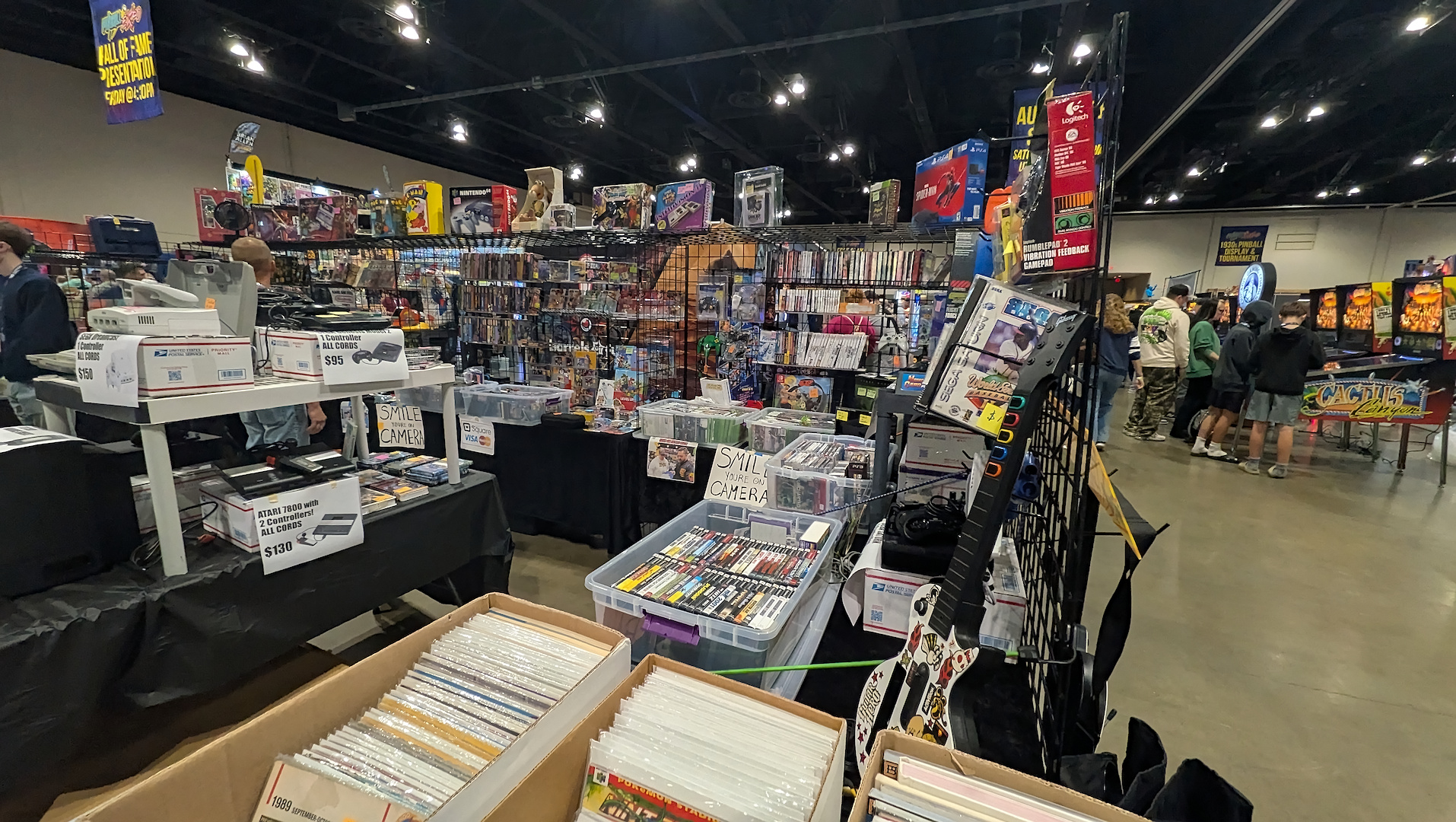
The past, present, and future share a show floor at Pinball Expo 2026
It’s October in the Midwest, which means it’s time for the pinball world to descend on a convention center in Chicagoland for the annual Pinball Expo. Once thought to be an entertainment sector slowly bleeding out, pinball has come back in a big way in recent years. I visited one of Chicago’s last old-school manufacturers before heading down the road to see what’s new in the silver-ball universe.
Behind the silver ball
Hundreds gathered on a brisk fall Friday morning outside Stern Pinball’s headquarters in Elk Grove, Illinois, waiting to enter a Wonka-like wonder factory where piles of raw parts become licensed creations from Jaws to the brand-new Fallout. Stern invited me to tour its offices and factory floor before heading off to the convention in nearby Schaumburg, Illinois.
An early-morning line begins to form outside of Stern HQ as buses of Pinball Expo attendees arrive for tours.
An early-morning line begins to form outside of Stern HQ as buses of Pinball Expo attendees arrive for tours.
As I stood with my tour group in Stern Pinball’s HQ lobby, mouth agape at the dozens of machines lining the walls, we were greeted by the man himself, Gary Stern, who gave us some background on the company’s 40-year history. After a stop at Gary’s podium, we were ushered to the factory floor entrance, where Stern employee and legendary game designer George Gomez briefed us on the tour rules and answered questions. According to Gomez, “at any given time, Stern controls 90 percent of the current pinball market, and everybody else splits the rest.”
Gary Stern greets visitors at the Stern factory tour.
Gary Stern greets visitors at the Stern factory tour.
While the industry may be expanding toward something more reminiscent of its glory days, there’s no doubt who still rules the market. With a steady stream of new license releases, Stern has cemented itself as the brand in modern pinball.
Stern HQ. I think I could work in this office…
Credit: Nick Indge
Stern HQ. I think I could work in this office… Credit: Nick Indge
What I saw on the expo floor, though, showed me that the remaining 10 percent of the market is doing some really interesting things, and hobbyist projects are booming. From modular home setups to open development kits that let anyone with silver-ball dreams try their hand at game design, there was something for everyone. In short, it’s a very exciting time to be a pinball fan.
The Stern pinball headquarters in Elk Grove Village, Ill.
The Stern pinball headquarters in Elk Grove Village, Ill.
A view of the machine collection inside of Stern Pinball’s offices.
Nick Indge
A view of the machine collection inside of Stern Pinball’s offices. Nick Indge
A lineup of Stern releases from the 2012-2014 era.
Nick Indge
A lineup of Stern releases from the 2012-2014 era. Nick Indge
A view of the machine collection inside of Stern Pinball’s offices. Nick Indge
A lineup of Stern releases from the 2012-2014 era. Nick Indge
A row of game releases at the Stern HQ offices.
Nick Indge
Some of the more recent modern releases lined up at Stern HQ.
Nick Indge
Latest from the show floor
Stern’s latest offering, Fallout, stood near the entrance of a convention floor packed with the latest machines from manufacturers like Jersey Jack, Barrels of Fun, Spooky Pinball, and others. I’ve attended this show for the last four years, and each year seems to bring new companies into the fold. Despite more than 25 years of advances in home entertainment, nothing quite matches the tactile thrill of launching a metal ball around a wooden cabinet.
The new Fallout machine from Stern Pinball.
Credit: Nick Indge
The new Fallout machine from Stern Pinball. Credit: Nick Indge
Several companies showed off their latest attempts to bring pinball into virtual reality without abandoning physical controls, letting players wear a VR helmet while pressing real buttons on a pedestal setup. It’s a fun novelty that demonstrates what’s possible, but if the lines at the expo were any indication, most people still prefer walking up to a physical machine and enjoying the tactile controls, visuals, and sounds that come with it.
American Pinball’s upcoming remake of Circus Voltaire.
Nick Indge
American Pinball’s upcoming remake of Circus Voltaire. Nick Indge
The new Bon Jovi game from Barrels of Fun.
Nick Indge
The new Bon Jovi game from Barrels of Fun. Nick Indge
Spooky Pinball’s latest: Beetlejuice.
Nick Indge
Spooky Pinball’s latest: Beetlejuice. Nick Indge
The new Bon Jovi game from Barrels of Fun. Nick Indge
Spooky Pinball’s latest: Beetlejuice. Nick Indge
The new Sonic the Hedgehog pinball by Jersey Jack.
Nick Indge
The floor of this booth was an especially nice detail.
The modular market
One of the biggest questions facing anyone buying a pinball machine for home use is what to do when you get bored with a $10,000 game. Until recently, the options were to sell it, find someone willing to trade, or build your own virtual pin setup with screens instead of physical playfields. The Multimorphic P3 team saw an opportunity for another approach.
Multimorphic’s Portal pinball machine is a part of their P3 lineup of swappable table designs.
Multimorphic’s Portal pinball machine is a part of their P3 lineup of swappable table designs.
According to Multimorphic co-creative director Stephen Silver, “The way the P3 is designed is that the lower two-thirds is a ball-tracking interactive display… We have floating mechanisms above the screen, floating flippers, floating slings, floating targets. And the upper third is a swappable play field. We’ve got 10 different play fields now that we can swap and change the entire game.”
As demonstrated by the much-hyped Dungeon Crawler Carl prototype (whose lines never seemed to get shorter), the P3 system uses a playfield screen that can react to ball movement in real time, and the game can change to match player choices. In Dungeon Crawler Carl, for instance, the display layout changes based on which book in the series the player chooses.
“We’re planning on doing seven books in the game… you can play them in any order you want,” Silver explained. ” The idea being that you get to Faction Wars—the events of the seventh book—it’s a perfect wizard mode. When we started this, Faction Wars was the last book in the series. It still feel(s) like a good wrapping-up point for this story that we’re telling. In the future, we could always be open to adding more books, but right now that’s the plan.”
The first two entries in the book series had playable pin versions on the show floor, and Silver says that “every single book itself is the equivalent depth of a ’90s Williams game… It’s like seven really solid games in one,” Silver said.
Dungeon Crawler Carl will enter production “at the end of the year, and then it should be rolling out to delivery early next year,” he said.
Multimorphic’s upcoming Dungeon Crawler Carl pinball.
Multimorphic’s upcoming Dungeon Crawler Carl pinball.
The platform’s versatility extends beyond in-house designs. Multimorphic offers a free software development kit (SDK) that lets community members design and distribute their own table creations for the P3 system. Machine owners can swap physical overlay kits or remove them entirely to play original games on the reactive screen.
“There are 30 different games available on the system now because you can do software-only games,” Silver said. “It’s the only third-party development platform in pinball. So anybody can download the free SDK and develop third-party software games… and release it through our store to an audience of P3 owners that are hungry for new content.”
Dungeon Crawler Carl cabinet artwork by Brad Albright. Voice actor Jeff Hays also reprises his audiobook roles for the machine.
Dungeon Crawler Carl cabinet artwork by Brad Albright. Voice actor Jeff Hays also reprises his audiobook roles for the machine.
Pocket Pinball and pinball construction set
Sitting on one of the more unassuming tables of the PinExpo show floor was Pocket Pinball, a free Android APK that lets users load any Visual Pinball X (VPX) table on their phone or tablet. But the project’s developer, Johnny Zen, had something else to show off: a closed beta for his Pinball Construction Set. An homage to the 1982 classic Bill Budge Apple II game of the same name, the browser-based tool lets users design their own pinball machine with an easy drag-and-drop interface. Multimorphic may have the only free pinball SDK for now, but if Zen has his way, that won’t be true for long.
Pocket Pinball running on my tablet.
Pocket Pinball running on my tablet.
Whereas most modern pinball designs start at the CAD desk, the upcoming Pinball Construction Set keeps the process entirely within a browser. Zen compares the system to building a coaster in Roller Coaster Tycoon: Users can choose between three styles or start with a blank slate. After selecting a template, such as a standard or wide-body layout, they can add traditional design elements like ramps, targets, and scoops by clicking and dragging them into place.
The program is still in closed beta, but aspiring pinball developers can register their interest to be notified when it becomes publicly available. Zen also plans to add a marketplace where users can commission artwork from freelance artists. “If you needed some artwork for your apron or playfield, you basically look at the artist profiles, then the app will send the artist’s team the exact measurements of what you need,” he said.
Homebrew heaven
One of the most exciting trends in pinball’s modern resurgence is the rise of homebrew design, with passionate hobbyists turning basement-built machines into careers with some of the industry’s biggest players. Often serving as playable resumes, homebrew games give aspiring designers a chance to flex their creative muscles without the licensing restrictions that come with producing commercial machines.
Who Shot Mr Burns? This impressive homebrew looks ready for the arcade floor.
Who Shot Mr Burns? This impressive homebrew looks ready for the arcade floor.
One of this year’s homebrew highlights was Shaolin Flow, an ode to the great Hong Kong action movies that those of us who grew up in the ’90s watched on Saturday afternoon network TV. Complete with an optional Wu-Tang soundtrack, Shaolin Flow lets players choose between traditional flipper-button controls and a more punchy approach. Two fist-shaped sensors sit atop the playfield, to the left and right of the flippers. Players activate the flippers by throwing punches over the sensor.
What initially looked like a gimmick quickly proved to be a great time. Adding a physical element to an already physical game felt more natural than I expected, and the absence of any perceptible input lag made the experience seamless.
Passing your fists over the green sensors allows you to control flippers by punching.
Passing your fists over the green sensors allows you to control flippers by punching.
As the tools for designing and building pinball machines become more accessible, the homebrew scene continues to grow. Each year brings more entries to the floor, transforming what was once a smaller corner of proudly displayed projects into a dedicated, walled-off section featuring games from the future stars of pinball design. This year’s homebrew showstopper could see its creator designing a licensed table for one of the industry’s major manufacturers by the following year’s show.
An Akira-themed homebrew pinball machine.
Nick Indge
An Akira-themed homebrew pinball machine. Nick Indge
A Minecraft-themed homebrew table.
Nick Indge
A Minecraft-themed homebrew table. Nick Indge
A Beastie Boys homebrew pinball machine.
A Beastie Boys homebrew pinball machine.
A Minecraft-themed homebrew table. Nick Indge
A Beastie Boys homebrew pinball machine.
So much more
Project Pinball is a charity that raises money to place pinball machines in children’s hospitals. Great cause!
Credit: Nick Indge
Project Pinball is a charity that raises money to place pinball machines in children’s hospitals. Great cause! Credit: Nick Indge
Pinball Expo isn’t just an industry trade event; it’s also a celebration of every era of pinball history. Volunteers haul machines from their personal collections to the show floor, where the general public can play them all weekend. And it’s not just balls and flippers. Walk the aisles, and you’ll see artists, merch and crafts vendors, accessories, retro video games, traditional arcades, and enough aftermarket mod kits to turn any pinball machine into a second hobby.
Pieces of the world’s largest Sonic collection on display.
Nick Indge
Pieces of the world’s largest Sonic collection on display. Nick Indge
Ever wanted to learn how to solder? There’s a booth for that.
Nick Indge
Ever wanted to learn how to solder? There’s a booth for that. Nick Indge
A selection of custom playfield accessories to add some extra flavor to your pinball table.
A selection of custom playfield accessories to add some extra flavor to your pinball table.
Ever wanted to learn how to solder? There’s a booth for that. Nick Indge
A selection of custom playfield accessories to add some extra flavor to your pinball table.
A booth selling original pinball machine manuals and schematics.
Nick Indge
Pinball artist Brian Allen’s artwork booth.
Nick Indge
A retro gaming booth.
A vendor selling custom light-up pinball logo signs.
Nick Indge
Ever wanted to play pinball with the drums from Donkey Kong? There’s a mod for that.
Nick Indge
The floor of this booth was an especially nice detail.
The future
See you later, Flippy!
See you later, Flippy!
For decades, pinball production was concentrated among a handful of major manufacturers in the Chicagoland area. While the region might still be the industry’s epicenter, newer challengers to Stern’s dominance, like Texas-based Barrels of Fun or European producers like Dutch Pinball, show that things are changing.
Today, aspiring developers can turn a good idea into a playable VPX table without ever putting down their phone. Whether it’s a bedroom developer working with a free SDK or one of the industry’s biggest players, pinball is being made by more people in more places, and fans are all the better for it.
When Israeli Jewish mob terror makes Western headlines
Twice recently, Israeli Jewish mob terror in the occupied West Bank broke through the international media’s wall of self-censorship: first, when the mobs attacked Israeli soldiers, and again when they brutally beatThe Washington Post photographer Heidi Levine. The irony is damning. Attacking Israeli soldiers is news; violence against a Western journalist becomes international headlines and may even force Israel to stage a token, rotating door arrest, for PR consumption. But when Israeli soldiers and Jewish mobs terrorize Palestinian farmers, torch their cars, burn their olive trees, and drive them from their land, coverage too often disappears into the background.
The day following the vicious attack on the American journalist, another Israeli Jewish mob attacked a delegation of European diplomats in the Palestinian Christian village of Taybeh.
They smashed the window of a consular vehicle and beat a French mayor with iron bars. The Israeli army sought to bury the incident in the same talking points: it would investigate. Benjamin Netanyahu’s office urged “caution,” suggesting the reports were part of a “coordinated campaign to smear Israel,” and Jews in the West Bank.
When the world witnesses Israeli Jewish mob terror firsthand, Zionist defenders deflect, portray themselves as perpetual victims, and cry conspiracy against Jews.
Worse, these attacks unfold under the watchful eye of Israeli soldiers, who not only stand by as settlers terrorize Palestinians but at times join in the abuse themselves. And when a Palestinian is murdered by these mobs, the community is denied, by the occupying Israeli military, to mourn their dead. The question is not why these hateful Jewish mobs are violent, but why they are allowed to act with complete impunity.
The campaign to dispossess Palestinian farmers from their land has now acquired a religious imprimatur.
On the first day of the olive harvest season, October 16, Rabbi Dov Lior, a prominent religious authority among the illegal West Bank Jewish colonizers, issued a religious Halakha ruling on Teshuva, declaring it “permissible and virtuous” for Jewish colonizers to steal Palestinian olives, pontificating that harvesting the crop constitutes an exercise of Jewish ownership.
The Polish-born rabbi’s edict rests on the premise that Palestinians cannot claim ownership of their land without a deed from (European) Jews. Under the protection of an occupying army and a culture of religious impunity, the Israeli Jewish mobs’ theft becomes an instrument of the broader Zionist project of ethnic cleansing. This is not merely a theological dispute over land. It is a religious license for dispossession, a sanction for kosher theft.
On the same day the Rabbi Koshered the theft of non-Jewish property, mobs descended on Palestinian villages. They attacked farmers, stole their harvest, burned vehicles, trees, and injured residents across at least eight villages. In Abu Falah, Israeli rights activist described soldiers standing “literally shoulder-to-shoulder with settlers as they attacked Palestinians.”
READ: Jerusalem church leaders say lack of accountability fuels Israeli occupiers’ attacks in West Bank
The Israeli military provides security to protect “Jews” in the occupied West Bank. Its soldiers possess the authority, weapons, and institutional power to intervene, only on their behalf. They watch Jewish mobs operating with no fear of consequences. The Israeli army assists and protects Israeli Jewish settler mobs, or stands by as they attack Palestinians, only to arrest the assaulted Palestinians if they dare to fight back.
Jewish colonizers have found an almost absurdly “animal” way to steal Palestinian land: sheep. As a recent 60 Minutes report highlighted, settlers establish so-called “shepherding outposts” on hilltops, then graze their flocks on land Palestinians have farmed and herded for generations. A flock of “Jewish” sheep are used as a tool to reclaim the new “Jewish land” title. According to a report by the Israeli watchdog groups Peace Now and Kerem Navot, the “Jewish” shepherding outposts have so far seized nearly 200,000 acres or 14% of the West Bank’s total area for the exclusive benefit of “Jewish-only” grazing. No bulldozers, no Jewish mob terror is necessary, “Jewish” sheep can do the work one pasture at a time.
Imagine the international uproar if Palestinians were systematically attacking Jewish farmers, destroying their crops, strangling their livelihoods, and driving them from the land. The headlines would be “Jewish hate,” “terrorizing Jews,” “persecuting Jew,” “economic strangulation of Jews,” …etc. Western leaders would line up expressing solidarity with the “poor farmers” and condemning the repression of Jews.
When Palestinians are the victims, and the destruction is carried out by Zionist mobs in the name of Judaism, imposing economic suffocation and territorial dispossession to achieve their delusional “biblical” objectives, organized Jewish mob terror is reduced to a “handful,” their terror is euphemized as “alleged,” and their violence is relegated to an “investigation.”
This is how ethnic cleansing is normalized and can advance without every family being forcibly loaded onto a truck. People can be driven out through relentless intimidation, the destruction of livelihoods, and the calculated denial of conditions necessary for ordinary life.
Destroying people’s livelihood is not a random act of vandalism. A burned mature olive tree represents generations of accumulated labor and investment. A missed harvest means lost a year’s income. It is the systematic campaign, ideologically rooted to make Palestinian life economically unsustainable, sever Palestinians from their land, and ultimately drive them out.
U.S. Representative Rosa DeLauro captured this in a single question after a masked Israeli Jewish mob attacked Washington Post photographer Heidi Levine, breaking four vertebrae and a rib. “If the settlers will do this to an American journalist on camera, in broad daylight, imagine what Palestinian families face when no one is watching,” DeLauro said.
The answer is written in the blood of the more than 80 Palestinians murdered by Israeli forces and Jewish mobs in 2026 — nine American citizens since 2022 — and engraved in the broken bones of nearly 2,000 more injured in daily Zionist terror. Palestinians are left to suffer in silence as systematic destruction continues, and the impunity of Jewish apartheid emboldens the machinery of Zionist hate and terror.
Unlike the Washington Post reporter or the European diplomats, the Palestinian suffering generates no headlines, their torment goes unreported, their Israeli Jewish attackers face no accountability, and no one is watching.
OPINION: Israeli Spy Pollard stole the files, today’s it’s delivered through official channels
The views expressed in this article belong to the author and do not necessarily reflect the editorial policy of Middle East Monitor.
UK To Send Typhoon Jets to Saudi Arabia Against Houthi Attacks
Britain will send Royal Air Force Typhoon fighter jets, an A400M transport plane and military advisers to Saudi Arabia to strengthen the kingdom’s defenses against increasing Houthi drone and missile attacks, the British government said Tuesday.
Prime Minister Andy Burnham authorized the deployment, which was announced by Defence Secretary Wes Streeting. The Typhoons will conduct defensive air patrols over Saudi Arabia, protecting cities, civilians and critical national infrastructure by intercepting airborne threats.
The British aircraft will serve exclusively in a “defensive role” and will not conduct offensive operations against the Houthis in Yemen.
An RAF A400M will help transport defense supplies, and British military advisers will assist Saudi staff officers. Britain will also continue providing air-to-air refueling support for Saudi-led operations for another 90 days.
The Saudi-led coalition said Wednesday that it shot down five drones launched toward the kingdom over the Medina area and eastern regions.
Coalition spokesman Turki Al-Maliki said Tuesday that forces had intercepted another drone above Riyadh, several hours after shooting down a Houthi ballistic missile headed toward the Saudi capital. Residents heard two loud explosions Tuesday morning and received warnings through mobile phone applications. No injuries or damage were reported.
Al-Maliki later said coalition forces had destroyed the launch platform from which the ballistic missile was fired. He did not identify its location.
In Yemen, government forces said Tuesday that they carried out 744 air and ground attacks on Houthi military targets over the previous 24 hours. Majid Al-Nuzaili, spokesperson for the government forces, said the operations struck command-and-control centers, firing positions, troop concentrations, reinforcements and supply lines on multiple fronts.
Al-Nuzaili said the attacks “neutralized” about 200 Houthi fighters and destroyed or damaged 90 military vehicles and other equipment. The claims could not be independently verified.
Houthi military spokesperson Yahya Saree said Tuesday that Saudi forces launched 93 air and missile strikes across eight Yemeni provinces during the previous 24 hours, raising the number since the current escalation began to 2,793. The figures could not be independently verified.
Houthi-run al-Masirah TV also said eight fishermen were killed in attacks on two fishing boats off Dhubab district in southwestern Taiz province. Saudi Arabia did not immediately respond to the allegation.
Cambodia and Laos are not pawns in a Chinese encirclement
<
article id=”post-951559″>
In late September, China and Laos opened a Beijing-funded training and support center and an aviation academy at Ban Keun airport, about 50 kilometers north of Vientiane. China’s Ministry of National Defense says the facility will train Lao Air Force pilots and is “not directed against any third party.”
Even so, much of the commentary has linked Ban Keun to Cambodia’s Ream Naval Base, which Beijing helped finance and where it also funded a joint training center, and has read the two as part of a Chinese effort to encircle Vietnam from the west.
The evidence so far supports a more cautious view. Satellite imagery shows the Ban Keun runway at about 2,000 meters, long enough for most Chinese fighters and the Y-20 transport, but well short of the roughly 3,000 meters long-range bombers such as the H-6 need.
Reuters has reported eight K-8 light attack jets at the site, a type flown by both the Chinese and Lao air forces, and some analysts note that the airfield appears designed to accommodate a longer runway later. The site deserves close monitoring, but nothing yet shows that it is a Chinese forward base.
Ream has inspired similar predictions for years. Yet the first foreign warships to dock at the upgraded base, in April 2025, were Japanese, followed within days by a Vietnamese patrol vessel.
A US Navy ship called in January 2026, and Phnom Penh and Washington have agreed to resume the Angkor Sentinel exercise, suspended since 2017, early next year. Some Chinese military commentators have speculated that Beijing turned to Laos partly because Cambodia had opened Ream to other navies.
Vietnam’s concerns are understandable. Hanoi already faces Chinese pressure on its northern border and in the South China Sea, and it will naturally watch any Chinese military presence to its west. The trouble lies in some of the remedies being proposed now.
An essay published in The Diplomat in June 2025 argued for a Thai-Vietnamese entente to manage Chinese influence in Laos and Cambodia. It called the two countries “inherently weak”, able to threaten Vietnam only with the backing of China or Thailand, and proposed quiet Thai and Vietnamese pressure to make Lao and Cambodian development decisions “more transparent and accountable to Thailand and Vietnam’s security interests.”
One of its authors recirculated the argument after the Ban Keun announcement. The essay’s timing also matters to Cambodian readers. Within weeks of its publication, Thailand and Cambodia were fighting their heaviest border clashes in more than a decade, and the hostilities flared again in December.
Few Cambodians will see a framework that makes Bangkok a co-manager of their country’s security choices as a neutral proposal. Such commentary reflects a wider unease, at least in parts of the region’s strategic community, about smaller neighbors growing more capable.
Vietnam has become one of Asia’s fastest-growing economies and has steadily modernized its armed forces. Phnom Penh has not treated that rise as a threat to be contained, and it is fair to ask why comparable growth in Cambodia or Laos should be.
For Cambodians, the proposal has a familiar ring. Vietnamese settlement gradually absorbed the Mekong Delta from the 17th century onward. Siam took Battambang and Siem Reap in the 1790s, and Cambodia recovered them only in 1907.
In the 1830s, Emperor Minh Mang administered Cambodia as a Vietnamese province and imposed Vietnamese administrative and cultural practices on its people. Siam and Vietnam then fought two wars over the kingdom before settling in 1845 to an arrangement in which the Cambodian king paid tribute to both courts.
The entente essay itself acknowledges that this made Cambodia a buffer state. Historians such as David Chandler have suggested that the kingdom might not have survived the 19th century intact without the French protectorate established in 1863.
The 1845 settlement was a bargain between two stronger neighbors over how to manage a weaker one, and a Thai-Vietnamese entente meant to shape Lao and Cambodian decisions would rest on the same premise.
Nor is the pattern confined to the 19th century. Under the 1977 Treaty of Friendship and Cooperation, Vietnam kept troops in Laos for more than a decade, and its advisers wielded wide influence over the Lao army. Mainland Southeast Asia has known several hierarchical orders, Angkor’s among them, and none is a model the region should wish to revive.
The argument also applies a double standard. If close ties with major powers and new military infrastructure are a worry when Cambodia or Laos pursues them, the same test should apply to Vietnam and Thailand.
Vietnam has expanded land reclamation across all 21 features it controls in the Spratly Islands, adding harbors and airstrips. Chatham House analysts judge that the scale of this work is rapidly overtaking China’s.
Hanoi maintains comprehensive strategic partnerships with China, the United States and Russia, and in March 2026, it signed an agreement with Russia to build the Ninh Thuan 1 nuclear power plant.
Thailand is a US treaty ally that co-hosts Cobra Gold, one of Asia’s largest multinational exercises, while also seeking to buy submarines and other arms from China.
These are ordinary hedging choices, and Cambodia has never claimed a right to approve them. It expects the same treatment. Yet when Cambodia upgrades a naval base or Laos trains its own pilots, the decision is too often judged solely by what it means for someone else, as if both countries were meant to stay militarily weak.
A state that cannot patrol its own coast or airspace is more exposed to outside interference, and modest defence capacity is part of what lets a small state stay non-aligned.
Laos is admittedly the harder case. Ban Keun is run jointly with the People’s Liberation Army, and Vientiane has said little in public about the terms of Chinese access. Greater openness would serve Laos’s interests as much as its neighbors’.
The entente approach is also likely to backfire. If Bangkok and Hanoi press Phnom Penh and Vientiane over their security choices, both governments will probably lean harder on Beijing for support. Thailand and Vietnam would then face more Chinese influence along their borders, the very outcome an entente is meant to prevent.
The region already has rules for handling such concerns. The UN Charter rests on the sovereign equality of states, and ASEAN’s Treaty of Amity and Cooperation commits its members to non-interference and the peaceful settlement of disputes.
Cambodia has gone further, enshrining these principles in its constitution. Article 53 commits the kingdom to permanent neutrality and non-alignment and bars foreign military bases on its territory, a point Hun Manet repeated when Ream reopened.
If Vietnam or Thailand has questions about Ban Keun or Ream, it can raise them through bilateral defense talks or ASEAN forums such as the ASEAN Defense Ministers’ Meeting. Cambodia has opened Ream to visiting navies, including Vietnam’s, and has shown it will answer such questions.
Vietnam spent much of the 20th century fighting for the right to make its own strategic decisions free of interference from larger powers. Cambodia asks its neighbors to respect that same right.
Sereysovathana Mogn is a junior researcher and lecturer at the Institute for International Studies and Public Policy, Royal University of Phnom Penh.
Review: Carrie is a triumphant remix with one major flaw
Carrie White, the telekinetic prom queen from hell, is one of the most beloved horror icons in popular culture. First introduced in Stephen King’s 1974 novel, Carrie, the character was immortalized in director Brian de Palma’s 1976 adaptation, widely regarded as one of the best horror films of all time. It’s certainly one of the best King adaptations. So Mike Flanagan faced a massive challenge when he signed on to create an eight-episode miniseries for Prime Video based on the book, released just in time to mark the 50th anniversary of de Palma’s film.
I was among the skeptics who questioned why a Carrie miniseries was even necessary, although as a diehard Flanagan fan (“Flana-fan”?), I was willing to give him the benefit of the doubt. If anyone has a unique affinity for smartly adapting horror in general, and King’s work in particular, it’s Flanagan. And you know what? With one (very big) exception, Flanagan pulls it off, giving us a richly textured version of the story that is as much about kindness and lost innocence as bloody, vengeful rage—although we get plenty of the latter, too.
(Many spoilers below for the novel and the 1976 film, but there are no major reveals for the new series until after the second gallery. We’ll give you a heads-up when we get there.)
King initially meant to write a short story after reading an article in Life magazine about telekinesis. He imagined a scene where a bullied young girl gets her first period in a high school locker room as the centerpiece of the story but struggled to capture how his female character would react in that situation. He wrote three pages and tossed them in the trash. Fortunately, his wife, Tabitha, salvaged the pages and convinced King to try again. He eventually expanded it into a full-length novel, basing Carrie on two girls he knew in high school who’d been bullied relentlessly.
Fun fact: in an early draft of the infamous prom scene, King had Carrie grow horns and use her telekinetic powers to take out an airplane flying overhead. His editor convinced him to go with a more “subtle” ending. Granted, dumping pig’s blood on his protagonist and having her destroy the entire town in revenge is hardly subtle, but it’s a vast improvement on devil horns.
Carrie was not an instant bestseller; it was the mass market paperback edition that sold over a million copies and put King on the map as a writer. It also piqued the interest of director Brian de Palma after a mutual friend of King’s recommended the book. De Palma instantly recognized the film potential and optioned the rights before searching for the perfect actress to play Carrie.
Sissy Spacek was still relatively unknown, although she’d had a breakthrough role in the 1973 neo-noir drama Badlands. Her husband, a production designer, convinced her to audition for the film. She wasn’t de Palma’s first choice for Carrie, but Spacek was determined to win him over, even rubbing Vaseline in her hair and wearing her seventh grade sailor dress to the audition. She got the part, and the rest is cinematic history.
De Palma kept most of the novel’s key scenes intact in his adaptation, with a few changes. For instance, in the book, Carrie kills her mother after the latter stabs her by telekinetically stopping her heart, calling it a “gift” since Margaret White has always longed for “darkness.” In the film, Carrie impales Margaret (Piper Laurie) with flying kitchen knives, crucified within a door frame, before perishing herself. The director also tried to include a framing device in which stones fall from the sky onto the White family home—a key moment from Carrie’s childhood in the book—but in the opening scene the rocks just looked like falling raindrops, and there was a mechanical malfunction while filming the house’s final destruction by falling stones. So de Palma opted to destroy it by fire instead.
In the novel, survivor Sue Snell is psychically drawn to a dying Carrie, experiencing the tormented girl’s final moments in a kind of mind meld as she comforts her. De Palma opted to end Carrie with one of the best jump scares in film. A repentant Sue (Amy Irving) visits Carrie’s grave with flowers, only to have a hand shoot from under the soil and grab her arm; Sue wakes up screaming from her nightmare, still traumatized by the events on Prom Night. De Palma shot the scene backwards to make it feel like a dreamscape. And that was actually Spacek’s hand bursting up through the soil; she let herself be buried on set to pull it off.
“They’re all going to laugh at you”
Carrie White (Sissy Spacek) has been relentlessly bullied for years.
Carrie White (Sissy Spacek) has been relentlessly bullied for years.
The school gym teacher Miss Collins (Betty Buckley) tries to encourage the shy, reclusive Carrie
The school gym teacher Miss Collins (Betty Buckley) tries to encourage the shy, reclusive Carrie
Primary bully Chris (Nancy Allen) hatches a plan with Billy (John Travolta) to torment Carrie at the high school prom.
Primary bully Chris (Nancy Allen) hatches a plan with Billy (John Travolta) to torment Carrie at the high school prom.
The school gym teacher Miss Collins (Betty Buckley) tries to encourage the shy, reclusive Carrie
Primary bully Chris (Nancy Allen) hatches a plan with Billy (John Travolta) to torment Carrie at the high school prom.
Carrie and Tommy (William Katt) are crowned prom king and queen.
A bloodied Carrie unleashes her rage
All is fire and blood
Carrie’s mother, Margaret White (Piper Laurie) meets a fitting end
Setting up a jump scare for the ages.
Carrie was a critical and box office hit, snagging Oscar nominations for Spacek and Laurie—a rare thing for a horror film. And the film has withstood the test of time, as compulsively watchable 50 years later as it was in 1976. The tragic story of an emotionally damaged, tormented young girl with supernatural gifts, pushed to her breaking point, seems to resonate with something psychologically primal in all of us. Others have tried and failed to recapture that magic. The less said about the 1999 sequel, the 2002 TV film, the 2013 remake, and the 1988 Broadway musical, the better.
Enter Mike Flanagan, who boldly set out to re-invent Carrie for the 21st century. The showrunner has a gift for creatively remixing classic material in interesting ways, while remaining true to the spirit of the original. Another strength is building memorable multifaceted characters, and he has eight episodes, not two hours, in which to do so. Flanagan reclaims certain elements, such as the stones raining down on the Whites’ house. The novel was also partly episoltary, including segments of fictional court transcripts and news coverage created by King (who enjoyed mimicking all the different writing styles). Flanagan incorporates video interviews as a framing device, in which surviving witnesses recount their memories of the tragic events.
But there are also significant changes. The Carrie in King’s novel and de Palma’s film is a flinching, socially inept, mousy misfit. She lost her father as a baby and has been bullied all her life, not to mention being physically and emotionally abused at home by her religious zealot mother. In Flanagan’s version, Carrie (Summer H. Howell) has been homeschooled since birth. The death of her conspiracy theorist father (Tahmoh Penikett) in a freak construction accident forces both Carrie and her mother Margaret (Samantha Sloyan) into the real world after years of hardly ever leaving the house. (A social worker describes the family as having been a “cult of three.”)
This Carrie is smart, two grades ahead in terms of academic achievement, surprisingly open and curious, and an avid reader—thanks to the kindness of a next-door neighbor who would regularly leave books for Carrie to read on the sly by hiding them in a shared birdhouse. None of her fellow students catch her frequent literary allusions, but the principal, Henry Grayle (Matthew Lillard) does. So does Peter Morton (Tom Gabley), the gay guidance counselor. He and Carrie exchange a few of their favorite book quotes, after which he shows her the wonders of the high school library (“It’s all for you”).
But Flanagan’s Carrie is also extremely sheltered and unprepared for the harsh realities of high school in the 21st century, in addition to grieving for her father. First her gold cross sets off the metal detector. Then she thinks the school shooting drill is for real and has a panic attack. She’s never played volleyball or any team sport, so gym class is a disaster.
And then comes the infamous locker room scene and Carrie’s first period. De Palma’s camera lingered just a bit too longingly on the naked adolescent girls in the showers, although the scene did capture Carrie’s extreme vulnerability in that moment. Flanagan’s version has Carrie start her period fully clothed—but wearing white pants. High school bully Chris (Alison Thornton) pushes her into the shower before leading the other girls in a chant of “plug it up” while pelting her with sanitary napkins and tampons. And of course it’s all captured on multiple cell phones.
The 22-year-old Howell, best known to date for playing Alison Pierce in the Chucky franchise, beat out 1400 young actresses to play Carrie. She didn’t even read King’s novel or watch the 1976 movie, the better to interpret Flanagan’s own take on the character. Spacek defined the role but Howell redefines it with just as much assurance. She hits every single note, registers every small shift in expression and emotion, in a stellar performance that should cement her status as a gifted young actress on the rise.
WARNING: Major spoilers for the Mike Flanagan series below. Stop reading now if you haven’t finished watching.)
“F*&k you, I exist”
A more demure version of Carrie’s (Summer H. Howell) famous “first period” scene.
Prime VIdeo
A more demure version of Carrie’s (Summer H. Howell) famous “first period” scene. Prime VIdeo
Chris (Alison Thornton) and Sue (Siena Agudong) are BFFs who plan to attend Duke together after graduation.
Prime VIdeo
Chris (Alison Thornton) and Sue (Siena Agudong) are BFFs who plan to attend Duke together after graduation. Prime VIdeo
This version of Carrie and her mother Margaret (Samantha Sloyan) presents a much more loving, less overtly abusive relationship.
Prime VIdeo
This version of Carrie and her mother Margaret (Samantha Sloyan) presents a much more loving, less overtly abusive relationship. Prime VIdeo
Chris (Alison Thornton) and Sue (Siena Agudong) are BFFs who plan to attend Duke together after graduation. Prime VIdeo
This version of Carrie and her mother Margaret (Samantha Sloyan) presents a much more loving, less overtly abusive relationship. Prime VIdeo
Amber Midthunder plays phys ed teacher Rita Desjardin.
Prime VIdeo
Matthew Lillard shines as Principal Henry Grayle.
Prime VIdeo
Carrie is horrified to discover a fake Instagram account mocking her
Prime VIdeo
Lillard brings a jaded weariness to Principal Grayle (R.I.P.)—a once-idealistic educator whose kindness has been beaten into submission. But he still shows some fire when Chris’s high-powered lawyer father, John (Michael Trucco) threatens to sue the school, reminding John (in a moment lifted from the novel) that by his reasoning the school could counter-sue, and Chris’s long history of bullying would be laid open during discovery.
In the de Palma film, John Travolta’s Billy was a dim-witted jock, bonded to Nancy Allen’s vapid Chris by hormonal lust and their shared nasty brutish natures. Neither had any redeeming qualities. That’s not the case in Flanagan’s series. Arthur Conti’s Billy is a high school dropout who works on a farm when not dealing drugs to partying high schoolers. He’s dark and broody, smart and sarcastic, a compulsive rule-breaker. And he’s dangerous—catnip for a spoiled, rebellious golden girl like Chris, whose perfect life has unexpectedly hit the skids. Her parents are divorcing, the father she idolizes is facing financial ruin, and since she didn’t apply for financial aid in time, she can’t join her bestie, Sue (Siena Agudong), at Duke University in the fall.
None of this excuses Chris’s malicious behavior, not just toward Carrie but toward her future stepsister, Brooklyn (Rowan Danielle), and the school as a whole, mostly via a fake Instagram account devoted to smearing students and faculty alike. It’s Carrie who asks the key question: why go to such great lengths to target Carrie particularly? Chris’s answer—“I don’t know. You were weird, and you pissed me off”—speaks to her profound lack of self-awareness. Yet it’s her recklessness and stubborn pride that seals her doom. Chris is given many chances to reverse course, face accountability, and do the right thing; however torn, she can never bring herself to do it, until it is much too late.
Flanagan improves on both de Palma’s film and King’s novel in his treatment of faith, embodied in the character of Carrie’s mother, Margaret White. Margaret is a cartoonish caricature in those earlier incarnations, with her candles and crucifixes, sexual repression, and psychotic rants about sin and atonement. Flanagan understands the complicated nature of faith; this is the man who created the exquisite Midnight Mass, after all, which also starred Sloyan (part of the “Flana-fam” of actors) in a pivotal role.
Sloyan was the perfect choice to play Margaret. She’s a grieving widow who has spent the last 15 years shutting out the world out of fear, ill-equipped to hold down even a job as a checkout clerk. She can’t help judging customers for, say, buying vibrators and condoms and helpfully lecturing them on their poor life choices. She’s intelligent, like Carrie, and has clearly done an excellent job homeschooling her daughter. However nutty her specific beliefs might be, she is not always wrong in her assessments; she’s just so rigidly unlikable, nobody wants to cede her the points.
Where King’s Margaret actively disliked her daughter—viewing her as the polluted spawn of the night her drunken husband effectively raped her—Sloyan’s Margaret clearly loves Carrie, wanting only to protect her from a world of sin and depravity. (She also clearly loved and depended upon her late husband.) She wages battle on behalf of her bullied daughter with admirable ferocity. Flanagan understands another crucial aspect of Margaret’s faith: it’s all about control. So when Margaret feels that control slipping away—when she’s forced to work and confront the ugliness of the world or when Carrie pushes back on her authority—she throws herself into re-exerting her control, even if that means locking Carrie in the prayer closet for hours on end to save her immortal soul.
Above all, Flanagan understands how even a mother’s love can be poisoned by fear when Carrie uses her newfound powers to wrest control of the household from her mother. The final interaction between mother and daughter starts with Margaret washing away all the blood in the bath, recalling how she did the same thing the night Carrie was born. As they prepare to pray together, Carrie asks if god can forgive her for what she has done. “Even if god doesn’t, I forgive you,” Margaret replies, before tearfully asking if Carrie can forgive her—for what we know (but Carrie doesn’t) will be Margaret’s attempted murder of her own child.
Worst prom ever
Carrie is befriended by Emmaline (Thalia Dudek), who encourages her to develop her telekinetic gift.
Prime VIdeo
Carrie is befriended by Emmaline (Thalia Dudek), who encourages her to develop her telekinetic gift. Prime VIdeo
Carrie attends prom with Tommy Ross (Joel Oulette)
Prime VIdeo
Carrie attends prom with Tommy Ross (Joel Oulette) Prime VIdeo
Chris and Billy (Arthur Conti) plot revenge for Chris’s expulsion.
Prime VIdeo
Chris and Billy (Arthur Conti) plot revenge for Chris’s expulsion. Prime VIdeo
Carrie attends prom with Tommy Ross (Joel Oulette) Prime VIdeo
Chris and Billy (Arthur Conti) plot revenge for Chris’s expulsion. Prime VIdeo
The face of rage.
Prime VIdeo
A shout-out to Brian de Palma’s 1976 film adaptation.
Prime VIdeo
King’s novel alludes to Margaret’s grandmother having similar telekinetic abilities, which Margaret had always attributed to witchcraft, and the novel ends with an Appalachian woman writing a letter to her sister in 1988, telling her about her four-year-old daughter’s emerging telekinetic gifts. He even hints at a recessive “TK” gene as the cause. Flanagan turned all that into a cult of women with supernatural gifts, led by Adelaide (Kate Siegel), who sense Carrie’s nascent power and track her down. (Here it is Adelaide, not Carrie, who stops Margaret’s heart after interviewing her as a witness.) He also introduces Emmaline (Thalia Dudek), who befriends Carrie and encourages her worst instincts, only to be revealed as an astral projection of the real Emmaline. (She is definitely not a high school student.)
Of course, everything comes down to that famous prom scene, with Carrie being crowned queen before being doused with pig’s blood. De Palma’s sequence followed that moment with an eerie silence, the only sound that of the clanking empty bucket, before all hell breaks loose. Flanagan chooses to have Carrie telekinetically explode everyone’s cell phone and have the screen cut to black as we hear agonized screams to close the penultimate episode. Yet the final episode opens with another interview segment; those segments keep interrupting the action, which is a bit frustrating but forgivable. (There are already fan cuts popping up on YouTube stitching together the prom night footage without the breaks.)
There is really only one flaw in Flanagan’s Carrie, and it’s a major change from the source material: Carrie is not solely responsible for the prom night carnage—and she survives (a twist that also featured in the 2002 TV film). Sue admits she knew Carrie was “fucked” on the very first day because she was genuinely kind and innocent, admirable qualities that make certain people like Chris feel inferior and lash out with cruelty. But plenty of others found Carrie disarmingly likeable. We see glimpses of a darker Carrie—telekinetically breaking Chris’s nose in class, for instance, and telling her to “plug it up” as she walks past. Honestly, Chris deserved it. But Carrie only feels shame and guilt over her actions, rejecting Emmaline’s celebratory gloating over the incident.
Is this a person so psychologically damaged that she would quickly turn murderous and take out an entire town in revenge for a vicious prank? Flanagan doesn’t seem to think so, since he blinks and lets Emmaline “take the wheel” after poor Tommy (Joel Oulette) is killed when Carrie brings down an overhead walkway. Emmaline (who is that damaged) temporarily possesses Carrie to inflict the worst of the ensuing deadly havoc on her behalf. That one creative decision takes away Carrie’s agency at the most crucial moment and seriously undercuts the foundation on which the whole character arc rests.
Of course, Carrie does plenty of damage on her own, including crushing Billy and Chris to death after flipping their car when Billy tries to run her down. She’s both horrified and strangely elated at what she has done. But she just feels horror when Emmaline vanishes abruptly and Carrie realizes what she’s done to the town, limping home for the final confrontation with her murder-minded mother. That’s the devastating revelation that truly breaks her: she’s a monster in the eyes of her own mother.
Somehow that one huge misstep isn’t enough to sink this compelling, addictive series—a tribute to the power of the core story.
As for why Carrie survives, Flanagan has plans for another two seasons, taking us into uncharted territory with King’s blessing. Prom night set Carrie down a dark path, drunk on her newfound power with a weakened moral compass. She’s unwittingly caught between two different factions seeking to exploit her immense power—her new bestie, Emmaline, and Adelaide’s group—plus another group that seems intent on killing Carrie and others like her. It will be interesting to see what Flanagan comes up with, given the chance, now that he’s freed from the constraints of the original novel.
All eight episodes of Carrie are now streaming on Prime Video, as is the 1976 film.