11.2 C
London
Tuesday, October 20, 2026
Home Blog

Talking with China, say what you’re told you can’t say

0
talking-with-china,-say-what-you’re-told-you-can’t-say
Talking with China, say what you’re told you can’t say

<

article id=”post-951441″>

For years, the idea of speaking forthrightly to China would evoke an admonition from the US State Department and most of the American policymaking class: “We can’t do that. They won’t like it.”

They’d often add, “China has red lines, don’t you know?”

There are things you are told you just can’t say – questioning China’s political system, Taiwan, democracy, human rights and China’s ‘development rights’ (challenging China’s right to do anything it wants – legal or illegal – to develop its economy and industry). In short, you can’t mention any of the things that make communist China such a threat to peace and prosperity.

That sort of advice from the “experts” was rampant during the communist Soviet Union era as well.

Remember President Ronald Reagan’s speech at the Berlin Wall’s Brandenburger Gate in 1987 when he slipped in a line: “Mr. Gorbachev,” he said, “tear down this wall.”

Many of Reagan’s advisors and staff told him: “You can’t say that.”

Even his respected Secretary of State George Schulz was opposed.

But Reagan followed his instincts and was proven right.

The Trump-Xi summit in Washington last month suggests the restraining habits of the foreign policy class die hard.

The DC visit included only two fairly short public speeches.

It is, of course, possible that President Trump was more direct in his private meetings with Chairman Xi. But, assuming decades of experience are anything to go by, if the idea is that when you show restraint Beijing will reciprocate, and even change its behavior, you will always be disappointed.

When it comes to the Chinese Communists, if you won’t say it in public – as Reagan did with the Soviets – it’s a win for the communists.

So what should be said in public? A good starting point is not giving an unchallenged platform to Xi’s cognitive warfare, designed to distort history, claim unearned legitimacy, and fracture American alliances.

Correct distortions

First, tell the truth about history. Xi mentioned the Flying Tigers implying the Chinese communists fought together with the U.S. against Japan during World War Two. That is not true. The Flying Tigers fought alongside the Nationalist Kuomintang (KMT), which bore the brunt of the fighting, rather than Mao’s Communists, who fought relatively little.

Unfortunately, the White House’s official visit read-out reinforced Xi’s self-serving distortion of history.

President Xi also pointedly criticized Japan, warning of resurging Japanese ‘militarism.’ That should have been countered by noting that Japan, once a fierce enemy, has become a true friend, a consensual, humane democracy that has done much good in the region and worldwide.

It should also have been stated that Japan is America’s strongest ally and that the US will not let it be bullied.

Highlight what the CCP has done to Americans

Apart from correcting distortions, what would help America’s position in the region, and show Americans at home that their government puts them first, is bringing up areas where communist China has caused direct harm to Americans.

One example is fentanyl and precursors from China killing upwards of 800,000 Americans since 2013 – as the death toll rises. Xi could stop it in an afternoon. Such is the nature of China’s “beyond Orwellian” surveillance state.

However, the White House’s official readout stated the US and China are in fact cooperating to end the fentanyl assault. That is delusional.

And there is the murderous Covid that China unleashed on the United States and the world in 2019 and did nothing to help solve, much less take responsibility. This should not be allowed to fade into the memory void – long Covid is still killing Americans. And millions have not recovered from the economic destruction that destroyed business dreams and likely cost Trump the 2020 election.

Show why our way is better

Xi liberally talks nonsense about how communist China is good for the world. Why not accurately talk about the benefits of our own system? Especially in this 250th year since the Declaration of Independence, talk about human rights, consensual government, freedom of speech, expression, movement, and religion – all the things Xi describes as bad.

Speak up for the freedom of expression that Americans enjoy – and simultaneously have US marshals, Secret Service, FBI, and local police crack down on Chinese thugs illegally threatening and attacking the democratic rights of anti-CCP protesters in Washington and elsewhere. Collar them, arrest them, imprison them, and deport them. And kick out of the country any Chinese embassy and consulate officials involved. And even close a consulate, as happened in Houston during the first Trump administration, to show the president is serious.

Instead, the administration did nothing. Talk about letting someone walk over you.

Finally, Taiwan deserved a mention as a friend of America and an example of what the Chinese people can be, without the yoke of communism.

Trump does have his own style – especially when dealing with leaders such as Xi Jinping, who rule by force rather than popular consent.

But he can fairly assess whether the standard policy-community approach has yielded useful results.

During his first term in office, his administration spoke clearly about China – with Secretary of State Mike Pompeo’s speech at the Nixon Library in 2020 that followed successive speeches on China by National Security Advisor Robert O’Brien, Attorney General William Barr and FBI Director Christopher Wray, as well as two speeches in Mandarin by Deputy National Security Advisor Matt Pottinger suggesting the Chinese people could do better than a dictatorship.

It rattled Chinese communists and – had Covid not come along and had Trump been reelected in 2020, the world might be very different.

The lesson here: An American president gains nothing by being too afraid to speak up for the nation’s principles, especially when it’s a fight over liberty and between a system that embodies freedom and one that enslaves.

Trump will be meeting Xi twice more this year. He might stop taking counsel from the foreign policy blob and get back to the Trump of the first term, or even the Trump of the 2016 campaign who said: “We can’t continue to allow China to rape our country… we’re going to turn it around, don’t forget it. We’re like the piggy bank that’s being robbed. We have the cards. We have a lot of power with China.”

But maybe Xi would refuse to meet that Trump?

Maybe. And that’s fine.

Grant Newsham is a retired US Marine officer and former US diplomat. He was the first Marine liaison officer to the Japan Self Defense Force. He is the author of the book When China Attacks: A Warning To America. 

Pennsylvania issues alert on congenital measles—something US hasn’t seen for decades

0
pennsylvania-issues-alert-on-congenital-measles—something-us-hasn’t-seen-for-decades
Pennsylvania issues alert on congenital measles—something US hasn’t seen for decades

Pennsylvania’s health department issued a health alert Monday as cases of measles in pregnancy and, in turn, cases of congenital measles have continued to increase. Before the current outbreak—which continues to rage across the state—congenital measles cases hadn’t been seen in decades, the department noted in its advisory.

The alert included detailed clinical guidance for managing measles exposures and cases during pregnancy as well as cases in newborns. Many doctors have never seen such cases in their careers given the decades of successful use of the measles, mumps, and rubella (MMR) vaccine. But now, with vaccination rates slipping nationwide, the highly infectious virus is better able to get footholds in communities and spread rapidly through under-vaccinated pockets, as is happening in Pennsylvania.

As of October 19, Pennsylvania had reported 1,286 measles cases this year across 42 counties. Of those, 247 have been hospitalized, and six people have reportedly died (though the latest reported death is still pending an investigation by the state health department before it is added to the state tally).

The Pennsylvania health department did not immediately respond to a request for information from Ars Technica. But reporting from The 19th earlier this month put the number of measles cases during pregnancy at 53. At least one case of congenital measles led to a death; the first death reported in the current outbreak was in a newborn baby boy, who died immediately after birth while his mother was severely ill with measles.

Risky infection

Pregnant people who have not been vaccinated against measles nor previously had the infection are susceptible. A case of measles during pregnancy increases the risk of hospitalization, pneumonia, the need for oxygen support or mechanical ventilation, and death. It also increases the risk of miscarriage, stillbirth, low birth weight, and preterm labor. The MMR vaccine is not recommended during pregnancy because it is a live attenuated vaccine and poses a theoretical risk of causing an infection in a fetus. If a pregnant person is exposed to the virus, they’re recommended to receive intravenous immunoglobulin to help protect against infection—but only if it is given within six days of exposure.

If there’s a measles infection during pregnancy, the measles virus can pass to a fetus in utero or can transmit during or just after birth, leading to a congenital case. These cases can vary widely in symptoms and severity. Some babies will remain asymptomatic while others develop severe, multisystem disease and death. Some common symptoms of congenital measles include fever and jaundice. They can also develop the telltale measles rash, but it is sometimes delayed or atypical given a newborn’s underdeveloped immune system. Other symptoms can include low platelet counts, pneumonia, and neurologic complications.

Even if a newborn survives the acute infection, they are at risk of long-term complications. These include immune amnesia, a type of immunosuppression in which the measles virus destroys immune cells and adaptive responses. They are also at risk of subacute sclerosing panencephalitis (SSPE), a progressive, fatal neurological disorder that can strike years after an infection.

The alert warns that babies with congenital measles need long-term clinical follow-up and monitoring for these neurologic and immunologic complications, and parents need counseling on how to spot early signs of SSPE, which include seizures, regression in milestones, and academic difficulties in older children.

Macron rebukes French authorities over handling of protest violence

0
macron-rebukes-french-authorities-over-handling-of-protest-violence
Macron rebukes French authorities over handling of protest violence


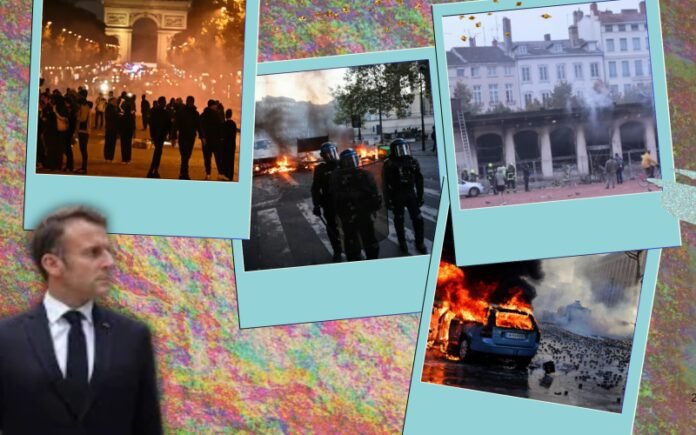
France’s President Emmanuel Macron has condemned the “failures in anticipation and intelligence” by French authorities, the Elysee Palace said Monday, after nationwide cost-of-living protests were marred by violence.

Despite the failures, Macron has refused the resignation of Interior Minister Laurent Nunez, the presidential palace added.

Macron and his government are under pressure from opposition politicians, who have called for Nunez to be removed, after mass rallies on Saturday over the rising cost of living and high fuel costs turned violent.

In some of the worst urban violence France has seen in years, nearly 2,400 people were arrested, while almost 1,000 police and gendarmes (French armed police) were injured, the Interior Ministry said Sunday.

Interior minister: Police ‘lost control’ of situation

Nunez on Monday admitted that police across the country had “lost control” of the situation over the weekend.

As tens of thousands of people took to streets across the country to protest rising costs and social inequality, crowds of mostly masked and mostly male youths clashed with police, looting shops and torching public and private property, including the historic Limoges city hall.

Nunez agreed with Macron over what he called authorities’ “lack of anticipation,” saying he tendered his resignation “because I felt responsible for everything that happened.”

Macron has instructed Nunez to “take all necessary steps to ensure transparency over the failures in planning and intelligence that led to the violence,” according to a statement from his office.

The president also ordered Nunez to “put in place new operational methods for security forces” to handle the crisis — and how to deal with violent looters — moving forward.

Organizers, hoping to revive the momentum of the 2018-2019 “Yellow Vest” movement that challenged Macron during his first term, called the protests just six months before the country is set to elect his replacement.

This weekend’s mobilization called on students, workers, retirees, farmers, climate activists and anti-fascists to take to the streets and voice their dissatisfaction with the country’s economic and social outlook.

France’s CGT union put nationwide turnout at 500,000.

Initially it was reported that only 10,000 police and gendarmes had been deployed nationwide. But the Interior Ministry quickly corrected that tally, saying that 60,000 had been mobilized ahead of the protests, including 5,000 in Paris.

Paris deployed 14,000 police and gendarmes in Paris alone during a recent high-profile visit by Pope Leo XIV, when as many as 700,000 people gathered in the center of the capital to hear the pontiff deliver Mass.

Macron’s opponents looking to assign blame

Jean-Luc Melenchon, leader of the far-left France Unbowed (“La France Insoumise”, or LFI) party and a perennial presidential candidate, attended the rally in Paris on Saturday.

Melenchon has criticized media coverage of the unrest, stressing that most demonstrations had been peaceful.

His rival Marine Le Pen of the far-right National Rally (RN) accused him of “legitimizing violence” and seeking to “plunge the country into chaos.”

Le Pen’s political ally and successor as RN leader, Jordan Bardella, described those responsible for the violence as “professionals of chaos” and accused the far left of discrediting legitimate social demands.

Benoit Payan, the left-wing mayor of Marseille, slammed violent protesters using the event as an excuse to destroy property and attack police in remarks to French outlet BFMTV, saying, “It is unacceptable to use this type of claim to enter, break and destroy the foundations that unite us as a nation.”

Payan described violent protesters as “useful idiots of the far right.”

Citing ProPublica, Lawmakers Introduce Bill to Help U.S. Citizens Sue ICE for Wrongful Detentions

0
citing-propublica,-lawmakers-introduce-bill-to-help-us.-citizens-sue-ice-for-wrongful-detentions
Citing ProPublica, Lawmakers Introduce Bill to Help U.S. Citizens Sue ICE for Wrongful Detentions

What Happened: A New Mexico Democrat in the House introduced a bill last week that would make it easier for U.S. citizens to sue immigration agents and the federal government over wrongful detentions and arrests.

Rep. Teresa Leger Fernández credited ProPublica’s reporting as the catalyst for the bill, the Justice for Citizens Wrongfully Detained by ICE Act. Earlier this month, we revealed that more than 500 U.S. citizens have been detained in warrantless arrests during the second Trump administration.

Leger Fernández said the legislation would roll back the protections from lawsuits that agents and the federal government currently have. It would also establish a minimum level of compensation for people who win their suits, and extend the statute of limitations for such cases.

The legislation would also take back any unspent Immigration and Customs Enforcement funding from President Donald Trump’s so-called One Big Beautiful Bill Act.

Leger Fernández’s bill was introduced with co-sponsor Rep. Bonnie Watson Coleman, a New Jersey Democrat.

Why It Matters: It can be difficult to sue federal officers for wrongful arrests or excessive force, or for local prosecutors to bring charges. Federal agents can claim immunity in response to civil lawsuits or to state charges and can move their cases to federal court.

People who accuse immigration agents of wrongdoing can currently only sue in a narrow set of circumstances, and previous Democratic bills aiming to change that have not passed.

Some local prosecutors have announced investigations into the wrongful arrests of U.S. citizens or prosecuted federal agents accused of wrongdoing during immigration enforcement actions.

What They Said: In an interview with ProPublica, Leger Fernández emphasized that accountability could not only address past wrongs, it may also help head them off in the future. “We know that when there are consequences, bad actors start behaving better because they don’t want to face those consequences,” she said.

Without legislation, Leger Fernández said, agents “will continue to violate the law, to violate their own policy, and to violate the Constitution without any consequences.”

Asked about the legislation, the Department of Homeland Security, ICE’s parent agency, repeated claims that it is not arresting U.S. citizens and defended its immigration operations as “highly targeted.”

Background: The federal government denies that there is any pattern of immigration agents detaining U.S. citizens, but according to ProPublica’s count, more than 100 citizens were held after agents questioned their citizenship. At least 70 children and teens were also detained.

Last year, congressional Democrats announced a wide-ranging investigation into immigration agents’ detention of U.S. citizens after our earlier investigation found that more than 170 citizens were detained by immigration agents.

Read the Investigation

Support Independent Journalism:

As a nonprofit newsroom, we rely on donations from individuals like you to fuel our work. Your support today will directly fund investigations that shine a light on urgent issues: corporations prioritizing profits over public safety, health insurers denying coverage to patients, unintended consequences of new laws and more.

What recent polling suggests will happen in the US midterm elections

0

As the November midterm elections approach, many people in the US are feeling rather pessimistic about their futures. An Economist/YouGov survey in the US completed on October 12 asked how respondents felt about about their futures compared with ten years ago. Altogether, 23% said they were more optimistic, with 48% saying they were more pessimistic.

Another question in the survey, conducted from October 10-12, just over three weeks out from the November 3 election, asked: “Do you feel that things in this country these days are under control or out of control?” Only 19% thought they were under control, while 70% thought the opposite. A third asked about the direction the country is taking. Altogether 27% thought that it is “generally heading in the right direction” while 66% thought it is “off on the wrong track”.

Explaining the pessimism

There are numerous factors which can explain the pessimism but two stand out: attitudes to the US president, Donald Trump, and the state of the economy under his administration. Respondents were asked if they agreed or disagreed with various of descriptors of the president. The chart below shows the percentages who agreed with each of them.

Percentage of Americans agreeing with descriptors of Donald Trump

Graph showing how many people agree with various descriptors of Donald Trump, October 2026.

YouGov/Economist poll, Author provided (no reuse)

It is readily apparent that large numbers of Americans really dislike the president – corruption being the most prominent descriptor followed by perceptions that he is dangerous. Only 28% thought he is effective and 23% that he is honest.

A second explanation for the pessimism is the state of the US economy, particularly the impact of inflation on the day-to-day lives of citizens. Altogether 34% of respondents thought that the economy and inflation were the most important issues facing the country. When asked about the president’s handling of inflation, 28% of respondents approved while 67% disapproved.

It is important to note that Americans were very much focused on domestic issues when responding to questions about the most important issues facing the country. Only 6% of them thought that foreign policy was the most important issue.

Voting intentions for the midterms

Typically, the incumbent president’s party loses seats in Congress in the midterm elections. In the 2018 midterm elections in Trump’s first term, the Republicans had a net loss of 39 seats in the House of Representatives – but they actually gained two seats in the Senate. So, on the face of things, we would expect the Democrats to gain in the House given Trump’s current unpopularity, while the Senate race remains uncertain.

But the federal structure of American politics means that while presidential popularity influences the way people vote in Congressional elections, it is not the only thing that matters.

Tip O’Neal, the Democrat speaker of the House of Representatives from 1977 to 1987 used to say: “All politics is local.” State politics and issues are important in these elections, allowing members of Congress to distance themselves from the president and focus on local issues. That said, there is evidence that national political issues are growing in importance in Congressional elections over time.

Voting intentions for Democrats vs. Republicans in the house elections 2026 **

Graph showing voting intentions in 2026 US midterm elections

YouGov/Economist poll, Author provided (no reuse)

The second chart shows voting intentions of respondents in the House of Representative elections classified by sex, ethnicity, age and education. The Democrats were ahead by seven percentage points overall, registering 46% in voting intentions compared with 39% for the Republicans.

Looking at different demographic groups, the Democrats were ahead or level with the Republicans in all groups except white voters. Also, there were some striking differences between support for the parties. Women, black and Latino voters, the young and voters with college degrees all strongly support the Democrats. In general, this means that the likelihood of the Democrats winning control of the House is very high in these elections.

The third chart shows voting intentions in the Senate elections. The demographics of support are quite similar to the House elections except that the gap between the Democrats and Republicans is narrower. Some 45% of respondents intend to vote Democrat, with 40% supporting the Republicans. The Republicans were ahead among whites, in the 45-65 age group, and respondents with no college degrees.

Support for Democrats vs. Republicans in the senate elections 2026

Graph showing voting intentions for the senate in the 2026 midterms

YouGov/Economist poll, Author provided (no reuse)

Democrat Senators and their independent allies Bernie Sanders from Vermont and Angus King from Maine, currently have 47 seats in the Senate. Therefore, the party needs to win in at least four states to take control of the chamber. If, for example, they won three seats this would give them 50% but their votes could be overridden by the vice-president, J.D. Vance. He is the speaker of the Senate and has a casting vote in the event of a tie.

Key senate contests

NBC news has suggested likely Democrat wins in North Carolina and in Maine, both of which are currently held by the Republicans. In addition, it classifies Alaska, Iowa, Ohio and Texas, all currently held by Republicans, as “toss-ups” as far as Democrat wins are concerned.

We can look at the winning margins in the previous Senate elections in these states to provide a rough guide to how easy it will be for the Democrats to take them. In the 2020 Senate elections, when Joe Biden beat Donald Trump for the presidency, the Republicans took Iowa with a margin of 6.5 percentage? points over the Democrats. In Texas the margin of victory was 9.5 points and in Alaska 13 points. In the 2022 midterm elections the Republicans beat the Democrats by 6 points in Ohio.

Clearly if the Democrats win North Carolina, Maine, Iowa and Ohio they would take control of the Senate. In addition, according to the Forbes newsletter, recent polling shows the Democrats lead by 50% to 43% in Alaska and 51% to 49% in Texas.

Depending on the turnout one or both of these traditionally Republican states could be a win for the Democrats. Ultimately control of the Senate will depend on the extent to which Trump’s unpopularity influences these Congressional races.

Russian spacecraft maneuvers in “extreme proximity” to satellite used by Ukraine

0
russian-spacecraft-maneuvers-in-“extreme-proximity”-to-satellite-used-by-ukraine
Russian spacecraft maneuvers in “extreme proximity” to satellite used by Ukraine

A Russian military satellite maneuvered in “extreme proximity” of a commercial Earth-imaging satellite in recent days in the first known example an unsanctioned rendezvous in low-Earth orbit, according to the orbital intelligence company LeoLabs.

The Russian spacecraft, Kosmos 2612, “conducted a deliberate series of maneuvers toward ICEYE-X36, a US-operated commercial imaging satellite,” LeoLabs said. “Kosmos 2612 closed from hundreds of kilometers away to extreme proximity to ICEYE-X36. It then maneuvered around ICEYE-X36, remained nearby for an extended period, and then began moving away.”

US military officials and independent analysts have tracked Kosmos 2612 since its April launch on a Soyuz rocket from a spaceport in northern Russia. Within weeks, it became apparent that at least four of the six satellites from that launch were stalking ICEYE-X36 after they adjusted orbits to line up with the orbit of the ICEYE spacecraft.

Russia’s modus operandi

The situation remained stable until last week, when Kosmos 2612 began rapidly moving toward ICEYE-X36. By Friday, Kosmos 2612 was holding station 2 to 3 kilometers away before shifting positions ahead of and behind the ICEYE satellite, LeoLabs said. The satellites were within 500 meters (1,640 feet) of one another over the weekend, and “likely quite a bit closer than that,” said Adam Marsh, LeoLabs’ vice president of technical solutions.

LeoLabs operates a global network of radars to track objects as small as 2 centimeters, about the size of a marble, in low-Earth orbit. The proximity of Kosmos 2612 and ICEYE-X36 “occasionally made it difficult to distinguish the two spacecraft independently,” LeoLabs said.

“This was not a routine conjunction or ‘fly by,’” LeoLabs said. “The sequence included a controlled approach, changes in relative position, close-proximity loitering, additional small maneuvers, and a controlled departure. The behavior is consistent with sophisticated rendezvous and proximity operations (RPO).”

Satellites often fly near one another in orbit, usually by happenstance and at high closing velocities. Russia has previously deployed satellites in orbits close to the US government’s most sophisticated and secret spy satellites. The difference this time is that Russia’s target was a commercial satellite. Kosmos 2612 got much closer to ICEYE-X36, then stayed a while. The deliberate nature of the Russian maneuvers makes this weekend’s event “strategically important,” LeoLabs said.

“To my knowledge, this is the first LEO rendezvous of two active satellites where the owner of one of the sats (satellites) did not give approval,” Jonathan McDowell, an astrophysicist who tracks global launch and satellite activity, wrote on X.

“There are parallels that have happened in geosynchronous orbit, but they’re not even close to the same as this,” Marsh told Ars. “As far as this kind of event, rendezvousing in, staying there for a few days, and getting very, very close in low-Earth orbit, this is the first time we’ve ever seen this without consent. We’ve seen them test it with their own satellites before, but not like this.”

As of Monday, Kosmos 2612 is moving away from the ICEYE satellite at a relative velocity of about 10 mph (17 kilometers per hour), according to Marsh.

ICEYE is a Finnish company with a fleet of high-resolution radar imaging satellites capable of resolving features on Earth’s surface through cloud cover or darkness, which inhibit conventional optical reconnaissance satellites. The company has launched 80 satellites to date, and four more ICEYE satellites are set to launch this week on a SpaceX rideshare mission.

The company’s US subsidiary, ICEYE US, owns the ICEYE-X36 satellite. ICEYE satellites provide imagery to numerous military users, including Ukraine, which has used ICEYE’s “near-real-time space-based intelligence” since the Russian invasion in 2022. A Russian government official in 2022 said civilian satellites supporting Ukraine’s military are a “legitimate target.”

Taking out a single satellite in a constellation of dozens would have little effect on ICEYE’s capacity to support its customers, which also include the US military and several European defense ministries.

“We are aware of the situation and tracking it closely,” an ICEYE US spokesperson told Ars. “Our constellation architecture is designed for continuity and resilience.”

Gen. Stephen Whiting, head of US Space Command, said in April that it was “evident” that Russia is operationalizing anti-satellite weapons. US government leaks have also suggested Russia is eyeing the placement of a nuclear weapon in orbit. The US military disclosed last month that it, too, has placed weapons in space, without elaborating.

There were no reports of physical damage to the ICEYE-X36 satellite by the time Kosmos 2612 started its retreat Sunday. But getting so close to a US-owned satellite with military utility was a provocation, said retired Lt. Gen. John Shaw, a former deputy commander of US Space Command.

“So far, the best interpretation of the Russian activity is clear messaging that they will intentionally conduct aggressive activity near platforms they perceive as actual or potential threats to their interests,” Shaw said. “A broader point is the acknowledgment this activity in the space domain is not at all different from what we often see Russia conduct in the other domains—close-in aggressive and provocative behavior.”

Russian Air Force aircraft routinely fly in a buffer zone near US and Canadian airspace, and fighter jets downed a US military drone over the Black Sea in 2023. “If the Russians were willing to do this to an unmanned US military platform, it would seem their threshold for attacking an ‘unmanned’ commercial space platform cannot be too different,” Shaw said.

The world is crumbling in ‘The History of Concrete’

0
the-world-is-crumbling-in-‘the-history-of-concrete’
The world is crumbling in ‘The History of Concrete’
It’s the second-most used material on Earth, it’s an environmental disaster, and it’s falling apart all around us. Meet concrete, the subject of a new feature-length documentary by John Wilson, a filmmaker with a knack for finding laugh-out-loud absurdity in the mundane.

The History of Concrete stitches together quick cuts of handheld footage and deadpan narration in the same style as How To with John Wilson, the HBO show that made the filmmaker’s career. As in his episodes on “how to make small talk” and “how to put up scaffolding,” the titular subject of the film isn’t really the point. Instead, Wilson uses the theme of concrete as a kind of connective tissue, taking the viewer on a sprawling exploration of the overlooked corners of our world. Concrete’s pervasiveness allows this film to venture anywhere — a family-run mortuary that specializes in tattoo preservation, a patriotic brick-laying competition in Las Vegas, and a 3,100-mile spiritual race in which runners circle a single block in Queens for weeks on end.

It would be a stretch to call the documentary a climate film. (In fact, it’s explicitly styled like a Hallmark movie.) But with each turn of the lens, Wilson sheds light on an unfolding environmental disaster. After all, he points out, concrete is the third biggest contributor to global warming. And although concrete is an indispensable part of modern life, its short, crumbling lifespan makes it a hazard on an increasingly disaster-prone planet. (Reader beware, there are more grim facts about concrete — and spoilers —  ahead.)

Wilson’s fascination with concrete started when the basement of his apartment building in Queens began intermittently flooding. He tried to patch the repair himself with a store-bought concrete mix, but the leak kept coming back. His frustration is widely shared: As climate change intensifies storms and raises sea levels, New Yorkers are dealing with more extreme rainfall and coastal flooding than ever before. The abundance of concrete worsens flooding by preventing stormwater from seeping into the soil and, when it cracks, fails to block the water from filling subway stations and buildings for dozens of days a year.

More on concrete

Wilson goes on to discover our concrete-smothered world is full of hazards, owing to the material’s surprisingly short lifespan. Structures like the Brooklyn Promenade, which makes up the upper most deck of a four-layered expressway, aren’t supposed to last more than 40 years according to Sam Schwartz, a former New York City traffic commissioner who Wilson interviews. Today, the 1,800-foot-long artery is covered in patch jobs. Schwartz tells Wilson that a mass catastrophe could be just a few years away.

With these facts in mind, any city starts to look like a morass of potential disasters. It’s no wonder that Wilson spent at least a year filming the cracks around New York. Some places, such as a public swimming pool sanitation facility that is inundated with leaks, are given a few minutes of screentime. Others, including the architecturally famous Spring Street Salt Shed, which is patched with packing tape, and a 10-year-old skyscraper in midtown Manhattan that may already need to be demolished, are presented in a quick, jaw-dropping montage. As Wilson says, it feels as though “we’re all in danger somehow.”  

Perversely, climate change is making this problem even worse. Studies show that extreme weather hastens the deterioration of concrete structures around the world. And while Wilson doesn’t say this, it’s worth noting that even structurally sound concrete is a hazard as the planet warms. The material creates an “urban heat island” effect that can cause local air temperatures to rise as much as 7 degrees Fahrenheit, turning the pavement into a scalding 140 degrees F griddle and killing hundreds of people in places like Arizona every year.

More on urban heat

But, as a contractor tells Wilson, “We’d be up a creek without concrete. It is used for everything.” Places like New York require vast amounts of the material to build new housing and maintain urban areas. Unfortunately, sand — the key ingredient in concrete — is vanishing as coastlines erode and humans use up some 50 billion tons of the stuff per year. While most people remain blissfully unaware, Wilson says, experts have been trying to warn us of an impending global sand shortage. 

Near the end of the film, Wilson takes a peek at a concrete recycling plant, one of the few existing solutions to these problems. These facilities exist to stop debris from demolitions going to landfills, and, ideally, to make newly usable material with fewer emissions. But the one that Wilson found near Brooklyn’s marine terminal was also filling nearby neighborhoods with dangerous amounts of airborne dust, prompting protests and the plant’s eventual closure in 2025.

For now, our dependency on concrete seems as intractable as its pitfalls. “Once you’re used to something, it becomes hard to change your lifestyle without external pressure,” Wilson says.

I was already aware of the environmental costs of concrete when I first moved to New York City as an early-career climate reporter, but I wasn’t prepared for what it would feel like to be surrounded by so much of it. I found myself questioning the commonly cited statistic that urban lifestyles have a smaller carbon footprint than suburban ones. After all, these studies generally account for the energy and materials residents consume directly, while leaving out the emissions embodied in the buildings, sewers, and other parts of the built-up environment that make city life possible.

Although my own back-of-the-envelope calculations support the idea that living here is probably the greener choice, I still rush through my commutes to spend less time amid the chaos. But walking out of the Manhattan theater where I saw The History of Concrete, my gray surroundings came into sharper focus — almost like the film had never stopped. There’s a kind of poetry in Wilson’s work: the banal becomes beautiful, the bizarre becomes delightful, and the heartbreaks become unguardedly funny. His curiosity, bordering at times on voyeurism, is an invitation to join him in the simple act of paying attention.

And so I noticed the toddler lying on her belly outside of the gum-plastered entrance to the subway station. A dumpling food truck, seemingly stuck in a pothole. Groups of women in ballgowns rushing past, their long skirts dragging into puddles — all of it part of a concrete world worth noticing.


China next-gen solar tech curb to impact SpaceX AI computing plan

0
china-next-gen-solar-tech-curb-to-impact-spacex-ai-computing-plan
China next-gen solar tech curb to impact SpaceX AI computing plan

<

article id=”post-951453″>

Beijing has proposed banning exports of the technology used to make next-generation solar cells, a move that could complicate United States technology guru Elon Musk’s plan to expand into space solar power.

The ban, which covers production technology for perovskite and tandem solar cell modules, is part of a proposal by China’s Ministry of Commerce and Ministry of Science and Technology to control exports of 40 technologies in artificial intelligence, biomedicine and solar manufacturing. Fourteen would face outright bans, while 26 would require licenses. Products made with the controlled technologies could still be exported. The public can comment until November 15.

Musk said on a Tesla earnings call in late January that the company would work toward producing 100 gigawatts of solar cells a year in the US. Media reports said part of that capacity would power SpaceX satellites.

Perovskite cells, often stacked on silicon in tandem designs, are efficient, light and flexible. On Earth, they degrade quickly when exposed to moisture and oxygen, but space has almost none of either. The cells can also heal themselves after radiation damage, making them a leading option for satellites.

Besides perovskite and tandem cell module production technology, the 14 technologies proposed for a ban include AI-driven malicious code generation and mutation, and proprietary cell and gene therapy process platforms. Those requiring a license include AI-assisted vulnerability discovery and engineering technology for polysilicon lines with an annual capacity of 30,000 tons or more.

The 40 technologies span three fields:

  • In AI, 23 technologies related to large models, AI agents, computing clusters and information processing would be covered. Technologies already in the public domain through open-source releases or academic papers would be exempt.
  • In biomedicine, five technologies related to cell and gene therapy, small nucleic acid drugs and pathogenic microorganisms would be covered. Outbound licensing deals that do not involve a transfer of ownership would qualify for automatic licenses and other facilitation measures.
  • In solar, 12 technologies related to polysilicon, wafer and cell manufacturing would be covered. The controls would also extend to the key and core equipment that carries these technologies.

“In recent years, AI, biomedical and solar technologies have been increasingly applied in sensitive fields, and all major economies have imposed export controls to varying degrees. China has drawn on common international practice and imposed necessary controls in accordance with the law,” said a spokesperson for the Ministry of Commerce.

“The aim is to guard against the risks of technology getting out of control and spreading improperly, while safeguarding normal international technology exchanges and cooperation. This will help ensure that science and technology remain a force for good that is safe, controllable and beneficial to humanity,” he said.

The spokesperson described the revision as a routine update to China’s catalog of technologies prohibited or restricted from export, which the two ministries have adjusted periodically since 2001. He added that it does not target any specific country, region or entity.

He said most AI and biotech activity would not be affected, adding that offering AI models to overseas users through application programming interfaces (APIs), apps, websites, software-as-a-service (SaaS) or lightweight on-device versions would not count as an export.

Downloading an open-source Chinese model to run on computers outside China would not be affected, but a Chinese firm would need a license to install a controlled model on an overseas client’s servers.

The proposal follows a September 21 agreement in New York between US Treasury Secretary Scott Bessent and Chinese Vice Premier He Lifeng to notify each other of AI incidents that could threaten national security, with Bessent citing non-state actors in cyberattacks and bioweapons as examples.

Musk’s solar push

Musk announced the 100-gigawatt plan on a Tesla earnings call in late January, saying the company would cover the entire supply chain from raw materials to finished solar panels. Days later, he sent a team to visit Chinese solar firms involved in equipment, silicon wafers, cell modules and perovskite technology. GCL Group confirmed the visit, while JinkoSolar said it had signed no agreements.

In early February, SpaceX acquired Musk’s AI firm xAI. The trillionaire said space would become the cheapest place to generate AI computing within two to three years, using satellites with near-constant solar power. On February 8, Musk wrote on X that SpaceX’s overriding priority was a Moon city, possibly achievable in under 10 years.

In March, Reuters reported that Tesla was in talks to buy about US$2.9 billion of Chinese solar manufacturing equipment, some of it needing Chinese export approval.

Citing an industry expert, the 21st Century Business Herald, a state-owned newspaper, said on October 17 that China would allow foreign firms to buy its perovskite cells, but not the related manufacturing equipment.

“Space photovoltaics is the core energy source for strategic industries such as commercial spaceflight, space stations, space computing and deep-space exploration. It serves both civilian and defense needs and bears on the security of China’s space energy strategy,” Zhao Lei, a researcher at the Chinese Academy of Sciences’ Institute of Electrical Engineering and director of its solar cell technology research department, told the newspaper.

“Western countries have long imposed a technology blockade on China in traditional multi-junction III-V compound space solar cells (costly gallium arsenide-based satellite cells), tightly controlling exports of high-performance epitaxy equipment to hold back our space solar development through an equipment gap,” he said. “The situation has now changed.”

The restrictions date back to 1989, when the US imposed an arms embargo on China after the Tiananmen crackdown. The embargo barred exports of defense items and space technology to China, including III-V space solar cells controlled under the International Traffic in Arms Regulations (ITAR).

Zhao said that while China has been shut out of III-V cell technology, it leads in the two cheaper routes, crystalline silicon cells and perovskite cells, including tandem designs, and has the world’s most complete solar supply chain, making space solar one of the few high-end sectors where it is strong from end to end.

He said export controls would let China keep selling its products abroad while stopping foreign firms from using its best production equipment to quickly build their own factories and win orders from Chinese suppliers.

In other words, Musk could still use perovskite cells in his satellites, but he would need to buy them from China instead of producing them in the US.

Chinese firms held 96% of global polysilicon capacity and 91.3% of solar cell capacity at the end of 2025, according to the newspaper.

Perovskite solar cells were first developed in Japan in 2009, but Chinese firms have led the push to mass-produce them. Microquanta Semiconductor began producing perovskite modules in 2023 and GCL Group is building a 2-gigawatt line. LONGi Green Energy Technology set a 35.5% efficiency record for tandem cells in July.

Meanwhile, across the strait, Taiwan’s Minister of Economic Affairs Kung Ming-hsin told Bloomberg in an October 12 interview that the island would add AI servers and cutting-edge semiconductors to its controlled-export list, aligning with US export-control requirements.

Once the rules take effect, unlicensed shipments to China would become a criminal offense under Taiwan’s Foreign Trade Act.

“Going forward, some of our measures on controlled items will correspond to American ones,” Kung said, citing Taiwan’s commitments under the Agreement on Reciprocal Trade it signed with the United States this year.

He declined to say when the new measures would take effect. He added that Taiwan plans to raise billions of dollars for US industrial parks to support a local supply chain for Nvidia and other AI hardware makers.

Read: US-China open hotline to rein in runaway AI

Follow Jeff Pao on X at @jeffpao3

From Miss Israel to Cultural Diplomacy: Melanie Shiraz Launches New Initiative To Build Bridges Beyond Politics

0
from-miss-israel-to-cultural-diplomacy:-melanie-shiraz-launches-new-initiative-to-build-bridges-beyond-politics
From Miss Israel to Cultural Diplomacy: Melanie Shiraz Launches New Initiative To Build Bridges Beyond Politics


The former Miss Universe contestant and data scientist tells The Media Line how her experiences at Berkeley, on the pageant stage, and in an unexpected conversation with a Lebanese driver inspired a new approach to representing Israel

Former Miss Israel Melanie Shiraz is establishing the Israel Cultural Diplomacy Institute, a new organization intended to help Israeli artists, musicians, athletes, and other cultural figures connect with international audiences through their talents rather than political arguments.

When I asked Shiraz about her new initiative, she traced its origins to her experiences in data science, campus advocacy, and representing Israel at the 2025 Miss Universe competition in Thailand.

Her goal is to provide training and support for Israelis who represent their country internationally but may lack the communication skills or professional guidance needed to engage with unfamiliar, and sometimes hostile, audiences.

Shiraz described the concept as “non-advocacy advocacy,” an approach that allows Israelis to introduce themselves through music, art, sports, and other shared interests rather than beginning with political disagreements.

Poised and articulate, Shiraz moved comfortably between the technical language of data science and deeply personal accounts of Jewish identity, fear, and encounters with people whose political views differ from her own.

The former beauty queen believes those different experiences have taught her something about communicating in a polarized world: Personal relationships can accomplish what arguments over historical facts and competing political narratives often cannot.

We are often flattened into this narrative that has to do with the war and with conflict, and people don’t get a chance to know us

“We are often flattened into this narrative that has to do with the war and with conflict, and people don’t get a chance to know us,” Shiraz told The Media Line.

Her institute is intended to help change that.

An Israeli Childhood, an American Education

Shiraz’s path to cultural diplomacy began long before she entered a beauty pageant.

Born in Israel, she spent much of her childhood moving between Israel and the United States, including periods in Florida and California. Her upbringing exposed her to both Israeli society and the Jewish Diaspora, giving her a perspective shaped by life on both sides of the Atlantic.

She is the daughter of Israeli American communications professional and commentator Estee Shiraz.

Melanie Shiraz as a child. (Courtesy)

Melanie Shiraz attended the University of California, Berkeley, where she earned degrees in data science and interdisciplinary studies. She became involved in Jewish student life through organizations including Chabad, Hillel, and the Jewish Student Union.

Berkeley was also where she first began publicly advocating for Israel.

“What a lot of people don’t know about me is that I actually started advocating for Israel publicly when I was myself a student at Berkeley,” she said.

The experience challenged her expectations about political debate at a prestigious university.

Shiraz had assumed that students would be receptive to evidence, research, and historical information. Instead, she often encountered people whose positions were shaped by moral convictions and emotional responses that did not necessarily change when confronted with additional facts.

She described the problem using concepts familiar from classical rhetoric.

One person is discussing Logos and facts and evidence, and the other is discussing ethos and pathos, the things that morally move them and emotionally move them

“One person is discussing Logos and facts and evidence, and the other is discussing ethos and pathos, the things that morally move them and emotionally move them,” she said.

When people approach a disagreement from those different perspectives, she explained, they may believe they are debating the same issue while barely communicating.

That realization influenced the approach she later adopted during speaking engagements on American campuses.

Melanie Shiraz graduates from the University of California, Berkeley, 2020. (Courtesy)

After graduating from Berkeley, Shiraz returned to Israel, where she subsequently earned a master’s degree in business administration from Tel Aviv University.

Her professional career took her into data science and financial technology. She worked with algorithms, became involved in startups, and co-founded a London-based financial technology venture developing payment-processing services for small businesses.

But the Hamas-led attacks on Israel on October 7, 2023, and the international reaction to the ensuing war prompted her to reconsider how she wanted to use her skills.

Eventually, she turned from technology to pageantry.

Why Miss Universe?

In July 2025, Shiraz won the Miss Universe Israel competition in Miami, competing under the designation Miss Caesarea. She went on to represent Israel at the international Miss Universe pageant in Thailand that November.

For someone with an academic background in data science and a career in technology, the change was striking. Shiraz, though, saw the competition as a communications opportunity.

“When I started investigating and thinking of how I can best advocate for my people, I stumbled across Miss Universe,” she said.

She was interested in the competition’s substantial following in Asia and South America, regions where she believed Israelis had fewer opportunities to engage directly with the public.

Those audiences might know Israel largely through international news coverage, she reasoned, without having met Israelis or learned much about their everyday lives.

Miss Universe Israel Melanie Shiraz. (Courtesy)

Shiraz wanted to offer a different picture.

The competition also exposed her to the intensity of online hostility surrounding Israel.

During Miss Universe, a video circulated on social media appearing to show her directing a hostile glance toward Palestinian contestant Nadeen Ayoub. Other footage showed that the two women were standing in different rows and that Shiraz was not looking toward Ayoub.

The controversy generated widespread abuse and threats against Shiraz, reinforcing her concerns about how misleading online material can shape perceptions.

Her experience also convinced her that people who represent Israel internationally need preparation and support, particularly when their appearances become entangled in political disputes.

Why Facts Alone May Not Change Minds

Shiraz’s understanding of algorithms has made her skeptical of the picture of public opinion presented by social media.

As a former data scientist, she said, she understands how platforms select, amplify, and distribute information.

Bots, artificial engagement, and recommendation systems can create impressions of widespread hostility that do not necessarily reflect interactions in everyday life.

She believes algorithms also encourage people to seek information that confirms their existing beliefs.

“What I’ve actually found out, especially now more than ever, because algorithms really modify what they show you to fit what you already believe, people are only seeking data points that already support what they believe,” she said.

The consequences extend beyond the internet.

Melanie Shiraz, Miss Universe Israel 2025, July 17, 2025. (Edgarpageants/Creative Commons)

When people become accustomed to consuming information that reinforces their worldview, they may be less willing to consider competing accounts of political events.

Shiraz has consequently become less interested in simply presenting additional facts to audiences that reject her positions.

Instead, she looks for subjects on which people can recognize one another’s experiences.

During campus appearances, for example, she has encountered accusations concerning the deaths of Palestinian children. Rather than immediately arguing over responsibility for the conflict, she said she tries to acknowledge the suffering of children and establish a conversation based on shared humanitarian concerns.

She recalled visiting Palestinian children receiving treatment in Israeli hospitals and discussing their care as an example of concern that extends beyond national identity.

That’s where the bridges get built

“And I think that’s where the bridges get built,” she said.

An Israeli and a Lebanese Driver

One of Shiraz’s most memorable experiences took place far from a university lecture hall or international pageant.

After speaking at a pro-Israel student conference in the United States, she entered an Uber on her way to the airport.

During the ride, she realized that her driver was Lebanese.

When he asked where she was from, Shiraz hesitated.

She was conscious of the hostility Israelis and Jews sometimes face when identifying themselves publicly. Revealing her nationality to someone from a country formally at war with Israel seemed potentially uncomfortable.

But she decided not to conceal her identity.

“And then I realized if I am to hesitate now and not say who I am, I am cowering in the face of all of the people that want me to cower,” she recalled.

Shiraz told the driver that she was Israeli and correctly identified him as Lebanese from his accent.

Rather than becoming hostile, their exchange developed into a conversation about the countries they came from and the cultural experiences they shared.

The driver eventually began asking questions about October 7.

To Shiraz’s surprise, he said he knew little about the attacks and wanted to understand what had happened.

She described the exchange as curious rather than confrontational.

“It ended up being one of the most profound conversations I have had on that entire tour,” she said.

In an opinion article published by The Jerusalem Post, Shiraz also reflected on the importance of listening to the driver’s experiences rather than treating the encounter solely as an opportunity to explain Israel’s perspective.

The exchange reinforced an idea that had emerged repeatedly during her campus visits: People whose national identities might place them on opposing sides of a conflict can sometimes engage more openly than those who view the region almost entirely through political arguments.

Shiraz said encounters like these have encouraged her to invest more energy in face-to-face relationships and cultural activities.

For her, the willingness to acknowledge another person’s experience is a more promising starting point than assuming that disagreement makes communication impossible.

Turning Personal Experience Into an Organization

The Israel Cultural Diplomacy Institute is Shiraz’s attempt to turn those lessons into a broader effort.

She wants to support Israelis whose careers naturally bring them into contact with international audiences, including performers, artists, athletes, and others whose work can introduce people to Israeli society without requiring them to attend a political event.

The initiative is not intended to turn every cultural representative into a political spokesperson.

Instead, Shiraz wants participants to have the confidence, communications training, and institutional backing to share their own experiences and respond thoughtfully when questions about Israel arise.

Her time as Miss Israel showed her that even talented, accomplished people may lack support when they suddenly find themselves representing their country on an international stage.

I know it sounds silly because of course we have so many people representing Israel already, but what I found out during my role is that there’s such little support infrastructure for these people

“I know it sounds silly because of course we have so many people representing Israel already, but what I found out during my role is that there’s such little support infrastructure for these people,” she said.

Shiraz acknowledged that she entered pageantry with an advantage: Years of campus activism, public speaking, and professional experience had prepared her to communicate under pressure.

Many other Israelis entering international competitions or cultural exchanges do not have that background.

They may excel at their chosen field while being unprepared for the political attention their nationality attracts.

Melanie Shiraz meets with Israel’s president, Isaac Herzog, at his residence in Jerusalem, Oct. 11, 2026. (Courtesy)

Shiraz believes they deserve assistance.

“Not everybody is, and they should receive the training and the support to be able to do that,” she said.

She has not yet announced a launch date, funding arrangements, or the full organizational structure of the Israel Cultural Diplomacy Institute.

For now, its proposed mission reflects the philosophy she developed through an unusual sequence of experiences, from Berkeley classrooms and technology startups to the Miss Universe stage and an unexpected conversation with a Lebanese driver.

Shiraz wants Israelis to have more opportunities to be encountered as individuals, through their abilities, personalities, and shared interests, before they are judged by the political controversies surrounding their country.

The institute is intended to help prepare them for those encounters—and make more of them possible.

Multiple Killed, Including Children, in Fire at Popular Beach Resort

0
multiple-killed,-including-children,-in-fire-at-popular-beach-resort
Multiple Killed, Including Children, in Fire at Popular Beach Resort


A devastating fire at a popular beach resort in Bangladesh killed 10 people, including a 5-year-old boy, after flames swept through a wooden building that authorities say had been operating without proper fire safety approval.

The tragedy unfolded Saturday morning, October 17, at Tuptup Resto and Resort near Inani Beach in Cox’s Bazar, a major tourist destination along the Bay of Bengal.

The blaze broke out around 7:30 a.m. and spread rapidly through the three-story resort, which housed a restaurant on the ground floor and guest accommodations above.

Many visitors were still asleep when the fire began. As flames engulfed the building, some guests reportedly sought refuge in bathrooms, hoping to escape the spreading fire.

“Some people had taken shelter in the washrooms to save their lives, but they died there,” volunteer Saiful Islam told the Associated Press.

Firefighters arrived as the blaze consumed much of the wooden structure. Strong coastal winds reportedly contributed to the rapid spread of the flames, complicating rescue efforts.

Authorities confirmed that 10 people died. Several others were injured, with local hospital officials reporting six patients receiving treatment.

Among the victims was 5-year-old Faizan Nur, who had traveled to the coastal resort with his family for a vacation.

The tragedy was particularly devastating for one family, which lost six relatives, including the young boy, his mother, three aunts and an uncle.

Other victims included university students who had been visiting the popular beach destination during a holiday.

As grieving families struggled to comprehend the loss, troubling details emerged about the resort’s safety record.

Bangladesh’s Fire Service and Civil Defence revealed that the property had been operating without a valid fire safety license despite receiving an official warning months earlier.

Fire service Director General Sultanul Afreen Junaid said inspectors had visited the resort in June and classified it as hazardous. A formal notice was issued on June 11, but the property reportedly continued operating.

Officials also said the resort lacked essential fire protection equipment, including alarms, extinguishers and an adequate emergency response plan.

The revelations have raised serious questions about why the property was allowed to accommodate tourists after authorities identified potential safety hazards.

Police have since opened a criminal investigation involving 23 people, including resort owner Tanvir Ahmad and manager Mohammad Sumon.

Sumon was detained following the fire, while authorities continued searching for the owner. Four suspects have been named in the case, with another 19 listed as unidentified.

Investigators have not established the exact cause of the blaze. Officials initially suggested that it may have originated near the resort’s kitchen, but that possibility remains under investigation.

A five-member committee has been formed to examine what caused the fire, whether safety regulations were violated and whether failures by authorities contributed to the tragedy.

The disaster has also renewed scrutiny of building safety at tourist accommodations in Cox’s Bazar, where beachfront resorts and guesthouses attract visitors from across Bangladesh.

For families who had traveled to the coast expecting a relaxing vacation, the tragedy has left an unimaginable loss.

Authorities are continuing DNA testing to confirm the identities of victims whose remains could not be immediately identified, while investigators work to determine why repeated safety concerns apparently went unaddressed before the deadly fire.

0FansLike
0FollowersFollow
0FollowersFollow
0SubscribersSubscribe
- Advertisement -
Google search engine

Recent Posts