President Trump Says Fort Hood Shooter’s Execution Will Not Be Livestreamed
US President Donald Trump announced that the December 3 firing-squad execution of Nidal Malik Hasan, the former Army psychiatrist who killed 13 people and injured 32 at Fort Hood in 2009, will not be televised, reversing plans discussed by Defense Secretary Pete Hegseth to livestream the execution.
Hegseth’s proposal had drawn condemnation from the UN human rights office, human rights groups and Republican lawmakers.
President Trump described Hasan on Truth Social as “a very bad and evil man, who killed 13 people, including a pregnant soldier, who died, along with her unborn son, and injured, very seriously, 32 more innocent people.”
After alleging that the Federal Bureau of Investigation under the Obama administration had evidence of communications between Hasan and an extremist cleric before the shooting, President Trump addressed the proposed broadcast.
“I think streaming the execution for all to see might have been a strong deterrent for the World to witness how America deals with Terrorists and SCUM like Hasan, but many very good and well-meaning people would rather not watch him die, through streaming, or through any other visual device.”
He added, “He will die, as scheduled, by firing squad, but this event will not be streamed. That said, the execution may be viewed in person by the immediate families of the victims, if they so choose. They deserve to witness JUSTICE!”
Hegseth told podcaster Jack Posobiec aboard the USS Abraham Lincoln last week that the execution would be public. He separately told Real America’s Voice that Hasan was “gonna get a firing squad of soldiers–as it should be.”
The UN human rights office told AFP that livestreaming the execution would be “tantamount to a public execution and would breach the absolute prohibition of torture.”
Outgoing Sen. Thom Tillis of North Carolina said public executions belong to “oppressive dictatorships like Iran and Afghanistan,” while Georgia GOP Rep. Austin Scott said “live-streaming executions is what jihadists do. America is better than that.”
Amnesty International documented 11 public executions in Iran in 2025 and six in Afghanistan. More than 2,700 executions were recorded across 17 countries last year.
The last public US execution was Rainey Bethea’s 1936 hanging. Hasan’s would be the US Army’s first execution of a soldier since World War II and the first death penalty imposed on an armed service member in 65 years.
The drone has become the signature weapon of the Russo-Ukraine war. On any day in Ukraine, tens of thousands of drones are out hunting the battlefield for targets. These could be individual enemy soldiers or vehicles, or they could be larger targets such as depots, headquarters, bridges or power plants.
Yet, this drone war has been possible only because of a less obvious but equally vital technology. Elon Musk’s SpaceX Starlink system is a secure digital satellite communications network that Ukraine has become fully reliant on.
Two days later, 500 Starlink terminals arrived in Ukraine. In February 2022, Musk granted the Ukrainian government and military the use of Starlink, initially for free. By July 2020, Starlink had provided 15,000 terminals.
The Ukrainians have fully admitted their dependence on Musk: “Without Starlink, we would have been losing the war already,” one platoon commander reportedly told the Wall Street Journal in 2022.
Starlink allowed the government and the armed forces to communicate securely, at the heart of its vital system of C4ISR (the military term for command, control, communications, computers, intelligence, surveillance and reconnaissance).
Without Starlink, the defense of Ukraine would have been very difficult: perhaps impossible.
The cost to Starlink was considerable, though. Musk initally provided 2,000 terminals for free and 300 discounted. He waived monthly services for about 5,500 more. Starlink’s total contribution to the Ukraine war effort in 2022 alone was US$80 million. Musk provided a vital military capability gratis and eventually on a (discounted) contractual basis.
The strategic and commercial partnership between Starlink and Ukraine has been vital to the war effort for more than four years.
Crisis resolved
But Ukraine’s dependency on Starlink – or Starshield as the system’s military application is called – has not come without conditions.
In September 2022, having repulsed the initial Russian attacks, the Ukrainian armed forces were planning their first assault on the port city of Sevastopol in Crimea, then the home of Russia’s Black Sea fleet. The plan was to sail remotely controlled boats, loaded with explosives, to cripple the fleet.
It was a bold plan – the first attempt by the Ukrainians to attack territory that the Russians had held since 2014 and that they considered sovereign. And it was a controversial attack – the Russian ambassador to the US, Anatoly Antonov, had personally warned Musk that attacking Crimea would be a red line that could lead to nuclear war.
Musk was concerned. He believed that this was potentially escalatory. He advised Fedorov: “Once Russia is fully mobilized, they will destroy all infrastructure throughout Ukraine.” He urged him to avoid a third world war: “Seek peace while you have the upper hand.”
Musk refused a Ukranian request to activate Starshield operations in the region, posting on X that: “If I had agreed to their request, then SpaceX would be explicitly complicit in a major act of war and conflict escalation.”
But following this crisis, relations between Musk and Ukraine’s leadership stabilized. Starshield has continued to play an indispensable role in Ukraine. It has been the digital communications spine of the Ukrainian armed forces and the enabler of all its operations in this war.
Indeed, when the Ukrainians informed him that in 2026 the Russians had acquired some Starlink terminals on the black market and were accessing the system to help them prosecute the war inside Ukraine, he identified the serial numbers of those terminals and disabled them.
Speed limit
In the past week, however, Ukrainian armed forces once again have been exposed to the jeopardy of their dependence on Starlink.
On the night of October 13-14, without any warning, SpaceX imposed a speed limit of about 160 kilometers per hour on some Starlink services, meaning this is the maximum speed Ukrainian drones and missiles can travel and remain connected. Starshield terminals mounted on drones have been particularly badly affected. Ukraine’s 7th Rapid Reaction Corps was forced to cancel several missions.
Given the importance of drones to the Ukrainian war effort, the Starlink constraint is very serious. The speed limit has compromised Ukrainian drone fleets operating above the kill zone. It has also undermined Ukrainian air defense against intensifying Russian drone attacks on cities and infrastructure, as 160 kmph is too slow for intercepts.
Since strategic bombardments against Ukrainian energy infrastructure have become Russia’s principal means of prosecuting this war and will only intensify into the winter, the Starlink embargo is deeply concerning. It may become critical if it continues.
Unlike September 2022, it appears that this is not a random individual decision by the Starlink boss. It seems to reflect troubling shifts in US policy on Ukraine.
On October 9, the US president, Donald Trump announced a deal with his Russian counterpart, Vladimir Putin, to lift sanctions on Russian diesel and allow it access to global markets. The plan was, he said, to reduce the price of fuel – although how effectively the relatively small amount of Russian diesel will do that is unclear. The high price of diesel has much more to do with the intractable war in Iran.
The following day, Trump called for the removal of Ukrainian president, Volodymyr Zelensky: “Time for Ukraine to get a new president,” he told reporters. The day after that, the US president announced that an energy ceasefire was in immediate effect and that Russia and Ukraine would stop targeting each other’s energy infrastructure.
Ukraine has not used Starlink to hit Russia’s oil refineries. Starlink does not work in Russia and the Ukraine deep strikes rely on other communications systems. So Ukraine’s strategic bombardments remain technically unaffected by the Starlink embargo.
Musk has put the responsibility for the slowdown in Starshield squarely on the US government, posting on his X social media platform: “Starshield systems are owned and controlled by the US government. Any limits on speed or usage are decided by the US military and ultimately POTUS.”
In September 2022, Musk instituted a policy that contradicted US policy on Ukraine – he turned off Starlink against the wishes of the Biden administration. Now, so Musk says, in October 2026, it’s the US government that is restricting Starlink. But the result is effectively the same: Ukraine is the victim.
This winter always looked as if it will be hard for Ukraine. It just got harder.
Teen Dies Days After Doctors Mistake Cancerous Tumor for Hormonal Problems
A 19-year-old girl died just two days after her birthday following a devastating cancer battle that began with symptoms doctors initially believed were caused by hormonal changes and other common medical conditions.
Liberty York, from Stratford-upon-Avon, England, spent months seeking answers as a massive tumor grew in her chest. By the time doctors diagnosed her with a rare and aggressive cancer, it had already spread to nearby lymph nodes.
Now, her grieving mother is speaking out about the warning signs she believes were missed and hoping her daughter’s story will prevent other families from experiencing the same heartbreak.
Liberty first became ill in May 2024, complaining of exhaustion, nausea and unusual breast symptoms. According to her mother, Hannah York, 41, a physician initially suspected a hormonal issue and recommended further testing.
Liberty was also diagnosed with Addison’s disease, a condition affecting the adrenal glands. When her left breast began swelling, doctors suspected mastitis, an inflammation of breast tissue, and prescribed antibiotics.
But her symptoms continued to worsen.
After five medical visits, Liberty was referred to breast specialists, who believed she had an abscess. Hannah recalled being reassured that cancer was highly unlikely.
It wasn’t until August 21, 2024, approximately three months after her symptoms began, that a biopsy revealed the devastating diagnosis: angiosarcoma, a rare cancer that develops in the cells lining blood vessels.
The tumor in Liberty’s chest weighed approximately 10 pounds.
By then, the disease had spread to her lymph nodes. According to her mother, a shortage of available beds at a specialist hospital delayed Liberty’s admission for treatment.
Her condition deteriorated so severely that she could barely walk 30 feet, and her affected breast had swollen to approximately ten times its normal size.
Hannah recalled watching helplessly as her daughter suffered without adequate pain relief.
Following an emergency room visit, Liberty was finally admitted to the hospital and underwent major surgery on September 10, 2024.
Surgeons removed the tumor, her affected breast, surrounding tissue extending toward her rib cage, and lymph nodes under her left arm.
But her recovery was complicated by pneumonia and blood clots.
By November, doctors informed the family that the cancer had spread to Liberty’s left lung and was no longer curable.
She began palliative chemotherapy, intended to slow the disease and relieve symptoms rather than eliminate the cancer.
In May 2025, another lump appeared near her surgical scar, signaling further progression. Liberty eventually made the difficult decision to discontinue treatment and return home for end-of-life care.
Her 19th birthday fell on May 30, 2025.
Although she spent much of the day sleeping, Liberty had requested a celebration inspired by the popular Netflix period drama Bridgerton.
Just two days later, in the early hours of June 1, Liberty died peacefully in her sleep at home, surrounded by the familiarity of her family home.
Hannah said one of the most painful moments came when her daughter learned she was leaving the hospital to die.
Liberty asked her mother why this was happening, a question Hannah could not answer.
More than a year after her daughter’s death, Hannah is supporting a campaign aimed at improving the recognition of cancer symptoms in children and young adults.
She believes the repeated explanations for Liberty’s symptoms cost precious time, although it has not been established whether an earlier diagnosis would have changed her outcome.
Hannah also acknowledged struggling with guilt over trusting the initial medical assessments and wondering whether she should have pushed harder for answers.
Her concerns come as the Children’s and Young People’s Cancer Association in Britain promotes new guidance through its Child Cancer Smart campaign.
Dr. Sharna Shanmugavadivel, a pediatric emergency physician involved in the initiative, warned that soft-tissue sarcoma can be particularly difficult to identify because its symptoms often resemble less serious conditions.
A growing lump may initially be mistaken for an injury, infection or harmless fatty growth. When symptoms do not improve with treatment, she emphasized, further investigation becomes especially important.
According to Sarcoma UK, angiosarcoma is extremely rare, accounting for approximately 0.05% of all cancers. It can develop in several parts of the body, including the breast, and may spread rapidly.
The organization advises people to seek medical evaluation for unexplained lumps or swelling, particularly when they are growing, painful or persistent. Most lumps are not cancerous, but early evaluation can help identify serious conditions.
For Hannah, the campaign is about making sure Liberty’s experience leads to greater awareness and potentially earlier diagnoses for other young patients.
She believes her daughter never received the opportunity she deserved to fight the disease.
“I want my awareness work to ensure that some good comes from Liberty’s death and to help other families,” Hannah said.
After agents with Homeland Security Investigations, a division of U.S. Immigration and Customs Enforcement, raided the Washington, D.C., home of Rep. Ilhan Omar, D-Minn., on Monday morning, officials who spoke to The Intercept raised questions about whether the raid was political in nature.
Though the investigation into Omar has reportedly been ongoing for years, an ICE official working in immigration enforcement suggested the timing of the raid raised questions.
“She’s always been a thorn in the side of the Trump administration,” said the ICE official, who spoke to The Intercept on the condition of anonymity to protect their livelihood. “This has to be politically motivated.”
The raid is the latest of what several officials inside ICE told The Intercept were a series of moves — policy changes, sweeping initiatives, and, in Omar’s case, a specific operation — that reflect a scramble to help lift Republicans’ dimming prospects in November’s midterm elections.
In the last month, ICE has undertaken steps like requiring vehicle stop training, announcing surges into sanctuary cities, and freezing then quickly unfreezing non-criminal deportations — what one official called a “midterm panic move.”
According to analysts, these politically charged moves are rapidly degrading the reputation of law enforcement agencies among many Americans.
“Throughout the Trump administration, we have seen them use law enforcement for overtly political purposes, often directly targeting blue states or blue politicians for their actions” said Aaron Reichlin-Melnick, a policy analyst and senior fellow at the American Immigration Council. “This is something that has really been a significant challenge for the reputation of law enforcement, because we have seen so many issues along these lines where there are allegations of these overtly political actions.”
Reporting had linked the raid on Omar’s home immigration paperwork — she arrived in the U.S. as a refugee in 1995 and naturalized five years later — but a second ICE official familiar with the matter questioned that explanation.
“There is something more than that, there have to be other charges for the substantiation of the warrant because a judge wouldn’t sign something beyond statute of limitations,” said the official, who is with Homeland Security Investigations, the arm of ICE that carried out the raid, who also spoke to The Intercept on the condition of anonymity.
An article in the New York Post suggested the investigation might be related to an effort by Omar in 2019, just after she arrived in Congress, to correct her birth year in a Minnesota state legislature library.
The statute of limitations for crimes related to citizenship, according to a Justice Department website, is 10 years. Civil denaturalization proceedings do not have a statute of limitations, but must meet certain conditions, according to Reichlin-Melnick.
“In order to subject someone to civil denaturalization,” Reichlin-Melnick said, “the government has must prove either that the person committed fraud or that they were ineligible for naturalization in the first place.”
“A Waste of Time”
According to accounts from inside ICE, the moves, allegedly motivated by the midterms, are creating chaos and confusion inside the agency — and fostering resentment among employees.
“We are highly trained agents who should be working child exploitation and trafficking cases, instead we are being used as pawns in our administration’s games,” said the Homeland Security Investigations official, touching on a shift away from the ICE branch’s traditional areas of focus. “I think everything happening with the agency right now is related to the midterms and to stoke divisive fires.”
“We are highly trained agents who should be working child exploitation and trafficking cases, instead we are being used as pawns.”
Politically motivated operations started ramping up inside Homeland Security Investigations after federal agents were ordered to pursue a criminal voter fraud probe across nine states in early September, according to the first ICE official.
“The voter fraud initiative was just inefficient and ridiculous,” the official said. “Knocking on doors to question people about voting before you even have evidence to present to them is a non-starter.”
The official added, “Directing your entire workforce to do that for weeks instead of real criminal investigations is a waste of time.”
“It Backfired”
With the midterms themselves approaching, fresh controversies engulfed ICE, prompting the administration to react with a string of messy policy changes and public announcements.
As the voter fraud investigations were underway, public backlash erupted after immigration officers from ICE’s other division, Enforcement and Removal Operations, or ERO, shot and wounded a 28-year-old Venezuelan man during a traffic stop in Austin, Texas, on September 20.
Days later, on the weekend of September 25, ICE leadership quietly issued internal orders for a major change that would overhaul nationwide immigration enforcement. The orders directed all deportation officers to stop arresting undocumented immigrants without criminal histories. After news of the orders broke in the right-wing Daily Wire, the Department of Homeland Security, ICE’s parent agency, denied the story.
Despite the denial, ICE officials operating across the country told The Intercept that the orders were legitimate and stayed in place for nearly a week.
“We reverted back to Biden-era enforcement,” said one official with Enforcement and Removal Operations, who was ordered to stop all arrest of non-criminal immigrants, including those who had standing deportation orders from immigration judges. “The DHS denied it but the orders stayed in place for 4-5 days and we followed them.”
Another deportation officer, who also asked for anonymity, described the orders as a “midterm panic move” in response to the ICE shooting in Austin.
“Our FODS” — field office directors — “told us through our team group chats and word-of-mouth to keep it out of the press, it was never in writing. I think leadership wanted to dial things back after the Austin shooting, but the orders got leaked and it backfired.”
On the same day as the leak and denial, the Department of Homeland Security seemed to take a harder public line by announcing a “nationwide public safety surge in sanctuary cities” targeting “criminal illegal aliens.”
Vehicle Stops “Shit Show”
On October 1, a week after the stand-down order, the Washington Examiner reported on another leaked DHS guidance that announced the formally amended ICE’s vehicle stops policy.
The Department of Homeland Security issued another direct denial, downplaying the significance of the guidance, which took aim at keeping unexperienced personnel from engaging with vehicles.
“Wrong, this is nothing new. This memo makes no changes to how ICE conducts vehicle stops,” the department said. “ALL officers have always received vehicle stop training.”
“The footage looks like a carjacking.”
In 2025, the DHS cut training time requirements for ICE’s academy by approximately 40 percent, including cuts to driving and firearms training. The cuts came ahead of a hiring spree that added about 12,000 people to ICE’s ranks to meet the Trump administration’s deportation goals.
The recent amendments to ICE’s vehicle stops policy marks the third time this summer that department and ICE leadership ordered Enforcement and Removal Operations officials to change how they engage with vehicles. Previously, ICE halted and then amended its policy after immigration officers shot and killed two men during traffic stops in Texas and Maine in July. These orders were also challenged by official government social media channels.
“There’s clearly a disconnect between leadership on the ground level and what’s coming out of Washington” said one official. “It’s a total shitshow.”
Then, on Thursday, October 8, plainclothes ICE officers opened fire on a vehicle during a targeted enforcement operation in New York City. At least seven rounds were fired into the car, according to reports. The driver, a 28-year-old Dominican man, was struck in the neck as his 5-year-old son sat in the backseat.
“The footage looks like a carjacking, they fucked up again,” said another Homeland Security Investigations official after reviewing video of the incident. “ERO was never given the freedom to work like they have in the past 2 years. They were always much more restrictive with their general enforcement.”
“Now comes these free-for-all mandates, and these guys who weren’t used to ‘enforcement’ and dealing with the public who were thrust into this world. Couple that with no tactical training — disaster.”
Can cockroach movement reverse India’s democratic decline?
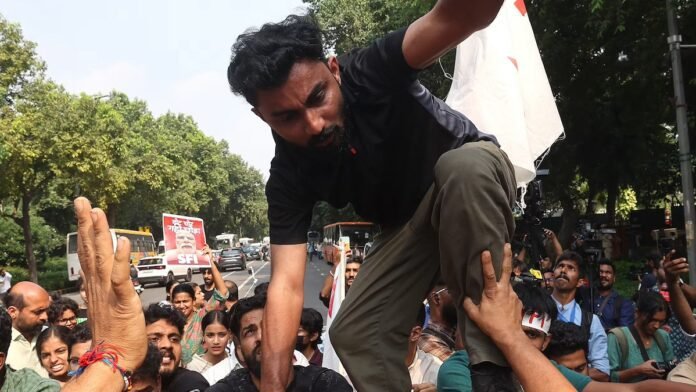
More than 25,000 police officers were deployed across New Delhi recently to prevent demonstrations led by India’s new youth-led political movement, the Cockroach Janta Party (CJP). Government authorities had denied the CJP permission to protest on public-order grounds.
The ensuing security operation saw the authorities shut one in six metro stations in the capital, barricade dozens of central roads and cancel over 250 trains in what Indian rail officials called an “unprecedented closure.”
The protests underscore a paradox at the heart of Indian politics. On the one hand, they show just how far India’s democracy has declined. On the other, they offer up glimmers of the key ingredients needed for democratic renewal: widening political participation, greater opposition coordination and mobilization around concrete demands.
The protests grew out of discontent over a nationwide electoral roll review known as the Special Intensive Revision. The revision, which began in 2025, has removed more than 130 million names from eligible voter lists – almost a tenth of India’s entire population.
India’s Election Commission has led the revision and says it is necessary to remove duplicate and ineligible voters. But critics allege the review has political motivations.
Indian police detain a protester during a demonstration in New Delhi on October 13. Photo: Rajat Gupta / EPA via The Conversation
In the state of West Bengal earlier in 2026, almost 12% of registered voters were removed from voter rolls before India’s ruling Bharatiya Janata Party (BJP) sailed to an election victory in a state it had not previously governed.
One analysis found that in a large number of constituencies the BJP won, the number of deleted voters exceeded the party’s margin of victory. These events do not definitively prove that Special Intensive Revision deletions changed the state election results. But the pattern is troubling.
So when the Indian Express recently reported that Election Commission members themselves raised 14 objections to voter exclusion during the revision, all of which were overruled by Chief Election Commissioner Gyanesh Kumar, the CJP called for his resignation and took to Delhi’s streets.
All of this is occurring in the context of considerable democratic decline under Narendra Modi’s government. This has taken the form of executive centralisation, intensified use of anti-terror laws and growing media ownership concentration.
No democracy watchdogs currently classify India as a full democracy. In 2021, Freedom House downgraded India from “free” to “partly free”, while the Sweden-based V-Dem Institute now classifies the world’s most populous country as an “electoral autocracy.”
Arresting the decline
The protests are unlikely to arrest India’s democratic decline. Modi’s government is powered not just by the BJP, but also by the Rashtriya Swayamsevak Sangh. This is a century-old Hindu nationalist organization with well-organized networks extending into schools, unions, charities and neighborhoods.
The combination of deep grassroots organization and effective government control of the media makes Modi’s government extraordinarily capable of mobilizing supporters. These advantages help explain why Modi has remained in power for 12 years in a country historically known for turning incumbents out of power.
But the cockroach movement is getting three aspects of its political activism right. First, the movement has begun to restore a sense of political efficacy in India, or the belief that collective action can force a powerful government to retreat.
Earlier in 2026, CJP-led protests successfully forced Modi’s education minister, Dharmendra Pradhan, to resign over a scandal involving leaked exam papers. The stakes are extremely high. In a country where university graduates make up two-thirds of unemployed 20- 29-year-olds, success in such exams offers a rare pathway to upward mobility.
One indication that participation in the protest movement is now widening came from popular Indian YouTuber, Dhruv Rathee. In a recent interview, Rathee told the BBC that he was not a political figure but now felt compelled to participate in his first protest because “basically the foundation of our democracy is at stake here.”
The protests have brought together forces from across Indian society. Photo: Vipin / EPA via The Conversation
Second, the protests have brought together previously distinct forces across broad sectors of Indian society. For example, lawyers, farmers’ organizations and activists have come together to back the protests.
It is especially important to coordinate the CJP and the Indian National Developmental Inclusive Alliance (India) of opposition parties. This is because challenging a dominant party at the polls requires above all opposition coordination.
Opposition groups need not agree on every policy. The CJP is able to supply youth mobilization without the historical baggage of an established opposition party, while the India bloc can bring parliamentary representation and organization.
Third, protests are more effective when they coalesce around a clear and specific demand. Mahatma Gandhi’s 1930 Salt March, a 24-day, 240-mile march to protest the British colonial monopoly on salt production and trade, epitomized this strategy. It brought together broad social alliances in opposition to a discrete policy that could be reversed.
A focused demand, in this case the resignation of the chief election commissioner, also gives any movement strategic flexibility. This includes the ability to pause mobilization after concessions without entirely dissolving the coalition that produced it.
India’s incumbent government retains formidable advantages. The BJP has enormous organizational resources, and nearly three years remain before the next national election in 2029, though an upcoming 2027 election in India’s largest state of Uttar Pradesh will provide an important test of the government’s popularity.
That is ample time to outlast protests, exploit opposition divisions and wait for public attention to shift elsewhere. So, the recent demonstrations have not reversed India’s democratic decline.
But they have widened political participation, focused public attention on the institutions that underpin democracy and weakened the belief that public resistance is futile.
Trump shuts down Hegseth plan to livestream military execution
US President Donald Trump scrapped plans to livestream the execution of the former Army major who killed 13 people at Fort Hood, overruling Pentagon chief Pete Hegseth on Thursday after the proposal drew opposition from Republicans, religious leaders and the public.
The reversal ended a plan to broadcast Nidal Hasan’s December 3 firing-squad execution. It also marked a rare public disagreement between Trump and one of the president’s closest allies, although the Pentagon said the two were “completely aligned.”
Hegseth had announced plans to livestream the execution at the Fort Hood military base in Texas, the site of Hasan’s 2009 attack. No other country is known to televise or livestream judicial executions.
Trump and his advisers had been unaware of the livestream plan, said a White House official speaking on condition of anonymity.
“I think streaming the execution for all to see might have been a strong deterrent for the World to witness how America deals with Terrorists and SCUM like Hasan but, many very good and well meaning people would rather not watch him die, through streaming, or through any other visual device,” Trump wrote in a social media post. “He will die, as scheduled, by firing squad, but this event will not be streamed.”
The families of Hasan’s victims will be able to view the execution in person if they so choose, as is standard at US executions.
Some of Trump’s fellow Republicans, including Vice President JD Vance, as well as religious leaders had expressed everything from doubts to outright condemnation of the Pentagon’s livestream plan.
Opinion polls showed a majority of Americans opposed livestreaming it. Archbishop Timothy Broglio, who oversees the spiritual care of Catholic members of the US armed forces, also raised objections, while Pope Leo condemned capital punishment in all its forms.
An attorney representing Hasan could not immediately be reached for comment, and it was unclear if the scheduled December 3 execution date would be delayed by legal challenges.
A SPLIT WITH HEGSETH
It was Trump’s first major public split with Hegseth, a Trump ally. But it was unclear whether the split would politically imperil Hegseth given their strong ties.
In a statement, the Pentagon said Trump spoke with Hegseth about the decision before announcing it on Truth Social.
“The Secretary supports the President’s decision, and they are completely aligned,” chief Pentagon spokesman Sean Parnell said in a statement.
Capital punishment in the US already was facing renewed scrutiny after Christa Pike, convicted of murder in the 1990s, survived two lethal injections in a failed execution attempt by Tennessee last month that left her badly injured and requiring hospitalization.
‘SERIOUS CONSEQUENCES’
A military jury convicted Hasan, a former US Army psychiatrist, of premeditated murder for fatally shooting 13 unarmed soldiers and wounding 32 others in a medical facility at the vast base. Law enforcement shot Hasan during his rampage, paralyzing him from the waist down, and he now uses a wheelchair.
Hegseth had said the broadcasting of the execution was needed to ensure that people understand that “there’s serious consequences for these types of things.”
Midterm elections on November 3 will determine whether Republicans retain control of Congress as voters increasingly register disapproval of Trump’s policies in opinion polls.
Senator John Curtis, a Republican representing Utah, called the cancellation “the right move” in a statement.
US Representative Richard Neal, a Democrat from Massachusetts, called the original plan “a profound failure of moral judgment and basic human decency.”
Googlebook review: Android on a laptop is still Android
Android was designed for phones, but that hasn’t stopped Google from trying to adapt the OS and its apps to larger machines over the years. Googlebooks are just the latest attempt after tablets, Chromebooks, and foldables induced little change in how people interact with Android software. These new Android-powered laptops are designed to pick up where the web-focused ChromeOS left off, offering premium hardware and native support for Android apps.
Google sees Googlebooks as an alternative to Windows and macOS, but these platforms are entrenched with decades of software and UI conventions that keep users locked in. Googlebooks have to offer something very special to steal users away from either of the dominant operating systems.
For devoted Android phone users, there are some cool things in Googlebook OS, but the Android roots of these machines are impossible to miss. Sometimes it feels like using a Chromebook, and sometimes it feels like using a giant phone. It almost never feels like using a premium laptop, and that’s the problem.
OEMs pulling their weight
While there were a few premium Chromebooks, the platform was really only successful in the budget segment. With Googlebooks, the company is almost conspicuously ignoring lower-cost options. And as most of the lineup clocks in at well over a thousand dollars, Googlebooks are not just a new take on budget-oriented Chromebooks.
The Glowbar doesn’t do a whole lot, but it’s kind of pretty.
Credit: Ryan Whitwam
The Glowbar doesn’t do a whole lot, but it’s kind of pretty. Credit: Ryan Whitwam
All of the launch Googlebooks have excellent touchscreen displays, aluminum and magnesium bodies, biometric unlock (fingerprint or face), and big trackpads. There’s also the Glowbar, which doesn’t do very much right now. It lights up in Google colors when Gemini is activated with the wake word and during boot-up. It also shows the battery level when you plug in a Googlebook. The latter is modestly useful, but it’s not really a selling point.
There’s something in the lineup for most premium laptop buyers. If you want a convertible, there’s the Acer machine. Sleek and spendy? Asus and HP have you covered. Want something a little bigger? Lenovo has a 15.3-inch model with an HDMI port and USB-A.
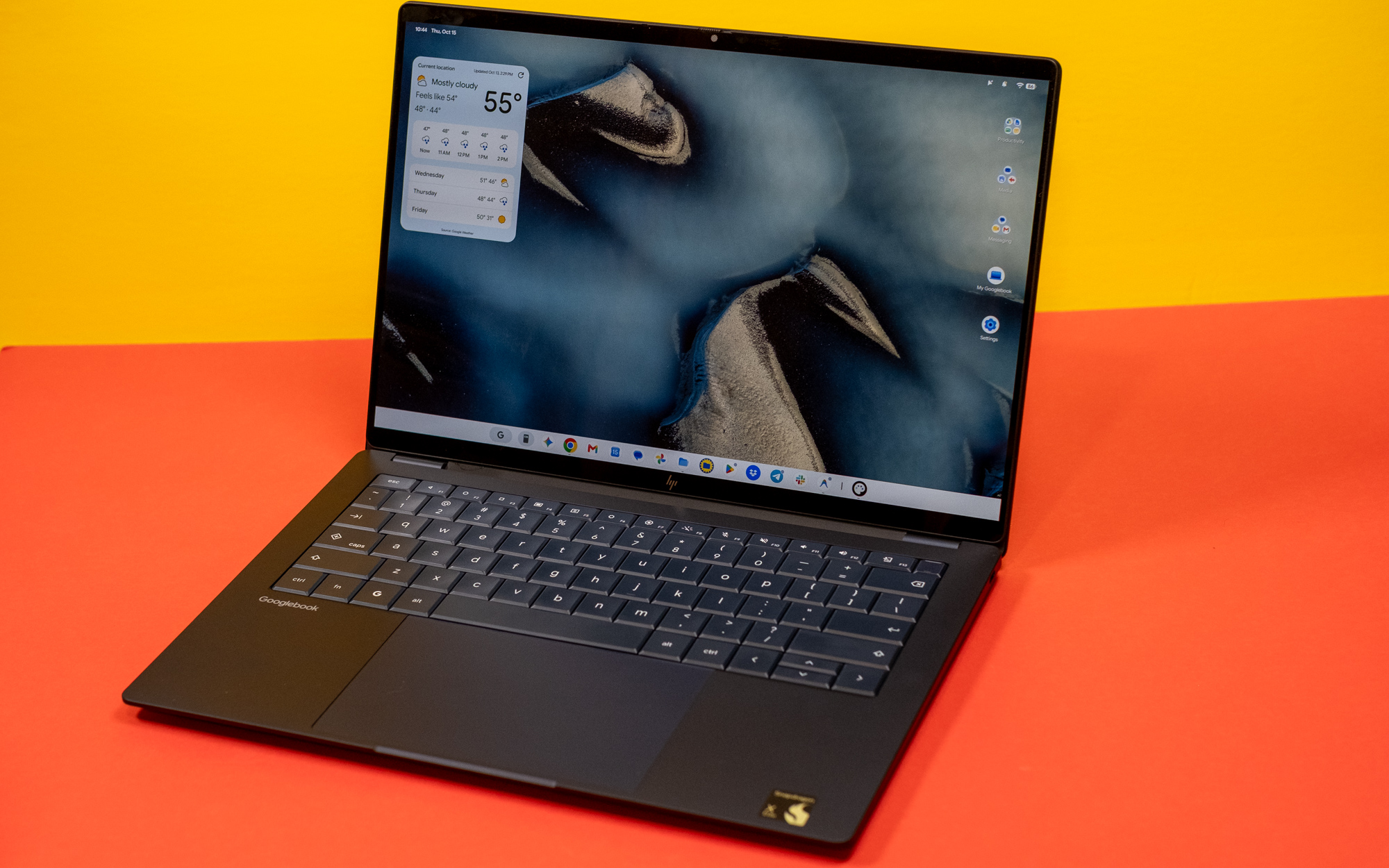
The $1,300 Snapdragon-powered HP Googlebook 14 could pass for an even more expensive Windows laptop.
Credit: Ryan Whitwam
The $1,300 Snapdragon-powered HP Googlebook 14 could pass for an even more expensive Windows laptop. Credit: Ryan Whitwam
The least-spendy model, the Acer Googlebook 14, starts at $899, and that’s a limited-time deal. Even this one gets a lot of the hardware right. It has a vibrant OLED screen, a metal chassis, and three USB-C ports (all of which can charge the laptop). However, you won’t get a haptic trackpad, just the old-fashioned kind that physically clicks. The supposedly DTS-tuned speakers also don’t sound great. Still, the hardware is at least as nice as any $900 Windows laptop. Acer hasn’t decided when the price will change or what it will be, but it’s at $899 for the rest of the year at least.
The next step up from that is the Dell XPS Googlebook at $999, but this model has an LCD instead of OLED. If you want the most capable Google laptops with OLED and haptic trackpads, you’re looking at spending at least $1,100 for the Lenovo version. This machine is solid, and the larger footprint allows for vents in the hinge instead of on the bottom. But I don’t love the slightly wobbly feel of the keys or the flex in the middle of the keyboard. The HP Googlebook 14 has a much nicer keyboard, a better overall look, and a Snapdragon X Elite chip inside. However, it’s also $1,300.
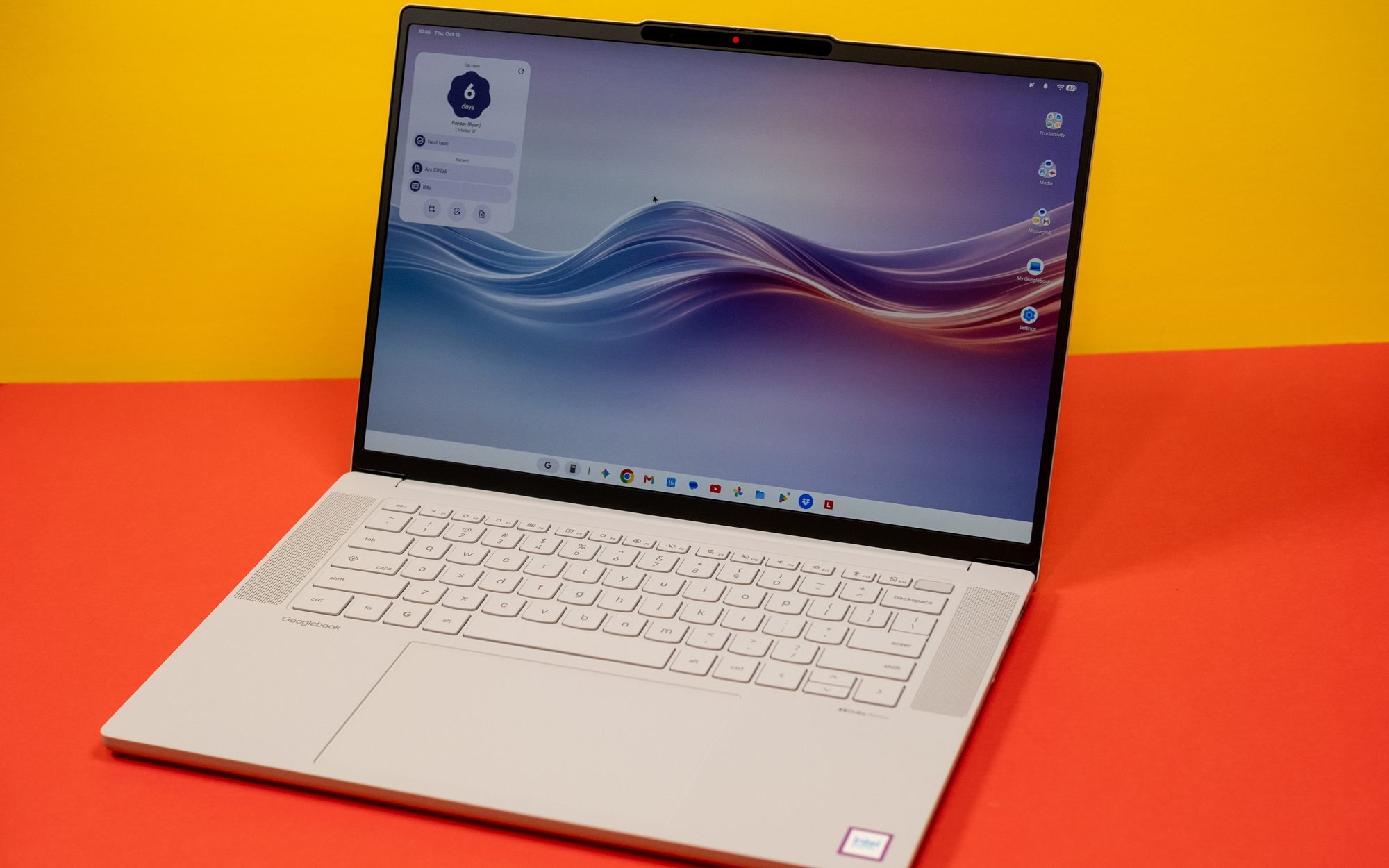
The Lenovo Googlebook 15 is a little bigger, offering an HDMI port and a legacy USB-A.
Credit: Ryan Whitwam
The Lenovo Googlebook 15 is a little bigger, offering an HDMI port and a legacy USB-A. Credit: Ryan Whitwam
I appreciate that Google is pushing for things like haptic trackpads and high-resolution OLED screens, but the more expensive Googlebooks suffer from the same issue as premium Windows laptops—they don’t exist in a vacuum. If you’re spending $1,300 on a laptop, the entry-level MacBook Air is probably a better overall option for most people.
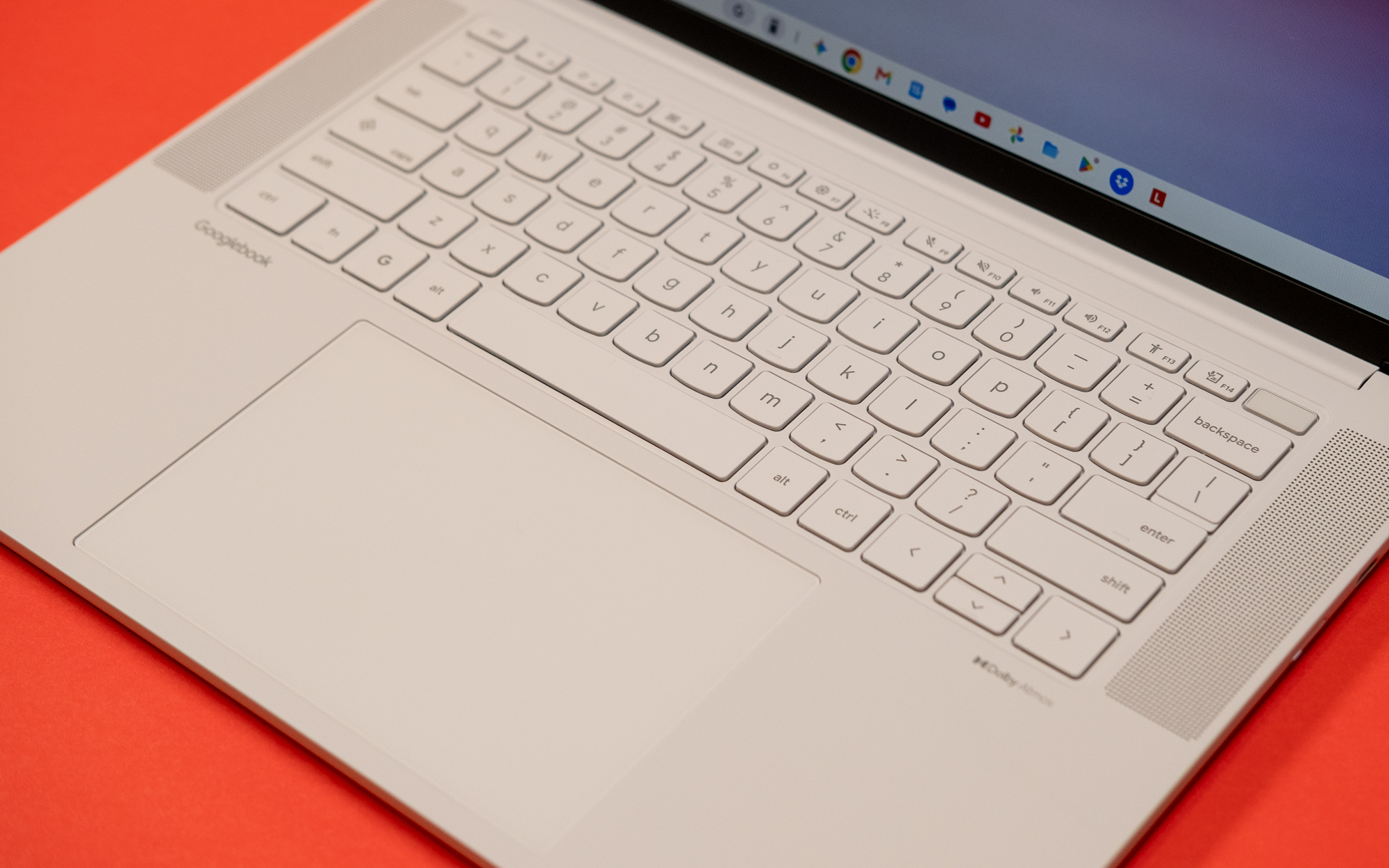
All of the launch Googlebooks have the same keyboard layout, which is a bit different from what you get on other laptops. There’s a G button that works similarly to the Windows button, and the top F-row has been revamped. You get the usual Windows staples like brightness and volume control, but there are also Android navigation buttons and a voice input key that activates the AI-powered Rambler.
The Googlebook keyboard (seen on the Acer Googlebook 14) might take a little getting used to.
Credit: Ryan Whitwam
The Googlebook keyboard (seen on the Acer Googlebook 14) might take a little getting used to. Credit: Ryan Whitwam
Probably the best change to the Googlebook keyboard is ‘quick insert’ in place of ‘caps lock’ (you can still get caps lock with the Fn toggle). Just press this key to add emoji, recent screenshots, clipboard contents, recently visited URLs, and more. Admittedly, I don’t mind using function layers on a keyboard, so the extra step to access caps isn’t a concern. You may feel differently, and that’s okay.
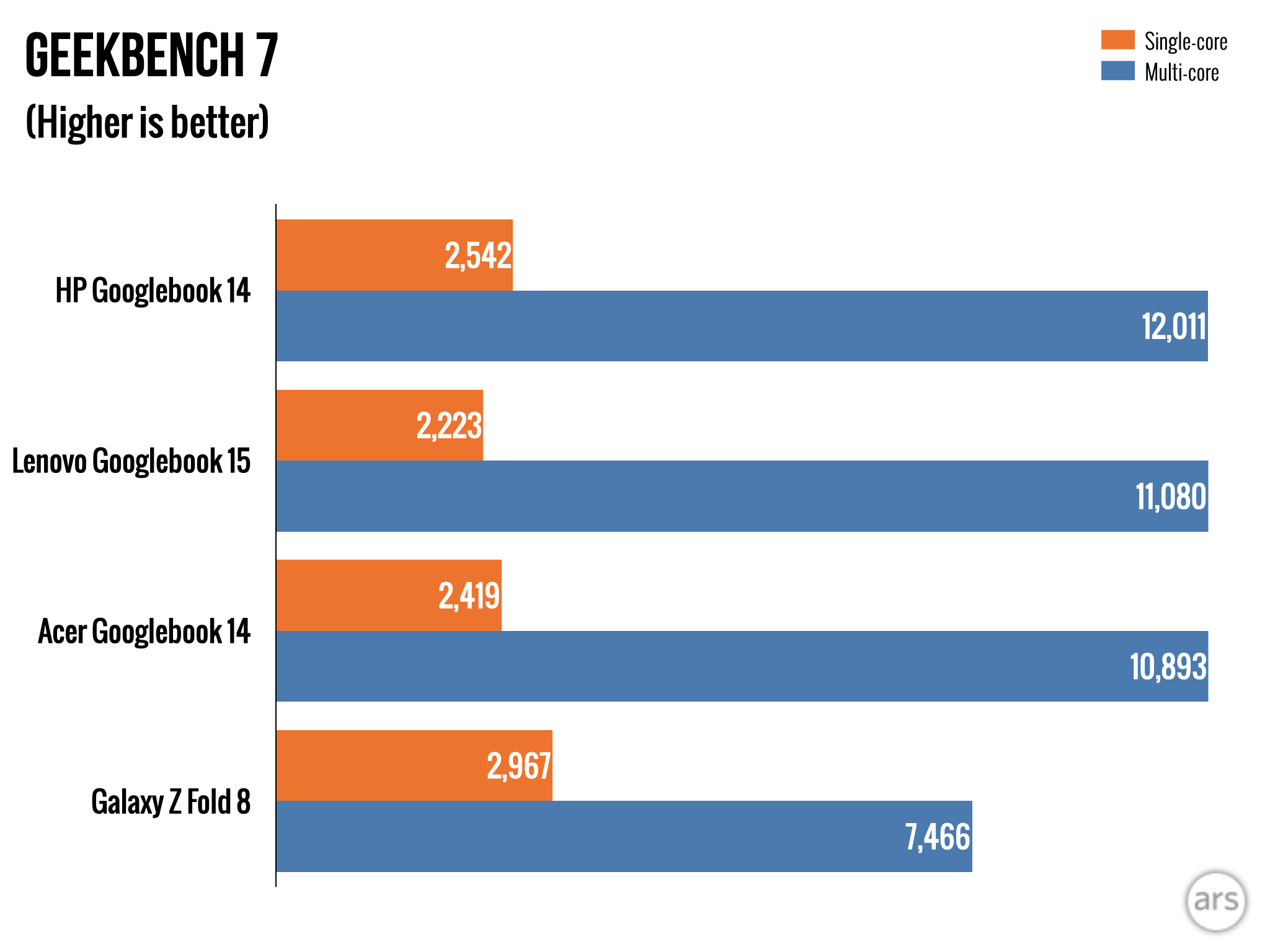
Googlebooks all perform similarly in CPU tests.
Credit: Ryan Whitwam
Googlebooks all perform similarly in CPU tests. Credit: Ryan Whitwam
Googlebooks come in both Intel and Snapdragon variants. I’ve been using both, and general performance feels about the same. There have been some reports of app issues with Intel-powered Googlebooks, but I haven’t run into any apps that will only run on Snapdragon.
Snapdragon’s GPU performance is better on Android.
Credit: Ryan Whitwam
Snapdragon’s GPU performance is better on Android. Credit: Ryan Whitwam
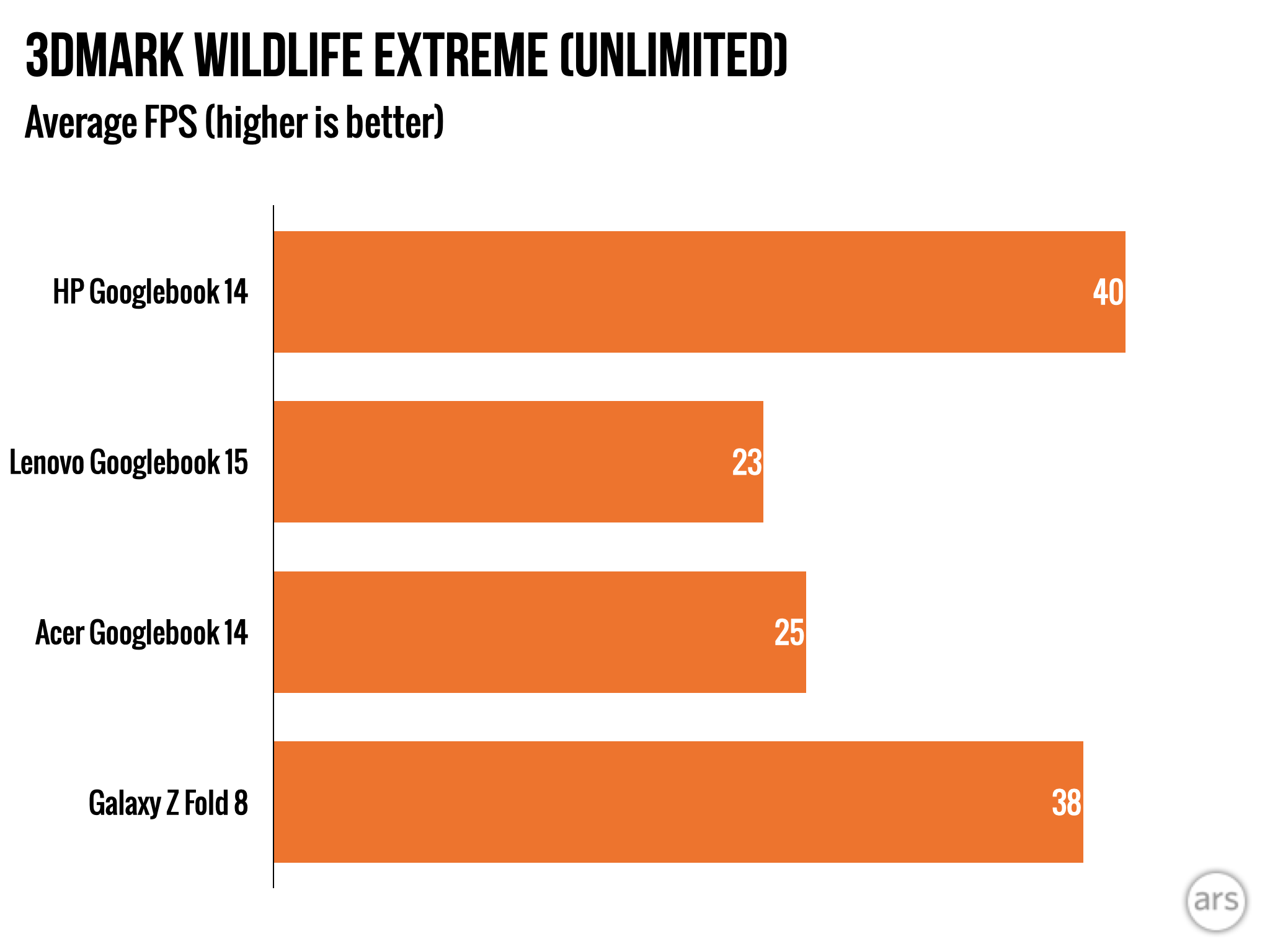
The Snapdragon model (HP) seems to have a higher performance ceiling, if you can find a way to reach it. Gaming performance also appears better on Snapdragon, but even the heaviest Android games seem fine on the Intel models (Lenovo and Acer). It can be hard to push these machines when you’re relying on software that was originally designed to run on phones. Unsurprisingly, software proves to be the biggest hurdle for Googlebooks.
Using Android—err, Googlebook OS
Google has flirted with Android on larger screens on a few occasions, mostly with tablets and tablets that impersonate laptops. This is the first time it has totally revamped the OS for a laptop, but it’s still Android under the hood. Sometimes that’s good, and other times not so much.
Setting up a Googlebook is a snap for Android users. Just like configuring a new phone, you can scan a QR code with your current phone to copy your accounts, data, and apps over automatically. You can be up and running in minutes, and your phone will integrate deeply with the OS. Well, provided it runs Android 17. That’s going to be a sticking point, since most phones don’t have that update yet.
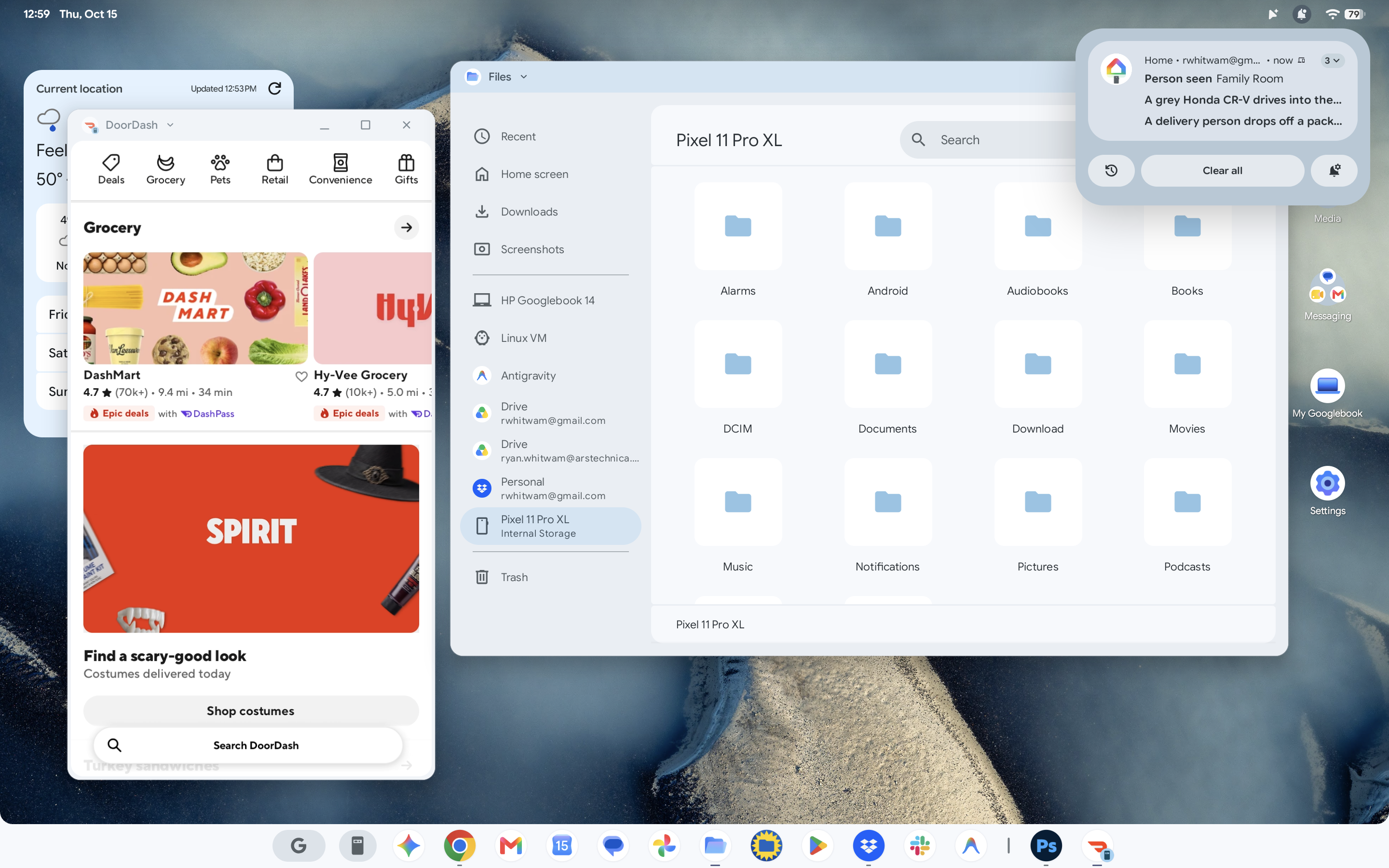
With Google’s “Better Together” services, a Googlebook can access files on your Android 17 phone, sync notifications, remember where you left off in apps, and even mirror apps from your phone. This all sounds great, and when it works, the experience can be good. However, there are various limitations and bugs that get in the way.
Googlebooks can stream apps, mirror notifications, and access storage from your Android phone.
Credit: Ryan Whitwam
Googlebooks can stream apps, mirror notifications, and access storage from your Android phone. Credit: Ryan Whitwam
To remain in contact, the phone and Googlebook need to be on the same Wi-Fi network, and switching to other networks can break the connection in annoying ways. Even when the devices appear to have a solid connection, I have rarely seen any hint of Google’s Continue On feature, which is supposed to let you pick up where you left off in a phone app. Mirroring phone apps on your laptop can also be handy, but the performance is varying degrees of bad, and apps with system-level security features won’t work at all. You are also limited to one app at a time, and they won’t stay open in the background.
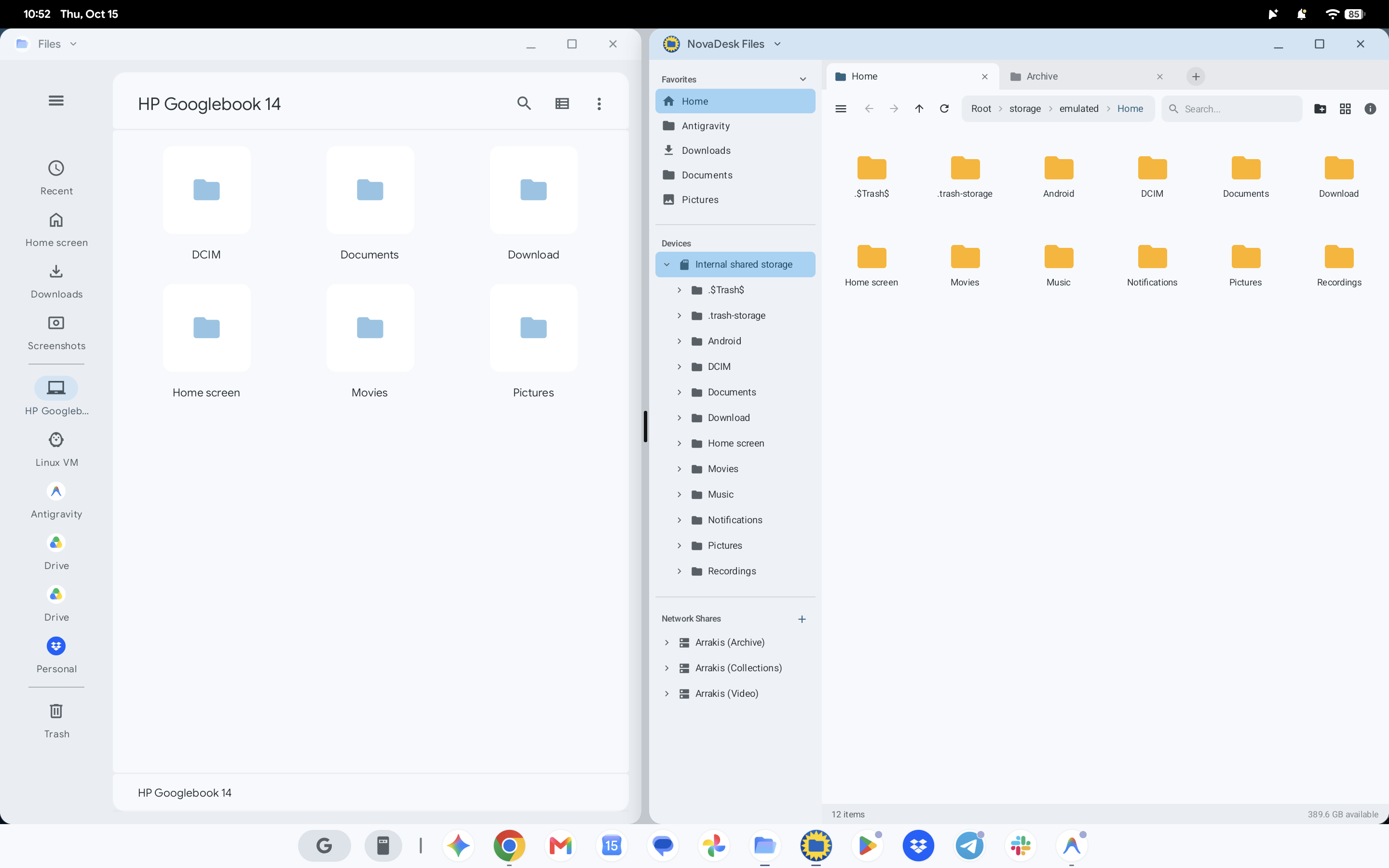
Accessing the files on your phone from the laptop is a good idea, but the transfer speed is often sluggish. More annoyingly, the connection only goes one way—the Files app on the Googlebook can see your phone, but the Google Files app on a phone can’t see the Googlebook. Speaking of the Files app, this is emblematic of how far behind Google is with desktop software. The app lacks basic things like tabs and support for network shares. It’s nice that it can access my phone, but it feels very restrictive if you’re used to Finder or Windows Explorer.
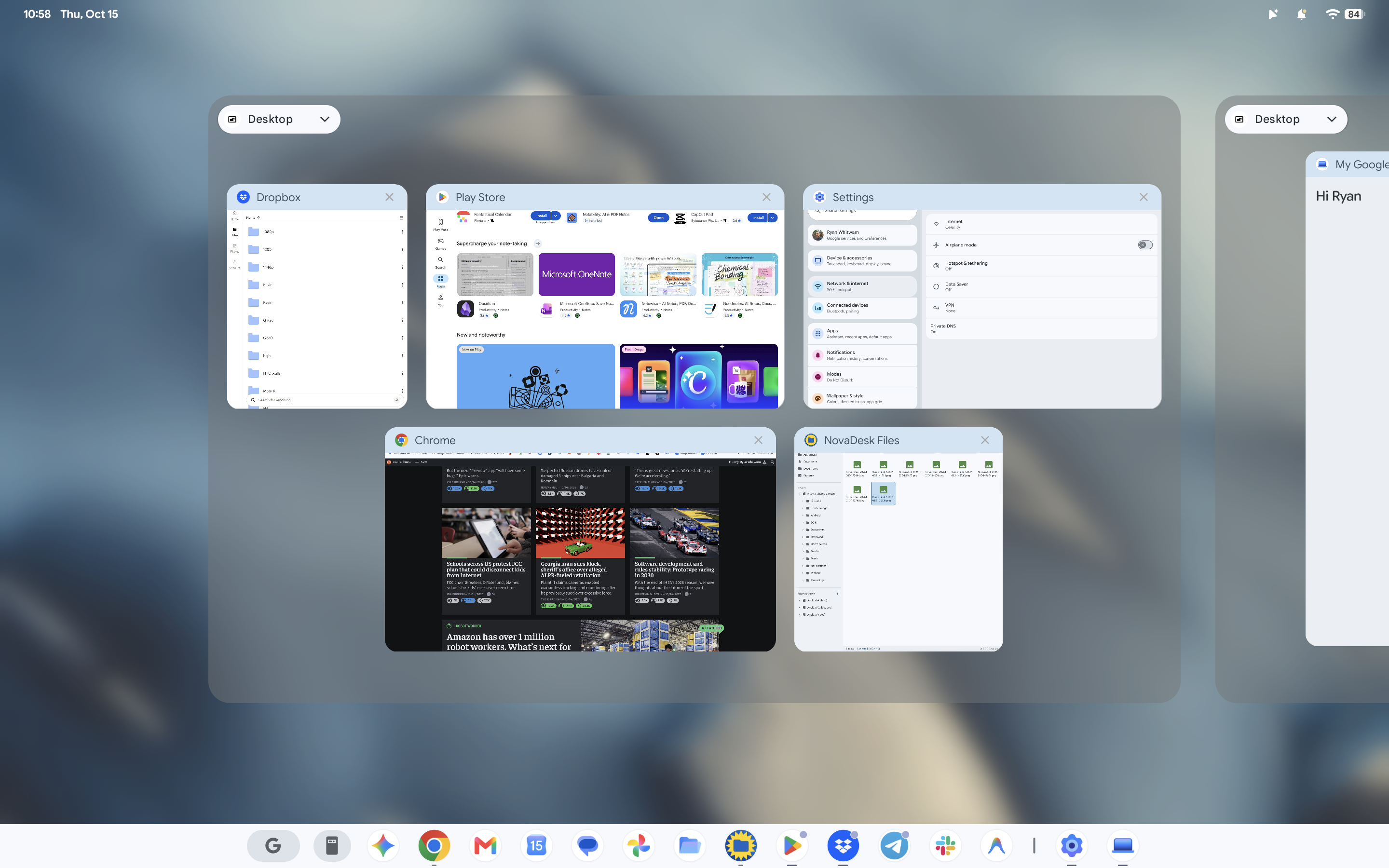
Google has at least done a good job of making Android look like a desktop OS. There’s a proper desktop that you can fill with app shortcuts, folders, widgets, and files. There’s a folder in the storage tree where you can manage that content, or you can simply drag things onto it from a file manager. You also get ChromeOS-style split-screen support and multiple desktops. These features work, but they’re not as intuitive or capable as what you get on either macOS or Windows.
Managing multiple desktops on Googlebook OS.
Credit: Ryan Whitwam
Managing multiple desktops on Googlebook OS. Credit: Ryan Whitwam
AI is a big part of the Googlebook experience. Google talks a lot about Magic Pointer, which you can activate by wiggling the cursor. This allows you to hand any content on your screen over to Gemini, but calling it magic is a little silly. You can have it translate text, make images, create calendar appointments, and so on. You’re basically feeding Gemini screenshots and asking it to do things.
Magic Pointer can be useful sometimes, but it’s hardly revolutionary to streamline the process of feeding screen content into an AI by attaching it to the mouse. You still have to contend with the inaccuracy of Gemini. Even adding calendar appointments can fail, which means you have to double-check almost everything the AI does.
Magic Pointer is an optional feature, and you can adjust the sensitivity of the gesture. However, I never found a level that I was entirely happy to use. Too much sensitivity, and the gesture triggers when you don’t intend it. Too little, and you have to shake the mouse so hard that the cursor is probably going to be nowhere near what you wanted to highlight.
Rambler, which debuted on the Pixel 11 lineup, is included with all Googlebooks. This AI-powered voice input feature works in any text field on the laptop, which is handy if you want to add a lot of text without typing and don’t mind sounding like a robot. This has been popular on phones, and most people using it on a Googlebook will probably be impressed.
Create My Widget is another head-scratcher, though. The pitch is that you can simply describe the widget you want, and the AI will place it on your desktop. It sounds cool, but in reality, the content you can rope in is so limited as to make the feature largely useless. If you want calendar countdowns and sports scores, great. If you want system info or app content, you’re out of luck.
All the mobile apps
Googlebooks come with the Play Store, which is crammed full of all the Android apps you could ever want. But desktop apps? Google says it has worked with devs to optimize apps for Googlebooks, and some software has been newly built from the ground up for a desktop experience. For example, Chrome on Googlebooks is a mostly desktop-class experience. It’s missing a few niche features like split windows, tab groups, and multiple profiles, but it will work with all of your extensions.
On other platforms, I’ve routinely used desktop clients for Dropbox and Drive to sync files. I had hoped something similar would be possible on these Android laptops, but no such luck. Dropbox runs on a Googlebook, but it’s not optimized. The UI is clunky, and even if you save a folder offline, it only updates when you refresh the app manually (just like a phone running the app).
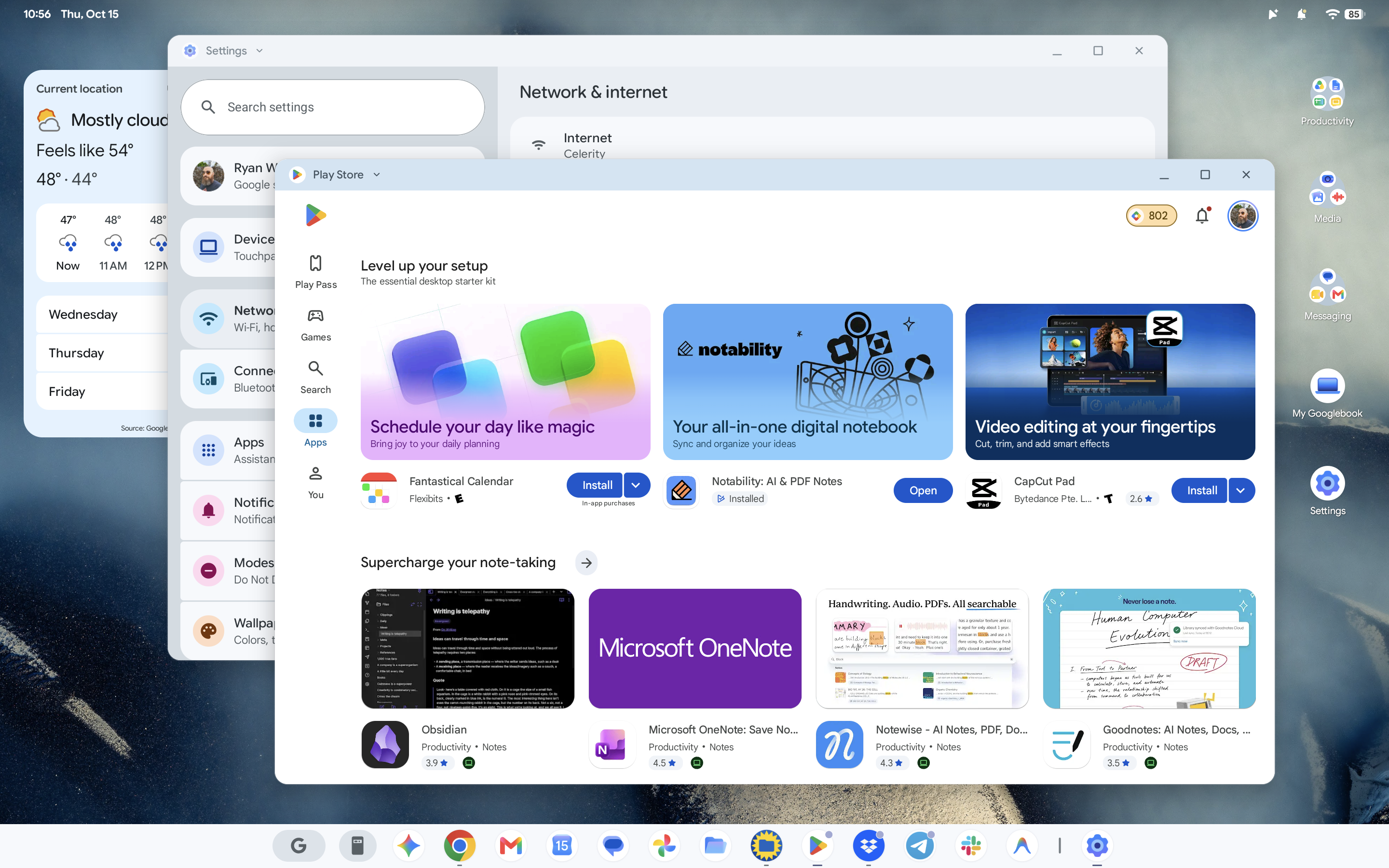
The Play Store highlights the handful of desktop-caliber apps currently available.
Credit: Ryan Whitwam
The Play Store highlights the handful of desktop-caliber apps currently available. Credit: Ryan Whitwam
Meanwhile, the Drive app isn’t even an Android app—it’s a progressive web app (PWA). So you can’t set it up to sync a folder to the device. All you have is the option to make individual files in Drive available offline. Without a real desktop app experience here, you actually get a lot more functionality out of Google’s cloud storage system on Windows and macOS.
Drive isn’t the only Google web app masquerading as a native app. Gmail and Calendar are also PWAs on the Googlebook, offering the same experience you’d get opening them in a browser tab. Gmail exists as an Android app with a large screen format. Why not adapt that for Googlebooks? Real operating systems have email apps. If you’re just going to end up in a web app, why not buy a Chromebook for a third of the price?
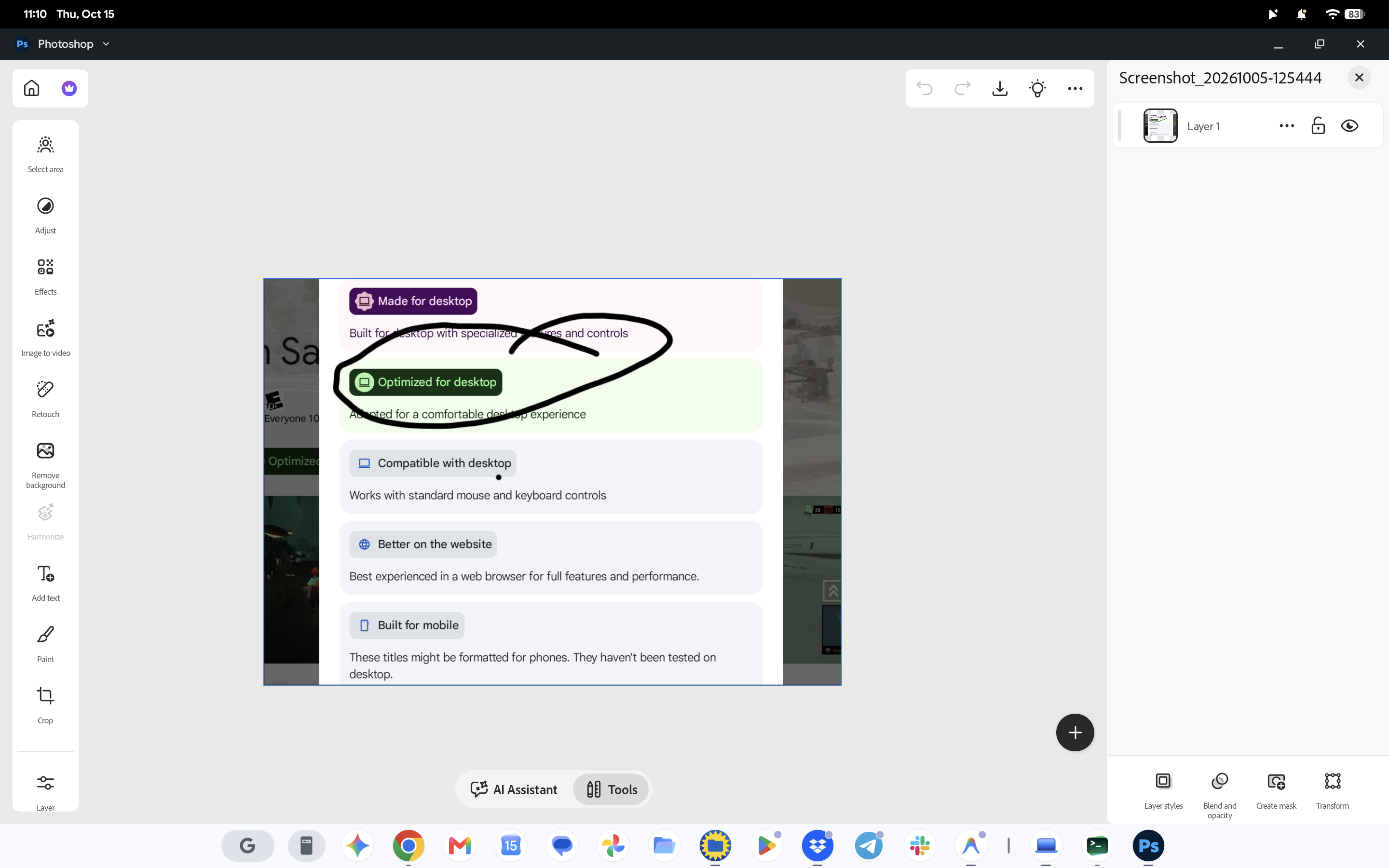
The Play Store uses labels to let you know which apps are best on a laptop, but most apps in the Play Store are very obviously built around a phone experience. Google is in a tough spot here. Developers only build for what people use, and so far, no one has been demanding desktop-style Android apps. As you peruse the Play Store, you’ll see a few of those “optimized” labels, but there are many more “Compatible with desktop” tags, which means you can expect only nominal support for a keyboard and mouse.
The most problematic apps are flagged in the Play Store as “Built for mobile” or even “Better on the website.” Some popular apps fall into these categories. For example, team chat app Slack is an abysmal experience on anything other than a phone. The app runs on Googlebooks, but the web UI is much more desktop-friendly. You are supposed to be able to install Slack as a progressive web app, essentially what Google is doing with Gmail, Drive, and other apps. However, this doesn’t work currently for unknown reasons. Again, you could just use a Chromebook if you wanted everything in a browser tab.
Adobe’s optimized version of Photoshop is still very limited on Googlebooks.
Credit: Ryan Whitwam
Adobe’s optimized version of Photoshop is still very limited on Googlebooks. Credit: Ryan Whitwam
Even apps that have been optimized for desktop can be frustrating on a Googlebook. These apps are aware you have a keyboard, but they can respond to button presses in ways you don’t expect. Photoshop is a major offender here. The app has a poorly scaled mobile UI shifted into landscape, and there are only a few keyboard shortcuts. Sometimes, you’ll see a UI element that looks like it should be controllable with the arrows or enter key, but you just end up moving the cursor around and selecting the wrong thing. In fairness, Android’s Photoshop app is free, whereas the real Adobe suite on other platforms costs money. But calling this a desktop app is a stretch.
You’ll find lots of phone-first apps that don’t fully understand that you have a trackpad, ignoring hover interactions and right-clicks. Many apps also expect you to frequently trigger the Android back gesture to navigate the UI. On that last count, Google has a solution. Googlebooks have Back, Home, and Multitasking buttons on F1-F3. So you can make phone apps work, but reaching up to mash F1 constantly is annoying.
The Android lineage of Googlebook OS also means that even apps built for desktop may not operate the way you’d expect on a desktop PC. Android was designed for a memory-constrained environment, so the system closes apps in the background whenever it needs to free up RAM. It’s common to come back to an app you left in the background to find that it has lost your place and has to reload. This is a phone-like experience that doesn’t really fit with a real computer.
Can vibes save it?
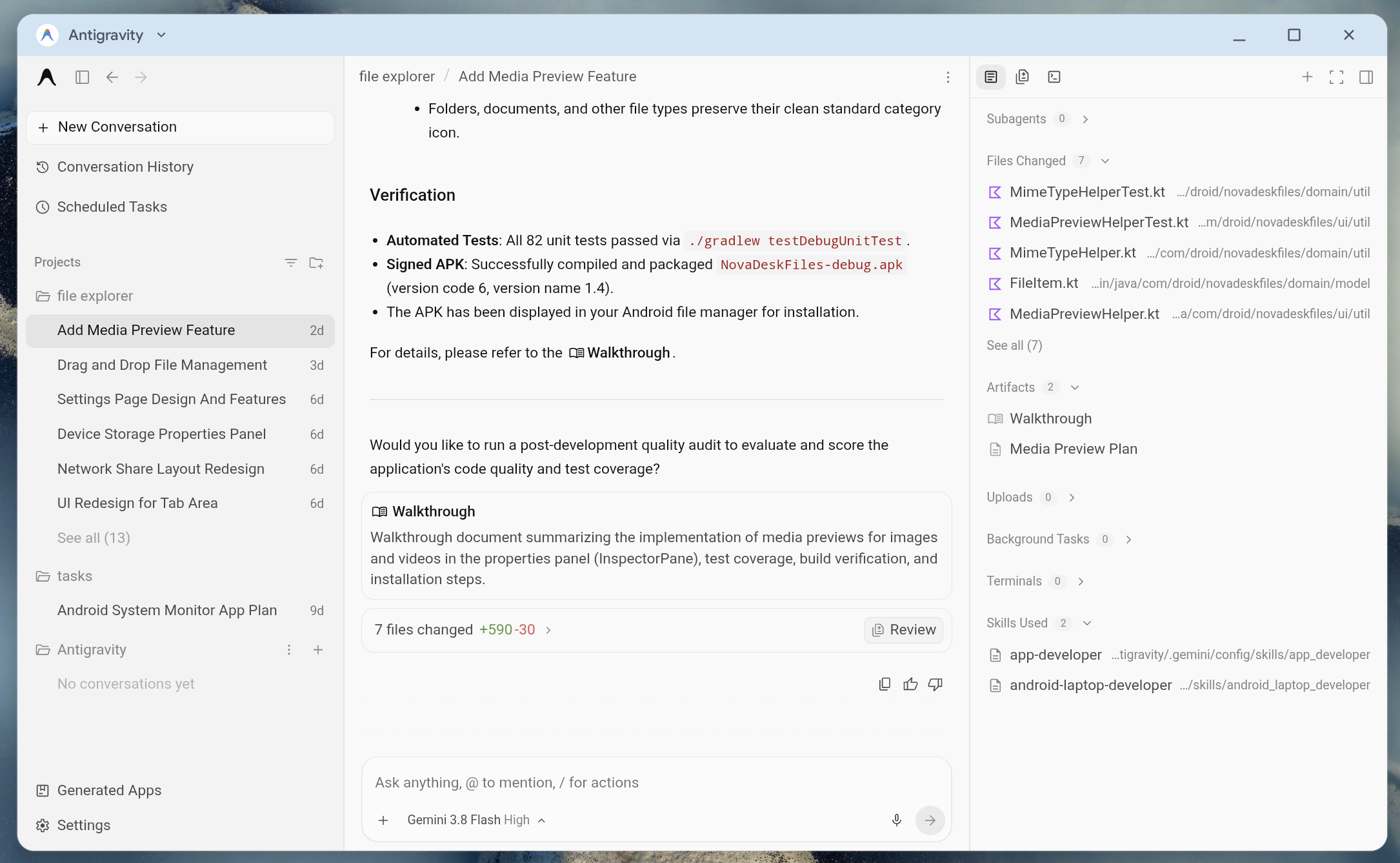
Google is aware that Googlebook apps may not fulfill all needs. One possible solution to that, say reps, is to simply make what you need with Antigravity. The new Android version of Google’s AI-centric development app is included on every Googlebook, giving you the option to vibe code apps for your laptop. The AI can generate plans, mockups, and line after line of code to bring your idea to life.
Antigravity on Googlebook OS.
Credit: Ryan Whitwam
Antigravity on Googlebook OS. Credit: Ryan Whitwam
Antigravity can autonomously download all the Android developer tools it needs and builds APKs ready for installation on your device. Installing your apps is technically sideloading, as they’re not hosted in the Play Store, but Google gives these special treatment. They get scanned by Play Protect, but you don’t have to enable unknown sources in the settings. Google also confirms these apps won’t be affected by developer verification when that rolls out on Googlebooks next year.
After struggling with the Files app for a few days, I decided the lack of network shares was a deal-breaker. I keep most of my files on a NAS so I can access them from any device, and Googlebooks were cramping my style. I first tried to find an alternative in the Play Store, but the apps with sufficient features were totally unoptimized for a laptop, so I decided to test Antigravity on Googlebooks by making one.
Using Google’s default Gemini Flash model, I was able to get a functional but very buggy file manager installed in a few minutes. Making it work reliably and support all the features I needed took several hours of prompting over a few days, but the result is something I like using more than Google’s default Files app.
My custom file manager is essentially Windows Explorer on Android. While I did not set out with that intent, that’s where I ended up. The app has a desktop-friendly UI, tabs, network share support, expandable file trees, file previews, and more buttons. It has more features than Google’s default app, although it lacks the deep phone and system integration of the default file manager.
Left: Default Files app, Right: My vibe-coded replacement
Credit: Ryan Whitwam
Left: Default Files app, Right: My vibe-coded replacement Credit: Ryan Whitwam
On one hand, it’s cool that you can create your own apps with the included Antigravity software. However, you’ll need to pay someone (probably Google) for enough AI compute to get the job done. It took a lot of iterations and bug hunting with Gemini 3.8 Flash to get my app where I needed it to be, and lighter models will struggle to produce something functional. It’s also not ideal to expect people buying a laptop to spend hours chatting with a robot to make it do basic laptop things. It should do those things out of the box.
The first step on a long road
I keep coming back to one inescapable question that hangs over everything Google is doing with these new laptops: Do Googlebooks need to exist? This seems like a lot of effort just to deliver deeper Android phone integration and more AI features when Chromebooks are already established in the market. True, that’s not a premium part of the market, but going after premium laptops means you need a premium experience, and currently, Googlebooks don’t offer that.
Port location and selection vary across the lineup.
Credit: Ryan Whitwam
Port location and selection vary across the lineup. Credit: Ryan Whitwam
The hardware is solid—it’s smart that Google is pushing for things like OLED and haptic trackpads on Googlebooks. Its OEM partners have made some very nice-feeling laptops for Google’s software, but the OS isn’t doing its part. I just don’t feel more productive on a Googlebook than I do on a Chromebook.
I’ve been using Android since the beginning—this should be a good laptop for someone like me. However, the rough edges of the Googlebook experience are still wearing me down. It’s great that it talks to my phone, but that conversation is too often one-sided and buggy. It’s good, in theory, that Googlebooks have a deep software library with the Play Store, but too few apps are actually good on a laptop. And it’s cool that Googlebooks have such nice hardware, but they’re too expensive for what you get.
Googlebooks have generously sized touchpads, and most of them are haptic.
Credit: Ryan Whitwam
Googlebooks have generously sized touchpads, and most of them are haptic. Credit: Ryan Whitwam
Maybe Google can fix this—ChromeOS looked a lot different a year or two after its consumer launch, after all. But Google has a lot of work ahead to make the Googlebook experience what it needs to be, and in the meantime, it’s not a viable alternative to macOS and Windows. Does Google have the patience to spend years doing this work? The company’s recent history leaves me feeling skeptical, and that makes it difficult to recommend a Googlebook to even the most ardent Google customers.
The good
Laptop hardware looks and feels great
Extremely quick setup
Deep Android phone integration
Access to millions of Android apps running natively
The bad
High price tags and no budget options
Very few Android apps work well on laptops
Missing features of more mature desktop operating systems
China, Russia quietly moving toward a new Arctic axis
Russian President Vladimir Putin’s advisor Nikolai Patrushev’s recent visit to China points to something more consequential than another round of Russia-China strategic rhetoric: Moscow is trying to turn maritime cooperation with Beijing into infrastructure, technology and logistics that can survive geopolitical pressure.
The proposals discussed during the October 8-13 visit — linking China’s Maritime Silk Road with Russia’s Trans-Arctic Transport Corridor, developing Russian ports, exchanging container-terminal automation technology and conducting joint maritime research — are still largely unimplemented plans.
Yet they deserve attention because they sit at the intersection of three trends reshaping the global economy: the securitization of supply chains, the opening of the Arctic and the fragmentation of maritime globalization.
Patrushev’s pitch was mostly commercial. Russia wants Chinese companies involved in the Northern Sea Route and related corridors, direct container links between Shanghai’s Yangshan port and Russian ports, investment in terminals and Chinese digital expertise in port automation.
He also proposed cooperation in shipbuilding, maritime education and research. Beijing, for its part, described maritime cooperation as a “blue driving force” for bilateral relations.
The economic logic is clear. China is Russia’s biggest trading partner, and Moscow has become an increasingly important supplier of energy and raw materials to China. China’s government data said two-way trade exceeded US$200 billion for a third consecutive year in 2025.
So maritime transport is becoming a strategic extension of the relationship, rather than just a means of moving cargo. And the Arctic adds a particularly interesting dimension to the partnership. Russia recorded 37.9 million tonnes of cargo traffic on the Northern Sea Route in 2024, including 3.09 million tonnes of transit cargo, marking a record high.
The numbers are tiny compared with the global flows of the Suez Canal, and the NSR is hampered by ice, high insurance premiums, specialized vessels, thin infrastructure and a short operating season. But the route’s geopolitical and geoeconomic significance is increasingly hard to ignore.
Reuters reported a Chinese container ship made a 20-day trip from China to Britain via the Arctic in October 2025, compared with some 40-50 days on traditional routes. That does not make the Arctic a substitute for Suez, but it does make it a potentially valuable second network.
For China, that distinction matters. Beijing has spent years building redundancy into its trade routes, ports and energy supply chains. A stronger northern corridor could reduce exposure to chokepoints such as Suez, Bab el-Mandeb and Malacca while giving Chinese firms access to Russian Arctic resources and infrastructure.
For Moscow, Chinese capital, shipping demand and technology could help turn an ambitious Arctic strategy into a functioning logistics system. The geopolitical implications will no doubt be watched closely in Washington.
The United States already regards the Arctic as an arena of intensifying strategic competition. In 2025, the US Coast Guard reported five China-affiliated research vessels operating in or near the US Arctic and increased its own patrols.
In 2024, it encountered a joint Chinese Coast Guard-Russian Border Guard patrol in the Bering Sea, the northernmost such Chinese Coast Guard presence then observed by the service.
A Sino-Russian maritime network is not ipso facto a military alliance and Washington should not regard every commercial port project as a cloaked naval base. The more critical question is cumulative strategic resilience.
Joint work on ports, digital systems, shipbuilding, research, navigation and logistics could enable China and Russia to develop maritime infrastructure with economic value in peacetime and strategic utility in a crisis.
Japan has even more reason to pay attention. Its security environment already includes increasingly frequent Chinese-Russian military activity around its territory, which Tokyo has explicitly highlighted.
A more integrated Russian-Chinese maritime system stretching from Shanghai through Vladivostok and into the Arctic would complicate Japan’s strategic picture, particularly around the Sea of Japan, the Kuril Islands and the approaches to the Bering Strait.
For Taiwan the significance is indirect, but perhaps greater. Beijing’s maritime pressure on Taiwan already includes naval activity, coast guard operations, legal measures and other gray-zone coercion.
Taiwan’s defense ministry has cautioned that Chinese exercises are increasingly threatening a blockade and control of the island’s maritime approaches. Russia’s contribution to a broader Chinese maritime ecosystem may not in itself tip the balance in the Taiwan Strait, but it may encourage China to think that disruption in one theater need not cripple its broader trade and energy flows.
Over 80% of global goods trade is still carried by sea. UNCTAD forecasts a sharp slowdown in seaborne trade growth due to geopolitical disruption and rerouting of shipping from the Iran war and its associated Strait of Hormuz blockade. The Russia-China initiative is therefore part of a larger global movement toward securing vulnerable supply chains.
There is an irony here. The two countries describe the project as a contribution to cheaper, safer and more stable trade. Yet the same process could deepen the fragmentation of the global maritime system into competing networks with different technologies, standards, financing channels and security arrangements.
That is why the least dramatic elements of Patrushev’s proposal, which covers port automation, digital shipyards, research cooperation and common technical standards, are also its most important.
They are the building blocks of 21st-century maritime power: whoever controls the software, data, equipment and logistics architecture of ports can shape trade without ever firing a shot.
The West should neither brush this off as Russian bombast nor blow it up into a Sino-Russian maritime bloc on the horizon. There are still considerable commercial barriers and Arctic shipping won’t take over Asia-Europe routes any time soon.
But South Korea’s first commercial Arctic round trip in 2026, while cutting the time of the voyage, also exposed the route’s unresolved problems with cargo volumes, ice navigation, insurance and fuel costs.
Still, the direction of the Arctic route is clear. China supplies Russia with capital, goods and technology, while Russia offers China strategic geography. If the two can link these strengths coherently, they will create a parallel maritime system built for an age in which commercial efficiency and geopolitical security are increasingly indistinguishable.
Did Netanyahu’s Phone Call With al-Sharaa Change Israeli-Syrian Relations?
Damascus has not confirmed the reported conversation between Netanyahu and Ahmed al-Sharaa, while Syrian analysts say direct contacts could reduce tensions but remain far from a peace agreement
[DAMASCUS] Israeli Prime Minister Benjamin Netanyahu said Thursday that he spoke by telephone with Syrian President Ahmed al-Sharaa during deadly clashes in southern Syria in July 2025, claiming the conversation helped stop the killings. Damascus has not confirmed the call, which Netanyahu disclosed less than two weeks before Israel’s parliamentary elections.
Netanyahu made the announcement on October 15 at a Likud campaign gathering with members of Israel’s Druze community in Yarka, a northern Israeli town. He described the conversation as brief and tense but did not explain how it was arranged or provide further details.
The Israeli prime minister also discussed Israeli military operations during the violence in Syria’s predominantly Druze As-Suwayda Governorate, including airstrikes against the Syrian Defense Ministry building and a target within the presidential palace compound in Damascus.
Violence erupted in July 2025 following clashes between Druze and Bedouin groups, with Syrian government forces and tribal fighters subsequently becoming involved. Israel carried out strikes against Syrian military positions, saying it was acting to protect the Druze community.
In its first response to Netanyahu’s announcement, the Syrian government neither confirmed nor denied the conversation. An unnamed official source quoted by the state-run Syrian Arab News Agency (SANA) rejected attempts to involve Syria’s Druze community in Israeli election campaigning, describing it as an integral part of the country’s national fabric.
The source accused Israel of interfering in the July 2025 violence and arming an unauthorized armed group to destabilize As-Suwayda. The allegation has not been independently verified.
According to the Syrian government, Israeli airstrikes during the clashes prevented Syrian forces from intervening to restore order. Damascus maintained that US mediation, rather than Netanyahu’s reported conversation with al-Sharaa, had brought those strikes to an end.
Syria also reaffirmed its cooperation with the United States and Jordan on a roadmap intended to restore stability in As-Suwayda and called for international pressure on Israel to comply with the 1974 Disengagement Agreement.
The Media Line sought comment from Ahmad Mowaffaq Zaidan, media affairs adviser to al-Sharaa, and Mohammad al-Jafal, adviser for Afro-Asian affairs at Syria’s Ministry of Foreign Affairs and Expatriates. Neither had responded by publication time.
The disclosure comes as Israel and Syria pursue US-mediated security negotiations despite continuing disagreements over Israeli military deployments and Syrian sovereignty.
Israel captured the Golan Heights from Syria in 1967 and expanded its military presence in southern Syrian territory following the fall of Bashar Assad’s government in December 2024. Damascus demands that Israeli forces withdraw from areas entered after Assad’s removal and that both countries return to the arrangements established under the 1974 agreement.
Israeli authorities maintain that their military operations and deployments are necessary to protect the country’s northern border.
Although Israel and Syria have no formal diplomatic relations, contacts between senior officials have become an important part of efforts to prevent further confrontation.
In August, Reuters reported, citing informed sources, that Mossad chief Roman Gofman spoke with Syrian Foreign Minister Asaad al-Shaibani on August 14 about Turkey’s military presence in Syria.
Jordan subsequently hosted US-mediated talks between senior Syrian and Israeli delegations on August 23, according to SANA. Those discussions addressed Israeli military operations, measures to reduce tensions, and the possibility of reaching a security agreement.
Netanyahu’s disclosure suggests that contact may also have occurred directly between the countries’ leaders, although Damascus has yet to acknowledge such an exchange.
Syrian political analyst Firas Allawi told The Media Line that the reported conversation could signal a willingness to communicate despite the deep disagreements between Damascus and Israel. He cautioned against interpreting it as evidence of an approaching peace agreement.
The issue depends on the willingness of both sides to address outstanding matters, foremost among them Syrian sovereignty and the Israeli military presence
“Any political contact between the two sides could represent an initial step toward reducing tensions, but it does not necessarily mean that a peace agreement is close,” Allawi said. “The issue depends on the willingness of both sides to address outstanding matters, foremost among them Syrian sovereignty and the Israeli military presence. The timing of Netanyahu’s announcement also calls for an examination of his domestic political calculations, without overlooking the possibility that these contacts are part of broader efforts to reshape the regional landscape.”
Allawi’s comments come as Netanyahu campaigns ahead of Israel’s October 27 parliamentary elections. The Israeli prime minister made his announcement before Druze voters while describing his government’s efforts to protect members of their community in Syria.
The timing raises questions about the political purpose of the disclosure, although the contacts reported between Israeli and Syrian officials in recent months suggest that discussions have continued beyond the immediate circumstances of the 2025 clashes.
For retired Syrian military pilot and analyst Khaled Mansour, the value of direct political communication depends on whether it can lead to practical arrangements that reduce the risk of further fighting.
The success of any negotiation process will also remain tied to addressing the Israeli military presence inside Syrian territory and providing mutual security guarantees that do not undermine Syrian sovereignty
“Moving from military confrontation to political understandings requires tangible measures on the ground, including ending escalation, limiting military operations, and establishing clear security arrangements that prevent renewed clashes,” Mansour told The Media Line. “The success of any negotiation process will also remain tied to addressing the Israeli military presence inside Syrian territory and providing mutual security guarantees that do not undermine Syrian sovereignty.”
The dispute over the buffer zone established under the 1974 agreement remains a central obstacle. Syria seeks the withdrawal of Israeli forces from territory entered after December 2024, while Israel insists on security arrangements intended to prevent hostile forces from operating near its border.
Mansour said sustained negotiations would require more than occasional direct contacts between senior leaders.
“Political contacts may help prevent military miscalculations and establish channels for containing crises, but building lasting peace requires enforceable understandings and clear mechanisms for monitoring compliance, not merely contacts or political statements.”
Despite continued US diplomatic involvement, Israel and Syria have yet to reach a comprehensive agreement governing military deployments and security arrangements along their shared frontier.
Beyond those disagreements, the possibility of direct communication between Netanyahu and al-Sharaa has raised hopes among some Syrians that dialogue could eventually help end decades of conflict.
Bakhour Shmantoub, head of Syria’s small Jewish community, told The Media Line that he hoped contacts between the governments could develop into a broader peace process.
The region is tired of wars, and peace is necessary
“Yes, it could open the door to peace. The region is tired of wars, and peace is necessary,” Shmantoub said.
14 injured, including 2 foreign journalists, in attacks by Israeli occupiers in West Bank
At least 12 Palestinians and two foreign journalists were injured Friday in attacks by Israeli occupiers across the West Bank, Anadolu reports.
Also, four vehicles, including one belonging to the Palestinian Civil Defense, were set ablaze.
The injuries were reported in Abu Falah, Burham, Deir Jarir, Burqa and Turmus Ayya in the Ramallah and Al-Bireh governorate, according to the Palestinian Red Crescent Society, the Civil Defense and the Palestinian rights group Al-Baydar.
In Burham, near Birzeit north of Ramallah, the Red Crescent said its teams treated a 70-year-old man injured in an assault by Israeli occupiers.
Three other Palestinians were injured in a similar attack in Deir Jarir, east of Ramallah, and taken to a medical center for treatment, the organization added.
The Palestinian Red Crescent Society said its teams in Ramallah treated a 63-year-old woman and a 40-year-old man injured during an attack on farmers harvesting olives in Abu Falah.
Both were taken to a hospital, the group said.
In Burqa, east of Ramallah, the Red Crescent reported four injuries after Israeli occupiers attacked Palestinian farmers.
Al-Baydar said the victims sustained injuries to their heads, backs and hands, while a foreign journalist was pepper-sprayed during the assault.
In Turmus Ayya, north of Ramallah, local sources told Anadolu Agency that occupiers attacked olive pickers and torched three Palestinian vehicles in the Al-Nabaat area.
READ: China urges Israel to halt ‘forced establishment’ of settlement expansion in occupied West Bank
Warning sirens sounded in the town to alert residents to the attacks, the sources added.
Al-Baydar said American journalist and international solidarity activist Heidi Levine was injured when Israeli occupiers assaulted her in the presence of Israeli troops.
Levine was taken to Al-Istishari Hospital for treatment, the organization added.The Palestinian Civil Defense said one of its members sustained bruises when Israeli occupiers attacked an emergency crew responding to the burning vehicles in Turmus Ayya.
The occupiers assaulted firefighters after they arrived at the scene and set fire to a Civil Defense vehicle, the agency said.
Civil Defense volunteers from Abu Falah and Turmus Ayya also helped extinguish the fires, according to the agency.
The Civil Defense warned that targeting emergency personnel and vehicles posed a direct threat to efforts to protect lives and property and respond to emergencies.
Elsewhere, in Rammun, east of Ramallah, Israeli occupiers assaulted Palestinian farmers and forced them off their land during the olive harvest, according to Al-Baydar.
In Qabalan, south of Nablus, occupiers chased and physically assaulted a Palestinian woman before stealing her olive harvest, the organization said.
Similar attacks targeted farmers and olive pickers in the eastern part of Burin village and the town of Majdal Bani Fadil, also south of Nablus.
In Arraba, southwest of Jenin, Israeli occupiers attacked homes belonging to the Al-Rahhal family, Al-Baydar reported.
On Monday, the Palestinian Colonization and Wall Resistance Commission said it had documented 136 attacks linked to the olive harvest season carried out by Israeli forces and occupiers since the beginning of October.
According to the commission, the incidents included beatings, expulsions, intimidation, gunfire, tear gas and arrests.
They also included the theft of olives and harvesting equipment and damage to trees, causing losses to farmers and restricting their access to agricultural land.
The olive harvest is a vital source of income for thousands of Palestinian families in the occupied West Bank, where farmers face growing attacks and restrictions on access to their land during the season.
Attacks by Israeli forces and occupiers against Palestinians and their property across the occupied West Bank, including East Jerusalem, have intensified since the start of Israel’s genocide in Gaza in October 2023.
READ: Israeli rabbi permits occupiers to steal Palestinian olive harvest in West Bank