11.4 C
London
Saturday, October 17, 2026
Home Blog

Can a cockroach movement reverse India’s democratic decline?

0
can-a-cockroach-movement-reverse-india’s-democratic-decline?
Can a cockroach movement reverse India’s democratic decline?

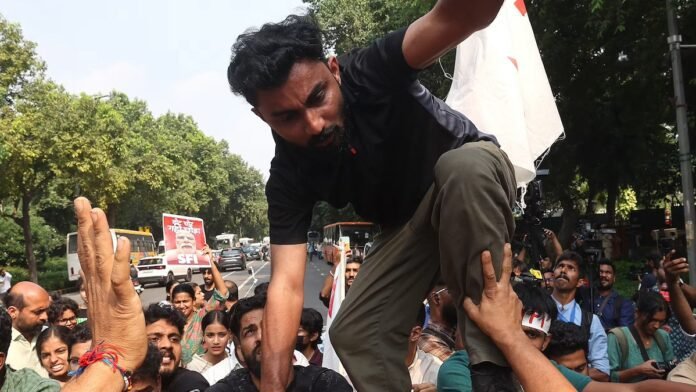
More than 25,000 police officers were deployed across New Delhi recently to prevent demonstrations led by India’s new youth-led political movement, the Cockroach Janta Party (CJP). Government authorities had denied the CJP permission to protest on public-order grounds.

The ensuing security operation saw the authorities shut one in six metro stations in the capital, barricade dozens of central roads and cancel over 250 trains in what Indian rail officials called an “unprecedented closure.”

Thousands of protesters were detained, with documented accounts of police brutality. While the epicenter is in Delhi, protests have been documented in five other major cities.

The protests underscore a paradox at the heart of Indian politics. On the one hand, they show just how far India’s democracy has declined. On the other, they offer up glimmers of the key ingredients needed for democratic renewal: widening political participation, greater opposition coordination and mobilization around concrete demands.

The protests grew out of discontent over a nationwide electoral roll review known as the Special Intensive Revision. The revision, which began in 2025, has removed more than 130 million names from eligible voter lists – almost a tenth of India’s entire population.

India’s Election Commission has led the revision and says it is necessary to remove duplicate and ineligible voters. But critics allege the review has political motivations.

Indian police detain a protester during a demonstration in New Delhi on October 13. Photo: Rajat Gupta / EPA via The Conversation

In the state of West Bengal earlier in 2026, almost 12% of registered voters were removed from voter rolls before India’s ruling Bharatiya Janata Party (BJP) sailed to an election victory in a state it had not previously governed.

One analysis found that in a large number of constituencies the BJP won, the number of deleted voters exceeded the party’s margin of victory. These events do not definitively prove that Special Intensive Revision deletions changed the state election results. But the pattern is troubling.

So when the Indian Express recently reported that Election Commission members themselves raised 14 objections to voter exclusion during the revision, all of which were overruled by Chief Election Commissioner Gyanesh Kumar, the CJP called for his resignation and took to Delhi’s streets.

All of this is occurring in the context of considerable democratic decline under Narendra Modi’s government. This has taken the form of executive centralisation, intensified use of anti-terror laws and growing media ownership concentration.

No democracy watchdogs currently classify India as a full democracy. In 2021, Freedom House downgraded India from “free” to “partly free”, while the Sweden-based V-Dem Institute now classifies the world’s most populous country as an “electoral autocracy.”

Arresting the decline

The protests are unlikely to arrest India’s democratic decline. Modi’s government is powered not just by the BJP, but also by the Rashtriya Swayamsevak Sangh. This is a century-old Hindu nationalist organization with well-organized networks extending into schools, unions, charities and neighborhoods.

The combination of deep grassroots organization and effective government control of the media makes Modi’s government extraordinarily capable of mobilizing supporters. These advantages help explain why Modi has remained in power for 12 years in a country historically known for turning incumbents out of power.

But the cockroach movement is getting three aspects of its political activism right. First, the movement has begun to restore a sense of political efficacy in India, or the belief that collective action can force a powerful government to retreat.

Earlier in 2026, CJP-led protests successfully forced Modi’s education minister, Dharmendra Pradhan, to resign over a scandal involving leaked exam papers. The stakes are extremely high. In a country where university graduates make up two-thirds of unemployed 20- 29-year-olds, success in such exams offers a rare pathway to upward mobility.

One indication that participation in the protest movement is now widening came from popular Indian YouTuber, Dhruv Rathee. In a recent interview, Rathee told the BBC that he was not a political figure but now felt compelled to participate in his first protest because “basically the foundation of our democracy is at stake here.”

The protests have brought together forces from across Indian society. Photo: Vipin / EPA via The Conversation

Second, the protests have brought together previously distinct forces across broad sectors of Indian society. For example, lawyers, farmers’ organizations and activists have come together to back the protests.

It is especially important to coordinate the CJP and the Indian National Developmental Inclusive Alliance (India) of opposition parties. This is because challenging a dominant party at the polls requires above all opposition coordination.

Opposition groups need not agree on every policy. The CJP is able to supply youth mobilization without the historical baggage of an established opposition party, while the India bloc can bring parliamentary representation and organization.

Third, protests are more effective when they coalesce around a clear and specific demand. Mahatma Gandhi’s 1930 Salt March, a 24-day, 240-mile march to protest the British colonial monopoly on salt production and trade, epitomized this strategy. It brought together broad social alliances in opposition to a discrete policy that could be reversed.

A focused demand, in this case the resignation of the chief election commissioner, also gives any movement strategic flexibility. This includes the ability to pause mobilization after concessions without entirely dissolving the coalition that produced it.

India’s incumbent government retains formidable advantages. The BJP has enormous organizational resources, and nearly three years remain before the next national election in 2029, though an upcoming 2027 election in India’s largest state of Uttar Pradesh will provide an important test of the government’s popularity.

That is ample time to outlast protests, exploit opposition divisions and wait for public attention to shift elsewhere. So, the recent demonstrations have not reversed India’s democratic decline.

But they have widened political participation, focused public attention on the institutions that underpin democracy and weakened the belief that public resistance is futile.

Maya Tudor is professor of politics and public policy, University of Oxford.

This article is republished from The Conversation under a Creative Commons license. Read the original article.


US Rep. Ilhan Omar challenges legality of FBI home search: WSJ

0
us-rep.-ilhan-omar-challenges-legality-of-fbi-home-search:-wsj
US Rep. Ilhan Omar challenges legality of FBI home search: WSJ

The defense of US Congresswoman Ilhan Omar have challenged the legality of a search of her Washington home, demanding that federal prosecutors immediately return all seized property and provide recordings made during the operation, The Wall Street Journal reported on Saturday.

In a letter sent late Friday, the Minnesota Democrat’s legal team argued that the search, conducted by Homeland Security Investigations agents early Monday under a federal judge-approved warrant, was “neither justified nor lawful.”

According to the Journal, the investigation focuses partly on how Omar, 44, obtained US citizenship after arriving from Somalia decades ago.

“There is no legitimate basis for any suggestion that she has violated any law concerning her citizenship status,” the letter said.

Her lawyers alleged that agents failed to follow the judge’s instructions, including a requirement to notify the US House general counsel before executing the warrant. They also said Omar and her attorneys were not given a copy of the warrant beforehand, as ordered by the judge.

The letter claimed agents prevented Omar from contacting her lawyers for more than an hour after the search began.

A Justice Department spokeswoman rejected the allegations, describing the letter as “riddled with false allegations and inaccuracies. Our attorneys and law enforcement partners complied with all court orders and legal obligations, as they always do.”

READ: Federal agents search US representative Ilhan Omar’s home in criminal investigation

Jeanine Pirro, the US attorney for Washington, defended the operation earlier this week, saying it had been approved by a federal judge mindful of constitutional protections.

“That judge would not have signed that warrant unless there was probable cause,” Pirro said on Fox News.

Omar’s lawyers also accused prosecutors of abusing the grand jury process through subpoenas issued in Washington and Minnesota.

“This vindictive, retributive, and politically motivated criminal investigation into one of the president’s chief congressional critics violates Representative Omar’s constitutional rights and threatens the separation of powers,” the letter said.

The search came three weeks before November’s midterm elections, in which Omar is seeking a fifth term.

The letter also accused the Justice Department of violating its longstanding practice of avoiding public investigative actions involving political candidates within 60 days of an election, a measure intended to prevent the appearance of partisan interference. Department officials have denied violating any policy.

“This search—which arose from a years-old, tired conspiracy theory concerning conduct stretching back decades—violated longstanding Justice Department policy concerning interference in elections,” the letter said.

Omar has long been targeted by President Donald Trump and conservatives, as well as GOP-led congressional investigations.

READ: Trump administration reopened citizenship probe into Rep. Ilhan Omar: Report

Jewish Educators Cancel Italy Study Trip Over Proposed Anti-Israel Declaration

0
jewish-educators-cancel-italy-study-trip-over-proposed-anti-israel-declaration
Jewish Educators Cancel Italy Study Trip Over Proposed Anti-Israel Declaration


Nearly 70 Jewish educators from US schools canceled an October 11–16 study trip to Reggio Emilia, Italy, after a proposed declaration asking visitors to distance themselves from Israeli policies in Gaza prompted safety concerns and accusations of antisemitism. The Italian host organization disputes that signing such a statement was ever required.

The Paradigm Project, a US professional network for Jewish early childhood educators, had organized the visit to study the city’s internationally recognized teaching methods. Organizers canceled the trip on October 7 after local activists questioned participants’ connections to Israel and reportedly examined their social media profiles.

A proposed declaration asked teachers to disavow the occupation of Gaza and violations of children’s rights in occupied territories. The American educators objected to being asked to take a political position concerning Israel’s government because of their Jewish identity.

Reggio Children, a partly municipally owned educational organization, said the additional language had been circulated for discussion but never formally adopted. Its official charter calls for respect for human rights, opposition to discrimination and war, and condemnation of genocide without naming a specific country.

“The text you quote was never adopted,” the organization said in a statement. It confirmed that a separate delegation of Israeli educators was attending the program as planned.

Reggio Emilia Mayor Marco Massari also denied that visitors were required to pass a political test. His earlier statements had acknowledged discussions about an additional commitment concerning Israeli government policies, contributing to conflicting accounts of the dispute.

US Special Envoy to Monitor and Combat Antisemitism Yehuda Kaploun welcomed the mayor’s clarification and expressed support for protecting visiting educators from intimidation.

Jewish community leaders in Italy criticized the proposed condition, arguing that Jews living outside Israel should not be expected to answer for decisions made by its government.

The controversy disrupted a longstanding educational exchange. The Reggio Emilia approach, developed after World War II by educator Loris Malaguzzi and local families, has influenced preschools internationally, including Jewish early childhood programs in the United States.

European Union leaders convene in Brussels

0
european-union-leaders-convene-in-brussels
European Union leaders convene in Brussels


European Union leaders convene in Brussels on Thursday for a packed ​summit to debate how best to curb surging exports from China blamed by industry groups for factory closures, how to cope ‌with high energy prices and how to bridge wide differences over the future EU budget.

The leaders from the EU’s 27 members meet less than a week after the European Commission secured an agreement with Beijing to limit imports of hybrid cars from China. It is a first step in what the EU hopes will be a broader plan to rein in ​the bloc’s goods trade deficit with China that hit €360 billion ($400.4 billion) in 2025 and is on course to surpass that level this year. ​The next EU-China meeting is planned for March.

Draft conclusions from the summit indicate leaders will request the EU executive, the ⁠Commission, to continue its dialogue with Beijing, while also making full use of EU trade defence measures and adding new trade instruments to protect the ​bloc further.

“These imbalances are not limited to one sector. We don’t have much time because every month that goes by, thousands of jobs are lost,” a ​senior EU diplomat said.

The summit comes as the bloc grapples with rising economic anxiety, which far-right parties are exploiting in elections. EU leaders tasked the Commission in June to produce concrete results in trade talks with Beijing by October. The hybrid cars deal was a first step, but the broader imbalance — spanning chemicals, steel and machinery — remains unresolved.

Beijing has said ​that hyping up the issue of economic imbalances is an excuse to promote protectionism and exert pressure on and restrict China.

GERMANY MAKES U-TURN ON CHINA ​IMPORTS

Franco-German proposals released last week are likely to be the focus of discussions. The EU’s two largest economies said there was an urgent need for measures to deal with ‌imports of ⁠chemicals and PET — the plastic widely used in packaging — and called for measures to retaliate quickly against countries that harm the bloc. An investigation into PET is expected to begin soon.

The paper marks a sharp turn for Germany, which only two years ago was the most vocal critic of EU anti-subsidy tariffs on Chinese electric vehicles.

The summit will kick off at 10 a.m. (0800 GMT) with a broad debate about EU competitiveness, of which relations with China are part. Several EU ​countries have also put high energy prices ​on the agenda, which the ⁠draft conclusions call an issue of “critical importance.”

The conclusions point to proposals already made by the European Commission, such as a one-year delay to the EU’s methane emissions rules for oil and gas imports and ask the EU executive to come ​up with further short-term measures.

EU leaders will also on Thursday discuss the bloc’s next seven-year budget, which requires unanimous approval ​and often produces the ⁠EU’s most divisive negotiations between net contributors and net recipients. The 2028-2034 budget is no different, with a special summit set for late November to try to reach agreement.

One of Friday’s main topics will be the challenges facing Ukraine, with President Volodymyr Zelenskiy due to attend. Leaders are likely to discuss Ukraine’s funding needs for ⁠2027. The ​draft conclusions indicate leaders will also express regret over the US decision to temporarily lift ​sanctions on Russian diesel.

US President Donald Trump said at the weekend Zelenskiy should be replaced as Ukraine’s leader. Zelenskiy received a strong show of support in London on Wednesday.

Trump protects Putin from Graham-Blumenthal bill

0
trump-protects-putin-from-graham-blumenthal-bill
Trump protects Putin from Graham-Blumenthal bill

The late Senator Lindsey Graham with Trump. It was clear from the start that The Graham-Blumenthal Bill would do little, if anything, for Ukraine.

The single most predictable action of the Trump second presidency happened just a few hours ago. Trump signed an executive order that exempted Russia from all of the key possible sanctions that could have been placed on it by the Graham-Blumenthal bill. Here is a link to the order and here is how it opens.

The specific sanctions lifted (in other words, the ones that will not take place), include:

  1. The rate of duty on goods from the Russian Federation shall be increased by 500% ad valorem …
  2. The rate of duty on goods from the largest five importers of crude oil and natural gas that originated in the Russian Federation shall be increased by 100% ad valorem …
  3. The rate of duty on goods from the top five facilitators of Russian oil sanctions evasion shall be increased by 100% ad valorem …
  4. The increases in the rates of duty provided by this order shall apply in addition to any other duty, fee, tax, exaction, or charge applicable with respect to the good …

Even more extraordinary, Trump made sure to waive the monitoring clause, which was supposed to be the tool to track what was happening in Russia on these issues. 

In other words, he has used Graham-Blumenthal to protect Russia further, which is the least surprising thing possible. Look, as was said in early September, this version of Graham-Blumenthal was always part of the Trump con and was never going to force Trump to do anything to hurt Putin, contrary to what its backers were proclaiming.

By the way, Lindsey Graham himself, the chief proclaimer of this bill before his passing, was either a witting or an unwitting part of the con. He acted as if a bill such as this might help Ukraine, when it was never going to do so. The bill as constructed, if passed, was never going to be used to hurt Russia (or China) because Trump always held the ultimate power in his hands. So it was all a shell game being played to deceive people. Here was the conclusion of that section of the piece.

So Graham-Blumenthal might not give him any more powers than those he believes he already has, and if it does give him more powers, it will not be used to help Ukraine or hurt Russia. That is why it is part of a con. 

So, all we are really left wondering now is whether the bill is used to hammer Ukraine’s European partners. It will certainly never be used on China, which is actually the country most at risk if you read the bill closely.

However, the bill has achieved one important thing. It forced Trump to do a cravenly pro-Putin (and unpopular) move less than three weeks before the US midterm elections. It also forced him to do it at the end of a week in which he also made two other unpopular pro-Putin moves. These include the diesel purchase from Russia and the Starlink/Spaceshield freeze or limitation on Ukrainian military operations over Ukraine.

In that sense, passing Graham-Blumenthal ended up being a good thing. Trump is already sweating about the damage his pro-Russian steps are doing to his own popularity and GOP prospects in the midterms. He would not have wanted to take such a step as exempting Russia at this time, but he had to because he was never going to allow a step to be taken that would do material damage to Putin’s Russia.

So this will make his cravenness and Republican weakness to dictatorship and hostility to democracy a major news story for a while longer. It might empower a new Congress to take more aggressive action. That was the one good thing I could see from the bill long-term when I wrote in the September piece: 

However, the November elections do hold out the possibility of installing a new Congress which will try to take back the powers of the legislative branch and stand up to the White House. In that case, having a Congress that establishes that it can play an active role in tariffs/sanctions would be a useful precedent. Indeed anything now that establishes Congress’s power is a good thing.

For those who say do not vote for it as it gives Trump power to tariff Europe / Japan / South Korea – well, he already seems to believe he has that power. If he then says, “Aha, Graham Blumenthal validates my power,” he is actually admitting Congress has a key role to play. That could bite him in the derriere starting in late January when the new Congress is seated.

The vast majority of Americans will never vote on foreign policy, particularly for midterms. That has to be understood. But if this further makes it clear to the American people that the USA is being run by a pro-Putin crime syndicate that is spreading corruption far and wide, that might help sway a few votes. It is heartening to see, in one poll, that worry about corruption in the US government is now the number one concern of Americans. If that is true, this story will only reinforce that fear.

So it was a good thing that Graham-Blumenthal was passed, an entirely predictable thing that Trump made sure that nothing was done to damage Russia with it – and all we can do is hope that it politically has the effect that it might on the US midterms.

Phillips P. O’Brien is a professor of strategic studies at the University of St. Andrew. This article was originally published here, on his Substack, Phillips’s Newsletter. It is republished with permission.

Why BioWare’s Neverwinter Nights still has thousands of active players

0
why-bioware’s-neverwinter-nights-still-has-thousands-of-active-players
Why BioWare’s Neverwinter Nights still has thousands of active players

Neverwinter Nights was made by the studio that produced seminal RPGs Baldur’s Gate, Star Wars: Knights of the Old Republic, Mass Effect, and Dragon Age. It sold well and was critically acclaimed at launch. Yet, somehow, it has not been canonized in most gamers’ minds over the decades the same way the games that came before and after it were.

Nonetheless, more than two decades later, it still has a tight-knit and surprisingly active community that none of those other games can rival. I think that’s partly because it was a completely different beast.

BioWare is known for making multi-character, story-driven role-playing games that focused primarily on single-player story campaigns, though some supported co-op play in those campaigns. With Neverwinter Nights, BioWare instead made a game that was as focused on a modding toolset for content creation as it was on giving players a pre-packaged story, and that emphasized multiplayer at least as much as solo play.

Today you would expect this to be a calculated attempt to bring more long-term, always-on, multiplayer-as-a-service to an RPG franchise that has mostly appealed to solo players. You might imagine it would be about selling cosmetics, a subscription, or a battle pass, or maybe you would think it was about nabbing appealing engagement numbers.

But it’s clear from playing it today that Neverwinter Nights wasn’t primarily made for those reasons. Instead, it came from a passion for tabletop role-playing and a desire to get closer to that in video game form than ever before.

Yes, the BioWare team noted in some interviews that they saw this as a trial run for exploring the idea of making a massively multiplayer game (MMO)—something that, in the year 2000, was seen by many as the hot new business opportunity in gaming, and which was in many ways the precursor to the games-as-a-service we see today. They then indicated they realized that an MMO was harder to make than they had assumed and abandoned that ambition well before Neverwinter Nights shipped.

Neverwinter Nights is not exactly an MMO. Instead, it’s designed for small communities of people to inhabit and create with, and it features a powerful toolset for virtual dungeon masters to use to subject regular players to challenges in an improvisational way on a live server.

“We always envisioned it as a table with four legs—the single player, the multiplayer, the DMing tools and the toolset (the module making tools),” BioWare’s Ray Muzyka told IGN around the time the game was released. “They all appeal to different groups, and we’ve tried to make them all equivalently high quality.”

Over the past month, I’ve been replaying Neverwinter Nights‘ main story campaign, The Wailing Death, as a solo player, for the first time in 20 years. The nostalgia has been strong in this replay, but I have also found that BioWare didn’t quite nail “equivalently high quality” for all the pillars. Still, it doesn’t matter, because as we’ll see when we check in with the game’s community, the campaign is not the point.

Table of Contents

The single-player experience is… fine

“The single player experience has to be as good as anything we’ve ever done in [Baldur’s Gate], [Baldur’s Gate 2], or Throne of Bhaal and hopefully better,” Muzyka told IGN. “Our goal here at BioWare is that each game we do has to be better than the previous one.”

If single-player is one of the legs, it might be fair to call Neverwinter Nights‘ table a little wobbly. It still stands, but you know how irritating it can be.

For example, Neverwinter Nights leaves behind Baldur’s Gate or Icewind Dale‘s party-based systems, and instead has the player controlling just one character directly. It makes sense for a multiplayer game, but doesn’t work as well for a single-player experience in this case—at least with the Dungeons & Dragons rules of the time.

I chose to play a monk, a martial arts specialist, simply because I’ve always been drawn to that particular fantasy identity, and because I’d never played one in a D&D game. I regretted that decision after a while.

For many of the character levels covered in The Wailing Death, the monk basically just picks between two fighting modes: one that misses more but attacks more frequently, and one that’s just normal. That, along with some intense restrictions on which weapons or armor can be used while keeping all their benefits, and a couple of knockdown and stun attacks that often don’t work, make up the whole kit for many hours of playtime, particularly in the first act. (It does get better later on, though.)

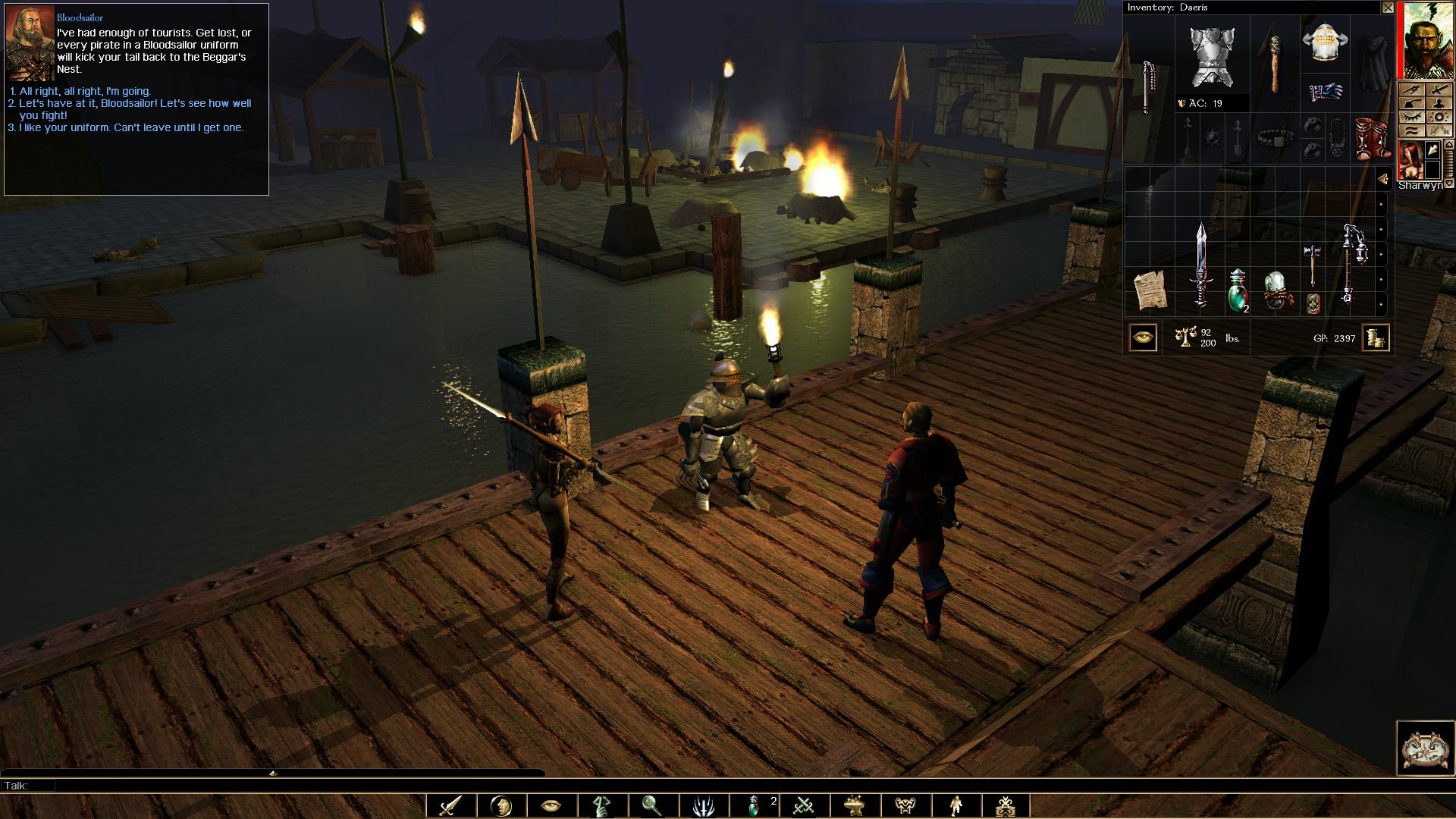
The player character talks about pirates on a dock in a plague-sticken city

The original campaign is fun and nostalgic, but it’s arguably not BioWare’s best.

The original campaign is fun and nostalgic, but it’s arguably not BioWare’s best. Credit: GOG

A kit like this makes sense in a pen-and-paper RPG with a live dungeon master (DM), because the player and DM can work together to invent creative expressions of their abilities, and it works in a party in a video game because it’s just one of multiple complementary characters with a wide range of skills and spells.

But for a game that is about 80 percent battling enemies without controlling any other characters, it gets monotonous quickly. There aren’t as many meaningful character builds, gearing, or tactical choices as you’re used to in some other RPGs until quite a ways into the campaign. Often, you just run in and watch the dice roll until either you die or the enemy dies, while sometimes drinking potions.

This problem is less severe with some other classes, but the tension is usually there to some degree.

Whereas Baldur’s Gate 2, for example, had a partial authored background for your character that then played into the narrative, Neverwinter Nights leaves you as an Elder Scrolls-like blank slate. I normally love that! It’s good for role-playing with friends, because you can make up your own character completely. But it means the story can’t be character-driven, and the gameplay doesn’t provide enough flexibility or freedom in return.

Still, I enjoyed my experience with the campaign when I replayed it recently, even if it couldn’t match Baldur’s Gate 2, Knights of the Old Republic, Mass Effect, or other BioWare classics for me personally. While the story wasn’t anything special by BioWare’s standards, there was something genuinely cozy to me about the genericness of the narrative. It took me back to an earlier time in CRPGs, before things got quite so precious. “This is just like D&D!” was still enough to sell it on its own. Maybe it’s just nostalgia, though.

Since most people played the game solo, and it was a relatively small portion of the player base that dove deep into the construction kit or DM tools, I think this is the main reason Neverwinter Nights has not achieved the same pantheon status as other BioWare titles that came before and after it.

But for those lucky few who were invested in those other table legs, it actually was quite special—and amazingly, it remains so today.

The persistent worlds of Neverwinter Nights

“The main thing I would shout from the rooftops if I could, is that firing up Neverwinter Nights and launching its original campaign… does not do justice to what Neverwinter Nights has become since,” a longtime player named Daniel Morris told me. He goes by Irongron in the community, and he runs Arelith, which is both one of the OG persistent multiplayer servers and one of the most popular servers today. Morris is also working on a visual overhaul of the original campaign; he hopes to release it next year.

Arelith hit its peak player count “a little less than two years ago,” as Morris tells it—not way back when the game was new. “Our community is the heart of Arelith, it’s not just our audience, but where we find our DMs and developers,” he said.

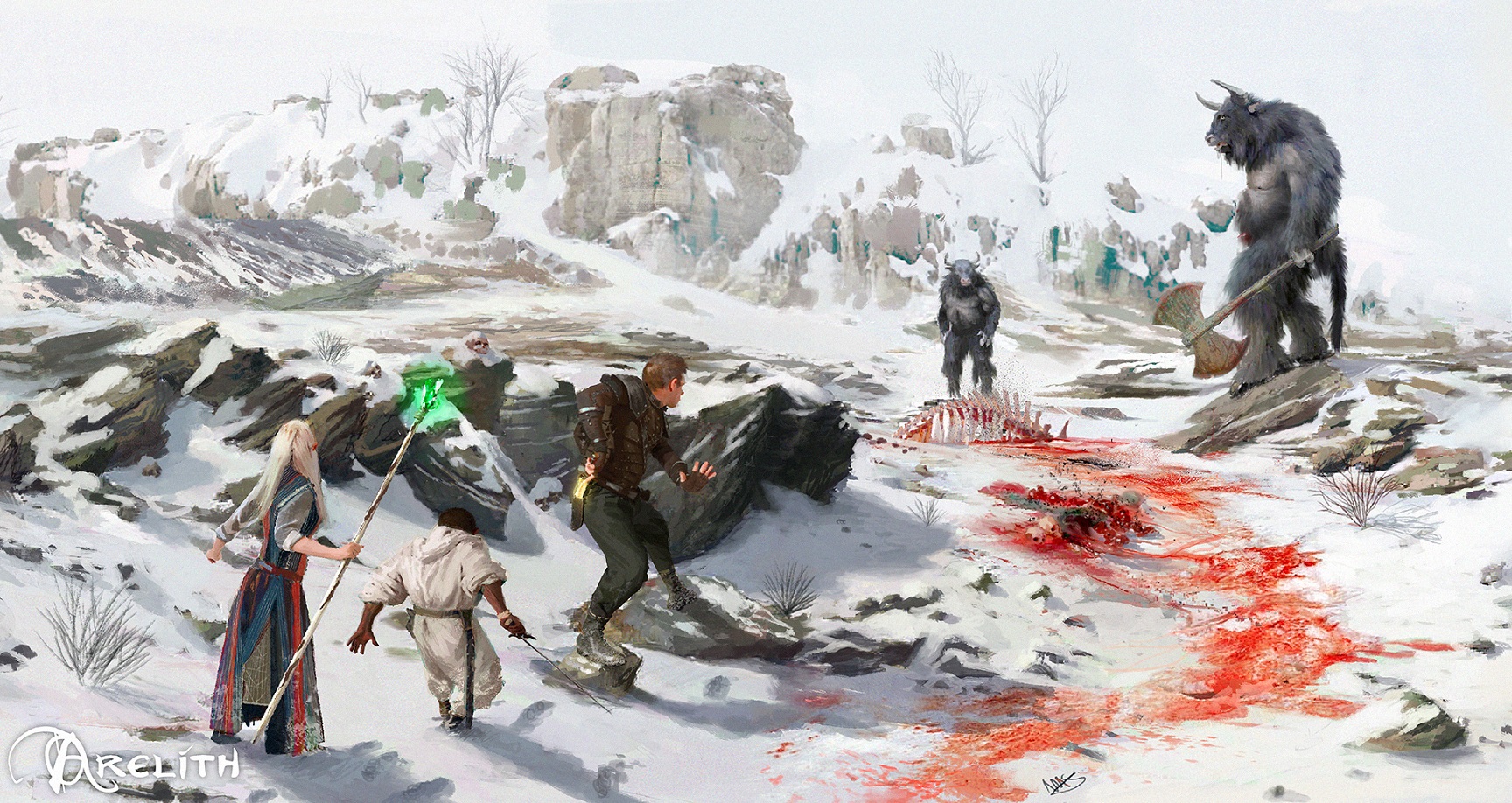
Adventurers battle in the snow

Arelith is a fountain of creativity; for example, this is original artwork commissioned for the game’s loading screens from artist Matheus Graef.

Arelith is a fountain of creativity; for example, this is original artwork commissioned for the game’s loading screens from artist Matheus Graef. Credit: Matheus Graef

I spent many evenings in my younger days playing multi-user dungeons (MUDs), the text-based online role-playing games that preceded MMOs like EverQuest or World of Warcraft. While there were big MUDs, many were small communities of just one or two dozen people, and often, those same people were the ones actually making the game’s content. For example, I was a room builder for one MUD; I wrote the descriptions for places in the MUD’s world and decided which monsters, NPCs, or items inhabited those places.

Neverwinter Nights‘ multiplayer platform and community—both as it was back in the 2000s and as it is today—reminds me of those MUD days. There’s an ownership of that shared world that is entirely lost in the MMO days, perhaps more akin to a modern, small Minecraft server than an MMO with thousands of users.

That seems to be part of the appeal for a player I spoke with who goes by the name NelaK in the community, and who has, among other things, taken over maintenance and moderation of the Neverwinter Vault, the community’s de facto hub for two decades. The website hosts news, patches, assets, mods, a forum, a wiki, and an associated Discord server.

“It’s not an MMO, and that’s a good thing in my opinion. The communities are smaller, which means your roleplay and your actions matter and can affect the world,” said NelaK. “The world itself can be tailored around what the players want. That’s a unique thing that you can’t get from an MMO or from smaller-scale multiplayer games. It sits in a sweet spot where you can have enough players that it feels like a proper community and a world you can engage with while you can still matter.”

Baldur’s Gate and Icewind Dale did have multiplayer, where each player could control one or more characters directly. As noted, Neverwinter Nights limits each player to one character, but it adds a new role: a dungeon master, who can spawn enemies, occupy and act as NPCs, and more, to aid in group storytelling, similar to a pen-and-paper game.

“While Arelith is essentially a mini MMO, many of the other servers pride themselves in running highly curated, beautifully crafted campaign worlds much closer to tabletop role-playing game emulator that Neverwinter Nights was first intended as,” Morris told me. He called Neverwinter Nights “a direct translation of the tabletop role-playing game experience into the digital sphere.”

It’s as much a construction kit as it is a game

The game’s modding kit and easy-to-use scripting tools let players build scenarios relatively quickly. It essentially let players build a little RPG world, run it, and inhabit it. It was a bustling scene back then, and there’s still a community doing this today. The combination of the relative simplicity of the graphics and the elegance of the tools make this toolset an unusually excellent balance between flexible, powerful, and easy to learn.

“The tile-based areas are basic and limiting in some respects, but they do mean that building areas is quick and easy,” explained NelaK. “It’s much more approachable than a lot of other platforms.”

For NelaK and some other members of the game’s community today, the game’s tools aren’t just the remaining appeal—they’re the main appeal.

“I’ve been playing Neverwinter Nights since launch day. I remember one of my friends dragging me along to the store because they really wanted the game and I went just to keep them company,” he remembered. “I ended up buying it, and I’ve been hooked ever since, but to this day, I’ve still never played through the original campaigns… and yet I’ve played Neverwinter Nights or spent time building or working on something Neverwinter Nights-related most days since.”

I toyed around with the tools quite a bit back in the day. I remember re-creating a big chunk of the world of my favorite MMO at the time, Meridian 59, with the intent to make a story-driven, single-player campaign for that game; Meridian 59 had very little narrative as it was.

I also remember that Neverwinter Nights was for many years a common way for would-be narrative designers to make a portfolio piece for applying for jobs within the games industry. When I was in college, a close friend of mine (Brian “Psychochild” Green, who at the time co-ran Meridian 59, and sadly has since passed) offered to show my Neverwinter Nights modules to some friends of his at BioWare if I wanted to interview for a job there to write for their next game, which, based on timing, probably would have been Mass Effect. I declined in order to focus on other priorities I had at the time, for better or worse.

Similarly, many (though certainly not all) people in the community have professional backgrounds closely related to, or at least adjacent to, game development.

“Neverwinter Nights provides a unique intersection of where I can apply my technical and professional skills along with my interest in video games and do it for something that doesn’t feel like work,” said NelaK. Morris specifically noted that several members of the Arileth team work or have worked in the games industry or software development.

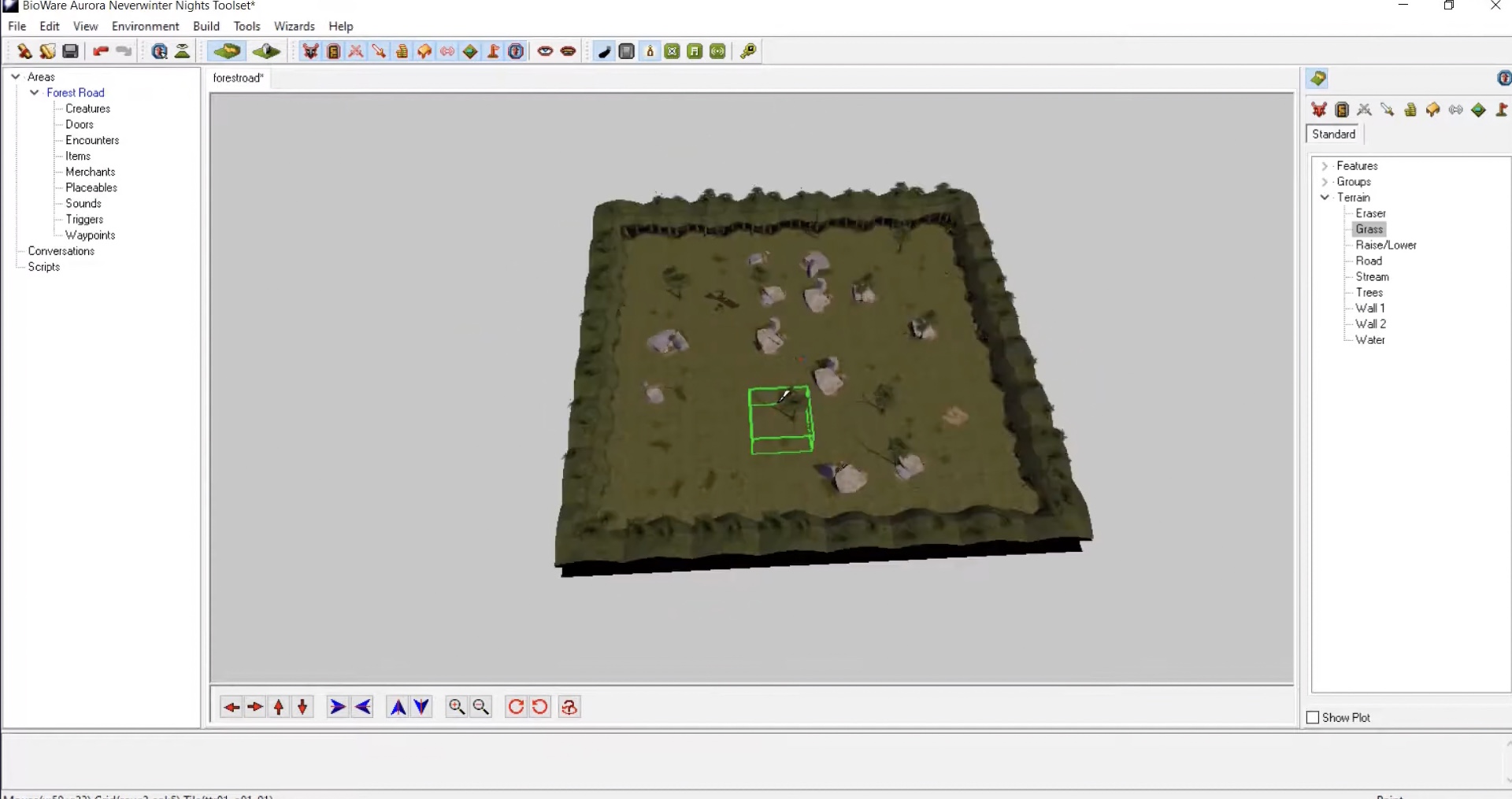
A 3D area with controls around it in a Windows interface

The Neverwinter Nights toolset.

The Neverwinter Nights toolset. Credit: RPG Design Workshop

This is the game’s legacy, not the story campaigns that shipped with the game. And that explains the game’s relative obscurity today: that’s a more niche appeal than a really good, story-driven, single-player RPG. But for the people who are into it, there’s nothing else that quite compares.

Returning to Neverwinter Nights today

I don’t imagine most people still regularly see references to Neverwinter Nights, but I sometimes do. For the past couple of years, I’ve enjoyed the dark fantasy trend on TikTok. These are short, vertical videos set to a particular kind of 1980s fantasy-type medieval synth music, depicting imagery from what feels like a long-lost, strangely nostalgic subgenre of fantasy media that is more implied in our memories’ liminal space between real fantasy movies and books of the ’80s and early ’90s than it is something that actually specifically existed.

It turns out Neverwinter Nights‘ assets fit that milieu quite well, so I sometimes saw videos of people creating online Neverwinter Nights servers meant to capture that vibe. It’s niche as hell, but it’s there. The TikTok videos from one of the game’s servers were actually how I got inspired to try the game again.

“Over the last year there’s been a bit of a resurgence, with new servers going live, and others going viral,” Morris told me. Some player-run servers “have had hundreds of thousands interacting with their TikTok videos.”

He added that his own community’s Discord server has 5,000 members, and that’s just one part of the game’s wider audience.

If you want to get back into the game or try it for the first time, you can buy the Enhanced Edition on GOG and other storefronts; a front-page poll on the Neverwinter Vault indicates that about 65 percent of the community primarily uses that version, as compared to previous releases or the sequel, Neverwinter Nights 2.

If you want to try the single-player, the Enhanced Edition comes with a plethora of officially sanctioned campaigns of varying quality—not just The Wailing Death.

But let’s say you, like some members of the game’s current community, are more interested in multiplayer than single-player. A good place to start is the Neverwinter Vault. Additionally, Enhanced Edition developer Beamdog hosts a list of active community servers you can join.

As I write this, a few hundred people are playing across a couple dozen servers, which is impressive. I love to see old games like this keep the community going. It’s especially important for Neverwinter Nights, because more than any other BioWare game or even most other RPGs in general, this game is its community.

Madonna Slammed Over Bizarre MTV Awards Performance (Video)

0
madonna-slammed-over-bizarre-mtv-awards-performance-(video)
Madonna Slammed Over Bizarre MTV Awards Performance (Video)


Pop superstar Madonna is facing a new wave of criticism following her appearance at the 2026 MTV Video Music Awards, with some insiders questioning her behavior and suggesting the 68-year-old singer is struggling to adjust to a changing music industry.

The Queen of Pop returned to the VMA stage on September 27 for the first time in 23 years, delivering an elaborate opening performance alongside younger stars Sabrina Carpenter and Charli XCX.

It should have been a triumphant night for the music legend.

After all, Madonna walked away with seven awards, including the prestigious Artist of the Year honor, proving that her influence remains enormous more than four decades after she first became famous.

But according to a new report from RadarOnline, not everyone was impressed by her return to the spotlight.

Anonymous sources criticized the singer’s stage presence, revealing outfits and acceptance speeches, with one claiming that people close to Madonna were concerned about her recent public appearances.

“She needs to stop trying to act like a teen idol and act her age,” one source told the outlet.

The criticism centered on Madonna’s appearance during the star-studded ceremony in Los Angeles.

The singer arrived wearing a revealing black corset, fishnet stockings and towering heels, embracing the provocative image that has defined much of her career.

Her opening performance featured a medley of songs from her latest musical project, Confessions II, along with an appearance by Carpenter for their collaboration, “Bring Your Love.”

Charli XCX also joined Madonna for “Danceteria Afterhours,” transforming the performance into a celebration of several generations of pop music.

The production included dancers, elaborate staging and celebrity appearances, with portions of the performance set inside a stylized nightclub bathroom.

Among the familiar faces were actress Julia Garner, comedian Seth Rogen and longtime Madonna associate Debi Mazar.

For many fans, the appearance was a reminder of Madonna’s reputation for theatrical performances and her willingness to challenge expectations.

But unnamed insiders quoted by RadarOnline offered a less flattering assessment.

One source alleged that Madonna appeared distracted and uncertain during portions of the ceremony, describing her opening performance as unfocused.

Another claimed the singer’s acceptance speeches raised eyebrows among people watching the show.

The outlet also reported that Madonna appeared confused while accepting an award for Best Dance, suggesting she did not immediately recognize what she was being honored for.

That award was presented for Confessions II – The Film, one of several categories in which her latest project was recognized.

However, the claims about Madonna appearing confused or behaving unusually reflect the opinions of anonymous sources. There is no verified evidence that she was experiencing a medical problem during the ceremony.

The singer has not publicly confirmed any health-related explanation for her appearance.

Another moment attracting attention involved her collaboration with Sabrina Carpenter.

According to the report, Madonna made comments suggesting Carpenter had not responded quickly enough to messages about their work together.

The alleged remarks came as the two celebrated their successful collaboration, which won Best Collaboration.

What Madonna intended by the comments remains unclear, and there is no confirmed indication of a serious dispute between the two performers.

The collaboration itself marked an important moment for both artists.

Carpenter, who has become one of pop music’s biggest contemporary stars, has frequently drawn inspiration from performers who came before her.

Madonna, meanwhile, has continued seeking opportunities to work with younger musicians and introduce her music to new audiences.

That approach has been a defining feature of her career for decades.

During the 1990s and 2000s, Madonna repeatedly reinvented her sound and image, collaborating with different producers and adapting to emerging musical trends.

Her ability to change with the times helped her remain commercially successful long after many of her contemporaries had faded from the charts.

Her latest VMA success suggests that her creative work continues to resonate.

According to MTV’s official results, Madonna won Artist of the Year, Best Collaboration, Best Dance, Best Long Form Video, Best Album, Best Cinematography and Best Choreography.

She also led the nominations with 11, an impressive achievement for an artist whose recording career began in the early 1980s.

But her continued success has not prevented criticism of her appearance, fashion choices or personal life.

RadarOnline’s sources suggested that Madonna’s willingness to wear revealing outfits and date younger men reflected a desire to remain relevant.

One insider singled out her relationship with Akeem Morris, a former soccer player who is several decades younger than the singer.

The couple’s age difference has attracted considerable attention since their relationship became public.

However, Madonna has never suggested that her relationships are intended to generate publicity, and the claims about her motives remain speculative.

The criticism also reflects a long-running debate surrounding the singer.

Throughout her career, Madonna has faced intense scrutiny for refusing to conform to expectations about how women should dress, behave or express themselves as they grow older.

Her provocative performances were controversial even at the height of her commercial success.

In 1984, she shocked audiences with her now-famous rendition of “Like a Virgin” at the inaugural MTV Video Music Awards.

That performance, featuring Madonna rolling across the stage in a wedding dress, became one of the most memorable moments in VMA history.

More than four decades later, she continues to attract attention through a similar combination of music, fashion and theatrical spectacle.

The singer has also faced serious health challenges in recent years.

In June 2023, Madonna was hospitalized with a severe bacterial infection that forced her to postpone the opening of her Celebration Tour.

She later returned to the stage and completed the tour, including a massive free concert in Rio de Janeiro in May 2024 that drew an estimated 1.6 million people.

That recovery demonstrated her determination to continue performing despite the physical demands of touring.

Her 2026 VMA appearance represented another milestone, bringing her back to the awards show that helped establish her reputation as a pop culture trailblazer.

The performance also introduced material from Confessions II, a follow-up to her influential 2005 dance album Confessions on a Dance Floor.

The original album produced hits such as “Hung Up” and “Sorry” and became one of the most successful dance-pop releases of its era.

Its successor has continued Madonna’s exploration of electronic music while involving a new generation of collaborators.

Despite the controversy surrounding her latest appearance, the singer’s seven VMA wins offer a reminder of her continued importance within the industry.

The ceremony

Dems Have an Opportunity to Force an End to the Iran War. Will They Take It?

0


For months, Democrats have forced Republicans to take vote after vote on President Donald Trump’s unpopular war on Iran. Now those votes could help Democrats retake Congress — and they will immediately have opportunities to follow through on their anti-war rhetoric.

Democratic leaders like House Minority Leader Hakeem Jeffries of New York have been cagey about their strategy on Iran for the lame-duck period before the next Congress is sworn in on January 3. So far, months of Capitol Hill maneuvering have produced few concrete results. And one path to potential progress for ending the war is laden with risk: threatening a government shutdown.

Opponents of the war say that, with Democrats pushing for support based on their efforts to end to the war, they owe it to voters to put government spending on the line.

“It will certainly demonstrate whether Democrats are willing to stretch themselves and put up a fight and get uncomfortable,” said Hannah Morris, the vice president of government affairs for the liberal, pro-Israel group J Street, which opposes the conflict. “So much of the rhetoric has been about the Iran war.”

In the months since the conflict began on February 28, Democrats and the handful of Republicans opposed to the war have poured most of their energy into votes based on the 1973 War Powers Resolution, which limits the president’s power to wage war without congressional approval. In June, they succeeded in securing House and Senate passage of a war powers resolution, but the Trump administration has ignored the vote, arguing the law is unconstitutional.

Advocates still believe the Trump administration should be bound by the June resolution, but they concede that other paths may have more teeth.

If they really want to stop the war, Democrats will have to confront questions of timing, divisions within their own caucus, and the risk of a government shutdown.

One prime opportunity could be the December 11 expiration of a spending bill called the continuing resolution that has been funding the government since the last shutdown. Democrats could attempt to attach a rider to the bill prohibiting the use of any of its funds for the Iran war. If that bill does not pass both chambers, the government shuts down.

The process will provide Democrats with rare leverage before the next Congress is sworn in.

Congressional Democratic leaders have not said whether they are willing to risk a shutdown, however. Jeffries did not tip his hand when he was asked during a recent interview with CNN.

“Listen, we’ll deal with the appropriations process when we deal with the appropriations process,” he said. “Right now, the mechanism that is in front of us will be to aggressively move war powers resolutions until we end this war in the best interest of the American people.”

Some Democratic candidates in hotly contested races have gone much further than Jeffries, zeroing in on the appropriations issue. Rep. Tom Barrett, of Michigan’s 7th Congressional District, was one of the few Republicans to vote for an Iran war powers resolution. But environmental activist Will Lawrence still attacked him at a recent debate on the issue of war funding.

Morris, who is part of a coalition of groups that have called on Congress to cut off funding for the war, said she is not sure how aggressively Democrats will be willing to pursue the issue during the lame-duck period.

“Will they be willing to shut down the government over this? I don’t have real answers. I think there are a lot of variables here,” she said.

Another option supported by many advocates is the pending debate over the National Defense Authorization Act, the annual Pentagon budget and policy bill. Critics of the war argue that Congress could attempt to insert a provision into the law cutting off authorization for the conflict.

Democrats should be willing to block the bill if it does not include “meaningful restrictions” on the administration’s ability to wage the war, said Hassan El-Tayyab, legislative director for Middle East Policy at the Friends Committee on National Legislation.

“That’s the mandate we’re seeing from the American people,” he said. “They shouldn’t pass a massive defense bill while leaving the administration free to pursue yet another open-ended war in the Middle East.”

The defense bill is generally considered “must-pass” legislation on Capitol Hill, providing leverage for Senate Democrats who could block it with a filibuster. The office of Sen. Jack Reed, D-R.I., who plays a key role in the process as the top Democrat on the Senate Armed Services Committee, did not respond to a request for comment.

Falling short of either of those paths, Democrats could continue to try to pass more war powers resolutions. With their party poised for a dramatic shift in its favor in the midterm elections, Democrats could even try to exert pressure on Republican legislators to vote in favor of the resolutions, some opponents of the war believe.

Democrats could also wait until January, when they are widely predicted to retake control of one or both chambers of Congress. Holding the gavel in the House or Senate will give them vastly expanded powers to set military spending and launch investigations into the conduct of the war.

One key Democrat, Rep. Adam Smith of Washington, told The Intercept in a statement he was willing to pursue multiple paths to stopping the war, but all of them face obstacles until the next Congress.

“I am open to exploring options for using the NDAA or appropriations bills as a way to end the war,” said Smith, the ranking member of the House Armed Services Committee. “That effort would most likely require bipartisan support. Unfortunately, I am not confident that there is sufficient Republican will or support for such legislative efforts or to override an inevitable veto.”

Whether in this Congress or the next, cutting off spending for the war appears to be the best way for Democrats to force the Trump administration to negotiate with Iran, according to Brian Finucane, a former State Department official who serves as a senior adviser at the nonprofit International Crisis Group.

“If they are serious,” he said, “they should be willing to play hardball, and that would require using the power of the purse.”

Science says your boss should talk less in meetings

0
science-says-your-boss-should-talk-less-in-meetings
Science says your boss should talk less in meetings

Close to 1 billion meetings take place each day around the world. CEOs spend nearly three-quarters of their workdays in meetings. Planning for and spearheading meetings eats up the lion’s share of managers’ time. In much of the industrialized world, meetings are both the metronomes and menaces of people’s working lives.

Given the enormous time spent in workplace meetings, do we know what they accomplish or how to make them as worthwhile as possible? For decades, the answer was… not really. Meetings weren’t a particularly accessible subject of study. But that has changed. Once a tiny niche area, “meeting science” is a growing specialization among organizational and social psychologists. The field is accelerating as archived virtual meetings provide vast swaths of data. And it is providing a fascinating window into human behavior.

Meeting to talk helps fulfill basic human needs to connect, communicate, and cooperate. People have long come together—in caves, fields, market squares, and town halls—to get something done, share ideas, get on the same page, or just to remark on the weather. But meeting scientists define their subject as gatherings of people “with some goal or structure to the event,” says organizational psychologist Liana Kreamer of the Florida Institute of Technology, who coauthored a review of over three decades of meeting science in the 2026 Annual Review of Organizational Psychology and Organizational Behavior.

As a graduate student, Kreamer was interested in studying teamwork, leadership, and work relationships. During her doctorate work with meeting scientist Steven Rogelberg, she realized that meetings would be a fine venue for studying all of that and more. “You can use a meeting as a stage to study anything you want,” she says. After all, at their core “meetings are a fundamental aspect of how we organize and interact as social beings,” Kreamer and coauthors Rogelberg and Jon Gray, both of the University of North Carolina in Charlotte, wrote in the 2026 article.

To tap meetings for study, researchers typically use two approaches. The first is a classic survey in which researchers retroactively ask people about their real or simulated meeting experiences and analyze the responses. The second method is to analyze specific behaviors and trends extracted from audio and video recordings of meetings. Such precise content is “where the music is,” says industrial and organizational psychologist Nale Lehmann-Willenbrock, director of the Center for Better Work at the University of Hamburg, Germany.

In one experiment, Lehmann-Willenbrock and colleagues extracted data from video-recorded meetings to study how leader communication affects team interaction during decision-making. The researchers found that respectful, attentive inquiry by meeting leaders enhanced team performance, in contrast to when leaders asked questions but didn’t attentively listen to responses.

Leading with listening

As with many meeting science studies, their findings about what improves meetings’ effectiveness often seem obvious, but meeting researchers note that meetings often stray far from these ideals.

Such research also consistently reveals the importance of active listening, says Lehmann-Willenbrock: not just passive acknowledgement by the listener but actively providing thoughtful feedback. In virtual meetings, because “we’ve all learned to mute ourselves if we’re not talking, very often, active listening is killed completely.”

The balance of listening and speaking also can influence how well a meeting goes. Meeting leaders and participants may retain very different views of whether a meeting was successful, notes Lehmann-Willenbrock. “Often, leaders talk the most, which is also why they often think their meetings are pretty good,” she says. Kreamer also emphasizes that it’s important that meeting leaders lead but not dominate the discussion. Leaders should monitor the proportion of time they are speaking to allow for inclusion of many voices.

Research supports a checklist of additional things that leaders can do before, during, and after a meeting to make it a success, says Lehmann-Willenbrock. To set the stage, leaders should choose appropriate rooms, refreshments, and lighting, invite only those who need to be there, plan to start and end on time, prepare an agenda, set and communicate clear goals, and allow time for pre-meeting conversation.

Socializing first, especially in virtual meetings, is beneficial, Lehmann-Willenbrock says. Her research has shown that “for more introverted participants and more quiet participants, this warmup phase is really helpful because it helps them make more active contributions inside the meeting.”

Indeed, her studies on face-to-face meetings have shown that pre-meeting small talk predicts meeting effectiveness, particularly for more introverted participants. But pre-meeting talk is rare in virtual meetings; she says leaders should consider establishing a norm of arriving early or using the first few minutes for an informal check-in.

Engaging attendees

Facilitators can increase the likelihood of a successful meeting by making sure all opinions are heard. Kreamer recommends a technique called silent brainstorming to get all participants, even shy and reluctant ones, to engage in idea generation. It involves creating a shared virtual space, such as a chat or online document, to which all participants contribute simultaneously. Kreamer points to a 2009 study that found this approach (some researchers call it “brainwriting”) was more effective than traditional free-for-all spoken brainstorming in meetings.

Kreamer uses this technique when she and her students are dreaming up research ideas in class. “We can all see each other working,” she says, and the quieter students don’t worry about interrupting or having to verbally express their suggestions. After 10 minutes, she reviews the ideas with the group.

Zofia Walters, a doctoral student in industrial organizational psychology working with Kreamer, has been studying another aspect of meeting inclusiveness: the needs of neurodiverse participants. Her studies provide evidence that while practices like minimizing distractions, documenting instructions, using shared calendars, and building regular check-ins into meetings likely benefit all employees, they may be especially helpful for people with ADHD.

In a survey of 147 employees from a variety of workplaces, Walters asked participants about their most recent virtual meeting: how effective it was, how fatigued they felt afterward and their emotional state. Participants also reported how much time they spent multitasking during the meeting, such as by answering emails, and how long their camera was on. They also shared whether they had an ADHD diagnosis, either formal or informal (based on self-assessment).

In findings yet to be published, Walters reported that individuals with ADHD were more likely to report feeling more meeting fatigue, especially when the camera was on for extended periods, than non-ADHD peers. They also reported poorer emotional states. Her findings also suggest that multitasking during meetings may help ADHD attendees manage boredom or hyperactivity.

Effective meeting practices don’t end when the meeting ends. After a meeting, leaders can ensure it was time well spent by communicating action items to participants, taking concrete steps to implement the ideas and tasks generated in the meeting, and assessing employee engagement, meeting satisfaction, and meeting effectiveness, Lehmann-Willenbrock and colleagues concluded in a 2018 paper in Organizational Dynamics.

The downsides—and upsides

Does all this time spent in meetings take a toll on workers? The evidence seems to suggest so. Research has found that employees anticipate feeling worse and being less productive when their day is jam-packed with meetings, especially when they are working on complex tasks.

Meetings are sometimes seen as the default way to get things done, but often, people don’t specify what they want to achieve from them, says cognitive scientist Ava Scott of the University of Copenhagen. This, she says, “makes a lot of meetings feel very purposeless.”

Recurring meetings tend to be the most aimless, Scott’s research on Microsoft employees has found; one participant described the content of these successive meets as dreamlike in their similarity to one another. If there’s no clear goal, you don’t know why you’re meeting, and everyone’s very busy, it probably indicates that taking up people’s time with a meeting isn’t ideal, says Scott. Kreamer notes that some companies, such as Shopify, have cut all recurring meetings.

Nevertheless, a 2026 study of more than 9,000 workers in Norway found that while meetings are both common and costly, their benefits may make them worth enduring. The research, led by economist David Deming at Harvard University and based on data collected by Norwegian survey company Norstat, found that meeting intensity is positively associated with subsequent wage growth and on-the-job learning. One possible explanation for the finding is that these meetings may offer the chance to interact with more senior colleagues and so enable the transmission of key knowledge.

The important caveat is that the study, published by the National Bureau of Economic Research, was correlational, so it can’t establish a causal relationship between the number of meetings attended and wage increases; it does further suggest that although the cost of meetings is particularly high for high-wage companies, the benefits may be even higher. That leads the authors to conclude: “Meetings are the broccoli of work—widely disliked, but probably good for us anyway.”

Strategies for success

Humor can help make a meeting successful—as long as it’s authentic, supportive, or positive rather than demeaning. Used appropriately, humor can spur new ideas and enhance team performance. This is most likely to work when meeting participants are well-acquainted, Lehmann-Willenbrock reported after analyzing videos of meetings at two German companies. People have to know each other well enough to feel safe making a joke, she says.

But not everyone is comfortable using humor in meetings, says science educator and comedian Vita Stout, now at Sierra College in Rocklin, California. The former bat researcher attended the International Congress for Bat Research in Austin, Texas, in 2022, and took notes on the jokes being used in meeting talks—transcribing exact quotes, their timing, and audience response. Stout’s research, coauthored with bat scientists and published in the Proceedings of Biological Sciences B, argued that when well-timed and used appropriately, humor in scientific meetings can be a tool for connection and community-building. But joke-telling was more prominent among meeting participants with privilege and power, with older, well-established male scientists making jokes more frequently than early career researchers and scientists from underrepresented groups.

As in comedy, timing is also key when planning meetings. Scheduling should consider the human circadian rhythm and avoid meeting during the after-lunch energy dip. Lehmann-Willenbrock admits ruefully that her own academic environment often doesn’t obey that rule. “A lot of our committee meetings are scheduled when people are at their most tired,” she says, or digesting lunch.

It’s also important to be mindful of people’s work and family obligations in meeting scheduling. “I have two small kids,” she says, “and I always get really angry when a meeting gets called that’s about something… diversity- or inclusion-related, and then it’s scheduled at 5 pm.”

Some research suggests there are cultural differences in basic expectations for meetings. In a survey of 1,432 workers from six countries, for example, Lehmann-Willenbrock and collaborators measured how frustrated, irritated, and upset individuals became in imagined scenarios in which leaders or other participants showed up five, 10, or 15 minutes late to meetings. Respondents from the United States and the Netherlands were especially perturbed by a late leader and a high degree of lateness. People from China and Chile weren’t so frustrated by the same situations.

There are very few cross-cultural studies like this in the world of meeting science, says Kreamer. “We have these best practices of meetings that we’ve learned over the past 30 years,” she says, but the bulk of studies have come out of Europe or North America. That’s a deficit she’d like to see addressed to see whether the same rules for optimal meeting success apply. As soon as those results are out, we’ll have to call another meeting.

Knowable Magazine, 2026. DOI: 10.1146/knowable-101426-2

This story originally appeared in Knowable Magazine.

How Hollywood films have reimagined the South Asian epic Ramayana

0
how-hollywood-films-have-reimagined-the-south-asian-epic ramayana
How Hollywood films have reimagined the South Asian epic Ramayana

American audiences will be able to watch an English-dubbed version of “Ramayana,” a Hindi film based on a South Asian epic tradition, in theaters in November 2026.

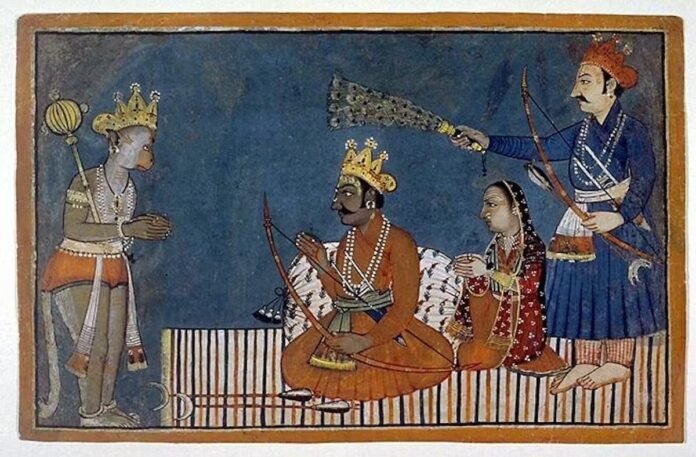
The Sanskrit “Ramayana,” or “Journey of Rama,” is an epic poem that was composed sometime between 400 BCE and 400 CE. The epic follows Rama, an exiled prince and an incarnation of the Hindu god Vishnu, as he journeys to rescue his wife, Sita, from the demon king Ravana.

For hundreds of years, people from different religious traditions across South Asia have retold the “Ramayana” through dramas, narrative poems, shadow puppet plays, pageants, folk songs, comics, television shows and many other mediums. Director Nitesh Tiwari’s upcoming “Ramayana” film is the latest retelling of this epic tradition.

For over a decade, I have studied how South Asian epics have been retold within and outside the Indian subcontinent. While many American moviegoers may not recognize the word “Ramayana,” they may have already encountered its characters and stories on the big screen.

Sita’s struggles in ‘A Little Princess’

A striking example is Academy Award-winning director Alfonso Cuarón’s 1995 film, “A Little Princess.” Although an adaption of Frances Hodgson Burnett’s well-known 1905 children’s novel of the same name, Cuarón’s movie begins with Sara Crewe – the daughter of a wealthy British Army captain posted in colonial India – telling the story of the Ramayana.

As Sara narrates the tale of Rama, the film presents scenes inspired by the epic. Actors portraying Rama and Sita are shown living in exile in a lush green forest. When Sita begs Rama to follow a demon disguised as a beautiful golden deer, Rama draws a magical protective circle around the princess and instructs her to stay within the circle’s borders. The story reaches a turning point with the demon king Ravana’s abduction of Sita after she exits the circle.

But the Ramayana is more than a story to Sara – it has parallels with her own life, especially after she is separated from her father when she moves to New York to attend boarding school. Cinema and media studies scholar Jyotsna Kapur explains that “the man cast as Rama is Sara’s father and the Ramayana is the imaginative thread that binds father and daughter together through their struggles while apart.”

At boarding school, Sara initially lives like a princess – like Sita – thanks to her father’s immense fortune. Yet after the apparent death of Captain Crewe in World War I, Sara’s headmistress confines the now-penniless child in the school’s attic.

While mourning her father, the heartbroken Sara uses a piece of chalk to draw a circle on the floor of the attic resembling the one Rama creates to protect Sita. Like Sita, Sara is eventually rescued – by Captain Crewe, who survives the war, whereupon they return home to India.

By weaving these stories together, Cuarón used the epic’s themes of exile and separation to provide a fresh take on Hodgson Burnett’s classic novel.

Many cinematic Hanumans

The divine monkey Hanuman is one of the most beloved Ramayana characters. In the epic tradition, Hanuman is a loyal devotee of Rama, and he is the one who locates where Sita is being held captive in Ravana’s kingdom of Lanka.

Hanuman shows up in multiple different films. Pixar animator Sanjay Patel’s Academy Award-nominated 2015 short film, “Sanjay’s Super Team,” focuses on Sanjay, an Indian American boy who would rather watch cartoons than worship Hindu deities like Hanuman, Vishnu and the goddess Durga with his father.

Sanjay, however, gains a new appreciation for his family’s religious traditions when he reimagines Hanuman, Vishnu and Durga as superheroes resembling the three protagonists of his favorite animated television show, “Super Team.”

Ryan Coogler’s massively popular Marvel movies “Black Panther” and “Black Panther: Wakanda Forever” are set in the fictional African country of Wakanda. In both films, a character called M’Baku proclaims “Glory to Hanuman!” M’Baku is the leader of the Jabari tribe, a Wakandan community that worships a gigantic white gorilla deity.

In the original “Black Panther” comics, this gorilla god is known as Ghekre and is based on a deity of the same name revered by the Akan Baoule people of the Ivory Coast. But in the “Black Panther” movies, the Jabari’s gorilla god is referred to as Hanuman.

Hanuman is at the heart of Dev Patel’s 2024 critically acclaimed action-thriller “Monkey Man.” The unnamed hero of this movie is an Adivasi belonging to one of India’s many Indigenous groups. Hanuman inspires him to avenge the rape of his mother by a corrupt policeman working for a deceitful Hindu nationalist spiritual leader.

My current book project is about cinematic adaptations of the Ramayana and the Mahabharata, a South Asian epic tradition about a catastrophic war. I argue that “Monkey Man” draws from a variety of different narratives, including the Ramayana tradition and popular American revenge films like “John Wick” to shed light on key social justice issues in India, including sexual violence and Hindu nationalism.

Rama and Hindu nationalism in “Slumdog Millionaire”

Hindu nationalist interpretations of the Ramayana in modern India surface in the 2008 Oscar winner for Best Picture: Danny Boyle’s “Slumdog Millionaire.”

While many Hindus worship Rama, Sita and Hanuman as deities, Hindu nationalists have also presented Rama as a historical figure – the legendary ruler of the ancient kingdom of Ayodhya.

On December 6, 1992, a mob of Hindu nationalists demolished the Babri Masjid – a 16th-century mosque in the city of Ayodhya in northern India. They claimed that the mosque had been built by first destroying a Hindu temple that marked the location of Rama’s birth. Following the Babri Masjid demolition, more than 2,000 people were murdered in riots across South Asia in 1992 and 1993.

“Slumdog Millionaire” follows Jamal Malik, an impoverished Muslim contestant on the Indian version of “Who Wants to Be a Millionaire?” When asked “In depictions of God Rama, he is famously holding what in his right hand?” Jamal has a flashback to the violent riots in the city of Mumbai after the destruction of the Babri Masjid.

As a 5-year-old, as Jamal flees the Hindu nationalist mob that had just killed his mother, he encounters a boy dressed as Rama holding a bow and arrow. The adult Jamal then states: “I wake up every morning wishing I didn’t know the answer to that question. If it weren’t for Rama and Allah, I’d still have a mother.”

The new Ramayana film

The newest Ramayana movie’s tagline, “Our Truth, Our History,” seems to suggest that there is just one “accurate” and “historical” way to tell the Ramayana. This reflects Hindu nationalist ideology in which the Sanskrit “Ramayana,” along with retellings that closely follow the ancient epic, are the only legitimate versions of Rama’s story.

Yet as indicated by Hollywood films like “A Little Princess,” “Slumdog Millionaire,” “Sanjay’s Super Team,” the “Black Panther” movies and “Monkey Man,” there is no single way to depict or understand this immensely diverse epic tradition.

Sohini Sarah Pillai is an assistant professor of religion, Kalamazoo College.

This article is republished from The Conversation under a Creative Commons license. Read the original article.

0FansLike
0FollowersFollow
0FollowersFollow
0SubscribersSubscribe
- Advertisement -
Google search engine

Recent Posts