Diesel Above 2.16 Euros Drives Truckers and Farmers to Protest in Sicily, Calabria
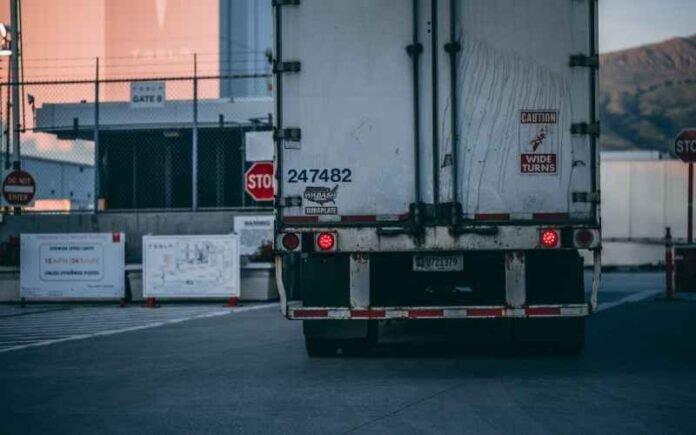
Truck drivers in Sicily halted their vehicles at ports and company yards to protest soaring fuel costs, part of a wave of demonstrations that also disrupted traffic in Calabria, Basilicata and Campania in southern Italy.
Trucks belonging to members of the Sicilian transport committee stood idle at ports and did not unload ships. Others were parked in company yards as the strike by Sicilian truckers began.
“Participation is total,” committee coordinator Salvatore Bella said. “No heavy vehicles are moving in Sicily.” The committee planned a news conference later in the morning.
Bella criticized Transport Minister Matteo Salvini, though the text does not give Salvini’s title. He said he did not understand why Salvini had summoned unions that are not striking while excluding those that are. “It is unheard of to leave Sicilian truckers out,” he said.
Companies belonging to Confindustria Catania are not taking part. The group had initially announced a truckers’ strike from Oct. 16 to Oct. 22.
In Gela, in the province of Caltanissetta, dozens of trucks have been stopped since the previous night at a protest camp set up by farmers over fuel prices. Drivers who halted their vehicles along the roundabout at the town’s entrance said they can no longer bear the increases. They cited 8,000 euros more per year for each vehicle that travels 100,000 kilometers, and diesel that has climbed above 2.16 euros per liter, up 0.35 euros since February.
Traffic slowed, backed up and forced some drivers onto other roads at the entrance to Gela on State Road 117 bis, which links the town with Catania. Truckers briefly blocked the road near Castelluccio before it was cleared, in part because police arrived. Authorities are monitoring the situation. A procession of farm vehicles and tractors also traveled part of the Gela-Catania road.
Calabria
A protest called by Fedralog, the regional logistics federation, began in Calabria and is set to continue through the 20th. Trucks are parked along road edges without full blockades, under police supervision, though narrowed roadways are causing delays. About 15 sites have been identified, including near Lamezia Terme airport, the port of Gioia Tauro and A2 highway junctions near Cosenza.
The action adds to farmers’ protests that have continued for days. In Corigliano Rossano, high school students joined farmers who have occupied a roundabout on State Road 106 for three days. Farmer representative Mario Oliveto, who promoted the protest, led them by tractor, and Mayor Flavio Stasi was present.
Basilicata
Spontaneous truckers’ committees staged sit-ins and blockades, complicating road traffic. The region is also facing a fuel emergency because of a strike at Eni’s Taranto refinery. The worst problems were reported along the Ionian state road at the Calabria and Puglia borders and on the Bradanica road in the Vulture-Melfese area. Most filling stations in Potenza and other towns posted “sold out” signs. Farmers, backed by the Coldiretti agricultural group, planned a rally at 9 a.m. in front of the regional government headquarters in Potenza.
Campania
Truckers have protested since midnight on highways in the provinces of Caserta and Napoli, with vehicles gathered near the Nola toll booth on the A30 Caserta-Salerno and at Caianello on the A1 Milan-Naples. The sites leave a gap for other traffic but still cause delays. Others are at Caserta Sud. At about 9:15 a.m., Autostrade said the Nola exit on the A30 was temporarily closed in both directions, with a kilometer of backup toward Caserta. Highway police and Autostrade staff were on scene, and drivers were advised to use the Tufino exit.
A fresh wave of outrage over the Trump administration’s use of Immigration and Customs Enforcement has surged after two high-profile events involving ICE in the span of a week: the shooting of a young father in New York City last Thursday, and the Monday morning Homeland Security Investigations raid on Rep. Ilhan Omar’s home.
Reporting from the Wall Street Journal suggests that the raid was a part of an ongoing effort by the Trump administration to strip the Minnesota Democrat of her U.S. citizenship. Omar arrived in the United States as a child refugee from Somalia and became a naturalized citizen in 2000, long before the start of her political career. The outspoken progressive congresswoman has since become a foe of President Donald Trump; in a statement, her spokesperson condemned the raid on her home as “an unprecedented escalation in the weaponization of federal law enforcement to target political enemies.”
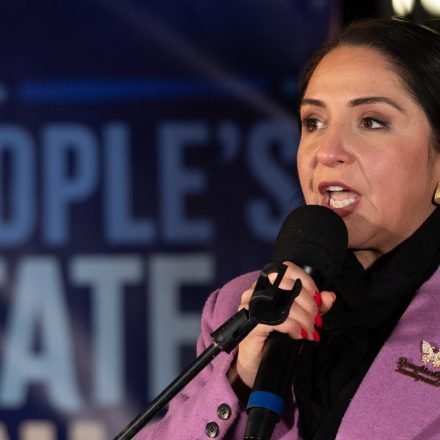
Omar’s House colleague, Rep. Delia Ramirez, D-Ill., argues this sort of weaponization is an inherent feature of the Department of Homeland Security, which was established in 2003 as part of the George W. Bush administration’s mounting war on terror. This week on The Intercept Briefing, host Jessica Washington speaks with Ramirez about a new bill she introduced on Tuesday to abolish DHS and what the raid on Omar’s home reveals about the department.
“The Department of Homeland Security cannot be reformed. It should be dismantled,” said Ramirez. “What they did — just three weeks from an election — was to attempt to create such paralysis on everyday people. … If they can do this to one of my colleagues, they can do that to anyone. And it should concern everyone.”
Washington also speaks with Rozina Ali — a journalist covering the war on terror, Islamophobia, the Middle East, South Asia, and literature — and Will Sommer, a senior reporter covering right-wing media and conspiracy theories at The Bulwark.
Ali and Sommer unpack the role of conspiracy theories and anti-Muslim propaganda in the attacks on Omar, and how DHS has been historically weaponized against Muslims in the United States.
“Over the last 30 years, we have been conditioned to believe that Muslims, and now more broadly immigrants, are not just a threat to national security, but a threat to the American way of life,” said Ali.
“The right has been really eager to denaturalize Ilhan Omar for really going back a decade almost to the first Trump administration,” said Sommer. He called the investigation into Omar “one of the most striking examples we’ve seen of how the Trump administration is willing to use law enforcement to achieve its political aims and to sort of threaten its enemies.”
For more, listen to the full conversation of The Intercept Briefing on Apple Podcasts, Spotify, YouTube, or wherever you listen to podcasts.
Transcript
Jessica Washington: Welcome to The Intercept Briefing. I’m Jessica Washington, politics reporter at The Intercept. On Monday, Homeland Security Investigation agents searched the home of Minnesota Congresswoman Ilhan Omar. Reporting from the Washington Post suggests that the probe centers on allegations that Omar’s late father lied on immigration paperwork decades ago when Omar was a teenager.
According to a source familiar with the case who spoke to the paper, the Department of Homeland Security had previously declined to move ahead with an investigation years prior based on similar allegations. There still weren’t many details out as of Wednesday. The Department of Justice has vaguely described a “federal criminal investigation,” but Omar has long been a political foe of President Donald Trump.
In a statement to The Intercept, Omar called the raid “an outrageous abuse of power and an unprecedented escalation in the weaponization of federal law enforcement to target political enemies.” The raid on Omar’s home comes days after an Immigration and Customs Enforcement agent shot 28-year-old Oscar Belgal in the neck in New York City, with his 5-year-old son in the back seat.
The incidents have reignited concerns about the violent weaponization of the Department of Homeland Security by President Donald Trump against immigrants and the administration’s perceived political enemies.
The group Democracy Defenders Fund filed a complaint over the raid on Tuesday, arguing it violates the Hatch Act, a federal law that restricts political activity by members of the government’s executive branch. With early voting in Minnesota scheduled to start Friday, the group says the raid “appears to be timed to influence voters in the upcoming midterm election.”
Rep. Delia Ramirez, a Democrat from Illinois, introduced a new bill this week to dismantle the Department of Homeland Security and abolish immigrant detention in the United States. I’m speaking to her on Wednesday, October 14. Congresswoman Ramirez, welcome back to The Intercept Briefing.
Rep. Delia Ramirez: Oh, happy to be on.
JW: First, I wanna get your reaction to the Homeland Security Investigation search of Representative Ilhan Omar’s home on Monday. Were you surprised by the news? And what do you think it tells us about how the Department of Homeland Security is operating under President Donald Trump?
DR: I’m gonna tell you that, unfortunately, I’m not surprised by what happened — but it is still bone-chilling.
You’re talking about a department that was created to have full authority to violate civil rights every single day, now weaponized against a sitting member of Congress — sending, I don’t know, 20 HSI agents into her home at 4:30 in the morning.
Cruelty, complete control, and authoritarianism, and demonstrating their ability to get away with whatever they think they can, was the point of what they just did.
And it is clearly the embodiment of abuse of power. But it also shows us exactly why the Department of Homeland Security cannot be reformed. It should be dismantled. And that what they did — just three weeks from an election — was to attempt to create such paralysis on everyday people to believe that if they can do this to one of my colleagues, that they can do that to anyone. And it should concern everyone.
“Demonstrating their ability to get away with whatever they think they can, was the point of what they just did.”
Anyone that cares deeply about our democracy, about our ability to exercise our freedom of speech, or to be protected from being harmed by the federal government should see what is happening to my colleague Ilhan Omar as a clear indicator that this could also happen to them, if we don’t stop them.
And that justice is not just that she gets her phone back, or they leave her alone. Justice is holding accountable the leadership that made that terrorizing experience for Ilhan happen.
JW: Speaking of stopping them, I want to get into the bill that you introduced on Tuesday, the Reimagining Safety Act, which would abolish the Department of Homeland Security, eliminate all immigrant detention, and repeal “duplicative and overreaching terrorism laws.”
Now, there has been some forward momentum on the movement to abolish Immigration and Customs Enforcement, at least from progressives — but this bill would get rid of all of DHS. Can you talk about how that would work and why, in your opinion, it’s not enough to just abolish ICE?
DR: I just mentioned to you what’s happening to Congresswoman Omar, and to me, it’s a clear indicator of the greatest threat to our security: It’s not immigrants; it’s the Department of Homeland Security.
And I know that a lot of people say, DHS is “rogue,” we need to address this “rogue” organization. But it’s not rogue. I wanna be clear with people. DHS did not exist my entire lifetime. As a matter of fact, it’s been operating less than 23 years. And it was built exactly to do what it’s doing right now: to violate our rights under pretense of securing our safety, and it’s been, in fact, empowered to act with impunity, which is why people keep saying like, “How can they possibly get away with what they’re doing, and why can’t Congress stop them?”
Because frankly, since its inception, DHS has been utilized by the government to target and persecute people that they consider the public enemy. And we know that fascism always requires a public enemy. Muslim Americans, Latinos, Haitians, protesters. DHS has never kept us safe. And 24 years ago, Americans, Republicans, and Democrats alike, let’s be clear, raised a flag about how DHS would constitute unprecedented consolidation of power, and yet this agency was still formed under the United States Congress.
“The greatest threat to our security is not immigrants; it’s the Department of Homeland Security.”
DHS has been a problem of the administration for its entirety. And administration after administration has demonstrated to us that this agency needs to be completely dismantled piece by piece. And when you have people like Donald Trump with very authoritarian tendencies, you have clearly seen what they’re capable of doing. And frankly, I don’t think we’ve seen the full extent of what they could do.
So this is a moment for us to ask ourselves: What kind of world do we wanna live in? And do we want to continue to live with the fear that this agency can be weaponized against you, to persecute you, to arrest you, to detain you, to denaturalize you, to attempt to question your own citizenship, to kill you?
And at the same time, ask ourselves: If FEMA and TSA and cybersecurity and the Coast Guard and other critical programs are important for us, how can we allow them to be politicized by this agency that constantly keeps taking away the resources that these critical programs need? And so for me, this is the moment that we don’t just abolish ICE or abolish CBP — we take on the institution that was created to allow ICE and CBP to operate in the way that it does.
“Do we want to continue to live with the fear that this agency can be weaponized against you, to persecute you, to arrest you, to detain you, to denaturalize you, to attempt to question your own citizenship, to kill you?”
JW: To your point, there are all of these other functions of the Department of Homeland Security, from federal disaster relief to TSA screenings to customs enforcement. What happens to all those other functions if DHS is dismantled?
DR: I’m glad you asked me that question ’cause people keep saying, “Do you not care about FEMA?” Actually, because I care about FEMA, I want to dismantle the Department of Homeland Security.
H.R. 10803, the Reimagining Safety Act, it’s a first of its kind bill, and for the very first time, it’s a bill that community stakeholders spent months designing a Cabinet-level department. Because the Reimagining Safety Act would actually establish another department, the Department of Community Safety, that in fact is about protecting our communities.
It would dismantle DHS by preserving the Cybersecurity and Infrastructure Security Agency — we call it CISA, that was created under the Department of Homeland Security; protecting and expanding the Federal Emergency Management Agency; protecting and redirecting the Transportation Security Agency and custom functions into the Department of Transportation; while abolishing ICE and CBP and reinvesting funds in community.
And, certainly, I think the other piece of that is the surveillance: limiting government surveillance and reining in the unlawful abuses of data and curb the militarized enforcement that you’re seeing under DHS while beginning the process of taking what we call USCIS, that’s also under the Department of Homeland Security, and establishing it as its own separate civil immigration system that no longer operates under this agency that could call Renee Good, Alex Pretti, or Silverio Villegas terrorists.
JW: Thinking about your bill — obviously, Republicans currently control every lever of power, and only a handful of Democrats support abolishing ICE, and fewer still have called to abolish the Department of Homeland Security. Why introduce this bill now, knowing that it likely can’t pass this current Congress, much less get signed by President Donald Trump?
DR: Every single issue, whether it’s talking about universal healthcare, Medicare for All, whether it’s talking about raising wages — and now I introduced Living Wage for All — or blocking bombs and ending endless wars, oftentimes the assumption has been it is too early, or Republicans control, or Democrats have not arrived.
The people have arrived to where we are. They believe that this agency is the biggest threat to their well-being. And for me, this is an opportunity to provide a roadmap on how we actually in fact address the problem and then create a solution that centers people’s safety — and not just rhetoric of protecting the homeland under the guise of protecting us from terrorism, so that they can terrorize us.
Jessica, I am clear that this bill is not gonna pass overnight, but I am also clear that our community expects for us to propose something that is tangible, something that is comprehensive, and something that gets to the root of the problem by creating a permanent solution, so that we’re never here again.
“Our community expects for us to propose something that is tangible … that gets to the root of the problem.”
That means that over the next few months, and perhaps over the next year, we are building the support and changing the conversation in such way where in the same way only nine or 10 of my colleagues were willing to, out loud, say “Abolish ICE” two months ago, now we have actually more like 45, 50 of them, that we are in the same place when we’re talking about reimagining safety in this country.
I am providing a bill that begins to respond to what our communities are demanding. I’m hoping that Congress doesn’t continue to be behind the ball of what the people are asking of them. And now I’m giving them something that they could actually in fact use.
I wanna tell you too that, look, in 2002, people expressed concerns about DHS. And 25 years later, those warnings have been validated as we watch what they’re doing. It’s a weapon pointed at anyone that the state considers a public enemy, whether it’s Congresswoman LaMonica McIver, whether it’s Congresswoman Omar, or the millions of people in this precise moment that are living in fear because of the way that this agency was created.
“We were OK before 2003 without DHS, and we can live in a life without it as well.”
JW: On the subject of looking to the future, if Democrats take one or both houses of Congress in the upcoming midterms, I’m curious what else you’re thinking about in terms of reining in DHS, and if you have any other priorities for the next session.
DR: Let me just come back to this bill, ’cause I think it’s really important — my own bottom line on it. The Reimagining Safety Act takes apart DHS and creates a new agency, a new agency that responds to what people are asking for — for we the people that they’ve elected to represent them, to keep them safe, to protect the mission of community safety, and to protect the public.
And it means that dismantling DHS is doing the work Congress should have done actually 24 years ago, to actually look at these agencies, all agencies under this department, but also how DOJ has been weaponized against us. How we created a Department of War. Just think about that: We’ve created a department where we want to spend more money on war than we want to actually spend on housing, on healthcare, on wages, and on infrastructure.
So for me, this is a moment for us to actually demonstrate that we’re going to fight like hell for accountability, to take on corruption, to end the terror, while also creating tangible ways to address the issues.
And one of those, and I’m going to be introducing a resolution [Thursday] around what should our positioning be when it comes to immigration. Because this agency is about what is wrong and what needs to stop so that we can actually have safety, but then we also need to talk about how we restore our systems of asylum, how we actually in fact establish legal pathways, and how do we bring 11 million people who are in fear, in the shadows, crying daily, to finally come out of the shadows into a justice status.
I am gonna be working really hard to make that front and center with our leadership, and I’m disappointed that our leadership isn’t centering that as one of the very first things that they wanna work on in the first 100 days. Because unfortunately, that is telling the people that have been under siege by this administration: Being an immigrant or being brown or being a protester isn’t the top priority of people that need to be protected.
When our leadership is talking about first 100 days of many important things, but not a word around immigration, and not a word around real accountability to what has happened under ICE and CBP.
JW: Thank you, Congresswoman. We’re gonna leave it there, but people can read more about your bill, the Reimagining Safety Act, at theintercept.com, where we have a story out about it. And thank you so much for joining The Intercept Briefing.
DR: Thank you. Appreciate it.
Jessica Washington: Next, I speak with Rozina Ali, a journalist covering the war on terror, Islamophobia, the Middle East, South Asia, and literature; and Will Sommer, a senior reporter covering right-wing media and conspiracy theories at The Bulwark. Will, welcome to the Intercept Briefing, and Rozina, welcome back.
Will Sommer: Thanks for having me.
Rozina Ali: Thank you so much for having us.
JW: Rozina, I want to start with you. In your new book, “Seasons of Fury: Four Families and the Rise of Islamophobia in America,” you discuss the history of how immigration enforcement has been weaponized against Muslims in the United States. And while I want to preface by saying that there’s still a lot we don’t know about the raid on Congresswoman Ilhan Omar’s home, we do know that Omar is outspoken, Muslim, Black, and an immigrant. She’s also been a consistent target of Trump and his allies.
How might this relate to the broader history of how the Department of Homeland Security has been weaponized against Muslims in the United States?
RA: Well, I really appreciate this question. There’s a very long history when it comes to using immigration enforcement to target Muslims and the Muslim community in the United States, and I just wanna go back a little bit before 9/11 to the late 1990s.
One thing that was happening was the use of secret evidence against Muslim immigrants, a lot of Arabs and South Asians, and a lot of Muslim immigrants, to, essentially, detain them and deport them. And what that meant was actually using classified evidence that the government brought forward that the defendant could not see.
And it actually kind of reminds me of what’s happening with Ilhan Omar now, is that we don’t actually know what the allegations are. We don’t know what the case is hinged on.
What the DHS did after 9/11 was actually broaden out its use of immigration enforcement to target Muslim communities. One of the things it did was actually institute a registry called the National Security Entry-Exit Registration System. That essentially allowed the U.S. government to detain thousands of Muslim immigrants and eventually deport them — even though they had no criminal charges.
One of the things that protects Ilhan Omar is that she is a U.S. citizen, but one of the things that does chill me is there is this longer, broader history of the government using immigration enforcement in order to deport people and detain people, even if they have not been guilty of any criminal charges.
JW: That makes a lot of sense, the concern, because we know there’s history of this power being used in secretive ways, kind of similar to what’s potentially happening now. And I do, again, want to caution that we do not have all the details on this case at the moment. But Will, I wanted to bring you in to kind of get into the origins at least where some of these conspiracy theories that have been swirling around Congresswoman Omar.
You wrote about this in September, kind of where you found that many in MAGA world were frustrated that after nearly a decade of conspiracy theories — some of which were pushed by Trump about alleged immigration fraud from Omar — she remains not only in the United States, but in Congress.
Will, can you explain some of the conspiracy theories that are fueling this push to deport Omar? Is there any evidence for them? And do we know if they had anything to do with the raid on her home?
WS: The right has been really eager to denaturalize Ilhan Omar for really going back a decade, almost to the first Trump administration. A lot of it was fueled by this idea that she had married her brother as some kind of immigration scheme, or essentially that this man she was married to was secretly her brother.
Now, I looked into the origins of this at the time. I thought, “Well, is this true? Could it be?” No, it’s not. In fact, it all started on some random kinda Somali Minnesotan message board where someone said, “Yeah, she’s married to her brother.” And then from there, once she became more prominent as a Democratic figure, people on the right kinda dug through that and sort of built this whole conspiracy theory based off of this one post.
Essentially, now that Trump is back in power, there’s this demand on the right because, as with other conspiracy theories, they’ve come to believe this. So they’re saying, you know, “Oh man, when are we finally gonna deport Ilhan Omar?” So Markwayne Mullin, the head of DHS, has been under this pressure, and he gave this interview at the Republican convention to [right-wing YouTuber] Benny Johnson, and he said, “Oh yeah, she married her brother.”
And Benny Johnson said, “Well, OK. Are you gonna deport her?” Now, you kinda can’t deport her anyway, even if she had married her brother. But there’s all this demand. And so what we’re seeing with this latest investigation is it’s not even related to the brother thing, reportedly. It’s — according to the Washington Post and some other outlets — related to this idea that Ilhan Omar’s father, who is dead now, misstated her age on a citizenship application.
Essentially, she was 17, according to the official record. But had she been a year older, 18, it would’ve kind of complicate it because she would’ve been an adult. It would’ve made it harder for her to get citizenship. This is this idea that’s been pushed by her Republican opponents in elections in the past. It’s really thin, and we can kinda get into it in a second. But this is some thin gruel, essentially, that they’re trying to manufacture this whole effort to pull her citizenship.
JW: I really wanna get more into the conspiracy theory of it and what’s being pushed here. And I think it’s interesting that it’s almost like they’re kind of grasping at any little thing they can get their hands on.
At first, it’s the brother-marriage of it all, which, as you pointed out, has very thin evidence, essentially no evidence. And then it’s pulling at these other threads about her dad, which have all been swirling in the ecosystem for a while.
I want to get a little bit deeper into what conspiracy theories, what role they have here, and I want to talk about what Donald Trump said on Monday night after the raid. He spoke at an Ohio rally pushing more conspiracy theories about Rep. Ilhan Omar and the Somali community in Minnesota in general. Let’s hear that clip now.
Trump: Just look at what’s happening in the once great state of Minnesota. What a mess they have done. Somalia, wonderful, wonderful. And that Ilhan, somebody was asking me, I don’t know what they’re doing with her, but I can tell you this: She’s a disaster. She comes in from a country without laws, without police, without military, without — all they do is shoot each other. And she comes into our country, and she says, “I have a constitutional right.” She’s got a constitutional right. She’s telling us about the Constitution, and she comes from one of the worst countries anywhere on the planet. Last week, savage Somali gang members shot two people in the high school parking lot in the middle of a football game. Just days later, a few miles away, the FBI arrested a radicalized Somalian who was planning to carry out an ISIS-style terrorist attack at the Mall of America, aiming to kill as many as possible, in his words. This is not what we want in this country.
Crowd: Deport! Deport! Deport! Deport!
Trump: What they have done to Minnesota.
JW: Rozina, this isn’t the first time we’ve seen the administration spread conspiracy theories about Muslims. Ahead of Operation Metro Surge in Minneapolis, for example, we heard similar rhetoric about the Somali community. What role have conspiracy theories played in the targeting of Muslims in the United States?
RA: Oh, where to start?
JW: Yeah, there’s a lot.
RA: There is a lot. I think one of the most enduring theories of Muslim communities is that there are radical elements that are living among Muslim neighborhoods, among Muslim communities. And that is a conspiracy theory born out of, obviously, the war on terror framework.
But one of the things that we saw in the aughts, especially under the Obama administration and especially as Trump rose in power, was this notion that Muslims, not just foreign elements, but Muslims living inside the United States are secretly hiding their agenda.
And this is something that we hear with regards to Abdul El-Sayed, that basically any Muslim that you meet is hiding a secret agenda, and what they wanna do is enact Sharia law in the United States. No one has yet to explain what Sharia law means and what that would mean to enact it, but this is one of the things that keeps coming up over and over again.
What is so interesting about this speech that Trump made recently is that he is actually throwing every theory against the wall that he can. That he mentions ISIS — something we haven’t heard for a long time. He mentions radicalization. He mentions fraud. And so all of these things that have been talking points that have been used against Muslim communities, particularly against the Somali community in Minnesota, he is using all at once in this one speech.
“What is so interesting about this speech that Trump made recently is that he is actually throwing every theory against the wall that he can.”
I will say, this is also the talking points — well, fraud is a new one — but when it comes to radicalization and when it comes to the notion of radical elements threatening the security and Western way of life of the United States, these are talking points he was peddling back in 2015 when he eventually called for a Muslim ban.
This is actually something that we see Donald Trump doing a lot, which is, he peddles conspiracy theories. He puts them on the main stage. His allies reinforce them and regurgitate them, and he gives them legitimacy, right? He legitimizes them by using a government framework to offer some veneer of truth to them. And unfortunately, as we know, one iteration of the Muslim ban was eventually upheld by the Supreme Court.
JW: As Rozina said, fraud is kind of a newer iteration of these kind of Muslim conspiracy theories. Where did it originate from, and why has it become such a powerful talking point on the right when targeting particularly the Somali community in Minnesota?
WS: I should say: Minnesota has a very — despite being a Democratic state — it has a very intense Republican activist and kind of like quasi-journalist scene going on. And so a lot of that has been built around, again, building, talking about Ilhan Omar. And now we’ve seen it kinda going after the Somali community in various ways.
But really, this hit a new level in January with this young man named Nick Shirley, who’s like a YouTuber. He went around, he was led around by one of these Minnesota conservative journalist types to various daycares, and they said,”Look at the fraud here.”
Now look, there are some criminal fraud cases that are being prosecuted in Minnesota. But there was this broader sense created by this video of, like the Somali community are parasitic, that they’re up to no good, they’re stealing all this money, what have you.
And then in fact, that helped justify then — at least in the view of the Trump administration — the ICE surge into Minneapolis. And so this has created this idea of constant Somali American fraud, not just in Minnesota, but all over the place. And so obviously it dovetails with the Ilhan Omar idea as well, that she forged her citizenship, she somehow faked that.
JW: That makes a lot of sense. It is really interesting to see the way the administration targeted Minnesota, both because of the Somali community, which was particularly vulnerable, because as we’ve mentioned this is both a Black, immigrant, and Muslim community, so this trifecta of areas that the Trump administration is targeting. And then also you had Ilhan Omar, who was this image that the administration could attack and go after, and it was really popular to their base to do so.
Rozina, when we’re talking about the stories that kind of stick when it comes to conspiracy theories, what sort of stuff has really stuck and why? I’m curious to understand why in the imagination of so many people in the U.S. these conspiracy theories have really stuck.
RA: I think one of the most enduring theories that keeps coming up over and over again and that really has stuck is this notion that, as I mentioned, that Muslims have nefarious secret agendas, but also that they have ties to foreign organizations and foreign elements.
And one of the things that we hear with regards to Ilhan Omar, too, is that — and I think I’ve heard this from some right-wing talking points in the previous days — is that there might be allegations that she has some financial ties or connections to foreign groups. This is something we have heard about Zohran Mandani. This is something we have heard about Abdul El-Sayed. This is actually something that has been a part of the American narrative about Muslims for decades.
One of the crucial things that was happening in the ’90s was that the U.S. government was looking for financial ties to foreign organizations among the Muslim community. And one of the things that happened immediately after 9/11 was that the United States government shut down the biggest Muslim charity in the United States, called the Holy Land Foundation, because of alleged nefarious ties to militant groups abroad.
Because there has been a government framework for this, I think it is really easy for a lot of conspiracy theorists and for a lot of Islamophobes, frankly, to keep regurgitating this notion that “just look at the financial ties of Muslims.” And one of the lasting shifts that we have seen in the last 25 years is that that scrutiny is not just against Muslim immigrants or visa holders, but also against Muslim Americans and citizens of the United States. And I don’t think we’re actually going to be able to break out of those conspiracy theories so easily if we don’t actually start discussing and reckoning with how we think about what terrorism is.
So for example, with the Holy Land Foundation case, that is a case that keeps coming up over and over again. A lot of those ties, financial ties, it’s a really complicated case, but a lot of those financial ties were related to Hamas, but it’s also relevant to remember that Hamas at the time was a governing body in Gaza that was supplying aid to people.
And essentially, the way we talk about terrorism, the way we talk about countries abroad, has a real impact for how we think about the Muslim community at home. So I just wanna go back to Abdul El-Sayed for just really quickly, is that one of the biggest talking points peddled against him these days is that his mother is connected to the Muslim Brotherhood.
Now, there’s very little understanding of what it had meant to be a supporter of the Muslim Brotherhood in Egypt, right? Because we just see that through the lens of terrorism, it’s completely dismissing all the political dynamics on the ground in those countries abroad. And I think what a lot of conspiracy theorists and Islamophobes have done so effectively is forever tie Muslim communities in the U.S. to what Americans largely think of as nefarious elements in other countries.
JW: I think that’s all really important, recognizing, to your point, that none of these conspiracy theories — I mean, again, they had taken new iterations — but that conspiracy theories against Muslims in the United States is not a new phenomenon. I guess I am curious if we’re moving into a new phase though, of danger, essentially, from the administration.
Will, coming back to your September piece, in it you compare the calls to deport Rep. Ilhan Omar to the Department of Justice’s attempts at convicting the president’s political enemies. And those have, for the most part failed, in terms of getting these convictions, “locking up” his enemies, as he’s said he wants to do.
Does this raid of a sitting congresswoman’s home signal a new, more dangerous era from the White House when it comes to threats against the administration’s perceived political enemies? Are we entering a new, more dangerous phase?
WS: I think the raid represents sort of the confluence of two alarming trends. One is what we’ve been talking about, which is the growing, second tide of Islamophobia that we’re seeing from this administration, that I think was sort of on the back burner as there was so much promotion on the right about fears about immigration from Latin America. Now, we see in Texas there’s so much anger at Muslim communities in that area in particular.
We’re also seeing though, as you said, the politicization of the Justice Department. I mean, this raid falls within the 60 days. Typically, the DOJ doesn’t raid politicians this close to an election, particularly something that’s about a 30-years-old child immigration case. Clearly, it’s political. It’s an attempt to make Ilhan Omar the face of the Democratic Party, suggest all this fraud.
Look, a lot of those attacks, those political lawfare, what have you, is related to Israel and Palestine, people like Fergie Chambers, Max Blumenthal, have either faced indictments or had their devices seized, in Max Blumenthal’s case. Certainly a lot of it aimed at campus activists as well.
I think the Ilhan Omar thing is really one of the most striking examples we’ve seen of how the Trump administration is willing to use law enforcement to achieve its political aims and to threaten its enemies.
“The Ilhan Omar [raid] is one of the most striking examples we’ve seen of how the Trump administration is willing to use law enforcement to achieve its political aims and threaten its enemies.”
JW: You mentioned that post-Watergate 60-day rule, which is an unwritten policy designating a blackout period effectively before elections during which the Department of Justice is not supposed to conduct activity which could influence voters. There’s also the Hatch Act, which states that government employees cannot use their authority or influence to interfere with or affect an election. There was actually a Hatch Act complaint filed yesterday by a watchdog group over the raid on Ilhan Omar’s house.
At this point, Will, with an administration that has already done so much over the years without consequence, does the Hatch Act and do these other kind of long-standing norms serve any purpose or any protection?
WS: No. At this point, unfortunately, I think the Hatch Act is a dead letter in terms of, no one’s gonna enforce it, at least until Democrats retake some kind of power. Look, the administration is using government money to buy political ads, outright political ads. And so certainly, I think they’re going to unfortunately be able to get away with things like raiding a congresswoman’s house.
I think really it’s just become, the idea that they would use Justice Department or DHS to achieve political aims is just understood now that that’s something Trump is gonna do.
JW: And Rozina, from your perspective, does this raid to you signal a kind of new, more dangerous era, for not just the president’s political enemies, but also disfavored groups?
RA: Yeah, I want to just go back specifically to the Somali community living in the United States. It is telling that President Trump disparaged the country of Somalia as he also bombs this country with hundreds of airstrikes in the past year alone, displacing more people and causing more people to search for refuge abroad.
We mentioned the ICE Operation Metro Surge in Minnesota last December. Trump was talking about the Somali community in Minnesota, and ostensibly fraud was the reason, one of the reasons, for which he sent ICE agents into the city.
One of the things that the government learned very quickly was that a lot of Somalis living in Minnesota are actually citizens. They are naturalized or that they were born here, and they could not be easily picked up and detained or deported, even though there were some who were. Yet what happened in the months after Operation Metro Surge was that it really chilled the Somali community living in the city. Even though there were so many people who did go out and protest and help each other, there were a lot who basically stayed at home. And I actually spoke with several people who would not leave their house for months.
Now, one of the things that really frightens me about what the DOJ and DHS did with regards to Ilhan Omar is that it is actually expanding the war against Somalis. It’s now seeing ways in which to not just frighten asylum-seekers and refugees and visa holders, but also naturalized citizens.
“What this administration has done so effectively is actually telling everyone that there are some communities who are no longer protected the way they used to be.”
And I think what this administration has done so effectively is actually telling everyone that there are some communities who are no longer protected the way they used to be. And we saw that also in the context of, for example, the arrest of Mahmoud Khalil and pro-Palestine protesters. We are seeing a level in which government is used to target people who before would have protections from the government, and now they are being told that they are actually vulnerable.
And Ilhan Omar, it’s possible that nothing comes of this raid, and things will just go back to normal. But what worries me is the larger chilling effect on the community, including now naturalized citizens.
JW: Trump aside, the Trump administration aside, Rozina, is this just the logical endpoint of effectively decades of crafting a federal domestic surveillance and police state that is laser-focused on immigrants and Muslim Americans?
RA: Yes, it is, right? One of the things that has happened over the 20, or last 25 years has been one immense power that has been concentrated in the executive branch. This notion that when it comes to national security, the government has a lot of leeway to violate people’s civil rights But the other thing — one of the other enduring legacies of the last 30 years — is precisely what the American public is willing to accept.
“We have been conditioned to believe that Muslims … are not just a threat to national security, but a threat to American way of life.”
And over the last 30 years, we have been conditioned to believe that Muslims, and now more broadly immigrants, are not just a threat to national security, but a threat to American way of life.
And again, Trump is able to throw everything — when it comes to Ilhan Omar and the Somali community — throw everything at them. They’re a threat to national security. They are threatening how we live in this country. They are threatening what it means to be American. They are taking away our money and our dollars, and he is using all of these talking points to help build up public support for this agenda against the Somali community. I don’t think such a blatant targeting and explicit targeting would have been met with such support even in, for example, October or November 2001.
JW: I think those are all very good points. I hate when people say this is the only form of acceptable bigotry, because I can frankly say that there are many forms of acceptable bigotry. But the extent to which Islamophobia is a part of American culture is accepted, I think is not just troubling, it’s decades of conditioning, as you’ve pointed out. It is decades of feeding these conspiracy theories, of repeating them until they feel almost natural to so many of us.
But I want to give you both an opportunity to just share any final thoughts. Will, I want to start with you. Is there anything else that you’d wanna add?
WS: As this case goes forward, it’ll be interesting to see what it looks like. But the idea that Ilhan Omar lied about her birthday or whatever is all based on, there was this one congressional website that said she was born in 1981 instead of 1982. And so Republicans have seized on this. Look, it’s one website, right? I looked in the court records, all this stuff. Before she became famous, she was listing her birthday as 1982, all this stuff. And so if that’s gonna be the crux of it, that one website had a typo, I don’t think the administration’s gonna have a lot to run on here.
JW: There’s very thin evidence for some of these conspiracy theories, although people will take very thin evidence and run with them. Rozina, any final thoughts from you?
“What does this mean for denaturalization efforts across the board?”
RA: I agree with Will, I don’t think that the government has that much to go on. It seems to be very thin evidence. But again, it is government resources that are being used to basically go on a, what appears to be for right now, a witch hunt. But again, what worries me is the more lasting effects of this, which is, what does this mean for denaturalization efforts across the board? And there seems to be not just support for it, but also a deliberate desire to run with such an agenda.
JW: And we’re gonna leave it there. But Will, Rozina, thank you both so much for joining me on The Intercept Briefing.
WS: Thank you.
RA: Thank you.
JW: That does it for this episode. We wanna hear from you. Tell us what you’re following or want to see more coverage of. Email us at podcasts@theintercept.com, or leave us a voicemail at 530-PODCAST. That’s 530-763-2278. This episode was produced by Andrew Stelzer. Laura Flynn is our supervising producer. Jordan Uhl is our social media producer.
Ben Muessig is our editor in chief. Maia Hibbett is our managing editor. Nara Shin is our copy editor. William Stanton mixed our show. Legal review by David Bralow. Slipstream provided our theme music. This show and our reporting at The Intercept do not exist without you. Your donation, no matter the amount, makes a real difference.
Keep our investigations free and fearless at theintercept.com/join. And if you haven’t already, please subscribe to The Intercept Briefing wherever you listen to podcasts. Do leave us a rating or review. It helps other listeners find our reporting. Until next time.
“Devoid of Any Factual Basis”: Again and Again, Judges Have Dismissed Trump’s Voter Data Lawsuits
Since September 2025, the Department of Justice’s Civil Rights Division has sued 30 states and the District of Columbia to demand their unredacted voter rolls.
The rolls contain confidential information on millions of Americans and have historically been managed by states. Now these lists are a major focus of President Donald Trump’s push to take federal control over elections and prosecute alleged noncitizen voters.
To date, there have been final rulings in 26 of the DOJ lawsuits.
Four cases are yet to be decided, and one state settled.
Of the judges randomly assigned to the 26 cases, eight were Trump appointees, four were appointed by another Republican — George W. Bush — and 14 were appointed by Democrats.
Tactic No. 1
The first seven lawsuits used the same opening, citing Trump’s March 2025 executive order on election integrity to claim the Justice Department needed states’ voter rolls to check that they were following federal election laws.
“The United States’ championing of its claims under the [election laws], in both its briefing and its presentation at the hearing on this matter, can only be described as halfhearted. And for good reason, since neither statute gives the United States the power to compel Maine to produce its current [unredacted voter list].” Maine federal Judge Lance E. WalkerTrump appointee
The judges ruled that there was no legal or factual basis for the government’s demand. They noted that the laws require states to keep accurate, up-to-date computerized voter lists that include confidential information. But the statutes give the federal government limited power to enforce those mandates.
Several judges accused the administration of using the election laws as a pretext to suppress voting.
“The foundation upon which American democracy has been built is the right to vote. … Now it seems the Executive Branch of the United States government wants to abridge the right of many Americans to cast their ballots. … The Court does not take lightly DOJ’s obfuscation of its true motives.” California federal Judge David O. CarterBill Clinton appointee
“Public statements from government officials reveal its intentions: to create a nationwide voter-database, for potential weaponization in future elections; as a ‘fishing expedition,’ hoped to advance unsubstantiated claims of non-citizen voting; and as a tool for immigration enforcement.” Pennsylvania federal Judge Cathy BissoonBarack Obama appointee
In an extraordinary rebuke (echoed by other courts around the country), the judge hearing the Oregon case wrote that the federal government’s actions undermined the judiciary’s longstanding trust in the Justice Department. He called them “chilling.”
“The presumption of regularity that has been previously extended to Plaintiff that it could be taken at its word — with little doubt about its intentions and stated purposes — no longer holds.” Oregon federal Judge Mustafa T. KasubhaiJoe Biden appointee
All seven lawsuits using the first tactic were dismissed.
Tactic No. 2
The next 19 lawsuits used a different strategy.
They made no mention of Trump’s executive order and didn’t depend on federal voting laws. Instead, they cited a provision of the Civil Rights Act of 1960 called Title III, which requires the preservation of state and local election records.
The government lawyers claimed that Title III gave the attorney general “sweeping power” to obtain these records to curb noncitizen voting. In reality, the law allowed the federal government to access such records to protect the right to vote, for example, by enabling investigations into practices that disenfranchised Black voters in the South.
Judges rejected the government’s arguments, ruling that Title III applies only to voter registration documents, not records that states generate themselves, like voter rolls. They noted the government had also failed to give an explanation of why it needed the records, as the statute requires.
“Clearly, this demand is devoid of any factual basis.” West Virginia federal Judge Thomas E. JohnstonGeorge W. Bush appointee
Several judges marveled at the audacity of the administration’s attempt to use an anti-discrimination law to keep people from voting and condemned the administration’s logic.
“Title III was the Department of Justice’s answer to two years of resistance and obstruction by state election officials who destroyed, failed to retain, or simply refused to disclose the voting records … that would prove that black voters were victims of disparate treatment and had been unlawfully excluded from the rolls based on nothing more than their race.” D.C. federal Judge Randolph D. MossObama appointee
Judges also noted that there was a conflict between the DOJ’s claim to be enforcing election laws, which require voter lists to be continuously updated, and Title III, which bans any alteration of voter records.
“The United States’s proposed interpretation of the CRA would therefore criminalize the same conduct that the [voting laws] require. This Court will not read [Title III] to produce such an absurd result.” Maryland Judge Stephanie A. GallagherTrump appointee
The administration’s interpretation of Title III, wrote Bissoon, the Pennsylvania judge, “does violence” to the law’s meaning.
To date, judges have dismissed 19 DOJ complaints that relied on the Civil Rights Act claim.
In written opinions, every one of the 26 judges has rejected the Justice Department’s arguments and thrown out its lawsuits. Four cases are still ongoing.
The Trump administration has appealed most of its losses to federal appeals courts and has said it will consider taking its fight to the Supreme Court.
A Justice Department spokesperson issued a statement in response to ProPublica’s questions: “Our attorneys are skilled, principled advocates who argue every case honestly and in good faith. Disagreement with the government’s position is not evidence of bad faith. We look forward to making our case on appeal.”
The only appeal decided so far backed the district judge who threw out the Michigan case.
“Back then, the government used this power to ensure that everyone who had the right to vote could freely exercise that right. But today, the government invokes Title III for an inverse purpose — to ensure that some people have not voted.” Sixth Circuit Court of Appeals opinion
On Oct. 9, a U.S. district judge ruled that the Justice Department’s national effort to acquire and share state voter rolls was an illegal abuse of its authority. A Justice Department spokesperson said the department is “reviewing the ruling.”
Sisi warns against threats to Saudi Arabia, says Gulf security is linked to Egypt’s national security
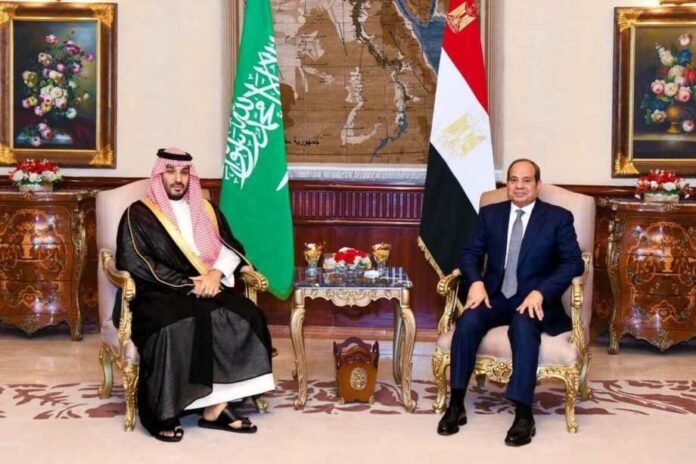
Egyptian President Abdel Fattah el-Sisi warned on Thursday against continued attacks targeting Saudi Arabia, stressing that the security of the Kingdom and the Gulf region is directly linked to Egypt’s national security.
Sisi said Egypt and Saudi Arabia occupy central positions in the Arab and Islamic worlds, warning that any threat to either country would have serious consequences for regional security.
He emphasised that Egypt’s position on Gulf security reflects shared strategic interests rather than diplomatic solidarity alone.
“The security of the Gulf and Saudi Arabia is linked to Egypt’s national security,” Sisi said, describing the relationship as “not merely a gesture of goodwill, but a reality and a shared interest.”
The Egyptian president reaffirmed Cairo’s support for Saudi Arabia’s stability, saying that targeting the Kingdom was contrary to both Arab and Egyptian national security interests.
He described Saudi Arabia as a highly influential regional state and stressed that threats to its security were unacceptable.
While reiterating Egypt’s commitment to de-escalation and diplomatic solutions to regional crises, Sisi warned against any violation of Saudi sovereignty or threats to maritime security in the Red Sea.
“We act with great restraint and strive to find solutions,” he said, “but we will not allow anyone to violate the borders of the Kingdom of Saudi Arabia, nor will we permit threats to the security of the Red Sea or its shipping lanes.”
Sisi said Egypt was seeking to prevent further escalation across the region while addressing security challenges along its own borders.
Turning to Sudan, he said Cairo had spent years working to resolve differences between the Sudanese Armed Forces and the Rapid Support Forces in an effort to prevent the conflict from escalating.
He added that Egyptian mediation efforts had achieved temporary progress, but the situation had ultimately developed in a direction that Cairo had hoped to avoid.
Blue Origin is going all in on the New Glenn rocket
Blue Origin announced a major expansion of its already considerable Florida launch facilities on Friday morning with the intent of eventually flying 150 rockets a year from there.
The company said it would add two additional launch pads for the New Glenn rocket, in addition to two already under construction at Cape Canaveral. The company is also investing heavily in a new manufacturing facility that will produce up to 150 upper stages for a larger variant of the New Glenn rocket.
Additionally, the company plans to procure two additional landing ships to catch and return the first stage of the New Glenn rocket (it currently has one, named Jacklyn). Finally, Blue Origin said it would add a new customer integration facility, built in conjunction with the US Space Force, that will feature four payload bays to process multiple missions at the same time.
“These investments are centered on one goal: building the capacity to support more missions, more reliably, and more efficiently,” wrote Ian Richardson, senior vice president of operations at Blue Origin, in an update on the company’s website this morning. “As we look ahead, this infrastructure is designed to support multiple flights per week by the end of the decade.
$3 billion and counting
To date, Blue Origin has invested about $3 billion in facilities and infrastructure in Florida, largely to support the construction and launch of the heavy-lift New Glenn rocket. The company now has more than 5,000 employees working in Florida and 500 suppliers in the state.
“Our manufacturing and operations footprint has more than doubled in the last couple of years, now spanning more than 20 sites across Brevard and Orange Counties,” Richardson wrote. “Blue Origin is the only company—and the largest employer—to manufacture, launch, and refurbish rockets on the Space Coast.”
That would seem to be a reference to superseding the 800-pound gorilla on the Florida Space Coast, SpaceX, which has launched hundreds of rockets into orbit over the years from Florida. Blue Origin has launched to orbit twice.
But Blue Origin is expanding its rocket facilities while SpaceX is pulling back from the commercial launch market with its Falcon 9 and Falcon Heavy vehicles. As Ars has reported, a growing launch crisis is emerging as commercial satellite customers have struggled to purchase a Falcon launch after 2028.
This has created an opening for medium- and heavy-lift vehicles that, if Blue Origin can get New Glenn flying successfully and frequently, it is poised to fill. The company’s previous investments, along with the new infrastructure, suggest Blue Origin founder Jeff Bezos is deadly serious about making this a reality.
Barreling back from BE-4 setback
After a promising start, the New Glenn rocket program was stalled in late May, when a problem with one of the rocket’s BE-4 engines led to the catastrophic loss of the vehicle and its only launch site, Launch Complex 36A at Cape Canaveral.
Since then, the company has been urgently rebuilding the site at 36A to support a return-to-flight mission for New Glenn before the end of 2026. While this is unlikely, the company appears on track to resume New Glenn launches during the first few months of 2027.
A map of some of Blue Origin’s key Florida facilities.
Credit: Blue Origin
A map of some of Blue Origin’s key Florida facilities. Credit: Blue Origin
Blue Origin has previously announced its plans to rebuild 36A as rapidly as possible, as well as completing the nearby Launch Complex 36B site to support a larger version of New Glenn. This 9×4 variant of the rocket has nine first-stage engines compared to the smaller 7×2 variant, with seven engines.
The new launch pads announced Friday morning are likely intended to support the larger 9×4 variant, as Richardson wrote, “These pads will be rapidly sited and constructed by replicating the design and construction approach being demonstrated with the build of LC-36B.”
The 9×4 rocket is designed to carry 70 metric tons to low-Earth orbit, and more than 20 tons to trans-lunar injection. The company has not confirmed this, but Blue Origin likely needs the 9×4 variant as part of its plans to launch a human lander to the Moon for NASA as part of the Artemis Program. It could debut in 2028 if development goes well.
Throttling Starlink puts added strain on US-Ukraine relations
Overnight on October 13-14, Russia launched 39 ballistic missiles and more than 120 drones at Kyiv and Kharkiv in one of its heaviest bombardments for some time. We already knew that Russia’s new-generation jet-powered drones pose a significant threat to Ukraine’s air defences. They are simply too fast to intercept consistently – so many more can get through than was the case with its less sophisticated drones.
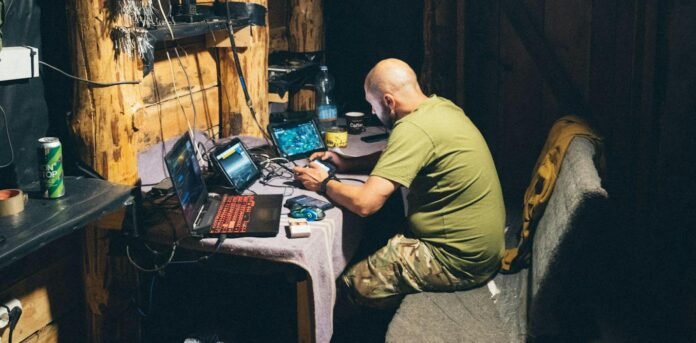
But another factor made it even harder for Ukraine to defend itself. A speed limit had been imposed on the SpaceX Starlink satellite system it has depended on since early in the war. This effectively meant that the interceptors it uses to try to shoot down the jet-powered drones became ineffective.
Elon Musk took to his social media platform X to assert that the US govenrment controls Starlink’s military application, Starshield, so any decision to limit it would be “decided by the US military and ultimately POTUS”.
But it isn’t just Ukraine’s air defences that are hampered by the Starlink slowdown, writes Anthony King. Starshield is the vital backbone of Ukraine’s military operations. So, just as Kyiv is celebrating the success of Operation Vivaldi, a well-planned counteroffensive that has set back Vladimir Putin’s bid to capture the Donetsk region in eastern Ukraine, suddenly its frontline operations have been compromised.
King, the director of the Strategy and Security Institute at the University of Exeter, explains how Ukraine has come to depend on Starshield and what the apparent restriction will mean for its survival as Russia increases the intensity of its bombardment as winter approaches.
Vivaldi, meanwhile, represents a coup for Ukraine’s military. The Russian president has repeatedly said he was confident of capturing Donetsk and neighbouring Luhansk by year’s end. This now looks implausible to say the least, writes Chris Tuck, an expert in military strategy at King’s College London.
Months in the planning, the operation showed how Ukraine’s commanders have become adept at combining resources and technology in innovative ways. Most importantly, writes Tuck, it shows how Ukraine has been able to restore manoeuvrability to a battlefield that the sheer number of drones in the air had seemingly made impossible.
The sobering news for Volodymyr Zelensky, though, is that the worse things go for Russia on the battlefield, the more it will redouble its attacks on Ukraine’s cities. The Ukrainian president recently reported intelligence intercepts reporting that Putin had told his military commanders to abandon the rules of war that protect civilians. As Zelensky reported: “He said there are no rules now.”
This has been widely reported as a “new Russian doctrine”. But in truth it’s anything but. The principle of “Sodcit” – or “strategic operations to destroy critical infrastructure” – has long been a key element of Russia’s way of waging war, writes Tracey German.
German, an expert on Russian security policy at King’s College London, identifies this as a strategy of exhaustion – by which attacks on an enemy’s economic, material and moral resources over time gradually breaks its people’s morale. She traces it back via Syria and Chechnya to the “Soviet Clausewitz”, Alexandr Svechin, whose 1923 book Strategy has informed Russian (and many other countries’) military planners ever since.
On Russia’s home front – and among Russian émigrés meanwhile – the war appears to be prompting something of a rethink as to what many people think of the motherland. Marina Yusupova-Ryder, of Edinburgh Napier University, has provided some fascinating insights as to how this has changed over the course of the war.
Yusupova-Ryder interviewed 40 men in Russia and abroad in 2013-14 and again in 2022-23, asking them about their sense of national identity and what they thought of Russia in general. She says there was a dramatic shift between the two sets of interviews.
The first time she spoke with her interviewees, most saw Russia in a generally positive light and were secure about their own sense of national identity. By 2022-23, only two were positive about their country. One even went as far as to say Russia was like Voldemort, the evil wizard from the Harry Potter books.
The idea – as yet unconfirmed – that the Trump administration may have decided to hamstring Ukraine’s use of Starlink was made all the more believable by events over the past week.
Last Friday, as US negotiators met in Miami with representatives from Ukraine and its European allies, Donald Trump announced he had done a deal with Putin to lift sanctions on the sale of Russian diesel, potentially putting billions into Russia’s war chest.
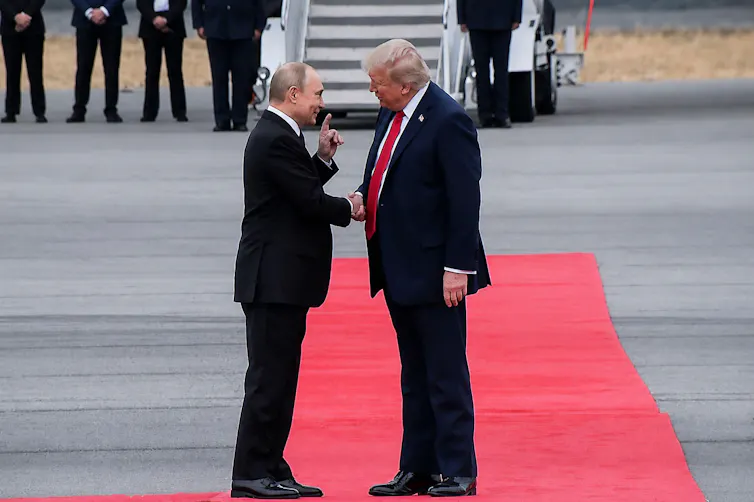
Rapport: Donald Trump and Vladimir Putin.Ian Shaw/Alamy Live News
The following day he called for Zelensky to be replaced. The day after that, he announced he had arranged an energy ceasefire, which both sides ignored. His administration also threatened to close down the prioritised Ukraine requirements list by which Ukraine’s European allies buy US weapons.
And his negotiators, Steve Witkoff and Jarrod Kushner, reportedly threatened to halt intelligence sharing. So the restrictions to Starlink may be part of that.
Stefan Wolff notes that this bullying is very much of a piece with the Trump administration’s approach to trying to get Ukraine to end the war by offering Russia concessions. It won’t, he writes, make America’s relations with its European allies any smoother.
Closer to home, UK prime minister Andy Burnham told Alastair Campbell and Rory Stewart on their The Rest is Politics podcast this week that he’d received information clearly demonstrating Russian interference in UK politics. He told the UN recently that Britain would set up a National Centre for Information Defence to guard against mischievous foreign disinformation.
Sweden could provide some useful lessons here. The country has been consciously guarding against propaganda and foreign manipulation since the early years of the cold war.
Drew Caveney-Holler of Durham University takes a close look at Sweden’s Psychological Defence Agency and how it attempts to spot and debunk foreign lies before they can gain traction. The agency is also experimenting in “prebunking” techniques – giving people the tools to spot information manipulation for themselves.
Scott Foster reports that surging Chinese industrial demand is helping drive a record boom in Japanese machine tool orders, particularly at the high end where China still relies heavily on imports. Export restrictions have slowed some sales but also given Chinese manufacturers a clear long-term target for technological catch-up.
Merz’s government is united only by the fear of collapse
Diego Faßnacht reports that Germany’s coalition is increasingly held together by the political cost of breaking apart rather than a shared governing program. Internal divisions over pensions, spending and Ukraine policy risk producing prolonged paralysis, with repeated compromises weakening both Merz’s authority and the coalition’s ability to act decisively.
Moscow sees time on its side as Trump pressures Kiev
James Davis reports that Trump has swung back toward pressuring Kiev, suspending some support and easing diesel-related sanctions as Washington tests Ukraine’s willingness to accept a negotiated settlement. Moscow, meanwhile, believes worsening battlefield and energy pressures strengthen its position and remains convinced that time is working in Russia’s favor.
Palestinian Authors Withdraw Children’s History Book From Penguin Random House Over Editorial Dispute
Palestinian American writers Alana Hadid and Jenan Matari withdrew a planned children’s book about Palestinian history from Penguin Random House following disagreements over passages concerning Hamas’ October 7, 2023 attacks on Israel, according to details published Thursday. The authors said they would instead release the book through another publisher in 2027.
The book, Displacement and the Palestinian American Story, had been scheduled for publication in September as part of Random House Children’s Books’ Race to the Truth series, intended for readers ages 10 to 13.
Hadid, the older sister of models Bella and Gigi Hadid, and Matari, an author and communications strategist, signed their publishing agreement in November 2024.
According to correspondence reviewed by The Guardian, disagreements intensified after editors inserted language stating that Hamas’ October 7 attacks violated international law. The authors objected, arguing that the addition conflicted with their account of Palestinian resistance and had been made without their approval.
Human Rights Watch has separately concluded that Hamas-led armed groups committed war crimes and crimes against humanity during the attacks, including the deliberate killing of civilians and hostage-taking.
The publisher also questioned repeated references to Jewish identity in descriptions of armed Zionist groups during the 1948 war, when approximately 700,000 Palestinians fled or were expelled from their homes.
Random House defended its editorial procedures, saying changes were intended to help younger readers understand contentious historical events. It subsequently proposed adding a publisher’s note and raising the intended readership age.
A company spokesperson said Random House respected the authors’ decision to withdraw the manuscript and remained committed to publishing Palestinian perspectives.
The authors subsequently reached an agreement with Interlink Books, a Palestinian-owned American publisher, which plans to release their work in 2027.
Saira Rao, who helped create the Race to the Truth series, said she would discontinue future collaborations with Random House over its handling of the project. The publisher said another installment remained scheduled for 2028.
Black Sea drone attacks enter NATO country’s territorial waters for first time
Russian drones are suspected of sinking a cargo ship and leaving chemical tankers ablaze near the Black Sea coasts of Bulgaria and Romania, respectively. The latest attacks mean that at least seven ships have been attacked in the exclusive economic zones of NATO member countries—and even within Romania’s territorial waters if Russian involvement is confirmed in the case of the chemical tankers.
Such attacks have spurred requests for NATO to redeploy counter-drone systems to provide more protection. In a social media post on October 15, NATO Secretary General Mark Rutte stated that NATO had increased “counter-drone capabilities” along the alliance’s eastern flank after meeting with the leaders of Bulgaria and Romania.
The latest attacks this week occurred within 24 hours between October 14 and October 15, when the two chemical tankers were set afire after Russian drones were detected in Romanian airspace, according to Deutsche Welle. Both ships were sitting at anchor near the mouth of the Sulina canal that connects the Black Sea to the Danube River, which has become a crucial shipping export route for Ukraine, Reuters reported.
The Comoros-flagged chemical tanker Yara J was struck within Romania’s territorial waters. All crew members were rescued and accounted for.
However, Romanian authorities are still searching for seven missing sailors after rescuing five people from the San Marino-flagged tanker Wine Trader, according to Reuters. This second tanker was struck while sitting just one mile outside Romanian territorial waters.
Reuters cited an anonymous NATO source as attributing the drone attacks to Russia.
A NATO statement also described a Marshall Islands-flagged bulk carrier named Sea Destiny as also having been targeted inside Romanian waters overnight, along with a Tanzanian-flagged tanker named Dania J coming under attack in the Danube port city of Izmail in Ukraine. But there were no immediate details about damage or casualties.
This comes just days after suspected Russian drone attacks sank a cargo ship and forced the evacuation of another vessel within two dozen miles of the coast of Bulgaria in the Black Sea on October 13. Those attacks occurred within Bulgaria’s exclusive economic zone.
One of the cargo ships that came under attack was the Ukrainian-operated coastal freighter Chelsea 3, registered under the flag of Malta. Bulgarian Prime Minister Rumen Radev told the Russian ambassador in Sofia that “it makes no sense for Ukraine to destroy its own ships in the Black Sea, and the results of these strikes favor Russia’s interests,” according to The Associated Press.
All 15 members of the Ukrainian-owned Chelsea 3 were safely evacuated by Bulgarian rescue operations after the ship was reportedly struck by three aerial drones.
But authorities were still searching for 11 missing crew members of the Guinea-Bissau-flagged cargo ship Dignity, which sank after coming under attack, The Associated Press reported. Five mariners were initially rescued from that ship.
Pattern of attacks and countermeasures
These incidents mark the latest in a growing series of unprecedented attacks on Black Sea shipping in the exclusive economic zones of NATO countries. One week earlier, aerial and sea drones sank the Togo-flagged cargo ship Alfa Watan and left the Palau-flagged cargo ship Able afire about 80 miles (128 kilometers) off the coast of Bulgaria on October 6.
The 18 crew members of the Able were rescued—two required hospitalization—but the 10-member crew of the Alfa Watan has been presumed dead after rescuers failed to find any survivors.
Such incidents first began when the Turkish-owned cargo ship Royad Mammadov came under drone attack and eventually sank near Romania’s Black Sea coast on October 5. All 11 crew members were rescued.
In response to the attacks, Bulgaria has stepped up cooperation with affected NATO member countries and the alliance as a whole. On October 14, Bulgarian Defense Minister Dimitar Stoyanov told the national parliament that the country would join NATO’s Drone Edge initiative that includes member countries committing a total of $40 billion toward developing more counter-drone capabilities over the next five years, according to independent news publication The Sofia Globe.
NATO officials began examining the possibility of moving existing anti-drone countermeasures to the region after receiving requests from Bulgaria, Romania, and Turkey, diplomats told Politico. The three countries are also cooperating on an initiative to safeguard freedom of navigation in the Black Sea, which Bulgaria Prime Minister Radev plans to present to the European Union this week.
Black Sea restrictions and warfare
Naval forces from NATO countries have avoided military exercises in the Black Sea since Russia launched its full-scale invasion of Ukraine in 2022, in accordance with the 1936 Montreux Convention that grants Turkey authority to restrict passage of ships through the straits leading into the Black Sea. This Turkish enforcement has also prevented Russia from reinforcing or rotating its Black Sea fleet during the war.
Despite lacking much of a conventional navy, Ukraine has managed to largely neutralize Russia’s warships and disrupt Russian-linked shipping and ports by using aerial and sea drones. But Russia has countered with its own drone attacks on Ukrainian ports and vessels, along with sometimes targeting ships from other countries in the region.
Since the fall of 2023, Ukrainian ships have typically stuck to sea lanes running through Romanian, Bulgarian, or Turkish territorial waters in the Black Sea, according to the Carnegie Endowment for International Peace. Such Black Sea shipping is especially crucial for Ukraine’s agricultural exports of grain, accounting for well over 90 percent.
The recent spate of probable Russian attacks in the Black Sea is now disrupting shipping carrying Ukraine’s latest harvest to the rest of Europe, with some cargo being rerouted overland or through the River Danube, Politico reported.
These unprecedented attacks in waters near NATO countries coincide with a growing wave of incidents attributed to Russian hybrid or gray-zone warfare tactics. Such incidents include an attempted explosive drone attack on Ukrainian cargo aircraft at Leipzig Airport in Germany and a Russian drone boat loaded with explosives found floating near a Romanian offshore gas platform in the Black Sea.
But since the start of the war, Turkey, Romania, and Bulgaria have continued upgrading their navies while forging closer cooperation on maritime security, according to Carnegie. The growing dangers for shipping in the Black Sea will likely accelerate this cooperative trend—and for the NATO alliance as a whole.
This article was updated on October 15 with news of the latest attacks on chemical tankers near and within Romania’s territorial waters, and NATO’s response.
Billy Graham’s Son Reveals Heartbreaking Childhood Memory
For millions of Christians around the world, Billy Graham was a beloved preacher who devoted his life to spreading the Gospel. But behind his extraordinary ministry was a family that sometimes went months without seeing him.
Now, his son Franklin Graham has shared a heartbreaking childhood memory that reveals the personal sacrifices his father’s worldwide mission demanded.
During a candid interview with Fox News host Sean Hannity, Franklin recalled a time when Billy Graham returned home from an extended preaching trip to Australia, only to discover that his young children barely recognized him.
The moment was especially painful for the legendary evangelist.
“Mama, who’s that strange man in the bed with you?” Franklin recalled asking his mother, Ruth Graham, after his father returned home.
Franklin, now 74, explained that he was too young to remember the encounter himself but had heard the story from his mother.
Billy had reportedly been away for approximately six months, traveling across Australia to deliver Christian messages to enormous crowds.
When he finally returned to his family in North Carolina, his children struggled to recognize the man who had spent so much time away.
Franklin said the experience deeply hurt his father, who was committed to his family despite the extraordinary demands of his ministry.
The story offers a rare glimpse into the private life of a man who became one of the most influential religious figures of the 20th century.
Billy Graham spent decades traveling around the world, preaching to millions of people and encouraging them to embrace Christianity.
His ministry took him to more than 185 countries and territories, where he addressed enormous audiences in stadiums, churches and outdoor gatherings.
But those international trips often required long separations from his wife and five children.
Franklin explained that traveling to Australia in the 1950s was far more complicated than it is today.
Commercial jet travel had not yet become widespread, and reaching distant destinations often required several flights and extended layovers.
“You would fly to Hawaii, then you’d stay a couple of days, then you’d fly to Fiji and stay a couple days,” Franklin told Hannity while describing the lengthy journey.
Only after those stops would travelers continue to Australian cities such as Sydney or Melbourne.
For Billy Graham, the difficult travel schedule was part of a calling he believed God had placed on his life.
One of his most historic international campaigns took place in 1959, when he traveled throughout Australia and New Zealand during a series of evangelistic gatherings known as the Southern Cross Crusade.
The campaign lasted several months and attracted extraordinary crowds.
According to the Billy Graham Evangelistic Association, more than 3 million people attended the meetings, representing roughly one-third of Australia’s population at the time.
An estimated 140,000 people publicly responded to Graham’s invitation to embrace the Christian faith.
The events became a defining chapter in his ministry and helped establish his international reputation.
However, while audiences were filling stadiums to hear his sermons, Ruth Graham was raising their children back home.
The couple married in 1943 and eventually welcomed five children: Virginia, Anne, Ruth, Franklin and Nelson.
Ruth played a central role in maintaining family life while her husband’s work frequently took him overseas.
Their children grew up in the mountains of North Carolina, where their mother worked to provide stability despite their father’s demanding schedule.
Franklin’s latest recollection illustrates how difficult those separations could be, particularly when the children were very young.
Although Billy was admired by millions, his family experienced the consequences of a ministry that regularly placed him on the other side of the world.
The story also highlights the complicated relationship Franklin had with his father’s legacy during his younger years.
Unlike the disciplined public image associated with Billy Graham, Franklin developed a rebellious reputation as a teenager.
He later acknowledged that growing up as the son of a world-famous evangelist did not automatically give him the same religious convictions.
In his autobiography, Rebel With a Cause, Franklin explained that he eventually had to make his own decision to embrace Christianity.
That personal transformation helped shape the ministry he would later build.
Today, Franklin serves as president and CEO of both the Billy Graham Evangelistic Association and Samaritan’s Purse, an international Christian humanitarian organization.
Through Samaritan’s Purse, he has overseen emergency relief operations following hurricanes, earthquakes, wars and other disasters.
The organization provides medical assistance, food, shelter and other resources to people facing difficult circumstances around the world.
Franklin has also continued his father’s evangelistic mission, traveling internationally to deliver Christian messages at large public gatherings.
In many ways, his career has followed a path similar to the one that kept Billy away from home during Franklin’s childhood.
Yet his recent conversation with Hannity demonstrates that he has not forgotten the sacrifices involved.
Billy Graham died February 21, 2018, at age 99, leaving behind a religious legacy that reached generations of believers.
He served as a spiritual adviser to numerous American presidents and became widely recognized for his ability to communicate Christian teachings to audiences of different backgrounds.
His televised crusades and radio broadcasts also helped bring his sermons into homes across the country.
For Franklin, however, his father’s legacy includes more than the massive crowds and historic preaching campaigns.
It also includes quieter family memories, including the emotional reality of a young child failing to recognize his own father after a long absence.
The story is a reminder that even the most celebrated public figures can face difficult choices between their life’s work and their responsibilities at home.
And while Billy Graham’s ministry touched millions of lives, Franklin’s recollection reveals that the sacrifices behind that mission were sometimes felt most deeply by the people who loved him most.