14.8 C
London
Friday, October 16, 2026
Home Blog

What do North Korea’s sub missile tests really prove?

0
what-do-north-korea’s-sub-missile-tests-really-prove?
What do North Korea’s sub missile tests really prove?

North Korea’s recent underwater launch of strategic cruise missiles underscores its accelerating drive to field a survivable, sea-based nuclear deterrent, even as significant engineering hurdles and platform limitations continue to constrain its naval ambitions.

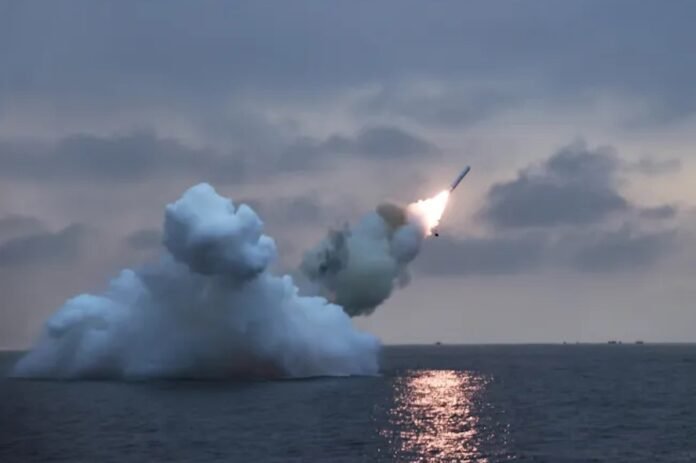
North Korea test-fired two types of submarine-launched strategic cruise missiles into the Sea of Japan, marking its first public underwater cruise missile test in nearly three years, according to state media and regional military officials, multiple media outlets reported this month.

Senior defense officials Kim Jong Sik and Jang Chang Ha oversaw the drill, which was intended to verify the operational readiness of naval combat systems and demonstrate the reliability of North Korea’s nuclear war deterrent, the state-run Korean Central News Agency (KCNA) reported.

Photographic evidence indicates the weapons were deployed from the 3,000-ton Hero Kim Kun Ok, a modified diesel-powered submarine unveiled in September 2023.

South Korea’s Joint Chiefs of Staff, which tracked the projectiles from launch to terminal flight, assessed that one missile was fired from a vertical launch system while the second was deployed horizontally from a torpedo tube — a staggered tactic that could complicate air defense radar detection.

Still, the test is not fully conclusive evidence that North Korea already has a functional sea-based nuclear deterrent. Test-firing a cruise missile from a submerged submarine may be a significant capability milestone, although it is only part of an entire system needed for a sea-based nuclear deterrent.

The submarine must operate reliably, maintain its weapons, avoid detection, and perform missions under realistic circumstances. Nuclear command and control capabilities – especially communicating with submerged submarines – must also be validated.

Looking at North Korea’s broader efforts to develop a survivable, sea-based nuclear capability, the country has not relied solely on undersea hulls, having previously test-fired “strategic cruise missiles” from surface warships.

In April 2026, North Korean leader Kim Jong Un oversaw the launch of two nuclear-capable strategic cruise missiles alongside three anti-ship missiles from the country’s largest 5,000-ton destroyer, the Choe Hyon, off Nampo to verify its integrated weapon command systems.

This Western coast trial followed earlier testing in August 2023, when North Korea fired purported Hwasal-2 strategic cruise missiles from an Amnok-class corvette off Munchon, demonstrating an evolving push to disperse nuclear-capable strike platforms across its surface fleet.

By distributing cruise missile launch points across both eastern and western coastal areas, North Korea clearly seeks to stretch allied tracking networks and present multi-axis strike threats during crises.

Because surface warships are relatively vulnerable to attack, these capabilities may be temporary as North Korea develops a more survivable undersea nuclear deterrent.

North Korea may be preparing to test a submarine-launched ballistic missile (SLBM), complementing its strategic cruise missiles. A US Congressional Research Service (CRS) report this month says North Korea demonstrated operational capability in 2019 by flight-testing the nuclear-capable Pukguksong-3 (KN-26) and then displayed the Pukguksong-4, -5, and -6.

However, the development of operational submarines capable of effectively deploying them has lagged behind North Korea’s naval missile technology. Hong Min mentions in a September 2023 report for the Korean Institute for National Unification (KINU) that North Korea is pursuing a dual-track naval strategy to deploy underwater nuclear strike capabilities.

According to Min, the short-term first track focuses on retrofitting approximately 20 aging, diesel-electric Romeo-class submarines with vertical launch systems (VLS) to deploy tactical nuclear-armed ballistic missiles, cruise missiles, and nuclear torpedoes—exemplified by the Hero Kim Kun Ok.

Joseph Bermudez Jr. and other authors mention in a September 2023 Beyond Parallel report that the Hero Kim Kun Ok represents a heavily modified Soviet-era Romeo-class vessel engineered to deploy SLBMs.

Bermudez and others say that the submarine features a reshaped bow, relocated diving planes for stability, and an aft-sail missile compartment housing ten vertical launch tubes—four large and six smaller cells intended for Pukguksong-series and modified KN-23 ballistic missiles.

However, Sukjoon Yoon points out in an October 2023 report for the S. Rajaratnam School of International Studies (RSIS) that the Hero Kim Kun Ok has structural weaknesses because it breaks the standard 10:1 Romeo-class length-to-width ratio, reducing hull strength for underwater launches.

Yoon explains that modifying the vessel’s original dimensions without a corresponding hull lengthening compromises structural integrity under dynamic underwater pressure.

He says an elevated center of gravity impedes submerged maneuverability, an unreliable superstructure makes cold launches risky, and added conning-tower stabilizers make the submarine considerably noisier, and easier to detect.

Given those design flaws, North Korea may be designing a follow-up to the Hero Kim Kun Ok, with Min saying that the country’s secondary long-term aim is to develop true nuclear-powered attack and ballistic missile submarines (SSN/SSBN).

In December 2025, North Korean state media released images of what appears to be the completed welded hull of an 8,700-ton “nuclear-powered strategic guided missile submarine.”

However, it is unclear how far along North Korea is on this project. As Vann H. Van Diepen points out in a March 2025 38North article, hull fabrication may have started at least a decade ago, but developing a compact nuclear reactor remains the pacing challenge, with several years of fitting out and sea trials expected before an operational vessel emerges.

Russia may be involved in North Korea’s efforts to develop nuclear propulsion, although it has not been definitively proven.

Anton Ponomarenko mentions in a May 2026 38North report that evidence centers on the dimensional compatibility between North Korea’s 8,700-ton nuclear submarine hull and Russian Akula-class OK-650 reactors, alongside the suspicious December 2024 sinking of the Russian military-linked freighter Ursa Major, which allegedly carried suspected naval nuclear reactor components destined for North Korea.

According to Ponomarenko, Russia views a nuclear-armed North Korea as a regional force multiplier and diplomatic leverage against China while securing North Korean munitions and troops for its war effort in Ukraine.

However, he says full reactor transfers remain speculative without the findings from a conclusive official investigation into the Ursa Major’s cargo manifest.

But even a retrofitted submarine like the Hero Kim Kun Ok could still pose a threat. Although it could be noisy and easily detected as soon as it leaves port, it could still launch cruise missiles from unpredictable locations and stretch South Korean, US, and Japanese anti-submarine capabilities, no matter how formidable they are.

While North Korea’s cruise missile test from the Hero Kim Kun Ok indicates its determined efforts to advance the development of a survivable sea-based deterrent, the effectiveness of such a deterrent may largely depend on its progress with subsequent submarine designs – possibly with Russian assistance.

Until North Korea can field a truly quiet, domestically proven nuclear propulsion system, its undersea fleet will remain caught between tactical ambition and profound engineering compromise.

Europe’s top institutions say ‘One Europe, One Market’ roadmap on track six months in

0
europe’s-top-institutions-say-‘one-europe,-one-market’-roadmap-on-track-six-months-in
Europe’s top institutions say ‘One Europe, One Market’ roadmap on track six months in


The presidents of the European Parliament, the Council and the European Commission said they have made steady progress on a plan to remove barriers within the European Union’s single market, six months after they signed it.

The three leaders reviewed the “One Europe, One Market” roadmap and a joint declaration on the EU’s legislative priorities for 2026. They reaffirmed their commitment to delivering tangible results for citizens and businesses, particularly in what they described as an unstable world.

The institutions said they remain focused on initiatives to strengthen Europe’s competitiveness, remove single market barriers and provide clean, affordable energy. They also pledged to boost the social dimension of the European project to promote social justice and a fairer, more inclusive Europe.

European Parliament President Roberta Metsola said the roadmap was meant to make the Union stronger, fairer and more competitive. She said the institutions are cutting red tape, removing barriers and deepening integration across all sectors.

“Parliament is committed to keeping up the momentum and working with the Council and Commission to deliver real results for people and businesses across Europe,” Metsola said.

Irish Taoiseach Micheál Martin, whose country holds the Council presidency, said all sides agree that urgent action is needed to enhance Europe’s competitiveness and productivity. He said the roadmap gives the Irish presidency’s program a strong strategic focus and that the Council has made strong progress on key initiatives under that presidency.

“We need to maintain momentum and focus on ensuring we can create a more competitive Europe for our citizens and businesses,” Martin said.

European Commission President Ursula von der Leyen called the single market of 450 million consumers one of Europe’s greatest assets, but said it can reach its full potential only if it is completed. She said the goal is a historic overhaul of the single market by the end of 2027.

She described the aim as a Europe where energy, capital, innovation and ideas flow freely across borders, and where businesses can grow and compete without barriers.

“Our commitment is stronger than ever, and we will deliver the ambition Europe needs,” von der Leyen said.

Trump Is Targeting Ilhan Omar. Where’s the Elite Media Outrage?

0


Adam Johnson is co-host of the Citations Needed podcast and author of “How to Sell a Genocide: The Media’s Complicity in the Destruction of Gaza,” which is available now.

Agents from the Department of Homeland Security on Monday raided the Washington, D.C., home of Rep. Ilhan Omar ostensibly in connection with a criminal investigation into her childhood immigration to the United States. The raid was signed off on by a federal judge, apparently after a “back-and-forth” with federal law enforcement, and has been condemned by civil rights groups as highly suspect.

On Wednesday, President Donald Trump’s targeting of Omar escalated even further as federal agents issued subpoenas to many of her relatives, including her sister Sahra Noor, and the Wall Street Journal reported the Trump administration’s ultimate goal is to strip Omar of her citizenship and deport her. This obscene abuse of power comes after years of Trump targeting Omar with threats, racist smears, intimidation, and calls for her deportation. 

But with rare exception, the response from the mainstream media’s pundit class has been largely muted, with the vast bulk of the coverage coming in the form of he said/she said, down-the-middle reporting. This is in stark contrast with how elite opinion-shapers responded with uniform outrage in the days after Trump’s also dubious raid on John Bolton, his former national security adviser and a neoconservative commentator, in August 2025. Both are part of a consistent pattern of Trump weaponizing the Department of Justice to attack his perceived enemies, yet only the latter solicited widespread media condemnation.

The very day of the Bolton raid, we saw scathing editorials from the New York Times, Washington Post, and Wall Street Journal. Over the next week, each of these newspapers also published separate pieces from their opinion staff opposing the raid, casting doubt on its legitimacy, and otherwise leveling outrage at the obvious power grab. The raid was explicitly condemned in Politico, The New Yorker, and The Atlantic, which published four different indignant columns.

As a rule for U.S. media, the consistent application of principle takes a back seat to class solidarity.

The raid on Omar’s home has thus far received zero of the above media interventions. No editorials, no opinion columns in the Times, Post, or Journal; no preening in The New Yorker or Politico or Atlantic about the erosion of “rule of law.” The Atlantic did run an article on the Omar raid but it was equivocal and Both Sides in its tone. (A similar Both Sides column The Atlantic published about the Bolton raid was not included in our list of opinion pieces expressing outrage over the Bolton raid.) 

This is in stark contrast to the breathless tone of outrage leveled at Trump when his DOJ targeted Bolton last year. “It is clear that Mr. Trump and his appointees,” the Times wrote in August 2025, “are perverting the justice system to serve their political interests and intimidate their critics.” “FBI raid targeting Bolton crosses a line in the Trump revenge campaign,” proclaimed the Trump ally–owned Washington Post. Even the right-wing WSJ editorial board, typically a staunch backer of Trump, got in on the fervor under the headline “Trump’s Vendetta Campaign Targets John Bolton,” which made clear “that second-term success for the President includes retribution.”

The Journal not only didn’t publish an editorial or column opposing the Omar raid as they did with Bolton, they published a column by assistant editorial page editor James Freeman endorsing it and using tabloid innuendo to cast aspersions on Omar.

This isn’t to say the mainstream press hasn’t reported on the Omar raid. The New York Times, Washington Post and Wall Street Journal all ran articles, and analysis, on the raid, but — unlike with the Bolton case — they have published no opinions expressing outrage and demanding recourse for the obvious authoritarian power grab.

The reasons for this glaring discrepancy are likely many: Omar is Black and Muslim, Bolton is white and not. Omar is a woman, Bolton is a man. Omar is considered “far left,” Bolton is squarely in the center-right of elite Washington consensus. Omar is a harsh critic of Israel, and Bolton is among its most overtly and bloodthirsty champions. The reality is it’s almost certainly a combination of all these factors. Writ large, Bolton is a member of The Club, and Omar isn’t.

A similar dynamic of asymmetric In-Group vs. Out-Group outrage could be seen during the early months of Trump’s first term when the media spilled oceans of ink lamenting Trump’s determination to intimidate the press and lock up reporters. Yet this same press almost entirely ignored his DOJ’s absurd prosecution of two independent reporters, Aaron Cantu and Alexei Wood, for covering the January 20 unrest during his 2016 inauguration — a case that was found to have no merit. Ultimately, the city of Washington, D.C., was, despite the lack of any sustained media attention, forced to settle with a payout to the persecuted reporters. 

As a rule for U.S. media, the consistent application of principle — as high-minded and lofty as they may appear — takes a back seat to class solidarity. Bolton is a corporate media figure, a national security elite, a hawk, and a committed institutionalist. He is, in other words, one of them. Omar is none of these things. As a direct result, her outrageous persecution by Trump is noted and perhaps critiqued around the margins but is not a source of widespread, sustained outrage and condemnation. This distinction is reserved, very clearly, for those in The Club.

Hegseth’s dubious low-T screening may flag up to 25 percent of the Army

0
hegseth’s-dubious-low-t-screening-may-flag-up-to-25-percent-of-the-army
Hegseth’s dubious low-T screening may flag up to 25 percent of the Army

Up to a quarter of active-duty Army members could receive a low testosterone result from mandatory military screening, despite the true prevalence of the condition likely being a tiny fraction of that figure, according to a study published Thursday in JAMA.

The finding adds to concerns that the mandatory screening announced by Defense Secretary Pete Hegseth in July will lead to a cascade of unnecessary medical evaluations for military members. Those evaluations could result in inappropriate testing, inaccurate results and diagnoses, and overtreatment that could cause harm, including infertility. Medical experts, including the Endocrine Society and the American Urological Association (AUA), have recommended against blanket screenings for these reasons. Still, the Pentagon has moved forward with the plans, releasing clinical guidance in September.

The JAMA study highlights the reasons why testosterone levels are not measured in men without symptoms—and also offers a glimpse of how many Army members could become ensnared in the clinically dubious screenings.

Researchers at the Pennington Biomedical Research Center in Louisiana and the US Army Research Institute of Environmental Medicine in Massachusetts conducted the study. The researchers drew data from a large military health survey, which included members at five US Army installations. The survey data included morning blood draws from fasting military members. The samples were collected between August 2024 and January 2026.

Estimating impact

From those samples, total testosterone levels were measured from 479 male, active-duty Army service members. (Those receiving testosterone treatment were excluded from the study—three men were excluded for this reason.) With some statistical weighting, the 479 included members were representative of the active-duty US Army personnel; the weighted mean age was about 30 years old, and the weighted mean body mass index (BMI) was 28.4, which falls in the “overweight” category.

Generally, experts are wary of universally screening men for low testosterone because testosterone measurements can be highly variable—and unhelpful. Levels can dip for a number of different reasons, including age, time of day, obesity, illness, physical stress, poor sleep, trauma, and various medications. Moreover, the conditions that can cause clinically significant low testosterone—a condition called male hypogonadism—are rare, affecting 1 percent of men at most. They include genetic conditions and problems with the pituitary gland.

Given the complexity, experts recommend that evaluations be prompted by patients self-reporting symptoms. In those cases, doctors use repeat testing and comprehensive evaluations to come to a firm diagnosis of male hypogonadism. With that being the current norm, researchers aren’t sure exactly what the military’s new universal screen will yield.

According to the new data, a large portion of the military may face alarming results. From the Army members in the survey, the weighted mean for morning total testosterone was 405 ng/dL. The Pentagon’s clinical guidance uses a threshold of less than 300 ng/dL for low testosterone, in line with recommendations from the AUA. Using that cutoff and extrapolating the data to the entire Army population, the researchers estimate that about 26 percent of active-duty Army service members would get a test result suggesting low testosterone.

The Centers for Disease Control and Prevention has a harmonized reference cut-off that’s a little lower, at 264 ng/dL. With that threshold, about 15 percent of Army service members would be estimated to have a low testosterone result.

Screening risks

As expected, the likelihood of low results scaled with weight and age; the higher the age and/or higher the BMI, the greater the odds of having a testosterone reading under either threshold. Of men under age 30, 19.5 percent had a low measurement, while 33 percent of men aged 30 and older had low levels.

“Published estimates of clinical hypogonadism are substantially lower than the prevalence of low testosterone observed here, underscoring that many men with a single low screening measurement do not have clinical hypogonadism,” the researchers write. But each positive screening result will require thorough follow-up, including repeat testing, further evaluation, counseling on modifiable factors (such as losing weight or improving sleep), and treatment considerations, the researchers note.

“Because testosterone replacement therapy is long-term and has potential adverse effects, distinguishing an isolated low screening value from clinically significant hypogonadism is essential,” they write.

While the study looked at results from all men—without first assessing possible symptoms of male hypogonadism—the military’s screening will likely be more limited. The mandatory screening only applies to men aged 30 and above, while younger men are allowed to opt in. It’s unclear how many will do so. The first step in the screening is to ask members about possible symptoms and risk factors. From there, some men might not proceed to having a testosterone test.

Still, the symptoms and risk-factor screening will likely catch a large swath of the military, leading to far more service members getting tested than before. Possible symptoms include vague problems that aren’t closely linked to male hypogonadism, such as “diminished physical performance,” “disturbed sleep,” and “low motivation.” The risk factors considered also include common conditions, such as obesity, type 2 diabetes, and low-trauma fractures. Those with such risk factors can go on to be tested even in the absence of symptoms, according to the Pentagon’s guidance.

Beloved Singer Shares Emotional Health Update

0
beloved-singer-shares-emotional-health-update
Beloved Singer Shares Emotional Health Update


Beloved Christian music star Amy Grant is opening up about her remarkable recovery after surviving two major health crises, including open-heart surgery and a devastating bicycle accident that left her struggling with memory loss.

The six-time Grammy Award winner, who turned 65 last November, shared an encouraging update during an appearance on NBC’s Today show on Tuesday, October 13.

And despite everything she has endured, the “Baby Baby” singer had reassuring news for fans concerned about her health.

“I’m good,” Grant declared. “I’m firing on all pistons.”

The upbeat announcement comes four years after a frightening bicycle accident left the singer with a traumatic brain injury that affected her memory, speech and ability to process information.

It also follows a lifesaving heart operation in 2020 to correct a congenital condition doctors discovered during a routine medical examination.

Grant admitted that the experiences dramatically changed her outlook on life, teaching her to appreciate moments she once might have taken for granted.

“When you’re a kid, you feel invincible,” she explained during the interview, reflecting on how serious health problems can change a person’s priorities.

The singer said those experiences became an important inspiration for her latest album, The Me That Remains, her first collection of original songs in 13 years.

But the road back to recording and performing was far from easy.

In June 2020, doctors discovered that Grant had been born with a heart defect known as partial anomalous pulmonary venous return, a condition in which some blood vessels connecting the lungs to the heart do not follow their normal route.

The problem had gone undetected for decades.

Although Grant had not realized she was living with the condition, doctors recommended surgery to correct it before serious complications could develop.

She underwent open-heart surgery and later recalled learning just how important the operation had been.

During a 2021 interview, Grant said she discovered that one of her doctors had written that she might not have survived beyond age 62 without treatment.

The revelation left her profoundly grateful that the condition had been discovered.

“I am glad to be alive,” she said.

But just two years later, Grant faced another frightening medical emergency.

In July 2022, the singer was riding her bicycle near her Nashville home when she crashed and suffered a traumatic brain injury.

She was wearing a helmet but was knocked unconscious and later hospitalized.

The accident forced her to postpone performances and begin a lengthy recovery process.

Grant later revealed that she had no memory of the crash itself.

“I don’t remember it,” she explained during a 2023 interview with Today.

But the difficulties extended far beyond forgetting the incident.

For months, the singer struggled with short-term memory problems and found herself unable to recall familiar information.

At one point, she even had trouble remembering the lyrics to songs she had performed for decades.

During a series of Christmas concerts, Grant relied on a teleprompter because she could not consistently remember the words to “Tennessee Christmas,” one of her signature holiday recordings.

She later revealed that she used the device throughout 22 performances while gradually rebuilding her confidence onstage.

Even everyday conversations became more difficult.

During a June 2026 appearance on The Kelly Clarkson Show, Grant described undergoing an extensive neuropsychological evaluation at Vanderbilt University approximately two years after the accident.

The tests revealed that her ability to process information had been significantly affected.

Grant recalled feeling as though conversations and events were moving ahead without her, leaving her struggling to keep up.

The experience was particularly challenging for someone whose career had depended on quickly connecting with audiences through music, storytelling and spontaneous conversation.

But a doctor’s advice helped change her approach to recovery.

Rather than withdrawing from activities because they had become difficult, Grant was encouraged to continue embracing the relationships and creative pursuits that gave her life purpose.

She took that advice seriously.

The singer created a small workspace at home that she affectionately named “Craftopia,” where she began writing again.

Sitting in a child’s chair with paper and a pen, Grant started putting her experiences into words.

Those early reflections eventually became the foundation for The Me That Remains, an album exploring healing, gratitude, family and the changes that come with growing older.

Working with producer Mac McAnally, Grant transformed those personal writings into songs.

She explained that the title track began as a poem before developing into a larger reflection on surviving difficult experiences.

“Everybody is recovering from something,” she told Today.

The album was released May 8, 2026, marking her first collection of new original material since 2013.

An expanded deluxe edition followed October 2, featuring seven additional tracks, including new collaborations and live performances.

The project also allowed Grant to work with people especially close to her.

Her daughters Sarah Cannon and Corrina Gill contributed vocals to “The Other Side of Goodbye,” adding a deeply personal family connection to the album.

Grant shares a blended family of five children with her husband, country music star Vince Gill, whom she married in 2000.

She said her recovery helped strengthen those relationships.

While struggling to regain her memory, Grant spent time sitting on the front porch with her children as they shared stories and helped her reconnect with familiar parts of her life.

Those conversations became meaningful reminders of the importance of family and the memories that shape a person’s identity.

The singer has also credited Gill with providing encouragement during some of her most difficult days.

Earlier this year, Grant reached another major milestone when she rode a bicycle for the first time since her 2022 accident.

The achievement came after months of working to improve her balance and rebuild her confidence.

For Grant, returning to an activity associated with such a frightening experience represented another step forward in her recovery.

Now, she is preparing for a busy holiday season.

The singer is scheduled to join Michael W. Smith and CeCe Winans for the Christmas Together tour beginning November 27.

She will also return to Nashville’s historic Ryman Auditorium for her annual Christmas performances with Gill in December.

The concerts continue a tradition that has made Grant one of the most recognizable voices in contemporary Christian and holiday music.

Her career spans more than four decades, with hits including “Baby Baby,” “Every Heartbeat” and “That’s What Love Is For.”

She helped introduce contemporary Christian music to mainstream audiences and became one of the genre’s most successful crossover artists.

In 2022, she received the prestigious Kennedy Center Honors in recognition of her contributions to American music.

But after surviving major surgery and a life-changing accident, Grant says her greatest achievement is not another award or hit record.

It is being able to embrace the life she has today.

Although she has acknowledged that her recovery required patience and adjustment, the singer’s latest comments offer reassurance that she is feeling strong and continuing to move forward.

For longtime fans who watched her overcome years of medical challenges, hearing Grant confidently declare that she is doing well may be the most welcome news of all.

Is the world pricing the risk of a US diesel export ban?

0
is-the-world-pricing-the-risk-of-a-us-diesel-export ban?
Is the world pricing the risk of a US diesel export ban?

A spike in diesel prices is hammering broad sectors of the US economy – especially agriculture and shipping – and becoming a flash point ahead of the November 2026 midterm elections.

This squeeze has prompted Republicans from hard-hit farm states to call for a ban on US diesel exports, with President Donald Trump reportedly weighing the idea as well. He also announced a deal on October 9 to supply Russian diesel to US and global markets.

Meanwhile, the G7 countries have agreed to release an additional 100 million barrels of diesel and crude oil from their emergency reserves.

What would happen if the US did enact an export ban? It’s a net exporter of petroleum products, so such a move would split the US and world markets for diesel. The resulting mismatch between domestic demand and supply could depress US diesel prices in the short term.

This would give some relief to American consumers, at least temporarily. But as a professor of finance who studies commodities and market volatility, I also see a big adverse shock hitting the rest of the world under that scenario.

The current political response to pricey diesel, however, shouldn’t be a surprise. A recent paper of mine, co-authored with two other economists, asks more broadly when governments are more inclined to restrict commodity exports. We found that export bans are more likely when prices are high and when politicians start weighing the preferences of commodity users, like consumers, over those of commodity producers, like the oil industry.

This could be what’s happening right now, amid record energy prices and just a few weeks from Election Day.

A global supply squeeze

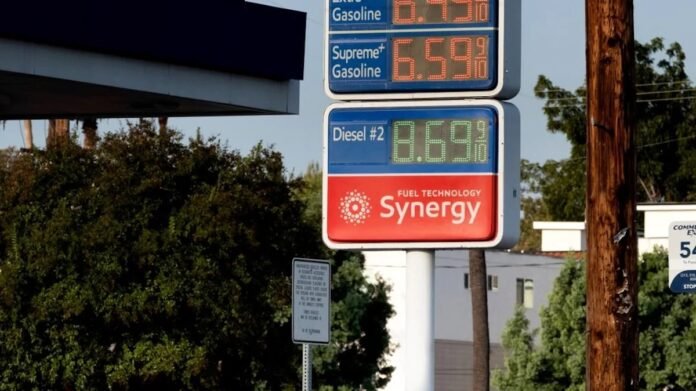
Diesel prices are hovering near all-time highs. The Energy Information Administration reports that the average price of the US benchmark, known as ultra-low sulfur diesel, has topped US$7 per gallon in some regions like the West Coast.

Soaring energy prices are also continuing to push US inflation up more broadly. Consumer prices in September jumped year-on-year by a higher-than-expected 3.7%, with gas prices responsible for more than half of the most recent monthly increase.

How did this happen? Before the conflict with Iran erupted in February 2026, key diesel exporters included Russia, Middle Eastern producers, the United States and China. Since then, those first two export sources have withered.

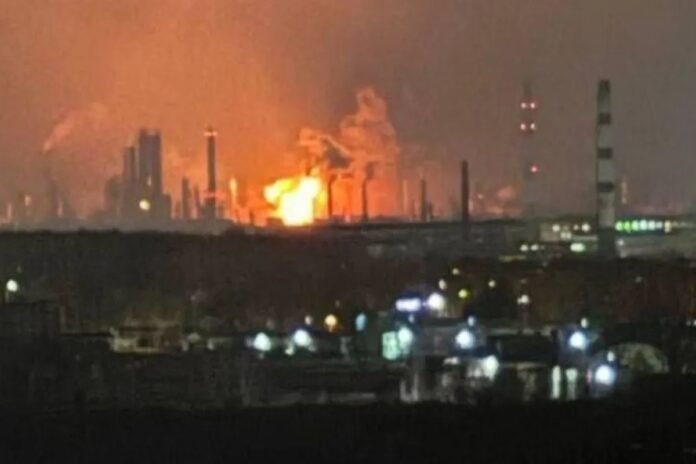
Russia, now in the fifth year of its war against Ukraine, banned diesel exports in July 2026 after Ukraine launched an effective air campaign that has knocked out more than half of Russia’s oil refinery capacity and destroyed many diesel storage-tank farms. That retaliatory campaign has pushed Russia from being a top diesel exporter to importing refined oil products, including diesel.

Meanwhile, in the Middle East, crude oil prices surged following missile attacks against Iran at the end of February. The Strait of Hormuz, which was the transit route for more than one-fifth of the global crude oil and natural gas output, essentially shut down amid fears over Iran targeting commercial ships sailing through.

Since then, increased shipments through Saudi and Emirati pipelines and actions by the US Navy in the strait have helped restart petroleum flows. But the threat to Hormuz shipping remains real, as seen by recent strikes by Iranian forces on multiple tankers in early October.

These shocks have changed the economics of petroleum shipments in two ways. First, the price of transporting oil has more than quintupled, as tanker owners charge record fees to travel through the strait. Those fees, of course, bleed into the price that diesel buyers pay.

Second, in the strait, the content of tanker cargo has changed. Many ships are now loaded with crude oil, rather than diesel, after Iranian strikes on Gulf countries earlier this year knocked out a substantial share of the Middle Eastern refining capacity. Insofar as there isn’t much additional refinery capacity elsewhere in the world, even these restored crude oil flows can’t bring diesel prices down to prewar levels.

What an export ban would look like

The effects of removing Russian and Middle Eastern diesel from the market are being felt worldwide. One result is that US diesel exports to the rest of the world have surged due to heightened foreign demand for the product and the high prices it can fetch abroad. Those export flows have been accompanied by the diesel price spike at home.

That jump in domestic prices is what’s driving discussions of a possible ban on US diesel exports, and it reflects a dynamic that my co-authors and I laid out in our study of commodity export restrictions and bans. While we focused on agricultural markets, our findings also apply to the current diesel crunch.

Governments of commodity-exporting countries typically balance the interests of commodity producers and exporters, who prefer high prices, against those of domestic consumers, who like lower prices. When consumers’ wishes matter relatively more – for example, as elections approach – the likelihood of a ban rises.

American consumers never like high energy prices. Nowadays, after years of elevated inflation, they seem especially unhappy about them. Until the Iran war, Trump had been able to tout a substantial fall in petroleum product prices after he returned to office in January 2025. That’s no longer the case.

Higher diesel prices are being felt across the economy. The fuel is used to heat homes, especially in the Northeast, and to power machinery, tractors, trucks, boats and trains. This is why farmers and transportation operators are especially hard hit. Furthermore, these businesses typically try to pass their cost increases on to their customers. So shoppers are shelling out more for groceries and any other goods that must be transported.

Under the scenario of an export ban, the cost of US diesel might fall in the short run, but world prices would spike. Soaring prices, however, would not be the only issue for the rest of the world.

Our research shows that a major exporting country’s ban would also increase market uncertainty and volatility. This is because restricting exports would effectively concentrate the rest of the world’s production, making the remaining supply base more fragile and increasing the rest of the world’s exposure to any subsequent output shocks.

If other countries think that their diesel situation is already bad, it would be much worse under a US export ban. And the G7 move to release more diesel into the global market indicates that the rest of the world might understand how US politics could lead to that outcome.

Michel Robe is a professor of finance and distinguished chair, University of Richmond.

This article is republished from The Conversation under a Creative Commons license. Read the original article.

Plex now helps sell movie theater tickets

0
plex-now-helps-sell-movie-theater-tickets
Plex now helps sell movie theater tickets

Plex, which made a name for itself by letting users share movies they own, is now helping sell movie theater tickets. The company is looking to monetize its content-discovery capabilities and expand its business beyond its media server software.

Plex partnered with Fandango, which has sold movie tickets since 2000, to drive ticket sales from people searching for movies to stream. Per the announcement:

Starting today, Plex users in the US will see a Fandango ticketing option on title pages for movies currently playing in theaters, allowing them to click through to Fandango to find showtimes and purchase tickets. The integration also enables direct attribution through Kochava, giving studios and advertisers greater visibility into how campaigns and audience engagement translate into ticket sales.

Fandango says it sells tickets for 31,000 movie theater screens in the US. The Plex deal allows it to leverage data from Plex’s streaming service (Plex claims users of the service “make more than 100 million streaming decisions each month”), including “ratings and cross-platform viewing” to gain “insight into audience intent,” the announcement said.

“Plex has a unique view into what movie fans are actively considering, from what they’re searching for to what they’re watching across services,” Jerramy Hainline, executive vice president at Fandango, said in a statement. “By connecting those discovery signals with Fandango ticketing, we’re making it easier for fans to turn that interest into a trip to the theater, while giving studios and advertisers a more direct, measurable path to ticket sales.”

Plex, meanwhile, is aiming to be “the place where people can discover what to watch, regardless of where that content lives,” Scott Olechowski, Plex’s co-founder and chief product officer, said in a statement.

Content discovery is a frequently cited challenge in the streaming industry, with various players, including smart TV OS operators, streaming service providers, and generative AI chatbots, trying to crack it. If Plex could use its user data to drive worthwhile recommendations, monetizing its content discovery could prove lucrative.

“For studios and advertisers, we’re also creating a more measurable path from discovery to purchase, helping marketers understand which campaigns are converting,” Olechowski said.

Plex’s Fandango partnership contrasts with its media server business, which lets users share movies they own with friends and family without paying Hollywood licensing fees.

The foray into movie ticket sales comes over two-and-a-half years after Plex launched its streaming service, where people can rent movies. Plex also launched a free ad-supported television (FAST) streaming service and has added social media capabilities to its platform.

These ventures give Plex additional revenue streams beyond its media server software. As it stands, the businesses coexist peacefully: Someone who only wants to use Plex for media hosting doesn’t have to use Plex’s on-demand streaming services. They can also opt out of some of Plex’s data sharing. (Notably, Plex says it collects data from media server users “searching on Plex.”)

On the media-hosting side, Plex has discussed challenges in making lifetime passes financially sustainable. Its new businesses may help fund advancements and/or maintenance to Plex’s media software. At the same time, the company appears largely focused on building out the non-server-software aspects of its business.

Attacking Trump, Zelensky showed lack of judgment

0
attacking-trump,-zelensky-showed-lack-of-judgment
Attacking Trump, Zelensky showed lack of judgment

Ukrainian President Volodymyr Zelensky’s harsh words about US President Donald Trump were an emotional response after Zelensky deliberately thwarted Trump’s request that Ukraine not strike Russian refineries. Unfortunately Zelensky is making matters worse, and Ukraine’s future is now in doubt.

Ukraine targeted two Russian oil refineries, according to Russian Deputy Prime minister Aleksandr Novak. The key target on Wednesday, October 14, and Thursday, October 15, 2026, was the Ryazan Oil Refinery. A Ukrainian drone swarm targeted the facility overnight, igniting multiple fires at the plant. Another plant in Saratov also was hit, but information on that strike is limited.

Zelensky excused the strikes saying the Russians had violated Trump’s alleged energy ceasefire. Neither side, however, ever agreed to a ceasefire, as the record clearly shows.

Zelensky also claimed Trump had slowed Starlink feeds to Ukraine, and that US intelligence failed to warn Ukraine of incoming Russian missiles aimed at Kyiv. It is uncertain if Zelensky is right that US intelligence deliberately did not notify Kyiv of an incoming missile strike.

US satellites can detect and track ballistic missile launches by picking up infrared rocket booster signatures. Launches from Russian territory have been handed over in near real time to Ukraine’s air defense units, especially its Patriot batteries.

Russian commentators and bloggers do not believe the US stopped intelligence reporting to Ukraine. While for one day Ukraine’s Starlink connectivity was slowed in order to show the Ukrainians that they faced losing their communications lifeline if they kept hitting Russian oil refineries, there is no hard evidence that the US deliberately shut down intelligence sharing.

Russian military experts say what fooled the satellites is that the missiles fired at Kyiv on October 12 and 13 were launched from converted S-400 air defenses, not from Russian territory, and that the closure time between launch and hit was only a matter of some seconds. The experts also think the US satellites did not pick up the S-400 launchers in Donetsk.

S-400. Photo: Russian Ministry of Defense

In mid-September Ukrainian forces successfully targeted and damaged two Russian S-400 surface-to-air missile launchers in the Vygonychi district of Russia’s Bryansk Oblast. Bryansk Oblast is in western Russia, directly bordering northeastern Ukraine (specifically Ukraine’s Chernihiv and Sumy oblasts) and Belarus. It is relatively close to the main route heading toward Moscow. Donetsk is much farther south in the Donbas region of eastern Ukraine, bordering Russia’s Rostov Oblast. There are no reports Ukraine attacked any S-400 sites in Donetsk.

Ukraine’s attack on the Bryansk S-400s is probably linked to preventing Russia from shooting down Ukraine’s Neptune missiles aimed at Moscow.

A Ukrainian FP-2 drone captures the moment of a precision strike on a Russian S-400 “Triumf” air defense launcher during a Special Operations Forces mission in occupied Crimea. Photo: Ukrainian Special Operations Forces

US-Ukraine relations are in bad shape

From what we now know, it is fair to say that Washington is not only frustrated but extremely angry with Zelensky, seeing him not only as uncooperative and not a team player but as directly undermining US interests when it comes to energy policy, a critical issue for the Trump administration. Zelensky’s hot temper and his attacks on Trump personally may have finally ruptured any future either for Zelensky or for Ukraine.

It is quite true that Zelensky has important allies on Capitol Hill and in Europe. But each of these relationships has significant caveats.

The President executes foreign policy. Congress can influence Presidential decisions, but the day to day management is in the Executive’s hands. While Trump is deeply involved in a critical election cycle, and has no strong interest in alienating his Republican allies, that will end in November (one way or another). After that, Trump is in the driver’s seat and Zelensky will have a hard time trying to recruit support in Congress. Trump can slow-go arms deliveries, restrict intelligence support, or make deals with the Russians, and Zelensky will not have much he can do to reverse any of that.

Volodymyr Zelenskyy had a meeting with King Charles III. Photo: official website of the President of Ukraine

As part of his verbal attack on Trump. on October 14th Zelensky shuttled off to the UK where he was given a high-level hero’s welcome, and even an audience with King Charles at Buckingham Palace. The British, who have few workable weapons, promised “speedy” delivery of some anti drone technology, but nothing else.

Zelensky was after European political support and he managed to upstage and again at least indirectly insult the American president.

While Zelensky’s support in Europe seems solid, Europe’s political situation is anything but stable and could shift against Ukraine very quickly.

Nigel Farage, head of Reform in the UK, does not want the UK fighting for Ukraine and is demanding Ukraine hold elections.

Marine Le Pen, the leading presidential candidate in France, advocates halting direct French financial aid to Ukraine, citing France’s severe domestic national debt and budget challenges. Le Pen criticizes European energy sanctions against Russia, calling them self-destructive for Europe’s economy and opposes sending offensive long-range weaponry or troops to Ukraine.

In Germany the resurgent AfD (Alternative for Germany) maintains a pro-Russian, anti-sanctions and anti-aid stance regarding the war in Ukraine. The party advocates for immediate diplomatic negotiations with Moscow and a complete halt to German military assistance to Kyiv.

While the war in Ukraine and relations with Russia grab the headlines in Europe, the real European crisis is population, specifically Muslims from the Middle East and North Africa. Around 15.4 to 17.4 million people living in Germany were born outside of Germany, and with their children account for 21.8 million, around 20 to 25% of the German population. In France, between 15 and 16 million are North African and Middle Eastern Muslims. Around 1.3 million living in London are Muslims, 51 percent born outside of the UK. About 23 to 25% of the population of Brussels is Muslim. The political reaction developing in Germany, France and the UK is closely linked to the population crisis and it is the silent war now underway on and off the continent.

There is also a Ukrainian population problem

A significant part of Ukraine’s draftable army is in Germany where 300,000 to 400,000 draft age young men sit and get welfare. Overall around 1.2 million draftable Ukrainians are in Europe, not Ukraine.

Meanwhile Ukraine is scraping the barrel trying to hustle young people into the army, trying to get rid of deferments and using harsh tactics in rounding up recruits. Ukraine’s borders are closed to young men.

From Ukraine’s point of view, if even one of the major European governments turns over, Ukraine’s lifeline will be severed. It is not a fantasy to think this is possible in one or two years (even without scheduled elections). If any of the Big Three change hands, the EU won’t be able to shovel money to Kiev, and arms supplies, already constrained, will dry up. NATO leadership may also have to change.

Zelensky’s mistake

It is hard to understand why Zelensky started a fight with Trump over Russian oil. To say he was stabbed in the back, and to make a show in the UK, which once was America’s most trusted ally, shows an unprecedented lack of judgement.

Trump is already furious with the Europeans over not supporting the US in the Iran War (and lately Houthis as well). Having Zelensky stir the pot even more, is not something welcomed in Washington.

Zelensky’s mistake and blunder has long term consequences, reinforced by the shifting sands of European politics, and Washington’s long term interests that differ markedly from Ukraine’s.

Stephen Bryen is a former US deputy under secretary of defense. This article was first published in his newsletter, Weapons and Strategy, and is republished with permisison.

Explosion Hits Syrian Gas Pipeline as Authorities Investigate Cause

0
explosion-hits-syrian-gas-pipeline-as-authorities-investigate-cause
Explosion Hits Syrian Gas Pipeline as Authorities Investigate Cause


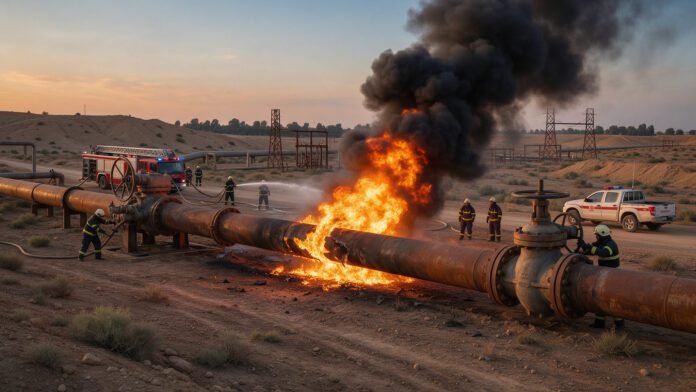
An explosion struck a major natural gas pipeline in northeastern Syria on Thursday, October 15, sparking a fire and prompting emergency crews to isolate the damaged section as authorities investigated the cause and assessed possible disruptions to energy supplies.

The Syrian Petroleum Company said the blast occurred at approximately 5:15 p.m. on the Jbessa gas export pipeline in the al-Arabidi area of southern Hasakah province, about 60 kilometers (37 miles) from the city of al-Shaddadi.

The damaged pipeline has a diameter of 16 inches and forms part of the infrastructure transporting gas from northeastern Syria toward facilities serving the country’s electricity network.

Company spokesman Oday al-Satouf said technical personnel had shut valves on either side of the affected section to contain the incident. Firefighters and security teams were dispatched to prevent the blaze from spreading and secure the surrounding area.

Authorities did not immediately report casualties or provide an estimate of the damage. The company also did not establish whether gas deliveries had been interrupted or identify those responsible for the explosion.

The incident followed another pipeline emergency earlier Thursday in western Syria. A pipeline carrying petroleum products from Baniyas to Homs was damaged near the village of Hudeida, causing gasoline to leak.

The Syrian Petroleum Company attributed that incident to sabotage intended to steal fuel. Emergency crews closed the affected section, while repair teams worked to stop the leak and restore service. Authorities also temporarily closed the Homs-Tartus highway.

Syria’s energy infrastructure has suffered repeated attacks in recent months.

On September 28, an explosion damaged another section of the Jbessa pipeline near Deir Ezzor, interrupting supplies to electricity-generating facilities. Syrian authorities blamed sabotage and said workers restored service on October 2 after replacing an 18-meter section.

An earlier explosion on the pipeline in August also disrupted gas deliveries to power stations.

The repeated incidents threaten efforts to rebuild Syria’s electricity and fuel networks after years of conflict. In January, authorities began transporting gas from the Jbessa fields toward the Furqlus processing facility in Homs province to support electricity generation.

No connection between Thursday’s two pipeline incidents has been established.

Oil shipping costs spike, lifting prices from pump to grocery

0
oil-shipping-costs-spike,-lifting-prices-from-pump-to-grocery
Oil shipping costs spike, lifting prices from pump to grocery


When the oil supertanker Esteem Explorer sails from the United States to Japan in late November, loaded with about 2 ​million barrels of crude, the journey will cost $81 million. The same journey would have cost $9.1 million last year, on average.

The shipping cost translates into $40.50 per barrel, ‌about nine times last year’s rate. While oil’s soaring selling price worries consumers, the Esteem Explorer’s expensive voyage illustrates how transport costs are further inflating the price. Refiners process oil into fuel to move food, retail goods and construction materials, and rising costs are stoking inflation in countries that depend on imports.

Every $10-per-barrel increase in shipping costs adds about 23 cents per gallon to gasoline, said Kenneth Medlock, a fellow in energy and resource ​economics at the Houston-based Baker Institute for Public Policy. On that basis, the Esteem Explorer’s shipping cost works out to at least 80 cents more per gallon of ​gasoline than last year, according to Reuters calculations.

“It’s sort of like a slow-moving train. It doesn’t all happen instantly … but the longer this ⁠drags on, the more sticky it becomes, which means you get more of a sustained impact at the grocery store, in the convenience store, at the mall,” Medlock said. “Everything gets more ​expensive because that’s how we move stuff around.”

Freight rates account for more than 40% of the price of US oil, based on Wednesday’s price around $95 per barrel, compared with 7% on ​average in 2025, according to LSEG shipping and oil price data.

Countries reliant on imports — including India, the Philippines and Indonesia — bear the brunt of the soaring costs, Medlock said.

Record oil tanker rates are already squeezing Asian refiners’ profits, the International Energy Agency said on Wednesday.

OIL’S ROLE IN THE ECONOMY

Refiners process oil into gasoline for cars, diesel for semi-trucks and farm equipment, and jet fuel for airplanes.

Attacks on ships related to the US-Iran war and ​the Russia-Ukraine war have boosted freight and insurance rates.

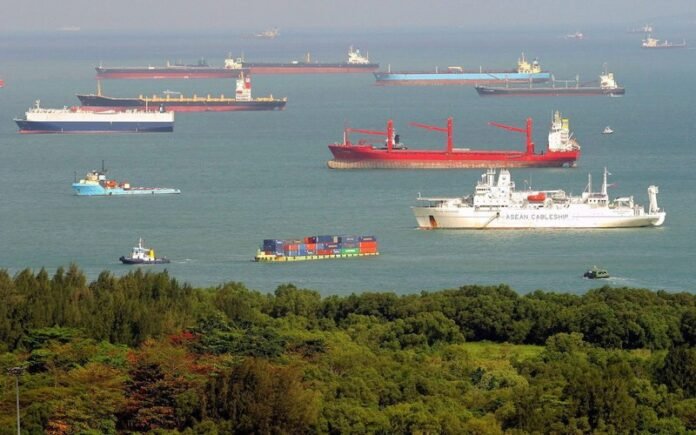
Rates to move oil from the Strait of Hormuz and the Red Sea in the Middle East to Asia surged to a ​record high around $34 per barrel this week, as shippers price in a risk premium for attacks on vessels. Fearing attack, ships are also sailing longer routes than before, tying up tankers longer.

Shippers moving Saudi oil ‌are using ⁠more vessels than before — transferring oil ship to ship — to reduce the risks for individual ships after attacks on Saudi Arabia’s main pipeline increased exports via the Strait of Hormuz. That strategy has reduced ship availability, raising costs and increasing the time cargoes are on the water.

The resulting shortage of very large crude carriers such as the Esteem Explorer has lifted prices for smaller vessels. Freight rates have quadrupled since the Iran war began in February for Suezmax ships, which can carry up to 1 million barrels of oil, for a route between the US Gulf Coast ​and Asia, and for Aframaxes, which carry up ​to 750,000 barrels, on the US ⁠Gulf Coast to Europe route, according to Signal Ocean.

While some shippers contract vessels for three to five years, many of them charter ships on the spot market about a month prior to loading. The long-term contracts, in which shippers and vessel owners lock in prices, could prove to ​be bargains for the shippers if prices rise further.

Oil market upheaval has provided a windfall for tanker owners. They have recently earned ​as much as $1.3 million ⁠per ship per day for a round trip from the Persian Gulf through the Strait of Hormuz to Asia, said Georgios Sakellariou, a Signal Ocean freight analyst. That compared with earnings of $55,000 per ship per day on average in 2025.

“If you’d have told me six weeks ago that we were seeing a million dollars per day, I wouldn’t have believed you,” said Michelle Wiese Bockmann, senior analyst ⁠at maritime intelligence ​firm Windward.

This year may be the most profitable ever, said a person at a company that owns and ​operates tankers primarily in the Americas.

“Our expectation is that as long as there is more crude oil demand than supply, tanker rates will remain strong. However, as soon as the crude oil market loosens, tanker rates will come off ​the boil quickly,” said Erik Broekhuizen, head of tanker research and consulting at ship broker Poten & Partners.

Source:  Reuters

0FansLike
0FollowersFollow
0FollowersFollow
0SubscribersSubscribe
- Advertisement -
Google search engine

Recent Posts