Damascus Seeks Probe Into Alfa Watan Sinking, 10 Missing Sailors, Including 9 Syrians
[DAMASCUS]Syrian authorities are calling for an independent international investigation into the attack that sank the cargo ship Alfa Watan in the Black Sea, while also questioning Bulgaria’s decision to halt search-and-rescue operations before the fate of 10 crew members was determined.
Mazen Alloush, director of international relations and cooperation at Syria’s General Authority for Ports and Customs, told The Media Line that Damascus has been following the case since the vessel was attacked early Tuesday, Oct. 6, while sailing inside Bulgaria’s exclusive economic zone.
Alloush said the information available to Syrian authorities indicates that the Alfa Watan had a 10-member crew, including nine Syrian nationals and one Egyptian, and that their fate remains unknown.
The Alfa Watan, which was sailing under the Togolese flag, sustained severe damage and sank.
The Bulgarian government described the attack as a serious violation of international law and a threat to commercial shipping and opened an investigation to determine the type of drones used and their origin.
Sofia has not formally blamed any party for the attack. Ukraine has accused Russia of responsibility, while Moscow has denied any involvement, leaving the identity of the perpetrator unresolved pending the investigation.
The case has also raised questions about the Alfa Watan itself, including its route, cargo, ownership, and management.
Bulgarian reports said the vessel was sailing north when it was attacked, while details about its cargo and ownership remain disputed.
Alloush said the authority had sent urgent official memoranda to the International Maritime Organization and the relevant Bulgarian maritime authorities, calling for an “independent and transparent” investigation into the circumstances of the attack and for the identification of its source and those responsible. He added that the Syrian side is also seeking an official explanation for why Bulgarian authorities ended the search-and-rescue operation without reaching a conclusive finding on the fate of the missing crew members.
Bulgarian authorities had announced the suspension of search efforts after failing to locate any of the missing sailors. Bulgarian officials said the ship was attacked roughly 70 nautical miles off the coast and sank rapidly after being hit.
A second commercial vessel, the Able, registered under the flag of Palau, was also damaged in the same attack, but all 18 crew members were rescued.
Alloush said Damascus is urging the use of all available technical means to locate and inspect the wreck of the Alfa Watan, arguing that examining the vessel could help determine the nature of the attack and clarify what happened. He said Syria does not want the case closed before all available search and investigative options are exhausted, particularly while it remains unclear whether any crew members were able to abandon the ship before it sank.
The case is also taking on an increasingly humanitarian dimension as time passes without confirmed information about the missing sailors.
Alloush said efforts must continue until authorities can provide answers to the families of the missing crew members and ensure that their rights are protected under relevant international maritime rules and conventions.
He also condemned the targeting of the commercial vessel, saying attacks that endanger civilian ships and their crews pose a serious threat to international maritime safety, especially in the Black Sea, where shipping risks have risen amid the continuing Russia-Ukraine war.
Alloush said the General Authority for Ports and Customs would continue following the case in coordination with the Syrian government, diplomatic and maritime bodies, as well as international institutions and Bulgarian authorities.
Anduril’s plan to save US sub edge from China’s undersea surge
A multibillion-dollar private initiative to overhaul US submarine manufacturing marks an urgent push to revitalize naval industrial capacity at a pivotal moment in the Indo-Pacific balance of power.
This month, multiplemediaoutlets reported that defense technology firm Anduril Industries will invest US$3.7 billion of its own capital to build a 2-million-square-foot “software-defined shipyard” at Sparrows Point in Baltimore County, Maryland, to expand US Navy submarine production capacity, according to company and defense officials.
Under a complementary US Navy contract worth up to $2.9 billion, with disbursements tied strictly to demonstrated production outcomes, the total $6.6 billion public-private venture aims to relieve severe bottlenecks in the Virginia-class nuclear attack submarine (SSN) program.
Dubbed “Arsenal-2,” the coastal facility will feature a 1,200-foot graving dock, direct rail access, and digitized workflow tracking, creating 3,100 direct manufacturing jobs and adding roughly nine million annual labor hours — a vital 15% capacity boost to the nation’s strained nuclear shipbuilding industrial base.
The intervention comes as legacy shipbuilders General Dynamics Electric Boat and Huntington Ingalls Newport News Shipbuilding continue to struggle to meet the US Navy’s minimum goal of two hulls annually.
To bridge near-term operational needs, Anduril will begin delivering critical gating components, such as torpedo tubes, from a certified Costa Mesa site by 2028, before Maryland operations begin around 2030, with long-term plans to supply full hull modules and help meet domestic fleet goals alongside AUKUS defense pact delivery commitments to Australia.
This private-sector expansion raises the question of whether the US can overcome domestic shipbuilding bottlenecks to maintain its undersea warfighting edge as China rapidly expands and modernizes its submarine fleet. The facility could boost US submarine production at a time when conventional shipyards repeatedly miss scheduled delivery milestones.
The scale of that industrial deficit is severe. A January 2026 US Congressional Research Service (CRS) report notes that while the US Navy aims to achieve a fleet goal of 66 SSNs, actual construction has never reached that threshold and has averaged just 1.1 to 1.2 boats per year since 2022 because of persistent workforce shortages, supplier bottlenecks, and component delays.
The CRS report notes that the US Navy is now pushing to raise production to 2.0 boats annually and eventually 2.33 per year to reduce backlogs, sustain domestic fleet requirements, and build replacements for three to five Virginia-class SSNs slated for sale to Australia under the AUKUS security pact.
These ongoing industrial delays affect Western Pacific operations, where attack submarines are vital to the US in a possible conflict with China over Taiwan, and forward deployments reaffirm their strategic importance.
Demonstrating that operational footprint, a June 2026 report by the South China Sea Probing Initiative (SCSPI), a Chinese think tank, found that in 2025 the US operated at least 11 nuclear-powered submarines in three Western Pacific operational corridors—the South China Sea, East China Sea, and Java Sea—to demonstrate forward presence and signal a clear undersea deterrence posture against China.
In a high-intensity Taiwan conflict, that forward undersea posture forms the tip of the US spear. In a May 2026 article for the Center for Strategic and International Studies (CSIS), Seth Jones says US SSNs provide an asymmetric operational advantage over China by exploiting the latter’s persistent anti-submarine warfare (ASW) deficiencies.
Jones notes that in simulated Taiwan Strait conflict scenarios, SSNs play a critical warfighting role by inflicting heavy attrition on Chinese invasion forces and hunting high-value amphibious vessels, surface escorts, and logistics ships.
Beyond direct strikes against transport fleets, he says these submarines screen against Chinese submarines attempting to break out past the First Island Chain, routinely cycling back to forward ports such as Yokosuka, Japan, to reload weapons and resume offensive hunting operations.
Yet dominating the undersea battlespace will prove far more contested than in previous conflicts. Rear Admiral Mike Brookes said in March 2026, in testimony before the US Congress, that China does not approach ASW as isolated platform engagements.
Instead, Brookes points out that China frames ASW as a networked “systems confrontation,” integrating air, surface, and seabed sensors, along with unmanned vehicles, into an anti-submarine warfare system-of-systems designed to control critical waters, compel adversary submarines to withdraw, and reduce port-departure detection risks for Chinese vessels.
Broadly, Brookes says China views undersea warfare as a crucial strategic enabler for naval operations under its “Near Seas Defense, Far Seas Protection” doctrine, central to US-China competition, supporting near-seas defense, ballistic missile submarine protection, sea-lane interdiction, and strikes against high-value targets such as allied aircraft carriers.
China is backing this doctrinal focus with unprecedented quantitative expansion. Outlining the growth of China’s submarine fleet, Brookes says that it now has about 60 units and could reach 70 by 2027 by adding up to six nuclear guided-missile submarines (SSGN), two nuclear ballistic missile submarines (SSBN), and retiring older Chinese and Russian-built units. He adds that China could field over 80 submarines by 2035, with nuclear-powered boats making up half the fleet.
China’s large submarine industrial base supports that growth. In a September 2023 China Maritime Studies Institute (CMSI) report, Sarah Kirchberger notes that China’s submarine industrial base drives rapid fleet expansion through massive state funding, state-owned bank credits, and infrastructure modernization across Bohai, Wuchang, and Jiangnan shipyards, which employ modular assembly, covered construction halls and commercial-military integration.
However, Kirchberger points out that persistent production bottlenecks curb qualitative parity with Western designs. She says China still grapples with acoustic-quieting deficiencies, vibration-suppression gaps, and reactor design issues, leaving boats vulnerable to detection by allied sonar arrays.
She adds that China’s shipbuilders still struggle to master indigenous marine diesels—as shown by stalled export deliveries to Thailand—and to overcome manufacturing challenges in advanced fuel-cell air-independent propulsion (AIP).
Despite those constraints, China has been innovating in submarine design at a very rapid pace. In February 2026, China may have launched the first Type 09V (or 095) SSN at Bohai Shipbuilding in Huludao, featuring an estimated 9,000-to-10,000-ton displacement, a 12-to-13-meter beam, large X-form stern rudders for littoral maneuvering, a pump-jet propulsor, and likely vertical launch missile cells.
In March 2026 testimony before the US Congress, Vice Admiral Richard Seif emphasizes that China’s rapid submarine growth reflects advances in platforms, sensors, weapons, endurance, and operational capabilities. Seif notes that even small improvements matter in undersea competition, where slight changes in quieting, endurance, or detection can decisively shift tactical advantages.
Ultimately, whether private-sector intervention can scale fast enough before the 2030s will determine whether the US maintains its decisive undersea margin, or whether China’s dense sensor networks and compressed qualitative innovations turn the Western Pacific into an anti-access sanctuary that neutralizes American naval deterrence.
A recent study of actual coding practices across hundreds of firms finds that human code review forms a significant “bottleneck” for the overall efficiency of AI coding tools, resulting in “little evidence that firms increase software output or reduce employment” by using them. Any efficiency increased during the actual coding phase, the study authors find, is “absorbed by downstream constraints in the production process”; as “the code review process significantly increases in length, pull requests are more likely to require revisions, and reviewers leave more comments.”
Cut once, measure twice
To come to these conclusions, Harvard University researchers Fiona Chen and James Stratton made use of aggregated analytics data from Jellyfish, which measures the granular output of engineering teams. That data encompasses 300 million individual “work events” (e.g., commits and pull requests) and issue management software data across more than 700,000 employees at over 700 relevant software development firms from 2021 through March of 2026.
To assess the impact of AI tools on these firms, the researchers used a mix of directly measured AI usage and analyses of GitHub activity to determine when each company started introducing either AI coding assistants (which can help auto-complete code primarily authored by humans) and/or AI coding agents (which primarily write and submit code autonomously based on prompts) into their workflows. The researchers then perform some complicated math to determine a “difference of differences” regression on key variables both before and after the introduction of these tools at different points in time across different organizations.
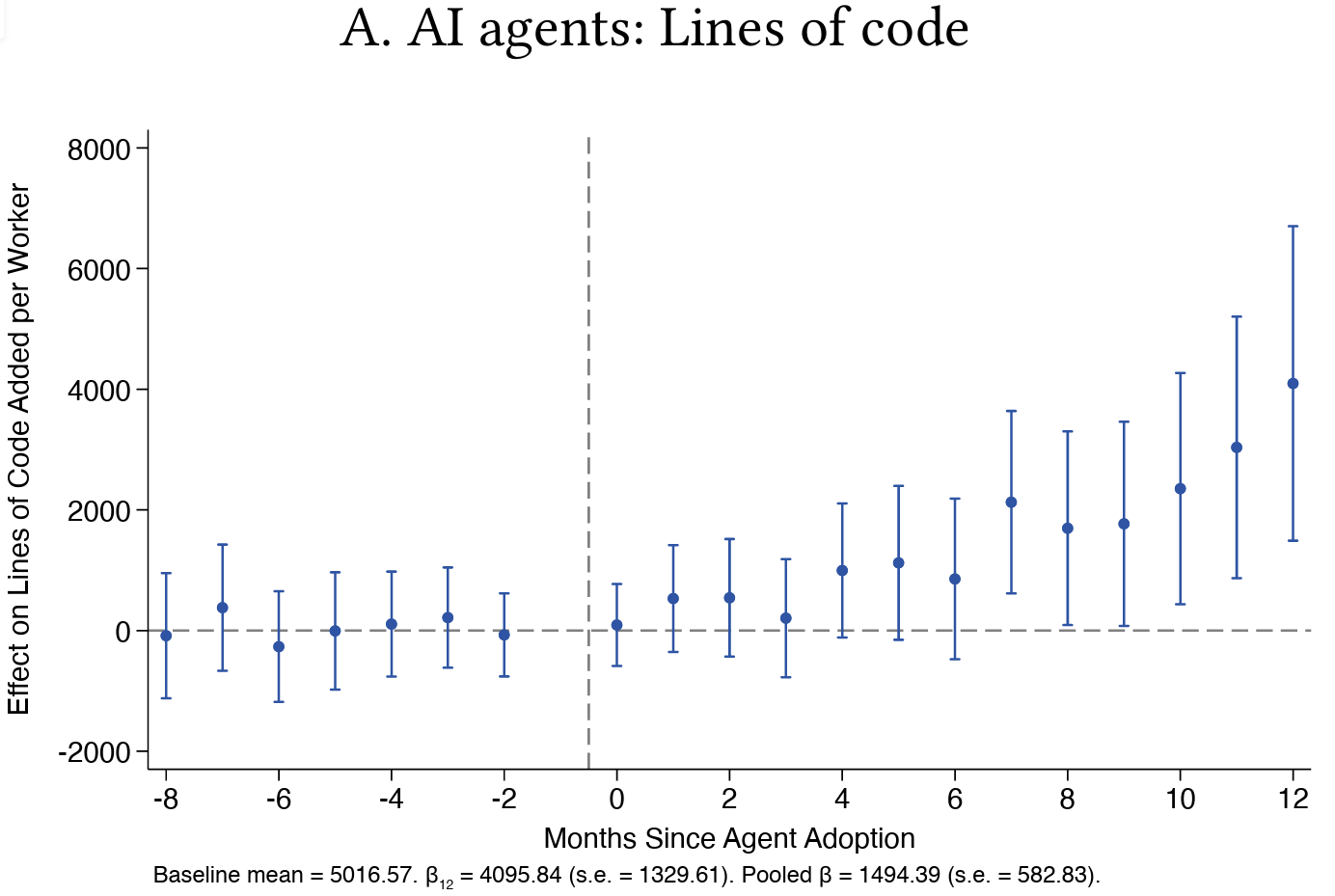
If there’s one thing AI coding agents are good at, it’s churning out a lot of code.
If there’s one thing AI coding agents are good at, it’s churning out a lot of code. Credit: Chen and Stratton
In terms of raw code being produced, the results are clear and stark. The introduction of AI coding agents at a firm leads to a 30 percent increase in total lines of code generated, a 20 percent rise in the number of total commits, and a 23 percent increase in pull requests on average, the researchers write. But all that extra code doesn’t translate directly into improved software output on the firm level. On the contrary, the resolution rate for Issues and Epics (i.e. wholesale software features) tracked by tools like Jira did not change in a statistically significant way after AI tools were introduced (the researchers also found no “compositional shift” in the size or complexity of those Jira-tracked issues across the AI introduction).
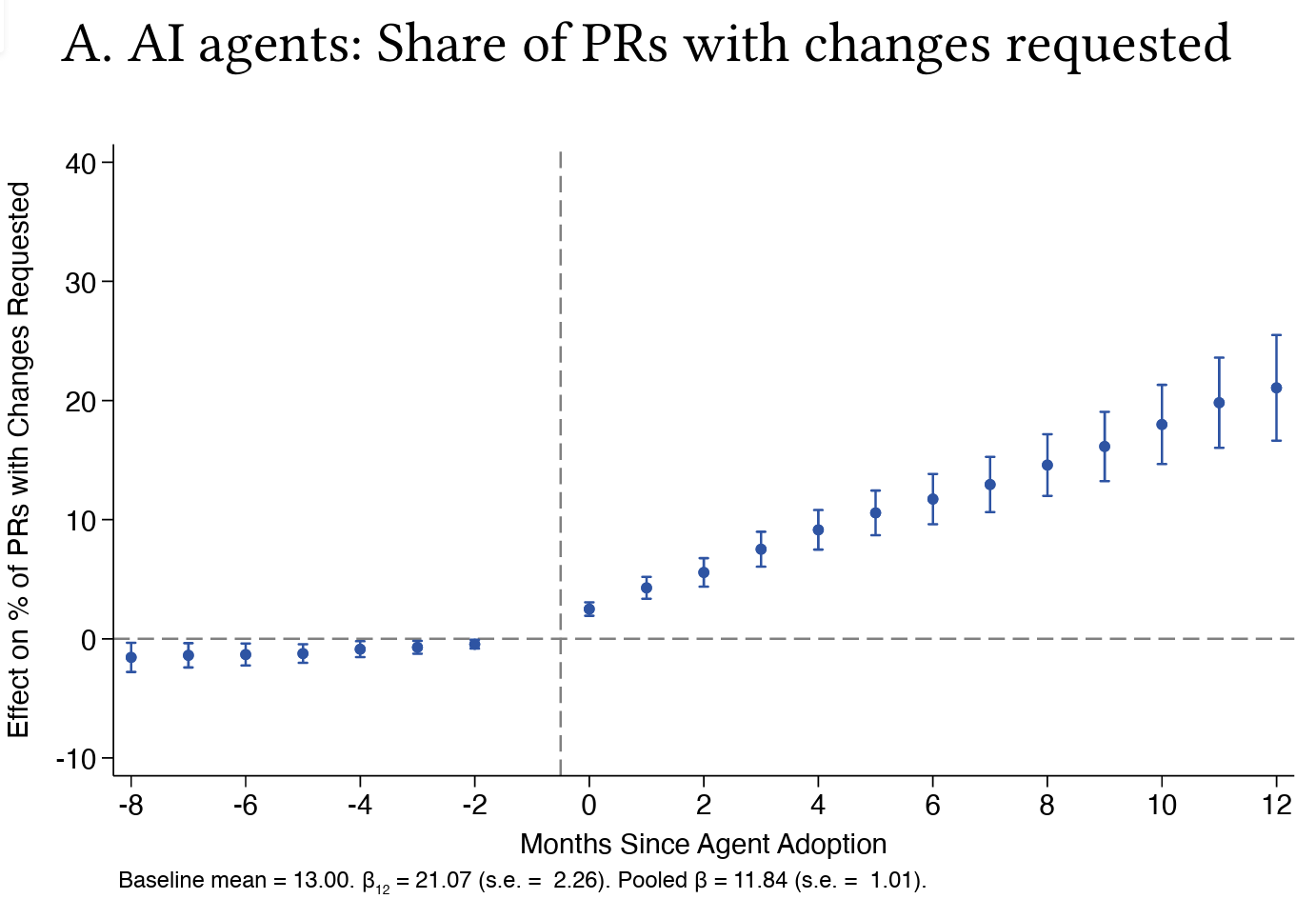
The reason for that discrepancy can be found directly in the code review process, which takes markedly longer on average after the introduction of AI coding agents. Overall, the average “review process” time between a pull request getting submitted and it being merged into the codebase balloons 49 percent on average after AI agents are introduced. That effect can be seen in more granular data, too, with “the share of pull requests with changes requested nearly doubl[ing], and the number of comments per pull request increas[ing] by 35%” following the AI agent shift, the researchers write.
In response to this change, the researchers found a 14 percent increase in the share of workers performing code reviews after AI agents’ introduction. They also write that they “cannot attribute significant employment changes to AI” after looking at total active workers across Jellyfish and cross-referencing with LinkedIn data at those firms.
Pull requests need changes a lot more often in the “agentic coding” era.
Pull requests need changes a lot more often in the “agentic coding” era. Credit: Chen and Stratton
While AI could also theoretically help with this review process, the researchers found that, so far, that impact has been marginal. Although 80 percent of measured firms used some form of AI code review by March 2026, AI agents were only responsible for 23.3 percent of all review comments and 10.8 percent of all pull requests, suggesting humans were still responsible for the vast majority of this work.
AI agents are still a relatively new part of the coding world, of course, and there have been significant updates and upgrades to their output even since this study’s March 2026 data cutoff. And while 95 percent of firms in the study have implemented AI coding agents by this point, many are doubtlessly still going through a learning process regarding when and how to best deploy them. These kinds of “coding time versus review time” trade-offs could improve as software engineering teams gain more experience with the pros and cons of siccing an AI agent on particular coding problems.
For now, though, letting AI write your code looks like a double-edged sword, with increases in coding speed counteracted by similar increases in human code review time and effort. It’s the kind of result that makes us wonder if the considerable time and expense to get AI coding agents working is really worth it for most companies.
Country singer and former The Voice contestant Kata Hay is facing a sweeping criminal case in Tennessee after authorities accused her of being involved in a crash that ultimately left another driver dead.
Hay, whose legal name is Kata Huddleston, was arrested in Oklahoma in December 2025 after Goodlettsville police issued a notice asking the public to help locate her in connection with a deadly crash near Interstate 65.
The case has since grown well beyond the initial vehicular homicide allegation.
Davidson County court records currently show Huddleston facing nine counts in an active felony case, including vehicular homicide, aggravated vehicular homicide, DUI-related charges and allegations that she left the scene of crashes.
The case remains unresolved, and the charges are allegations unless and until proven in court.
The investigation began after a series of crashes on Dec. 10, 2025, near Long Hollow Pike in Goodlettsville, just north of Nashville.
According to an arrest affidavit previously reported by local media, police first spoke with a woman who said her vehicle had been rear-ended by a red SUV on Interstate 65 near the Long Hollow Pike exit. The SUV allegedly continued driving.
Officers were then called to another collision nearby, where witnesses reported that a red SUV had come off the interstate, struck another vehicle and again left the scene.
The driver involved in that second crash was taken to TriStar Skyline Medical Center in critical condition.
Police later located a damaged red Kia Soul in a parking lot near Rivergate Parkway.
Authorities identified Huddleston as the driver.
According to the affidavit, officers reported smelling alcohol and said Huddleston appeared to have pinpoint pupils. Police also reported seeing a partially empty alcohol container inside the vehicle.
She was initially arrested on allegations including DUI, leaving the scene of a crash and having an open container.
The case became significantly more serious when the critically injured woman died at the hospital two days later.
Authorities subsequently obtained a vehicular homicide warrant.
Huddleston later failed to appear for a scheduled court proceeding, according to previous reports, prompting Goodlettsville police to issue a public alert saying investigators believed she could be headed toward Oklahoma.
Police said she might be traveling with a man and possibly towing a large camper.
She was ultimately arrested in Oklahoma in December before being returned to Tennessee.
Court records show that the original vehicular homicide case carried a $75,000 bond before it was closed following an indictment.
The charges were later incorporated into Davidson County case 2026-B-1294, which contains nine counts and remains active.
Those counts have been reported as including vehicular homicide, aggravated vehicular homicide, leaving the scene of an accident involving a death, two counts of leaving the scene involving significant property damage, DUI-related counts, open container and reckless endangerment.
Huddleston also has a previous DUI case in Nashville.
Davidson County court records show she was found guilty in 2021 in connection with a DUI case dating back several years.
Her legal history also includes a separate 2022 case involving unlawful sexual contact with a minor.
Huddleston pleaded guilty in that case and was sentenced to six months in jail, according to court reporting at the time. She was also ordered to undergo a mental health evaluation and participate in an intensive outpatient program.
Long before her legal troubles made headlines, Huddleston built a career as country performer Kata Hay.
She gained national attention in 2016 as a contestant on Season 10 of NBC’s The Voice.
Hay impressed the coaches during the competition and eventually joined Christina Aguilera’s team. She advanced to the show’s live playoff stage before being eliminated.
A decade later, the singer is now facing a dramatically different kind of spotlight as her Tennessee criminal case continues through the courts.
The current felony case does not yet show a final disposition, meaning there has been no conviction on the pending vehicular homicide-related charges.
Further court proceedings will determine whether prosecutors can prove the allegations and what penalties Huddleston could face if convicted.
Israelis mark three years since Hamas attack that set off Gaza assault
Israelis will on Wednesday mark three years since Hamas attacked Israel on October 7, 2023, triggering a military assault that destroyed much of Gaza, where conditions remain dire despite a year-old ceasefire that is meant to halt the war for good.
The attacks, during which militants killed 1,200 people and took 251 hostages to Gaza, marked the deadliest day in Israel’s history. Israel’s subsequent bombardment and ground operations have killed more than 74,000 people in Gaza, health authorities there say.
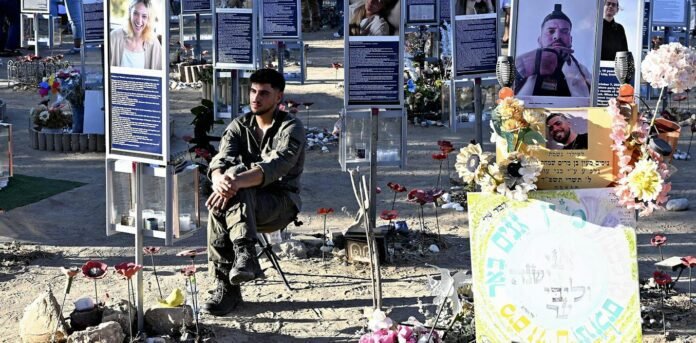
On Wednesday, Israelis will hold a vigil at the site of the Nova music festival near the Gaza border, where 348 young people were killed by militants during the attack.
They will also hold an event commemorating the anniversary at Hostage Square in Tel Aviv.
ISRAELI ELECTION 20 DAYS AWAY
The anniversary is the first for Israelis without any hostages still held in Gaza, with those dead and alive exchanged in swaps with Hamas for Palestinians held in Israeli jails. The remains of the last Israeli hostage were recovered in January.
It also comes just 20 days ahead of Israel’s first election since the attack, a vote that is viewed as a referendum on Prime Minister Benjamin Netanyahu’s long tenure in power.
Netanyahu has rejected blame for the security breach and resisted calls for an independent investigation. That has frustrated many in Israel, including families of those killed in the attacks, some of whom have joined the election race.
Item 1 of 5 A woman visits the site of the Nova music festival, where partygoers were killed and kidnapped during the deadly Hamas-led October 7, 2023 attack, on the third anniversary of the attack, near Reim, southern Israel, October 7, 2026. REUTERS/Ronen Zvulun
[1/5]A woman visits the site of the Nova music festival, where partygoers were killed and kidnapped during the deadly Hamas-led October 7, 2023 attack, on the third anniversary of the attack, near Reim, southern Israel, October 7, 2026. REUTERS/Ronen Zvulun Purchase Licensing Rights, opens new tab
A poll by the Israel Democracy Institute showed that 68% of Jewish Israelis said that the events of October 7 were a very central or fairly central element in their decision of which party to vote for.
Election polls show neither Netanyahu nor his main competitors would muster enough seats in parliament to form a coalition if a vote were held today.
US-BACKED CEASEFIRE FAILS TO HALT ISRAELI ATTACKS, DISARM HAMAS
The anniversary is also the first since an October 10, 2025, US-brokered ceasefire deal that halted major fighting but has failed to stop Israeli attacks in Gaza or secure the disarmament of Hamas and other militant groups.
The deal left Israel in control of some 53% of Gaza, since expanded by Israeli forces to nearly two-thirds. Hamas controls the remaining third, where the 2 million population mostly live in makeshift tents and bombed out buildings.
US President Donald Trump’s so-called “Board of Peace” has proposed several plans that would see Gaza rebuilt. But those plans, which fail to account for the property rights of Palestinians whose homes were destroyed, have failed to gain the buy-in of Israel or Hamas, which are still deadlocked in ceasefire talks.
The two have yet to agree on the terms of a deal that would see Hamas lay down its weapons in exchange for Israeli troop withdrawals. Israel says it will not pull back until Hamas fully disarms; Hamas says it has agreed to a phased process but will not disarm so long as Israeli attacks continue.
Israel has kept up a bombing campaign in Gaza that has killed a number of Hamas militants in recent months but has also killed many civilians, say Gaza health authorities, whose death figures do not distinguish between civilians and combatants.
More than 1,400 Palestinians in Gaza have been killed since the October 2025 ceasefire, the health authorities say. During the same time, five Israeli soldiers have been killed by militants or in combat, the military says.
Samsung dangles $560,000 bonuses to keep engineers from China
A Samsung memory chip worker earning about $60,000 a year could receive roughly $560,000 in bonuses before tax, according to the company’s largest union. Its estimate includes both Samsung’s existing profit-sharing bonus and a new special payment. Samsung hasn’t confirmed the amount.
On October 7, the company outlined how that special bonus would work: 10.5% of its chip division’s 2026 operating profit would go into an uncapped pool. Samsung plans to pay it in shares, subject to shareholder approval.
The next morning, Samsung estimated third-quarter operating profit at 107.4 trillion won, roughly $80 billion, almost nine times the year-earlier figure.
Those profits explain how Samsung can afford the payout. Findings released for a parliamentary audit the same week show the competition for the engineers it wants to keep.
What did the audit find?
The office of Choi Soo-jin, a People Power Party lawmaker on the National Assembly’s science and ICT committee, reviewed LinkedIn and other public career records. It traced at least 27 senior engineers from Samsung and SK Hynix who went on to work at ChangXin Memory Technologies (CXMT), China’s biggest DRAM maker.
Together they had spent 415.9 years at the two Korean companies, an average of 15.4 years each. Six were principal or executive-level staff with more than 20 years in mass production.
Eight worked in circuit design and seven in process integration. Others came from equipment, yield analysis, and advanced packaging, a mix that Dong-A Ilbo said was enough to run a whole chip factory.
Messages from Chinese headhunters obtained by Choi’s office offered pay increases of 60% to 100%, three to five years of guaranteed employment, rental housing, and help with children’s school costs.
Fifteen of the 27 didn’t go straight to CXMT. They first took jobs at equipment or materials suppliers, foreign companies, or universities. Choi’s office said that may have been a way around non-compete agreements, which usually last one to two years.
Why does it matter that they left CXMT?
The engineers stayed at CXMT for 2.9 years on average. According to their public profiles, 26 of the 27 have since left, and seven moved on to other Chinese chip companies, including Huawei’s Hong Kong research center and HiSilicon.
Public career records don’t establish why they left or whether any technology was transferred. But CXMT grew quickly over the same years. Its research and development staff rose from 2,606 at the end of 2022 to 7,491 in June 2026, and in September it said its fifth-generation DRAM was in mass production.
Choi’s office suggested CXMT had drawn on the engineers’ experience to build its factories and stabilize production. That illustrates the retention problem: experienced engineers can help a competitor build capabilities that remain after they leave.
Why bonuses rather than bans?
Seoul’s legal tools are limited. “There is no legal basis to crack down on or restrict lawful overseas hiring,” Korea’s industry ministry said, according to Dong-A Ilbo. Non-compete clauses expire, and the detours through suppliers and universities suggest they can be waited out.
Interest in working abroad extends beyond the chip industry. In a Bank of Korea survey of 2,694 researchers with master’s or doctoral degrees, 42.9% of those working in Korea said they were thinking about moving abroad within three years.
So the companies are competing on pay. SK Hynix moved first. Its profit-sharing system sets aside 10% of operating profit for employees, and a labor deal in late 2025 removed the old cap of 1,000% of base salary for the next 10 years.
The first payout under the new terms came to 2,964% of base salary, with a fifth of each payout deferred over two years, KED Global reported. A company official told the outlet the system was expected to curb talent losses to domestic and overseas rivals.
Samsung’s new plan follows the same logic. The special bonus arrives as shares, and most of them can’t be sold right away. Workers can sell a third immediately, another third after one year, and the last third after two years.
That ties two-thirds of the payout to Samsung’s share price for up to two years. Those holding periods alone don’t establish whether employees must stay to keep the award.
It is expensive. Samsung counts the bonus as a cost before it pays it, and it set aside about 15.4 trillion won for the first half of 2026. The Korea Economic Daily estimated the third-quarter charge at about 11.4 trillion won.
Is pay enough?
I’d argue keeping experienced engineers in Korea has become a national-security concern. Pay is one way chipmakers can respond. Bonuses on this scale give workers more reason to weigh an overseas offer against what they would leave behind.
But an uncapped bonus isn’t a guaranteed one. If memory profits fall while overseas offers stay generous, Samsung and SK Hynix will have a harder time competing on pay.
Choi wants a national system to track key personnel and incentives to bring them back to jobs in Korea. “Semiconductor technology is not just blueprints,” she said. “It is the experience and know-how that people have built up over 20 to 30 years.”
For now, record profits give the chipmakers room to pay more. The test is whether they can keep those engineers through the next downturn.
David Han is the founder of AIStockWire.com, which covers Korean chipmakers and AI stocks. The lawmaker’s and ministry’s comments are translated from Korean.
In most cases, hotspot-driven volcanism is relatively sedate, with lava flowing down mountainsides slowly enough that people can walk out of its way. But in a number of locations—Mount Etna, Hawaii, Iceland—lava gets expelled in dramatic fountains that can reach several hundred meters in height.
Right now, we’re not sure what powers them. However, thanks to a recent set of eruptions at the Kilauea volcano, we have some of the best documentation yet of erupting lava fountains. In a recent edition of Science, researchers from the US Geological Survey describe what we’ve seen and compare it with what we might expect based on our best ideas about what powers these fountains of molten rock.
Years of fountains
With three active volcanic regions that engage in fountaining, there has been a steady flow of dramatic videos of red-hot molten rock spouting from the Earth. But Kilauea has had only three fountaining episodes since 1823, even though it’s the youngest and most active volcano in Hawaii. That activity has led to intensive study, and we have a good idea of the volcano’s structure. Previous work has identified a couple of lava residues within a few kilometers of the surface, and the volcano had 35 separate data-gathering stations set up on Kilauea, including “seismic, infrasound, geodetic, gas, and visual and thermal cameras.”
Following a major eruption in 2018 that partly drained one of the underground lava reservoirs, there were indications that it was being steadily refilled. Starting in 2019, however, the refill accelerated, and the local peak inflated at a rate of more than 22 cm a year. Then, in 2023, that doubled to 57 cm a year, and spread to a nearby caldera.
In 2024, a large series of earthquakes accompanied the opening of a vent, and a 900-meter-long fissure opened, sending fountains as high as 160 meters into the sky over the course of 13 hours. Less than a day after that subsided, a second eruption followed. As of last month, 52 additional fountain eruptions had occurred, the most violent of which spewed lava over 400 meters into the air.
What have we learned from all of this?
Perhaps the most significant finding was that we could predict when a fountaining eruption was likely to happen. Each eruption caused rapid deflation of the summit of Kilauea and was followed by the relatively slow refilling of the Halemaʻumaʻu magma reservoir.
The USGS recognized that consecutive eruptions occurred when the summit tilt reached similar levels. While the precise tilt that was associated with eruptions tended downward over time, the difference between consecutive eruptions was relatively small. This pattern ultimately helped the organization issue alerts when eruptions were likely to occur, which was especially useful because there were no clear seismic signals immediately before fountains restarted.
What’s driving this?
What have the eruptions told us about the mechanism that drives fountain formation?
One leading idea is that pressure within a magma reservoir keeps water mixed with other materials until it reaches a shallow enough depth to exit as steam. That fragments the magma, which allows it to ascend more rapidly, which allows more steam to escape, and so on until there’s a jet of material near the surface. The alternative posits that things are driven by the release of carbon dioxide from the magma, which forms a magma/gas “foam” at the roof of the magma chamber. Once this reaches a critical point, the gas escapes, driving magma with it until the supply in the magma chamber is exhausted.
The new data doesn’t provide a clear picture. It clearly doesn’t favor the formation of a carbon dioxide foam, because the levels of the gas remained low throughout the eruption cycle. Sulfur dioxide levels rose during eruptions and dropped afterward, but remained high throughout the entire period. Levels of this chemical are associated with gases escaping from magma, so this implies that more of it goes on during eruptions, but it also occurs continuously between them.
So the evidence leans toward the steam-driven eruption model, but it’s unclear why a process that is occurring throughout the cycle suddenly triggers fountains when it rises a bit.
The other bit of information from the chemistry of the eruption is from magnesium oxide, which provides an indication of the temperature of the magma. It fluctuated throughout the eruption cycle, consistent with a cycle in which eruptions deplete a reservoir, which is then refilled with hot material. In contrast, other oxides rose over time, suggesting that the newly arriving material has a distinct chemical composition.
Despite the wealth of nearby sensors, the researchers acknowledged it would be nice to have more data. Sampling of gas levels is typically done at infrared wavelengths and, as you can probably imagine, there was a lot going on in the infrared during a fountaining eruption. And, because of the height of some of the fountaining, it wasn’t necessarily safe to install more monitoring hardware. One camera notably sacrificed itself in order to bring us images of red-hot, semi-molten rock falling from the sky.
While Kilauea has proven itself as a spectacular lab for studying volcanic activity, it hasn’t yet proven ready to give up all its secrets.
An Arizona County’s “Housing Hub” Is a Dead End for Many Homeless Families
A decade ago, nonprofit leaders in Arizona’s most populous county boasted that they had created the Amazon of homeless service systems. Families in crisis would no longer have to contact a dozen agencies in search of shelter or housing. A single system could point them to help.
But for all the hype, this system has become a dead end for many families. A 2023 evaluation found 94% of people who were assessed for housing help by the system didn’t receive it. And that didn’t account for parents who were unable to connect with a worker to see if they qualified for assistance.
Families say it hasn’t improved.
In interviews, 30 families that are homeless told ProPublica that calling the hotline, meeting with outreach workers or showing up at shelters rarely results in offers of help. Some families said they called 211 multiple times without being connected to the homeless response system for families, known as the Family Housing Hub. Others, who said they were sleeping in cars or outdoors, said they couldn’t get a spot on the waitlist for shelter.
The system has returned to what it was a decade ago, with families calling as many shelters as they can, repeating the very situation the hub was intended to fix.
Those who did make it onto the hub’s waitlist said they were left guessing how long it would take to get help. Some said operators told them to sleep in their cars.
Vanessa Lopez said she experienced this frustration after leaving a hostile relationship in the spring. While she and her two children stayed with a friend, Lopez said she repeatedly contacted 211, which functions as a referral service for the hub, hoping it would lead to shelter for her family.
Her friend eventually asked them to leave. Overwhelmed by the stress of not knowing where to take her family, Lopez took a leave from her job. By then, she said, she’d called 211 at least five times.
Yet no matter how dire her situation became, it still took months to get on the waitlist for shelter. During one call she said she broke down in tears, frustrated that others seemed to get help but she could not. She wondered if she needed to be addicted to drugs to receive assistance.
“It’s not me telling you no,” she said the operator told her. “It’s the system.”
Monique Lopez, the CEO of United Methodist Outreach Ministries, known as UMOM, which runs the Family Housing Hub and the shelter waitlist, acknowledged the frustrations of people like Vanessa Lopez (no relation). But before UMOM offers callers shelter or a spot on the waitlist, the organization first tries to help them find other options.
“We don’t start the conversation with, ‘Hey, do you want to get on the shelter waitlist?’” Monique Lopez said. “It really is ‘Let’s try to figure your situation out first.’”
Lopez attributed some frustrations to the number of organizations offering assistance through the hub. Each shelter has its own rules, and some families may not meet the requirements of every program.
To address the confusion, UMOM updated its website to provide more information about the homeless response system for families, she said. The federally funded system, known as Coordinated Entry, mandates that providers use an assessment to prioritize scarce housing.
“It’s not me telling you no. It’s the system.”
211 operator
But families told ProPublica that the process in Maricopa County often leaves them confused and hopeless. Family homelessness in the county has risen to its highest level in more than a decade, while every shelter is full and housing vouchers are scarce. In 2025, there were 630 units of shelter and transitional housing for families in the county, down from 769 the year before, according to the most recent federal data.
Monique Lopez acknowledged that family shelters are full, leaving few good options. “People are living in unsafe and unstable situations while waiting just to get into emergency shelter,” she said.
The process, experts said, shouldn’t leave people wondering if there is help and what it takes to get it.
“You have to have some kind of method for setting priorities when there aren’t enough resources to go around,” said Marybeth Shinn, an expert on family homelessness at Vanderbilt University. “The process should be transparent. People should know if they’re on a waitlist.”
UMOM and other Maricopa County nonprofits launched the Family Housing Hub in 2014, after years of planning and strategizing over how to end family homelessness in the county that is home to Phoenix. As they envisioned it, families would meet with a worker at UMOM who could match them with the best solution for their situation.
At the time, there was a national push to create these local systems. The U.S. Department of Housing and Urban Development in 2012 asked communities to establish a Coordinated Entry system. By 2018, the agency required it in order to receive housing and homelessness grants. The mandates coincided with a Barack Obama-era plan to end family homelessness by 2020. (That did not happen.)
Experts said the systems were set up without evidence they would be effective. When researchers did look at Coordinated Entry — in a 2021 study of single adults — they found issues similar to those now faced by families in Maricopa County, including concerns about fairness and a lack of transparency. People didn’t understand the screening process and generally received vague explanations about how their information would be used to decide if they would get help.
As Maricopa County nonprofit leaders developed their system for families, they also pledged to provide a “rapid response without waiting lists” to immediately meet the needs of any family asking for help.
People line up at what is known as “The Hill” in Tempe, Arizona, to receive food from volunteers with the organization AZ Hugs, which serves unhoused residents throughout the city.
The county saw a decline in family homelessness from 2015 to 2019. But then the numbers began to rise, even as the stock of emergency shelter increased. During the COVID-19 pandemic, efforts to address the problem began to fray. The group of nonprofit leaders, which called itself “Standing Strong for Families,” stopped meeting regularly. Arizona, along with other Sun Belt states, also saw an increase in housing prices. With one of the lowest supplies of housing for low-income people in the country, eviction filings began to soar.
By 2023, only 6% of families that were assessed by Maricopa County’s homeless response system received help with permanent housing, according to an analysis of three years of enrollment data from the system and interviews with providers and people who had sought housing assistance.
The evaluation, by Homebase, a nonprofit consulting group, was requested and paid for by the Maricopa Association of Governments, which provides staffing for the regional response to homelessness.
Homebase concluded the system for single adults who are homeless was accessible, but the family system was not. Across the system, auditors said, families encountered a “breakdown in communication” and a “lack of transparency.”
Ashley Oakley, UMOM’s chief development officer, said in a statement that the evaluation reflects a gap between the need in the community and the housing that’s available. Oakley called it “one of the biggest challenges” facing those who are working on family homelessness in Maricopa County.
To decide who gets onto the housing list, workers with the Family Housing Hub conduct an assessment of vulnerability, which assigns a score based on how long a person has been homeless and whether they have a disability. That score helps determine eligibility and priority for housing programs, Oakley said.
Nonprofit leaders recently developed a new evaluation. Before it was implemented over the summer, testing had showed it didn’t fully account for the vulnerabilities of families and needed more changes. Now, for example, households with children under 6 receive a higher score, making it more likely they can get help.
Any family sleeping in a place not meant for “habitation” or in a dangerous situation is eligible for shelter, said UMOM’s Oakley. To remain on the shelter waitlist, families must check in weekly and say where they slept the previous night. Staying in a hotel for a night should not “by itself” remove a family from the waitlist, Oakley said.
But families told ProPublica that they had been removed from the waitlist because they stayed in a hotel. (UMOM said it is reviewing its process to make sure check-ins are handled “consistently.”)
Families in dire situations may not get help, said Richard Southee, a regional executive director at Central Arizona Shelter Services, the largest shelter provider in Arizona. Southee also works on a committee that oversees Maricopa County’s response to homelessness.
That’s in part because the federal government has focused funding on more noticeable forms of homelessness, such as people living in encampments. Homeless families are typically less visible and move more frequently. They couch surf, stay in hotels or do other things to avoid drawing the attention of the Arizona Department of Child Safety. Child welfare officials sometimes consider a lack of shelter to be evidence of child neglect, along with other factors.
“We’re deciding who’s going to be at the back of the line, and we as a nation really have said people who are not chronically homeless are going to be at the back of the line,” Southee said. “You have to stay homeless to get to the front, and that’s a design choice.”
Felicia Vela and her two children were kicked out of a guest house they were renting in February, text messages from that time show. She said she searched online for help and was repeatedly directed to 211 for “emergency shelter,” which she called at least twice and explained her situation: She had stashed her belongings in a storage unit, text messages show, and was staying at a hotel that she couldn’t afford for much longer.
There was nothing immediately available, she said operators told her, with one saying the waitlist was closed and the other telling her it could take six months to a year to get shelter. (UMOM said to protect the privacy of clients, it does not comment on individual families. The organization also said that the waitlist does not close.)
When Vela didn’t have anywhere to go, she slept in her car while her children stayed with a friend. She tried to make extra money by donating plasma, but her blood pressure was too high.
Vela, who works a warehouse job, moved into an apartment with the help of a local nonprofit that is not associated with the hub, but she’s now fallen behind on rent and is facing eviction. Her car broke down, and she can’t get to work. She started calling 211 again, seeking rental assistance.
“It’s like I can’t get a break,” she said.
Every January, volunteers in cities across the country spend one night trying to count people who are homeless. In Maricopa County, the 2026 count showed the number of people in homeless families, at 2,103, was the highest it had been since 2015. The survey is considered an undercount, especially for families.
Over the summer, the waitlist for shelter ballooned to more than 200 families. It takes about seven weeks for those on the list to get shelter, according to UMOM.
Some families interviewed by ProPublica said they waited longer. And more people are entering the system than leaving it, delaying help for newly homeless families.
In Maricopa County, 139 units of shelter for families closed from 2024 to 2025, after COVID-19 pandemic relief funds expired. The state also cut $867,000 in funding to help families get into housing quickly. It had helped about 40 families.
As families wait, they have searched for other ways to access the homeless service system.
Some go to one of the city of Phoenix’s heat relief centers, inside a 21,000-square-foot former charter school. City officials said the number of families seeking help has doubled from a year ago. Some families said they were able to immediately get shelter through the workers there.
After city officials learned a local advocate, Austin Davis, was sending families to the center to receive shelter, he said they asked him to stop sending families.
Davis runs a local nonprofit that helps families like Vela’s find emergency shelter. He said his interactions with hundreds of families over the past year have shown the official channels to shelter are “too complicated.” Calling weekly to stay on the waitlist is time-consuming. The families are already managing day-to-day responsibilities while trying to resolve an overwhelming personal crisis, he said.
“The system is really designed to run people in circles until they either give up or hit enough roadblocks where they can’t continue,” Davis said.
Davis crowdsources donations to put the families in hotel rooms on and off for days, weeks or sometimes months.
Ebony embraces her daughter inside the hotel room where she was staying with five of her kids.
Ebony, a single mother of six who has breast cancer, needed longer-term help. She lost her job as a security guard this year after a chemotherapy treatment caused her to faint as she was about to begin her shift, she said.
Read More
In April, she lost her apartment. Ebony, who asked that her last name not be used to protect future job opportunities, said she called every number she could find looking for help, including 211. Eventually she was placed on the waitlist, but that didn’t solve her immediate problem of where to sleep.
She and her children stayed in hotel rooms until she ran out of cash. Then, she said, the family slept in an alley.
If a mother with breast cancer and young children sleeping outside was not vulnerable enough to get help, she wondered, who was?
The next day, she connected with Davis, who helped her pay for weeks of shelter. Then one morning she texted Davis with some good news.
She had met a pastor who helped her get into a local housing program. But she needed help for a few more days, until she could move into her new apartment.
Israel’s political rivals play the blame game as country marks years since October 7
The Israeli prime minister, Benjamin Netanyahu, and leading opposition figure Gadi Eisenkot took to social media as their country marked three years since the devastating Hamas attacks of October 7. As the country mourned, the rival politicians played the blame game.
Eisenkot is the man widely thought to be most likely to beat Netanyahu in this month’s general election. He is running hard on accountability for the October 7 attack, in which 1,200 Israelis died and 251 were taken hostage.
The subject of Eisenkot’s October 7 post on X – and the main thrust of his campaign – is his assertion that the prime minister had been warned about a potential attack and failed to protect his people. He says his first act if elected will be to launch an inquiry and has challenged Netanyahu to a televised debate in which October 7 will be the main topic of discussion.
For his part, Netanyahu’s post on X sought to deflect any blame for October 7 to Shin Bet, Israel’s domestic intelligence agency. Far from being culpable for the attack, the statement from his Likud party said it was Netanyahu who had led the fightback and protected – was still protecting – Israel from its bitter enemies in Gaza, Lebanon and Iran.
When Israelis go to the polls on October 27, it will be the first national election since the attacks and the subsequent war in Gaza. According to the Israeli Democracy Institute, 68% of Israeli Jews say October 7 is a central factor in deciding who to vote for.
So Netanyahu, campaigning for his fourth term in office, and the opponents hoping to oust him, are trying to exploit the events of October 7 to score points in what is proving to be a very tight race.
Netanyahu’s Likud party is currently projected to have 23 seats, putting him a whisker in front of his main challenger, former military commander Gadi Eisenkot, whose Yashar party is polling at 22 seats. Together, the party led by the former prime minister Naftali Bennett and Yair Lapid, also an ex-PM, is on 11 seats and the Democrats are on nine seats.
Apart from the two leading parties, the list is extremely tight and the outcome will depend on which of the two leaders can cobble together a governing coalition.
Opinion polls have found that the high cost of living, accountability for October 7 and security and foreign policy are the issues people are most concerned about. A recent study found that housing costs and food prices have overtaken some of the wealthiest countries in Europe.
But it is accountability and security that look to be the issues the politicians are set to fight on before the October 27 poll.
‘Betrayal from within’?
There has been a series of allegations that Netanyahu received prior warning about a serious threat from Hamas. The Wall Street Journal reported on September 28 that Egypt’s intelligence chief warned the prime minister of a threat several times, even visiting him 11 days before the attack.
The approach of Likud has been to deflect the blame onto intelligence and security chiefs for failing to alert the prime minister to the threat from Hamas. Yoav Gallant, formerly Netanyahu’s defence minister, has claimed that Hamas warned Shin Bet about the attack.
Family members of Liraz Assulin, a young woman who was killed on October 7 2023 at a memorial at the site of her death.EPA/Abir Sultan
This has spiralled into a “betrayal from within” theory – the idea that somebody inside Israel knew what was coming and deliberately kept Netanyahu in the dark. The prime minister’s wife, Sara Netanyahu, has added fuel to this conspiracy by insinuating in a televised interview that Yair Golan, leader of the opposition Democrats party and a former deputy IDF chief of staff, may have had advance knowledge of the attack.
This conspiracy theory has gained some traction on the Israeli right. According to a poll published in the daily newspaper Maariv, 40% of respondents believe there was “betrayal from within”.
Netanyahu rejects the treason argument, insisting that October 7 was a massive intelligence and operational failure by Israel’s security agencies. His October 7 post on X doubled down on this message, insisting that had he been informed immediately of the attack, he could have been “updated in real time — everything would have looked different”.
The post, which quoted his Likud party, said the allegations against him were the work of political enemies who were “broadcasting false political propaganda against Prime Minister Netanyahu and the Likud all day long, with the aim of toppling right-wing rule and paving the way for a left-wing government that will establish a Palestinian state”.
Politics of tragedy
Eisenkot is hardly a left-winger. He is staunchly opposed to a two-state solution. Yet Netanyahu’s campaign released an AI_generated video depicting Eisenkot running past a young man in a shirt reading “Israel unity,” to instead embrace Mansour Abbas, leader of the Arab Ra’am party. The caption read: “Eisenkot has no government without Yair Golan and the Arab parties.” Reports said the young man was intended to represent Eisenkot’s son Gal, who was killed fighting in Gaza.
Still taken from Likud campaign video.Facebook via Times of Israel
The video was shared on Netanyahu’s social media account, but an Israeli official later denied the prime minister had seen it.
The prime minister recently attempted to ban Arab parties from running candidates in the election, but the ban was subsequently overturned in a unanimous decision of Israel’s Supreme Court.
Hundreds of Israelis gathered to mark the October 7 anniversary at the site of the Nova music festival, where 378 young people were killed, while in commemoration services around the country, millions more mourned the attack. Families of people killed in the attack spoke of their loss, while former hostages spoke of rebuilding their lives.
The prime minister vowed to “complete the mission” and “continue settling the score with all the murderers”. His opponents vowed to hold him to account for his failure to prevent the tragedy.
With only weeks before the people of Israel deliver their verdict at the polls, the country clearly remains deeply divided about whose message to heed.
Moving B-1 bombers from UK to US is no drone warfare solution
US Air Force has moved its B-1 bombers out of the UK. Image: US Air Force
On October 4, the US pulled its 12 B-1 strategic bombers out of Fairford, UK and returned them to the United States. Reports say the planes returned to Ellsworth Air Force Base in Rapid City, South Dakota. The bombers were pulled out when intelligence reported that an attack by armed drones against Fairford was imminent.
While the US may have prevented an unnamed enemy, generally believed to be Iran, from executing a strike on the bombers and support infrastructure at Fairford, bringing the bombers back to the United States does not mean they are out of danger.
There were over 350 unauthorized drone incursions detected across roughly 100 domestic US military installations, alongside widespread civilian mass sightings in late 2024, particularly across the Northeast and in New Jersey.
In 2025, the high volume continued across both domestic military sites and borders, including tracking tens of thousands of drone movements along the southern border, and prompting congressional investigations and enhanced counter-UAS authorities. In 2026 (so far) the frequency remains high.
In the UK a series of unauthorized drone incursions affected four primary Royal Air Force bases utilized by the US Air Force in England including RAF Lakenheath, RAF Mildenhall. RAF Feltwell and RAF Fairford. In addition at RAF Akrotiri, the British Royal Air Force base in Cyprus, was struck by an Iranian-manufactured Shahed-type loitering munition on March 1, 2026.
The US uses Akrotiri for regional reconnaissance, intelligence operations, and force deployments. This includes hosting US Air Force units—such as Detachment 1 of the 9th Reconnaissance Wing supporting reconnaissance aircraft like the U-2—as well as shared intelligence and security detachments.
Inside Iran’s drone blitz of RAF base as terrifying attack on Brits in Cyprus landed with chilling accuracy
At Fairford intelligence suggested that the possible attack would be launched from trucks carrying drones, similar to the way Ukraine attacked Russia in Operation Spiderweb in June 2025.
In that operation, Ukrainian operatives smuggled large quantities of first-person-view (FPV) attack drones deep inside Russian territory, concealed inside wooden cabins mounted on the back of commercial trucks.
The drones were then launched from close proximity to the targeted airfields. The drones hit multiple deep-interior Russian air bases spanning multiple time zones, including Olenya, Ivanovo Severny, Dyagilevo, Belaya (Siberia), and Ukrainka.
The operation targeted Russia’s long-range strategic bomber fleet (such as Tu-95MS and Tu-22M3 aircraft used to launch cruise missiles against Ukraine), destroying or damaging multiple high-value aircraft.
A damaged Russian air force Tu-22M bomber following the Dec. 5 drone raid.
The severity of the drone threat to US airbases and other sensitive sites (including dams, nuclear power plants, communications and energy infrastructure) is unclear. US and UK authorities do not typically release information on drone incursions unless they have to do so from public pressure.
Ellsworth is not necessarily safe. Local law enforcement and base officials previously reported multiple unauthorized drone sightings and incursions in restricted airspace near the base.
For instance, the Meade County Sheriff’s Office issued warnings regarding multiple waves of unauthorized drones spotted north of the base, prompting local authorities and base defense to remind the public that the installation is a strict “no-drone zone.”
It would be highly unusual for a single drone operator to run multiple waves of drones, suggesting that Ellsworth, like Barksdale and other sensitive sites, have been extensively reconnoitered by an adversary or adversaries.
A few drones recovered around US bases do not tell us a great deal. All of them are commercial drones (primarily of Chinese origin), just as the drones flying across the US southern border are commercial drones from China, sometimes modified to carry explosives or transit drugs such as fentanyl.
There is no control system on the purchase of drones; no licensing system, and tracing ownership is nearly impossible. Because drones can be bought in the US, or flown across the border, they pose a significant threat since they can easily be transported on ground vehicles or flown to other destinations with very low probability of detection.
The US is stepping up its efforts to better protect US bases from drone incursions. The UK appears to be farther behind when it comes to countermeasures. In general, most drone incursions are successful, and few are shot down or otherwise intercepted.
The big risk is when surveillance turns into kinetic strikes. This could happen at any time. US bases are no more secure than those abroad, including the UK.
Stephen Bryen is a former US deputy undersecretary of defense and special correspondent at Asia Times. This article was first published on his Weapons and Strategy Substack and is republished with permission.