14 C
London
Saturday, October 10, 2026
Home Blog

As Trump’s Wall Closes in, DHS Intimidates a Border Tribe With Surveillance, Masked Agents and Drones

0
as-trump’s-wall-closes-in,-dhs-intimidates-a-border-tribe-with-surveillance,-masked-agents-and-drones
As Trump’s Wall Closes in, DHS Intimidates a Border Tribe With Surveillance, Masked Agents and Drones

Reporting Highlights

  • Promising Cooperation: The Tohono O’odham Nation sued to stop a wall from being built on their land. In court, DHS gave assurances that the government would engage with the tribe in good faith.
  • Intimidation Tactics: ProPublica found that DHS has surveilled an ongoing border prayer ceremony and questioned tribal members outside the reservation. 
  • Border Security: Despite steep declines in border crossings, officials describe the tribe’s land in Southern Arizona as “one of the most dangerous smuggling and trafficking corridors.”

These highlights were written by the reporters and editors who worked on this story.

At 4:59 a.m. on Aug. 25, Verlon Jose, the chairman of the Tohono O’odham Nation in Southern Arizona, received an email from the head of the U.S. Border Patrol’s Tucson Sector. Government contractors were en route to conduct soil tests for construction of a 62-mile wall along the Nation’s southern boundary, wrote acting chief patrol agent Henry N. Laxdal.

If the tribe wished to have cultural monitors observe the work, they were welcome to, but they could not interfere with the government’s operations.

The work would begin in exactly one minute.

Jose, 59, was already aware of the contractors’ arrival. An hour earlier, a tribal member had called to report a caravan heading south through the reservation, and Facebook was lighting up with similar accounts. The convoy included not only work trucks and drilling rigs, but Border Patrol vehicles as well.

Dozens of border wall contractor and Border Patrol vehicles pass the Tadai Me:i prayer camp on the morning of Aug. 27. Nate Sosa

For months, the O’odham had maneuvered to avoid such a scene, taking their case to federal court. Their homeland straddles the border, and thousands of tribal members live in Mexico. A wall would disrupt routine border crossings for ceremonies and family visits and destroy landscapes they consider their duty to protect, members and leaders say. Their lawsuit argued that the Trump administration’s efforts to build it despite their opposition constituted an historic attack on tribal sovereignty.

But administration attorneys gave assurances that the government was engaging with the O’odham in good faith, and a judge in Washington, D.C., denied the tribe’s request for a preliminary injunction. In his Aug. 25 email providing Jose a 60-second heads up, the Border Patrol chief said his agency’s willingness to accommodate cultural monitors underscored its “commitment to ongoing coordination” with the Nation.

As daylight broke, Jose learned the contractors were guarded by federal agents in masks and tactical gear, drawn from a special operations cadre that participated in citywide sweeps in Minneapolis and Chicago the previous year, which left three people dead, including two U.S. citizens. When the tribe’s chief of police tried to reach the worksite, he was stopped at a roadblock set up by the agents.

Border Patrol agents in tactical gear stand near parked white and green trucks in a desert landscape.
Merrian Felix
A border patrol agent dressed in tactical gear sits in a tactical vehicle in a desert landscape.
Davy Cross

Border Patrol tactical team members amass around the Tadai Me:i prayer camp on Aug. 26.

Jose issued a statement on the Nation’s website declaring the incursion illegal and revealing that the Department of Homeland Security had deployed a surveillance blimp and enlisted Mexican security forces to help protect the work crews.

For a quarter-century, Tohono O’odham leaders have staved off a border wall by allowing DHS to use the reservation as a testing ground for some of the government’s most aggressive homeland security measures — from vehicle barriers on the reservation’s southern boundary, to state-of-the-art surveillance towers, to law enforcement partnerships with the Border Patrol and Immigration and Customs Enforcement.

Despite the collaborations, and assurances from the Trump administration, ProPublica found that DHS has turned its vast apparatus on tribal members, with 24-hour surveillance directed at an ongoing border prayer ceremony and tribal members being questioned outside the reservation about their ceremonial activities. ProPublica’s account is based on photos, videos, court filings, interviews with tribal leadership, firsthand observations and more than 1,000 contemporaneously written observations compiled by tribal members.

The battle over a border wall on the Nation has broken along familiar partisan lines in Arizona. While GOP legislative leaders have filed briefs in support of the project, Democratic Gov. Katie Hobbs has done the same in support of the tribe.

Progressive U.S. Rep. Adelita Grijalva, whose district includes the reservation, has said she is crafting legislation to rein in the Department of Homeland Security’s sweeping powers to waive federal laws in order to expedite wall construction. The Trump administration has used those authorities to circumvent environmental and cultural preservation statutes on 60 occasions across its two terms.

For Deshane Gregg, whose vehicle was forced off the road by a convoy of contractors and federal agents, the recent show of force on the reservation has felt like a government siege, not cooperation.

“You just feel helpless. You see these people, and they’re just so aggressive. They want you to react. They want you to show them that we could be ugly too,” she said. “We’re just here doing prayer. We’re just here, not trying to bother them, but it gets to you when it’s constantly being like that.”

“The drones flying over us all day,” she added, “it’s a lot.”

A drone hovers over the Tadai Me:i camp during morning prayer songs on Aug. 27. Ryan Devereaux/ProPublica

ProPublica sent DHS, U.S. Customs and Border Protection, and the Border Patrol nearly 30 questions about the government’s surveillance and interactions with tribal members and leaders. The agencies answered none of those questions. Instead, CBP pointed to a statement Commissioner Rodney Scott made in August, in which he described the reservation’s southern boundary as “one of the most dangerous smuggling and trafficking corridors on the Southwest border” and a “remote desert that has facilitated decades of drug loads, migrant deaths, and cartel activity.”

Regarding construction of a wall, Scott said, “Congress funded this work, a Federal court has affirmed it, and CBP is carrying it out under the legal authorities that apply. Under President Trump’s leadership, we are securing the border and giving our agents the tools and support they need to protect the American people.”

A meme shows a light-skinned individual with a futuristic mask partially covering their face. The words “Resistance is Futile” span the top of the image in white block letters.
A post on X from James Percival, general counsel of the Department of Homeland Security, celebrates the denial of a request for an emergency injunction against border wall construction filed by Tohono O’odham leadership in August. Screenshot of X

With no sign the White House or the O’odham government is backing down, DHS has cast off any pretense that the agency will work cooperatively with the Nation. Within hours of the judge’s denial of the emergency injunction, on Aug. 14, the department’s general counsel, James Percival, posted a celebratory meme depicting one of the cybernetic Star Trek supervillains known as “the Borg.”

“RESISTANCE IS FUTILE,” it read.

“We respect tribal sovereignty but not to the detriment of border security,” he wrote. “This wall is getting built. Our authority is beyond dispute.”


The O’odham have inhabited the Sonoran Desert, from what is now Southern Arizona to Mexico’s Sea of Cortez, for thousands of years. According to the tribe, roughly 14,000 of its 37,000 enrolled members live on tribal land west of Tucson. Approximately 3,000 more reside in Mexico. At 2.8 million acres, their reservation is the largest on the southern border by a long shot.

During President Donald Trump’s first term, Arizona saw 226 miles of border wall built, but the Nation maintained its status as the longest unwalled section in the state. Confirmation that things would be different this time came in February, when CBP informed the tribe that it planned to seal off the reservation entirely, tapping nearly $52 billion from Trump’s so-called One Big Beautiful Bill Act.

A dirt road passes through a lush Southwestern desert landscape. There is a heavy metal fence on the left side of the frame and a jagged mountain formation on the horizon.
A vehicle barrier marks the U.S. border with Mexico in the Chukut Kuk District of the Tohono O’odham Nation. Cam Mackey

The tribe’s elected leaders met with DHS Secretary Markwayne Mullin in hopes of changing the administration’s mind. As an enrolled citizen of the Cherokee Nation, Mullin is the first Native American to head the department. “Maybe we can work with this guy,” Jose recalled thinking.

But Mullin’s message was clear: We want to work with you, but we’re building the wall. Justice Department attorneys were prepared to defend the project to the Supreme Court. O’odham council member Vivian Juan-Saunders, who also attended the April 21 meeting, recalls the secretary saying, “Don’t mess with me.” Mullin’s office did not respond to questions from ProPublica, including about the exchange.

The message was more direct the following month, when tribal leaders met with Scott. According to Jose, the CBP commissioner told the delegation that if they filed a lawsuit opposing the wall, the Nation could lose access to three border gates members use to travel to and from Mexico. Accessible only to tribal members, the gates are maintained at the discretion of CBP.

Juan-Saunders confirmed that CBP threatened to close the gates, as did another council member, Jesse Navarro. CBP declined to comment on the alleged threat.

In June, a $1.3 billion contract to build the wall, known as the “Tucson 5” project, was awarded to Sullivan Land Services Co., also known as SLS and SLSCO. The Texas firm has a long history of Republican political donations and was a major recipient of border wall contracts during Trump’s first term.

The O’odham filed a lawsuit to stop the project on June 16 in the U.S. District Court for the District of Columbia. The tribe contended it would reduce the size of its reservation, which can only be done by Congress — and that the wall would mark an enduring act of trespass on sovereign lands and destroy sacred cultural sites.

The administration’s plans cast aside decades of tribal cooperation with DHS, the Nation’s lawyers argued, and came at a time of record-low border crossings.

Trump and his administration have repeatedly claimed that the border is safer than ever, with CBP reporting border apprehensions 94% lower than they were during the Biden presidency, and Border Patrol “encounters” hitting their lowest levels in more than 50 years. The Nation underscored these figures as evidence that a wall is unnecessary.

The tribe’s interim chief of police, James Cook, claimed there had been a 90% drop in reports of illegal entry over the preceding year, saying in a sworn declaration that smuggling and other border-related crimes had “almost disappeared.”

Benjamin S. Hollinder, a senior Border Patrol official, argued in a sworn declaration opposing the tribe’s lawsuit that the absence of a wall on the Nation has produced a funneling effect, channeling smugglers onto the reservation, and saying that dynamic would intensify once the rest of Arizona was walled off.

“Not having a border barrier system in this particular area makes it a vulnerable and a desirable area for [transnational criminal organizations] to operate,” wrote Hollinder. “If encounters of aliens entering illegally between ports of entry increase, vulnerabilities in the area will become particularly problematic.”


The Nation sought the preliminary injunction to bar border wall activity until the litigation was resolved.

On the eve of a July 22 hearing, DHS filed a notice affirming that to accelerate the project, it was waiving, in whole or in part, more than 30 laws, including several that mandate tribal consultation.

In court filings, the government acknowledged its long history of working “cooperatively” with the tribal government while also arguing that the Nation “does not hold veto power over the United States’ sovereign duty to secure its borders.”

Trump administration attorneys contended that an injunction was premature; planning was ongoing, thus problems the Nation envisioned could still be addressed.

The government insisted construction would be limited to the Roosevelt Reservation, a 60-foot-wide zone that runs across California, Arizona and New Mexico on the U.S. side of the border, where CBP was authorized to construct barriers as it saw fit.

Riyaz Kanji, the tribe’s lead attorney, argued the Roosevelt Reservation doesn’t extend onto tribal land, and even if it did the rugged landscape would force construction to diverge far from the 60-foot boundary.

Sweeping as its powers were, Kanji contended, DHS could not override a sovereign government. The administration’s plans, he argued, constituted a “blatant and unprecedented disregard for the tribe’s rights.”

Adam R.F. Gustafson, a Justice Department attorney, countered that the tribe had already approved a barrier on its land many years ago. The question now was what kind of barrier it should be. That was for DHS to decide, he argued. The department was “committed” to consultation, he continued. “We take very seriously the tribe’s views on this,” he told the court.

The judge appeared swayed by DHS’ assurances but needed time to consider. “I don’t think the government is trying to go outside of that 60-foot strip,” he said.


A red and white sign in a desert landscape is seen through a barbed-wire fence and warns against trespassing on the Tohono O’odham Nation for anyone who’s not a tribal member.
Signs placed by Tohono O’odham tribal leaders warn contractors that their presence on the reservation would be considered trespassing. Cam Mackey

The O’odham suspected the government would not be as mindful as it claimed.

Two days after the meeting with Mullin, the DHS secretary, a border wall contractor had “inadvertently disturbed a cultural site” west of the reservation. The crew had bulldozed a 70-foot swath through the Las Playas Intaglio, a 200-foot long earthen etching in the shape of a fish that was at least 6,500 years old. The site was well marked and well known to area archaeologists.

Wynona P. Larson Yazzie, an O’odham tribal elder, Marine Corps veteran and former tribal police officer, had organized prayer runs that included stops at the intaglio. She’d visited the site the day before its destruction. Since then, she’d closely followed the Nation’s lawsuit.

On Aug. 6, Larson Yazzie saw a disturbing filing from the tribe’s attorneys. They’d received word that in four days government contractors would enter the reservation to conduct tests. DHS, the tribe argued, was “exploiting” the judge’s reflection period to “move forward with highly disputed actions.”

Tribal leaders erected dozens of 8-foot-wide “no trespassing” signs along the three main access roads leading through the reservation to the border.

Larson Yazzie, meanwhile, began making plans of her own.

She was joined by Amy Juan, a longtime O’odham activist. Juan, 40, had grown up riding in her grandfather’s truck over the clanking cattle guard at Ko:li Ki:jig, a traditional crossing on the U.S.-Mexico line. After 9/11, a locking gate was placed over the cattle guard. The Border Patrol built a “forward operating base” near her grandparents’ home that would eventually feature a helipad, a detention space and an endless cycle of agents. Around the reservation’s perimeter, CBP established some of the largest Border Patrol stations in the country. Checkpoints went up on roads leading north.

Two people visit across a fence made of barbed wire strung between thick metal posts in a desert landscape. In the background, a surveillance camera rises above them.
O’odham tribal members Daniel Oriol Figueroa Cervantes, left, from Mexico, and Amy Juan, from Arizona, visit over the border barrier at the Tadai Me:i prayer camp on Aug. 29. Ryan Devereaux/ProPublica

Human rights groups documented U.S.-born tribal members being arrested and deported, and verbal and physical abuse by Border Patrol agents. CBP did not respond when asked about the report’s allegations.

For Juan, the Nation’s collaboration with DHS had sacrificed safety and civil liberties for elusive gains. Virtually everyone on the reservation had been touched by the dark side of border smuggling. During the mid-2000s, some tribal members, enticed by a chance at life-changing money, got involved in moving people and drugs, fueling cycles of arrest and incarceration that exacerbated challenges the community was already facing.

At the same time, virtually everyone also had a story about negative interactions with the Border Patrol — a child traumatized at a checkpoint, an unlawful traffic stop or a loved one assaulted by an agent.

“We want safety and the same respect as the next person,” Juan said. “We’ve never been against keeping people safe, but at what cost?”

Larson Yazzie was similarly concerned. She worried that in the face of DHS pressure the Nation would fold and, like the intaglio, the borderlands would be lost.


An Indigenous person stands near a burning fire surrounded by camping chairs in a desert landscape campsite.
A tribal member stands near the fire burning in the Tadai Me:i prayer camp in early September. Cam Mackey

Prayer fires are an important O’odham tradition, often convened in moments of communal struggle. To Larson Yazzie, the coming of a wall was such a time.

The chosen site was symbolic: the border gate at Ko:li Ki:jig. The camp had limited amenities — cots and chairs that encircled the fire, a cooler for ice, a weathered canopy for relief from the sun. They called it Tadai Me:i — roadrunner on fire.

Someone was always awake to watch the flame, which was lit on Aug. 9, as the Trump administration’s contractors were preparing to enter the reservation. The first drone sighting in the area was recorded the following night, at 11:43 p.m., documented in the first of two activity logs. Kept in spiral notebooks, the logs offered a minute-by-minute account of what participants in the ceremony saw and heard.

The handwritten observations, shared with ProPublica, span 13 days and chart a steady escalation by DHS, culminating in an elite tactical team that blocked tribal authorities from issuing trespassing citations to contractors or removing them.

The camp wasn’t a protest site like those seen in Minneapolis, Chicago or other cities over the past year. Participants didn’t shout at passing Border Patrol agents. They focused on the fire, making sure there was enough sugai — creosote bush, a fragrant desert plant — to keep it burning. They were in ceremony, concentrating on morning prayers and nightly cleanses. The atmosphere was that of a family gathering in a moment of crisis. There were jokes and levity amid the uncertainty.

Larson Yazzie knew at least one legislative council member who opposed the gathering. They feared it could lead to large groups converging on the reservation to physically block the border wall, in an occupation similar to the 10-month protest on Standing Rock Sioux land that halted construction of the Dakota Access Pipeline in 2016. The idea terrified tribal leaders. With its lethal heat and unforgiving terrain, the desert was dangerous enough without outsiders squaring off against Border Patrol.

A ceremonial fire burns on Aug. 27 at a prayer camp near the traditional Ko:li Ki:jig border crossing on the Tohono O’odham Nation. Nate Sosa

Supporters of the ceremonial fire were themselves uneasy. They knew the story of Ray Mattia, the 58-year-old who was shot and killed by the Border Patrol in 2023 while unarmed on the doorstep of his home on the reservation. Agents, who were backing tribal police on the call, claimed to have mistaken a cellphone he was holding for a gun.

“My fear is that they gonna start shooting us,” said 24-year-old camp visitor Collin Quasule. Quasule had videos on his phone of recent interactions he’d had with federal agents, including agents trailing him as he drove around the reservation, following him to his home, pulling him over without explaining why, refusing to accept his legal name and birthdate, and winking at him when he protested his detention.

Across the reservation, community members were on the lookout for large trucks traveling together with out-of-state plates. On Aug. 12, Juan received a call about a caravan: six trucks with Texas plates, following an unmarked SUV with government plates. She called the tribe’s police department. The caravan was intercepted and escorted off the land by tribal authorities. The driver of the unmarked vehicle was confirmed to be a Border Patrol agent. The interception was one of nearly a dozen tribal police recorded over a three-day period.

During the camp’s first seven days, the activity log filled with nearly 665 observations, mostly federal agents buzzing around their location.

A lined white notebook page containing log entries tracking Border Patrol movements and surveillance sits on a table.
An activity log kept by tribal members documents border wall construction and law enforcement activity on the Tohono O’odham Nation. Ryan Devereaux/ProPublica

While many would drive by without stopping, other agents would park and watch. At least one was reported snapping photos of the campers. ProPublica later obtained video of an agent doing exactly that. Mexican security forces, both military and police, were also observed conversing with Border Patrol agents over the international boundary. “It appeared that the 2 BPs were showing the Mexicans pictures on their phones,” read an Aug. 11 entry.

“Surveillance has heightened,” Juan said, days after the prayer fire was lit. “Drones, helicopters, a lot of air activity.” The choppers included both marked CBP and what appeared to be military Black Hawks. The drones were of the handheld quadcopter variety, let loose directly over the camp, at times during prayer song ceremonies.

On the fourth night, a gathering was held. Upwards of 100 people turned up, including members of distant sister tribes.

The evening was peaceful until Juan received a text from an elder couple who’d left early to return to their home near Tucson. The Border Patrol had stopped them at a checkpoint a half-mile outside the reservation, they reported. The officers said they were conducting an “immigration check” and asked to see tribal ID.

“Where you guys coming from?” the agent asked.

“Ceremony,” the couple replied.

“Oh,” the agent said, “is that the one going on down south?”

The encounter was unusual, said Juan. The checkpoint is rarely staffed. When agents are on hand, she said, “they never ask us for a tribal ID.”

When Juan shared the information with the gathering, people immediately began packing up, afraid, she surmised, of a late-night encounter with Border Patrol.

A Border Patrol agent stops to film the Tadai Me:i prayer camp on Sept. 30. Davy Cross

On Aug. 14, Judge Richard J. Leon declined the Nation’s injunction request. “I fully expect the government in the months ahead to follow through on its guarantees of consultation and cooperation with the Nation to address the Nation’s concerns regarding border wall construction!” he wrote.

Eleven days later, on Aug. 25, the Border Patrol sent the Nation its one-minute notice that the contractors were coming. Larson Yazzie jumped in her truck and raced for the border to document what was happening. An agent on foot stopped her. He’d laid a spike strip in the road ahead, he warned. Larson Yazzie filmed the contractors in the distance.

When the tribal police department’s interim chief arrived, he too was stopped at a Border Patrol roadblock. A trio of Border Patrol supervisors approached, including two from a nearby station and a third representing BORTAC, the agency’s special operations wing. The SWAT-style agents wore desert camo, masks and patterned scarves favored by U.S. military units in Iraq and Afghanistan.

It was only after promising not to interfere that the tribal police chief was permitted to record. He observed three drilling rigs manned by a handful of operators. An equal number of agents stood guard. The contractors’ heavy vehicles were all beyond the 60-foot zone that government attorneys assured the judge they would not leave.

The chief also encountered a trio of Bureau of Indian Affairs agents, who claimed to have been sent on orders from Washington, D.C. Their mission, they said, was to “preserve the peace and monitor activities.”


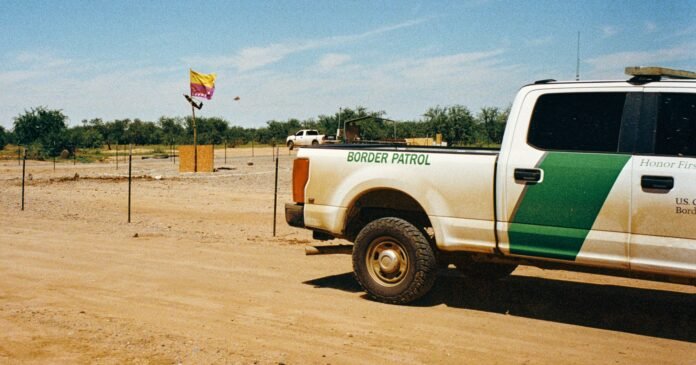
On the left, a red and yellow painted sign with graffiti-style white letters warns that “Community Members Only!” are allowed on the Tohono O’odham Nation. A white and green Border Patrol truck is driving on a dirt road on the right.
A Border Patrol vehicle is parked near the Tadai Me:i prayer camp on the Tohono O’odham Nation. Cam Mackey

For the prayer camp’s participants, the need to relight the flame, which they had extinguished after a seven-day ceremony, was self-evident. They began that night.

Davy Cross, a stocky 57-year-old with an intricate tattoo running down the left side of his face, was tending the fire when, at 4:33 a.m., he noticed buzzing above his head.

At first, the machines were visible. There were at least five. “I seen all the red lights,” Cross recalled. But as they got lower, the drones went dark. Cross could still hear them and feel the draft of the rotors against his skin. Then, he said, “they disappeared.”

The drones were soon replaced by an airplane and a helicopter. Shortly after 9 a.m., a caravan of Border Patrol and construction vehicles trundled into view. The work trucks continued on, but much of the Border Patrol force remained, forming a semicircle around the camp with Mexican state police closing the loop on the other side of the line.

“We got surround[ed] by over 30 vehicles,” Cross wrote in the activity log. A video of the moment spread across social media in the borderlands.

The tribe’s attorneys filed an appeal of the judge’s order allowing construction to proceed and pleaded for a halt to the government’s activities. They argued that the Trump administration was making “a mockery” of the court’s expectation of “consultation and cooperation.”

A convoy of Border Patrol and construction vehicles pass the Tadai Me:i prayer camp on Aug. 29. Ryan Devereaux/ProPublica

That night at the camp, Larson Yazzie was singing prayer songs when Juan pulled in. It was near midnight. Border Patrol agents were coming and going constantly. Some passed without stopping. Others idled at the edge of the firelight while the red lights of a surveillance blimp blinked over the mountains to the east.

Tadai Me:i wasn’t the only pocket of resistance on the border. In Texas, the Trump administration’s plans to run a wall through Big Bend National Park had brought together an unusual coalition that saw environmental nonprofits and river guides standing with hunters, ranchers and local sheriffs in opposition to the project. One week before the armed convoy rolled onto the Tohono O’odham reservation, Republican Gov. Greg Abbott announced that after speaking with the secretary of DHS, he’d secured a pause on the controversial project.

“There are technology tools that don’t include barriers,” the governor said at a press conference. “Think of drones, think of fiber optics.”

Last week, a judge granted a preliminary injunction halting construction in the Big Bend area while a lawsuit against the project proceeds.

To Juan, it was darkly ironic. For two and a half decades, the Nation had been a laboratory for the technology Abbott described. Yet when tribal leaders made that case, they were told to stand down; the wall was coming whether they accepted it or not. “What makes Texas the exception to us is very clear,” Juan said. “It’s good old boy conversations that are happening between the politicians and the CBP commissioners and Markwayne Mullin.”


Two individuals standing in a campsite are silhouetted against a rising sun, while a ceremonial fire burns in the foreground.
Sunrise at Tadai Me:i prayer camp on Sept. 26 Ryan Devereaux/ProPublica

The early fire watch that morning fell to a young Pascua Yaqui member named Nate Sosa.

At 3:28 a.m., Sosa heard a noise — a round being chambered in a weapon. A Border Patrol agent had exited his vehicle. With a long gun slung low across his back, he shined a light into Mexico. He then walked within feet of the campers asleep on their cots.

A half an hour later, a drone flew in from the north, followed by a helicopter. After that came a convoy dozens of vehicles long. At 6:02, while Larson Yazzie was leading the camp in prayer, a helicopter passed overhead. An hour later, a drone ascended above the fire.

Liz Quiroga, a 28-year-old tribal member and regular at the prayer site, sat with the camp’s logbook open in her lap. Over the next five days, the book would fill with 379 observations. Nearly two-thirds involved Border Patrol units near the fire. The arrival of Mexican authorities was documented six times. An additional 39 entries referenced unmarked vehicles and suspected “undercovers.” Whether those individuals were Border Patrol, contractors or tribal police was unclear. The logbook cataloged a dozen instances of aircraft flying over the camp, including four helicopters, three planes and five drones.

“Nobody has any idea what’s actually happening out here,” Quiroga said. “This is true dystopia.”

While its legal challenge continues, the Nation has ceased attempting to remove border wall contractors from its lands.

The camp and the surveillance that’s come with it remain.
Riyadh airport resumes normal operations after Houthi attacks: Media

0
riyadh-airport-resumes-normal-operations-after-houthi-attacks:-media
Riyadh airport resumes normal operations after Houthi attacks: Media

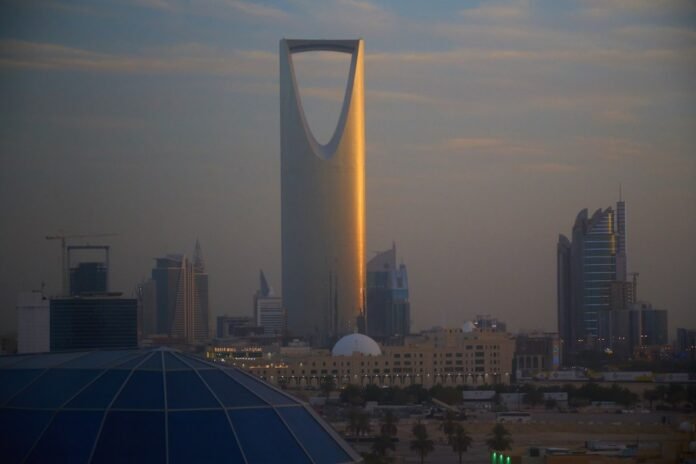
Passenger and air traffic at King Khalid International Airport in the Saudi capital returned to normal Friday after two attacks by Yemen’s Houthis killed three Saudi citizens and injured others, Saudi state media reported, Anadolu reports.

State-run Alekhbariya TV said passenger movement at the airport is “flowing smoothly,” with operational services resumed and air traffic back to normal.

The broadcaster said the rapid restoration of flights reflected the readiness of the airport’s infrastructure and the flexibility of Saudi Arabia’s civil aviation system in dealing with exceptional circumstances and containing their effect, while prioritizing the safety of passengers and staff.

It noted that the attack on the airport was not the first this week, with the country facing Houthi attacks targeting civilian airports since Tuesday.

-3 killed in 2 attacks on airport

Saudi Arabia’s General Authority of Civil Aviation said Friday that three citizens were killed and others injured in two attacks Thursday that targeted facilities at the airport and a Saudi Arabian Airlines aircraft.

It said one attack targeted airport facilities, while the second struck a Saudi Airlines aircraft.

The attacks injured a number of citizens and residents of different nationalities, it said.

The injuries ranged from minor to serious, and the wounded were taken to hospitals for treatment.

It also reported property damage from the attacks, without specifying the extent.

The agency did not identify the party responsible for the attacks, but the Houthis said Thursday that they had launched ballistic and cruise missile attacks targeting King Khalid International Airport in Riyadh, Najran Airport in the south and an air base in Khamis Mushait in the southwest.

Outrage grows as CDC reportedly poised to fund “unethical” vaccine trial

0
outrage-grows-as-cdc-reportedly-poised-to-fund-“unethical”-vaccine-trial
Outrage grows as CDC reportedly poised to fund “unethical” vaccine trial

Outrage has erupted among health experts over news that the Centers for Disease Control and Prevention is still eager to fund a widely condemned vaccine trial that would expose newborns in Guinea-Bissau to hepatitis B, putting them at high risk of a lifelong infection, which can lead to liver cirrhosis, liver cancer, and premature death.

The trial was suspended in January after its unethical design came to light and drew international outcry. Although the trial is still halted, staff of the CDC director’s office told the agency’s budget office in late September to set aside $1.6 million to fund the trial, according to a report by Rolling Stone. The money was to be pulled from funding for the CDC’s global health security programs, which might otherwise go toward efforts like combating the Ebola outbreak currently raging in the Democratic Republic of the Congo.

The Department of Health and Human Services, which oversees the CDC, did not respond to a request for comment from Ars Technica.

If the trial moves forward, it would be funded by the US but run by Danish researchers, who have separately been accused of misconduct. In December, the CDC announced the award of an unsolicited grant for $1.6 million to a research group at the University of Southern Denmark, led by married couple Christine Stabell Benn and Peter Aaby. The pair have produced numerous studies that have been promoted by anti-vaccine advocates, drawing concern and criticism from researchers. Stabell Benn and Aaby are currently under investigation by Danish authorities over allegations of “falsification” and “scientific misconduct” related to previous vaccine research.

In January, amid criticism of the trial, officials in Guinea-Bissau said they had suspended the research, saying ethical and technical reviews of the trial’s design were ongoing. “There has been no sufficient coordination in order to take a final decision regarding the study,” Quinhin Nantote, the minister of public health for Guinea-Bissau, said at the time. “Faced with this situation, we decided to suspend it.”

Denounced design

The trial intends to enroll 14,000 newborns in Guinea-Bissau, half of which would get a newborn dose of hepatitis B vaccine, while the other half would not. The aim is to try to find alleged vaccine harms from the newborn dose—despite the fact that the newborn dose has been proven safe and effective after decades of global use and is the current standard of care.

Guinea-Bissau has a high burden of hepatitis B in its population, and newborns who are not vaccinated at birth are at risk of acquiring a chronic, life-threatening infection. Authorities in Guinea-Bissau want newborns to be vaccinated and intend to begin universally administering birth doses in 2028. The country, which experienced a coup in November 2025, does not currently have the resources or infrastructure to provide those routine vaccinations.

Stabell Benn and Aaby have argued that the trial is not unethical because newborns in Guinea-Bissau are currently not routinely given a dose of hepatitis B vaccine at birth. But outside experts point to ethical guidelines, such as the Declaration of Helsinki, which requires trials to provide the “best proven intervention”—which is a birth dose of hepatitis B vaccine—regardless of whatever the current standard is in the country hosting the trial. Placebos may only be used when there is no proven intervention or there is “compelling and scientifically sound methodological reasons” to withhold a proven intervention.

In a scathing rebuke in February, the World Health Organization laid out a bullet-point list of “why withholding the vaccine is unethical.” The WHO notes that the entire premise of the trial is based on “hypothetical safety outcomes without sufficient credible evidence,” which don’t justify putting newborns at risk. The agency also blasted Stabell Benn and Aaby’s defense of the trial, saying: “Resource constraints cannot be used to justify withholding proven care in a research study involving people. Ethical obligations require minimizing risk and ensuring a prospect of benefit for participants.”

Renewed outrage

According to the Rolling Stone report, the trial’s design has been revised to now ask mothers if they are infected with hepatitis B—which can pass from mother to infant during birth—and test a small fraction of them for the infection. But the changes have not eased concerns that having an unvaccinated group as part of the trial is fundamentally unethical.

For now, the trial is still on hold, pending final authorization from Guinea-Bissau officials. But the CDC, under anti-vaccine Health Secretary Robert F. Kennedy Jr., appears eager to move forward with it once it is approved. Researchers at the University of Southern Denmark, where Stabell Benn and Aaby are based, recently granted approval to the revised trial design, CIDRAP reported Thursday. Professor Jakob Grauslund, dean of the university’s faculty of health sciences, also told the outlet that the “relevant ethics committee in Guinea-Bissau” has signed off on the trial and that government authorization is the final step.

“[T]he study cannot begin until the necessary national authorization has been obtained,” Grauslund said.

Nonprofit advocacy group Stand Up for Science vowed to block the trial. “We stopped this unethical study the first time and we’ll do it again,” Colette Delawalla, the group’s CEO and founder, said in a statement. “This is a gross violation of human rights and the use of bad science against some of the most vulnerable people in the world.”

Damascus Seeks Probe Into Alfa Watan Sinking, 10 Missing Sailors, Including 9 Syrians 

0
damascus-seeks-probe-into-alfa-watan-sinking,-10-missing-sailors,-including-9-syrians 
Damascus Seeks Probe Into Alfa Watan Sinking, 10 Missing Sailors, Including 9 Syrians 


[DAMASCUS] Syrian authorities are calling for an independent international investigation into the attack that sank the cargo ship Alfa Watan in the Black Sea, while also questioning Bulgaria’s decision to halt search-and-rescue operations before the fate of 10 crew members was determined.  

Mazen Alloush, director of international relations and cooperation at Syria’s General Authority for Ports and Customs, told The Media Line that Damascus has been following the case since the vessel was attacked early Tuesday, Oct. 6, while sailing inside Bulgaria’s exclusive economic zone.  

Alloush said the information available to Syrian authorities indicates that the Alfa Watan had a 10-member crew, including nine Syrian nationals and one Egyptian, and that their fate remains unknown.  

The Alfa Watan, which was sailing under the Togolese flag, sustained severe damage and sank.  

The Bulgarian government described the attack as a serious violation of international law and a threat to commercial shipping and opened an investigation to determine the type of drones used and their origin.  

Sofia has not formally blamed any party for the attack. Ukraine has accused Russia of responsibility, while Moscow has denied any involvement, leaving the identity of the perpetrator unresolved pending the investigation.  

The case has also raised questions about the Alfa Watan itself, including its route, cargo, ownership, and management.  

Bulgarian reports said the vessel was sailing north when it was attacked, while details about its cargo and ownership remain disputed.  

Alloush said the authority had sent urgent official memoranda to the International Maritime Organization and the relevant Bulgarian maritime authorities, calling for an “independent and transparent” investigation into the circumstances of the attack and for the identification of its source and those responsible. He added that the Syrian side is also seeking an official explanation for why Bulgarian authorities ended the search-and-rescue operation without reaching a conclusive finding on the fate of the missing crew members.  

Bulgarian authorities had announced the suspension of search efforts after failing to locate any of the missing sailors. Bulgarian officials said the ship was attacked roughly 70 nautical miles off the coast and sank rapidly after being hit.  

A second commercial vessel, the Able, registered under the flag of Palau, was also damaged in the same attack, but all 18 crew members were rescued.  

Alloush said Damascus is urging the use of all available technical means to locate and inspect the wreck of the Alfa Watan, arguing that examining the vessel could help determine the nature of the attack and clarify what happened. He said Syria does not want the case closed before all available search and investigative options are exhausted, particularly while it remains unclear whether any crew members were able to abandon the ship before it sank.  

The case is also taking on an increasingly humanitarian dimension as time passes without confirmed information about the missing sailors.  

Alloush said efforts must continue until authorities can provide answers to the families of the missing crew members and ensure that their rights are protected under relevant international maritime rules and conventions.  

He also condemned the targeting of the commercial vessel, saying attacks that endanger civilian ships and their crews pose a serious threat to international maritime safety, especially in the Black Sea, where shipping risks have risen amid the continuing Russia-Ukraine war.  

Alloush said the General Authority for Ports and Customs would continue following the case in coordination with the Syrian government, diplomatic and maritime bodies, as well as international institutions and Bulgarian authorities.  


Anduril’s plan to save US sub edge from China’s undersea surge

0
anduril’s-plan-to-save-us-sub-edge-from-china’s-undersea-surge
Anduril’s plan to save US sub edge from China’s undersea surge

A multibillion-dollar private initiative to overhaul US submarine manufacturing marks an urgent push to revitalize naval industrial capacity at a pivotal moment in the Indo-Pacific balance of power.

This month, multiple media outlets reported that defense technology firm Anduril Industries will invest US$3.7 billion of its own capital to build a 2-million-square-foot “software-defined shipyard” at Sparrows Point in Baltimore County, Maryland, to expand US Navy submarine production capacity, according to company and defense officials.

Under a complementary US Navy contract worth up to $2.9 billion, with disbursements tied strictly to demonstrated production outcomes, the total $6.6 billion public-private venture aims to relieve severe bottlenecks in the Virginia-class nuclear attack submarine (SSN) program.

Dubbed “Arsenal-2,” the coastal facility will feature a 1,200-foot graving dock, direct rail access, and digitized workflow tracking, creating 3,100 direct manufacturing jobs and adding roughly nine million annual labor hours — a vital 15% capacity boost to the nation’s strained nuclear shipbuilding industrial base.

The intervention comes as legacy shipbuilders General Dynamics Electric Boat and Huntington Ingalls Newport News Shipbuilding continue to struggle to meet the US Navy’s minimum goal of two hulls annually.

To bridge near-term operational needs, Anduril will begin delivering critical gating components, such as torpedo tubes, from a certified Costa Mesa site by 2028, before Maryland operations begin around 2030, with long-term plans to supply full hull modules and help meet domestic fleet goals alongside AUKUS defense pact delivery commitments to Australia.

This private-sector expansion raises the question of whether the US can overcome domestic shipbuilding bottlenecks to maintain its undersea warfighting edge as China rapidly expands and modernizes its submarine fleet. The facility could boost US submarine production at a time when conventional shipyards repeatedly miss scheduled delivery milestones.

The scale of that industrial deficit is severe. A January 2026 US Congressional Research Service (CRS) report notes that while the US Navy aims to achieve a fleet goal of 66 SSNs, actual construction has never reached that threshold and has averaged just 1.1 to 1.2 boats per year since 2022 because of persistent workforce shortages, supplier bottlenecks, and component delays.

The CRS report notes that the US Navy is now pushing to raise production to 2.0 boats annually and eventually 2.33 per year to reduce backlogs, sustain domestic fleet requirements, and build replacements for three to five Virginia-class SSNs slated for sale to Australia under the AUKUS security pact.

These ongoing industrial delays affect Western Pacific operations, where attack submarines are vital to the US in a possible conflict with China over Taiwan, and forward deployments reaffirm their strategic importance.

Demonstrating that operational footprint, a June 2026 report by the South China Sea Probing Initiative (SCSPI), a Chinese think tank, found that in 2025 the US operated at least 11 nuclear-powered submarines in three Western Pacific operational corridors—the South China Sea, East China Sea, and Java Sea—to demonstrate forward presence and signal a clear undersea deterrence posture against China.

In a high-intensity Taiwan conflict, that forward undersea posture forms the tip of the US spear. In a May 2026 article for the Center for Strategic and International Studies (CSIS), Seth Jones says US SSNs provide an asymmetric operational advantage over China by exploiting the latter’s persistent anti-submarine warfare (ASW) deficiencies.

Jones notes that in simulated Taiwan Strait conflict scenarios, SSNs play a critical warfighting role by inflicting heavy attrition on Chinese invasion forces and hunting high-value amphibious vessels, surface escorts, and logistics ships.

Beyond direct strikes against transport fleets, he says these submarines screen against Chinese submarines attempting to break out past the First Island Chain, routinely cycling back to forward ports such as Yokosuka, Japan, to reload weapons and resume offensive hunting operations.

Yet dominating the undersea battlespace will prove far more contested than in previous conflicts. Rear Admiral Mike Brookes said in March 2026, in testimony before the US Congress, that China does not approach ASW as isolated platform engagements.

Instead, Brookes points out that China frames ASW as a networked “systems confrontation,” integrating air, surface, and seabed sensors, along with unmanned vehicles, into an anti-submarine warfare system-of-systems designed to control critical waters, compel adversary submarines to withdraw, and reduce port-departure detection risks for Chinese vessels.

Broadly, Brookes says China views undersea warfare as a crucial strategic enabler for naval operations under its “Near Seas Defense, Far Seas Protection” doctrine, central to US-China competition, supporting near-seas defense, ballistic missile submarine protection, sea-lane interdiction, and strikes against high-value targets such as allied aircraft carriers.

China is backing this doctrinal focus with unprecedented quantitative expansion. Outlining the growth of China’s submarine fleet, Brookes says that it now has about 60 units and could reach 70 by 2027 by adding up to six nuclear guided-missile submarines (SSGN), two nuclear ballistic missile submarines (SSBN), and retiring older Chinese and Russian-built units. He adds that China could field over 80 submarines by 2035, with nuclear-powered boats making up half the fleet.

China’s large submarine industrial base supports that growth. In a September 2023 China Maritime Studies Institute (CMSI) report, Sarah Kirchberger notes that China’s submarine industrial base drives rapid fleet expansion through massive state funding, state-owned bank credits, and infrastructure modernization across Bohai, Wuchang, and Jiangnan shipyards, which employ modular assembly, covered construction halls and commercial-military integration.

However, Kirchberger points out that persistent production bottlenecks curb qualitative parity with Western designs. She says China still grapples with acoustic-quieting deficiencies, vibration-suppression gaps, and reactor design issues, leaving boats vulnerable to detection by allied sonar arrays.

She adds that China’s shipbuilders still struggle to master indigenous marine diesels—as shown by stalled export deliveries to Thailand—and to overcome manufacturing challenges in advanced fuel-cell air-independent propulsion (AIP).

Despite those constraints, China has been innovating in submarine design at a very rapid pace. In February 2026, China may have launched the first Type 09V (or 095) SSN at Bohai Shipbuilding in Huludao, featuring an estimated 9,000-to-10,000-ton displacement, a 12-to-13-meter beam, large X-form stern rudders for littoral maneuvering, a pump-jet propulsor, and likely vertical launch missile cells.

In June 2026, satellite imagery uncovered an unexpected, sleek “sailless” submarine launched in Shanghai measuring roughly 120 meters long and 10 to 11 meters wide. With a streamlined bow and an unusually reduced sail designed to cut acoustic and hydrodynamic drag, the vessel is likely nuclear-powered.

In March 2026 testimony before the US Congress, Vice Admiral Richard Seif emphasizes that China’s rapid submarine growth reflects advances in platforms, sensors, weapons, endurance, and operational capabilities. Seif notes that even small improvements matter in undersea competition, where slight changes in quieting, endurance, or detection can decisively shift tactical advantages.

Ultimately, whether private-sector intervention can scale fast enough before the 2030s will determine whether the US maintains its decisive undersea margin, or whether China’s dense sensor networks and compressed qualitative innovations turn the Western Pacific into an anti-access sanctuary that neutralizes American naval deterrence.

AI coding agents generate more code, but not more software

0
ai-coding-agents-generate-more-code,-but-not-more-software
AI coding agents generate more code, but not more software

Anyone who has even tangentially associated with computer programming knows that modern AI coding assistants and agents can be incredibly efficient at generating huge amounts of functional code. But coders making use of those tools also know better than to trust the accuracy of that code, meaning substantial effort needs to be spent reviewing any AI-generated output.

A recent study of actual coding practices across hundreds of firms finds that human code review forms a significant “bottleneck” for the overall efficiency of AI coding tools, resulting in “little evidence that firms increase software output or reduce employment” by using them. Any efficiency increased during the actual coding phase, the study authors find, is “absorbed by downstream constraints in the production process”; as “the code review process significantly increases in length, pull requests are more likely to require revisions, and reviewers leave more comments.”

Cut once, measure twice

To come to these conclusions, Harvard University researchers Fiona Chen and James Stratton made use of aggregated analytics data from Jellyfish, which measures the granular output of engineering teams. That data encompasses 300 million individual “work events” (e.g., commits and pull requests) and issue management software data across more than 700,000 employees at over 700 relevant software development firms from 2021 through March of 2026.

To assess the impact of AI tools on these firms, the researchers used a mix of directly measured AI usage and analyses of GitHub activity to determine when each company started introducing either AI coding assistants (which can help auto-complete code primarily authored by humans) and/or AI coding agents (which primarily write and submit code autonomously based on prompts) into their workflows. The researchers then perform some complicated math to determine a “difference of differences” regression on key variables both before and after the introduction of these tools at different points in time across different organizations.

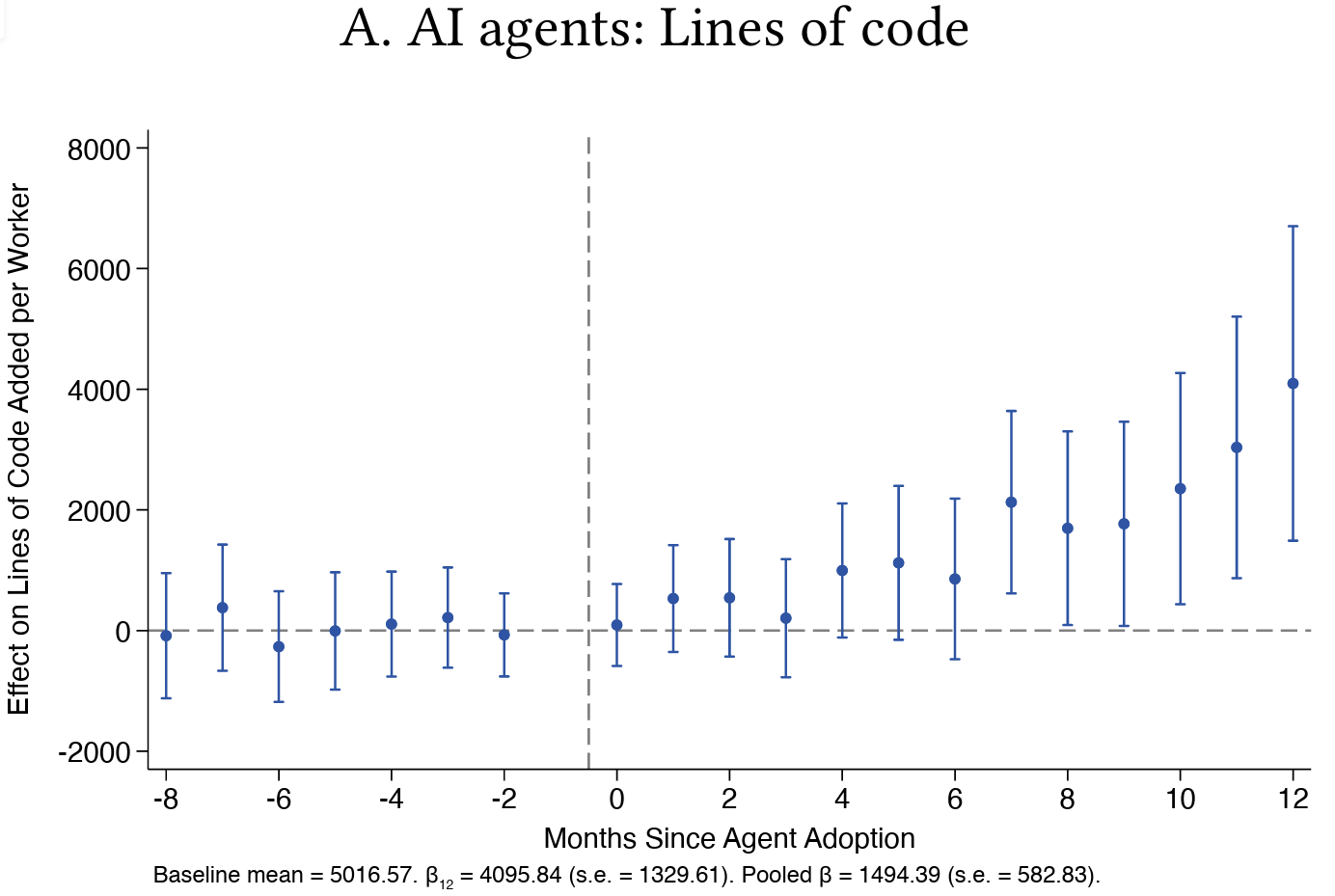
If there’s one thing AI coding agents are good at, it’s churning out a lot of code.

If there’s one thing AI coding agents are good at, it’s churning out a lot of code. Credit: Chen and Stratton

In terms of raw code being produced, the results are clear and stark. The introduction of AI coding agents at a firm leads to a 30 percent increase in total lines of code generated, a 20 percent rise in the number of total commits, and a 23 percent increase in pull requests on average, the researchers write. But all that extra code doesn’t translate directly into improved software output on the firm level. On the contrary, the resolution rate for Issues and Epics (i.e. wholesale software features) tracked by tools like Jira did not change in a statistically significant way after AI tools were introduced (the researchers also found no “compositional shift” in the size or complexity of those Jira-tracked issues across the AI introduction).

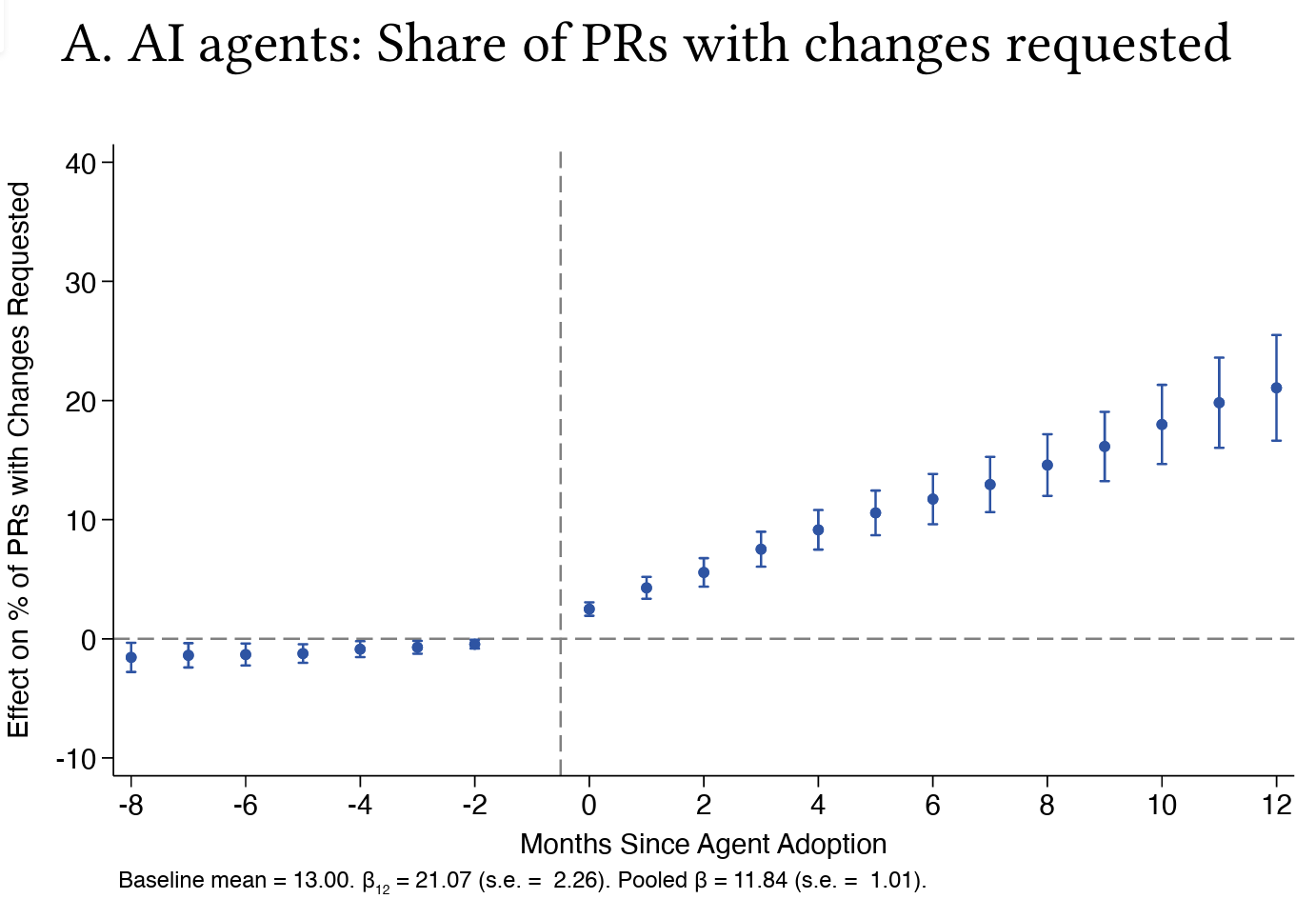
The reason for that discrepancy can be found directly in the code review process, which takes markedly longer on average after the introduction of AI coding agents. Overall, the average “review process” time between a pull request getting submitted and it being merged into the codebase balloons 49 percent on average after AI agents are introduced. That effect can be seen in more granular data, too, with “the share of pull requests with changes requested nearly doubl[ing], and the number of comments per pull request increas[ing] by 35%” following the AI agent shift, the researchers write.

In response to this change, the researchers found a 14 percent increase in the share of workers performing code reviews after AI agents’ introduction. They also write that they “cannot attribute significant employment changes to AI” after looking at total active workers across Jellyfish and cross-referencing with LinkedIn data at those firms.

Pull requests need changes a lot more often in the “agentic coding” era.

Pull requests need changes a lot more often in the “agentic coding” era. Credit: Chen and Stratton

While AI could also theoretically help with this review process, the researchers found that, so far, that impact has been marginal. Although 80 percent of measured firms used some form of AI code review by March 2026, AI agents were only responsible for 23.3 percent of all review comments and 10.8 percent of all pull requests, suggesting humans were still responsible for the vast majority of this work.

AI agents are still a relatively new part of the coding world, of course, and there have been significant updates and upgrades to their output even since this study’s March 2026 data cutoff. And while 95 percent of firms in the study have implemented AI coding agents by this point, many are doubtlessly still going through a learning process regarding when and how to best deploy them. These kinds of “coding time versus review time” trade-offs could improve as software engineering teams gain more experience with the pros and cons of siccing an AI agent on particular coding problems.

For now, though, letting AI write your code looks like a double-edged sword, with increases in coding speed counteracted by similar increases in human code review time and effort. It’s the kind of result that makes us wonder if the considerable time and expense to get AI coding agents working is really worth it for most companies.

‘The Voice’ Star Arrested for Vehicular Homicide

0
‘the-voice’-star-arrested-for-vehicular-homicide
‘The Voice’ Star Arrested for Vehicular Homicide


Country singer and former The Voice contestant Kata Hay is facing a sweeping criminal case in Tennessee after authorities accused her of being involved in a crash that ultimately left another driver dead.

Hay, whose legal name is Kata Huddleston, was arrested in Oklahoma in December 2025 after Goodlettsville police issued a notice asking the public to help locate her in connection with a deadly crash near Interstate 65.

The case has since grown well beyond the initial vehicular homicide allegation.

Davidson County court records currently show Huddleston facing nine counts in an active felony case, including vehicular homicide, aggravated vehicular homicide, DUI-related charges and allegations that she left the scene of crashes.

The case remains unresolved, and the charges are allegations unless and until proven in court.

The investigation began after a series of crashes on Dec. 10, 2025, near Long Hollow Pike in Goodlettsville, just north of Nashville.

According to an arrest affidavit previously reported by local media, police first spoke with a woman who said her vehicle had been rear-ended by a red SUV on Interstate 65 near the Long Hollow Pike exit. The SUV allegedly continued driving.

Officers were then called to another collision nearby, where witnesses reported that a red SUV had come off the interstate, struck another vehicle and again left the scene.

The driver involved in that second crash was taken to TriStar Skyline Medical Center in critical condition.

Police later located a damaged red Kia Soul in a parking lot near Rivergate Parkway.

Authorities identified Huddleston as the driver.

According to the affidavit, officers reported smelling alcohol and said Huddleston appeared to have pinpoint pupils. Police also reported seeing a partially empty alcohol container inside the vehicle.

She was initially arrested on allegations including DUI, leaving the scene of a crash and having an open container.

The case became significantly more serious when the critically injured woman died at the hospital two days later.

Authorities subsequently obtained a vehicular homicide warrant.

Huddleston later failed to appear for a scheduled court proceeding, according to previous reports, prompting Goodlettsville police to issue a public alert saying investigators believed she could be headed toward Oklahoma.

Police said she might be traveling with a man and possibly towing a large camper.

She was ultimately arrested in Oklahoma in December before being returned to Tennessee.

Court records show that the original vehicular homicide case carried a $75,000 bond before it was closed following an indictment.

The charges were later incorporated into Davidson County case 2026-B-1294, which contains nine counts and remains active.

Those counts have been reported as including vehicular homicide, aggravated vehicular homicide, leaving the scene of an accident involving a death, two counts of leaving the scene involving significant property damage, DUI-related counts, open container and reckless endangerment.

Huddleston also has a previous DUI case in Nashville.

Davidson County court records show she was found guilty in 2021 in connection with a DUI case dating back several years.

Her legal history also includes a separate 2022 case involving unlawful sexual contact with a minor.

Huddleston pleaded guilty in that case and was sentenced to six months in jail, according to court reporting at the time. She was also ordered to undergo a mental health evaluation and participate in an intensive outpatient program.

Long before her legal troubles made headlines, Huddleston built a career as country performer Kata Hay.

She gained national attention in 2016 as a contestant on Season 10 of NBC’s The Voice.

Hay impressed the coaches during the competition and eventually joined Christina Aguilera’s team. She advanced to the show’s live playoff stage before being eliminated.

A decade later, the singer is now facing a dramatically different kind of spotlight as her Tennessee criminal case continues through the courts.

The current felony case does not yet show a final disposition, meaning there has been no conviction on the pending vehicular homicide-related charges.

Further court proceedings will determine whether prosecutors can prove the allegations and what penalties Huddleston could face if convicted.

Israelis mark three years since Hamas attack that set off Gaza assault

0
israelis-mark-three-years-since-hamas-attack-that-set-off-gaza-assault
Israelis mark three years since Hamas attack that set off Gaza assault


Israelis will on Wednesday mark three years since Hamas attacked Israel on ​October 7, 2023, triggering a military assault that destroyed much of Gaza, where conditions remain dire despite a year-old ceasefire that is ‌meant to halt the war for good.

The attacks, during which militants killed 1,200 people and took 251 hostages to Gaza, marked the deadliest day in Israel’s history. Israel’s subsequent bombardment and ground operations have killed more than 74,000 people in Gaza, health authorities there say.

On Wednesday, Israelis will hold a vigil at the site of the Nova music ​festival near the Gaza border, where 348 young people were killed by militants during the attack.

They will also hold an event commemorating ​the anniversary at Hostage Square in Tel Aviv.

ISRAELI ELECTION 20 DAYS AWAY

The anniversary is the first for Israelis without ⁠any hostages still held in Gaza, with those dead and alive exchanged in swaps with Hamas for Palestinians held in Israeli jails. The remains ​of the last Israeli hostage were recovered in January.

It also comes just 20 days ahead of Israel’s first election since the attack, a vote ​that is viewed as a referendum on Prime Minister Benjamin Netanyahu’s long tenure in power.

Netanyahu has rejected blame for the security breach and resisted calls for an independent investigation. That has frustrated many in Israel, including families of those killed in the attacks, some of whom have joined the election race.

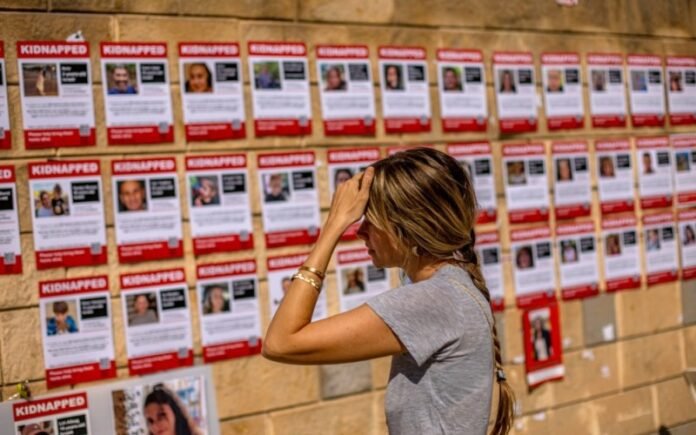
Item 1 of 5 A woman visits the site of the Nova music festival, where partygoers were killed and kidnapped during the deadly Hamas-led October 7, 2023 attack, on the third anniversary of the attack, near Reim, southern Israel, October 7, 2026. REUTERS/Ronen Zvulun

[1/5]A woman visits the site of the Nova music festival, where partygoers were killed and kidnapped during the deadly Hamas-led October 7, 2023 attack, on the third anniversary of the attack, near Reim, southern Israel, October 7, 2026. REUTERS/Ronen Zvulun Purchase Licensing Rights, opens new tab

A poll by the Israel Democracy Institute showed ​that 68% of Jewish Israelis said that the events of October 7 were a very central or fairly central element in their decision of ​which party to vote for.

Election polls show neither Netanyahu nor his main competitors would muster enough seats in parliament to form a coalition if a vote were ‌held today.

US-BACKED ⁠CEASEFIRE FAILS TO HALT ISRAELI ATTACKS, DISARM HAMAS

The anniversary is also the first since an October 10, 2025, US-brokered ceasefire deal that halted major fighting but has failed to stop Israeli attacks in Gaza or secure the disarmament of Hamas and other militant groups.

The deal left Israel in control of some 53% of Gaza, since expanded by Israeli forces to nearly two-thirds. Hamas controls the remaining third, where the 2 million population mostly live in makeshift tents ​and bombed out buildings.

US President Donald ​Trump’s so-called “Board of Peace” has proposed ⁠several plans that would see Gaza rebuilt. But those plans, which fail to account for the property rights of Palestinians whose homes were destroyed, have failed to gain the buy-in of Israel or Hamas, which are ​still deadlocked in ceasefire talks.

The two have yet to agree on the terms of a deal that would ​see Hamas lay down ⁠its weapons in exchange for Israeli troop withdrawals. Israel says it will not pull back until Hamas fully disarms; Hamas says it has agreed to a phased process but will not disarm so long as Israeli attacks continue.

Israel has kept up a bombing campaign in Gaza that has killed a number of ⁠Hamas militants ​in recent months but has also killed many civilians, say Gaza health authorities, whose ​death figures do not distinguish between civilians and combatants.

More than 1,400 Palestinians in Gaza have been killed since the October 2025 ceasefire, the health authorities say. During the same time, five ​Israeli soldiers have been killed by militants or in combat, the military says.

Source:  Reuters

Samsung dangles $560,000 bonuses to keep engineers from China

0
samsung-dangles-$560,000-bonuses-to-keep-engineers-from-china
Samsung dangles $560,000 bonuses to keep engineers from China

A Samsung memory chip worker earning about $60,000 a year could receive roughly $560,000 in bonuses before tax, according to the company’s largest union. Its estimate includes both Samsung’s existing profit-sharing bonus and a new special payment. Samsung hasn’t confirmed the amount.

On October 7, the company outlined how that special bonus would work: 10.5% of its chip division’s 2026 operating profit would go into an uncapped pool. Samsung plans to pay it in shares, subject to shareholder approval.

The next morning, Samsung estimated third-quarter operating profit at 107.4 trillion won, roughly $80 billion, almost nine times the year-earlier figure.

Those profits explain how Samsung can afford the payout. Findings released for a parliamentary audit the same week show the competition for the engineers it wants to keep.

What did the audit find?

The office of Choi Soo-jin, a People Power Party lawmaker on the National Assembly’s science and ICT committee, reviewed LinkedIn and other public career records. It traced at least 27 senior engineers from Samsung and SK Hynix who went on to work at ChangXin Memory Technologies (CXMT), China’s biggest DRAM maker.

Together they had spent 415.9 years at the two Korean companies, an average of 15.4 years each. Six were principal or executive-level staff with more than 20 years in mass production.

Eight worked in circuit design and seven in process integration. Others came from equipment, yield analysis, and advanced packaging, a mix that Dong-A Ilbo said was enough to run a whole chip factory.

Messages from Chinese headhunters obtained by Choi’s office offered pay increases of 60% to 100%, three to five years of guaranteed employment, rental housing, and help with children’s school costs.

Fifteen of the 27 didn’t go straight to CXMT. They first took jobs at equipment or materials suppliers, foreign companies, or universities. Choi’s office said that may have been a way around non-compete agreements, which usually last one to two years.

Why does it matter that they left CXMT?

The engineers stayed at CXMT for 2.9 years on average. According to their public profiles, 26 of the 27 have since left, and seven moved on to other Chinese chip companies, including Huawei’s Hong Kong research center and HiSilicon.

Public career records don’t establish why they left or whether any technology was transferred. But CXMT grew quickly over the same years. Its research and development staff rose from 2,606 at the end of 2022 to 7,491 in June 2026, and in September it said its fifth-generation DRAM was in mass production.

Choi’s office suggested CXMT had drawn on the engineers’ experience to build its factories and stabilize production. That illustrates the retention problem: experienced engineers can help a competitor build capabilities that remain after they leave.

Why bonuses rather than bans?

Seoul’s legal tools are limited. “There is no legal basis to crack down on or restrict lawful overseas hiring,” Korea’s industry ministry said, according to Dong-A Ilbo. Non-compete clauses expire, and the detours through suppliers and universities suggest they can be waited out.

Interest in working abroad extends beyond the chip industry. In a Bank of Korea survey of 2,694 researchers with master’s or doctoral degrees, 42.9% of those working in Korea said they were thinking about moving abroad within three years.

So the companies are competing on pay. SK Hynix moved first. Its profit-sharing system sets aside 10% of operating profit for employees, and a labor deal in late 2025 removed the old cap of 1,000% of base salary for the next 10 years.

The first payout under the new terms came to 2,964% of base salary, with a fifth of each payout deferred over two years, KED Global reported. A company official told the outlet the system was expected to curb talent losses to domestic and overseas rivals.

Samsung’s new plan follows the same logic. The special bonus arrives as shares, and most of them can’t be sold right away. Workers can sell a third immediately, another third after one year, and the last third after two years.

That ties two-thirds of the payout to Samsung’s share price for up to two years. Those holding periods alone don’t establish whether employees must stay to keep the award.

It is expensive. Samsung counts the bonus as a cost before it pays it, and it set aside about 15.4 trillion won for the first half of 2026. The Korea Economic Daily estimated the third-quarter charge at about 11.4 trillion won.

Is pay enough?

I’d argue keeping experienced engineers in Korea has become a national-security concern. Pay is one way chipmakers can respond. Bonuses on this scale give workers more reason to weigh an overseas offer against what they would leave behind.

But an uncapped bonus isn’t a guaranteed one. If memory profits fall while overseas offers stay generous, Samsung and SK Hynix will have a harder time competing on pay.

Choi wants a national system to track key personnel and incentives to bring them back to jobs in Korea. “Semiconductor technology is not just blueprints,” she said. “It is the experience and know-how that people have built up over 20 to 30 years.”

For now, record profits give the chipmakers room to pay more. The test is whether they can keep those engineers through the next downturn.

David Han is the founder of AIStockWire.com, which covers Korean chipmakers and AI stocks. The lawmaker’s and ministry’s comments are translated from Korean.

What’s been driving Hawaii’s lava fountains?

0
what’s-been-driving-hawaii’s-lava-fountains?
What’s been driving Hawaii’s lava fountains?

In most cases, hotspot-driven volcanism is relatively sedate, with lava flowing down mountainsides slowly enough that people can walk out of its way. But in a number of locations—Mount Etna, Hawaii, Iceland—lava gets expelled in dramatic fountains that can reach several hundred meters in height.

Right now, we’re not sure what powers them. However, thanks to a recent set of eruptions at the Kilauea volcano, we have some of the best documentation yet of erupting lava fountains. In a recent edition of Science, researchers from the US Geological Survey describe what we’ve seen and compare it with what we might expect based on our best ideas about what powers these fountains of molten rock.

Years of fountains

With three active volcanic regions that engage in fountaining, there has been a steady flow of dramatic videos of red-hot molten rock spouting from the Earth. But Kilauea has had only three fountaining episodes since 1823, even though it’s the youngest and most active volcano in Hawaii. That activity has led to intensive study, and we have a good idea of the volcano’s structure. Previous work has identified a couple of lava residues within a few kilometers of the surface, and the volcano had 35 separate data-gathering stations set up on Kilauea, including “seismic, infrasound, geodetic, gas, and visual and thermal cameras.”

Following a major eruption in 2018 that partly drained one of the underground lava reservoirs, there were indications that it was being steadily refilled. Starting in 2019, however, the refill accelerated, and the local peak inflated at a rate of more than 22 cm a year. Then, in 2023, that doubled to 57 cm a year, and spread to a nearby caldera.

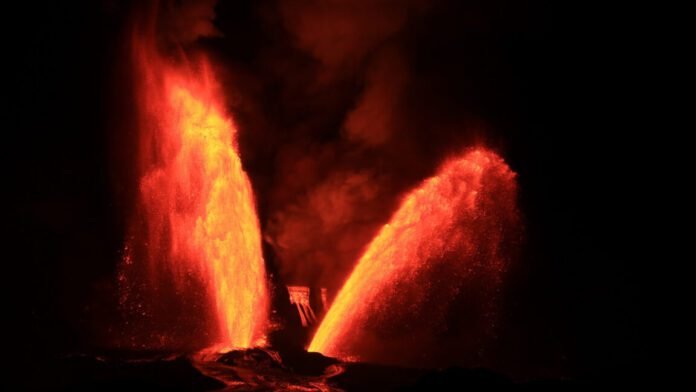
In 2024, a large series of earthquakes accompanied the opening of a vent, and a 900-meter-long fissure opened, sending fountains as high as 160 meters into the sky over the course of 13 hours. Less than a day after that subsided, a second eruption followed. As of last month, 52 additional fountain eruptions had occurred, the most violent of which spewed lava over 400 meters into the air.

What have we learned from all of this?

Perhaps the most significant finding was that we could predict when a fountaining eruption was likely to happen. Each eruption caused rapid deflation of the summit of Kilauea and was followed by the relatively slow refilling of the Halemaʻumaʻu magma reservoir.

The USGS recognized that consecutive eruptions occurred when the summit tilt reached similar levels. While the precise tilt that was associated with eruptions tended downward over time, the difference between consecutive eruptions was relatively small. This pattern ultimately helped the organization issue alerts when eruptions were likely to occur, which was especially useful because there were no clear seismic signals immediately before fountains restarted.

What’s driving this?

What have the eruptions told us about the mechanism that drives fountain formation?

One leading idea is that pressure within a magma reservoir keeps water mixed with other materials until it reaches a shallow enough depth to exit as steam. That fragments the magma, which allows it to ascend more rapidly, which allows more steam to escape, and so on until there’s a jet of material near the surface. The alternative posits that things are driven by the release of carbon dioxide from the magma, which forms a magma/gas “foam” at the roof of the magma chamber. Once this reaches a critical point, the gas escapes, driving magma with it until the supply in the magma chamber is exhausted.

The new data doesn’t provide a clear picture. It clearly doesn’t favor the formation of a carbon dioxide foam, because the levels of the gas remained low throughout the eruption cycle. Sulfur dioxide levels rose during eruptions and dropped afterward, but remained high throughout the entire period. Levels of this chemical are associated with gases escaping from magma, so this implies that more of it goes on during eruptions, but it also occurs continuously between them.

So the evidence leans toward the steam-driven eruption model, but it’s unclear why a process that is occurring throughout the cycle suddenly triggers fountains when it rises a bit.

The other bit of information from the chemistry of the eruption is from magnesium oxide, which provides an indication of the temperature of the magma. It fluctuated throughout the eruption cycle, consistent with a cycle in which eruptions deplete a reservoir, which is then refilled with hot material. In contrast, other oxides rose over time, suggesting that the newly arriving material has a distinct chemical composition.

Despite the wealth of nearby sensors, the researchers acknowledged it would be nice to have more data. Sampling of gas levels is typically done at infrared wavelengths and, as you can probably imagine, there was a lot going on in the infrared during a fountaining eruption. And, because of the height of some of the fountaining, it wasn’t necessarily safe to install more monitoring hardware. One camera notably sacrificed itself in order to bring us images of red-hot, semi-molten rock falling from the sky.

While Kilauea has proven itself as a spectacular lab for studying volcanic activity, it hasn’t yet proven ready to give up all its secrets.

Science, 2026. DOI: 10.1126/science.aef2931  (About DOIs).

0FansLike
0FollowersFollow
0FollowersFollow
0SubscribersSubscribe
- Advertisement -
Google search engine

Recent Posts