A Delta Air Lines flight from New York to Tel Aviv was evacuated after landing in Israel on Tuesday morning following a bomb threat that prompted authorities to move the aircraft to an isolated area and launch security checks.
All passengers were safely removed from the plane shortly after it landed. Security officials examined the aircraft and the surrounding area as authorities treated the threat as an emergency.
No unusual findings were detected during the security checks, and authorities later declared a return to routine.
There were indications during the response that the bomb threat could be a hoax. Authorities nevertheless maintained a high state of readiness following the attempted hijacking last month of a Flydubai flight.
Delta resumed service to Israel last month after suspending flights for more than six months following the outbreak of the war with Iran.
The airline operates direct flights between New York and Ben Gurion Airport.
The bomb threat follows an attempted hijacking last month of a Flydubai flight FZ1073, traveling from Dubai to Tel Aviv on September 30. The plane made an emergency landing in Tabuk, Saudi Arabia, after its Omani co-pilot allegedly attacked the captain and attempted to seize control of the aircraft.
UAE Attorney-General Hamad Saif Al Shamsi said the 29-year-old co-pilot had planned a suicide attack targeting Ben Gurion Airport and used two previous Tel Aviv flights to familiarize himself with the route.
He allegedly attacked the captain with an emergency axe before crew members and passengers restrained him.
The aircraft, carrying more than 170 passengers and crew, plunged more than 16,000 feet in about 30 seconds before other pilots regained control and landed safely.
UAE prosecutors classified the incident as a terrorist act and said the suspect confessed to acting alone.
Marie Osmond has endured heartbreak throughout her decades in the spotlight, but nothing could have prepared the beloved singer for the devastating loss of her 18-year-old son, Michael.
As the entertainer prepares to celebrate her 67th birthday on October 13, renewed attention is being given to one of the darkest chapters of her life and the emotional struggle she faced while trying to remain strong for her family.
Michael Bryan Blosil, one of Osmond’s eight children, died by suicide in February 2010 after struggling with depression. His death left the singer devastated and forced her to confront a loss she later described as the most difficult experience of her life.
“I’ve been through some tough things in my life,” Osmond told Oprah Winfrey during an emotional interview later that year. “This is probably the hardest thing I’ve been through.”
Michael was living in Los Angeles and attending the Fashion Institute of Design and Merchandising when he died. He had previously received treatment for depression and substance use.
In her interview with Winfrey, Osmond recalled a heartbreaking conversation with her son shortly before his death.
Michael had expressed feelings of loneliness, telling his mother that he felt he had no friends.
Osmond, who had experienced postpartum depression herself, understood how overwhelming those feelings could become.
She promised Michael that she would come to see him the following Monday, hoping she could help him through the difficult period.
But Michael died before she arrived.
Reflecting on their final conversation, the singer acknowledged the painful reality that someone experiencing a mental health crisis may need support immediately.
His death devastated the Osmond family, particularly Marie, who was already navigating the challenges of raising a large family following her 2007 divorce from music producer Brian Blosil.
Yet one of her most difficult decisions came just days after laying Michael to rest.
Rather than taking an extended break from performing, Osmond returned to the Las Vegas stage alongside her brother Donny less than two weeks after her son’s death.
The decision surprised some fans and drew criticism from people who questioned why she would return to work so quickly.
But for Osmond, music provided a way to cope with the overwhelming grief.
“The way Osmonds survive is we keep singing,” she told the audience during her emotional return to the Flamingo Las Vegas. “And that’s what we want to do tonight.”
She dedicated a moving performance to Michael, whom she affectionately called her angel.
Donny stood beside his sister throughout the difficult evening, offering encouragement as she struggled through the show.
Later, Osmond explained that returning to work had been a deliberate decision, not an indication that she had moved past her son’s death.
In a 2010 interview with Winfrey, she described the stage as her safe place and admitted she feared that staying away too long might make it impossible to return.
She also had seven other children who needed their mother during an extraordinarily painful time.
Years later, Osmond continued defending her decision to return to performing, explaining that singing helped her process the loss while maintaining a sense of stability for her family.
But returning to the spotlight did not mean the grief had disappeared.
An insider previously told RadarOnline that Osmond struggled emotionally even while continuing to work.
“She was trying to stay strong and busy herself with other things in her life,” the source claimed, adding that the singer continued to cry frequently as she adjusted to life without Michael.
Faith and family also played an important role in helping Osmond navigate her grief.
Throughout her career, the singer has spoken openly about her religious beliefs and the comfort she finds in prayer.
Her brother Donny remained a source of support, while her children gave her reasons to keep moving forward.
Another meaningful chapter began in May 2011, when Osmond remarried her first husband, Steve Craig, nearly 26 years after their divorce.
The couple chose May 4 for their wedding, a date with special emotional significance because it was both Michael’s birthday and the birthday of Osmond’s late mother, Olive.
Osmond wore the same wedding dress she had worn when she first married Craig in 1982, turning the ceremony into a celebration of renewed love while honoring two people she had lost.
Over the years, the singer has continued speaking about Michael, mental health and the lasting impact of losing a child.
Her experiences have also reinforced her belief that grief does not follow a predictable timeline and that people find different ways to survive unimaginable loss.
For Osmond, music, faith and family became sources of strength during a time when she struggled to imagine how life could continue.
Now, more than 16 years after Michael’s death, his memory remains an important part of the singer’s story.
As she approaches another birthday, Osmond’s journey is a reminder that even those who spend their lives entertaining millions can experience deeply personal heartbreak away from the spotlight.
And while the pain of losing Michael has remained with her, the singer has continued to honor his memory through the family and life they shared.
Trump aligns with Putin yet again, squeezing Ukraine and Europe
Image: Ian Shaw / Alamy Live News via The Conversation
The deal struck by Donald Trump with his Russian counterpart, Vladimir Putin, on October 9 to allow Russia to sell millions of tonnes of diesel is a major departure from US policy and runs counter to Ukrainian and European interests.
It also directly contradicts a law signed by the US president in September to authorize fresh US sanctions and tariffs on nations that import Russian oil and gas.
The timing of this deal was unfortunate. A senior Ukrainian and European delegation was in Miami for talks with Trump’s envoys, Steve Witkoff and Jared Kushner. On the table were apparently new US proposals that included a pre-winter de-escalation in the four-and-a-half-year war.
Once in the room, the US envoys reportedly signaled that sanctions relief on Russia was coming. But this still left Ukrainian and European officials blindsided by the announcement. Unsurprisingly, the talks ended the same day without any agreement and a day earlier than planned.
If the diesel deal between the US and Russia was just about fuel, it would be modest at best. The amounts mentioned in Trump’s announcement amount to just under six million barrels. This is roughly a day and a half of US diesel demand based on data from the US Energy Information Administration.
The deal will hardly have any significant impact on global diesel prices, even if Russia can provide the volumes in Trump’s announcement. And this is already in doubt, given that the lack of Russian diesel exports is primarily due to a Kremlin-imposed export ban.
Meanwhile, the rise of diesel prices began with, and is primarily a result of, Trump’s war against Iran. So if the deal is about bringing the price of diesel down ahead of the crucial midterm election in the US in early November, it’s unlikely to have a major impact.
But its effect on the Ukraine war is likely to be considerably larger and more damaging.
Bullying tactics
Since returning to power in January 2025, Trump’s approach to ending the Russian war against Ukraine has often been to try and bully Kyiv into concessions. These attempts have largely failed. Ukraine – and its European allies – have consistently rejected the idea of ceding any territory to Russia.
Trump’s diesel deal is another attempt to bully by pressuring Ukraine to give up one of its most effective, recent tools. Kyiv’s long-range drone and missile campaign against Russian refineries has reportedly caused Russian refining capacity to fall by up to 60% over recent months.
In recent weeks, Trump has been trying to force Zelensky to stop targeting Russian refineries, blaming Ukraine – rather than the war against Iran – for high diesel prices. Kyiv’s position in this regard has been consistent.
As Zelensky said again after Trump announced his diesel deal: “Ukraine will not set Russian oil refineries on fire if Russia does not destroy our energy infrastructure.”
This was a reiteration of a proposal made by the Ukrainian president on September 22 and endorsed by Trump. But Putin’s spokesman Dmitry Peskov said that a halt to refinery strikes would not on its own bring down prices. That, he said, would also require the lifting of sanctions on Russian energy exports.
The diesel deal with Russia that Trump announced on October 9 provides this sanctions relief. So Putin got the economic half of an energy truce that he really wanted without having to commit to its military half.
Indeed, when Trump declared an “energy ceasefire” that “both parties have agreed” (both sides said they hadn’t agreed anything), Russia greeted Trump’s announcement by striking Ukrainian power plant.
Long hard winter in prospect for Ukraine
Trump followed his announcement of the diesel deal by further aligning himself with the Russian leader, telling Ukraine on October 10 to “get a new leader.”
Rocky relationship: a meeting between the US and Ukrainian presidents at the White House in February 2025 ended in discord. Photo: EPA/Jim Lo Scalzo/pool via The Conversation
Meanwhile, it emerged from the talks in Miami at the weekend that Washington has threatened to cut intelligence sharing and block weapons sales to Ukraine if the strikes continue, although the US has declined to comment on the claims.
Ukraine has recently achieved a major battlefield success with its Operation Vivaldi counteroffensive, which analysts believe has halted Russia’s attempts to seize the strategically vital Donetsk region in eastern Ukraine. This has made the economic front of the war all the more important.
It has also added strain to already fragile transatlantic relations. The EU’s foreign policy chief, Kaja Kallas, said that “suspending sanctions on Russian diesel provides Moscow with more revenues to wage war” and that this was “not the time to ease pressure on Russia, and Europe won’t.”
But Europe now depends more on US diesel than it did in the past, a vulnerability that is likely to limit how hard Europe will push back. Europe’s dependence on energy imports from the US more generally also puts a question mark over how effective and sustainable the EU’s next sanctions package will really be.
Meanwhile, a pathway to a comprehensive settlement remains just as hard to envisage as it was before the diesel deal. The lifting of US sanctions on Russian diesel means that even a partial energy truce will now be harder to reach – adding more pain and suffering for Ukraine as winter approaches.
Most worrying in the long term, all the signs are that under Trump the US is closer to Moscow’s position than at any point since the full-scale invasion.
Amazon has over 1 million robot workers. What’s next for human employees?
No organization in the world operates more robots than Amazon. The company already has more than 1 million robots working in warehouses around the clock to make tens of millions of same-day and one-day package deliveries happen on a daily basis—and Amazon is poised to significantly grow that robotic fleet in the coming years as it establishes new factories to churn out increasingly more capable robot workers.
Despite deploying so many robots, Amazon is also the second-largest corporate employer in the world, with more than 1.5 million full-time and part-time human workers, according to its 2025 annual report. Amazon executives say that the growing robot fleet has eased the burden on its human workforce by taking on the toughest fulfillment center tasks that carry the greatest risks of physical fatigue and injury. But labor advocacy groups and independent researchers point to evidence suggesting that warehouse automation driven by AI is not all upside for the humans who work alongside robots.
“For the last 100 years, most of the automation that we’ve seen usually happens away from workers—you’re taking that high-risk task away from the worker, and you’re doing so in a way that is not physically proximate,” Brian Greenwood, professor of business at George Mason University, told Ars. “The rise of collaborative robots really changes that dynamic for two reasons: one is that it is physically proximate, and two, the robot has the ability to dictate the pace of work.”
In many ways, robotics and AI are well suited to the relentless pace of work that is already happening inside e-commerce fulfillment centers. Amazon’s promise of speedy deliveries for its 200 million Prime subscribers in particular requires hundreds of thousands of human employees to speedily assemble and ship out customer orders that often combine a dizzying array of products.
Much of the work in fulfillment centers also frequently involves “dull, dirty and dangerous” tasks that people may prefer to hand over to robots. The injury and illness rate for workers in the US warehouse sector has typically been more than double the average across all industries, according to the US Occupational Safety and Health Administration.
“You have almost 2 million people working in the warehousing sector in the United States, and it’s characterized by very high turnover and very high workplace injury rates,” said Greenwood.
But robots are still far from capable of handling the many different tasks that human workers can perform. So Amazon still has a massive human workforce working in tandem with the company’s growing fleet of wheeled robots and robotic arms—and workplaces can get complicated when humans are expected to keep pace with robotic counterparts.
Amazon’s robotic era
Amazon has rapidly built its robotic fleet following the pivotal decision to acquire the robotics company Kiva Systems in 2012. Kiva was among the earliest companies to pioneer wheeled mobile robots that bring racks of items to warehouse workers, instead of requiring people to continually walk around grabbing items off of shelves inside fulfillment centers.
Since the acquisition, Kiva was renamed Amazon Robotics and has focused on deploying an array of mobile robots and robotic arms that Amazon primarily manufactures in-house at facilities in Massachusetts. This year, the company also announced it would build additional production factories in Austin, Texas, and Greenwood, Indiana, to churn out even more robots in the future.
“There’s a theme of how we look at the challenges that we can help our associates and our employees with, and how we can make our customers’ lives better through these technologies,” Scott Dresser, vice president of Amazon Robotics, told Ars. “Each step of the way, [we are] tackling a hard or deep set of technical challenges to achieve that goal.”
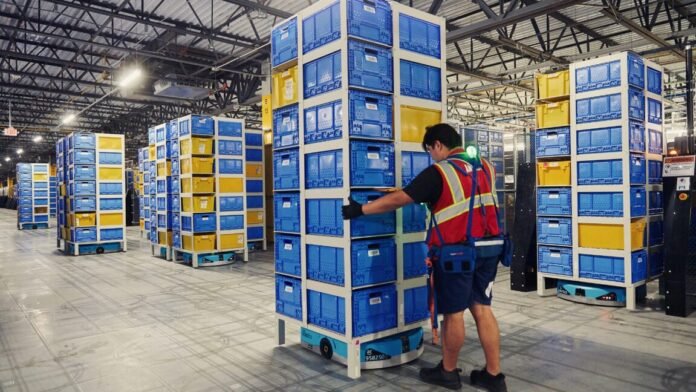
Most of Amazon’s million-robot fleet still consists of those wheeled mobile robots. The company claims that its robotic Sequoia system can identify and store items up to 75 percent faster at fulfillment centers by coordinating swarms of such robots. Hercules and Titan robots, the size of a pool table or a baby grand piano, respectively, roam warehouse aisles to retrieve tall fabric shelving units called pods packed with plastic tote crates and bring them to human employees at various workstations.
Such mobile robots typically follow grid lines of stickers laid out on the floor and stay within fenced-in areas away from human employees. But the newest mobile robot, called Proteus, has sensors that allow it to operate safely around humans and other objects in a more free-roaming role.
Those swarms of mobile robots traveling through narrow lanes between rows of storage pods can also sometimes create robotic traffic jams. That is why Amazon began coordinating its robots using a suite of AI foundation models collectively named DeepFleet, which can help predict potential robot congestion ahead of time.
More recently, Amazon has been deploying a growing number of robotic arms that can grab items stowed high up inside inventory pods, sort packages and place them in carts or on top of mobile robots, and handle the many different individual products that Amazon customers order when shopping online.
The company expects to more than double its existing fleet of robotic arms this year, according to Amazon CFO Brian Olsavsky in a July earnings call. When Ars sought clarification, Dresser described the current number of deployed robotic arms as being in the single-digit thousands.
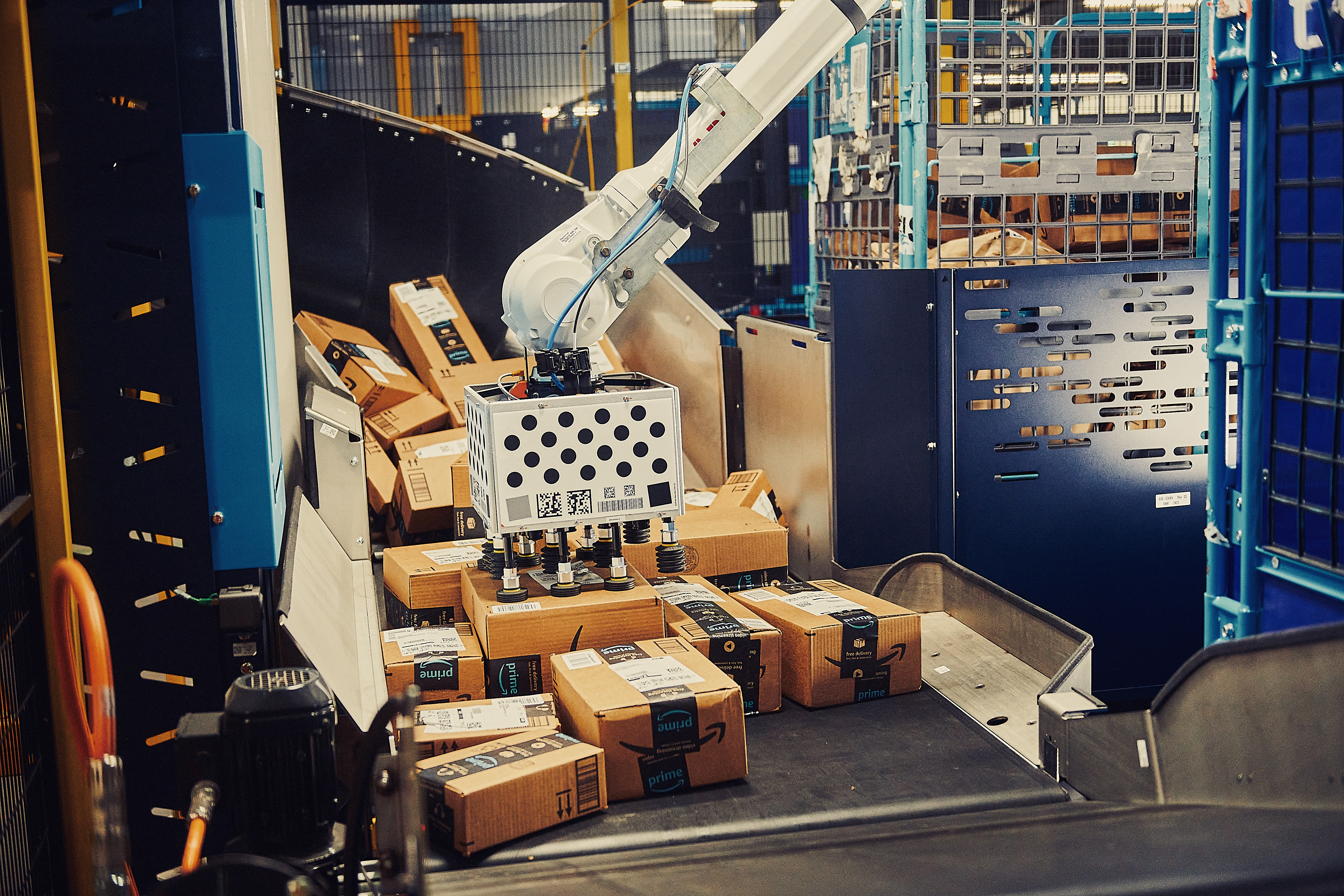
A robotic arm system called Cardinal uses a suction system to grab boxes from a pile of Amazon packages and stack them inside a rolling cart.
A robotic arm system called Cardinal uses a suction system to grab boxes from a pile of Amazon packages and stack them inside a rolling cart. Credit: Amazon
The robotic arms race
Amazon first bought third-party robotic arms to help lift and stack heavy pallets and bins inside its fulfillment centers. But the first robotic arm developed in-house by Amazon Robotics to sort individual mailer envelopes and boxes from cluttered piles, called Robin, began testing in 2021 before debuting at a facility in Lakeland, Florida, in 2022.
“With Robin, it was really that first attempt at taking a number of customer orders all in a jumble and building the advanced robotics to identify the items in that scene, to strategize on how to pick them up and build a motion plan that would be successful in placing it down on one of our mobile drive units,” Dresser explained.
The robotic arm uses eight suction cups to pick up individual packages. But before it takes any action, the robot’s software analyzes a top-down view of the conveyor belt cluttered with packages and quickly ranks possible picking actions.
In a 2023 research paper, the Amazon Robotics team described having developed several picking strategies for the robots to follow early on—but each had its own limitations. One strategy that prioritized picking larger packages encountered challenges when smaller packages lay on top of or overlapped with larger ones. Another strategy that favored picking up packages near the top of piles would fail in practice to retrieve “unreachable picks” and partially buried packages.
Improvements came from replacing such hand-crafted algorithms with an AI approach known as machine learning. The machine learning model initially trained on more than 394,000 picking actions from deployed robotic arms to estimate pick probabilities of success, and then used an online pick ranker to prioritize optimal actions for the Robin robots.
The best machine-learning method in that trial achieved a 93.73 percent success rate compared to 92.28 percent success for the best-performing traditional algorithm. That may seem trivial at first glance, but it meant the machine-learning method resulted in about 16,500 fewer failed picks than the traditional method during a work period involving more than 1 million total picks. That matters for an operation like Amazon’s that prioritizes speed and efficiency at scale.
The Amazon Robotics team further showed how such a machine-learning method could reduce the failed pick rate by 20 percent during an experiment involving 2 million picks by robotic workstations set up to resemble the operations of Amazon’s Robin fleet. They presented this work at the International Symposium on Experimental Robotics in July 2025.
Next up was Cardinal, a robotic arm that can place packages weighing up to 50 pounds into wheeled carts that are eventually brought to Amazon trucks waiting in loading docks. These robots first began operating at a facility in Nashville, Tennessee, in November 2022.
“Think of it as a game of Tetris: You’re sorting packages, and you’re placing them into the cart, and you want to be able to pack that as densely as you possibly can,” Dresser told Ars. “Dense containers are great from a sustainability perspective and from a transportation cost perspective.”
Cardinal built on lessons learned from Robin’s development in picking up and manipulating packages, while adding the capability to densely pack customer orders into the carts. Amazon has just started to deploy Cardinal in larger numbers and will continue to do so over the next several years, Dresser said.
A robotic arm system called Sparrow can handle millions of different products while packing container-size totes.
A robotic arm system called Sparrow can handle millions of different products while packing container-size totes. Credit: Amazon
AI-driven robot successors
Robin and Cardinal can handle several dozen package variations. But the newer Sparrow robotic arm was developed to tackle an even more challenging task—handling the hundreds of millions of products of varying shapes and sizes that can go into customer orders.
Specifically, Sparrow focuses on consolidating items from partially filled container-size totes to create densely packed totes. When items get picked out as customer orders are being fulfilled, Sparrow continually refills the totes.
“When we think about how AI applies to the physical space in robotics, Sparrow was really the first place where we truly deployed foundation models that enabled us to deal with that high diversity of products,” Dresser told Ars.
Such foundation models have helped the Amazon Robotics team to efficiently identify and classify those hundreds of millions of items to develop new robotic strategies for grasping them, Dresser explained. They also eliminated the need for manually coding every single item.
More recently, the Amazon Robotics team has created a foundation model for robotic perception that can handle new, never-before-seen products that may end up in Amazon fulfillment centers. The team also developed a generalized action model compatible with different types of robotic arms that may use varying combinations of suction and finger grasping.
“If you need to build ad hoc perception models for every such task and embodiment, that just doesn’t scale,” Kapil Katyal, a senior applied science manager at Amazon Robotics, said during a presentation attended by Ars at the Intelligent Robots & Systems conference held in Pittsburgh on September 29.
“So one of the initiatives we took up in our team was to design a foundation model which could work for any new embodiment of robots that we deploy, and across all of the perception tasks that we need to perform over those,” Katyal said.
Most of the robotic arms have relied primarily on vision. But Amazon’s newest robotic arm, Vulcan, is the first to combine vision with force feedback sensors capable of providing a sense of touch. This enables the robot to accurately pick out or stow away items within the fabric-covered inventory pods.
“You need to be able to insert an item, create space, or pull something out,” Dresser said. “Those are really hard things to do with traditional non-touch-based systems today, like the suction-based systems that are part of Sparrow.”
Vulcan initially began operating at Amazon fulfillment centers in Spokane, Washington, and Hamburg, Germany, starting in 2025. It is not widely deployed yet, but Dresser said the company expects to scale up use of this robotic arm in 2027.
The Vulcan robotic arm has force-feedback sensors that provide a sense of touch as it picks and stows items in tall inventory pods.
The Vulcan robotic arm has force-feedback sensors that provide a sense of touch as it picks and stows items in tall inventory pods. Credit: Amazon
Parsing the human impact
Each new robot has benefited Amazon’s human workforce, according to the company. For example, Vulcan focuses on picking and stowing items located in the top rows of inventory pods that would otherwise require a person to use a step-ladder, along with handling items located just above the floor. That enables employees to focus on picking and stowing items that are within more comfortable reach.
But investigations by labor advocacy groups, journalists, and the US Congress have painted a less rosy picture of Amazon’s automation drive over the years. The Strategic Organizing Center (SOC), a coalition of trade unions headquartered in Washington, DC, published reports in May 2021 and April 2022 showing higher injury rates at Amazon’s robotic warehouses compared to non-robotic warehouses. That analysis drew on injury data reported by companies to the US government from 2017 through 2020.
“Amazon likes to talk about its latest robots because it doesn’t want to talk about the tens of thousands of Amazon workers who are injured every year due to Amazon’s obsession with maximizing speed and minimizing costs,” Joan Moriarty, director of strategic research and Campaigns at SOC, said in an email to Ars.
The organization also gathered nearly 1,000 responses from Amazon workers in an online survey conducted in February 2021. “Workers consistently report that the presence of robots increases the pace of work expected in Amazon facilities, forcing them to make fast, repetitive motions, substantially increasing the risk of injury,” Moriarty said.
The US Senate Committee on Health, Education, Labor and Pensions (HELP) also conducted a 2024 investigation led by Sen. Bernie Sanders (I-Vt). The committee’s report noted how Amazon’s internal data also suggested a link between robotic productivity and increased pressure on human workers, leading to higher injury rates.
Amazon has described these reports as flawed and being reliant on older data predating the deployment of its most modern robots, including the robotic arms that became operational over the past several years. The company also touted improvements in its overall workplace injury rates without detailing any potential differences between robotic and non-automated warehouses.
“All of these claims ignore the fact that since 2019 our Global Recordable Incident Rate has improved 43 percent and our Global Lost Time Incident rate, which includes the most serious injuries that require employees to take time away from work, has improved 70 percent,” an Amazon spokesperson told Ars. “Our consistent year-over-year improvements have worked in parallel with our robotics growth across our operations network.”
The most nuanced findings on Amazon’s automation drive may come from a research study published in the journal ILR Review in April 2025. That analysis showed Amazon’s robotic warehouses had a 40 percent decrease in severe injuries compared to legacy fulfillment centers—which suggests some benefits from having robots take on the most physically challenging and risky tasks.
However, the same study also found that robotic fulfillment centers had a 77 percent increase in less severe injuries associated with physical strain from repetitive motions.
“At least one of the mechanisms by which this appears to be manifesting is through the pace of work, in that pick rates for the robotic fulfillment centers are off the charts higher,” said Greenwood at George Mason University, who was one of the paper’s coauthors.
A faster pace of work driven by partial automation could mean “the robot is dictating the pace of work” and spurring human employees to perform certain repetitive actions more quickly, Greenwood told Ars. “That appears to be what’s driving the strains and the sprains that we observe,” he said.
The study drew in part on Amazon company data obtained by journalists at Reveal and The Center for Investigative Reporting, covering weekly data at more than 150 Amazon warehouses from 2016 through 2019. Although the data is older, Greenwood said the findings are still relevant to Amazon’s ongoing automation efforts.
“I haven’t seen a tremendous amount of evidence to suggest that these dynamics are changing, inasmuch as you still have a tremendous amount of turnover in the warehousing context—and that’s not just Amazon,” Greenwood said.
Greenwood and his colleagues also analyzed online comments posted on Reddit by Amazon fulfillment center employees. In those comments, Amazon employees described work at robotic fulfillment centers as being less physically stressful but also mentally exhausting because of the physical repetitiveness and faster pace associated with higher productivity expectations.
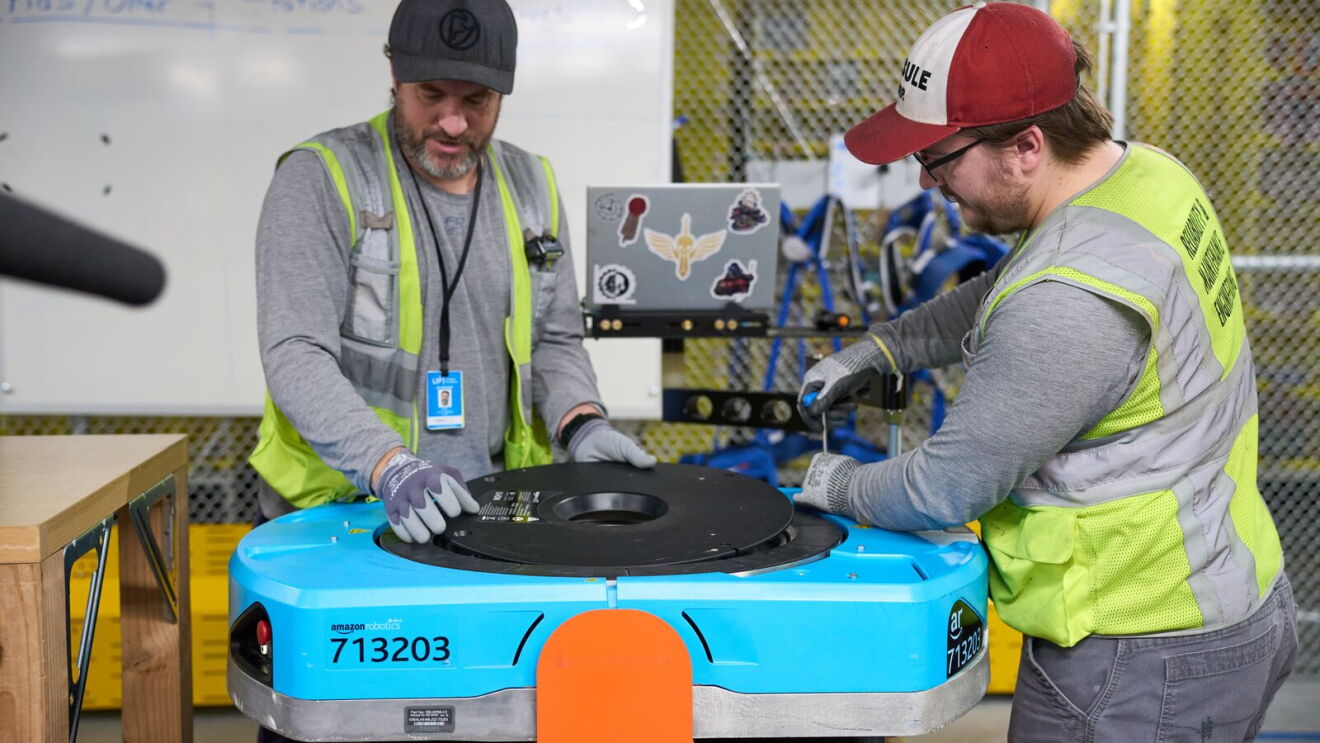
Amazon has opened new roles for employees to build and maintain mobile robots and robotic arms.
Amazon has opened new roles for employees to build and maintain mobile robots and robotic arms. Credit: Amazon
The future of work
An obvious question is whether automation efforts by Amazon and other companies will end up replacing some potential human hires with robots. For its part, Amazon has touted the robotics push as providing new job opportunities for human employees. Fulfillment centers with advanced robotics typically require 30 percent more employees working in reliability, maintenance, and engineering roles, and the new facilities for manufacturing additional robots will also supposedly bring more than 300 jobs each.
“As we recognize that each of these robotics [developments] can change the nature of work, we’re providing opportunities for our employees to upskill and learn some of these things,” said Dresser at Amazon Robotics. “We’ve actually increased the number of robotic maintenance technicians that we have in the network by over 30 percent, and that is a much higher-skilled, higher-compensated job.”
The company has also described its automation efforts as going hand in hand with a growing business that needs more human employees. “As we’ve deployed robots over the past decade, we’ve seen our operational footprint grow, creating hundreds of thousands of jobs as we expanded our network,” the Amazon spokesperson told Ars.
However, there are apparently internal discussions within Amazon about robots potentially reducing the need to hire humans. In October 2025, The New York Times reported on internal strategy documents suggesting that the robotics push could allow the company to reduce projected hiring needs in the United States by more than 160,000 people by 2027 and 600,000 people by 2033. (An Amazon spokesperson responded at the time by saying the documents reflected the views of just one group inside the company.)
Even as Amazon looks to build out its robotic fleet beyond the million-robot mark, discussions about the company’s workplace safety and working conditions are unlikely to go away. Although just a very small fraction of Amazon’s hundreds of thousands of employees have unionized in the United States, labor unions have “traditionally served a very good role in terms of improving worker safety,” Greenwood said.
“Now, obviously, I understand that firms are not always excited to engage in that conversation, and I can’t say that would solve the problem here,” Greenwood told Ars. “But developing a better relationship between management and labor is usually the best path forward to try to figure out how to reduce these injury rates, which would have benefits for Amazon as well.”
The first Amazon Labor Union that was organized among workers at a warehouse in Staten Island, New York, in April 2022, has been pushing what it describes as a Safety Bill of Rights that outlines changes it would like to see to make their workplace safer. The image that accompanies the document declares: “We are not robots.”
Pope Leo to be hospitalised on Tuesday ahead of lung surgery
Pope Leo will go into hospital on Tuesday for surgery to remove a small growth found on one of his lungs, the Vatican said, as the pontiff kept up a busy schedule on Monday, holding seven previously planned meetings in the morning.
Leo, 71, said on Sunday that the growth, a small nodule, had been found on a recent check-up, was “well-contained” and had been spotted early. Ahead of his hospitalisation, the pope cancelled all his public events from Tuesday until October 20.
Dear friends, during some recent medical examinations, the doctors found a small, localized nodule in my lung. It was detected at a very early stage and is well-localized. The doctors believe that it is best to intervene, so, following their advice, I have decided to undergo…
The nodule was found during a routine health check, the Vatican press office told journalists earlier on Monday, before confirming that the pope is expected to be hospitalised late on Tuesday morning, ahead of his surgery.
It did not say when the actual operation would take place.
A regular advisory on the pope’s daily schedule, issued at noon (1000 GMT) on Monday, said he met that morning with visiting bishops from Argentina, Nicaragua and the United States, among others.
In a meeting at the Vatican with members of a Rome-based charity group on Monday, the pope spoke in a strong, clear voice, thanking them for their work.
COMPLICATION RATE FOR NODULE REMOVAL LOW
Leo, elected pope by the world’s cardinals in May 2025, is relatively young for a Church leader. He enjoys sports, including tennis, and is not known to be a smoker or to have had health issues previously.
The Vatican has said the pope’s recovery is expected to take about a week.
A nodule on the lung is a small, localised lesion that can be benign. The American Thoracic Society says fewer than 5% of lung nodules overall prove cancerous, although risk rises with age, size, and other factors such as smoking.
Dr. Federico Venuto, chief of thoracic surgery at Rome’s Policlinico Umberto I hospital, said surgeries to remove lung nodules are usually minimally invasive, and can sometimes involve use of a thin camera tube called a thoracoscope.
“The complication rate is extremely low,” he told Reuters.
POPE’S TRANSPARENCY ABOUT HEALTH UNUSUAL
Leo’s decision to discuss his upcoming surgery publicly on Sunday marked a contrast with his predecessor, the late Pope Francis, who died in April 2025 at age 88.
Francis was hospitalised several times as he grew frail in his later years and did not usually announce his hospital visits in advance, sometimes sparking a media frenzy over his health.
Canadian Cardinal Gérald Lacroix said on Monday that he was grateful for Leo’s transparency.
“I really appreciated yesterday … (that) he himself said, ‘This is what’s going on,’ very transparent, and asked for prayers,” said Lacroix. “I like that.”
Leo, the leader of the 1.4-billion-member Church, had several public appointments on his calendar for this week, including a Mass in St. Peter’s Square on Wednesday morning.
The Vatican said the Mass would now be led by Filipino Cardinal Luis Tagle, a Vatican official whom Leo last week approved as the dean of the Church’s College of Cardinals, in the first selection of an Asian cleric to the elite role.
In the event of a papal death or resignation, the dean of the cardinals is responsible for organizing the secret conclave to elect his successor.
The pope is the final earthly authority for the world’s Catholics and does not have a deputy who steps in when he is sick. When a pope is incapacitated, the business of the Vatican’s vast bureaucracy carries on as usual, holding off on any decisions that require papal approval.
Pentagon Finally Counts an Iran War Death — Six Months Late
The Pentagon quietly acknowledged additional Iran war deaths on Friday evening after The Intercept repeatedly demanded an explanation for inaccurate statistics on a War Department website tracking U.S. casualties from the conflict.
Almost 900 U.S. troops have been wounded or killed in the war with Iran, according to the official Pentagon count, including the two deaths added on Friday. This raises the Pentagon’s total to 21 dead.
The additional war dead include Maj. Sorffly Davius, a signals and communication officer with the New York Army National Guard who was assigned to the headquarters of the 42nd Infantry Division and died while on duty in Camp Buehring, Kuwait, on March 6. For more than six months, The Intercept has raised Davius’s case in dozens of emails and phone conversations with Pentagon officials and publicly in 10 articles.
The Pentagon recently revamped the website of the Defense Casualty Analysis System, or DCAS — which provides official counts of dead and wounded for Congress and the White House — to include more detailed casualty category tables. But it initially listed no “non-hostile” illness or injury fatalities, despite the Pentagon announcing in March that Davius died “as a result of a non-combat related incident.”
At first, the military claimed that Davius was involved in another operation instead of Epic Fury — the original designation of the Iran war. Two weeks ago, however, The Intercept revealed that a recent National Guard news release admitted that when “President Donald Trump made the decision to attack Iran and launched Operation Epic Fury on Feb. 28, the [42nd Infantry] division headquarters began conducting combat operations.” The 42nd served as the primary headquarters leading what became, according to Maj. Gen. Jack James, the division commander, the “largest and first long-range precision fires campaign in the history of the United States Army.” James specifically saluted Davius, whom the Guard admitted was “conducting operations” when he died.
Last week, The Intercept pointed the Pentagon to the non-hostile illness or injury casualty count for Epic Fury on the website, and emphasized its tally showing zero deaths was not possible.
“I will check within,” Patricia Kreuzberger, a Pentagon spokesperson said on Tuesday. “Let me reach out to leadership.”
Three days later, and after repeated follow-up messages on Friday, the tally was updated, to 1.
In addition to Davius, the DCAS death count now also includes an unidentified Navy suicide that occurred last month, according to a U.S. official who spoke on the condition of anonymity. DCAS currently lists this death as “pending,” despite the recent addition of a “self-inflicted” category to the website.
A “War Department official” told The Intercept by email on Sunday that “the Department is introducing a ‘Pending Adjudication’ category to track the status of active duty casualties pending final categorization and reporting in DCAS.” She added: “This new category will allow the Department to minimize reporting delays while ensuring data consistency between the DoW and Joint Staff.”
The “pending” designation, however, isn’t new. The Pentagon re-introduced it to DCAS in mid-July, and major discrepancies have continued in the tally since.
Many casualties remain uncounted in DCAS, including a sailor who suffered a non-combat-related injury aboard the USS Abraham Lincoln as it was involved in “strike missions in support of Operation Epic Fury” on March 25.
Most Iran war casualties in the official count — 454 personnel as of Friday — have occurred since July 7, after the Trump administration claimed the conflict ended. At that time, the Pentagon switched from counting casualties under Epic Fury to the anodyne moniker “Overseas Operations.”
The most recent casualties are three Army personnel wounded in action this month. The latest known Iran war fatality is Capt. Bianca Wilkerson, 37, of Norfolk, Virginia, who died on September 18 from a “coronary issue,” according to her brother. He said she returned from Saudi Arabia on September 10 and was headed back but died on the return flight, according to reporting by the Virginian-Pilot. A U.S. official told The Intercept that Wilkerson died “as a result of a non-combat-related incident,” but after nearly a month, DCAS still lists no non-hostile illness or injury deaths.
“There is no excuse for a mistake of this magnitude,” Reps. Chrissy Houlahan, D-Pa., and Adam Smith, D-Wash., said in a joint statement on Friday after the House Armed Services Committee discovered “a discrepancy in the Pentagon’s reporting of casualty numbers” and brought it to “the Trump Administration’s attention.” They continued: “The failure of Secretary Hegseth to immediately take ownership of the problem also does a grave disservice to the men and women putting their lives on the line in service to our country.”
For six months, The Intercept has reported on anomalies in official counts offered on DCAS. When the first ceasefire was struck between the Trump administration and Iran on April 7, the tally of U.S. casualties was 385. Despite a pause in hostilities, the number slowly rose to 428, according to Pentagon statistics. But on April 21, the number of wounded-in-action troops declined by 15 without public acknowledgment by the War Department. Despite repeated questions for months, the Pentagon has not explained the adjustment.
Other discrepancies have also gone unjustified for months. An Army “illness/injury” death appeared on or about May 26 but disappeared by June 1. On July 20, the Pentagon repeatedly altered DCAS, adding 100 casualties to the war’s tally without explanation; the total number of wounded cited by DCAS on that date included counts of 413, 427, and 447. Three days later, the Pentagon dropped the Iran war death toll from 18 to 14. On July 22, DCAS added 10 recent casualties to the Epic Fury count. By July 25, those wounded personnel were dropped from the tally. They may have been added to the Overseas Operations casualty toll, but the Pentagon has failed to offer any explanations.
Prior reporting by The Intercept also found that the Pentagon’s official tally of dead and wounded personnel is a gross undercount, stemming from what one U.S. government official called, in April, a “casualty cover-up.” When the Washington Post also suggested last month that the Pentagon had suppressed the casualty numbers, self-styled War Secretary Pete Hegseth called the report “DISGUSTING and FAKE.”
When asked by The Intercept about the Pentagon’s continued peddling of bogus statistics, Kreuzberger did not offer an explanation. An email from a nameless “War Department official” said: “We have nothing to provide beyond the Defense Casualty Analysis System website.”
Russia was not ready for the data center war it started with Ukraine
When Russia began attacking Ukrainian data centers and telecommunication infrastructure, it apparently failed to prepare for possible retaliation. Now Russia’s digital services are facing widespread outages after Ukrainian drone strikes knocked out three of the largest data centers owned by Russian tech giant Yandex within several days.
Pro-Kremlin bloggers are warning that Russia’s centralized digital economy could collapse because the country is not prepared for the “data center war” it started, according to poststranslated by the pseudonymous independent researcher ChrisO_wiki. The Russian commentators also suggested that Ukraine’s decentralized digital services could prove more resilient than Russia’s system if the countries continue trading such blows.
Russia initially launched a drone strike campaign targeting Ukrainian data centers and mobile phone networks in late September. The attacks temporarily disrupted Internet and cell phone service for up to 100,000 households in the Ukrainian capital of Kyiv and came as part of a broader long-range strike campaign that has involved Russian missiles and jet-powered drones hitting Ukraine’s power grid infrastructure, transportation hubs, and even residential apartment building blocks.
The first Ukrainian drone attack damaged a data center in the Sasovo region southeast of Moscow on October 8, which houses two of the three supercomputers that Yandex has used to train its YandexGPT AI model.
It was not immediately clear how much damage may have occurred to the supercomputers, which are based on Nvidia A100 GPU chips. The Chervonenkis supercomputer has a computing performance rated at 29.42 petaflops and ranks at 101 on the Top 500 List of supercomputers, while the Lyapunov supercomputer is rated at 20.03 petaflops and ranks at 161.
A second Ukrainian drone strike knocked out another Yandex data center in the Kaluga region southwest of Moscow on October 9. This is one of the largest data centers in Russia, with a maximum 63-megawatt capacity.
A third Ukrainian drone strike then forced Yandex to suspend operations at its data center in Vladimir, east of Moscow, on October 11, according to BBC News. This facility houses the third of Yandex’s three supercomputers, Galushkin, which ranked 134 on the Top 500 list and is rated at 20.64 petaflops of computing performance.
Russia’s vulnerable digital economy
More importantly for Russian society, the damage to Yandex’s data centers has reportedly caused interruptions or outages to popular Russian payment apps and digital banking services, email, e-commerce platforms, video streaming services, ride-hailing and food delivery apps, and navigation and map services. Yandex’s search engine also accounts for about 70 percent of the market share in Russia.
The disruptions are even more widespread, because the data center damage also impacts Yandex’s cloud computing service, which counts some of Russia’s largest companies as customers, according to The Moscow Times, an independent newspaper. These include large grocery and fast-food chains as well as a household appliance retailer.
The Russian milblogger writing under the name Ratio Militaris warned that Yandex’s hypercentralized digital ecosystem had become a wartime weakness for Russia, in a post translated by ChrisO_wiki:
Yandex and the digital ecosystem it created that had long been one of Russia’s advantages compared to even Western countries, has proven to be a weak link—including, and even primarily, due to hyper-centralization—both at the market level, where Yandex had become a powerful monopolist, and at the level of specific infrastructure solutions, where the entire power of the information giant was concentrated in a few (the exact number is no secret, but perhaps inappropriate to specify) large nodes—those aforementioned data centers.
Russian companies like Yandex will also have a hard time establishing infrastructure backup systems outside of Russia to provide additional wartime resiliency. That is partly because of the “Sovereign Internet Law” passed by the Russian parliament and signed into law by President Vladimir Putin in 2019, according to Russian milblogger Artjockey, whose writing was translated by ChrisO_wiki.
In its pursuit of a “sovereign Internet,” the government has effectively blocked Russian companies from using infrastructure even in friendly nations, while “unfriendly” countries have blocked access via sanctions anyway… it is virtually impossible to replicate Russian IT infrastructure in places like Belarus or Kazakhstan—though, in any case, the necessary capacity simply isn’t there. China might have the capacity, but that would require legislative changes to allow key services and registries to be moved there.
By comparison, Ukraine has a much more decentralized digital ecosystem consisting of smaller data centers. It has also taken steps to build out backup infrastructure, including moving some equipment and networks underground or outside the country.
Western tech giants like Microsoft and Amazon have also provided free cloud services to help Ukraine migrate crucial government services to other parts of Europe, enabling many essential Ukrainian digital services to keep going despite Russia’s sustained missile and drone attacks. Amazon Web Services alone is hosting more than 15 petabytes of data from over 60 Ukrainian government organizations, along with data from Ukraine’s largest private energy company, DTEK.
Meanwhile, Russians may be waiting up to six months until Yandex can replace damaged data center equipment, according to an unnamed IT expert interviewed by Russian newspaper Kommersant. A lengthy timeline for repairs may not be so surprising when considering Amazon’s own experience after Iranian drone strikes knocked out multiple data centers in Bahrain and the United Arab Emirates earlier this year.
Iran war-depleted arsenal making US a less potent power
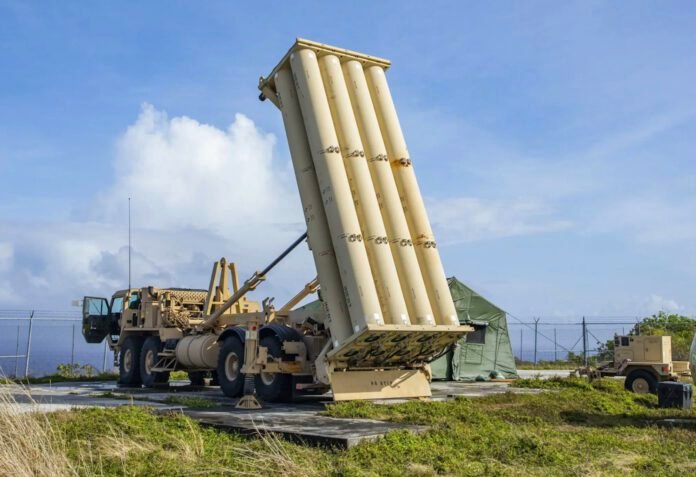
The Terminal High Altitude Area Defense (THAAD) missile defense system. Photo: Sgt. 1st Class David T. Chapman / US Army
The Iran conflict has exposed a glaring blind spot in US war strategy. America can escalate in hours, but it can take years to rebuild the arsenal it consumes. Washington has begun addressing the arms-replenishment problem, a calculation it should have made before escalating.
The Pentagon’s recent awards reflect the intensity of the challenge. In the past few days, it has announced a US$24.4 billion contract for Raytheon to accelerate Standard Missile-6 (SM-6) production, after awarding $20.7 billion for AMRAAM missiles and a $58.6 billion Patriot deal with Lockheed Martin. Each is meant to replenish stocks depleted by the war, but signing the contracts does not put depleted missiles back in the arsenal.
The shortage is already showing on the battlefield. Commanders on US bases in the Middle East have reportedly begun letting some incoming Iranian missiles land when they are headed for unpopulated areas, saving scarce interceptors for missiles that could do real harm.
Yet in a recent Time magazine interview, President Donald Trump downplayed a Pentagon report on munitions shortages while acknowledging that some stocks are running low.
Independent estimates underscore the large-scale drawdown of high-value munitions. According to the Center for Strategic and International Studies (CSIS), the US stockpile of Patriot and THAAD interceptors had fallen to fewer than 827 and 278, respectively, by July 27.
The drain on the reserves started earlier. In the 12-day war of June 2025, US forces reportedly fired more than 150 THAAD interceptors and about 80 SM-3s to defend Israel from Iran’s incoming projectiles.
Washington recognized the replenishment challenge even before the Iran escalation. In January, the Pentagon and Lockheed Martin signed agreements to raise annual THAAD output from 96 to 400 and Patriot PAC-3 production from roughly 600 a year to 2,000 by the end of the decade.
But while money can be raised, borrowed or reallocated, factories, workers and supply chains don’t move as quickly. The manufacturing lead time of these interceptors ranges from 25 to 51 months, meaning they can’t be scaled up overnight. A Pentagon Inspector General report released in September found that the Iran war had exposed industrial bottlenecks, triggering a shortage of key munitions.
To be sure, the US military can still sustain the current Iran fight. Yet rapidly depleting munitions may weaken deterrence in other theaters. The Congressional Budget Office estimates that US forces have probably used between one-half and two-thirds of their missile-defense interceptor inventory since June 2025, and rebuilding it may take at least five years, even with increased production.
The shortage is already affecting Ukraine. Kyiv has reported an acute shortage of Patriot interceptors since the Iran war began. In August, President Volodymyr Zelensky warned that Ukraine had two and a half times fewer interceptors than it had in 2025, while Russia fires twice as many ballistic missiles a month.
Washington has historically underestimated how long military commitments can last, straining its arsenal. The 2003 Iraq war was expected to produce a rapid victory, yet the US military commitment lasted far longer.
Just 11 days into the 2003 Iraq war, US forces were running critically low on some key weapons, having fired 700 of 1,200 Tomahawk cruise missiles and thousands of satellite-guided bombs. The Pentagon rushed to replenish stocks, but production couldn’t keep pace with wartime consumption.
Trump is doubling down on the same mistake, pursuing a swift, decisive victory while promising to end America’s past “forever wars.” He initially said the Iran war would last just a few weeks, but it is now in its eighth month.
Washington cannot claim it was blindsided. Although not in the specific context of interceptors, it had been warned about a lagging defense industrial base and inadequate munitions stocks since at least January 2023, with warnings that the US could not afford to wait until war began to address replenishment.
The Pentagon only moved earlier this year to expand production of PAC-3 and THAAD interceptors. Plainly, the US does not need to know exactly how long a war will last before deciding to act.
But the unexpectedly prolonged conflict’s impact on stockpiles, and the long time needed to rebuild them, is undermining US deterrence in other theaters and making Washington a less potent and reliable ally worldwide.
UN pledges technical support for Palestinian elections amid vote delay
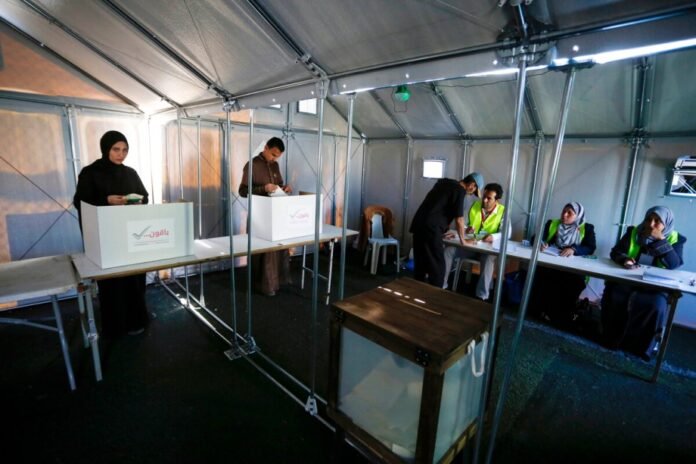
The UN reaffirmed its commitment Monday to assisting Palestinian electoral authorities following the postponement of legislative elections originally planned for late November, Anadolu reports.
“We will continue to support the Palestinian Central Election Commission to ensure that technical preparations are in place when the actual elections take place,” Stephane Dujarric, spokesperson for UN Secretary-General Antonio Guterres, told reporters.
The remarks followed a decree issued Saturday by Palestinian President Mahmoud Abbas rescheduling legislative elections for Sept. 11, 2027. The move formally rescinded an earlier order that had scheduled parliamentary elections for Nov. 28, 2026, which would have marked the first parliamentary vote in 20 years.
The presidential decree instructs Palestinians across the occupied West Bank and the Gaza Strip to participate in simultaneous votes for the presidency of the State of Palestine and members of the Palestinian Legislative Council.
Palestinian authorities said the postponement followed a decision by the Executive Committee of the Palestine Liberation Organization (PLO), along with consultations with political factions, establishing a consensus over obstacles posed by Israeli measures and the need to secure viable political, security and field conditions for free, fair and inclusive elections.
READ: Palestinian president postpones legislative elections to Sept. 11, 2027
ICEJ visitors turned purchases into a show of solidarity as Ireland and the Netherlands enforce new restrictions, and Norway weighs a broader trade ban
“This piece of legislation written by the Irish parliament shall not stand,” said Paul Coulter, national director of the International Christian Embassy Jerusalem (ICEJ) in Ireland, as he held up a copy of Ireland’s new law restricting imports from Israeli settlements. Then he tore the document apart in front of the camera.
This piece of legislation written by the Irish parliament shall not stand
The gesture came during an ICEJ visit to Israeli communities in the West Bank—known in Israel as Judea and Samaria—where Christian visitors traveled through Samaria, Gush Etzion and Efrat and were encouraged to shop at local businesses. The tour, organized during ICEJ’s annual Feast of Tabernacles gathering in Jerusalem, was intended as a direct response to a growing set of European measures restricting trade in products from Israeli settlements. Some of those measures are already in force; others remain proposed legislation.
Ireland’s ban took effect on Sept. 15. The Netherlands followed with a broader restriction on Sept. 22 that reaches even goods carried in personal luggage. Norway, meanwhile, is considering legislation that would prohibit imports from and exports to Israeli settlements, along with certain property transactions and services. The Norwegian proposal remains under consideration after a public consultation that closed Sept. 19.
David Parsons, ICEJ senior vice president and spokesman, said the organization brought Christians attending the Feast of Tabernacles into the area specifically to support businesses affected by the measures.
“In recent weeks, several European countries and even Canada and others have announced that they’re going to pass sanctions against the Jewish communities in Judea and Samaria,” Parsons told The Media Line. “We brought them here to the Shomron, to Samaria, also down to Gush Etzion, Efrat, to go and show support by buying goods here.”
The governments imposing or considering the restrictions present them as measures directed at settlements they consider illegal under international law, rather than at Israel as a whole. Ireland says its law is part of an effort to comply with international legal obligations identified in the International Court of Justice’s 2024 advisory opinion. The Irish government argues that Israeli settlements in what it refers to as occupied Palestinian territory are unlawful and undermine prospects for a two-state solution. Its law prohibits imports originating in designated settlement postal codes and makes violations subject to existing customs law, including search, seizure and forfeiture powers.
Parsons rejected that reasoning and argued that the economic effect was precisely the point. “The real intent of these European countries is to dry up the settlements and their livelihoods, the way of life, so they’d have to leave here,” he said. That characterization is disputed by the governments behind the measures, which describe them as a legal and political distinction between Israel and territory captured in 1967.
The real intent of these European countries is to dry up the settlements and their livelihoods, the way of life, so they’d have to leave here
The Irish measure, however, stops short of restricting what tourists bring home for themselves. Noncommercial goods in personal baggage are exempt when intended for the traveler’s own consumption or use. That distinction became part of Coulter’s message during the trip.
“Come and buy Israeli wine. It’s some of the best wine in the world,” he said. Later, addressing Irish visitors specifically, he added: “Break the boycott. If you can buy Israeli wine, buy it.” Coulter noted that Irish law does not prevent tourists from returning with those products for private consumption.
Coulter said opposition to ICEJ’s position has also followed the organization at home. He described venues receiving calls demanding that ICEJ events be canceled and demonstrations outside meetings that went ahead.
“We have our own hashtag, #BoycottApartheidICEJ,” he said. “Our venues are lobbied and phoned to cancel our meetings, and when the venues won’t cancel, we actually have protest mobs screaming and shouting at the gates of our meetings.”
Norway has not yet enacted its proposed trade ban. Its Foreign Ministry opened the proposal for public consultation in June, saying Norwegian citizens and companies should not contribute economically to maintaining settlements that the government considers unlawful. The proposal would prohibit importing goods from Israeli settlements and exporting goods to them. It would also restrict certain real estate purchases, construction and property-related services, and acquisitions of businesses based in the settlements. Violations would carry criminal liability.
Dag Øyvind Juliussen, national director of ICEJ Norway, said the prospect of criminal penalties has sharpened opposition among supporters of Israel in his country. “They want to pass a bill that would make it a crime to trade with the Jewish inhabitants in Judea and Samaria, the so-called settlements,” he told The Media Line, adding that the legislation must still go through the Norwegian parliament.
They want to pass a bill that would make it a crime to trade with the Jewish inhabitants in Judea and Samaria, the so-called settlements
For Juliussen, joining the shopping tour was a way to turn that opposition into a physical act. “This is what we need to do,” he said. “This area has been the heartland of the Jewish people for 3,000 years.” He said Christians who share that view should make their position visible by supporting the people and businesses living there.
The Netherlands has taken a different approach. Since Sept. 22, travelers entering the country have also been barred from bringing in products that Dutch authorities identify as coming from Israeli settlements covered by the measure. That includes items bought for personal use, such as gifts or souvenirs.
Dutch customs officers can check luggage and ask where an item was made or purchased. Products found to fall under the ban may need to be surrendered or seized. The measure does not apply to Israeli goods generally, but specifically to products linked to the settlements covered by the Dutch restrictions. Customs authorities say inspections are selected on the basis of risk assessments and objective information rather than a traveler’s nationality, religion, ethnicity or appearance.
Parsons said the possible long-term consequences went beyond lost sales. He accused European governments of pursuing policies that could eventually pressure Jews to leave the communities. “Are you really willing to support ethnic cleansing of that nature through these sanctions and criminal laws against buying goods from this area?” he asked. His language went far beyond the stated position of the governments involved, which say their measures are aimed at settlements and at preserving the possibility of a negotiated two-state outcome.
Take out your plastic, take out your dollars, your shekels and buy goods from Judea and Samaria
ICEJ’s response during the tour was deliberately practical. “We’ve done that now by bringing dozens of Christians on several buses to these areas to shop,” Parsons said. His instruction to participants was straightforward: “Take out your plastic, take out your dollars, your shekels and buy goods from Judea and Samaria.”
That leaves people traveling together on the same ICEJ tour subject to different rules once they return home. An Irish visitor can bring a bottle of locally produced wine back for personal consumption under Ireland’s exemption. A Dutch traveler carrying the same bottle from a location covered by the Netherlands’ restrictions may have to surrender it at customs. For those filling shopping bags during the visit, the legal distinction may not become real until they reach their destination airport.