US turning B-52 bomber into long-range China ship killer
While the US is arming its long-serving B-52 with potent ship-killing missiles to take on China’s expanding navy, severe munition constraints and operational vulnerabilities could undermine its strategic impact.
This month, multiplemediaoutlets reported that the US Navy plans to award a sole-source contract to Lockheed Martin to integrate the AGM-158C Long-Range Anti-Ship Missile onto the US Air Force’s B-52 Stratofortress fleet, according to a Naval Air Systems Command notice.
The effort will encompass missile software updates, flight testing, test-asset repairs, and separation clearances from both internal launchers and wing pylons, enabling the heavy bomber to carry up to 20 stealthy, autonomous anti-ship cruise missiles.
Derived from the AGM-158 Joint Air-to-Surface Standoff Missile (JASSM) already deployed on the aircraft, the LRASM uses onboard sensors, electronic support measures, and infrared terminal guidance to strike heavily defended naval targets beyond 320 kilometers without relying on GPS or active radar emissions.
The integration program rounds out maritime strike upgrades across the US Air Force’s strategic triad following previous deployments on the B-1B Lancer and recently disclosed launches from the B-2A Spirit.
US Department of Defense (DoD) planners aim to leverage the B-52’s intercontinental range and immense payload capacity to mass standoff firepower against enemy warships across the Indo-Pacific, creating a persistent maritime strike deterrent that reduces operational risks for carrier strike groups (CSGs) facing sophisticated Chinese air defenses.
The rationale for the US using strategic bombers such as the B-52 for maritime strike is that these assets provide an asymmetric, cost-effective counter to China’s People’s Liberation Army Navy (PLAN) in the Western Pacific.
In an April 2025 report, the US Congressional Research Service (CRS) notes that the PLAN has become the world’s largest naval force by hull count, surpassing the US Navy in battle force ships between 2015 and 2020.
Citing DoD estimates, the CRS report says that the PLAN now exceeds 370 battle force platforms—excluding roughly 60 missile-armed patrol combatants—and projects it will expand to 395 ships by 2025 and 435 by 2030, driven primarily by surface combatants.
Against China’s naval numerical superiority, US bombers such as the B-52 provide intercontinental range, rapid transit speeds, and massive payload capacity, and can launch multiple LRASMs from multiple unpredicted azimuths outside hostile air defenses.
Such a capability may also address a potential anti-ship firepower gap in the US Navy. In a February 2023 article for the Center for International Maritime Security (CIMSEC), Dmitry Filipoff notes that the Harpoon missile, the US Navy’s main anti-ship weapon, cannot fit into more than 9,000 vertical launch cells across the fleet.
Filipoff points out that destroyers and cruisers carry only eight Harpoon missiles each, forcing vulnerable carrier air wings to mass salvos within hostile air defenses – a burden that is amplified by the Harpoon’s relatively short range of 128 kilometers for most variants.
That vulnerability, he notes, could leave the US Navy virtually unable to mass modern anti-ship cruise missile strikes.
Furthermore, bombers can return to base and rearm within hours, generating high sortie salvos that saturate naval formations without placing vulnerable US carriers at risk. In contrast, surface combatants such as destroyers and cruisers face acute replenishment delays.
Under the US Distributed Maritime Operations (DMO) operational concept, air-based anti-surface fires disperse launch platforms to confound adversary targeting while concentrating massed effects against enemy warships. By striking beyond enemy ranges, these aviation assets secure the localized sea control required for joint power projection.
Still, the LRASM isn’t a wonder weapon. It might be effective against isolated PLAN ships, but such cases are probably rare. Daniel Rice mentions in a July 2024 China Maritime Studies Institute (CMSI) report that PLAN CSGs organize fleet air defense in three concentric rings.
According to Rice, the outer defense zone, spanning 185 to 400 kilometers, uses carrier-borne J-15 fighters to intercept airborne hostiles. He describes the middle zone, extending 45 to 185 kilometers, with Type 052D destroyers and Type 054A frigates equipped with radars, HQ-16 missiles, and HHQ-10 interceptors. Finally, Rice describes an inner zone reaching 45 kilometers that relies on terminal defense systems.
A US-China conflict over Taiwan would use vast precision-guided munitions like the LRASM, incurring high costs and potentially outpacing US manufacturing capacity.
As Seth Jones points out in a May 2026 article for the Center for Strategic and International Studies (CSIS), the US could expend between 450 and 1,000 LRASMs within just the first week of a conflict over Taiwan.
Jones adds that while LRASM is considered highly effective against Chinese naval targets, it carries a steep price tag of roughly US$3 million per munition and a two-year production lead time.
Beyond munition limits, US kill chains – the assets, sensors, and processes guiding munitions from launch to target – face severe vulnerabilities. Heather Penney notes in a May 2023 Mitchell Institute report that the People’s Liberation Army (PLA) plans to strike high-value nodes like Airborne Warning and Control System (AWACS) aircraft, jam datalinks like Link-16, destroy reconnaissance satellites, and induce operational chaos.
Without long-range assets, US bombers armed with LRASMs may need to find PLAN targets with onboard radars, lowering standoff distance and risking PLA missiles and fighters.
Compounding these network vulnerabilities, forward US airfields across the Pacific remain acutely exposed to preemptive destruction before bombers can even take flight. Specifically, the PLA seeks to eliminate US aircraft on the ground through coordinated, multi-axis salvos of ballistic and cruise missiles, naval fires, and special forces targeting Indo-Pacific airbases.
Exploiting an acute lack of US hardened shelters, the PLA plans to crater runways and taxiways to trap bombers and fighters on open ramps, inflicting the vast majority of US aircraft losses before sorties can launch.
Such vulnerabilities can force the US to conduct bomber maritime strike missions launched from the US mainland. However, that approach may not suit time-sensitive targets such as PLAN CSGs, and it depends on a potentially fragile aerial tanker refueling chain that could be vulnerable to attack.
Significantly longer distances could further strain airframes and increase maintenance costs. More flying hours could strain pilots and support crews, increasing the risk of accidents and losses from fatigue and human error.
Ultimately, while integrating LRASMs onto the B-52 provides the US with a potent, asymmetric counter to China’s expanding naval fleet, its strategic value will depend on whether the US can sustain costly missile stockpiles and safeguard the vulnerable airbases, aerial tankers, and targeting networks required to deliver them.
Polish defense minister: Europe must adopt ‘war-mode’ arms production
Poland’s defense minister said Tuesday that Europe must speed up production of ammunition and weapons to keep pace with Russia or risk harming future generations.
Deputy Prime Minister Władysław Kosiniak-Kamysz, who also serves as defense minister, said he favors a “war-mode” approach to the defense industry. He spoke at a press conference on the sidelines of the Warsaw Security Forum.
“This is what the Russian Federation does at the moment. We cannot overlook this fact,” he said.
Russia moved toward wartime defense production before its full-scale invasion of Ukraine in 2022. It is projected to spend 7.5% of its gross domestic product on its armed forces in 2026.
An Estonian intelligence report said Russia produced roughly 7 million artillery, mortar, tank and rocket rounds in 2025. Russian forces currently use about 10,000 to 15,000 rounds a day in Ukraine.
Europe’s defense industry, by contrast, has been shaped by decades of underinvestment and fragmentation. A leaked report on Europe’s defense readiness said the 27 EU member states and Norway are expected to produce only 2 million 150 mm shells this year.
European and NATO rearmament efforts have produced the largest annual increase in defense spending since the Cold War, the report said. Even so, total EU defense spending in 2025 was estimated at 418 billion euros, or 2.2% of the bloc’s GDP.
Kosiniak-Kamysz said the “time has come” for Europe to prepare to defend itself by multiplying production. He called failure to do so a “costly” mistake that would negatively affect future generations.
Poland is among the biggest defense spenders relative to its GDP, devoting 4.7% to core defense capabilities, according to U.S. NATO envoy Matthew Whitaker.
Don’t Stop at ICE, Says Progressive Dem: Abolish the Department of Homeland Security
Rep. Delia Ramirez is expected to introduce a bill to abolish the Department of Homeland Security and eliminate all immigrant detention in the United States on Tuesday, the Illinois Democrat shared exclusively with The Intercept.
The Reimagining Safety Act would repeal “duplicative and overreaching terrorism laws,” according to the bill summary and text, and curtail the widespread surveillance state that emerged in the wake of 9/11 terror attacks.
It comes the day after agents from Homeland Security Investigations searched the home of Rep. Ilhan Omar, D-Minn., in what the Department of Justice has described as an opaque “federal criminal investigation.” HSI is a component of Immigrations and Customs Enforcement, the agency at the center of mounting concerns about the violent weaponization of DHS against immigrants and the Trump administration’s perceived political enemies.
The sweeping legislation faces long odds in Congress, but Ramirez argues that strictly limiting the government’s immigration enforcement apparatus is critical for public safety in the wake of yet another shooting by federal immigration agents.
Last Thursday, an ICE agent shot 28-year-old Oscar Belgal in the neck by firing into his car, where Belgal’s 5-year-old child was in the backseat, in New York City. Belgal was the latest of at least 25 people shot by federal immigration agents in the past year; six of those shootings were fatal. Deaths in detention are also surging under Trump. As of early October, at least 28 people have reportedly died in ICE custody this year, according to the National Immigration Project.
“Just this week, our communities were reminded that DHS is a weapon: pointed at a father shot in front of his 5-year-old and at Congresswoman Omar, who is using her voice to demand an end to fascism,” wrote Ramirez in a statement to The Intercept. “It is clear that now is the time to reimagine our safety, dismantle DHS, abolish ICE, and end the use of broad authorities to circumvent our rights and due process.”
Ramirez’s bill seeks to replace DHS with a new agency called the Department of Community Safety, which would oversee the Federal Emergency Management Agency. The new department would also fund new public safety measures like providing support to community violence intervention programs and public health-backed approaches to gun violence. And it would implement a new program where social workers, medical professionals, and interpreters aid asylum-seekers who arrive at the border.
Other DHS functions would be transferred to existing agencies. The DOJ would take over immigration enforcement authority; the Department of Transportation would assume the functions of the Transportation Security Administration and the Coast Guard; and the Department of the Treasury would conduct customs enforcement.
For example, the bill would prevent the federal government from placing people on the “no-fly list” without a criminal conviction or warrant. Civil liberties advocates have frequently criticized the database that restricts people from air travel, arguing it’s arbitrary, secretive, and racially biased.
The legislation would also terminate the ability of the secretary of state to declare “foreign terrorist” organizations, arguing that the arbitrary list has been weaponized against protesters and civil liberties groups.
In 2025, Trump’s State Department attempted to revoke the visas of several students who had protested or spoken out against Palestine under the guise that their support for Palestinians amounted to “material support” for Hamas, making them immediately deportable. The Treasury Department, meanwhile, in August sanctioned Palestine Action, a U.K.-based group that opposes Israel’s genocide in Gaza, as a foreign terrorist organization, allowing the federal government to freeze all the group’s U.S. assets, impose travel restrictions, and ban U.S. companies from conducting business with the organization.
The raid on Omar’s home, Ramirez said, is just the latest example to underscore how the Trump administration has weaponized DHS in particular. President Donald Trump and his allies have routinely and without evidence accused Omar, who became a U.S. citizen in 2000, of immigration fraud and threatened to deport her back to Somalia.
In a statement to The Intercept, Omar spokesperson Jackie Rogers called the raid “an outrageous abuse of power and an unprecedented escalation in the weaponization of federal law enforcement to target political enemies.”
Ramirez said the search was an example of DHS “acting as designed.”
“DHS has been utilized by the government to target and persecute those they consider the public enemy.”
“DHS is not rogue,” wrote the congresswoman. “For 23 years, since its inception, DHS has been utilized by the government to target and persecute those they consider the public enemy — whether it is Muslim-Americans, Haitians escaping violence, Latinos yearning for a better life, or dissenting voices demanding an end to the genocide in Palestine and the kidnapping of our neighbors.”
Congress is currently in recess until after the November elections to give members a chance to campaign, which means the bill won’t get a vote until November 9 at the earliest. The legislation is highly unlikely to pass this session. Republicans maintain the majority, and only a handful of Democratic members have called for abolishing Immigration and Customs Enforcement. Still fewer have called for abolishing the Department of Homeland Security.
But Ramirez said she hopes this bill shows what is legislatively possible if lawmakers want to unravel the surveillance and carceral state that has arisen in the last two decades.
“Every person dead in detention, everyone shot or killed by ICE and CBP, every neighbor deported to a third country, every family separated, every community FEMA failed,” wrote Ramirez, “every miscarriage due to substandard care, every dissenter wrongfully branded, targeted, and persecuted as ‘terrorist,’ and every threat against our elections by Trump, Markwayne [Mullin], and [Stephen] Miller is a reason DHS must be dismantled and something new must take its place.”
Scammers Are Stealing Millions From Food Stamp Recipients. Congress Could Fix It — but Won’t.
Reporting Highlights
Lamborghinis and Food Stamps? Trump officials claim many SNAP recipients are scammers, even as statistics show they’re far more likely to be victims.
Romanian Organized Crime: Transnational gangs, who once got rich siphoning funds from credit and debit cards, have now turned to pillaging SNAP benefits.
The Chip Solution: Most SNAP theft could be blocked by adding microchips to outdated magnetic-stripe cards, but Congress won’t fund the move.
These highlights were written by the reporters and editors who worked on this story.
It wasn’t the kind of call a grocery store gets every day. A customer with a thick Eastern European accent was on the phone saying he wanted to buy several thousand cans of Red Bull. Could the store have them in stock in a few days? Also, did they have equipment to move all those stacks of energy drinks into the parking lot, where two minivans would be waiting?
When the day came, Oct. 19, 2022, employees at the Smart & Final store in San Diego sold 3,960 cans of Red Bull and 720 of Monster Energy to two men and two women, all with the same accent, and helped them wheel the pallets out back. To pay for it all — the bill came to $10,747.05 — the group pulled out piles of plastic. These weren’t credit or debit cards; they looked more like hotel-room keys. There were 25 cards in all, each with a different amount loaded onto it, and the four people took turns swiping one after another. Then, the payment complete, they drove off.
In the days that followed, people as far away as New York and Florida made panicked calls to the store. They wanted to know why their food-stamp accounts (containing their Supplemental Nutrition Assistance Program, or SNAP, benefits) had been drained at this seemingly random location in San Diego.
It would turn out that what became known as the Red Bull Crew had gotten ahold of their SNAP data and used the funds to buy the energy drinks, which they then sold online or to smaller stores. It was hardly an isolated event. From September through November of that year, the same crew, part of a criminal syndicate based in Romania, bought at least $305,274.52 in energy drinks, using SNAP account information and PINs stolen from at least 174 victims nationwide, according to court documents and federal investigators.
To hear the Trump administration tell it, the SNAP program is under siege by well-heeled recipients of food stamps. Vice President JD Vance, upon being named “Fraud Czar” this spring, said: “There are people who have Lamborghinis who currently receive SNAP benefits.” Agriculture Secretary Brooke Rollins, whose agency oversees the program, regularly goes on TV and social media to allege that masses of SNAP recipients are scamming the system, driving Bentleys, Ferraris, Maseratis and, yes, Lamborghinis.
The federal government’s own statistics tell a different story. Confirmed cases of intentional program violations — fraud — committed by SNAP recipients account for $64 million a year, or about 0.08% of all benefits issued annually, according to the most recent 50-state reports compiled by the U.S. Department of Agriculture.
Meanwhile a far bigger fraud wave has exploded over the past five years: organized theft from SNAP recipients. In 2025, $470 million was stolen electronically from beneficiaries — and thus from the U.S. taxpayer — according to data supplied to ProPublica by Propel, a company that provides a mobile app for SNAP recipients to check their account balances and transaction histories. More than 990,000 households that received food assistance last year had benefits stolen. (The reason it’s necessary to use data from a private company: The federal government has stopped tracking rates of this crime.)
ProPublica interviewed nearly 100 victims of SNAP theft, federal prosecutors, Secret Service agents, USDA officials, caseworkers and other experts to understand what’s behind this phenomenon and why more isn’t being done to stop it. The victims are almost all working people with families, or retirees, who have struggled to afford groceries in the current economy. Most didn’t learn about the crime until they were in a checkout line, only to have their benefit card declined.
Upon reporting the disappearance of their food assistance, victims are informed that nothing can be done under current federal law. “The only thing they said was that [my benefits] cannot be refunded unless they were lost due to a natural disaster,” said one SNAP theft victim in Ohio. “They told me they’d add my name to the list,” said another in rural Oregon. “They advised if I feel the place is sketchy, don’t run my card there,” a victim in Philadelphia said. Still another, in Virginia, added, “They even charged me $2 for a replacement card.”
Perhaps the most vexing aspect of all: The federal government knows how to prevent the vast majority of this crime in a single step. Congress just hasn’t been willing to take it.
SNAP theft is an old scheme applied to a new target. For years, scammers would surreptitiously install skimming devices on card readers at ATMs, gas pumps and corner stores. These devices could read the data on people’s cards as they swiped — while a pinhole camera or overlay keypad captured their PINs — all of which could be picked up later or sent via Bluetooth to someone sitting in a nearby cafe or parking lot. This pilfered data, in turn, was used to make online purchases, or it was loaded onto cloned cards to withdraw cash.
Skimming became exponentially more difficult when credit and debit card companies installed digital microchips in the 2010s and then introduced tap-to-pay. But one kind of card did not get the new chips: Electronic Benefits Transfer, or EBT, cards, which people use to access SNAP and other public assistance. These still rely on the 1960s-era magnetic-stripe technology that skimmers can easily read.
EBT cards are not a particularly high-value target compared with bank cards. (The average monthly SNAP benefit is about $350 per household.) But funding boosts to SNAP during the pandemic temporarily increased benefit amounts, and profits could be considerable if you skimmed hundreds of people’s card information every month. Skimming teams, often run by Romanian gangs, pivoted. With cloned magnetic-stripe cards, they started buying up huge quantities of SNAP-eligible products like energy drinks and baby formula that are easy to store and resell.
“We’ve started many, many briefings saying that one of the biggest ways we’re going to fight this is to just get chips in the cards,” said Michael Peck, assistant special agent in charge of the Secret Service’s Criminal Investigative Division. Among the Secret Service’s lesser-known functions is investigating many financial crimes, and Peck leads its efforts against benefit theft. He said he and his team have delivered this message on Capitol Hill both at committee meetings and to individual members of Congress.
Yet congressional leadership has continually blocked legislation that would fund chip EBT cards nationally, despite universal support for the measure among Democrats and significant support among the Republican rank and file. For instance, House Committee on Agriculture Chairman Glenn Thompson, a Republican from Pennsylvania, said at a hearing in March that chip technology is “very effective.” But he shut down a bipartisan proposal to upgrade EBT cards with chips, citing unspecified budgetary constraints. (“Chairman Thompson is supportive of finding a fiscally responsible path forward for implementing policy that supports chip cards,” a committee aide said in a statement on his behalf. She added that “there was an appetite” for this reform among Republicans, but that Democrats weren’t willing to “find the budgetary offsets” for it.)
The Congressional Budget Office has yet to formally score the proposal, but multiple Hill staffers said they were told the total cost would be in the range of $215 million, as compared to the $600 million-plus annual loss on theft of SNAP and other benefits.
The main thing Congress has done about SNAP theft is to abandon a previous effort to help victims. The federal government had, since late 2022, been replacing people’s stolen funds, just as banks are required to do if your debit card is hacked. As a result, 753,929 households were compensated.
In December 2024, a bipartisan spending agreement that included a provision to extend these reimbursements through 2028 was on the brink of becoming law. But Elon Musk, who had been named a leader of the new Department of Government Efficiency, attacked the legislation more than 100 times on X, pushing to “defund everything.” (Musk did not reply to a request for comment.) Trump then sank the deal. Victims of SNAP theft can no longer get any of their benefits replaced. And with the government off the hook for losses, there is now less incentive to put money into the solution.
In the 22 months since, the Trump administration has gone on to strip funds for addressing EBT theft from the USDA’s annual budget requests to Congress, while cutting at least 650 of the staff of the federal Food and Nutrition Administration, the subagency that oversees SNAP. More than half of the technical experts whom the agency had hired to help it develop EBT card security guidance have been pushed out, according to the Government Accountability Office.
“Many of us who were working on fraud, we’ve left the federal government entirely,” said Kym Ayodeji, who had been a data scientist in the SNAP program until she departed this spring. (FNA, the agency she worked for, is also responsible for tracking fraud committed by retailers, which is far more prevalent than that committed by beneficiaries.) Ayodeji said she and her colleagues had been working on ways to identify retailers where unusually large quantities of certain items had been purchased and addresses where purchases made with many different EBT cards were being delivered. Some of this work was indefinitely delayed by firings, early retirements, agency reorganizations and government shutdowns, she said.
SNAP is federally funded and supervised. Congress and the USDA traditionally mandate, and pay much of the costs for, major changes to the system, especially involving technical coordination between states. States evaluate applicants and administer the accounts of those who are approved.
That said, states are allowed to adopt chip cards on their own. California has nearly completed the transition, and Alabama and Oklahoma began rolling out new cards this year. A handful of others initiated the process in recent months — before the One Big Beautiful Bill Act, starting Oct. 1, cut 50% of states’ administrative funding for SNAP, which Alabama and the others had tapped to transition to chip technology.
The rest — about 40 states — have likely missed their window, unless Congress acts. They’re also waiting for regulatory guidance on EBT card security and chip card implementation that the USDA has been claiming for nearly four years it is planning to publish. (The USDA Office of Inspector General has found that the agency’s failure to issue this has allowed the theft of at least $555 million in SNAP benefits.)
State-level SNAP administrators have also been overwhelmed with the hundreds of new requirements that the One Big Beautiful Bill Act has saddled them with. For one, the law mandates that states adopt intensive new work requirements for older adults and others, resulting in voluminous additional monthly paperwork. And federal funds will be slashed even further next year if states don’t scramble to reduce their “payment error rate,” a figure that measures unintentional over- and underpayments in SNAP benefits. With all of this to juggle, many state officials told ProPublica that they’ve put chip card implementation on hold in order to implement the Trump law — one of whose ostensible goals was to reduce fraud.
The White House declined to respond to a detailed list of questions. A USDA spokesperson, in an emailed statement, did not refute that Rollins has focused on individual SNAP recipient fraud rather than on EBT theft, but said that finding “cracks in public statements screams politics, not fact-finding.” The spokesperson also did not address ProPublica’s reporting showing that the agency has failed to deliver solutions on EBT theft specifically. Instead, the statement pointed to the agency’s work, in collaboration with the Department of Justice, combating retailer fraud. The USDA says it has cracked down on thousands of stores that were abusing their SNAP privileges.
Absent action from Congress or USDA leadership, it has largely been left to the Secret Service to apply an enforcement approach to what is arguably a policy problem. Agents first went after gangs like the Red Bull Crew, often by watching hours upon hours of grocery store surveillance footage. More recently, they’ve tried to get ahead of the scammers by heading to cities that have been hit by EBT theft attacks and then going store to store to check card readers for skimming devices. The agency has run more than 70 of these operations since April 2024, independent of any White House initiative.
During an operation in August in Burbank, California, a Secret Service analyst removes a skimming device from a convenience store’s card reader.Zaydee Sanchez/ProPublica
Most of them are led by Peck, the assistant special agent in charge. With his form-fitting black polo tucked into cargo pants and a contoured beard, he has a flat affect even as he lists off colorful details like how the criminals sometimes ship dishwashers full of cash overseas. But he also emphasizes the vulnerability of the victims and wishes there was even more his team could do for them. “The U.S. has been fighting the War on Drugs and the War on Terror for how many years?” he said. “We are pushing hard and we’re doing all we can with the resources and abilities that we have.”
One bright morning in late June, dozens of law enforcement officers gathered in a Secret Service meeting room on the top floor of a downtown Brooklyn skyscraper, with a commanding view of the New York City skyline. In addition to unarmed Secret Service analysts in short-sleeved shirts inscribed with the field office they were joining from (Nashville, Miami, San Diego), there were agents from the USDA Office of Inspector General as well as a smattering of NYPD officers — who had guns, handcuffs and the jurisdiction to make arrests should anything go awry that day.
From a podium, Peck recapped how the multiday New York operation was going so far, including that the previous day, officers had happened upon two foreign nationals installing a skimming device, chased them down and made arrests. “Be safe, watch backs, stay fed,” he concluded.
Then everyone dispersed into teams of three or four. Each was given a list of dozens of stores in Brooklyn or Queens — disproportionately ethnic and dollar stores, but also some larger chains like 7-11 — that they were assigned to visit, based on data analytics showing where skimming activity was most probable.
The squad that ProPublica joined was headed to Midwood, in South Brooklyn, which is home to Orthodox Jews and immigrants from the Middle East, Central Asia and elsewhere. As we walked around the neighborhood with these federal agents, we got plenty of confused looks and some scared ones, too.
“Hello, we’re here with the Secret Service,” one of the analysts would say upon entering each store. Then they’d ask the store manager for permission to inspect each card reader. They also handed out flyers in four languages telling the cashiers what to look out for.
When they did find a skimming device, they donned gloves and masks to handle it. After prying it off the card reader, they bagged it and tagged it, to be sent in for DNA and fingerprint testing as well as digital forensic analysis. Maybe a lead could be extracted, a connection to a larger EBT theft ring.
These missions are clearly well-intentioned, and every skimmer removed saves families from being deprived of food. Yet, plainly, conducting store-to-store checks of card readers is inefficient. Over the course of two years, the agency has spent tens of thousands of staff hours checking 69,805 point-of-sale terminals at stores, 42,972 gas pumps and 10,661 ATMs. They’ve found 637 skimming devices. And as one agent told ProPublica, “There could be a new skimmer on there tomorrow.”
Ultimately, it just won’t be possible to arrest one’s way out of this crisis, both federal and state law enforcement officials acknowledged. Low-level runners keep arriving from Romania and elsewhere; even if they do get caught, they’re often able to bond out of jail because they’re only facing state charges for nonviolent offenses. Then they disappear.
Funding for chip EBT cards still faces dim prospects on Capitol Hill, according to Democratic and Republican lawmakers and staffers, even with newfoundsupport from major retailer associations and big players like Walmart. There’s a chip card provision in the Senate’s draft version of this year’s Farm Bill, but the whole package is mired in a dispute between the parties — over the One Big Beautiful Bill Act’s cuts to SNAP funding — that looks like it will last until well after the midterm elections. This almost doesn’t matter, given that on the House side, the Farm Bill has already passed, and it contains no funding for chip cards.
And there’s been no movement on repeated bipartisan proposals from Sen. John Fetterman of Pennsylvania and others to renew the reimbursement program for families that have had their food assistance taken.
Certainly, the mass distribution of any new payment technology isn’t easy. California, Alabama and Oklahoma have had to phase in their new cards gradually, allowing customers to still use the card’s magnetic stripe if the chip isn’t working everywhere yet. And they’ve tried to notify rural convenience stores and gas stations, and help corner bodegas update their card readers, so that no one is left with only a chip card in a desert of stores that still just accept magnetic stripe.
But by doing all of this and employing additional data tools, California has reduced the theft of food and cash benefits by as much as 83% in just two years, the governor’s office said. And Alabama officials claim their state hasn’t had any confirmed EBT theft cases since they began to distribute chip cards this year.
Still, chip cards aren’t the entire solution and doubtlessly, scammers will find clever ways to get around this technology. Moreover, SNAP recipients have largely been denied the basic services that banks and credit card companies use to block likely fraudulent transactions in real time. (Think of the email or text alerts you get from your bank when suspicious purchases are attempted with your card information.)
If states were to try this without federal help, they would have to individually pay for the additional security features. Most have gone for cheaper options like advising or requiring SNAP recipients to change their PIN regularly and to lock their card when not using it. Both are useful stopgaps but require constant diligence.
State and county SNAP caseworkers said they’ve been deeply frustrated that ever since Trump and Musk killed the reimbursement program, all they can do for victims is suggest they change their PIN more often and maybe try reporting the crime to local law enforcement. “It is a short conversation,” said Norman Vogele, a caseworker in Oregon. The date of the crime and the missing amount is recorded. “It isn’t clear why we even do that much,” he said, “as there is zero recourse.”
The Red Bull Crew stayed on the run for over a year, using looted food benefits to buy hundreds of thousands of dollars of bulk energy drinks in Oklahoma, Kansas, North Carolina, South Carolina and Georgia. After hundreds of hours of surveillance by the Secret Service, federal prosecutors and local authorities, all but one of the members were arrested and served sentences ranging from one to three years. They’ve all since been released, and some may have been deported.
Meanwhile, every day, SNAP theft sprees keep popping up in new corners of the country. A Secret Service official sounded gloomy about the pursuit of street-level operatives on its own, without policy change. “You can arrest them,” he said. “But essentially once you take them off the street, there’s 10 more that are doing the same thing.”
The first-person accounts paired with images throughout this article have been edited for length and clarity.
Bennett warns Israel faces ‘slow-motion suicide,’ calls for Netanyahu’s removal
Former Israeli Prime Minister Naftali Bennett has warned that Israel faces a serious threat to its future under the current government, accusing Prime Minister Benjamin Netanyahu of political failures and calling for a change in leadership.
Speaking at an election conference organized by Yedioth Ahronoth and Ynet on Monday, Bennett described Israel’s current political and social trajectory as a “slow-motion suicide mission,” warning that continued divisions could undermine the state’s long-term viability.
Bennett focused particularly on the controversy surrounding military service exemptions for ultra-Orthodox (Haredi) Jews and government funding for institutions serving the community.
He argued that exempting large sections of the ultra-Orthodox population from military service, while providing public funding to their institutions, placed an increasingly unequal burden on other Israelis.
Bennett also criticized low employment participation among sections of the ultra-Orthodox community, arguing that the existing arrangements were economically and socially unsustainable.
READ: Netanyahu bloc projected to win 51 seats in Oct. 27 elections, opposition 53: Poll
He warned that if the current policies continued for another four years, “there won’t be a state.”
Bennett called for an end to Netanyahu’s tenure, holding the prime minister largely responsible for the country’s political and institutional problems and arguing that a change of government was necessary to address them.
He also raised allegations involving Netanyahu’s advisers and their reported connections to Qatar, singling out the prime minister’s adviser Yonatan Urich.
Bennett said information emerging from the affair raised serious questions about loyalty and foreign influence during the war.
He characterised the alleged conduct of individuals within Netanyahu’s inner circle as potentially among the “gravest instances of treason in Israel’s history” and called for security measures against anyone found to have been involved.
The allegations remain subject to investigation, and Bennett’s remarks do not establish criminal wrongdoing.
Former Israeli Defence Minister and Blue and White party leader Benny Gantz also warned about Israel’s political situation and called for a change of government.
READ: Israel bars crew members holding 29 nationalities from flights to Ben Gurion Airport
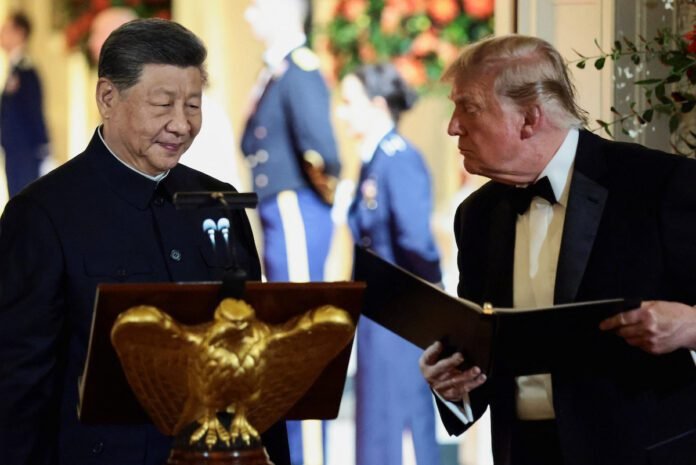
When Donald Trump went to Joint Base Andrews on September 23 to greet Xi Jinping in person, strategic analysts took notice.
American presidents rarely wait on the tarmac for visiting foreign leaders unless they want to say something. The gesture was not a scheduling quirk or a show of personal warmth. It signaled that Washington now treats China as a peer, a rival of equal standing.
How did the country that cast itself as the world’s sole “superpower”, the indispensable power of the postwar order, arrive at this point? Figures on GDP, defense budgets, university rankings, innovations and trade balances tell part of the story.
But they do not explain the mood of Americans. For that, it helps to borrow from psychology.
Grief is among the most ordinary human experiences. A death, a broken relationship, a grave illness or the loss of hard-won standing can leave a person numb and without direction.
In 1969, the psychiatrist Elisabeth Kubler-Ross set out five stages of coping in “On Death and Dying”: denial, anger, bargaining, depression, and acceptance. Later writers, including Iris Lin and Nhi U. Huynh, in their book, “The 7 Stages of Grief”, extended the model to seven stages: shock, denial, anger, bargaining, depression, reconstruction, and acceptance.
Nobody who has lost someone believes the stages arrive in tidy order. People double back, skip ahead and live in two at once. Nations arguably do the same.
The idea that the West is mourning a loss of status is not new. George Yeo, the former Singaporean foreign minister, has used Kubler-Ross’s framework to describe the West’s reaction to China’s rise.
In his reading, “the West is currently in the bargaining stage and has yet to traverse the difficult path of depression and acceptance.” Laid against the seven-stage version, his diagnosis acquires more texture. It also invites an argument, which I will come to in this piece.
Shock
For several decades after the Second World War, the US was the unchallenged center of the world economically, militarily, technologically, and culturally.
Western-led institutions, from the IMF to the World Bank and the WTO, set the rules. Their products and lifestyles set the aspirations. After the Cold War, some in the West declared the “end of history” and assumed that liberal democracy was where every society would eventually end up.
The first jolt came from China’s growth after Deng Xiaoping launched “reform and opening up” in 1978. For a time, the West comfortably regarded China as the world’s workshop, a place that made cheap goods and left the clever work to others.
By the 2020s, that picture was untenable. Chinese companies led in electric vehicles, batteries, green energy, and 5G, and competed hard in artificial intelligence and semiconductors. Policymakers in Washington and Brussels were stunned.
Like a bereaved person who functions normally on the surface while feeling nothing underneath, the West was slow to grasp that its monopoly had gone.
Denial
Shock tends to give way to denial, and the Western response followed the pattern.
For years, the standard commentary held that Chinese statistics were invented, that its companies merely copied, that innovation could not flourish under an authoritarian one-party state and that the political system would soon buckle under its own contradictions.
Each claim contained a grain of truth, which made it easier to cling to. Each was also a way of refusing to accept a loss.
There is irony here. After the Opium Wars of the 19th century, the Qing court initially refused to concede that Western gunboats and technology were superior. China paid heavily for that reluctance. The wheel has turned now.
Anger
When China’s industrial strength and technological progress became impossible to dismiss, anger followed. The past decade of American policy towards Beijing owes much to it.
Washington and its allies pressed grievances over intellectual property theft, state subsidies, human rights, Taiwan and the South China Sea. The anger also found expression in tariffs, export controls aimed at Huawei and the semiconductor supply chain, pressure on TikTok and security groupings such as the Quad and AUKUS.
Lin and Huynh observe that people in this stage often direct their pain outwards, towards an enemy, rather than inwards. The American version of this is easy to recognize. Deindustrialization, political polarization and widening inequality were largely home-grown. It was more comfortable to treat China as the “felon” behind them.
Bargaining
This is where Yeo places the West today, and the description fits much current policy. Having failed to “decouple” from China, Western governments now speak of “de-risking” and diversifying supply chains. The aim is to keep the benefits of trade while limiting dependence, and to do business on terms set in Washington and Brussels rather than Beijing.
Behind all the technocratic jargon is the age-old dream of going backward in time. As Lin and Huynh point out, people who bargain with loss end up torturing themselves with ‘what if’ questions. The geopolitical variation of the ‘what if’ question is: what if we never let China join the WTO?
Depression
Bargaining rarely works. Once it becomes clear that conditions will not slow China’s progress or revive the old order, a sense of despondency sets in; many signs of it are already visible across the US and Europe: bitter political divisions, extreme inequality, falling trust in democratic institutions, crumbling infrastructure and a young generation that doubts it will do as well as its parents.
Yeo’s point is that the West cannot see China clearly until it has gone through this reckoning with its own weaknesses. As in individual grief, the pain is useful. Nobody can rebuild without first admitting what has been lost, and that is uncomfortable for a society used to being told that it is exceptional.
Reconstruction
Reconstruction occurs when one ceases to wonder why this had to happen and wonders instead what could still be done. The crucial realization is that while one cannot change the situation, one can determine how one reacts to it.
For the West, it means treating China’s rise as a historical fact rather than as an existential threat or an affront. Energy spent on futile attempts at containment can be redirected towards the sources of Western strength: world-class universities, original research, open societies and sound institutions.
The aim becomes finding a new and balanced role in a multipolar world, not restoring a unipolar one.
Acceptance
The last stage is the most mature, and it is the one most easily misunderstood. Acceptance does not mean surrender, and it does not mean that the US needs to abandon Western values. It means giving up the hubris of supremacy and dealing with the world as it is now.
Lin and Huynh describe acceptance as a realistic understanding of the situation, combined with creativity and adaptation. In geopolitical terms, that is the condition for a durable, rules-based balance between Washington and Beijing.
Only then can the two powers cooperate seriously on problems that no one country can solve: climate change, pandemics, financial stability, nuclear security and the risks that come with artificial intelligence.
Where does the US actually stand?
My own view differs somewhat from Yeo’s. I think the US has moved further along than he suggests, and that the Joint Base Andrews reception is evidence.
But the claim needs qualification. Depression and reconstruction, as described above, are far from complete. American politics remains angry, and many in Congress would not describe their China policy as bargaining, let alone acceptance. But grief is not a march in formation.
A society can bargain in its trade policy, despair in its domestic politics and accept in its diplomacy, all at once. A president who greets his Chinese counterpart on the tarmac, with every ceremonial courtesy, is doing something that a country still in denial or fury would not do.
He is treating the other side as an equal. That is the central psychological shift, whatever disputes about tariffs and chips continue underneath.
But if this interpretation is accurate, the problem is not Washington’s getting caught in a grief loop, but rather its confusion between the two. An acceptance expressed at the airport while not being true everywhere else in policy cannot be called an acceptance. This is simply negotiation in disguise.
A cycle, not a conspiracy
The West often portrays China’s modern rise as a trick or an anomaly. It is better understood as part of a long historical cycle. Yeo points out that during the “century of humiliation”, from the Opium War of 1840 to the revolution of 1949, China went through something similar when confronted with Western power and technology.
At first, China fought back against the invaders and let its anger show in events such as the Boxer Rebellion. However, China later realized its weaknesses and adopted a policy of reform, accepting capitalism and Western technology starting in 1978.
Now, the West must learn the lesson China learned after much suffering: no power lasts forever, and the quicker a declining nation adapts, the more it will gain.
A shared future
In private and public life, grieving’s purpose is to let go of nostalgia and live in the present. If the US and its allies can mourn their fading primacy calmly and without strategic panic, the 21st century could be more stable and more inclusive than its first decades have been.
If they cannot, and continue to treat China’s rise only as a menace, the world will drift towards confrontation and, in the worst case, catastrophic war.
Trump’s welcome for Xi at Andrews may or may not prove the first diplomatic step towards acceptance. To be sure, it would be unwise to read too much into a single ceremony.
But history has repeatedly taught the same lesson: the dominance of any empire or civilization is never permanent. The societies that prosper are the ones that learn to live with change.
Follow Bhim Bhurtel on X at @BhimBhurtel. Subscribe to his Substack here.
India’s superpower dream is just another recycled Modi slogan
Famous Indian author Shashi Tharoor was famously quoted as saying: “Everything in India is recycled, even the dreams “
In October 2010, The Economist ran a cover titled “How India’s growth will outpace China,” citing India’s young population, dynamic private sector and a strong democratic system as advantages over China’s state-led model.
The IMF projected India’s growth rate at around 9.7%, while China’s was 10.5% at that time, suggesting the gap was narrowing. There was optimism in India; many believed it would overtake China, ushering in a new era of prosperity.
In 2010, China’s GDP was 3.6 times India’s (US$6.1 trillion vs. $1.7 trillion). By 2025, the gap had widened to nearly 4.9 times, with GDP of $19.5 trillion and $4 trillion, respectively.
But the gap widened on a per-capita basis between 2010 and 2025: China’s GDP per capita rose from $4,500 to $13,862, while India’s rose from $1,350 to $2,702, increasing the gap from 3.3 times to 5.1 times in 2025.
The argument is not that India has achieved nothing, but that the gap between its narrative and its capabilities has widened. India has spent too much political energy projecting power rather than building the capabilities that create it.
Politics of perception
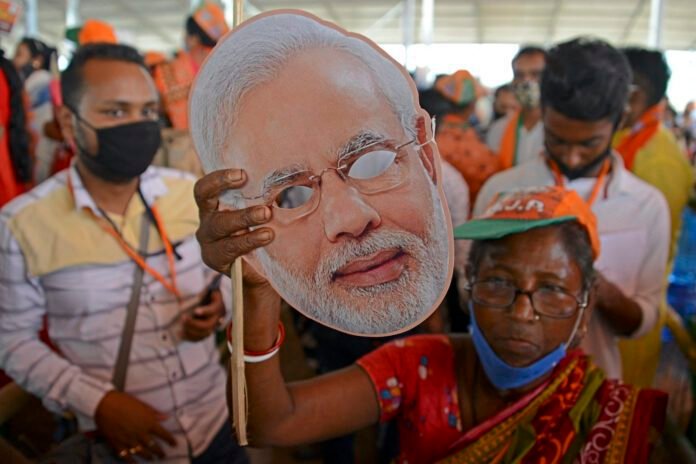
Indian leader Narendra Modi understands that modern politics rewards perception extraordinarily well. A spectacular summit, a grand diaspora rally, a hugging photograph with world leaders, a new slogan and a grand declaration can easily shape a powerful narrative about India’s arrival.
But symbolism and rhetoric don’t create capability. When confidence rests on promises rather than performance, it risks becoming false pride, i.e., Vishwaguru (World Teacher) creating an illusion of strength without the substance to sustain it.
The 2025 Lowy Institute Asia Power Index places India third in comprehensive power in Asia. But the same index says India’s actual regional influence remains below what its resources would lead one to expect; its “Power Gap” has widened to its largest level in the index’s history. That is the paradox of Modi’s India. India has more potential power than it converts into actual influence.
The best proof lies not in GDP, but in where Indians build their futures. Today more than 18.5 million Indian lives aboard in 2004 as per the UN, and India receives the highest remittances, around $150.7 billion in 2025. Out of all NRIs, the most influential and successful are the Indian Americans. Many NRI’s take pride in their success, but how much of it was built independently?
They studied at American universities, built careers within the American system, secured jobs in their companies, benefited from its opportunities, and live on their land. The American system provided much of the foundation for their success, yet they claim it entirely as their own. Irony isn’t it.
The tightening of H-1B rules and Suspension of IT & Tech Firms from the Permanent Labor Certification Program (PERM) is a reminder that success abroad ultimately depends on the institutions of the country where it is built. When leaving India becomes the pathway to Indian success, we must question our idea of national development.
Modi built the narrative, not the capability
Since 2014, Modi has turned the Indian diaspora into a powerful diplomatic brand, portraying their support and success abroad as evidence of a rising “New India.” The 2019 “Howdy Modi” rally in Houston became the symbol of this strategy.
But NRI success reflects not only Indian talent, but also the strength of the foreign systems in which they thrive, not necessarily the performance of the Indian state or its institutions. The “Vishwaguru” image was built on the global success of NRIs, achieved outside India.
While India focuses on the narrative of its rises, China focuses on building capabilities. It has spent the past decades relentlessly building industrial, technological, and scientific capabilities. When India announced its arrival as VishwaGuru, China responded with an unexpected technological leap: the AI model DeepSeek, which stunned the world.
Today, we are in the AI age; whoever wins the AI race will be the next superpower. Guess what, the world’s most populous country is missing from the AI revolution not because it lacks talent, but because it has spent years supplying talent to build America’s AI empire instead of its own.
Imagine having the manpower to build the future, yet choosing to be the workforce for someone else’s future. For example, Sundar Pichai and Satya Nadella, CEO of Google and Microsoft, respectively, are extraordinary examples of India reaching the pinnacle of global corporate power. But then there is another kind of success.
A 32-year-old, Yang Zhilin, a Tsinghua and Carnegie Mellon graduate who worked in the American tech ecosystem at Google Brain and Meta, returned to China and co-founded Moonshot AI.
Today, his company’s Kimi K3 AI model now rivals leading US models like Anthropic and OpenAI. As per Bloomberg Intelligence, the performance gap between top US and Chinese models has narrowed to 3%.
It clearly shows a difference between a country exporting talent and one that absorb, retain and mobilize it for its own technological power. Both Suder Pichai and Yang Zhilin’s are successful story but with a contrast: one shows how far talent can rise within an extra-ordinary system, the other shows how talent can build help create an extraordinary system.
For a country aspiring to be a technological power, the latter matters most.
Screenshot
Today, China dominates AI patent output, accounting for about 74.2% of granted AI patents in 2024, while India’s share is just 0.40%.
The contrast is striking. A country can host an AI summit, invite top tech CEO’s, make billion-dollar investment announcements, launch national missions and put “AI” into every government speech, but that doesn’t create technological power.
Superpowers are built on substance, not slogans. Yet, in Modi’s era, slogans have outpaced substance. India has immense technical talent, but much of it drives innovation abroad. India doesn’t need more Pichai’s abroad; it needs more Yang Zhilin’s building world-class tech at home.
Until that happens, India’s superpower dreams risk becoming a dream repeatedly recycled, while the world races ahead.
A Delta Air Lines flight from New York to Tel Aviv was evacuated after landing in Israel on Tuesday morning following a bomb threat that prompted authorities to move the aircraft to an isolated area and launch security checks.
All passengers were safely removed from the plane shortly after it landed. Security officials examined the aircraft and the surrounding area as authorities treated the threat as an emergency.
No unusual findings were detected during the security checks, and authorities later declared a return to routine.
There were indications during the response that the bomb threat could be a hoax. Authorities nevertheless maintained a high state of readiness following the attempted hijacking last month of a Flydubai flight.
Delta resumed service to Israel last month after suspending flights for more than six months following the outbreak of the war with Iran.
The airline operates direct flights between New York and Ben Gurion Airport.
The bomb threat follows an attempted hijacking last month of a Flydubai flight FZ1073, traveling from Dubai to Tel Aviv on September 30. The plane made an emergency landing in Tabuk, Saudi Arabia, after its Omani co-pilot allegedly attacked the captain and attempted to seize control of the aircraft.
UAE Attorney-General Hamad Saif Al Shamsi said the 29-year-old co-pilot had planned a suicide attack targeting Ben Gurion Airport and used two previous Tel Aviv flights to familiarize himself with the route.
He allegedly attacked the captain with an emergency axe before crew members and passengers restrained him.
The aircraft, carrying more than 170 passengers and crew, plunged more than 16,000 feet in about 30 seconds before other pilots regained control and landed safely.
UAE prosecutors classified the incident as a terrorist act and said the suspect confessed to acting alone.
Marie Osmond has endured heartbreak throughout her decades in the spotlight, but nothing could have prepared the beloved singer for the devastating loss of her 18-year-old son, Michael.
As the entertainer prepares to celebrate her 67th birthday on October 13, renewed attention is being given to one of the darkest chapters of her life and the emotional struggle she faced while trying to remain strong for her family.
Michael Bryan Blosil, one of Osmond’s eight children, died by suicide in February 2010 after struggling with depression. His death left the singer devastated and forced her to confront a loss she later described as the most difficult experience of her life.
“I’ve been through some tough things in my life,” Osmond told Oprah Winfrey during an emotional interview later that year. “This is probably the hardest thing I’ve been through.”
Michael was living in Los Angeles and attending the Fashion Institute of Design and Merchandising when he died. He had previously received treatment for depression and substance use.
In her interview with Winfrey, Osmond recalled a heartbreaking conversation with her son shortly before his death.
Michael had expressed feelings of loneliness, telling his mother that he felt he had no friends.
Osmond, who had experienced postpartum depression herself, understood how overwhelming those feelings could become.
She promised Michael that she would come to see him the following Monday, hoping she could help him through the difficult period.
But Michael died before she arrived.
Reflecting on their final conversation, the singer acknowledged the painful reality that someone experiencing a mental health crisis may need support immediately.
His death devastated the Osmond family, particularly Marie, who was already navigating the challenges of raising a large family following her 2007 divorce from music producer Brian Blosil.
Yet one of her most difficult decisions came just days after laying Michael to rest.
Rather than taking an extended break from performing, Osmond returned to the Las Vegas stage alongside her brother Donny less than two weeks after her son’s death.
The decision surprised some fans and drew criticism from people who questioned why she would return to work so quickly.
But for Osmond, music provided a way to cope with the overwhelming grief.
“The way Osmonds survive is we keep singing,” she told the audience during her emotional return to the Flamingo Las Vegas. “And that’s what we want to do tonight.”
She dedicated a moving performance to Michael, whom she affectionately called her angel.
Donny stood beside his sister throughout the difficult evening, offering encouragement as she struggled through the show.
Later, Osmond explained that returning to work had been a deliberate decision, not an indication that she had moved past her son’s death.
In a 2010 interview with Winfrey, she described the stage as her safe place and admitted she feared that staying away too long might make it impossible to return.
She also had seven other children who needed their mother during an extraordinarily painful time.
Years later, Osmond continued defending her decision to return to performing, explaining that singing helped her process the loss while maintaining a sense of stability for her family.
But returning to the spotlight did not mean the grief had disappeared.
An insider previously told RadarOnline that Osmond struggled emotionally even while continuing to work.
“She was trying to stay strong and busy herself with other things in her life,” the source claimed, adding that the singer continued to cry frequently as she adjusted to life without Michael.
Faith and family also played an important role in helping Osmond navigate her grief.
Throughout her career, the singer has spoken openly about her religious beliefs and the comfort she finds in prayer.
Her brother Donny remained a source of support, while her children gave her reasons to keep moving forward.
Another meaningful chapter began in May 2011, when Osmond remarried her first husband, Steve Craig, nearly 26 years after their divorce.
The couple chose May 4 for their wedding, a date with special emotional significance because it was both Michael’s birthday and the birthday of Osmond’s late mother, Olive.
Osmond wore the same wedding dress she had worn when she first married Craig in 1982, turning the ceremony into a celebration of renewed love while honoring two people she had lost.
Over the years, the singer has continued speaking about Michael, mental health and the lasting impact of losing a child.
Her experiences have also reinforced her belief that grief does not follow a predictable timeline and that people find different ways to survive unimaginable loss.
For Osmond, music, faith and family became sources of strength during a time when she struggled to imagine how life could continue.
Now, more than 16 years after Michael’s death, his memory remains an important part of the singer’s story.
As she approaches another birthday, Osmond’s journey is a reminder that even those who spend their lives entertaining millions can experience deeply personal heartbreak away from the spotlight.
And while the pain of losing Michael has remained with her, the singer has continued to honor his memory through the family and life they shared.
Trump aligns with Putin yet again, squeezing Ukraine and Europe
Image: Ian Shaw / Alamy Live News via The Conversation
The deal struck by Donald Trump with his Russian counterpart, Vladimir Putin, on October 9 to allow Russia to sell millions of tonnes of diesel is a major departure from US policy and runs counter to Ukrainian and European interests.
It also directly contradicts a law signed by the US president in September to authorize fresh US sanctions and tariffs on nations that import Russian oil and gas.
The timing of this deal was unfortunate. A senior Ukrainian and European delegation was in Miami for talks with Trump’s envoys, Steve Witkoff and Jared Kushner. On the table were apparently new US proposals that included a pre-winter de-escalation in the four-and-a-half-year war.
Once in the room, the US envoys reportedly signaled that sanctions relief on Russia was coming. But this still left Ukrainian and European officials blindsided by the announcement. Unsurprisingly, the talks ended the same day without any agreement and a day earlier than planned.
If the diesel deal between the US and Russia was just about fuel, it would be modest at best. The amounts mentioned in Trump’s announcement amount to just under six million barrels. This is roughly a day and a half of US diesel demand based on data from the US Energy Information Administration.
The deal will hardly have any significant impact on global diesel prices, even if Russia can provide the volumes in Trump’s announcement. And this is already in doubt, given that the lack of Russian diesel exports is primarily due to a Kremlin-imposed export ban.
Meanwhile, the rise of diesel prices began with, and is primarily a result of, Trump’s war against Iran. So if the deal is about bringing the price of diesel down ahead of the crucial midterm election in the US in early November, it’s unlikely to have a major impact.
But its effect on the Ukraine war is likely to be considerably larger and more damaging.
Bullying tactics
Since returning to power in January 2025, Trump’s approach to ending the Russian war against Ukraine has often been to try and bully Kyiv into concessions. These attempts have largely failed. Ukraine – and its European allies – have consistently rejected the idea of ceding any territory to Russia.
Trump’s diesel deal is another attempt to bully by pressuring Ukraine to give up one of its most effective, recent tools. Kyiv’s long-range drone and missile campaign against Russian refineries has reportedly caused Russian refining capacity to fall by up to 60% over recent months.
In recent weeks, Trump has been trying to force Zelensky to stop targeting Russian refineries, blaming Ukraine – rather than the war against Iran – for high diesel prices. Kyiv’s position in this regard has been consistent.
As Zelensky said again after Trump announced his diesel deal: “Ukraine will not set Russian oil refineries on fire if Russia does not destroy our energy infrastructure.”
This was a reiteration of a proposal made by the Ukrainian president on September 22 and endorsed by Trump. But Putin’s spokesman Dmitry Peskov said that a halt to refinery strikes would not on its own bring down prices. That, he said, would also require the lifting of sanctions on Russian energy exports.
The diesel deal with Russia that Trump announced on October 9 provides this sanctions relief. So Putin got the economic half of an energy truce that he really wanted without having to commit to its military half.
Indeed, when Trump declared an “energy ceasefire” that “both parties have agreed” (both sides said they hadn’t agreed anything), Russia greeted Trump’s announcement by striking Ukrainian power plant.
Long hard winter in prospect for Ukraine
Trump followed his announcement of the diesel deal by further aligning himself with the Russian leader, telling Ukraine on October 10 to “get a new leader.”
Rocky relationship: a meeting between the US and Ukrainian presidents at the White House in February 2025 ended in discord. Photo: EPA/Jim Lo Scalzo/pool via The Conversation
Meanwhile, it emerged from the talks in Miami at the weekend that Washington has threatened to cut intelligence sharing and block weapons sales to Ukraine if the strikes continue, although the US has declined to comment on the claims.
Ukraine has recently achieved a major battlefield success with its Operation Vivaldi counteroffensive, which analysts believe has halted Russia’s attempts to seize the strategically vital Donetsk region in eastern Ukraine. This has made the economic front of the war all the more important.
It has also added strain to already fragile transatlantic relations. The EU’s foreign policy chief, Kaja Kallas, said that “suspending sanctions on Russian diesel provides Moscow with more revenues to wage war” and that this was “not the time to ease pressure on Russia, and Europe won’t.”
But Europe now depends more on US diesel than it did in the past, a vulnerability that is likely to limit how hard Europe will push back. Europe’s dependence on energy imports from the US more generally also puts a question mark over how effective and sustainable the EU’s next sanctions package will really be.
Meanwhile, a pathway to a comprehensive settlement remains just as hard to envisage as it was before the diesel deal. The lifting of US sanctions on Russian diesel means that even a partial energy truce will now be harder to reach – adding more pain and suffering for Ukraine as winter approaches.
Most worrying in the long term, all the signs are that under Trump the US is closer to Moscow’s position than at any point since the full-scale invasion.